NEET UG . NEET Chemistry . Chemistry . Solutions
Chapter 10: Solutions
Ch 10
NEET Chemistry
NEET UG
Types of Solutions
Solutions and Their Components
Solution — A homogeneous mixture of two or more components, uniformly distributed throughout.
Components and Composition
- Solvent: The component present in the larger quantity; it determines the physical state of the solution.
- Solute: The component present in the smaller quantity.
- Component count: A binary solution has two components; ternary and quaternary solutions have three and four, respectively.
- Composition matters: Brass is copper and zinc; German silver is copper, zinc and nickel; bronze is copper and tin.
Types Based on Physical States
| Solution type | Solute | Solvent | Examples |
|---|---|---|---|
| Solid in solid | Solid | Solid | Alloys: brass, bronze, copper–gold alloy |
| Liquid in solid | Liquid | Solid | Mercury amalgam with sodium; ; |
| Gas in solid | Gas | Solid | in palladium; dissolved gases in minerals |
| Solid in liquid | Solid | Liquid | Sugar solution, salt solution, in |
| Liquid in liquid | Liquid | Liquid | Benzene in toluene; alcohol in water |
| Gas in liquid | Gas | Liquid | in water; in water |
| Solid in gas | Solid | Gas | Iodine vapours in air; camphor vapours in |
| Liquid in gas | Liquid | Gas | Water vapours in air; vapours in |
| Gas in gas | Gas | Gas | Air: |
Quick recap
- A solution is a homogeneous mixture of two or more uniformly distributed components.
- The solvent is present in greater quantity and determines the solution's physical state.
- The solute is present in smaller quantity.
- Binary, ternary and quaternary solutions contain two, three and four components, respectively.
- The nine solution types result from combining the solid, liquid and gas states of solute and solvent.
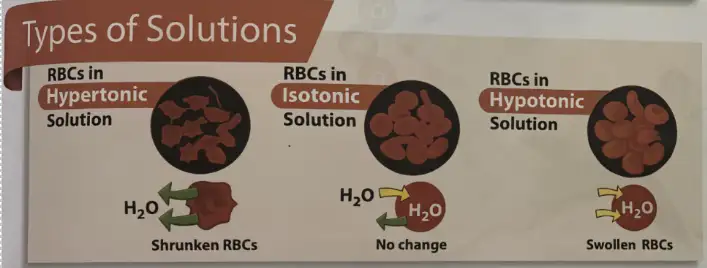
- RBCs shrink in hypertonic, remain unchanged in isotonic, and swell in hypotonic solutions.
Expressing Concentration of Solutions
| Concentration term | Symbol | Formula | Meaning | Effect of temperature |
|---|---|---|---|---|
| Mass percentage | Grams of solute present in of solution. | No effect | ||
| Mass-by-volume percentage | Grams of solute dissolved in of solution. | Changes | ||
| Volume percentage | Millilitres of solute present in of solution. | Changes | ||
| Strength | or | Grams of solute present in one litre (or one cubic decimetre) of solution. | Changes | |
| Parts per million | Parts of solute present in parts of solution. | No effect | ||
| Mole fraction | Moles of one component divided by the total moles of all components. | No effect | ||
| Molarity | Moles of solute dissolved in one litre (or one cubic decimetre) of solution. | Changes | ||
| Molality | Moles of solute present per kilogram of solvent. | No effect |
Symbols Used in the Formulas
- Mass terms: is the mass of solute; is the total mass of solution.
- Volume terms: is the volume of solute; is the total volume of solution.
- Other terms: and are parts of solute and solution; is moles of solute; is mass of solvent in kilograms.
Do not confuse molarity (moles per volume of solution) with molality (moles per mass of solvent). Molarity changes with temperature; molality does not.
Temperature and Concentration
Volume-based measures—, , strength and molarity—change with temperature; mass percentage, ppm, mole fraction and molality do not.
Quick recap
- Mass percentage gives grams of solute per of solution.
- Mass-by-volume and volume percentages give solute amount per of solution.
- Strength is solute mass per litre; ppm gives parts of solute per million parts of solution.
- Mole fraction is the moles of one component divided by the total moles of all components.
- Molarity is moles of solute per litre of solution; molality is moles of solute per kilogram of solvent.
- Temperature changes mass-by-volume percentage, volume percentage, strength and molarity, but not mass percentage, ppm, mole fraction or molality.
Solubility
Solubility — The maximum amount of a substance that dissolves in a specified amount of solvent at a specified temperature.
Solubility of a Solid in a Liquid
Key points
- Solubility varies: Not every solid dissolves in every liquid. NaCl and sugar dissolve readily in water, whereas naphthalene and anthracene do not.
- Nature: Polar solutes dissolve in polar solvents, and non-polar solutes in non-polar solvents: “like dissolves like.”
| Factor | Effect on solubility |
|---|---|
| Temperature: endothermic dissolution | Solubility increases as temperature rises; . |
| Temperature: exothermic dissolution | Solubility decreases as temperature rises; . |
| Pressure | No significant effect because solids are highly incompressible. |
Solubility of a Gas in a Liquid
Pressure and temperature
- Pressure: Gas solubility in a liquid increases as pressure increases.
- Temperature: Gas dissolution is exothermic; by Le Chatelier’s principle, increasing temperature decreases gas solubility.
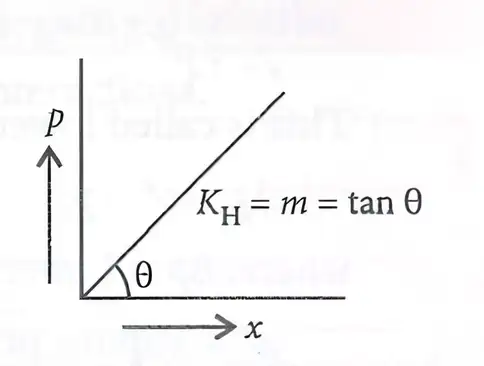
Henry’s law — At constant temperature, the partial pressure of a gas above a solution is directly proportional to its mole fraction in the solution.
Here, is the gas’s partial pressure in the vapour phase, is its mole fraction in the solution, and is Henry’s law constant.
Henry’s law graph
- Graph: A plot of pressure against mole fraction is a straight line through the origin; its slope is .
- Solubility and : At a given pressure, a higher means lower gas solubility.
Applications of Henry’s Law
Examples and effects
- Soft drinks: Soda water and soft-drink bottles are sealed under high pressure to increase the solubility of .
- Scuba diving: Tanks contain air diluted with helium: He, , and .
- Bends: High underwater pressure increases gas dissolution in the blood. As divers ascend, pressure falls and dissolved gases escape as bubbles; nitrogen bubbles can block capillaries, causing painful, dangerous bends. High nitrogen concentration is also toxic.
- Anoxia: At high altitude, oxygen partial pressure is lower, so less oxygen dissolves in blood. Reduced oxygen in blood and tissues can make climbers weak and unable to think clearly.
Quick recap
- Solubility is the maximum amount that dissolves in a specified amount of solvent at a specified temperature.
- “Like dissolves like”; NaCl and sugar dissolve in water, while naphthalene and anthracene do not.
- For solids, temperature effects depend on whether dissolution is endothermic or exothermic; pressure has little effect.
- Gas solubility increases with pressure and decreases with temperature.
- Henry’s law is ; the pressure-versus-mole-fraction graph passes through the origin with slope .
- High pressure underwater can cause bends, while low oxygen partial pressure at altitude can lead to anoxia.
Vapour Pressure of Liquid Solutions
Raoult’s Law for Volatile Liquid Solutions
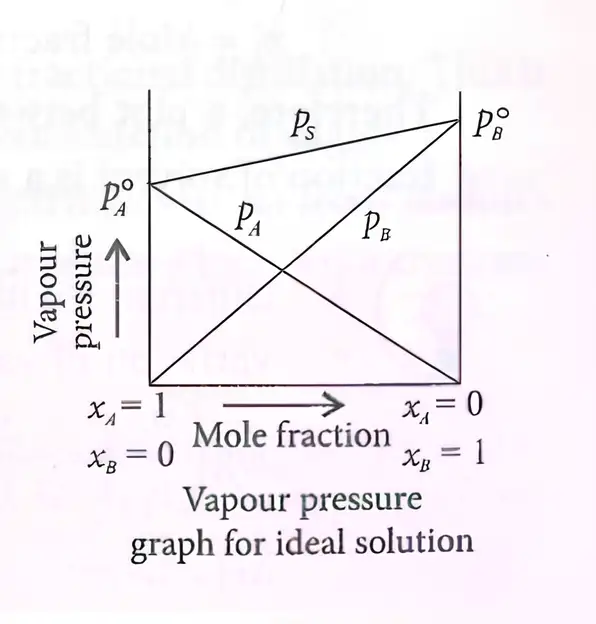
Raoult’s Law as a Special Case of Henry’s Law
| Point | Raoult’s law | Henry’s law |
|---|---|---|
| System described | A volatile liquid component in a solution | A gas dissolved in a liquid |
| Proportionality | ||
| Equation |
Connection between the laws
- Special case: Raoult’s law has the same proportional form as Henry’s law.
- Condition: Raoult’s law corresponds to Henry’s law when .
Solutions of Non-volatile Solids in Liquids
Why Vapour Pressure Decreases
- Adding non-volatile solute means fewer solvent molecules occupy the liquid’s surface.
- Fewer solvent molecules can escape from the surface.
- The solvent’s rate of evaporation decreases, so the solution’s vapour pressure falls.
What Determines the Lowering?
- Amount of solute: The lowering depends on the quantity of non-volatile solute present, not its chemical nature.
- Exception: This applies unless the solute undergoes association or dissociation.
- Example: At the same temperature, 1 molal sucrose and 1 molal urea solutions in water have the same lowering of vapour pressure.
Raoult’s Law for a Non-volatile Solute
Vapour Pressure and Solvent Mole Fraction
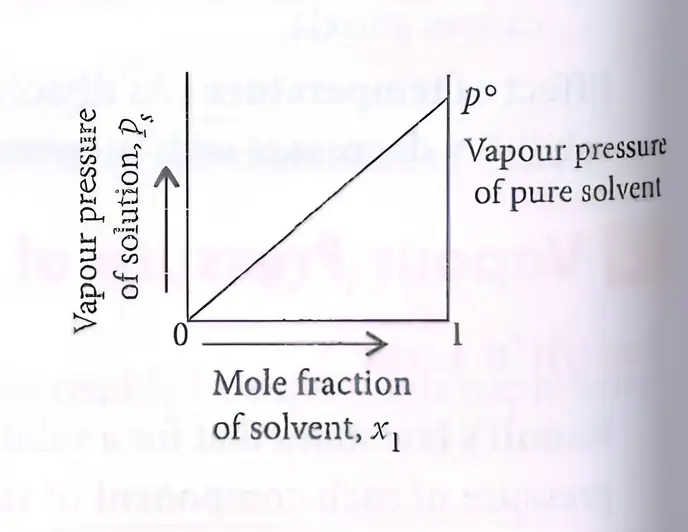
- Only solvent contributes: Since the solute is non-volatile, the solution’s total vapour pressure comes only from the solvent.
- Raoult’s law: The solution vapour pressure is proportional to the solvent mole fraction .
- Graph: A plot of against is a straight line through the origin; it reaches at .
Isopiestic solutions — Solutions that have the same vapour pressure are called isopiestic solutions.
Variation of Vapour Pressure with Temperature
State Raoult’s law for a binary solution of volatile liquids and write the expression for total pressure.
Why does adding a non-volatile solute lower the vapour pressure of a solvent?
Quick recap
- For volatile components, Raoult’s law gives ; partial pressures add to give total pressure.
- Raoult’s law is a special case of Henry’s law when .
- A non-volatile solute lowers solvent vapour pressure: .
- For a non-volatile solute, ; the graph against solvent mole fraction is linear.
- At the same temperature, equal molal sucrose and urea solutions have equal vapour-pressure lowering, unless association or dissociation occurs.
- Solutions with equal vapour pressure are isopiestic; vapour pressure also varies with temperature according to the logarithmic relation.
Ideal and Non-ideal Solutions
Raoult's Law and Mixing Behaviour
- Raoult’s law: In an ideal solution, each volatile component’s partial vapour pressure is proportional to its mole fraction.
- Mixing behaviour: Real solutions may show positive or negative deviations from Raoult’s law, depending on intermolecular interactions.
Azeotropes
Azeotrope separation
- Ethanol–water: The azeotrope formed during fermentation prevents pure ethanol from being obtained by fractional distillation.
- Both types: The identical liquid- and vapour-phase compositions prevent separation by fractional distillation.
Zeotropes
- Zeotropes: Mixtures whose composition changes during boiling and distillation.
- Boiling: Their liquid and vapour compositions differ, so they do not boil at a constant temperature.
- Separation: Their components can be separated by fractional distillation.
Quick recap
- Ideal solutions obey Raoult’s law at all temperatures and concentrations.
- Ideal mixing has and ; non-ideal mixing has nonzero values.
- Azeotropes have the same composition in liquid and vapour phases and boil at a constant temperature.
- Large positive deviation forms minimum-boiling azeotropes; large negative deviation forms maximum-boiling azeotropes.
- Azeotropes cannot be separated by fractional distillation, whereas zeotropes can.
Colligative Properties and Determination of Molar Mass
Colligative properties — Properties of a solution that depend on the number of solute particles relative to the total number of particles, not on their chemical nature.
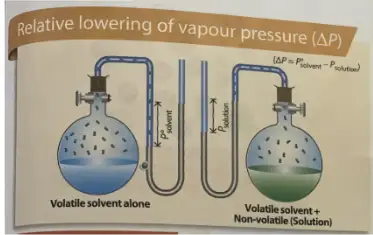
Relative Lowering of Vapour Pressure
- Raoult’s law: For a solution containing a non-volatile solute, the relative lowering of the solvent’s vapour pressure equals the solute mole fraction.
- Dilute solution: When , the relative lowering is approximately .
- Molar-mass use: The mass-based form relates the relative lowering to the solute molar mass .
Here, and are the vapour pressures of the pure solvent and solution; are mole amounts; are masses; and are molar masses.
Elevation of Boiling Point
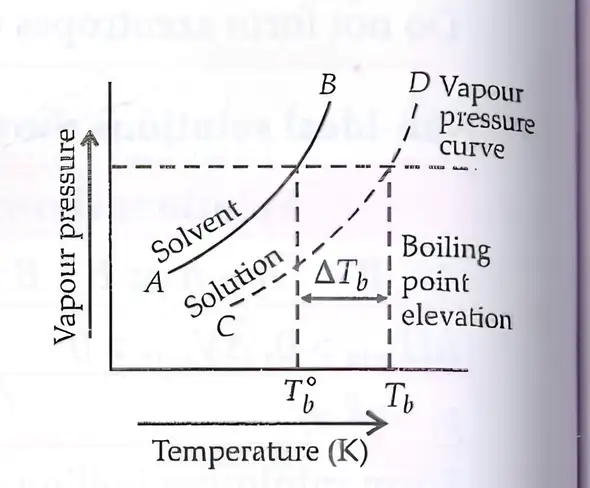
Elevation of boiling point — The increase in boiling point of a solution compared with the pure solvent, given by .
- Cause: A solution has lower vapour pressure than the pure solvent, so it must be heated to a higher temperature to boil.
- Dilute solutions: Boiling-point elevation is proportional to molality, .
- Constant: is the boiling-point elevation (ebullioscopic) constant; it depends on the solvent and has units .
- Example: Ethylene glycol added to water raises its boiling point and helps prevent vehicle-engine “boil-over” in summer.
Here, is the solute mass, its molar mass, and the solvent mass; masses are in grams.
Here, is the pure solvent’s boiling point and is its latent heat of vaporisation.
Depression of Freezing Point
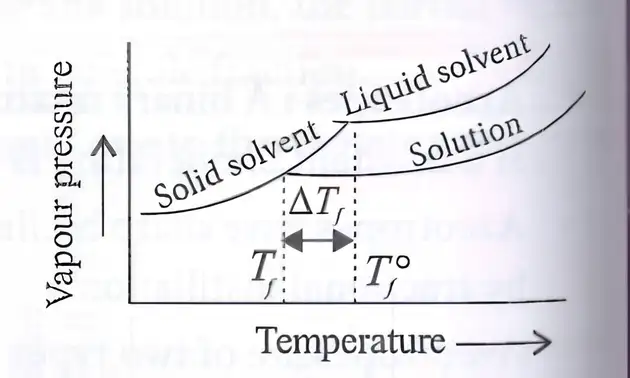
Depression of freezing point — The decrease in freezing point of a solution compared with the pure solvent, given by .
- Cause: Lowering of vapour pressure lowers the freezing point of the solution relative to the pure solvent.
- Dilute solutions: Freezing-point depression is proportional to molality, .
- Constant: is the freezing-point depression (cryoscopic) constant; it depends on the solvent and has units .
Here, is the solute mass, its molar mass, and the solvent mass; masses are in grams.
Here, is the pure solvent’s freezing point and is its latent heat of fusion.
Osmosis and Osmotic Pressure
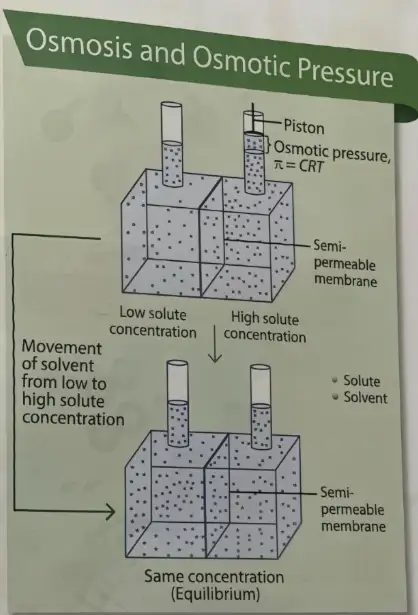
Osmosis — The spontaneous net flow of solvent through a semipermeable membrane from pure solvent or a less concentrated solution to a more concentrated solution.
Osmotic pressure — The minimum excess pressure applied to a solution to stop solvent from entering it through a semipermeable membrane.
Here, is the solute molar concentration, is solution volume, is solute mass, and is solute molar mass.
| Term | Meaning |
|---|---|
| Isotonic | Two solutions with the same osmotic pressure at a given temperature. |
| Hypotonic | The solution with lower osmotic pressure compared with another solution. |
| Hypertonic | The more concentrated solution, with higher osmotic pressure relative to a hypotonic solution. |
- Reverse osmosis: Applying pressure greater than the osmotic pressure makes solvent flow from the solution through the membrane toward the pure solvent; it is used to desalinate seawater.
- Haemolysis: A cell ruptures when solvent flows into it.
- Crenation or plasmolysis: A cell shrinks when solvent flows out of it.
- Measurement: Osmotic pressure is measured using an osmometer.
Here, is the molar mass of the solvent and is its density.
How can the molar mass of a solute be determined from osmotic pressure?
Why does a solution have a higher boiling point and lower freezing point than its pure solvent?
Quick recap
- Colligative properties depend on the number of solute particles, not their identity.
- Relative lowering of vapour pressure equals the solute mole fraction; for dilute solutions it can be used to find molar mass.
- Boiling-point elevation follows and depends on the solvent through .
- Freezing-point depression follows and depends on the solvent through .
- Osmotic pressure is given by and can determine a solute’s molar mass.
- Reverse osmosis uses pressure greater than osmotic pressure and is used for seawater desalination.
Abnormal Molar Masses
Abnormal Molar Mass and van't Hoff Factor
Abnormal molar mass — A molar mass determined from colligative-property measurements is abnormal when solute particles associate or dissociate, causing it to differ from the theoretically expected value.
van't Hoff factor
- Definition: The van't Hoff factor, , is the ratio of the observed colligative property to its calculated value.
- Molar-mass relation: also equals calculated molar mass divided by observed molar mass; here and denote those masses.
- Particle-count relation: is the ratio of moles of particles after association or dissociation to moles before the change.
Here, and are the observed and calculated colligative properties; and are the calculated and observed molar masses.
| Process | Effect on particle number | van't Hoff factor |
|---|---|---|
| Association | Particles combine; total particle number decreases. | |
| Dissociation | Particles split; total particle number increases. |
Modified Colligative-Property Equations
Interpreting observed properties
- Observed property below normal: The solute is associated.
- Observed property above normal: The solute is dissociated.
- Correction: Multiply the usual colligative-property expression by to account for the actual particle number.
and are the mole amounts of solute and solvent, respectively.
is the molal elevation constant and is molality.
is the molal depression constant and is molality.
is the number of moles of solute, is solution volume, is the gas constant, and is absolute temperature.
Degree of Dissociation
Degree of dissociation — The degree of dissociation, , is the fraction of initial solute formula units that dissociate.
Particle count during dissociation
- Starting amount: For an initial amount of mole, the undissociated amount is .
- Ion amounts: The amounts of and formed are and , respectively.
- Total particles: .
Use for dissociation of into ions.
Degree of Association
Degree of association — The degree of association, , is the fraction of initial solute particles that combine to form associated units.
Particle count during association
- Starting amount: For an initial amount of mole, the amount of unassociated is .
- Associated amount: The amount of formed is .
- Total particles: .
The total particle count gives the van't Hoff factor; rearranging gives the degree of association.
How does the van't Hoff factor identify association or dissociation?
Write the relation between and degree of dissociation for .
Write the relation between and degree of association when forms .
Quick recap
- Association lowers the number of solute particles and gives ; dissociation increases it and gives .
- The van't Hoff factor is the observed-to-calculated colligative-property ratio and equals .
- Multiply the usual colligative-property equations by to account for particle changes.
- For dissociation of , .
- For association of to form , .
NEET Chemistry — ALL CHAPTERS
1
Some Basic Concepts of Chemistry
2
Structure of Atom
3
Classification of Elements and Periodicity in Properties
4
Chemical Bonding and Molecular Structure
5
Thermodynamics
6
Equilibrium
7
Redox Reactions
8
Organic Chemistry - Some Basic Principles and Techniques
9
Hydrocarbons
10
Solutions
11
Electrochemistry
12
Chemical Kinetics
13
The d- and f- Block Elements
14
Coordination Compounds
15
Haloalkanes and Haloarenes
16
Alcohols, Phenols and Ethers
17
Aldehydes, Ketones and Carboxylic Acids
18
Amines
19
Biomolecules
20
The p-Block Elements (Group 13 and 14)
21
The p-Block Elements (Group 15 to 18)
22
Principles Related to Practical Chemistry