NEET UG . NEET Chemistry . Chemistry . Amines
Chapter 18: Amines
Ch 18
NEET Chemistry
NEET UG
Structure of Amines
Amines
Amines — Organic derivatives of ammonia formed by replacing one, two or three hydrogen atoms with alkyl or aryl groups.
Occurrence
- Occurrence: Amines are found in proteins, vitamins, alkaloids and hormones.
Diazonium Salts
Arenediazonium salts — Salts with the general formula , where is an aryl group (here, ) and is an anion.
Naming and stability
- Possible anions: , , , and .
- Naming: Use the parent hydrocarbon name followed by “diazonium” and then the anion name.
- Examples: is benzenediazonium chloride; is benzenediazonium hydrogensulphate.
- Primary aliphatic amines: Form highly unstable alkyldiazonium salts.
- Primary aromatic amines: Form arenediazonium salts that are stable for a short time in solution at –.
- Relative stability: Arenediazonium salts are more stable than alkyldiazonium salts.
- Reason: Positive charge in an arenediazonium ion is dispersed over the benzene ring.
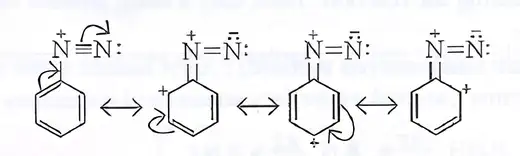
Structure of Amines
Shape and bond angle
- Hybridisation: The nitrogen atom in amines is hybridised.
- Geometry: Amines have a pyramidal shape because nitrogen has an unshared electron pair.
- Bond angle: The angle, where is carbon or hydrogen, is less than the tetrahedral angle of .
- Example: The bond angle in trimethylamine is about .
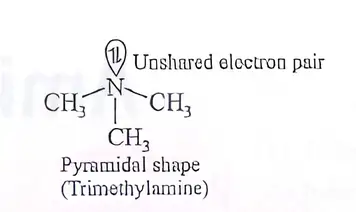
Quick recap
- Amines are ammonia derivatives formed by replacing one, two or three hydrogen atoms with alkyl or aryl groups.
- Arenediazonium salts have formula ; here is specified as the aryl group .
- Alkyldiazonium salts are highly unstable, while arenediazonium salts are briefly stable in solution at – and are more stable overall.
- Delocalization of positive charge over the benzene ring increases the stability of arenediazonium salts.
- Amine nitrogen is hybridised; its lone pair gives the molecule a pyramidal shape and reduces bond angles below .
Classification
Classification of amines — Amines are classified as primary, secondary or tertiary according to the number of alkyl or aryl groups attached to the nitrogen atom.
| Type | Groups attached to nitrogen | Characteristic group / structure | Examples |
|---|---|---|---|
| Primary () | One alkyl or aryl group | ; general form | — methanamine; — benzenamine (aniline) |
| Secondary () | Two alkyl or aryl groups | ; general form | — N-methyl methanamine; — N-methyl aniline |
| Tertiary () | Three alkyl or aryl groups | No N–H bond; general form | — N,N-dimethyl methanamine; — N,N-dimethylaniline |
Classify an amine by the number of carbon groups attached to nitrogen—not by the number of carbon atoms in those groups.
Quick recap
- Amines are classified by the number of alkyl or aryl groups attached to nitrogen.
- Primary amines have one carbon group attached to nitrogen and contain .
- Secondary amines have two carbon groups attached and contain .
- Tertiary amines have three carbon groups attached and no N–H bond.
Nomenclature
Common-System Naming
- Amine naming: Amines are named using conventions that identify the hydrocarbon groups attached to nitrogen.
- Naming systems: Common and systematic approaches are used to name aliphatic amines.
IUPAC Naming
- Common system: alkyl group + amine.
- IUPAC system: use an alkanamine name; mark substituents on nitrogen with N-.
Quick recap
- Common names of aliphatic amines are formed from the alkyl group followed by “amine.”
- IUPAC names of amines use the alkanamine form.
- Use di- or tri- for repeated alkyl groups in secondary or tertiary amines.
- The prefix N- identifies an alkyl group attached to nitrogen.
- is methylamine by the common system and methanamine by IUPAC.
- is trimethylamine by the common system and N,N-dimethylmethanamine by IUPAC.
Preparation of Amines
From Nitro Compounds
From Alkyl Halides: Hoffmann Ammonolysis

From Nitriles
From Amides by Reduction
Hoffmann Bromamide Degradation
Mechanism outline
- Primary amide + → N-bromoamide .
- Alkali removes water and promotes rearrangement → alkyl isocyanate .
- Hydrolysis of the isocyanate → primary amine ; the carbonyl carbon is removed.
Gabriel Phthalimide Synthesis
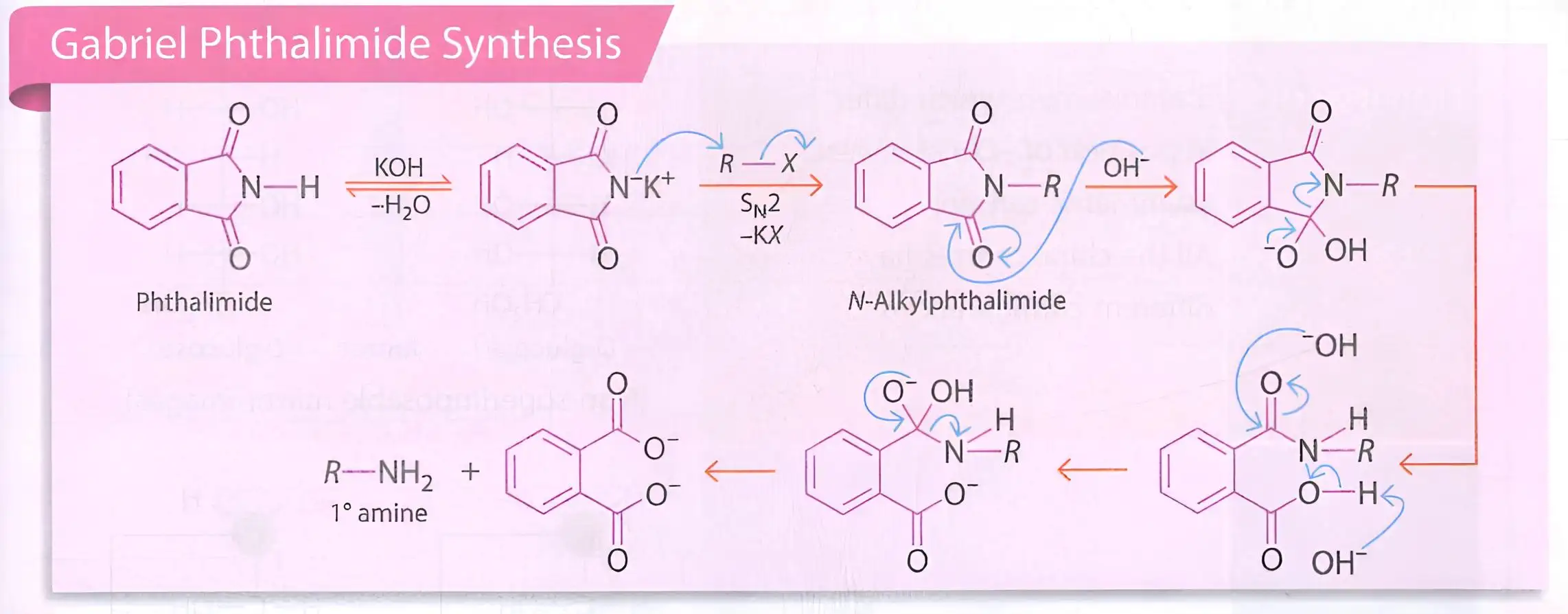
Gabriel synthesis sequence
- Phthalimide potassium phthalimide.
- Potassium phthalimide N-alkylphthalimide.
- N-alkylphthalimide sodium phthalate + primary amine .
Quick recap
- Nitro compounds reduce to amines using catalytic hydrogen or metals in acid.
- Ammonolysis of alkyl halides can yield several amine classes; excess ammonia favours primary amine formation.
- Nitrile reduction gives primary amines; using KCN before reduction extends the carbon chain by one carbon.
- LiAlH₄ reduces amides to primary amines without losing the carbonyl carbon.
- Hoffmann bromamide degradation gives a primary amine with one fewer carbon than its amide.
- Gabriel synthesis prepares primary alkyl amines, but not primary aromatic amines.
Physical Properties
Physical State and Odour
| Amine type | Physical state and odour |
|---|---|
| Lower aliphatic amines | Gases with an ammoniacal smell |
| Primary amines with three or more carbon atoms | Liquids with a fishy odour |
| Lower aromatic amines | Liquids with a characteristic unpleasant odour |
| Higher aromatic amines | Odourless solids |
Colour and Solubility
Colour and Solubility
- Colour: Pure amines are colourless but become coloured on exposure to air because of atmospheric oxidation.
- Water solubility: Amines can form hydrogen bonds with water, making them soluble; solubility decreases as the alkyl group becomes larger.
- Higher and aromatic amines: Generally insoluble in water but soluble in organic solvents.
Boiling Points
Intermolecular Forces and Boiling Points
- Polarity: Amines are polar; primary and secondary amines form intermolecular hydrogen bonds and exist as associated molecules.
- Compared with hydrocarbons: Amines have higher boiling points than hydrocarbons of comparable molecular masses because of polarity and intermolecular hydrogen bonding.
- Compared with alcohols and carboxylic acids: Amines have lower boiling points than these compounds of comparable molecular masses.
- Tertiary amines: They have no N–H bond and therefore cannot form intermolecular hydrogen bonds with one another.
More N–H bonds allow greater intermolecular hydrogen bonding.
Reason for the Isomeric Order
- Primary amine: Has two N–H bonds.
- Secondary amine: Has one N–H bond.
- Tertiary amine: Has no N–H bond; its ability to form intermolecular hydrogen bonds is least.
Quick recap
- Lower aliphatic amines are gases with an ammoniacal smell; some primary amines with at least three carbon atoms are fishy-smelling liquids.
- Lower aromatic amines are unpleasant-smelling liquids; higher aromatic amines are odourless solids.
- Pure amines are colourless but may become coloured by atmospheric oxidation.
- Water solubility decreases as the alkyl group grows; higher and aromatic amines are generally water-insoluble but dissolve in organic solvents.
- Amines generally boil above comparable-mass hydrocarbons but below comparable-mass alcohols and carboxylic acids.
- For isomeric amines, boiling point order is , reflecting decreasing N–H bonds and hydrogen bonding.
Chemical Reactions
Basic Character of Amines
Basicity of amines — Amines act as bases because the nitrogen atom has a lone pair that can accept a proton.
Factors affecting basic strength
- Alkyl groups: Their effect increases electron density on nitrogen, generally strengthening basicity compared with ammonia.
- Other effects: Solvation, steric hindrance and resonance also affect how readily an amine accepts a proton.
- Conjugate-acid stability: In water, hydrogen bonding and solvation stabilize the protonated amine; steric crowding can reduce this stabilization.
| Phase | Basicity order | Reason |
|---|---|---|
| Gas / non-aqueous | Solvation is absent; the effect of alkyl groups dominates. | |
| Aqueous, ethylamines | Solvation matters; bulky alkyl groups hinder hydrogen bonding, allowing the strong effect of the tertiary amine to dominate over the primary amine. | |
| Aqueous, methylamines | The secondary amine has a favourable balance of electron donation and solvation. |
Basicity of Aromatic Amines
Aniline and substituted anilines
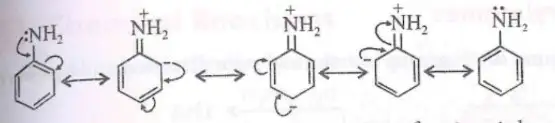
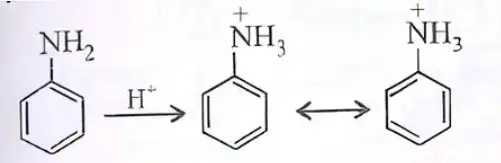
- Aniline: It is less basic than ammonia because the nitrogen lone pair is delocalized into the benzene ring by resonance, making it less available for protonation.
- Resonance: Aniline has five contributing resonance structures; its protonated anilinium ion has only two, so the ion is less resonance-stabilized.
- N-alkyl substitution: For aromatic amines, basic strength increases as .
| Amine | pKb |
|---|---|
| Aniline, | 9.38 |
| N-methylaniline, | 9.30 |
| N,N-dimethylaniline, | 8.92 |
Substituent effects on aniline basicity
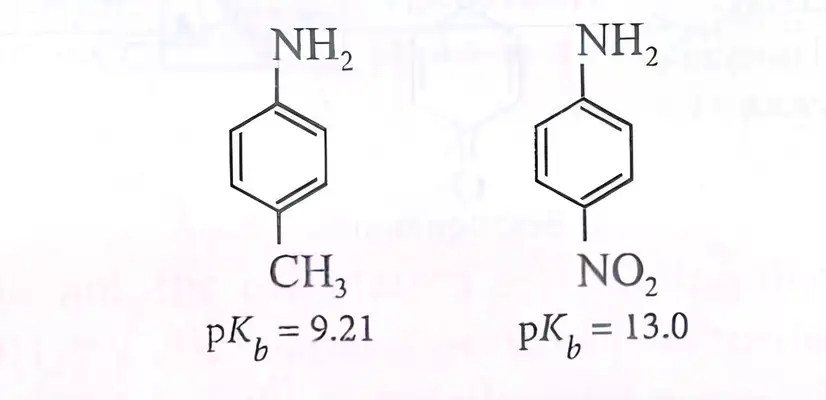
- Electron-releasing groups: Groups such as and increase electron density and generally increase basicity.
- Electron-withdrawing groups: Groups such as , , and halogens decrease basicity.
- pKb reminder: A lower indicates a stronger base.
Distinguishing Primary, Secondary and Tertiary Amines
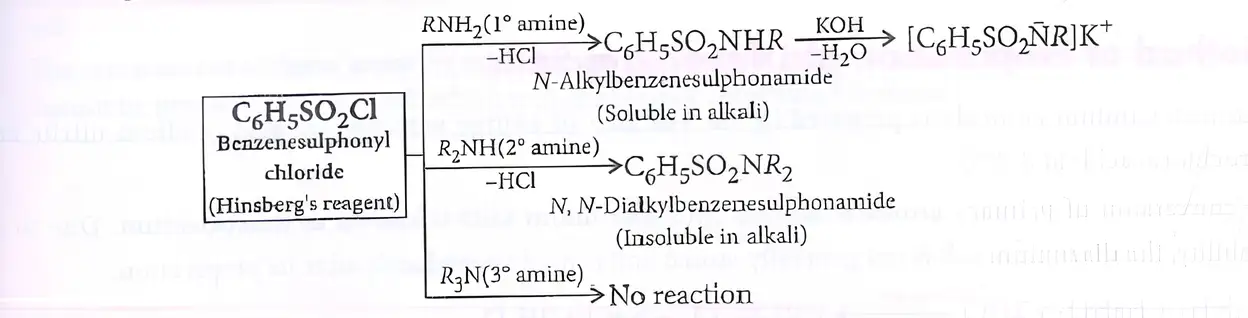
| Amine class | Reaction with benzenesulphonyl chloride | Behaviour in alkali |
|---|---|---|
| Primary, | Forms a sulphonamide containing an bond. | Dissolves in alkali; acidification precipitates the sulphonamide. |
| Secondary, | Forms an -disubstituted sulphonamide with no bond. | Insoluble in alkali. |
| Tertiary, | Does not form a sulphonamide. | Remains insoluble in alkali; dissolves in dilute acid by forming a salt. |
Other identification tests
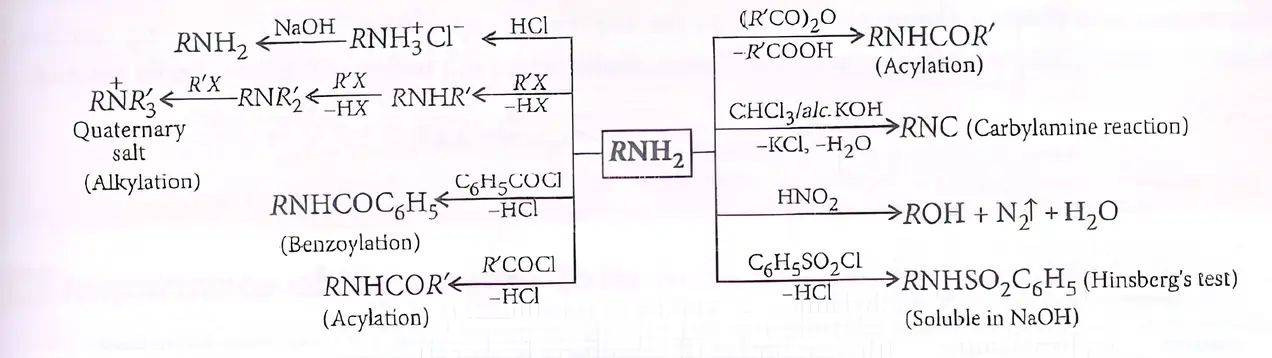
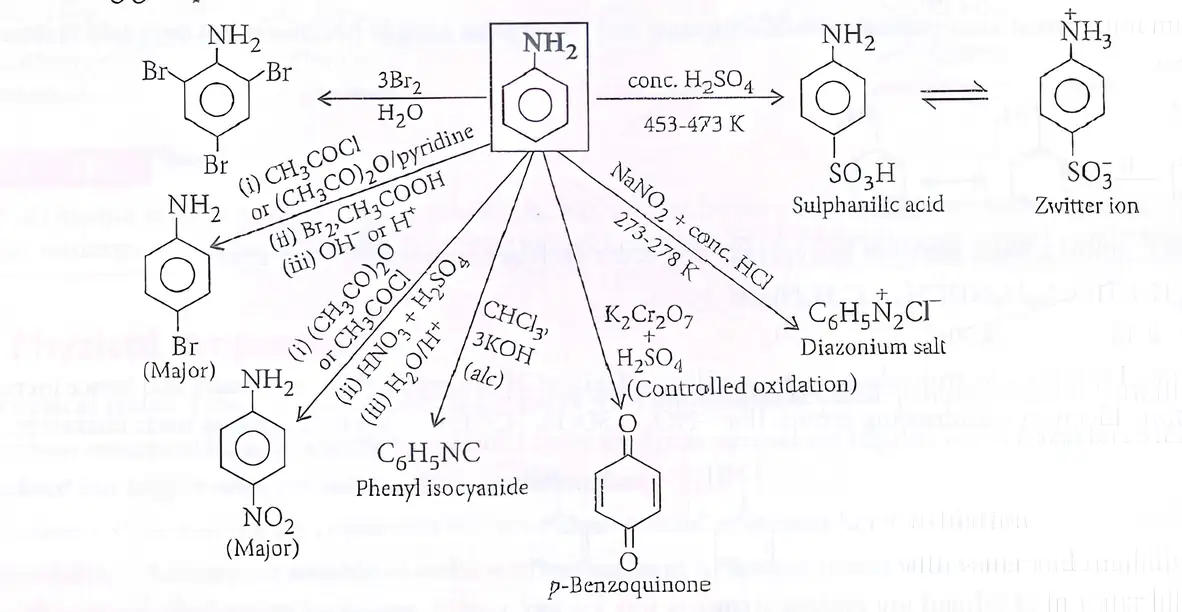
- Carbylamine test: Only primary aliphatic and primary aromatic amines give this test, forming foul-smelling isocyanides.
- Azo dye test: Only primary aromatic amines form orange-coloured azo dyes.
- Nitrous acid test: The products depend on the class of amine; the reaction is carried out at –.
| Amine class | Characteristic product |
|---|---|
| Primary aromatic | Benzenediazonium salt |
| Primary aliphatic | Alcohol, with evolution of nitrogen gas |
| Secondary aliphatic or aromatic | Yellow oily -nitrosamine |
| Tertiary aliphatic | Water-soluble nitrite salt |
| Tertiary aromatic | Green-coloured p-nitroso--dialkylamine |
Electrophilic Substitution Reactions of Arylamines
Aniline as an activating group
- Direction: The group directs electrophilic substitution to the ortho and para positions.
- Reactivity: The group strongly activates the benzene ring toward electrophilic substitution.
- Lewis basicity: Aniline can coordinate to Lewis acids used as catalysts, such as anhydrous .
- Friedel–Crafts reaction: The resulting positively charged nitrogen-containing salt has a strongly deactivating substituent effect, so aniline does not undergo Friedel–Crafts reactions.
| Substituent type | Basicity order |
|---|---|
| Alkyl substituents | N,N-dimethylaniline > N-methylaniline > aniline |
| Phenyl substituents | Aniline > diphenylamine > triphenylamine |
Oxidation of aromatic amines
- Aniline black: Oxidation of aromatic amines with a mixture of sulphuric acid and potassium dichromate produces a black dye called aniline black.
Why is aniline less basic than ammonia?
How does the nitrous acid test distinguish amine classes?
Why does aniline not undergo Friedel–Crafts reactions?
Quick recap
- Aliphatic amines: Alkyl groups raise basicity by the effect; observed order depends on phase and solvation.
- Aromatic amines: Resonance delocalization of the nitrogen lone pair makes aniline weaker as a base than ammonia.
- Substituents: Electron-releasing groups increase aniline basicity; electron-withdrawing groups decrease it.
- Identification: Hinsberg, carbylamine, azo dye and nitrous acid tests distinguish amine classes.
- Arylamine substitution: The group is strongly activating and ortho/para directing, but aniline does not undergo Friedel–Crafts reactions.
- Oxidation: Oxidation of aromatic amines with sulphuric acid and potassium dichromate gives aniline black.
Method of Preparation of Diazonium Salts
Preparation of Benzenediazonium Chloride
- Reagents: Aniline reacts with nitrous acid, generated in situ from sodium nitrite and hydrochloric acid.
- Conditions: The reaction is carried out at 0–5 °C (273–278 K) to prepare benzenediazonium chloride.
- Use: The diazonium salt is unstable and is generally used immediately after preparation.
Quick recap
- Aniline reacts with nitrous acid to form benzenediazonium chloride.
- Nitrous acid is produced from sodium nitrite and hydrochloric acid.
- Diazotisation is the conversion of a primary aromatic amine into a diazonium salt.
- Carry out the reaction at –.
- Use the unstable diazonium salt immediately after preparation.
Physical Properties of Diazonium Salts
Physical Properties
- Benzenediazonium chloride: A colourless crystalline solid, readily soluble in water and stable in the cold.
- On warming: It reacts with water; in the dry state, it decomposes easily.
- Benzenediazonium fluoroborate: It is insoluble in water and stable at room temperature.
Quick recap
- Benzenediazonium chloride is a colourless crystalline solid.
- It dissolves readily in water and is stable in the cold.
- When warmed with water, benzenediazonium chloride reacts; in the dry state, it decomposes easily.
- Benzenediazonium fluoroborate is water-insoluble and stable at room temperature.
Chemical Reactions of Diazonium Salts
Reactions Involving Displacement of Nitrogen
Displacement reactions — The diazonium group in an aryl diazonium salt is replaced by another group, releasing nitrogen gas.
Common replacements
- Products: Displacement can produce aryl halides, phenols, nitriles, nitro compounds, or biphenyls.
- Key change: The aryl group remains, while the diazonium group is removed and nitrogen is released.
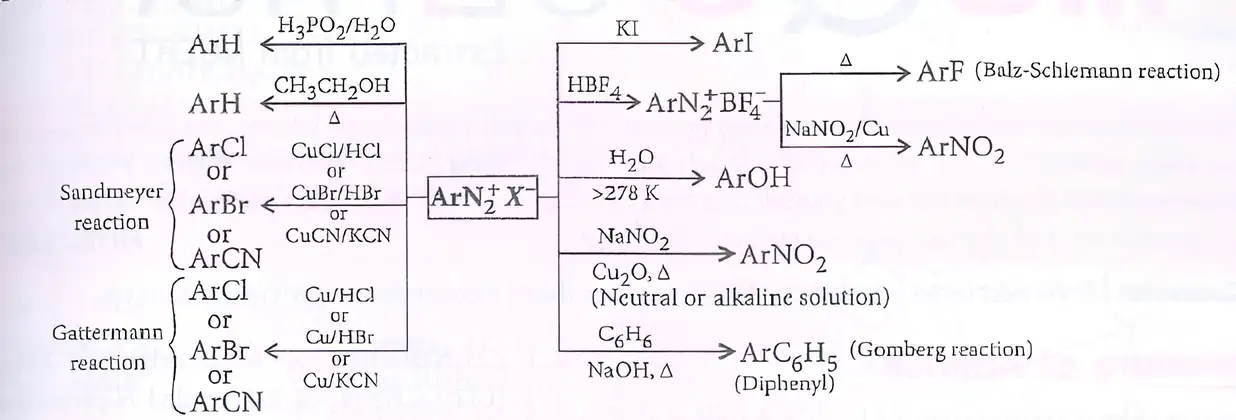
Reactions Involving Retention of the Diazo Group: Coupling
Azo coupling — An aryl diazonium ion couples with an activated aromatic ring, retaining the diazo group as an azo linkage, .
Coupling conditions and products
- Temperature: Carry out coupling at –.
- With aniline: At pH –, benzenediazonium salt forms -aminoazobenzene, a yellow dye.
- With phenol: At pH –, it forms -hydroxyazobenzene, an orange dye.
p-Aminophenol: pH-Dependent Orientation
Coupling position
- Acidic medium: At pH –, coupling occurs ortho to the amino group; the product is 4-amino-3-phenylazophenol.
- Basic medium: At pH –, coupling occurs ortho to the phenolic group; the product is 4-amino-2-phenylazophenol.
- Linkage: Both products contain the azo linkage .
| Medium | Coupling position | Product |
|---|---|---|
| Acidic, pH 4–5 | Ortho to the amino group | 4-amino-3-phenylazophenol |
| Basic, pH 9–10 | Ortho to the phenolic group | 4-amino-2-phenylazophenol |
How does pH affect azo coupling of p-aminophenol?
Quick recap
- Displacement reactions replace the diazonium group and release nitrogen.
- Displacement can form aryl halides, phenols, nitriles, nitro compounds, and biphenyls.
- Azo coupling retains the diazo group as an azo linkage.
- Coupling is performed at 0–5°C; aniline coupling is acidic and phenol coupling is basic.
- In p-aminophenol coupling, pH determines which substituent directs the coupling position.
Importance of Diazonium Salts in Synthesis of Aromatic Compounds
Diazonium Salts as Synthetic Intermediates Aryl diazonium salts allow a diazonium group to be replaced, helping introduce several groups into an aromatic ring.
Synthetic intermediate — A substance used as a step in preparing another compound; aryl diazonium salts enable the introduction of groups that are difficult to add directly to an aromatic ring.
Groups Introduced through Diazonium Salts
- Useful replacements: The diazonium group can be replaced to introduce , , , , , and into an aromatic ring.
- Synthetic value: This route helps prepare substituted aromatic compounds that may not be obtainable by direct substitution of benzene or a substituted benzene.
| Group introduced | Why the diazonium route is useful |
|---|---|
| and | Aryl fluorides and aryl iodides cannot be prepared by direct halogenation. |
| Chlorine in chlorobenzene cannot be replaced by through nucleophilic substitution; cyanobenzene can be prepared from a diazonium salt. | |
| , , , | These groups are also among the groups that can be introduced through diazonium salts. |
| Point | Direct substitution | Diazonium route |
|---|---|---|
| Access to certain groups | Some aromatic substitutions are not feasible by direct methods; for example, direct halogenation does not prepare aryl fluorides or iodides. | The diazonium group can be replaced to introduce these groups. |
| Cyanobenzene | Nucleophilic substitution of chlorine in chlorobenzene does not introduce . | Cyanobenzene can be obtained from an aromatic diazonium salt. |
For an exam answer, state both the groups accessible through diazonium salts and why the route is valuable: some products cannot be made by direct substitution.
Why are diazonium salts important in the synthesis of aromatic compounds?
Why is a diazonium salt useful for preparing cyanobenzene?
Quick recap
- Aryl diazonium salts are versatile intermediates for aromatic synthesis.
- They can introduce , , , , , and .
- Direct halogenation does not prepare aryl fluorides or aryl iodides.
- Chlorobenzene does not give cyanobenzene by nucleophilic substitution of chlorine.
- The diazonium route enables products that are difficult or impossible to make by direct substitution.
NEET Chemistry — ALL CHAPTERS
1
Some Basic Concepts of Chemistry
2
Structure of Atom
3
Classification of Elements and Periodicity in Properties
4
Chemical Bonding and Molecular Structure
5
Thermodynamics
6
Equilibrium
7
Redox Reactions
8
Organic Chemistry - Some Basic Principles and Techniques
9
Hydrocarbons
10
Solutions
11
Electrochemistry
12
Chemical Kinetics
13
The d- and f- Block Elements
14
Coordination Compounds
15
Haloalkanes and Haloarenes
16
Alcohols, Phenols and Ethers
17
Aldehydes, Ketones and Carboxylic Acids
18
Amines
19
Biomolecules
20
The p-Block Elements (Group 13 and 14)
21
The p-Block Elements (Group 15 to 18)
22
Principles Related to Practical Chemistry