NEET UG . NEET Chemistry . Chemistry . Aldehydes Ketones and Carboxylic Acids
Chapter 17: Aldehydes, Ketones and Carboxylic Acids
Ch 17
NEET Chemistry
NEET UG
Nomenclature and Structure of Carbonyl Group
Carbonyl Compounds
Carbonyl group — The carbonyl group is a carbon–oxygen double bond, written as .
| Class | Group structure | Carbonyl attachments | General formula* |
|---|---|---|---|
| Aldehyde | ; formaldehyde is | Carbonyl carbon is bonded to at least one H; the other attachment is H or a carbon group. | |
| Ketone | Carbonyl carbon is bonded to two carbon groups, which may be alkyl or aryl. | ||
| Carboxylic compound | Contains the carboxyl group, . |
Formula conditions
- Scope: These general formulas apply to the open-chain saturated compounds described here.
- Distinction: Aldehydes and ketones contain ; carboxylic compounds contain .
Nomenclature
| Class | Structure | Common name | IUPAC name |
|---|---|---|---|
| Aldehyde | Formaldehyde | Methanal | |
| Aldehyde | Acetaldehyde | Ethanal | |
| Aldehyde | Isobutyraldehyde | 2-Methylpropanal | |
| Aldehyde | -Methoxypropionaldehyde | 2-Methoxypropanal | |
| Aldehyde | Valeraldehyde | Pentanal | |
| Aldehyde | Acrolein | Prop-2-enal | |
| Aldehyde | Phthalaldehyde | Benzene-1,2-dicarbaldehyde | |
| Ketone | Methyl -propyl ketone | Pentan-2-one | |
| Ketone | Di-isopropyl ketone | 2,4-Dimethylpentan-3-one | |
| Ketone | Mesityl oxide | 4-Methylpent-3-en-2-one |
Naming rules
- Common aldehyde names: Derived from corresponding carboxylic acid names by replacing the ending “-ic acid” with “-aldehyde”; for example, acetic acid gives acetaldehyde.
- Common ketone names: Name the two alkyl or aryl groups attached to the carbonyl, followed by “ketone.”
- Common-name positions: Use Greek letters , , , , etc.; the carbon next to the carbonyl group is .
- IUPAC aldehydes: Replace the parent alkane ending “-e” with “-al”; the aldehyde carbon is carbon 1.
- IUPAC ketones: Replace “-e” with “-one” and give the carbonyl carbon the lowest possible locant.
Structure of the Carbonyl Group
- Hybridisation: The carbonyl carbon is -hybridised and forms three bonds; the double bond also contains one bond.
- Geometry: The carbonyl carbon and the three atoms directly attached to it lie in one plane, with bond angles of about (trigonal planar arrangement).
- Pi cloud: The -electron cloud lies above and below the plane of the atoms.
- Resonance: A carbonyl group is represented by the neutral and charge-separated contributing structures; the actual molecule is their resonance hybrid.
Do not confuse the trigonal-planar carbonyl carbon with a tetrahedral carbon; the carbonyl carbon is -hybridised.
Quick recap
- Aldehydes and ketones contain the carbonyl group, ; carboxylic compounds contain .
- Aldehydes have at least one hydrogen attached to the carbonyl carbon; ketones have two carbon groups attached.
- Common aldehyde names relate to carboxylic acid names; common ketone names list both attached groups.
- IUPAC aldehydes use “-al”; ketones use “-one” with a carbonyl locant.
- Carbonyl carbon is -hybridised and trigonal planar, with bond angles near .
- The carbonyl group is a resonance hybrid of neutral and charge-separated forms.
Preparation of Aldehydes and Ketones
Oxidation of alcohols
Product pattern
- Primary alcohols oxidise to aldehydes.
- Secondary alcohols oxidise to ketones.
- The listed oxidant is acidified potassium dichromate, .
Catalytic dehydrogenation of alcohols
Key points
- Condition: Pass alcohol vapour over heated copper at .
- Primary alcohols form aldehydes, while secondary alcohols form ketones; hydrogen gas is released.
Reductive ozonolysis of alkenes
Key points
- Process: Ozone cleaves the carbon–carbon double bond; reductive work-up converts the ozonide into carbonyl compounds.
- Product: A symmetrical alkene, , gives two molecules of the aldehyde .
Rosenmund reduction of acyl chlorides
Key points
- Reaction: An acyl chloride is reduced with hydrogen to an aldehyde.
- Catalyst: Palladium supported on barium sulphate is poisoned with sulphur, limiting further reduction.
Reduction of nitriles
| Route | Reagents and work-up | Product |
|---|---|---|
| Partial reduction | DIBAL-H, then water | Aldehyde, |
| Grignard addition | in dry ether, then | Ketone, |
| Stephen reduction | , then ether and water | Aldehyde, |
Preparation from esters
Key point
- Partial reduction: DIBAL-H followed by hydrolysis converts an ester into an aldehyde.
Preparation of ketones from acyl chlorides
Organocadmium route
- Preparation: A Grignard reagent reacts with cadmium chloride to form dialkylcadmium.
- Ketone formation: Dialkylcadmium reacts with an acyl chloride; this route stops at the ketone.
Aromatic aldehydes and ketones
Gattermann–Koch reaction
- Purpose: Formylates benzene to give benzaldehyde.
- Reagents: Carbon monoxide and hydrogen chloride with anhydrous and .
Friedel–Crafts acylation
- Purpose: Acylation of benzene produces an aromatic ketone.
- Reagents: An acyl chloride, or , and anhydrous .
Preparation from alkynes
| Route | Reagents | Products |
|---|---|---|
| Hydration | Dilute , , | Aldehyde or ketone |
| Hydroboration–oxidation | in THF, then | Aldehyde or ketone |
Key point
- Products: The alkyne structure and reaction route determine whether an aldehyde or ketone is formed.
Oxidative cleavage of 1,2-glycols
Key points
- Cleavage: Lead tetraacetate cleaves the carbon–carbon bond between the two hydroxyl-bearing carbons.
- Product pattern: A carbon bearing hydrogen gives an aldehyde; a fully substituted carbon gives a ketone.
Oxidation of the aromatic side chain
Etard reaction
- Conversion: Toluene is oxidised to benzaldehyde using chromyl chloride in carbon disulphide, followed by acidic hydrolysis.
Side-chain chlorination followed by hydrolysis
- Sequence: Chlorinate the methyl side chain of toluene under light, then hydrolyse to obtain benzaldehyde.
Quick recap
- Primary alcohols give aldehydes; secondary alcohols give ketones by oxidation or catalytic dehydrogenation.
- Reductive ozonolysis cleaves alkenes into carbonyl compounds; symmetrical gives .
- Rosenmund reduction converts acyl chlorides to aldehydes using poisoned .
- Nitriles form aldehydes by partial reduction or Stephen reduction, and ketones with a Grignard reagent.
- DIBAL-H reduces esters to aldehydes; organocadmium reagents convert acyl chlorides to ketones.
- Gattermann–Koch formylation gives benzaldehyde, while Friedel–Crafts acylation gives aromatic ketones.
- Alkyne conversions, glycol cleavage and toluene side-chain reactions are additional routes to aldehydes and ketones.
Physical Properties
Physical State and Odour
State and odour
- Lower members: Aldehydes and ketones up to are colourless, volatile liquids; formaldehyde is a gas at ordinary temperature.
- Higher members: Aldehydes and ketones are solids with a fruity odour.
- Odour: Lower aldehydes have an unpleasant odour, while ketones generally have a pleasant smell.
Boiling Points
Boiling-point trends
- Compared with hydrocarbons and ethers: Aldehydes and ketones have higher boiling points at comparable molecular masses because of weak dipole–dipole attractions.
- Compared with alcohols: Their boiling points are lower because aldehydes and ketones do not form intermolecular hydrogen bonds with one another.
- Isomeric compounds: Ketones have slightly higher boiling points than aldehydes because two electron-releasing alkyl groups make the carbonyl group more polar.
Solubility in Water
Water solubility
- Lower members: Aldehydes and ketones up to are soluble in water because their polar carbonyl group forms hydrogen bonds with water.
- Trend: Solubility decreases as molecular weight increases.
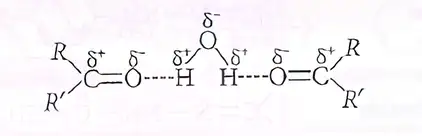
Quick recap
- Formaldehyde is a gas; lower aldehydes and ketones are volatile liquids, and higher members are solids.
- Lower aldehydes smell unpleasant, while ketones generally have a pleasant smell.
- Boiling points are higher than those of comparable hydrocarbons and ethers, but lower than those of alcohols.
- Ketones have slightly higher boiling points than isomeric aldehydes.
- Members up to are water-soluble; solubility falls as molecular weight increases.
- Two carboxylic acid molecules can form a dimer through hydrogen bonding.
Chemical Reactions
Polarity of the Carbonyl Group
Carbonyl group — The carbonyl group, , is polar, with an electrophilic carbon and a nucleophilic oxygen.
- Polarity: Oxygen’s greater electronegativity shifts electron density towards oxygen, creating a net dipole moment.
- Lewis acid–base character: Carbonyl carbon acts as a Lewis acid; carbonyl oxygen acts as a Lewis base.
- Resonance: The high dipole moment (–) is explained by resonance forms with charge separation.
- Addition pattern: Aldehydes and ketones usually undergo nucleophilic addition, unlike alkenes, which undergo electrophilic addition.

Acidity of α-Hydrogen Atoms
α-Hydrogen — An α-hydrogen is attached to a carbon adjacent to a carbonyl carbon; it is relatively acidic because its conjugate base is resonance-stabilised.
- Electron withdrawal: The carbonyl group withdraws electron density, making α-hydrogens easier to remove.
- Conjugate base: Deprotonation forms an enolate ion whose negative charge is resonance-stabilised.
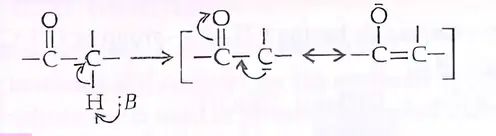
Nucleophilic Addition
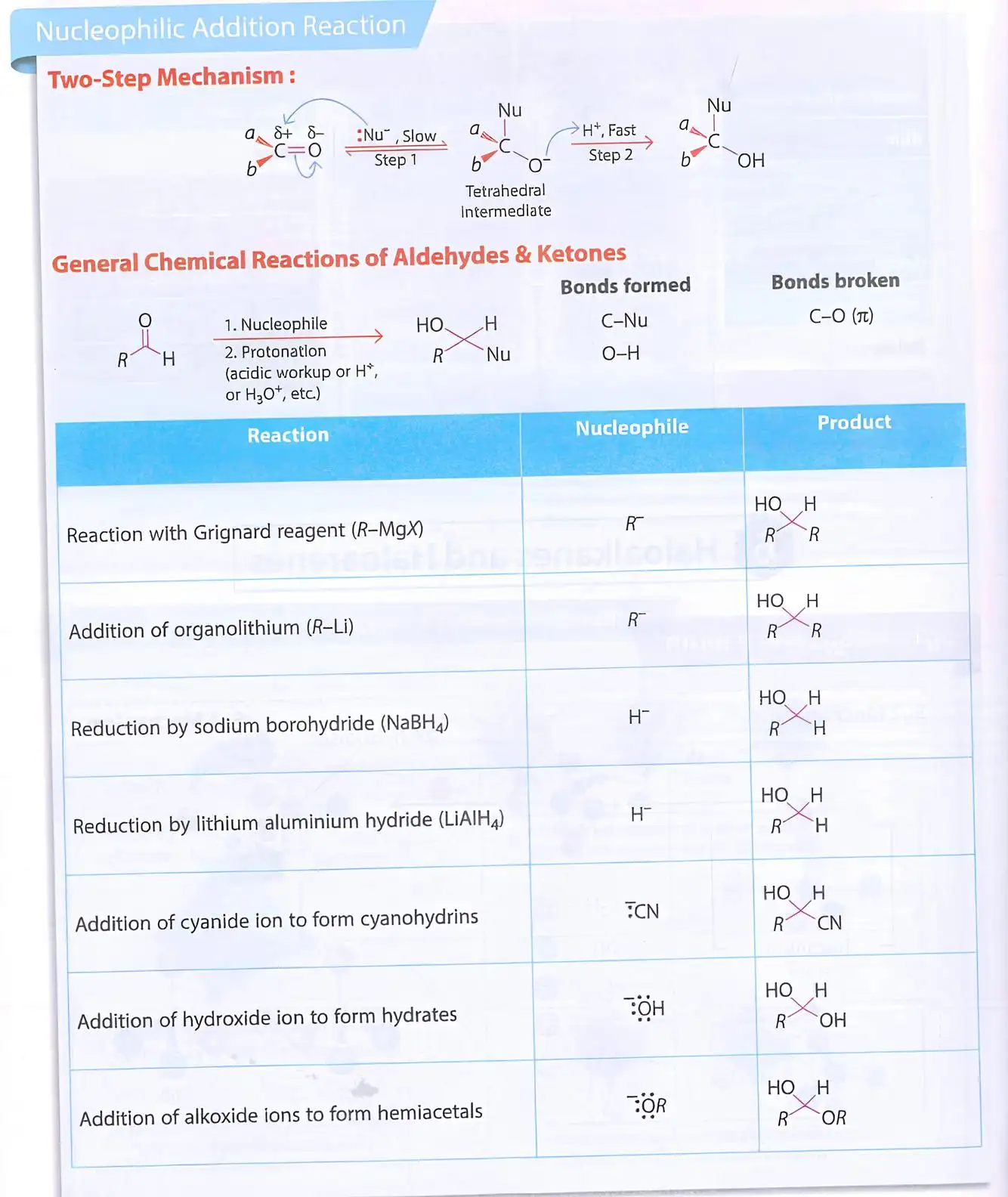
Nucleophilic addition — A nucleophile adds across a carbonyl bond, converting the carbonyl carbon into a tetrahedral carbon.
- Mechanism: A nucleophile attacks the electrophilic carbonyl carbon; the carbon–oxygen π bond shifts to oxygen, and the alkoxide is then protonated.
- Relative reactivity: Aldehydes are generally more reactive than ketones because of lower steric hindrance and less electron donation to the carbonyl carbon.
- Common products: Addition can form cyanohydrins, bisulphite adducts, alcohols, hemiacetals, acetals and ketals.
The order is from most reactive to least reactive.
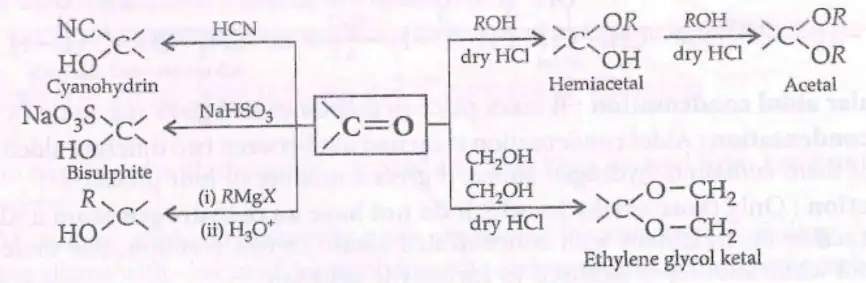
Nucleophilic Addition–Elimination
- General reaction: Ammonia or an ammonia derivative reacts with a carbonyl compound to form an imine or substituted imine, usually followed by heating.
- Substituent: In the product , may be alkyl, aryl or the groups listed below.
| Reagent | Derivative formed | Product name |
|---|---|---|
| Ammonia | Imine | |
| Amine | Substituted imine (Schiff base) | |
| Hydroxylamine | Oxime | |
| Hydrazine | Hydrazone | |
| Phenylhydrazine | Phenylhydrazone | |
| 2,4-Dinitrophenylhydrazine | 2,4-Dinitrophenylhydrazone | |
| Semicarbazide | Semicarbazone |
2,4-DNP Derivatives
- Appearance: 2,4-Dinitrophenylhydrazones are yellow, orange or red solids.
- Use: Their well-defined crystals and characteristic melting points help identify aldehydes and ketones.
Oxidation and Reduction
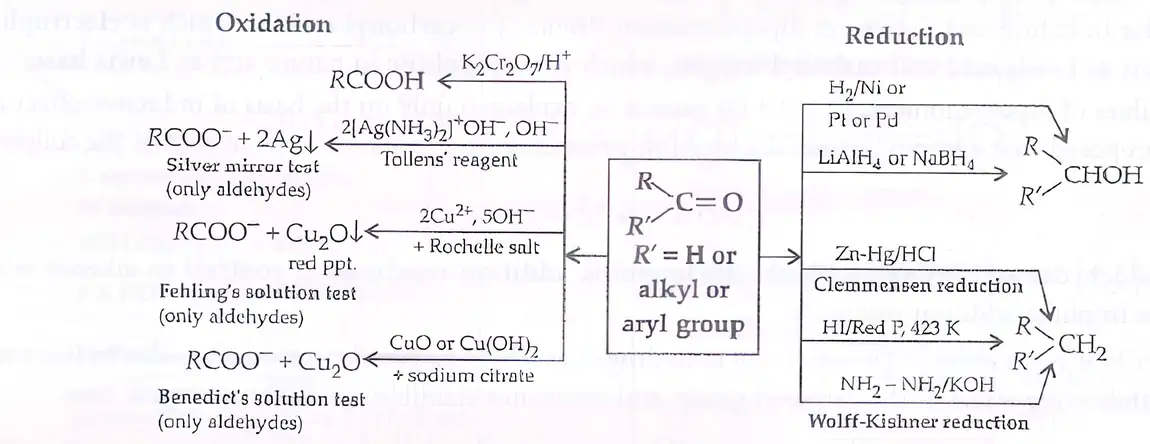
- Oxidation: Aldehydes are readily oxidised to carboxylic acids; ketones resist mild oxidation and stronger oxidation can involve carbon–carbon bond cleavage.
- Reduction: Aldehydes form primary alcohols, whereas ketones form secondary alcohols.
Haloform Reaction
Haloform reaction — Compounds containing a methyl carbonyl group or a group oxidisable to it react with halogen and alkali to form a haloform.
- Required groups: Compounds with or give the reaction.
- Iodoform test: Iodine and alkali produce a yellow precipitate of in a positive test.
- Application: α,β-Unsaturated methyl ketones can be converted to α,β-unsaturated acids without oxidising the carbon–carbon double bond.
Aldol Condensation
Aldol condensation — Aldehydes or ketones with at least one α-hydrogen react in dilute alkali to form a β-hydroxy carbonyl compound.
- Aldehyde product: A β-hydroxy aldehyde is called an aldol.
- Ketone product: A β-hydroxy ketone is called a ketol.
- Dehydration: Aldols and ketols readily lose water to form α,β-unsaturated carbonyl compounds.
- Requirement: At least one α-hydrogen is needed for the usual aldol reaction.

Intramolecular and Cross Aldol Condensation
- Intramolecular aldol: Diketones react within the same molecule to give cyclic products.
- Cross aldol: Two different aldehydes and/or ketones react with each other.
- Product mixture: If both reactants have α-hydrogens, cross aldol condensation can produce a mixture of four products.
Cannizzaro Reaction
Cannizzaro reaction — An aldehyde without an α-hydrogen undergoes self-oxidation and reduction in concentrated alkali: one molecule is reduced and another is oxidised.
- Products: One aldehyde molecule forms an alcohol; another forms a carboxylate salt.
- Intramolecular reaction: Dialdehydes without α-hydrogens can undergo intramolecular Cannizzaro reaction.
- Cross Cannizzaro: Formaldehyde and another suitable aldehyde can form the other aldehyde’s alcohol and a formate salt.
- Exceptions: Certain aliphatic monoalkylated aldehydes with α-hydrogens also react; has no α-hydrogen but does not undergo Cannizzaro reaction.
Electrophilic Substitution in Aromatic Carbonyl Compounds
- Ring reaction: Aromatic aldehydes and ketones undergo electrophilic substitution on the aromatic ring.
- Directing effect: The carbonyl group deactivates the ring and directs substitution to the meta position.
Distinguishing Aldehydes and Ketones
| Test | Aldehydes | Ketones |
|---|---|---|
| Schiff’s reagent | Pink colour | No colour |
| Fehling’s solution | Red precipitate | No precipitate |
| Tollens’ reagent | Silver mirror | No silver mirror |
| 2,4-Dinitrophenylhydrazine | Orange-yellow or red crystals; melting point characteristic of the aldehyde | Orange-yellow or red crystals; melting point characteristic of the ketone |
Important Test Exception
- α-Hydroxy ketones: They can reduce Tollens’ reagent, Fehling’s solution and Benedict’s solution.
Why are aldehydes generally more reactive than ketones towards nucleophilic addition?
Which aldehydes undergo the usual Cannizzaro reaction, and what are its products?
What does a positive iodoform test indicate?
Quick recap
- The carbonyl bond is polar: its carbon is electrophilic and its oxygen is nucleophilic.
- α-Hydrogen acidity comes from carbonyl electron withdrawal and resonance stabilisation of the enolate.
- Aldehydes are generally more reactive than ketones in nucleophilic addition; the reactivity order is .
- Aldol condensation needs an α-hydrogen; aldehydes without one generally undergo Cannizzaro reaction in concentrated alkali.
- The haloform reaction gives yellow iodoform from compounds containing or .
- Aromatic carbonyl groups are deactivating and meta-directing; aldehydes and ketones differ in common oxidation tests.
Uses of Aldehydes and Ketones
Industrial and Commercial Uses
| Compound or group | Use |
|---|---|
| Aldehydes and ketones | Used as solvents in the chemical industry, and as starting materials or reagents for synthesising other organic compounds. |
| Formalin | A 40% solution of formaldehyde used to preserve biological specimens. |
| Formaldehyde | Used to make Bakelite (phenol-formaldehyde resin), urea-formaldehyde glues and other polymeric products. |
| Acetaldehyde () | Starting material for manufacturing acetic acid, ethyl acetate, vinyl acetate, polymers and drugs. |
| Benzaldehyde | Used in perfumery and the dye industry. |
| Butyraldehyde, vanillin, acetophenone and camphor | Used as flavouring agents. |
Quick recap
- Aldehydes and ketones are industrial solvents and organic-synthesis starting materials or reagents.
- Formalin is a 40% formaldehyde solution used to preserve biological specimens.
- Formaldehyde is used to produce Bakelite, urea-formaldehyde glues and other polymers.
- Acetaldehyde is used to manufacture acetic acid, ethyl acetate, vinyl acetate, polymers and drugs.
- Benzaldehyde is used in perfumery and dyes; several compounds, including vanillin and camphor, are flavouring agents.
Nomenclature and Structure of Carboxyl Group
Nomenclature of Carboxylic Acids
- Common names: Many are derived from natural sources and end in “-ic acid”.
- IUPAC names: Replace the final “e” of the corresponding alkane with “-oic acid”; the carboxyl carbon is numbered 1. Use prefixes such as dicarboxylic acid for multiple –COOH groups.
Structure of the Carboxyl Group
These resonance forms help explain the reduced electrophilicity of the carboxyl carbon.
Quick recap
- Common carboxylic acid names commonly end in “-ic acid.”
- For a single carboxyl group, replace the parent alkane’s final “e” with “oic acid.”
- Number the carboxyl carbon as carbon .
- Use prefixes such as “di-” for multiple carboxyl groups and show their positions where required.
- The carboxyl carbon has a planar arrangement with bond angles of about .
- Resonance makes the carboxyl carbon less electrophilic than a carbonyl carbon.
Methods of Preparation of Carboxylic Acids
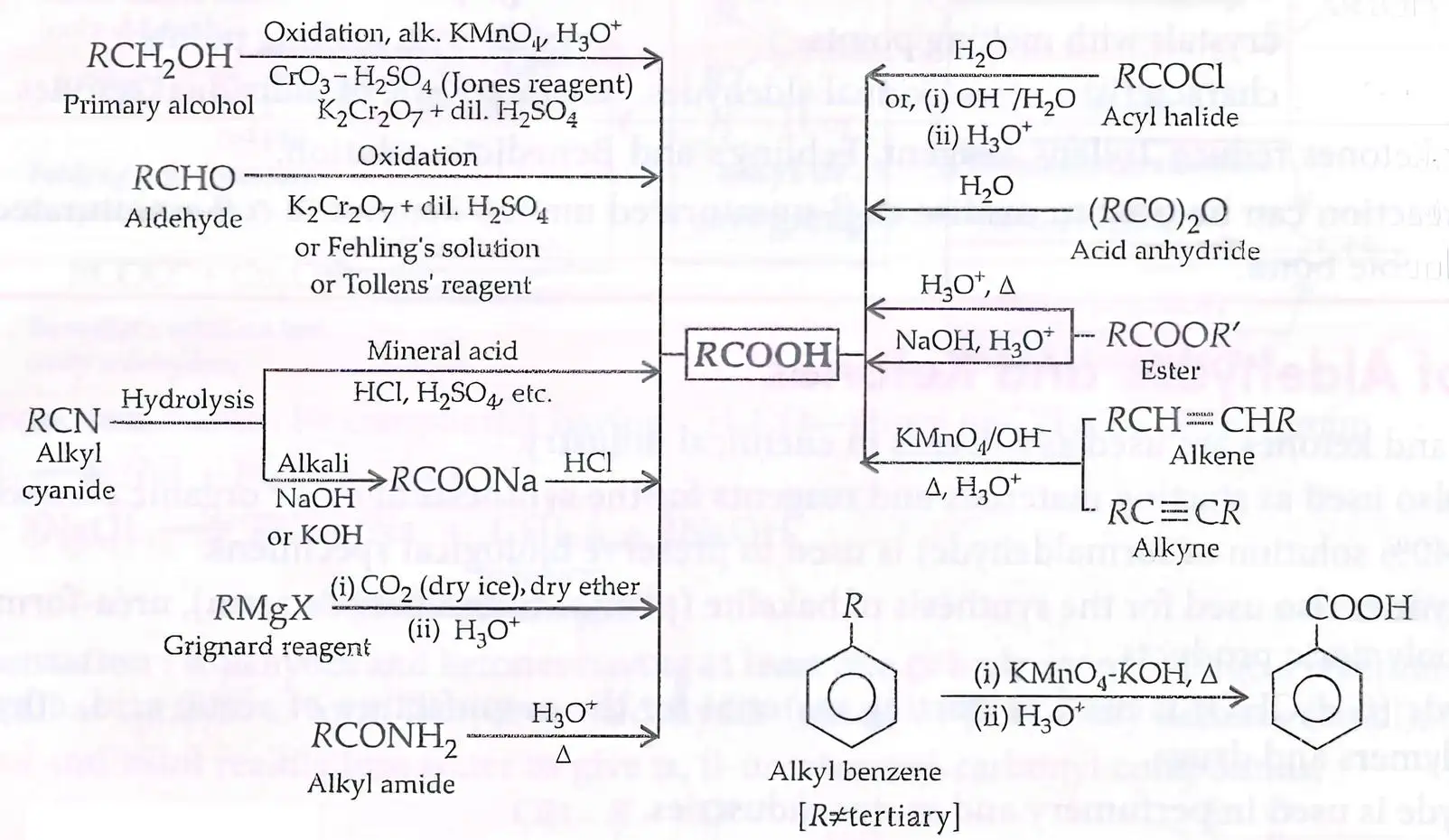
Preparation of Carboxylic Acids
Quick recap
- The lecture concerns methods for preparing carboxylic acids.
- The preparation routes begin from various compounds and their derivatives.
- The figure provides an overview of these preparation routes.
- Specific reagents, conditions, and equations are not included in the provided lecture text.
Physical Properties of Carboxylic Acids
Physical State
- Physical properties: Carboxylic acids show characteristic trends in physical state, odour, boiling point and water solubility.
Odour
- Odour: The first three carboxylic acids have a sharp, pungent odour; C₄–C₉ acids smell of rancid butter, while higher members are odourless.
Boiling Points and Molecular Association
Solubility in Water
- Lower acids: Aliphatic carboxylic acids with up to four carbon atoms are miscible with water through hydrogen bonding.
- Chain length: Water solubility decreases as the number of carbon atoms increases.
- Higher acids: They are practically insoluble in water because of the hydrophobic hydrocarbon chain.
Quick recap
- Carboxylic acids up to are colourless liquids; higher members are colourless waxy solids.
- The first three members smell pungent; – members smell of rancid butter; higher members are odourless.
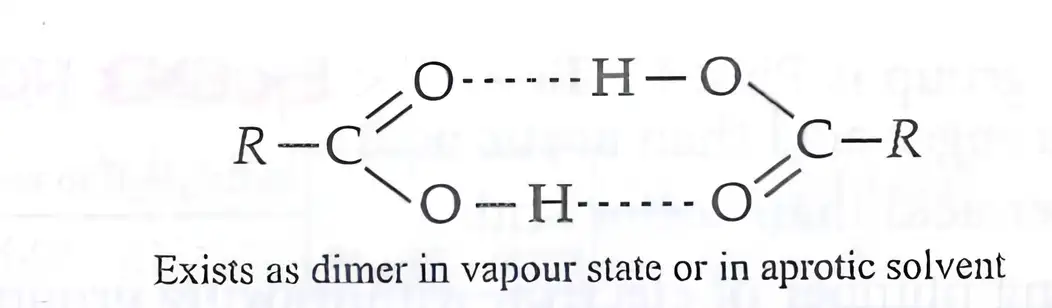
- Intermolecular hydrogen bonding gives carboxylic acids unusually high boiling points.
- Hydrogen-bonded dimers can persist in vapour and in aprotic solvents.
- Acids with up to four carbon atoms are water-miscible; solubility falls as the carbon chain grows.
Chemical Reactions of Carboxylic Acids
Reactions Involving Cleavage of the O–H Bond
Acidic Strength of Carboxylic Acids
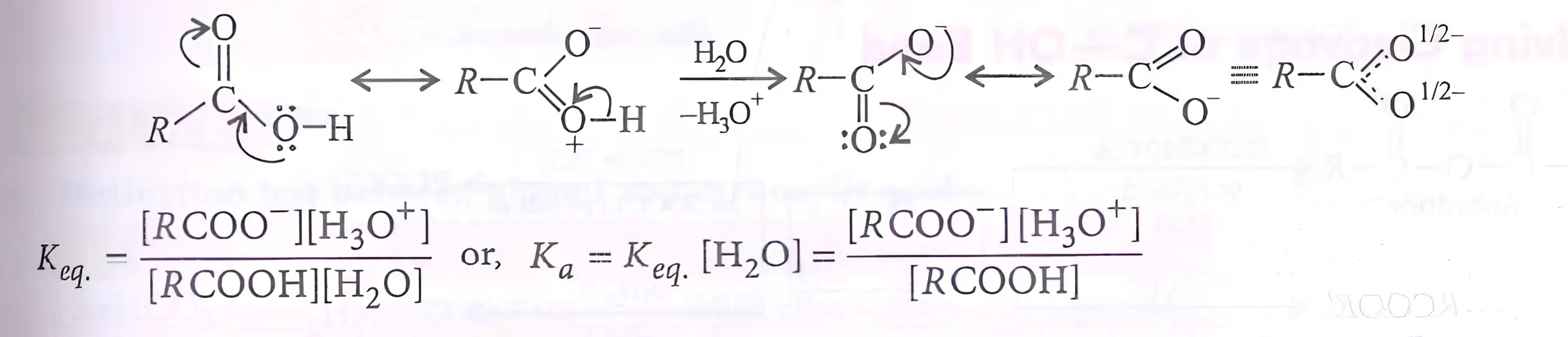
Use these relationships to compare acid strengths.
| Point | Carboxylic acids | Phenols |
|---|---|---|
| Conjugate base | Carboxylate ion | Phenoxide ion |
| Resonance stabilisation | Two equivalent contributors place negative charge on oxygen atoms. | Contributors are non-equivalent; some place negative charge on less electronegative carbon atoms. |
| Acid strength | Stronger | Weaker |
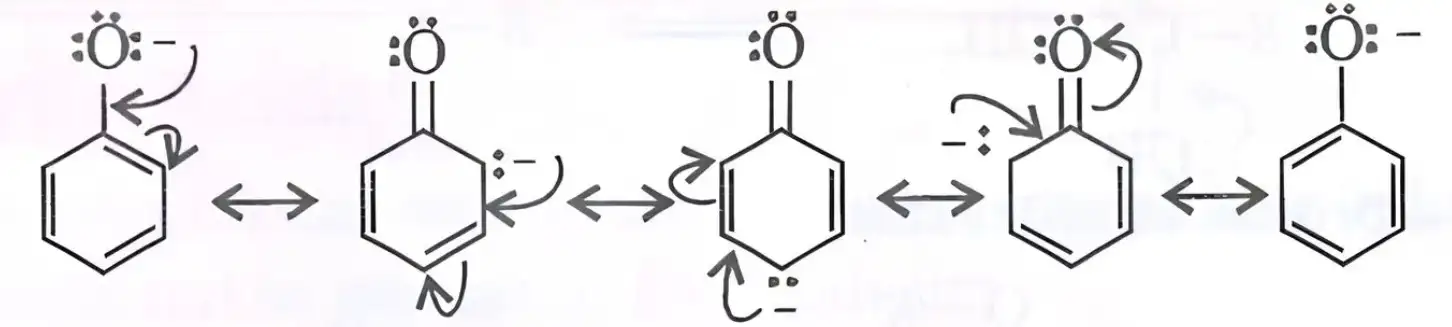
Effect of Substituents on Acidity
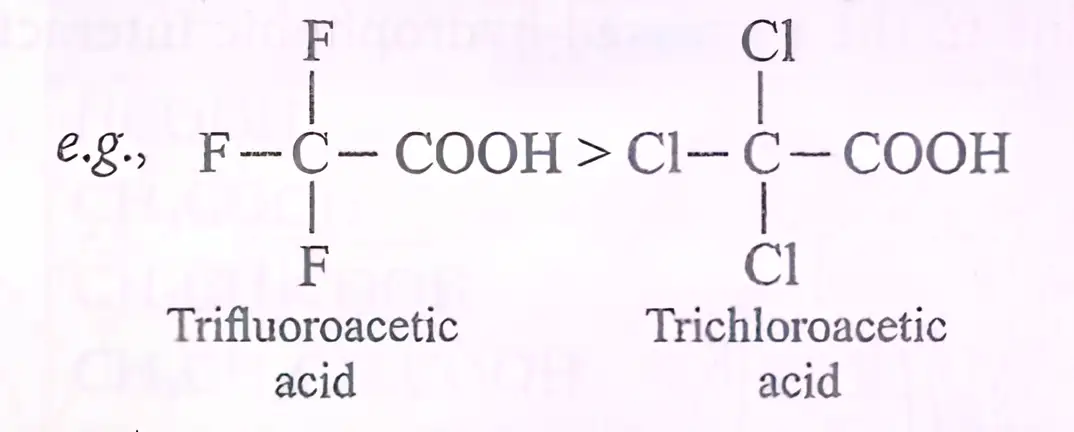
Electron-donating groups and aromatic acids
- Electron-donating groups (EDGs): They destabilise the carboxylate ion and decrease acidity; formic acid is stronger than acetic acid.
- Aromatic acids: An EWG on the phenyl ring increases acidity (for example, -nitrobenzoic acid is stronger than benzoic acid).
- Aromatic acids: An electron-releasing group decreases acidity (for example, -methoxybenzoic acid is weaker than benzoic acid).
Reactions Involving Cleavage of the C–OH Bond

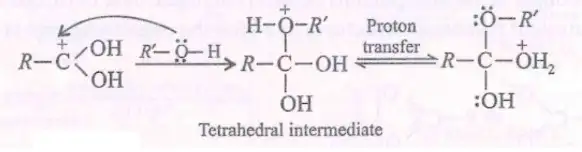
Esterification mechanism
- Protonation of the carbonyl oxygen activates the acyl carbon toward nucleophilic attack.
- The alcohol attacks the acyl carbon, forming a tetrahedral intermediate; proton transfers make an –OH group into a good leaving group.
- Water is eliminated, forming a protonated ester.
- Loss of a proton gives the ester and regenerates the acid catalyst.
Reactions of the –COOH Group
Decarboxylation and Kolbe electrolysis
- Decarboxylation: Heating a sodium carboxylate with soda lime removes the carboxyl carbon and gives an alkane with one fewer carbon atom.
- Kolbe electrolysis: Electrolysis of an aqueous sodium carboxylate solution couples alkyl groups, producing an alkane and carbon dioxide.

Substitution Reactions in the Hydrocarbon Part
Ring substitution in aromatic acids
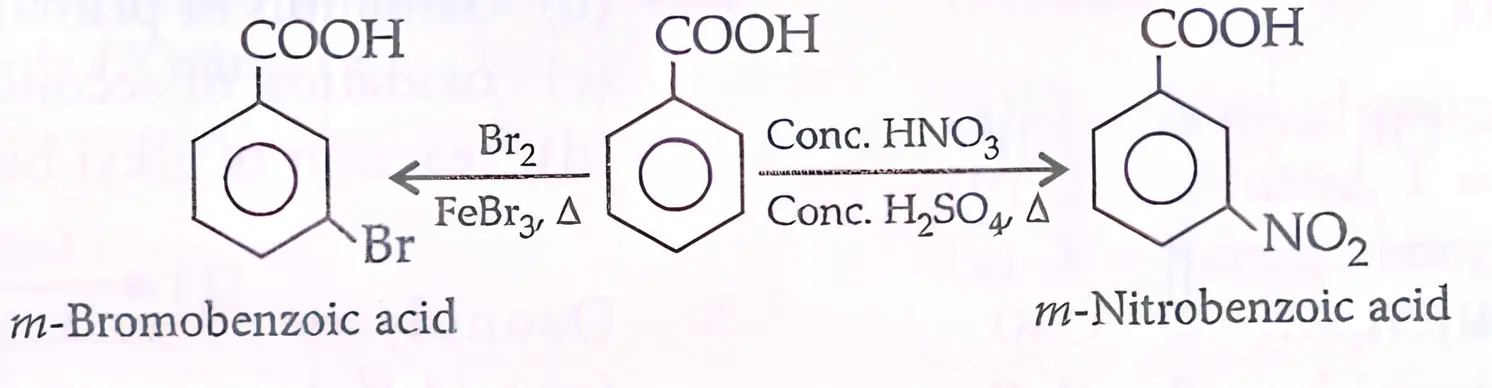
- Directing effect: The group is deactivating and meta-directing in electrophilic aromatic substitution.
- Examples: Bromination and nitration of benzoic acid occur mainly at the meta position.
Distinction Between Phenols and Carboxylic Acids
- Sodium hydrogencarbonate test: Carboxylic acids react with NaHCO₃ to release CO₂, producing brisk effervescence; phenols do not.
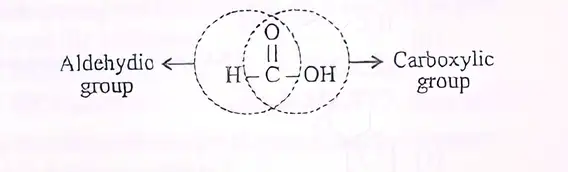
Abnormal Behaviour of Formic Acid
Why are carboxylic acids stronger acids than phenols?
How do electron-withdrawing groups affect carboxylic acid strength?
What distinguishes a carboxylic acid from a phenol in the sodium bicarbonate test?
Quick recap
- Carboxylic acids form salts with metals and bases; carbonates and bicarbonates release carbon dioxide.
- A stable, resonance-delocalised carboxylate ion explains carboxylic acid acidity; lower means a stronger acid.
- EWGs increase acidity, while EDGs decrease it; proximity and substituent electronegativity also matter.
- Esterification is a nucleophilic acyl substitution involving protonation, alcohol addition, water loss and deprotonation.
- reduces carboxylic acids to primary alcohols; decarboxylation and Kolbe electrolysis are characteristic reactions.
- The carboxyl group is meta-directing and deactivating; formic acid gives aldehyde-like reduction tests.
Uses of Carboxylic Acids
Industrial and Everyday Uses
| Compound | Use |
|---|---|
| Methanoic acid | Used in rubber, textile, dyeing, leather and electroplating industries. |
| Ethanoic acid | Used as a solvent and as vinegar in the food industry. |
| Hexanedioic acid | Used to manufacture nylon-6,6. |
| Esters of benzoic acid | Used in perfumery. |
| Sodium benzoate | Used as a food preservative. |
| Higher fatty acids | Used to manufacture soaps and detergents. |
Quick recap
- Methanoic acid is used across several industries, including leather and electroplating.
- Ethanoic acid is used as a solvent and as vinegar in food.
- Hexanedioic acid is a starting material for nylon-6,6.
- Benzoic acid esters are used in perfumery.
- Sodium benzoate is a food preservative.
- Higher fatty acids are used to make soaps and detergents.
NEET Chemistry — ALL CHAPTERS
1
Some Basic Concepts of Chemistry
2
Structure of Atom
3
Classification of Elements and Periodicity in Properties
4
Chemical Bonding and Molecular Structure
5
Thermodynamics
6
Equilibrium
7
Redox Reactions
8
Organic Chemistry - Some Basic Principles and Techniques
9
Hydrocarbons
10
Solutions
11
Electrochemistry
12
Chemical Kinetics
13
The d- and f- Block Elements
14
Coordination Compounds
15
Haloalkanes and Haloarenes
16
Alcohols, Phenols and Ethers
17
Aldehydes, Ketones and Carboxylic Acids
18
Amines
19
Biomolecules
20
The p-Block Elements (Group 13 and 14)
21
The p-Block Elements (Group 15 to 18)
22
Principles Related to Practical Chemistry