NEET UG . NEET Chemistry . Chemistry . Some Basic Concepts of Chemistry
Chapter 1: Some Basic Concepts of Chemistry
Ch 1
NEET Chemistry
NEET UG
Importance of Chemistry
Chemistry and Matter
Chemistry — The branch of science that studies the preparation, composition, structure, properties and reactions of substances.
- Matter: Chemistry studies its composition, structure, properties and interactions, including changes substances undergo.
- Basic constituents: Atoms and molecules help describe and understand matter; hence chemistry is also called the science of atoms and molecules.
Importance and Applications of Chemistry
- Central role: Chemistry is closely connected with other sciences and applies to areas such as weather patterns, brain function and computer operation.
- Industry and materials: Chemistry enables the production of fertilisers, alkalis, acids, salts, dyes, polymers, drugs, soaps, detergents, metals, alloys and new materials.
- Medicines: It provides methods to isolate lifesaving drugs from natural sources and to synthesise them.
- Drug examples: Cisplatin and taxol are effective in cancer therapy; AZT (azidothymidine) is used to help AIDS patients.
- Environment: Chemistry has produced safer alternatives to CFCs (chlorofluorocarbons), hazardous refrigerants responsible for ozone depletion in the stratosphere.
Quick recap
- Chemistry studies substances, matter and the changes they undergo.
- Atoms and molecules are the basic constituents used to understand matter.
- Chemistry is central to science and has applications in diverse fields.
- It supports the manufacture of industrial products and new materials.
- Cisplatin and taxol are used in cancer therapy; AZT helps AIDS patients.
- Safer alternatives to ozone-depleting CFC refrigerants have been synthesised.
Nature of Matter
Matter — Anything that occupies space and has mass.
Physical States of Matter
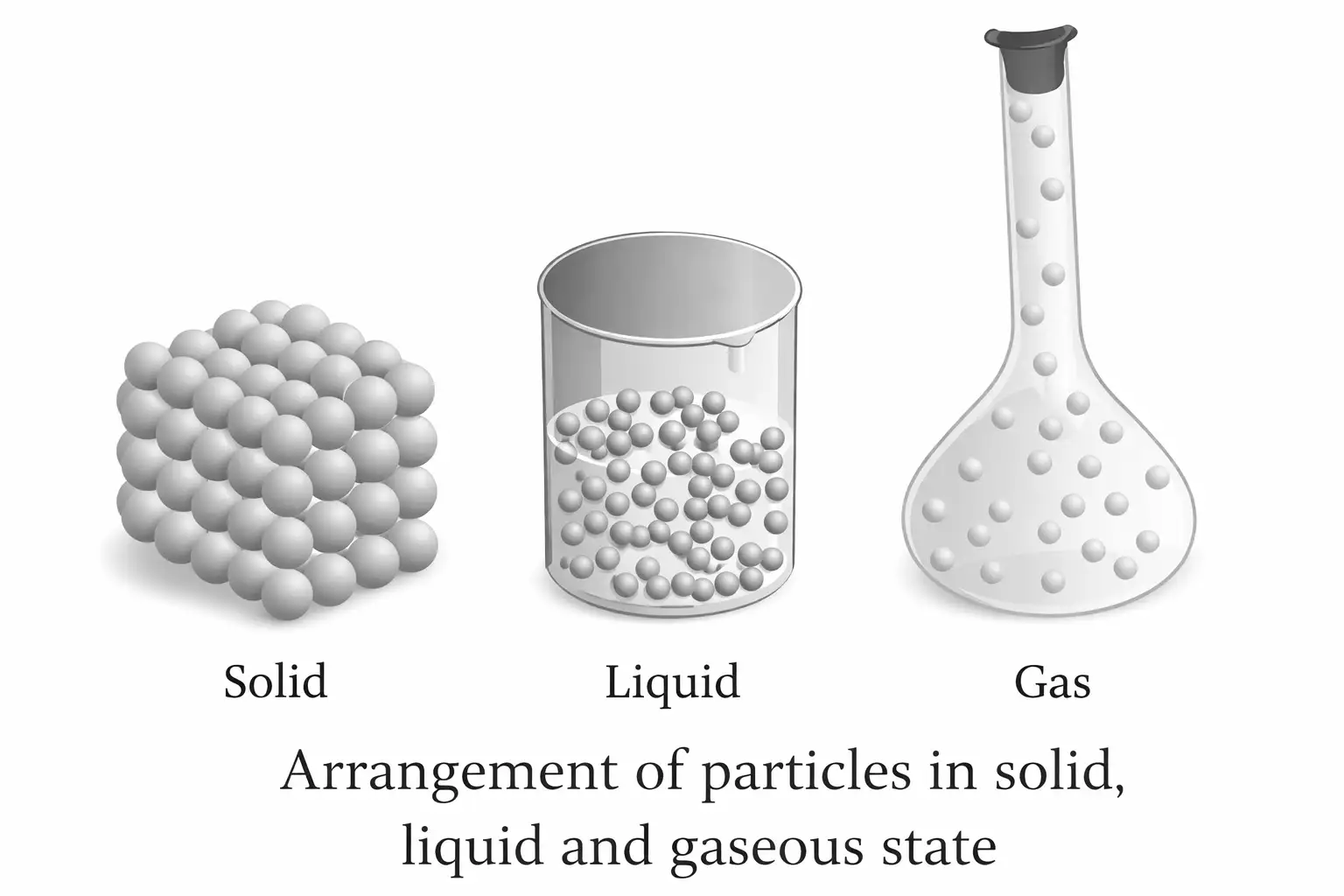
| State | Particle arrangement and motion | Shape | Volume |
|---|---|---|---|
| Solid | Particles are close together, strongly attracted and fixed in position. | Definite | Definite |
| Liquid | Particles are close together with weaker attractions; they move past one another. | Not definite; takes the container’s shape | Definite |
| Gas | Particles are far apart and move independently in random directions. | Not definite | Not definite; fills the container |
Interconversion of States
Changing State
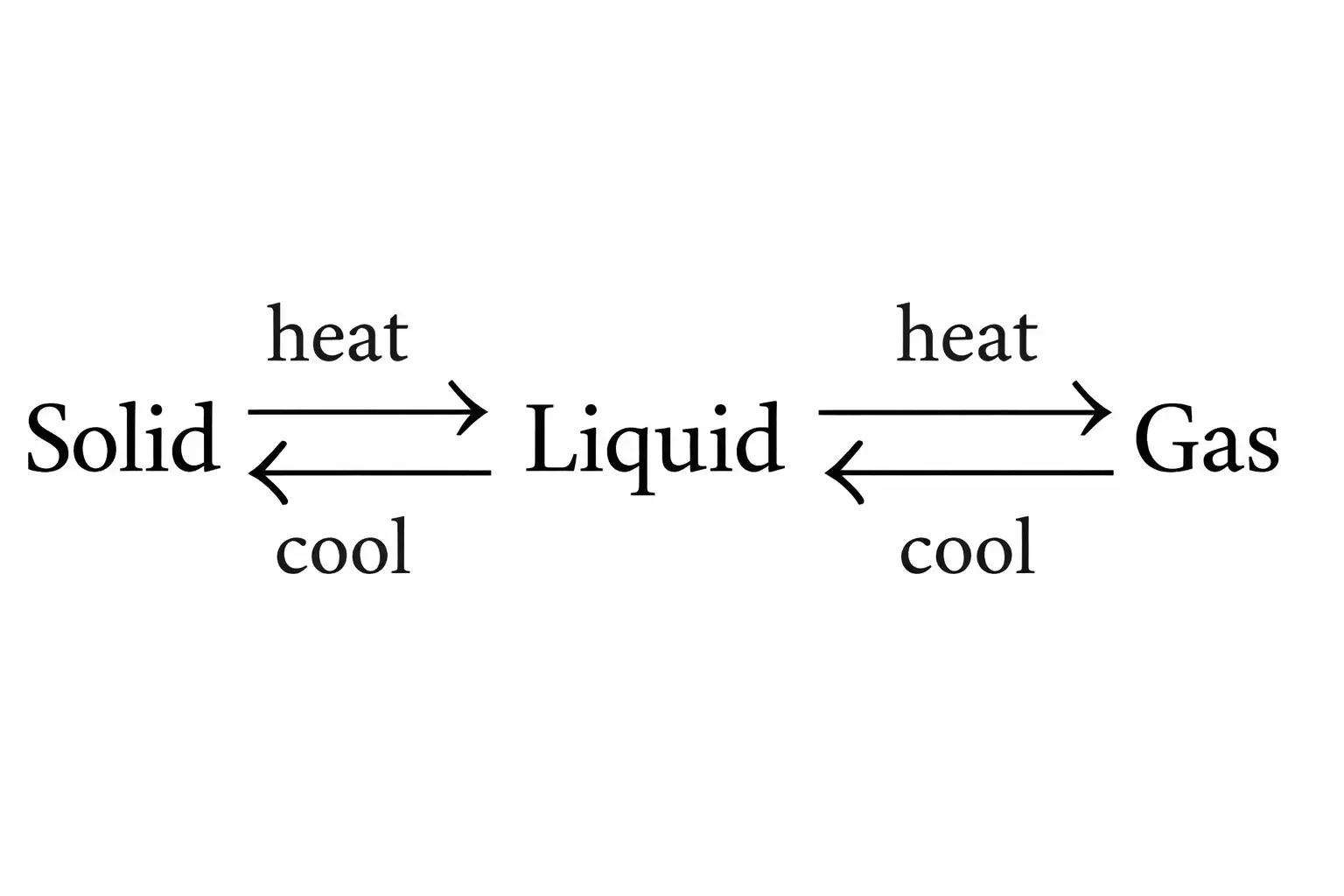
- Interconversion: Changes in temperature and pressure can convert one state of matter into another.
- Heating: A solid usually becomes a liquid; further heating changes the liquid into gas (or vapour).
- Cooling: Gas liquefies to liquid; further cooling freezes the liquid into a solid.
- Reversibility: These state changes can be reversed by reversing the conditions.
Classification of Matter
| Point | Pure substances | Mixtures |
|---|---|---|
| Composition | Fixed composition; may be an element or compound. | Contain two or more substances. |
| Separation | Cannot be separated by simple physical methods. | Made from substances mixed together. |
| Examples | Copper, silver, gold, water and glucose. | Sugar solution, air, and mixtures of salt and sugar. |
| Type | Composition and appearance | Example |
|---|---|---|
| Homogeneous | Uniform composition, appearance and properties throughout; components mix completely. | Sugar solution; air |
| Heterogeneous | Two or more physically distinct phases; composition is not uniform throughout. | Mixture of salt and sugar |
Quick recap
- Matter occupies space and has mass.
- Solids have a definite shape and volume; liquids have a definite volume but take their container’s shape.
- Gases have neither definite shape nor definite volume and fill their container.
- Temperature and pressure changes can interconvert the physical states of matter.
- On heating: solid → liquid → gas; on cooling: gas → liquid → solid.
- Pure substances are elements or compounds with fixed composition and cannot be separated by simple physical methods.
- Homogeneous mixtures are uniform; heterogeneous mixtures have distinct phases and non-uniform composition.
Properties of Matter and their Measurement
Physical and Chemical Properties
Chemical property — The ability of a substance to form new substances through decomposition or reaction with other substances.
- Examples: Acidity, basicity and combustibility.
- Key distinction: Physical properties can be measured without changing composition; chemical properties involve forming new substances.
SI Units and Prefixes
International System of Units (SI) — A decimal system of units, also called the metric system, for measuring fundamental and derived physical quantities.
| Physical quantity | Quantity symbol | Unit | Unit symbol |
|---|---|---|---|
| Length | metre | ||
| Mass | kilogram | ||
| Time | second | ||
| Electric current | ampere | ||
| Thermodynamic temperature | kelvin | ||
| Amount of substance | mole | ||
| Luminous intensity | candela |
SI Prefixes
- Use: Prefixes indicate multiples or submultiples of a unit.
| Prefix | Symbol | Multiple |
|---|---|---|
| yocto | ||
| zepto | ||
| atto | ||
| femto | ||
| pico | ||
| nano | ||
| micro | ||
| milli | ||
| centi | ||
| deci | ||
| deca | ||
| hecto | ||
| kilo | ||
| mega | ||
| giga | ||
| tera | ||
| peta |
Mass and Weight
Mass — The amount of matter present in a substance; its SI unit is the kilogram ().
Weight — The force exerted by gravity on an object.
| Point | Mass | Weight |
|---|---|---|
| Meaning | Amount of matter in a substance | Gravitational force on an object |
| Variation by location | Constant | May vary when gravity changes |
| SI unit | kilogram () | Not specified in this lecture |
- Measurement: Mass is measured accurately in laboratories using an analytical balance.
Volume and Density
Volume — The amount of space occupied by a substance; its units are based on length cubed.
- SI unit: Cubic metre ().
- Common chemistry units: Cubic centimetre () and cubic decimetre ().
Useful conversions between litres and cubic units.
Density — The mass of a substance per unit volume.
Density is calculated by dividing mass by volume.
- SI unit: ; the commonly used chemistry unit is .
Temperature
- SI unit: kelvin (). Temperature is also measured in degrees Celsius () and degrees Fahrenheit ().
Use for the Celsius temperature and for the Fahrenheit temperature.
Quick recap
- Physical properties can be measured without changing composition; chemical properties involve forming new substances.
- The SI, or metric, system is decimal and has seven base units.
- SI prefixes indicate powers of ten; learn each prefix and its stated multiple.
- Mass remains constant with location, while weight may change as gravity changes.
- Volume uses cubic units; density is mass per unit volume.
- Temperature conversions: and .
Uncertainty in Measurement
Measurement and Units
- Measurement: A measurement expresses the quantity or extent of something in comparison with a unit.
- Unit: A unit is a fixed quantity chosen as the standard for measurement.
Scientific Notation
- Scientific notation: A number is written as , where \(1 \leq N < 10\) and is an integer.
- Examples: ; .
Calculations in Scientific Notation
Use these rules for numbers in scientific notation.
Examples
- Multiplication: .
- Division: .
Make the exponents equal before combining the coefficients.
Examples
- Addition: .
- Subtraction: .
Precision and Accuracy
- Precision: The closeness of repeated measurements of the same quantity to one another.
- Accuracy: The agreement of a measured value with the true value.
Significant Figures
Do not count leading zeros as significant figures; they only locate the decimal point.
Rounding and Reporting Results
| First digit removed | Action |
|---|---|
| Greater than 5 | Increase the preceding digit by 1. |
| Less than 5 | Leave the preceding digit unchanged. |
| Exactly 5 | Leave the preceding digit unchanged if it is even; increase it by 1 if it is odd. |
Dimensional Analysis and Unit Conversion
Multiply the given quantity by a suitable conversion factor.
Either equivalent ratio can be used as a conversion factor, depending on which unit must cancel.
How do precision and accuracy differ?
How should a result be rounded after addition or subtraction?
What is dimensional analysis?
Quick recap
- Scientific notation expresses a number as , with .
- For multiplication and division, combine coefficients and add or subtract exponents; for addition and subtraction, first match exponents.
- Precision compares repeated measurements; accuracy compares a measurement with the true value.
- Significant figures include the certain digits and the final uncertain digit; leading zeros are not significant.
- Round addition/subtraction by decimal places and multiplication/division by significant figures.
- Dimensional analysis expresses quantities in fundamental quantities; conversion factors equal to 1 change units without changing the quantity.
Laws of Chemical Combinations
Conservation of Mass
Law of conservation of mass — Matter is neither created nor destroyed during a chemical change; the total mass remains constant.
- Implication: The total mass of reactants equals the total mass of products.
For a chemical reaction
Definite Proportions
Law of definite proportions — A given compound always contains its elements in the same fixed mass ratio, regardless of its source or method of preparation.
- Also called: Law of definite composition.
Multiple Proportions
Law of multiple proportions — If two elements form more than one compound, the masses of one element that combine with a fixed mass of the other are in a ratio of small whole numbers.
Gaseous Volume Relationships
Gay-Lussac’s law of gaseous volumes — When gases combine or are produced in a chemical reaction, their volumes are in a simple ratio if measured at the same temperature and pressure.
- Condition: Compare gas volumes at the same temperature and pressure.
Avogadro’s Law
Avogadro’s law — Equal volumes of gases at the same temperature and pressure contain equal numbers of molecules.
Reciprocal Proportions
Law of reciprocal proportions — When two elements combine separately with a fixed mass of a third element, the ratio of their masses is the same as, or a simple multiple of, the ratio in which they combine with each other.
State the law of multiple proportions.
How does Avogadro’s law relate gas volume to molecules?
Quick recap
- Mass is conserved during a chemical change: total reactant mass equals total product mass.
- A compound has a fixed mass ratio of elements, independent of its source or preparation.
- For multiple compounds made from the same two elements, combining masses follow small whole-number ratios.
- Reacting and produced gas volumes follow simple ratios at the same temperature and pressure.
- Equal gas volumes at the same temperature and pressure contain equal numbers of molecules.
- Reciprocal proportions compare two elements’ combining masses with a fixed mass of a third element.
Dalton’s Atomic Theory
Main Postulates
- Atoms: Matter consists of indivisible atoms.
- Elements: Atoms of the same element have identical properties, including mass; atoms of different elements have different masses.
- Compounds: Atoms of different elements combine in fixed whole-number ratios to form compounds.
- Chemical reactions: Atoms are rearranged; they are neither created nor destroyed.
- Limitations: The theory could not explain gaseous-volume laws or why atoms combine.
Quick recap
- Matter consists of indivisible atoms.
- Same element: its atoms have identical properties, including mass.
- Different elements: their atoms differ in mass.
- Compounds form when different elements' atoms combine in fixed ratios.
- Chemical reactions reorganise atoms; they are neither created nor destroyed.
- Limitations: the theory did not explain gaseous-volume laws or why atoms combine.
Atomic and Molecular Masses
Atomic Mass and the Unified Mass Unit
The average mass of an atom is compared with one-twelfth the mass of a carbon-12 atom.
Average Atomic Mass and Isotopes
Use fractional abundances; convert percentage abundance to a fraction by dividing by .
| Isotope | Relative abundance (%) | Isotopic mass (u) |
|---|---|---|
The extremely low abundance of carbon-14 contributes negligibly; the weighted result is approximately .
Molecular Mass and Formula Mass
Formula mass — The sum of the atomic masses of all atoms in an ionic compound’s formula unit.
The mass of a molecule is compared with one-twelfth the mass of a carbon-12 atom.
Related mass relations
- From equivalent mass: Atomic mass equivalent mass valency.
- For an elemental molecule: Atomic mass molecular mass atomicity, where atomicity is the number of atoms in one molecule.
- Actual mass of one molecule: Molecular mass .
- Specific-heat relation: Atomic mass specific heat (in calories).
- Vapour density relation: Molecular mass vapour density.
| Point | Molecular mass | Formula mass |
|---|---|---|
| Used for | Substances made of molecules | Ionic compounds, which consist of formula units |
| How to obtain | Add atomic masses in one molecule | Add atomic masses in one formula unit |
How is the average atomic mass of an element with isotopes calculated?
What is the distinction between molecular mass and formula mass?
Quick recap
- One unified mass unit is exactly one-twelfth the mass of a carbon-12 atom.
- .
- Average atomic mass is the abundance-weighted average of isotope masses.
- Molecular mass is the sum of atomic masses in a molecule; ionic compounds are described by formula mass.
- Molecular mass can be converted to actual mass per molecule using per mass unit.
- For elemental molecules, atomic mass equals molecular mass divided by atomicity; molecular mass also equals twice the vapour density.
Mole Concept and Molar Masses
The Mole
Mole — One mole is the amount of a substance containing as many entities as there are atoms in exactly of carbon-12.
The number of entities in one mole is the Avogadro constant, denoted by .
What one mole represents
- Particles: One mole contains entities, such as atoms, molecules or formula units.
- Carbon-12 reference: The mole is defined using the number of atoms present in exactly of .
- Gas volume: One mole of a gas occupies at STP, as stated in this lecture.
Molar Mass
Molar mass — The mass of one mole of a substance, expressed in grams, is its molar mass.
Mass relationship
- Numerical equality: Molar mass in is numerically equal to atomic, molecular or formula mass in .
- Unit distinction: Atomic/molecular/formula mass is expressed in ; molar mass is expressed in .
Gram Atomic Mass and Gram Molecular Mass
| Term | Meaning | Entities in one mole |
|---|---|---|
| Gram atom | Gram atomic mass of an element | atoms |
| Gram molecule | Gram molecular mass of a substance | molecules |
- One mole contains entities.
- Molar mass is the mass of one mole, expressed in grams.
- A gram atom counts atoms; a gram molecule counts molecules.
Define molar mass and state its relation to molecular mass.
Quick recap
- One mole contains the same number of entities as atoms in exactly of .
- The Avogadro constant is .
- Molar mass is the mass of one mole, expressed in grams.
- Molar mass in is numerically equal to atomic, molecular or formula mass in .
- One mole of gas occupies at STP according to this lecture.
- A gram atom corresponds to atoms; a gram molecule corresponds to molecules.
Percentage Composition
Mass Percentage
Mass percentage of an element — The percentage by mass of an element in a compound, calculated using the element’s mass in one mole of the compound.
Here, is the mass of the element in the compound and is the compound’s molar mass.
Empirical and Molecular Formulas
| Point | Empirical formula | Molecular formula |
|---|---|---|
| Meaning | Simplest whole-number ratio of atoms of each element in a compound. | Exact number of atoms of each element in one molecule. |
| Information | Gives the simplest ratio, not necessarily the actual atom count. | Gives the exact atom count in the molecule. |
| Relationship between compounds | Different compounds may have the same empirical formula. | According to the lecture, different compounds cannot have the same molecular formula. |
Relationship Between the Two Formulas
Here, denotes molecular formula and denotes empirical formula. The multiplier is a positive whole number: .
Here, is the molecular mass and is the empirical formula mass.
Example
- If the empirical formula is and , the molecular formula is .
- Obtain the molecular formula by multiplying every subscript in the empirical formula by .
How is the multiplier used to find a molecular formula?
Quick recap
- Mass percentage compares an element’s mass in the compound with the compound’s molar mass, then multiplies by .
- An empirical formula gives the simplest whole-number ratio of atoms.
- A molecular formula gives the actual number of each type of atom in a molecule.
- Different compounds may have the same empirical formula.
- The molecular formula is the empirical formula multiplied by .
- Find by dividing molecular mass by empirical formula mass.
Stoichiometry and Stoichiometric Calculations
Stoichiometry and Limiting Reagent
Stoichiometry — Calculation of the amounts, especially masses and sometimes volumes, of reactants and products using a balanced chemical equation.
Limiting reagent — The reactant completely consumed first; it limits the maximum amount of product that can form.
Ways to Express Concentration
| Measure | Definition / formula | Key point |
|---|---|---|
| Mass percent | Mass-based | |
| Volume percent | Volume-based | |
| Mole fraction | Dimensionless | |
| Molarity | , with volume in L | Moles per litre of solution |
| Molality | , with solvent mass in kg | Moles per kilogram of solvent |
| Point | Temperature-independent | Temperature-dependent |
|---|---|---|
| Measures | Molality and mole fraction | Molarity |
| Reason | Depend on masses or mole ratios, which do not change with temperature | Depends on solution volume, which changes with temperature |
Normality and Equivalent Mass
Normality — Number of gram-equivalents of solute per litre of solution.
is solute mass in grams, is solution volume in millilitres, and is gram equivalent mass.
Symbols Used for Equivalent Mass
- = atomic mass; = molecular or formula mass.
- = valency or total charge magnitude; = basicity; = acidity; = total change in oxidation number.
| Substance | Equivalent mass |
|---|---|
| Element | |
| Acid | |
| Base | |
| Salt | |
| Oxidising agent |
is gram molecular mass and is gram equivalent mass of the solute.
Dilution, Reactions and Mixing Solutions
Use when a solution is diluted without changing the amount of solute.
For two reactants in a balanced reaction, and are their stoichiometric mole coefficients.
For two solutions of the same solute, the final volume is .
Moles, Equivalents and Solution Strength
Symbols Used in Amount Relationships
- = molarity; = normality; and = solution volume in millilitres and litres.
- = mass in grams; = equivalent mass; = gram atomic mass.
| Quantity | Formula |
|---|---|
| Millimoles | |
| Equivalents | |
| Milliequivalents | |
| Moles of atoms (gram atoms) | |
| Gram equivalents | |
| Milliequivalents from mass | |
| Strength | , in |
Parts per Million
- and denote the masses of substance and solution; and denote their volumes.
Use mass fractions or volume fractions consistently for substance .
Mole Relationships and Concentration Conversions
| Entity | One mole corresponds to |
|---|---|
| Particles | atoms, molecules or other specified particles |
| Atoms | Gram atomic mass (one gram-atom) and atoms |
| Molecules | Gram molecular mass (one gram-molecule) and molecules; volume at STP |
| Ionic compounds | Gram formula mass and formula units |
is solute molecular mass in and is solution density in .
and refer to solute moles and molar mass; and refer to solvent moles and molar mass. With in , the denominator is solution volume in litres.
Do not confuse molarity with molality: molarity uses litres of solution, while molality uses kilograms of solvent.
Quick recap
- Stoichiometry uses balanced equations to calculate reactant and product amounts; the limiting reagent is consumed first.
- Mass percent, volume percent, mole fraction, molarity and molality express concentration in different ways.
- Molality and mole fraction are temperature-independent; molarity changes as solution volume changes.
- Equivalent mass depends on substance type, and normality counts gram-equivalents per litre.
- Dilution and mixing calculations use conservation relationships such as .
- One mole contains specified particles; one mole of gas occupies at STP.
NEET Chemistry — ALL CHAPTERS
1
Some Basic Concepts of Chemistry
2
Structure of Atom
3
Classification of Elements and Periodicity in Properties
4
Chemical Bonding and Molecular Structure
5
Thermodynamics
6
Equilibrium
7
Redox Reactions
8
Organic Chemistry - Some Basic Principles and Techniques
9
Hydrocarbons
10
Solutions
11
Electrochemistry
12
Chemical Kinetics
13
The d- and f- Block Elements
14
Coordination Compounds
15
Haloalkanes and Haloarenes
16
Alcohols, Phenols and Ethers
17
Aldehydes, Ketones and Carboxylic Acids
18
Amines
19
Biomolecules
20
The p-Block Elements (Group 13 and 14)
21
The p-Block Elements (Group 15 to 18)
22
Principles Related to Practical Chemistry