NEET UG . NEET Chemistry . Chemistry . Redox Reactions
Chapter 7: Redox Reactions
Ch 7
NEET Chemistry
NEET UG
Classical Idea of Redox Reactions-Oxidation and Reduction Reactions
Redox Reactions and Their Importance
Why redox reactions matter
- Redox reactions involve transformations of matter and occur in many physical and biological phenomena.
- Applications include pharmaceutical, biological, industrial, metallurgical and agricultural fields.
- Environmental relevance includes the hydrogen economy (liquid hydrogen as a fuel) and the development of the ozone hole.
Classical Definitions of Oxidation and Reduction
Oxidation — Addition of oxygen or an electronegative element to a substance, or removal of hydrogen or an electropositive element from it.
| Change | Example |
|---|---|
| Addition of oxygen | |
| Addition of oxygen; removal of hydrogen | |
| Addition of an electronegative element | |
| Removal of an electropositive element |
Reduction — Removal of oxygen or an electronegative element from a substance, or addition of hydrogen or an electropositive element to it.
| Change | Example |
|---|---|
| Removal of oxygen | |
| Addition of hydrogen | |
| Addition of hydrogen | |
| Removal of an electronegative element |
Do not treat oxidation and reduction as separate events in a redox reaction: they occur simultaneously.
Redox reaction — A reaction in which oxidation and reduction take place simultaneously.
Quick recap
- Oxidation: add oxygen/electronegative element or remove hydrogen/electropositive element.
- Reduction: remove oxygen/electronegative element or add hydrogen/electropositive element.
- Oxidation and reduction always occur simultaneously in a redox reaction.
- In the iron oxide–aluminium reaction, iron oxide is reduced and aluminium is oxidised.
- In the hydrogen sulphide–chlorine reaction, hydrogen sulphide is oxidised and chlorine is reduced.
- Redox processes are relevant to biological, industrial and environmental applications.
Redox Reactions in Terms of Electron Transfer Reactions
Oxidation and Reduction
Oxidising and Reducing Agents
Oxidising agent (oxidant) — A substance that removes electrons from another reactant; it causes oxidation and is itself reduced.
Nitrate ion as an oxidising agent
- Example: Nitrate ions oxidise copper to copper(II) ions and are reduced to nitrogen dioxide.
- Agent: Nitrate ion, , is the oxidising agent.
Reducing agent (reductant) — A substance that donates electrons to another reactant; it causes reduction and is itself oxidised.
Tin(II) as a reducing agent
- Example: Tin(II) ions donate electrons to iron(III) ions.
- Agent: is oxidised to , so tin(II) is the reducing agent.
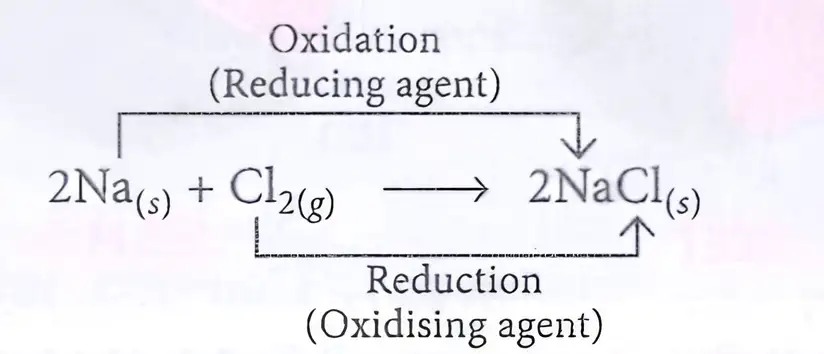
Competitive Electron Transfer Reactions
Zinc and copper(II) ions
- Oxidation: Zinc loses electrons to form .
- Reduction: Copper(II) ions gain those electrons and form copper metal.

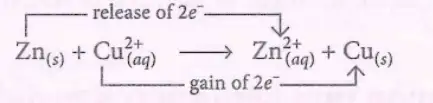
Copper and silver ions
- Oxidation: Copper loses electrons to form .
- Reduction: Silver ions gain electrons from copper and form silver metal.
- Observation: The solution becomes blue and silver deposits on the copper rod.

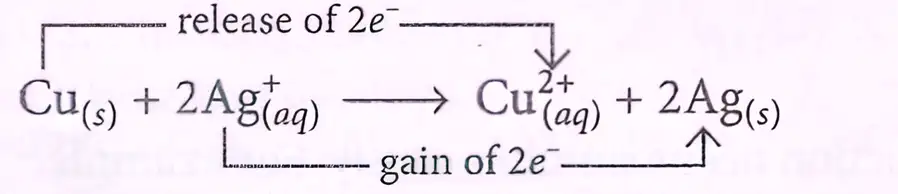
Metal electron-releasing tendency
- Zinc releases electrons to copper.
- Copper releases electrons to silver.
- Therefore, electron-releasing tendency: .
Galvanic cells
- Principle: Competition for electrons between metals can be used to design galvanic cells.
- Energy conversion: In a galvanic cell, a chemical reaction acts as the source of electrical energy.
Quick recap
- Oxidation is electron loss; reduction is electron gain.
- Oxidising agents accept electrons and are reduced; reducing agents donate electrons and are oxidised.
- Nitrate ions act as the oxidising agent in the copper reaction; tin(II) acts as the reducing agent with iron(III).
- Zinc transfers electrons to copper(II) ions; copper transfers electrons to silver ions.
- Metal electron-releasing tendency is .
- Galvanic cells use chemical reactions as a source of electrical energy.
Oxidation Number
Oxidation Number: Meaning and Rules
Oxidation number — The charge an atom has, or appears to have, when it is in a combined state.
Rules for assigning oxidation numbers
- Free elements: Each atom in an element in its free state has oxidation number .
- Monoatomic ions: The oxidation number equals the ion’s charge.
- Oxygen: Usually ; it is in peroxides, in superoxides, in , and on average in .
- Hydrogen: Usually , but in metal hydrides.
- Fluorine: Usually ; the source lists as the exception in .
- Neutral compounds: The sum of the oxidation numbers of all atoms is .
- Polyatomic ions: The sum of all oxidation numbers equals the ion’s charge.
- Fractional oxidation number: The average oxidation state of an element when its atoms in a compound have different oxidation states.
Use the total charge of the species as the sum.
Stock notation — A metal’s oxidation state is shown by a Roman numeral in parentheses after its name; examples: iron(II) sulphate and copper(II) sulphate. In , nitrogen has average oxidation number , giving nitrogen(I) oxide.
Oxidation, Reduction and Redox Agents
| Process | Oxidation | Reduction |
|---|---|---|
| Change in oxidation number | Increases | Decreases |
| Agent | Effect on another species | What happens to the agent |
|---|---|---|
| Oxidising agent (oxidant) | Increases its oxidation number | It is reduced |
| Reducing agent (reductant) | Lowers its oxidation number | It is oxidised |
Redox reaction — A reaction in which the oxidation number of one or more interacting species changes.
Oxidation Numbers in Important Compounds
Mixed and average oxidation numbers
- Carbon suboxide: In , the two terminal carbon atoms are each and the central carbon is .
- Tribromooctaoxide: In , two bromine atoms are and one is .
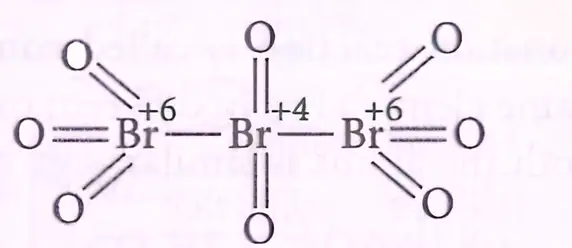
More oxidation-number examples
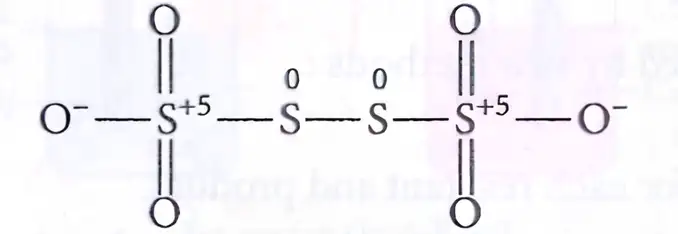
- Tetrathionate ion: In , two sulfur atoms are and two are .
- Nitrosyl complex: In , treating as gives iron oxidation number .
- Calcium oxychloride: In , chlorine is in and as chloride.
- Magnetite: In , the average iron oxidation number is ; it reflects iron(II) and iron(III) states, as in and .
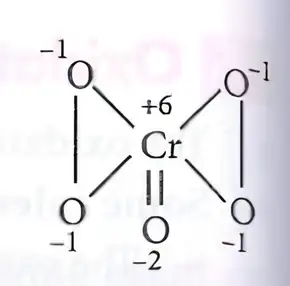
- Chromium peroxide: In , four peroxide oxygens are each and one oxo oxygen is , so chromium is .
Types of Redox Reactions
| Type | Meaning / condition | Example |
|---|---|---|
| Combination | Two or more reactants form one product; at least one reactant must be an element for the reaction to be redox. | ; |
| Decomposition | One compound breaks into two or more products; for it to be redox, at least one product must be an element. | ; |
| Displacement | An atom or ion in a compound is replaced by another atom or ion. | |
| Metal displacement | One metal replaces another metal in a compound. | ; |
| Non-metal displacement | A non-metal atom or ion is displaced by another atom or ion. | ; ; |
| Disproportionation | The same species is oxidised and reduced simultaneously; the element must have at least three variable oxidation states. | |
| Comproportionation | The reverse of disproportionation: the same element in different oxidation states forms a product with an intermediate oxidation state. |
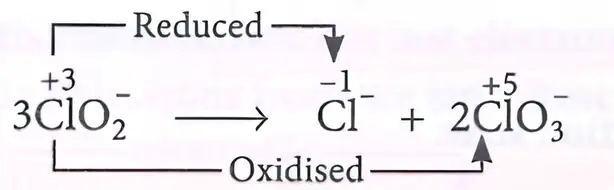
Oxidation-number changes in displacement examples
- Metal displacement: In , titanium changes from to and magnesium from to .
- Non-metal displacement: In , chlorine changes from to and bromine from to .
- Comproportionation: In the lead-storage-battery reaction, lead at and forms lead at in .
Balancing Redox Reactions
Oxidation-number method
- Write: Use the correct reactant and product formulas, then assign oxidation numbers.
- Identify: Find atoms whose oxidation numbers change and calculate each increase or decrease per atom.
- Equalise: Multiply by the number of atoms changing and choose coefficients so total increase equals total decrease.
- Balance charge: Add in acidic medium or in basic medium on the appropriate side.
- Finish: Add to balance hydrogen and oxygen; check atoms and total charge.
Half-reaction method
- Write the reaction in ionic form and separate it into oxidation and reduction half-reactions.
- Balance atoms other than oxygen and hydrogen in each half-reaction.
- In acidic solution, balance oxygen with and hydrogen with ; in basic solution, use to neutralise and simplify with water.
- Add electrons to balance charge in each half-reaction; multiply half-reactions until the electron counts match.
- Add the half-reactions, cancel electrons and any common species, then verify atoms and charge.
Redox Reactions as the Basis for Titrations
Redox titration — A method for determining the strength of an oxidant or reductant using a redox-sensitive indicator.
| Indicator approach | Example | Endpoint signal |
|---|---|---|
| Self-indicator | Intensely coloured | Its own colour signals the endpoint. |
| Added redox indicator | oxidises diphenylamine just after the equivalence point. | Diphenylamine develops an intense blue colour. |
| Starch indicator | Used when a reagent oxidises , such as , or reduces , such as . | Starch gives an intense blue colour with molecular iodine. |
What is the oxidation number of chromium in ?
How does disproportionation differ from comproportionation?
Quick recap
- In a neutral compound, oxidation numbers sum to ; in an ion, they sum to its charge.
- Oxygen and hydrogen usually have oxidation numbers and , with important exceptions; the source lists fluorine as in .
- Oxidation increases oxidation number; reduction decreases it.
- The oxidising agent is reduced, while the reducing agent is oxidised.
- Redox types include combination, decomposition, displacement, disproportionation and comproportionation.
- Balance redox equations by oxidation-number changes or the half-reaction method; titration endpoints may use self-indicators, redox indicators or starch.
Redox Reactions and Electrode Processes
Redox Couples and Electrodes
Electrode potential — The potential difference established at the interface between an electrode and its ions in solution; it indicates the electrode’s tendency to gain or lose electrons.
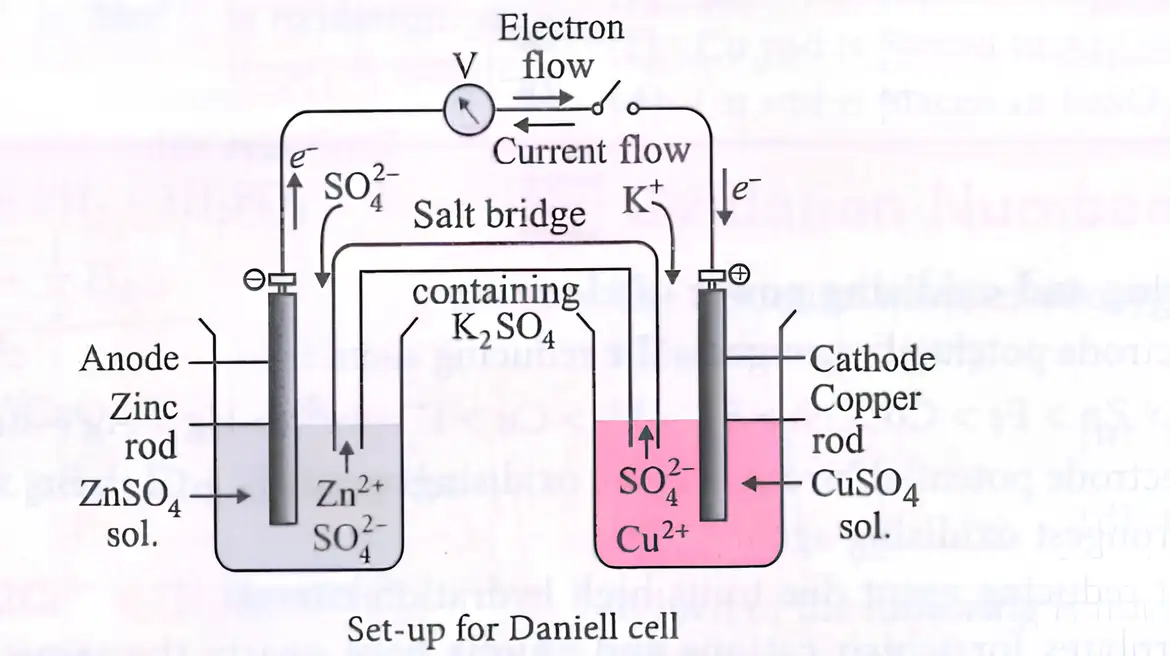
Salt bridge — A connection between two half-cell solutions that completes the circuit without mixing the solutions and helps maintain electrical neutrality.
Daniell Cell
- Electron flow: Electrons travel through the external circuit from the zinc electrode to the copper electrode.
- Salt bridge: Ions migrate through the bridge to preserve electrical neutrality in both half-cells.
Standard Electrode Potential and Electrochemical Series
Standard electrode potential () — The electrode potential measured when each species involved in the electrode reaction has unit concentration and the temperature is .
Reference and Meaning of Potential
- Hydrogen reference: The standard electrode potential of the couple is assigned by convention.
- Electrochemical series: A ranking of redox couples by standard electrode potential; it is also called the activity or electromotive series.
- Negative : The couple is a stronger reducing agent than .
- Positive : The couple is a weaker reducing agent than and its oxidised form is a stronger oxidising agent.
| Reduction half-reaction | (V) |
|---|---|
Using the Electrochemical Series
- Reducing strength: The more negative the reduction potential, the stronger the reducing agent; reducing strength increases upward in the series.
- Oxidising strength: The more positive the reduction potential, the stronger the oxidising agent; oxidising strength increases downward in the series.
- Strongest agents: is the strongest reducing agent in the stated order, attributed here to its high hydration energy; is the strongest oxidising agent.
- Reducing-agent order: .
- Halogen oxidising strength: .
Salt-Bridge Electrolytes and Equivalent Mass
Salt-Bridge Electrolyte
- Choice: Use electrolytes whose cations and anions have nearly equal ionic mobilities, so the bridge causes minimal liquid-junction potential.
Use the change in oxidation state per mole (the -factor) for the redox process.
How does the sign of indicate reducing and oxidising strength?
What are the functions of a salt bridge?
Quick recap
- Redox couple: Write the oxidised and reduced forms together, such as .
- Salt bridge: Connects half-cells, limits mixing, and maintains electrical neutrality.
- Standard potential: Measured at unit concentration and ; for is .
- Reducing agents: Strength increases as reduction potential becomes more negative.
- Oxidising agents: Strength increases as reduction potential becomes more positive.
- Equivalent mass: Molar mass divided by the change in oxidation state per mole.
NEET Chemistry — ALL CHAPTERS
1
Some Basic Concepts of Chemistry
2
Structure of Atom
3
Classification of Elements and Periodicity in Properties
4
Chemical Bonding and Molecular Structure
5
Thermodynamics
6
Equilibrium
7
Redox Reactions
8
Organic Chemistry - Some Basic Principles and Techniques
9
Hydrocarbons
10
Solutions
11
Electrochemistry
12
Chemical Kinetics
13
The d- and f- Block Elements
14
Coordination Compounds
15
Haloalkanes and Haloarenes
16
Alcohols, Phenols and Ethers
17
Aldehydes, Ketones and Carboxylic Acids
18
Amines
19
Biomolecules
20
The p-Block Elements (Group 13 and 14)
21
The p-Block Elements (Group 15 to 18)
22
Principles Related to Practical Chemistry