NEET UG . NEET Chemistry . Chemistry . The D and F Block Elements
Chapter 13: The d- and f- Block Elements
Ch 13
NEET Chemistry
NEET UG
Position in The Periodic Table
d- and f-Block Series
f-block elements — Elements in which the or orbitals are progressively filled in the two long periods.
Transition Elements
Transition elements (d-block elements) — Elements located between the s-block and p-block elements in the long-form periodic table.
Why they are called d-block elements
- Last electron: It enters a d orbital.
Quick recap
- The d-block comprises four series formed by filling the , , and subshells.
- The f-block involves progressive filling of the and orbitals in two long periods.
- Transition elements lie between the s-block and p-block in the long-form periodic table.
- They are called d-block elements because the last electron enters a d orbital.
Electronic Configurations of the d-Block Elements
General Electronic Configuration of d-Block Elements
General electronic configuration — The outer electronic configuration of d-block elements is generally .
Why Zn, Cd, Hg and Cn Are Not Transition Elements
- Configuration: Their outer configurations follow .
- Reason: The d subshell is completely filled in both their ground-state atoms and common oxidation states; therefore, they are not regarded as transition elements.
The Four Transition Series
| Transition series | d subshell | Elements included |
|---|---|---|
| First | 3d | Sc–Zn (atomic numbers 21–30) |
| Second | 4d | Y–Cd (atomic numbers 39–48) |
| Third | 5d | La; Hf–Hg (atomic numbers 57, 72–80) |
| Fourth | 6d | Ac; Rf–Cn (atomic numbers 89, 104–112) |
Electronic Configurations of the Transition Series
| Atomic number | Element | Configuration |
|---|---|---|
| 21 | Sc | |
| 22 | Ti | |
| 23 | V | |
| 24 | Cr | |
| 25 | Mn | |
| 26 | Fe | |
| 27 | Co | |
| 28 | Ni | |
| 29 | Cu | |
| 30 | Zn |
| Atomic number | Element | Configuration |
|---|---|---|
| 39 | Y | |
| 40 | Zr | |
| 41 | Nb | |
| 42 | Mo | |
| 43 | Tc | |
| 44 | Ru | |
| 45 | Rh | |
| 46 | Pd | |
| 47 | Ag | |
| 48 | Cd |
| Atomic number | Element | Configuration |
|---|---|---|
| 57 | La | |
| 72 | Hf | |
| 73 | Ta | |
| 74 | W | |
| 75 | Re | |
| 76 | Os | |
| 77 | Ir | |
| 78 | Pt | |
| 79 | Au | |
| 80 | Hg |
| Atomic number | Element | Configuration |
|---|---|---|
| 89 | Ac | |
| 104 | Rf | |
| 105 | Db | |
| 106 | Sg | |
| 107 | Bh | |
| 108 | Hs | |
| 109 | Mt | |
| 110 | Ds | |
| 111 | Rg | |
| 112 | Cn |
Why are Zn, Cd, Hg and Cn excluded from the transition elements?
State the general outer electronic configuration of d-block elements.
Quick recap
- The general outer configuration of d-block elements is .
- The d-block has four transition series: 3d, 4d, 5d and 6d.
- The first series is Sc–Zn; the second is Y–Cd.
- The third series includes La and Hf–Hg; the fourth includes Ac and Rf–Cn.
- Zn, Cd, Hg and Cn have filled d subshells in their ground states and common oxidation states, so they are not regarded as transition elements.
General Properties of the Transition Elements (d-Block)
Metallic Nature and Physical Properties
Metallic character
- Typical metals: Transition elements generally have high tensile strength, ductility, malleability, thermal and electrical conductivity, and metallic lustre.
- Structures: Most have typical metallic crystal structures at ordinary temperatures; Mn, Zn, Cd and Hg are exceptions.
- Melting and boiling points: Usually high because both and electrons contribute to metallic bonding.
- Atomisation enthalpy: Usually high because atoms are held together by strong interatomic interactions.
| Property | Trend | Explanation / exception |
|---|---|---|
| Atomic and ionic sizes | Generally decrease across a series; increase down a group. | Increasing nuclear charge and weak shielding by electrons cause the across-series decrease. Third-series radii are nearly those of the second series because of lanthanoid contraction. |
| Lanthanoid contraction | Regular decrease in atomic radii across the lanthanoids. | Filling orbitals before orbitals and the poor shielding of electrons lead to similar radii in corresponding and elements. |
| Ionisation enthalpy | Generally increases from left to right across a series. | The first ionisation enthalpies of Zn, Cd and Hg are high because of their filled configurations. |
| Second ionisation enthalpy | Cr and Cu have unusually high values; Zn has a low value. | Removing an electron from or disrupts stable or configurations. Ionisation of produces stable . |
| Third ionisation enthalpy | Very high for Mn; very low for Fe. | Ionising disrupts a stable configuration, whereas ionising produces stable . |
Oxidation States and Electrode Potentials
Variable oxidation states
- Cause: The energy gap between and orbitals is small, so electrons from both can participate in bonding.
- Common states: Compounds in the and states are mostly ionic.
- Range: The highest oxidation state generally corresponds to the total number of and electrons; the maximum rises from Sc to Mn and then falls towards Zn.
- Series pattern: Most transition elements show variable oxidation states; the first and last members of a series are exceptions in the general trend.
| Couple | Trend and explanation |
|---|---|
| Values show no regular trend because ionisation enthalpies and atomisation enthalpies vary irregularly. More negative values for Mn and Zn relate to stable and ; Ni is also more negative because of its high negative hydration enthalpy. Cu has a positive value, associated with its low hydration enthalpy. | |
| Values vary with the relative stability of the ions. Values are high for Mn and Zn, associated with stable and configurations; they are low for Fe and Sc because and are especially stable. V has a low value because has a stable half-filled set. |
Magnetic Properties
Paramagnetism and magnetic moment
- Paramagnetism: Ions and compounds with unpaired electrons are attracted to a magnetic field.
- Strength: Paramagnetism increases as the number of unpaired electrons rises from 1 to 5.
- Diamagnetism: Species with no unpaired electrons are diamagnetic.
Use for the number of unpaired electrons; the magnetic moment is measured in Bohr magnetons (BM).
Colour, Complexes and Other Chemical Properties
Colour in transition-metal compounds
- Cause: In anions’ presence, the metal’s orbitals split into lower- and higher-energy sets; absorption can promote electrons between them.
- Colour: These – transitions in incompletely filled orbitals commonly make transition-metal compounds coloured in solids and aqueous solutions.
- Colourless ions: , , , and have empty orbitals, so – transitions are impossible.
- Charge-transfer colour: is pale yellow, is deep yellow and is intense purple; their colour arises from charge-transfer spectra.
Complex formation
- Why complexes form: Transition-metal ions have high charge density (high charge-to-size ratio) and can accept lone pairs from ligands into available orbitals.
- Result: Transition metals form many coordination complexes.
Catalysis, interstitial compounds and alloys
- Catalysis: Variable oxidation states and complex formation help transition metals act as catalysts.
- Interstitial compounds: Small atoms such as H, C, B and N occupy spaces in the metal lattice; examples include , and .
- Alloys: Similar atomic sizes let one transition metal replace another in a crystal lattice, forming solid solutions and smooth alloys.
Stability of Higher Oxidation States
| Element / example | Key point |
|---|---|
| Ti | Its highest oxidation state, , occurs in tetrahalides . |
| V and Cr | Their highest halides are and , respectively. |
| Mn | A simple halide is not formed, but the oxyfluoride is known. |
| Fluorine | It can stabilise high oxidation states through high lattice enthalpy or strong bonds in covalent compounds. is stabilised by high lattice enthalpy; and by high bond enthalpy. |
| Vanadium(V) halides | is the only known pentahalide; other vanadium(V) halides hydrolyse to oxohalides . |
| Copper(II) halides | All are known except : oxidises to , while precipitates. |
Copper(I) and copper(II) stability
- Disproportionation: Aqueous is unstable and forms and copper metal.
- Aqueous stability: is more stable than because the more negative hydration enthalpy of more than offsets copper’s second ionisation enthalpy.
- Large anions: Some copper(I) compounds are more stable than corresponding copper(II) compounds, for example over and over .
Oxides and Oxoanions
Oxides in high oxidation states
- Oxidation state: The highest oxidation number in an oxide can match the element’s group number, as in , , , and .
- Beyond group 7: No higher oxides are known for the later elements in this trend; notable oxides include and .
- Oxides versus fluorides: High oxidation states are often more stable in oxides because oxygen forms multiple bonds with metals. Mn reaches in , but only in .
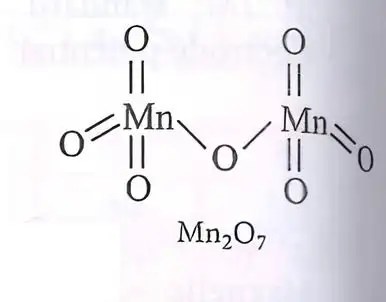
- Manganese(VII) oxide: In , each Mn is tetrahedrally surrounded by O atoms, with an bridge.
Oxoanions
- Examples: Tetrahedral oxoanions include , , , and .
Additional Exam-Relevant Facts
Classification and examples
- Pseudo-transition elements: Zn, Cd and Hg are d-block elements but are not transition elements; they are also called non-typical transition elements.
- White anhydrous salts: Anhydrous and are white because crystal-field splitting is absent, even though their ions have unpaired electrons.
- Copper stability: is favoured in aqueous solution over ; typical potentials are and .
- Melting-point extremes: Tungsten, (), has the highest melting point, about ; mercury, (), has the lowest, about .
Do not assume that every coloured transition-metal species is coloured by – transitions: ions with empty orbitals, such as , are coloured by charge transfer.
Why do transition metals show variable oxidation states?
State the formula for the spin-only magnetic moment and define its variable.
Why is not stable?
Quick recap
- Transition metals generally show metallic character, strong bonding, and high melting and atomisation enthalpies.
- Small energy differences between and orbitals produce variable oxidation states.
- Unpaired electrons cause paramagnetism; the spin-only moment is BM.
- Many transition-metal ions are coloured by – transitions; some empty- ions are coloured by charge transfer.
- Complex formation, variable oxidation states and lattice features explain complex formation, catalysis, interstitial compounds and alloys.
- Fluorine stabilises high oxidation states in some halides, while multiple metal–oxygen bonding helps stabilise high oxidation states in oxides.
- Aqueous disproportionates, and oxidises iodide; tungsten and mercury mark the highest and lowest melting-point extremes.
Some Important Compounds of Transition Elements
Oxides and Oxoanions of Metals
Formation and character of transition-metal oxides
- Formation: Transition metals combine with oxygen at high temperatures to form oxides.
- Monoxides: Metals generally form ionic monoxides, , up to manganese; scandium is an exception.
- Oxidation states: The highest oxidation number in an oxide generally equals the element’s group number; examples include , , , and .
- Beyond manganese: The only higher oxides known after manganese are and .
- Covalent character: It increases with oxidation number. High-oxidation-state oxides such as , and have relatively low melting points; is a green covalent oil.
- Acidity: Oxide acidity generally increases as the metal’s oxidation number rises.
| Oxide | Character / reaction |
|---|---|
| Basic | |
| Less basic than | |
| Amphoteric; reacts with alkalis to form and with acids to form | |
| Basic | |
| Amphoteric | |
| and | Acidic; form acids with water |
Potassium Dichromate
Potassium dichromate — Potassium dichromate, , is an orange chromium(VI) salt and a strong oxidising agent, especially in acidic solution.
Preparation
- Ore: Chromite, , is fused with sodium carbonate in air to produce sodium chromate.
- Conversion: Sodium chromate is acidified to sodium dichromate; treatment with potassium chloride gives the less soluble potassium dichromate.
Structure and physical properties
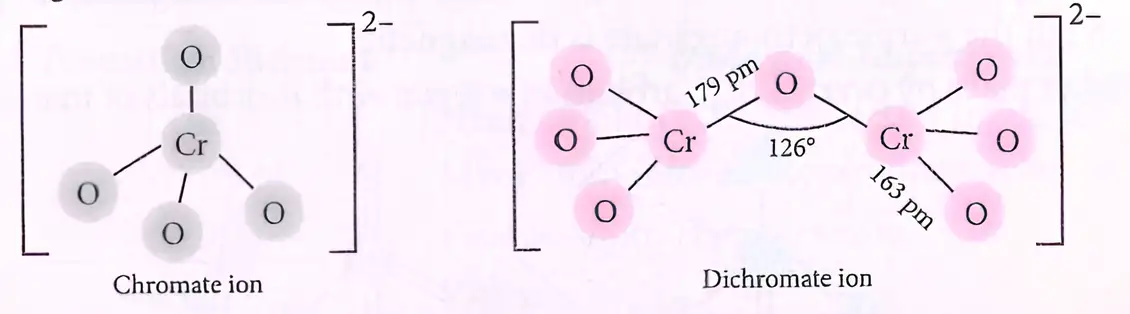
- Chromate ion: has a tetrahedral structure.
- Dichromate ion: consists of two tetrahedra sharing one corner; the bond angle is .
- Appearance and solubility: Potassium dichromate forms orange crystals, moderately soluble in cold water and readily soluble in hot water.
| Salt | Key property / use |
|---|---|
| Sodium dichromate, | More soluble in water; widely used as an oxidising agent in organic chemistry |
| Potassium dichromate, | Used as a primary standard in volumetric analysis; strong oxidising agent in acidic medium |
Oxidising action of dichromate
- Oxidised substances: Acidified dichromate oxidises iodide to iodine, hydrogen sulphide to sulphur, tin(II) to tin(IV), and iron(II) to iron(III).
- Ionic method: Add the six-electron dichromate reduction half-reaction to the balanced oxidation half-reaction of the reducing agent.
- Iron(II) example: The net ionic equation shows oxidised to .
Chromyl chloride test
- Test: Heat a chloride with solid potassium dichromate and concentrated sulphuric acid.
- Positive result: Red vapours of chromyl chloride, , are produced.
Potassium Permanganate
Potassium permanganate — Potassium permanganate, , is a purple manganese(VII) salt and a strong oxidising agent.
Preparation
- Starting ore: Pyrolusite, , is fused with potassium hydroxide and oxidised to green manganate, .
- Commercial route: Alkaline oxidative fusion is followed by electrolytic oxidation of manganate to permanganate.
- Laboratory route: Manganese(II) ions can be oxidised to permanganate by peroxodisulphate.
Disproportionation and structure
- Disproportionation: In acidic or neutral medium, manganate forms permanganate and manganese dioxide.
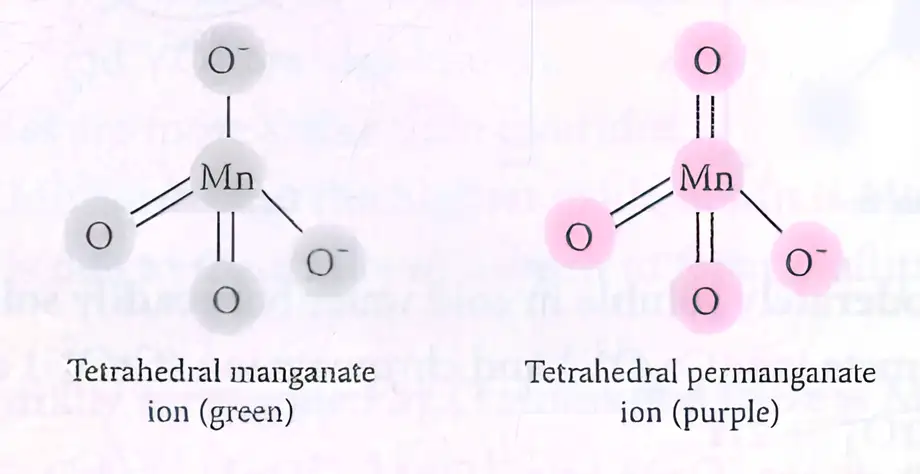
- Geometry: Both manganate and permanganate ions are tetrahedral.
- Magnetism: Green is paramagnetic with one unpaired electron; purple is diamagnetic.
- Bonding: The bonding involves overlap of oxygen orbitals with manganese orbitals.
Physical properties and thermal decomposition
- Appearance: forms dark purple, almost black crystals and is sparingly soluble in water.
- Structure type: Its crystals are isostructural with .
- Heating: At , potassium permanganate decomposes to potassium manganate, manganese dioxide and oxygen.
Oxidising action in acidic medium
- Reduction product: In acidic solution, permanganate is reduced to .
- Common oxidations: It oxidises iodide to iodine, iron(II) to iron(III), oxalate to carbon dioxide, hydrogen sulphide to sulphur, sulphite to sulphate, and nitrite to nitrate.
- Oxalate condition: Oxidation of oxalate or oxalic acid is carried out at .
Oxidising action in neutral or faintly alkaline medium
- Reduction product: Permanganate is reduced to solid .
- Iodide: It is oxidised to iodate, .
- Thiosulphate: It is oxidised almost quantitatively to sulphate.
- Manganese(II): It is oxidised to ; zinc sulphate or zinc oxide catalyses this oxidation.
Use dilute for volumetric titrations. Do not substitute (it can be oxidised to ) or (it is itself an oxidising agent and may oxidise the reducing agent).
Uses of potassium permanganate
- Analytical chemistry: Used in volumetric analysis as an oxidising agent.
- Organic chemistry: A common oxidant in preparative reactions.
- Other uses: Bleaches wool, cotton, silk and other textile fibres; decolourises oils.
| Element | Biological importance |
|---|---|
| Haemoglobin carries oxygen in blood; myoglobin stores oxygen in muscle. | |
| Present in plastocyanin and haemocyanin. | |
| Present in vitamin . | |
| Present in carbonic anhydrase. |
The Inner Transition Elements (f-Block)
f-block elements — Elements in which the last electron enters an orbital are called -block elements, also known as inner transition elements.
| Series | Elements described |
|---|---|
| Lanthanoids | The fourteen elements following lanthanum |
| Actinoids | The fourteen elements following actinium |
How does the chromate–dichromate equilibrium respond to acid and alkali?
What is the reduction product of permanganate in acidic and neutral media?
Quick recap
- Oxide covalent character and acidity generally increase with the metal’s oxidation number.
- is yellow; acidic conditions favour orange , while alkaline conditions favour chromate.
- Acidified dichromate is reduced from chromium(VI) to chromium(III) and oxidises several common reducing agents.
- Permanganate is reduced to in acid and to in neutral or faintly alkaline medium.
- Use dilute , not or , in permanganate titrations.
- -block elements are inner transition elements; the series are lanthanoids and actinoids.
The Lanthanoids
Electronic Configurations and Radii
Lanthanoids — The lanthanoids extend from lanthanum () to lutetium (); their general symbol is .
Configuration patterns
- Neutral atoms: They generally have with variable occupancy of the level; La, Gd and Lu also have a electron.
- Most stable ions: The predominant ions have configurations ; increases across the series from for La to for Lu.
- Notation: The configurations below show only electrons outside the core.
| Atomic number | Element | Neutral atom | Atomic radius (pm) | radius (pm) | |||
|---|---|---|---|---|---|---|---|
| 57 | La | — | 187 | 106 | |||
| 58 | Ce | 183 | 103 | ||||
| 59 | Pr | 182 | 101 | ||||
| 60 | Nd | 181 | 99 | ||||
| 61 | Pm | — | 181 | 98 | |||
| 62 | Sm | — | 180 | 96 | |||
| 63 | Eu | — | 199 | 95 | |||
| 64 | Gd | — | 180 | 94 | |||
| 65 | Tb | 178 | 92 | ||||
| 66 | Dy | 177 | 91 | ||||
| 67 | Ho | — | 176 | 89 | |||
| 68 | Er | — | 175 | 88 | |||
| 69 | Tm | — | 174 | 87 | |||
| 70 | Yb | — | 173 | 86 | |||
| 71 | Lu | — | — | — |
Lanthanoid Contraction
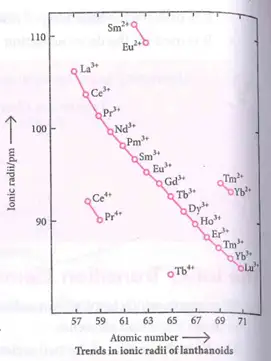
Lanthanoid contraction — The gradual decrease in atomic and ionic radii from lanthanum to lutetium is called lanthanoid contraction.
Cause and trend
- Cause: From La to Lu, nuclear charge increases as electrons are added to the orbitals.
- Poor shielding: electrons shield the growing nuclear charge imperfectly, so effective nuclear charge increases and radii decrease.
- Trend detail: Atomic radii decrease irregularly because of irregular electronic configurations; ionic radii decrease regularly.
Consequences of Lanthanoid Contraction
- Transition-series radii: Atomic radii of corresponding second- and third-transition-series elements are nearly identical; for example, and .
- Difficult separation: Similar radii cause these elements to occur together in nature and make their separation from mixtures difficult.
- Lanthanoid properties: Small differences in the atomic and ionic radii of lanthanoids cause differences in their basic properties.
- Separating lanthanoids: Small differences in lanthanoid radii are used to separate them by solvent extraction or ion exchange.
Why are zirconium and hafnium difficult to separate?
Oxidation States
- Origin of exceptions: Other oxidation states can be favoured by stable empty (), half-filled () or fully filled () subshells.
- Examples: is ; is ; is ; and is .
- Cerium: Formation of is favoured by its noble-gas configuration. ; it is a strong oxidant that can oxidise water very slowly, so is a useful analytical reagent.
- Other ions: Pr, Nd, Tb and Dy also show the state, but only in oxides of formula .
- Europium: is favoured by its stable half-filled configuration but is a strong reducing agent, changing to the common state.
- Ytterbium: has a fully filled configuration and is a reductant.
- Terbium and samarium: has a half-filled configuration and is an oxidant; samarium shows both and states.
| Ion | Configuration | Key behaviour |
|---|---|---|
| Strong oxidant; used as an analytical reagent | ||
| Strong reducing agent | ||
| Oxidant | ||
| Reducing agent |
Why do some lanthanoids show oxidation states other than ?
General Characteristics
- Appearance and air: Soft, silvery-white metals that tarnish readily in moist air; they burn in oxygen to form .
- Hardness: Generally increases with atomic number; samarium is exceptionally hard, like steel.
- Melting points: Usually –; samarium is an exception at .
- Conductivity: Their metallic structure makes them good conductors of heat and electricity.
- Density: Density and related properties change smoothly, except for Eu and Yb and occasionally Sm and Tm.
- Colour: Ions are generally coloured due to – transitions involving unpaired electrons. () and () are colourless.
- Magnetism: and are diamagnetic; the other trivalent lanthanoid ions are paramagnetic.
- Ionisation enthalpy: First values are about and second values about ; third values vary irregularly.
- Third ionisation exception: The third ionisation enthalpies of La, Gd and Lu are abnormally low due to exchange-enthalpy considerations, which stabilise the , and configurations, respectively.
- Standard electrode potentials: For , is generally in the range to ; Eu is an exception at .
Chemical Behaviour
- Hydrogen: On gentle heating, lanthanoids combine with hydrogen to form hydrides.
- Carbon: Heating with carbon forms carbides: , and .
- Dilute acids: They liberate hydrogen and form ions.
- Halogens: Burning in halogens forms trihalides, .
- Oxygen: Burning in oxygen forms oxides, .
- Basic compounds: Their oxides and hydroxides have formulas and and are basic, like alkaline-earth metal oxides and hydroxides.
What causes lanthanoid contraction, and how does it affect the third ionisation enthalpies of La, Gd and Lu?
Quick recap
- Lanthanoids generally have atoms and predominantly form stable ions with configurations from to .
- Lanthanoid contraction is the decrease in radii from La to Lu, caused by imperfect shielding by electrons.
- Contraction makes Zr and Hf radii almost equal and helps explain why they occur together in nature and are difficult to separate.
- Small differences in lanthanoid radii cause differences in basic properties and allow separation by solvent extraction or ion exchange.
- The common oxidation state is ; and states can be favoured by stable , or subshells.
- and are colourless and diamagnetic; other trivalent lanthanoid ions are generally coloured and paramagnetic.
- Lanthanoids form hydrides, carbides, trihalides and basic oxides and hydroxides.
The Actinoids
Electronic Configuration and Radioactivity
- Electronic configuration: Actinoids generally have the configuration 5f⁰–¹⁴ 6d⁰–² 7s², with irregularities due to the stability of f⁰, f⁷ and f¹⁴ arrangements.
- Radioactivity: All actinoids are radioactive elements.
Ionic Radii and Actinoid Contraction
- Actinoid contraction: Ionic radii decrease regularly across the series; the contraction is greater than in the lanthanoids because 5f electrons shield poorly.
- Cause: The 5f orbitals extend farther into space than the deeply buried 4f orbitals, contributing to the stronger contraction.
Oxidation States
- Common state: The most common oxidation state of actinoids is +3.
- Variable states: They also show +4, +5, +6 and +7 states; examples include Th, Pa, U and Np, respectively.
- Reason: The small energy difference among the 5f, 6d and 7s subshells allows several oxidation states.
General Characteristics
- Metallic character: Actinoids are silvery-white, highly electropositive metals that tarnish rapidly in air and form an oxide coating.
- Reactivity: They are not attacked by alkalies, are less reactive towards acids and are strong reducing agents.
- Physical and magnetic properties: They are strongly paramagnetic, generally dense, and have high melting and boiling points with no regular trend.
Lanthanoids vs Actinoids
Why is actinoid contraction greater than lanthanoid contraction?
Why do actinoids show a wider range of oxidation states than lanthanoids?
Name three colourless actinoid ions and give the reason.
Quick recap
- Actinoids from Th to Lr have general configuration and are all radioactive.
- Extra stability of , and causes configuration irregularities.
- Ionic radii decrease across the series; actinoid contraction is greater than lanthanoid contraction.
- The common oxidation state is ; a small –– energy gap permits higher states.
- Actinoids are silvery-white, strongly paramagnetic, have low ionisation energies and are strong reducing agents.
- Compared with lanthanoids, actinoids show higher oxidation states, form oxo-cations and complexes more readily, and have more basic compounds.
Some Applications of d- and f-Block Elements
Uses of d- and f-Block Elements
| Material or element | Application |
|---|---|
| Iron and steel | Important materials for construction. |
| Used in the pigment industry. | |
| , Zn, Ni and Cd | Used in the battery industry. |
| Cu, Ag and Au | Used to make coins and ornaments. |
| Catalyst in the manufacture of sulphuric acid. | |
| with | Used in the manufacture of polythene. |
| Iron | Catalyst in Haber’s process for manufacturing ammonia. |
| Ni | Catalyst for hydrogenation of fats. |
| Ni complexes | Useful in polymerisation of alkynes and other organic compounds. |
| Catalyst in Wacker’s process for oxidation of ethyne to ethanal. | |
| Its light-sensitive property is used in photographic industries. | |
| Neodymium and praseodymium oxides | Used to make coloured goggles that absorb yellow sodium light; useful for glass blowers. |
Quick recap
- Iron and steel are major construction materials.
- is used as a pigment; several transition metals and compounds are used in batteries.
- Cu, Ag and Au are used for coins and ornaments.
- Transition-metal catalysts are important in chemical manufacture and organic reactions.
- The light sensitivity of is used in photography.
- Neodymium and praseodymium oxides make goggles that absorb yellow sodium light.
NEET Chemistry — ALL CHAPTERS
1
Some Basic Concepts of Chemistry
2
Structure of Atom
3
Classification of Elements and Periodicity in Properties
4
Chemical Bonding and Molecular Structure
5
Thermodynamics
6
Equilibrium
7
Redox Reactions
8
Organic Chemistry - Some Basic Principles and Techniques
9
Hydrocarbons
10
Solutions
11
Electrochemistry
12
Chemical Kinetics
13
The d- and f- Block Elements
14
Coordination Compounds
15
Haloalkanes and Haloarenes
16
Alcohols, Phenols and Ethers
17
Aldehydes, Ketones and Carboxylic Acids
18
Amines
19
Biomolecules
20
The p-Block Elements (Group 13 and 14)
21
The p-Block Elements (Group 15 to 18)
22
Principles Related to Practical Chemistry