NEET UG . NEET Chemistry . Chemistry . The P Block Elements Group 15 to 18
Chapter 21: The p-Block Elements (Group 15 to 18)
Ch 21
NEET Chemistry
NEET UG
Group 15 Elements
p-Block Context
General Features
- p-Block: Elements in Groups – are p-block elements.
- Influencing factors: Atomic size, ionisation enthalpy, electron-gain enthalpy and electronegativity strongly affect their properties.
- Orbital effect: Second-period elements lack -orbitals; heavier elements may have - and/or -orbitals, affecting their properties.
Group 15: Members and Electronic Configuration
Pnictogens — Nitrogen, phosphorus, arsenic, antimony, bismuth and moscovium—the six Group 15 elements—are collectively called pnictogens.
Group 15 Overview
- Moscovium: is synthetic and radioactive; its short half-life and very low availability mean its chemistry is not yet established.
- Valence-shell configuration: .
| Element | Symbol | Atomic number | Electronic configuration |
|---|---|---|---|
| Nitrogen | |||
| Phosphorus | |||
| Arsenic | |||
| Antimony | |||
| Bismuth | |||
| Moscovium |
Physical Properties
- Atomic radii: Increase down Group 15, but are smaller than those of Group 14 because of the greater nuclear charge.
- Melting points: Rise from nitrogen to arsenic as atomic size increases, then fall towards antimony; heavier elements tend to form three rather than five covalent bonds due to the inert pair effect.
- Metallic character: Increases down the group.
- Ionisation enthalpy: Decreases down the group as atomic size increases; values are much greater than in Group 14 because the half-filled subshell is especially stable.
- Electronegativity: Decreases down the group.
- Allotropy: Every member except nitrogen exhibits allotropy.
Chemical Properties
Oxidation States
- Trend: Down the group, the stability of the oxidation state increases, while that of the state decreases due to the inert pair effect.
Halides
- General formula: Group 15 halides have the formula or .
Stability decreases as the size difference between nitrogen and the halogen increases.
The decreasing order given is shown below; the source relates the trend to decreasing electron density as halogen electronegativity increases.
Bond angle increases down the series as bond-pair repulsions decrease.
Hydrides
- General formula: Group 15 hydrides have the formula .
- Bond angle: Decreases down the group: .
- Basic character: ; , and are not basic.
- Boiling point: .
- Melting point: The stated order is .
- Thermal stability: Decreases down the group: .
- Reducing character: Increases down the group: .
- Solubility: is soluble; , , and are insoluble.
Oxides
- General formula: Group 15 oxides commonly have the formula or .
- Trioxide acidity: Decreases down the group as the central atom's electronegativity decreases.
and are neutral; acidic character increases as nitrogen's oxidation number increases.
Reaction with Metals
- Binary compounds: Group 15 elements react with metals to form compounds in which the Group 15 element has oxidation state .
- Examples: , and .
Quick recap
- Group 15 pnictogens are nitrogen, phosphorus, arsenic, antimony, bismuth and synthetic radioactive moscovium; their valence configuration is .
- Down the group, atomic radii and metallic character increase, while ionisation enthalpy and electronegativity decrease; all except nitrogen show allotropy.
- The state becomes more stable and the state less stable down the group due to the inert pair effect.
- Halides have formulas or ; hydrides have formula , and their key trends include the basicity order and the solubility of ammonia alone.
- Group 15 oxides have formulas or ; trioxide acidity decreases down the group, while nitrogen-oxide acidity increases with nitrogen oxidation number.
- Reaction with metals forms binary compounds with the Group 15 element in the oxidation state, such as , and .
Dinitrogen
Preparation of Dinitrogen
- Ammonium chloride and sodium nitrite: Their reaction produces dinitrogen.
- Ammonium dichromate: Heating it releases dinitrogen.
- Barium azide: Heating it produces dinitrogen and barium.
Chemical Properties of Dinitrogen
- With lithium: Dinitrogen forms lithium nitride on heating.
- With magnesium: Dinitrogen forms magnesium nitride on heating.
- With oxygen: At high temperature, dinitrogen and oxygen establish an equilibrium that forms nitric oxide.
- With hydrogen: Dinitrogen forms ammonia under Haber process conditions; the standard enthalpy of formation of ammonia is .
Quick recap
- Dinitrogen can be prepared from ammonium chloride and sodium nitrite.
- Heating ammonium dichromate or barium azide also produces dinitrogen.
- On heating, dinitrogen reacts with lithium and magnesium to form their nitrides.
- At , dinitrogen and oxygen form nitric oxide in equilibrium.
- The Haber process forms ammonia from dinitrogen and hydrogen at and .
- The standard enthalpy of formation of ammonia is .
Ammonia
Preparation of Ammonia
Laboratory preparation
- Ammonium salts: All ammonium salts react with an alkali to release ammonia.
- Urea route: Urea forms ammonium carbonate on hydrolysis; this can release ammonia and carbon dioxide.
Manufacture: Haber Process
Haber process — The large-scale manufacture of ammonia by the reversible reaction of nitrogen and hydrogen.
Operating conditions
- Optimum conditions: and .
- Catalyst and promoters: Iron oxide is the catalyst; and are promoters that increase the reaction rate.
- Enthalpy: The standard enthalpy of formation of ammonia is .
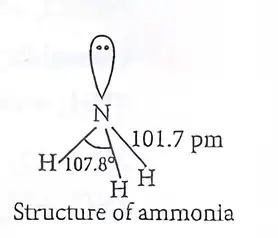
Structure of Ammonia
- Bonding: Nitrogen is hybridised; three hybrid orbitals overlap with hydrogen orbitals to form three covalent bonds.
- Lone pair and shape: The fourth orbital holds a lone pair, giving ammonia a trigonal pyramidal shape and an angle of .
- Association: In liquid and solid states, ammonia molecules associate through hydrogen bonds.
Basic Character
- Lewis base: Ammonia has a strong tendency to donate its nitrogen lone pair, so it acts as a strong Lewis base.
- In water: Ammonia accepts a proton from water, forming ammonium and hydroxide ions.
Reactions with Metal Ions
Precipitation of metal hydroxides
- Reaction: In aqueous solution, ammonia forms insoluble metal hydroxides that precipitate.
- Colours: Iron(III) hydroxide forms a brown precipitate; zinc hydroxide forms a white precipitate.
Formation of Complex Compounds
- Complex formation: Ammonia forms stable, soluble complex cations with metal ions such as , and .
- Silver complexes: Diamminesilver(I) hydroxide and chloride are soluble in water.
- Copper complex: Tetraamminecopper(II) sulphate forms a deep-blue solution.
Other Nitrogen Hydrides
| Hydride | Formula | Character |
|---|---|---|
| Ammonia | Basic | |
| Hydrazine | or | Basic |
| Hydrazoic acid | Acidic |
State the optimum conditions and catalyst system used in the Haber process.
Quick recap
- Ammonia is prepared from ammonium salts and alkali, urea, or magnesium nitride.
- The Haber process combines and at and using iron oxide and promoters.
- Ammonia is hybridised and trigonal pyramidal, with one lone pair and a bond angle.
- Its lone pair makes ammonia a strong Lewis base; in water it forms and .
- Aqueous ammonia forms insoluble metal hydroxide precipitates and soluble metal-ammonia complexes.
- Ammonia and hydrazine are basic; hydrazoic acid is acidic.
Oxides of Nitrogen
Oxides of nitrogen — Compounds of nitrogen and oxygen in which nitrogen has oxidation states from to .
Names, oxidation states and properties
| Name | Formula | Oxidation state of N | Appearance and acid–base nature |
|---|---|---|---|
| Dinitrogen oxide (nitrogen(I) oxide) | Colourless gas; neutral | ||
| Nitrogen monoxide (nitrogen(II) oxide) | Colourless gas; neutral | ||
| Dinitrogen trioxide (nitrogen(III) oxide) | Blue solid; acidic | ||
| Nitrogen dioxide (nitrogen(IV) oxide) | Brown gas; acidic | ||
| Dinitrogen tetroxide (nitrogen(IV) oxide) | Colourless solid/liquid; acidic | ||
| Dinitrogen pentoxide (nitrogen(V) oxide) | Colourless solid; acidic |
Preparations
Quick recap
- Nitrogen oxides range in nitrogen oxidation state from in to in .
- and are colourless, neutral gases.
- is a blue acidic solid; is a brown acidic gas.
- is a colourless acidic solid/liquid and is in equilibrium with .
- is a colourless acidic solid.
Nitric Acid
Preparation of Nitric Acid
Laboratory preparation
- Method: Sodium nitrate reacts with sulphuric acid to produce nitric acid and sodium hydrogen sulphate.
Ostwald’s process
- Step 1: Ammonia is catalytically oxidised to nitric oxide at about and using a platinum-rhodium gauze catalyst.
- Step 2: Nitric oxide is oxidised to nitrogen dioxide.
- Step 3: Nitrogen dioxide reacts with water to form nitric acid; the nitric oxide produced is recycled.
- Concentration: Distillation gives aqueous nitric acid up to about by mass; concentrated sulphuric acid dehydrates it further to about .
Properties of Nitric Acid
Physical properties
- Pure nitric acid: Colourless; in the gaseous state, it exists as a planar molecule.
- Impure nitric acid: Yellow because soluble nitrogen oxides are present.
Oxidising action on non-metals
- Strong oxidising agent: Hot, concentrated nitric acid oxidises non-metals to their highest oxyacids; nitrogen dioxide is evolved.
Reaction with metals
- Dual role: Nitric acid reacts with metals as an acid and as an oxidising agent.
- Products: The metal forms a nitrate, while the nitrogen-containing reduction product depends on the acid concentration and the metal.
| Acid concentration | Metal(s) | Main products |
|---|---|---|
| Very dilute | + metal nitrate | |
| Very dilute | + metal nitrate | |
| Dilute | + metal nitrate | |
| Dilute | + metal nitrate | |
| Dilute | ||
| Concentrated | + metal nitrate | |
| Concentrated | (metastannic acid) |
Brown Ring Test
Brown ring test — A test for nitrate ions: iron(II) ions reduce nitrate to nitric oxide, which forms a brown nitrosyl complex with hydrated iron(II) ions.
Nitrous acid
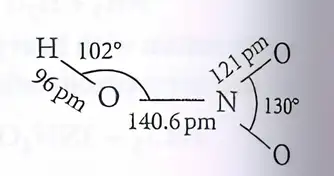
- Structure: Nitrous acid has the connectivity ; its bond lengths and bond angles are shown in the structural figure.
- Instability: Nitrous acid, , is unstable and exists only in solution.
How does nitric acid behave with non-metals?
What causes the brown ring in the nitrate test?
Quick recap
- Laboratory preparation: .
- Ostwald’s process converts ammonia to nitric acid through and ; is recycled.
- Distillation concentrates nitric acid to about ; dehydration with concentrated sulphuric acid gives about .
- Pure nitric acid is colourless; dissolved nitrogen oxides make impure acid yellow.
- Hot, concentrated nitric acid oxidises non-metals to their highest oxyacids, usually evolving .
- Metal reaction products vary with acid concentration and the metal; the brown ring test identifies nitrate ions.
- Nitrous acid, , is unstable and exists only in solution; its structure is .
Phosphorus-Allotropic Forms
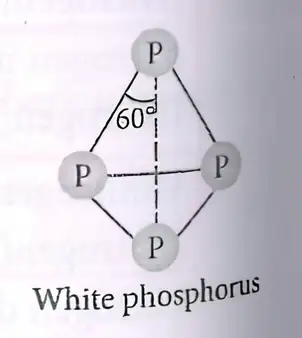
White Phosphorus
Reactions of White Phosphorus
- With boiling alkali: Dissolves in boiling solution in an inert atmosphere, forming phosphine and sodium hypophosphite.
- In air: Readily catches fire and produces dense white fumes of .
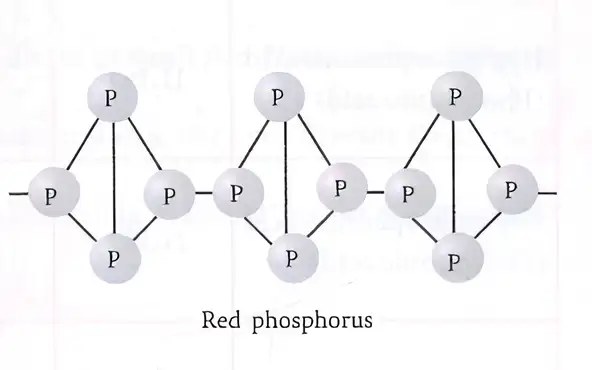
Red Phosphorus
Black Phosphorus
| Form | Preparation | Structure and properties |
|---|---|---|
| -black | Heat red phosphorus in a sealed tube at . | Opaque monoclinic or rhombohedral crystals; can be sublimed in air and does not oxidise in air. |
| -black | Heat white phosphorus at under high pressure. | Layered structure; does not burn in air up to . |
Why is white phosphorus more reactive than red phosphorus?
How are the two forms of black phosphorus prepared?
Quick recap
- White phosphorus is poisonous, waxy, water-insoluble, -soluble and glows in the dark.
- Strain in the tetrahedron makes white phosphorus unstable and highly reactive.
- Boiling converts white phosphorus to and sodium hypophosphite; burning forms .
- Red phosphorus is a less reactive, non-poisonous polymer prepared from white phosphorus at .
- High pressure produces black-phosphorus phases; -black and -black have distinct preparation conditions.
- -black does not oxidise in air; -black does not burn in air up to .
Phosphine
Preparation of Phosphine
Properties and Reactions
- Appearance and odour: Phosphine is a colourless gas with a rotten-fish smell.
- Toxicity: It is highly poisonous.
- Thermal decomposition: On heating, phosphine decomposes to phosphorus and hydrogen.
Reaction with Hydrogen Halides
- Anhydrous HX: Phosphine reacts with anhydrous hydrogen halides, such as HCl, HBr and HI, to form phosphonium halides.
- Aqueous HX: Phosphine does not form these salts in aqueous acid because water decomposes the phosphonium halide, regenerating PH₃.
Quick recap
- Phosphine, PH₃, can be prepared from calcium phosphide, phosphonium iodide or phosphorus under the stated reactions.
- Hydrolysis of calcium phosphide produces phosphine and calcium hydroxide.
- Phosphine is a colourless, rotten-fish-smelling and highly poisonous gas.
- Heating PH₃ gives phosphorus and hydrogen.
- PH₃ reacts with anhydrous HCl, HBr and HI to form phosphonium halides; water decomposes these salts.
Phosphorus Halides
Phosphorus Trichloride and Pentachloride
| Compound | Structure | Use |
|---|---|---|
| Trigonal bipyramidal: three equatorial and two axial atoms. | Used as a chlorinating and dehydrating agent. | |
| Trigonal pyramidal, with one lone pair on phosphorus. | Used in organic synthesis and to prepare , , and . |
Phosphorus Pentachloride ()
Preparation
- Direct chlorination: White or red phosphorus reacts with chlorine to form .
- Using sulfuryl chloride: also reacts with to produce .
Important Reactions
- Hydrolysis: Excess water converts into phosphoric acid and hydrogen chloride.
- With sulfur dioxide: Forms thionyl chloride and phosphoryl chloride.
- With phosphorus(V) oxide: Forms phosphoryl chloride.
- Reduction by zinc: Forms .
Phosphorus Trichloride ()
Preparation
- Direct chlorination: Phosphorus reacts with chlorine to form .
- Using thionyl chloride: reacts with to produce , sulfur dioxide, and disulfur dichloride.
Important Reactions
- Hydrolysis: Forms phosphorous acid and hydrogen chloride.
- With carboxylic acids: Converts acetic acid into acetyl chloride.
- With alcohols: Converts ethanol into chloroethane.
Quick recap
- has a trigonal-bipyramidal structure: three equatorial and two axial chlorine atoms.
- is trigonal pyramidal and has one lone pair on phosphorus.
- is a chlorinating and dehydrating agent; excess water hydrolyses it to and .
- hydrolyses to and reacts with acids and alcohols to form their chlorinated products.
- is used in organic synthesis and as a precursor to , , and .
Oxoacids of Phosphorus
Important oxoacids of phosphorus
| Acid | Formula | Oxidation state of phosphorus | Structure | Preparation |
|---|---|---|---|---|
| Hypophosphorous acid (phosphinic acid) | White + alkali | |||
| Orthophosphorous acid (phosphonic acid) | ||||
| Pyrophosphorous acid | ||||
| Hypophosphoric acid | Red + alkali | |||
| Orthophosphoric acid | ||||
| Pyrophosphoric acid | Phosphoric acid + heat | |||
| Metaphosphoric acid | Phosphorus acid + ; heat in a sealed tube |
Quick recap
- Hypophosphorous acid: ; phosphorus oxidation state .
- Orthophosphorous and pyrophosphorous acids have phosphorus oxidation state .
- Hypophosphoric acid has phosphorus oxidation state .
- Orthophosphoric, pyrophosphoric and metaphosphoric acids have phosphorus oxidation state .
- Metaphosphoric acid has the polymeric formula .
Group 16 Elements
Members and Electronic Configuration
Group 16
- Members: Oxygen, sulphur, selenium, tellurium, polonium and livermorium; the group is also called the chalcogens.
- Livermorium: A synthetic radioactive element produced in tiny amounts; its very short half-life limits the study of its properties.
All Group 16 elements have six valence electrons.
| Element | Symbol | Atomic number | Electronic configuration |
|---|---|---|---|
| Oxygen | |||
| Sulphur | |||
| Selenium | |||
| Tellurium | |||
| Polonium | |||
| Livermorium |
Physical Properties
| Property | Trend / explanation |
|---|---|
| Atomic and ionic radii | Increase down the group. |
| Ionisation enthalpy | Decreases down the group; values are lower than those of Group 15 because Group 15 has a stable half-filled subshell. |
| Electronegativity | Decreases down the group. |
| Electron gain enthalpy | That of oxygen is less negative than sulphur's because oxygen is very small. From sulphur to polonium, it becomes progressively less negative. |
| Melting and boiling points | Increase with atomic size up to tellurium; polonium has lower melting and boiling points than tellurium. |
Elemental Forms and Allotropy
Forms of the elements
- Oxygen: Exists as diatomic , due to – multiple bonding.
- Sulphur, selenium and tellurium: Exist as octatomic molecules, , and ; they do not form – multiple bonds.
- Allotropy: Every Group 16 element exhibits allotropy.
Oxidation States
| Element(s) | Common oxidation states |
|---|---|
| Oxygen | |
| Other Group 16 elements |
Stability trends
- state: Its stability decreases down the group as electronegativity decreases.
- state: Its stability increases down the group.
- state: Its stability decreases down the group due to the inert pair effect.
Hydrides
Here, represents a Group 16 element.
| Property | Order / observation |
|---|---|
| Physical state | is a liquid; the other Group 16 hydrides are gases. |
| Boiling point | |
| Bond angle | |
| Reducing power | |
| Acidic character | |
| Thermal stability |
Oxides
Group 16 oxides
- Types: Group 16 elements form oxides of the types and .
- Nature: Both types of oxides are acidic.
- Reducing property: Decreases from to .
Halides
Types and stability
- Types: Group 16 elements form halides of the types , and .
- Halogen order: Halide stability decreases as .
| Halide type | Structure / state |
|---|---|
| Hexahalides | Only hexafluorides are stable; they have an octahedral structure. |
| Tetrafluorides | is a gas, a liquid and a solid; they have a trigonal-bipyramidal structure. |
| Dihalides | All dihalides have a tetrahedral structure. |
| Monohalides | Exist as dimers. |
State the trends in acidic character and thermal stability of Group 16 hydrides.
Which oxidation-state stabilities change down Group 16, and why?
Quick recap
- Group 16 elements are chalcogens with valence-shell configuration .
- Atomic and ionic radii increase down the group; ionisation enthalpy and electronegativity decrease.
- Oxygen is diatomic, while sulphur, selenium and tellurium form octatomic molecules; all show allotropy.
- The stability of the and oxidation states decreases down the group, while that of increases.
- Hydride acidity and reducing power increase down the group, while thermal stability decreases.
- Group 16 oxides are acidic; halides occur mainly as , and .
Dioxygen
Preparation of Dioxygen
Laboratory preparation
- Oxo salts: Heating chlorates, nitrates or permanganates releases dioxygen.
- Catalyst and ratio: In the chlorate method, mix with in a ratio.
- Effect of : It lowers the melting point of , so oxygen is produced from rather than ; the reaction rate increases.
- Safety: must be free of carbon because a –carbon mixture is explosive.
Thermal decomposition of heavy-metal oxides
- Oxide decomposition: Heating certain heavy-metal oxides produces dioxygen.
Decomposition of hydrogen peroxide
- Catalysed decomposition: A catalyst such as decomposes aqueous hydrogen peroxide into water and oxygen.
Large-scale preparation by electrolysis
- Overall reaction: Electrolysis of water produces hydrogen at the cathode and dioxygen at the anode.
- Cathode: Hydrogen is formed as a by-product.
- Anode: Hydroxide ions are oxidised to water, dioxygen and electrons.
Physical Properties
- Appearance: Dioxygen is a colourless, odourless and tasteless gas.
- Magnetism: The molecule is paramagnetic because it has two unpaired electrons in antibonding molecular orbitals.
Chemical Properties
- Reactivity: Dioxygen reacts directly with metals (except noble metals such as gold and platinum), non-metals and some noble gases.
- Oxide character: The nature of an oxide formed can be basic, amphoteric or acidic, depending on the element.
Why is dioxygen paramagnetic?
Quick recap
- Laboratory dioxygen can be prepared by heating oxo salts, decomposing heavy-metal oxides or catalytically decomposing hydrogen peroxide.
- In the chlorate method, lowers the melting point; it must be carbon-free for safety.
- Water electrolysis produces at the cathode and at the anode.
- Dioxygen is colourless, odourless, tasteless and paramagnetic due to two unpaired electrons.
- Dioxygen reacts with many metals and non-metals to form oxides; reactions also include roasting, combustion and catalytic oxidation.
Simple Oxides
Classification of Oxides
| Type | Key feature | Examples |
|---|---|---|
| Simple oxides | Contain oxygen combined with one other element | , |
| Mixed oxides | Can be represented as a combination of simple oxides | , |
| Acidic oxides | Form acids on dissolving in water | , , , |
| Basic oxides | Form bases on dissolving in water | , , |
| Amphoteric oxides | React with both acids and bases | |
| Neutral oxides | Neither acidic nor basic | , , |
Acidic Oxides
Acidic oxide — An acidic oxide dissolves in water to form an acid.
Acidic strength trends
- Dioxides: Acidic nature decreases as .
- Trioxides: Acidic nature decreases as .
Basic Oxides
Basic oxide — A basic oxide dissolves in water to form a base.
Amphoteric Oxides
Amphoteric oxide — An amphoteric oxide reacts with both acids and bases.
What is the order of acidic nature of Group 16 dioxides and trioxides given here?
How does demonstrate amphoteric behaviour?
Quick recap
- Oxides are classified as simple, mixed, acidic, basic, amphoteric or neutral.
- Acidic oxides form acids in water; basic oxides form bases.
- For the listed Group 16 oxides, acidic strength decreases down the group.
- is amphoteric because it reacts with both acids and bases.
- , and are examples of neutral oxides.
Ozone
Preparation
Ozone — Ozone () is prepared from oxygen () by passing an electric discharge through it.
Properties and Chemical Actions
Physical properties
- Appearance: Ozone is a pale blue gas, a dark blue liquid and a violet-black solid.
- Decomposition: Ozone can decompose to oxygen and atomic oxygen: .
Oxidising action of ozone — Ozone oxidises substances such as lead sulphide and nitric oxide.
Estimation of ozone
- Principle: Ozone liberates iodine from iodide ions.
- Estimation: The liberated iodine is titrated with sodium thiosulphate solution to estimate ozone.
Structure of Ozone
Shape and bonding
- Hybridisation: The central oxygen atom is hybridised.
- Shape: Ozone has an angular (bent) molecular shape.
- Resonance: Ozone is a resonance hybrid of .
- Bond lengths: Resonance makes both O–O bonds equal in length; each is .
How is ozone prepared, and how is it used for estimation?
Why are the two O–O bond lengths in ozone equal?
Quick recap
- Electric discharge converts oxygen into ozone: .
- Ozone is pale blue as a gas, dark blue as a liquid and violet-black as a solid.
- The source labels the iodide reaction as “reducing action”; the reaction liberates iodine from iodide ions.
- Iodine liberated from iodide is titrated with sodium thiosulphate to estimate ozone.
- Ozone is angular, with a central -hybridised oxygen atom.
- Resonance makes both O–O bonds equivalent, each .
Sulphur-Allotropic Forms
Allotropic Forms of Sulphur
Allotropy — The existence of an element in different structural forms in the same physical state.
| Property | Rhombic sulphur (α-sulphur) | Monoclinic sulphur (β-sulphur) |
|---|---|---|
| Molecular form | S₈ | S₈ |
| Appearance | Yellow crystals | Colourless, needle-shaped crystals |
| Melting point | 385.8 K | 393 K |
| Specific gravity | 2.06 | 1.98 |
| Solubility in CS₂ | Readily soluble | Soluble |
Structure, Formation and Solubility
- Structure: The S₈ ring is puckered and crown-shaped in both rhombic and monoclinic sulphur.
- Formation: Rhombic sulphur crystals form when a solution of roll sulphur in CS₂ is evaporated.
- Solubility: Rhombic sulphur is insoluble in water, dissolves to some extent in benzene, alcohol and ether, and is readily soluble in CS₂.
Other Sulphur Ring Structure
- Cyclo-S₆: Its six-membered ring has a chair form.
Hydrogen Sulphide
- Name: H₂S is also called sulphurated hydrogen.
- Toxicity: H₂S is poisonous and can be fatal in large amounts.
- Antidote stated in the text: Dilute chlorine oxidises H₂S to sulphur, reducing its harmful effect.
Quick recap
- Rhombic (α) and monoclinic (β) sulphur both contain S₈ molecules.
- Rhombic sulphur is yellow; monoclinic sulphur is described as colourless and needle-shaped.
- The S₈ ring is puckered and crown-shaped in both forms; cyclo-S₆ has a chair-shaped ring.
- Rhombic sulphur crystals form by evaporating roll sulphur dissolved in CS₂.
- H₂S is poisonous; chlorine oxidises it to sulphur according to H₂S + Cl₂ → 2HCl + S.
Sulphur Dioxide
Preparation
Main sources
- Direct combination: Sulphur burns in oxygen to form sulphur dioxide.
- Laboratory preparation: Treat a sulphite ion with dilute acid.
- Industrial by-product: Roasting pyrite produces sulphur dioxide along with iron(III) oxide.
Physical Properties
- Appearance and smell: A colourless gas with a pungent smell.
- Solubility: Highly soluble in water.
- Liquefaction: Liquefies at room temperature under a pressure of .
- Boiling point: .
Chemical Properties
Reactions of sulphur dioxide
- With water: Forms sulphurous acid in a reversible reaction.
- With alkali: Forms a normal sulphite; excess sulphur dioxide converts it to a hydrogen sulphite.
- With chlorine: Forms sulphuryl chloride.
- Oxidation: Oxygen converts sulphur dioxide to sulphur trioxide in the presence of vanadium(V) oxide.
Bleaching Action
- Mechanism: In water, sulphur dioxide produces reducing hydrogen that converts coloured matter into colourless matter.
- Nature: Its bleaching action is due to reduction.
Reducing Nature
- Why it is a reducing agent: Sulphur dioxide is oxidised to sulphate while reducing agents such as and are reduced.
Structure
- Shape: The molecule is angular (bent).
- Bonding: It is a resonance hybrid of two canonical structures.

Quick recap
- Sulphur dioxide forms by burning sulphur, acidifying a sulphite, and roasting pyrite.
- It is a colourless, pungent gas, highly soluble in water, with a boiling point of .
- It forms sulphurous acid, sulphites or hydrogen sulphites, sulphuryl chloride, and sulphur trioxide.
- Its bleaching action occurs by reduction of coloured matter.
- It reduces and while being oxidised to sulphate.
- The molecule is angular and has resonance structures.
Oxoacids of Sulphur
Oxoacid — An acid containing hydrogen, oxygen and another element; sulphur forms several oxoacids with different structures.
| Acid | Formula | Structural feature |
|---|---|---|
| Sulphurous acid | One sulphur atom; two groups | |
| Sulphuric acid | One sulphur atom; two groups and two bonds | |
| Peroxodisulphuric acid | Two sulphur atoms joined by a peroxide bridge | |
| Pyrosulphuric acid (oleum) | Two sulphur atoms joined through an oxygen bridge |
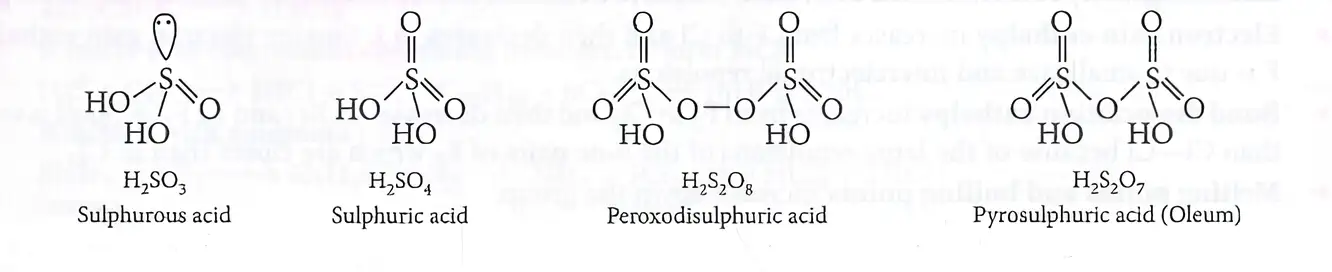
- Peroxo bridge: Peroxodisulphuric acid is identified by its linkage.
- Oleum: Pyrosulphuric acid has the formula .
Quick recap
- Sulphur forms oxoacids with different molecular structures.
- Sulphurous acid: .
- Sulphuric acid: .
- Peroxodisulphuric acid: ; it contains a peroxide bridge.
- Pyrosulphuric acid, also called oleum: .
Sulphuric Acid
Sulphuric acid — Sulphuric acid () is known as oil of vitriol and the king of chemicals.
Preparation: Contact Process
- Contact process: Sulphur is converted to sulphur dioxide, then sulphur trioxide; the latter is absorbed in sulphuric acid to form oleum.
- Final step: Oleum reacts with water to produce sulphuric acid.
Physical Properties
- Appearance: Pure sulphuric acid is a colourless, dense, oily liquid.
- Specific gravity: Its specific gravity is at .
- Mixing with water: Dissolving sulphuric acid in water is highly exothermic; always add concentrated acid to water slowly with constant stirring.
Do not add water to concentrated sulphuric acid: the heat released can cause dangerous splashing. Add acid to water instead.
Chemical Properties
Strong dibasic acid — Sulphuric acid is a strong dibasic acid because it ionises in two stages and can release two protons per molecule.
Formation of acid and normal sulphates
- Partial neutralisation: One mole of sodium hydroxide forms sodium hydrogen sulphate (acid sulphate).
- Complete neutralisation: Two moles of sodium hydroxide form sodium sulphate (normal sulphate).
Less-volatile acid displacement — Sulphuric acid displaces more volatile acids from their salts; the examples shown include hydrogen fluoride, hydrogen chloride and nitric acid.
Dehydrating agent — Concentrated sulphuric acid removes water from compounds; sugar is charred to carbon in the process.
Oxidising agent — Concentrated sulphuric acid acts as an oxidising agent, being reduced to sulphur dioxide while oxidising copper, sulphur or carbon.
Quick recap
- Sulphuric acid is called oil of vitriol and the king of chemicals.
- The contact process makes sulphuric acid via sulphur dioxide, sulphur trioxide and oleum.
- Sulphuric acid is a colourless, dense, oily liquid with specific gravity at .
- Its dissolution in water is highly exothermic: add acid to water, not water to acid.
- It is a strong dibasic acid and can form acid sulphate or normal sulphate salts.
- Concentrated sulphuric acid acts as both a dehydrating agent and an oxidising agent.
Group 17 Elements
Group 17 Elements and Electronic Configuration
Halogens — Group 17 elements are highly reactive non-metals called halogens; the name means “salt producers.” Astatine and tennessine are radioactive.
- Members: Fluorine, chlorine, bromine, iodine, astatine and tennessine.
- General configuration: ; each element has seven valence electrons.
| Element | Symbol | Atomic number | Electronic configuration |
|---|---|---|---|
| Fluorine | |||
| Chlorine | |||
| Bromine | |||
| Iodine | |||
| Astatine | |||
| Tennessine |
Physical Properties
- Atomic and ionic radii: Increase down the group; halogens are the smallest atoms in their periods.
- Ionisation enthalpy: Very high, and decreases down the group.
- Electronegativity: Fluorine is the most electronegative element; electronegativity decreases down the group.
- Electron gain enthalpy: Increases from fluorine to chlorine, then decreases towards iodine. Fluorine’s smaller value is due to its small size and strong interelectronic repulsions.
- Bond dissociation enthalpy: Increases from to , then decreases through to .
- F–F bond: Weaker than the bond because the closely spaced fluorine lone pairs repel strongly.
- Melting and boiling points: Increase down the group.
Oxidation States and Oxidising Ability
- Fluorine: Shows only the oxidation state because it is the most electronegative element.
- Other Group 17 elements: Chlorine, bromine, iodine, astatine and tennessine show , , , and oxidation states.
- Higher oxidation states: For chlorine, bromine and iodine, these are observed only in fluorides, oxides and oxoacids.
- Oxidising ability: All halogens have a strong affinity for electrons; their oxidising ability decreases from fluorine to iodine.
The oxidising strength of the halogens decreases down the group.
Hydrogen Halides
- Formation reactivity: The order of reactivity with hydrogen is .
| Property | Order |
|---|---|
| Boiling point | |
| Melting point | |
| Bond length | |
| Bond dissociation enthalpy | |
| Acidic strength | |
| Thermal stability | |
| Reducing power |
Oxides
- Fluorine: Forms and , called oxygen fluorides.
- Other halogens: Form oxides in which the halogen can have oxidation states from to .
Metal Halides and Displacement
- Ionic character: For the same metal, ionic character decreases in the order .
- Variable oxidation states: For a metal with multiple oxidation states, its halide in the higher oxidation state is more covalent than its halide in the lower oxidation state.
- Iodine displacement: Iodine does not displace chlorine or bromine from their chlorides or bromides, but it displaces them from their oxo-salts.
Why is the bond weaker than the bond?
State the trends in acidic strength and thermal stability of hydrogen halides.
Quick recap
- Group 17 elements have the general configuration ; astatine and tennessine are radioactive.
- Atomic and ionic radii increase down the group, while ionisation enthalpy and electronegativity decrease.
- Fluorine shows only the oxidation state; the other Group 17 elements show , , , and .
- Oxidising ability decreases as .
- Hydrogen halide acidic strength and reducing power increase from to , while thermal stability decreases.
- Fluorine forms oxygen fluorides; other halogens form oxides with oxidation states from to .
- Iodine displaces chlorine from an oxo-salt such as potassium chlorate, but not from chlorides.
Chlorine
Preparation
Laboratory and industrial preparation
- Manganese dioxide: Heating manganese dioxide with hydrochloric acid liberates chlorine.
- Other oxidants: Chlorine can also be prepared using potassium permanganate or by reacting sodium chloride with manganese dioxide and sulfuric acid.
- Deacon’s process: Hydrogen chloride is oxidised by oxygen in the presence of copper(II) chloride.
Electrolytic process
- Electrolyte: Concentrated sodium chloride solution (brine) is electrolysed.
- Anode: Chlorine gas is liberated at the anode.
Physical Properties
- Appearance: Chlorine is a greenish-yellow gas with a pungent, suffocating odour.
- Density: It is about times heavier than air.
- Liquefaction: It liquefies easily to a greenish-yellow liquid; its boiling point is .
- Solubility: Chlorine is soluble in water.
Chemical Properties
Reactions with elements
- Metals: Chlorine reacts with metals to form metal chlorides.
- Non-metals: It also reacts with phosphorus and sulfur to form their chlorides.
Reactions with hydrogen-containing compounds
- Hydrogen sulfide: Chlorine converts hydrogen sulfide into hydrogen chloride and sulfur.
- Hydrocarbon: Chlorine can convert the hydrogen in a hydrocarbon into hydrogen chloride, leaving carbon.
Reaction with Ammonia
| Condition | Products |
|---|---|
| Ammonia in excess | Ammonium chloride and nitrogen |
| Chlorine in excess | Nitrogen trichloride and hydrogen chloride |
Reaction with Alkalis
| Conditions | Products formed |
|---|---|
| Cold, dilute NaOH | Sodium chloride and sodium hypochlorite |
| Hot, concentrated NaOH | Sodium chloride and sodium chlorate |
Reaction with slaked lime
- Slaked lime: Chlorine reacts with calcium hydroxide to form bleaching powder, represented in the equation as calcium hypochlorite and calcium chloride, plus water.
Chlorine as an Oxidising Agent
- Oxidising action: Chlorine oxidises ferrous ions to ferric ions, sulfur dioxide to sulfuric acid, and iodine to iodic acid.
Chlorine as a Bleaching Agent
- Mechanism: In water, chlorine produces nascent oxygen in the textbook representation; this oxygen oxidises coloured substances to colourless products.
- Result: Chlorine bleaching is due to oxidation.
How does the reaction of chlorine with sodium hydroxide change with conditions?
Why does chlorine bleach coloured substances?
Quick recap
- Chlorine is prepared using oxidants such as MnO2 and KMnO4, by Deacon’s process, and by electrolysis of brine.
- It is a greenish-yellow, pungent gas, about 2.5 times heavier than air, and boils at 239 K.
- Chlorine reacts with metals, non-metals and hydrogen-containing compounds to form chlorides.
- With ammonia, the products depend on whether NH3 or Cl2 is in excess.
- Cold dilute alkali gives hypochlorite; hot concentrated alkali gives chlorate.
- Chlorine acts as an oxidising agent and bleaches by oxidation in the presence of water.
Hydrogen Chloride
Laboratory Preparation
Drying
- Drying agent: Hydrogen chloride gas is dried by passing it through concentrated .
Physical Properties
- Appearance and smell: Hydrogen chloride is a colourless gas with a pungent smell.
- Liquefaction: It is easily liquefied.
- Solubility: It is extremely soluble in water.
Chemical Properties
Reaction with salts of weaker acids — Hydrogen chloride reacts with salts of weaker acids, releasing the corresponding weaker acid.
Aqua Regia
Aqua regia — A mixture of 3 parts concentrated hydrochloric acid and 1 part concentrated nitric acid, used to dissolve noble metals.
- Ratio: Concentrated by volume.
- Examples: Aqua regia dissolves noble metals such as gold and platinum.
Quick recap
- Hydrogen chloride is prepared in two stages by reacting sodium chloride with sulphuric acid.
- Concentrated sulphuric acid is used to dry hydrogen chloride gas.
- Hydrogen chloride is colourless, pungent, easily liquefied and extremely soluble in water.
- It reacts with carbonate and sulphite salts, releasing carbon dioxide and sulphur dioxide respectively.
- Aqua regia is a 3:1 mixture of concentrated hydrochloric and nitric acids that dissolves gold and platinum.
Oxoacids of Halogens
Oxoacids of halogens — Oxygen-containing acids in which a halogen is the central atom.
Types and formulas
| Halogen | Hypohalous acid () | Halous acid () | Halic acid () | Perhalic acid () |
|---|---|---|---|---|
| F | HOF | — | — | — |
| Cl | HClO | HClO₂ | HClO₃ | HClO₄ |
| Br | HBrO | — | HBrO₃ | HBrO₄ |
| I | HIO | — | HIO₃ | HIO₄ |
Trends in properties
| Property | Trend |
|---|---|
| Thermal stability | Increases |
| Covalent character of the X—O bond | Increases |
| Oxidising power | Decreases |
| Acidity | Increases |
| Electronegativity of the central atom | Remains the same |
| Property | Trend |
|---|---|
| Electronegativity | Decreases |
| Thermal stability | Decreases |
| Oxidising power | Decreases |
| Acidic strength | Decreases |
Quick recap
- Oxoacids of halogens contain oxygen and have a halogen as the central atom.
- Acid names correspond to oxidation states: hypohalous , halous , halic , perhalic .
- Across the series, increasing oxidation state raises thermal stability, X—O bond covalent character, and acidity.
- Across the series, increasing oxidation state lowers oxidising power; central-atom electronegativity is unchanged.
- Down the halogen group, electronegativity, thermal stability, oxidising power, and acidic strength all decrease.
Interhalogen Compounds
Interhalogen Compounds
Interhalogen compound — A compound formed when two different halogens combine; the larger, more electropositive halogen is , and the smaller halogen is .
General formulae
- Types: Interhalogens commonly have formulae , , , and .
- Central atom: The larger halogen, , is the central atom; is the smaller halogen.
Preparation
Structures
| Type | Hybridisation | Shape | Bonding and lone pairs on central |
|---|---|---|---|
| Linear | Two bonded atoms; three lone pairs | ||
| T-shaped | Three bonded atoms; two lone pairs | ||
| Square pyramidal | Five bonded atoms; one lone pair | ||
| Pentagonal bipyramidal | Seven bonded atoms; no lone pairs |
Pseudohalides and Pseudohalogens
Pseudohalide ion — An ion made of two or more electronegative atoms, including at least one nitrogen atom, with properties similar to halide ions.
Pseudohalogen — A dimeric molecule corresponding to a pseudohalide ion.
| Pseudohalide ions | Corresponding pseudohalogens |
|---|---|
Quick recap
- Interhalogen compounds contain two different halogens; the larger halogen is the central atom.
- Common interhalogen formulae are , , , and .
- Their shapes range from linear and T-shaped to square pyramidal and pentagonal bipyramidal.
- Interhalogen preparations include direct halogen combination and further fluorination.
- Pseudohalide ions resemble halide ions; their corresponding dimers are pseudohalogens.
Group 18 Elements
Noble gases — Group 18 elements are gases that are very unreactive and form very few compounds.
Elements and electronic configuration
- Members: Helium (He), neon (Ne), argon (Ar), krypton (Kr), xenon (Xe), radon (Rn) and oganesson (Og).
- General configuration: ; helium is the exception, with .
- Valence shell: A complete outer shell helps explain the low reactivity of these elements.
| Element | Symbol | Atomic number | Electronic configuration |
|---|---|---|---|
| Helium | He | 2 | |
| Neon | Ne | 10 | |
| Argon | Ar | 18 | |
| Krypton | Kr | 36 | |
| Xenon | Xe | 54 | |
| Radon | Rn | 86 | |
| Oganesson | Og | 118 |
Physical properties
Physical state and periodic trends
- Physical state: Group 18 elements occur as monoatomic gases.
- Atomic radius: Increases down the group as additional shells are occupied.
- Ionisation enthalpy: Very high, but decreases down the group as atomic size increases.
- Electron gain enthalpy: Positive; noble gases have little tendency to accept an electron.
- Melting and boiling points: Very low because only weak dispersion forces act between atoms.
| Property | Trend |
|---|---|
| Melting point, boiling point, ease of liquefaction, solubility, adsorption and polarizability | Increase: |
| Thermal conductivity | Decreases: |
Chemical properties and xenon compounds
Why noble gases are unreactive
- Low reactivity: Noble gases are the least reactive group because they have very high ionisation enthalpies and positive electron gain enthalpies.
- Compound formation: Xenon forms several compounds, especially fluorides and oxygen compounds.
| Product | Reaction conditions |
|---|---|
| Excess Xe reacts with at and . | |
| ratio stated as ; , . | |
| ratio stated as ; , –. |
Properties and reactions of xenon fluorides
- Physical properties: , and are colourless crystalline solids that sublime readily at .
- Reactivity: They are powerful fluorinating agents and are readily hydrolysed, even by traces of water.
- Fluoride-ion acceptors: Xenon fluorides form cationic species with fluoride-ion acceptors.
- Fluoride-ion donors: They form fluoroanions with fluoride-ion donors.
Xenon–oxygen compounds
Hydrolysis products of xenon fluorides
- Hydrolysis of : Produces both xenon trioxide, , and elemental xenon.
- Partial hydrolysis of : One water molecule forms ; two water molecules form .
- Complete hydrolysis of : Produces xenon trioxide, .
Structures of xenon compounds
| Compound | Molecular geometry | Hybridisation |
|---|---|---|
| Linear | ||
| Square planar | ||
| Distorted octahedral | ||
| Trigonal pyramidal |
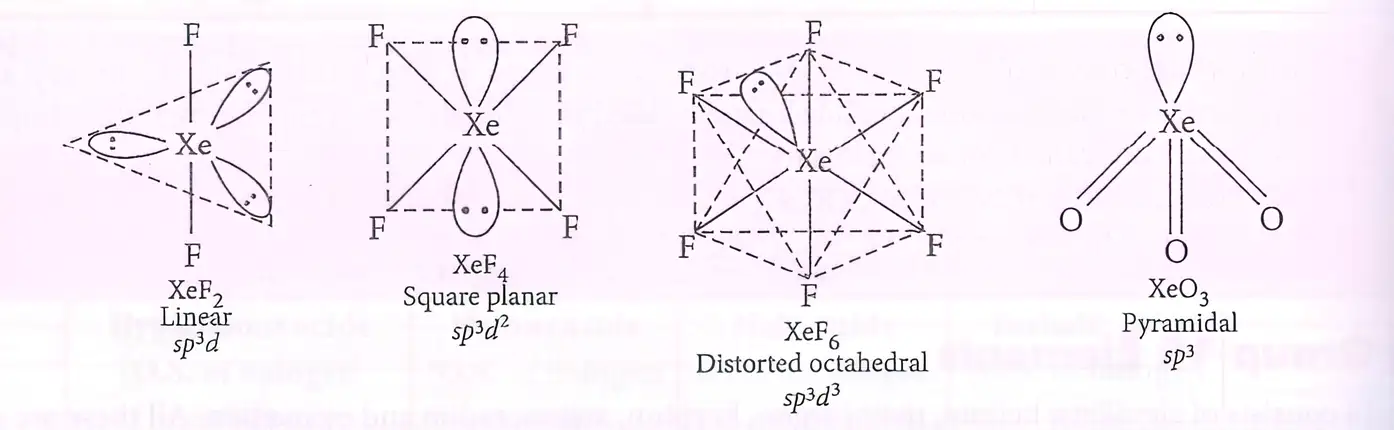
Solid-state xenon hexafluoride
- Gas phase: has a distorted octahedral structure.
- Solid state: Tetrameric and hexameric units contain square-pyramidal units linked by bent, pyramidal bridges.
Why are noble gases generally unreactive?
State the structures of , and .
Quick recap
- Group 18 elements have a complete valence shell; helium is , while the others follow .
- They are monoatomic gases with high ionisation enthalpies, positive electron gain enthalpies and low melting and boiling points.
- Atomic radii increase and ionisation enthalpy decreases down the group.
- Xenon forms , and ; the fluorides are colourless, sublimable solids and strong fluorinating agents.
- Hydrolysis of xenon fluorides can produce xenon oxides and oxyfluorides.
- , , and have linear, square-planar, distorted-octahedral and trigonal-pyramidal geometries, respectively.
NEET Chemistry — ALL CHAPTERS
1
Some Basic Concepts of Chemistry
2
Structure of Atom
3
Classification of Elements and Periodicity in Properties
4
Chemical Bonding and Molecular Structure
5
Thermodynamics
6
Equilibrium
7
Redox Reactions
8
Organic Chemistry - Some Basic Principles and Techniques
9
Hydrocarbons
10
Solutions
11
Electrochemistry
12
Chemical Kinetics
13
The d- and f- Block Elements
14
Coordination Compounds
15
Haloalkanes and Haloarenes
16
Alcohols, Phenols and Ethers
17
Aldehydes, Ketones and Carboxylic Acids
18
Amines
19
Biomolecules
20
The p-Block Elements (Group 13 and 14)
21
The p-Block Elements (Group 15 to 18)
22
Principles Related to Practical Chemistry