Alpha-Particle Scattering and Rutherford’s Nuclear Model of Atom
Thomson’s Atomic Model
Thomson’s plum pudding model — Proposed by J. J. Thomson in 1898, it pictured electrons embedded in a uniformly spread positive charge, like seeds in a watermelon.
- Limitation: Later studies showed that positive charge and electrons are not distributed as this model suggested.
Geiger–Marsden Alpha-Particle Scattering Experiment
Setup
- Proposal and experiment: Rutherford proposed alpha-particle scattering in 1906; Geiger and Marsden performed the experiment around 1911, following Rutherford’s suggestion.
- Source and beam: A radioactive source emitted alpha particles, which lead bricks collimated into a narrow beam.
- Target: The beam struck a thin gold foil of thickness .
- Detection: A rotatable zinc sulphide screen and microscope detected scattered alpha particles as scintillations; counts were measured at different scattering angles.
- Importance: Rutherford discovered the atomic nucleus, proposed the planetary model and estimated the nucleus’s approximate size.
Observations and Conclusions
| Observation | Conclusion |
|---|---|
| Most alpha particles pass through without deflection. | Most of an atom’s volume is empty space. |
| A small number scatter through angles from to . | A small, positively charged nucleus repels the positively charged alpha particles; deflection depends on how close they pass. |
| About in alpha particles is deflected through . | Such a rare reversal indicates that the nucleus is tiny; its size is nearly of the atom’s size. |
The number of particles scattered at angle falls rapidly as the scattering angle increases.
Impact parameter — The perpendicular distance between the initial direction of an alpha particle and the centre of the nucleus; it is denoted by .
is the atomic number of the nucleus, is the incident alpha particle’s kinetic energy, and is its scattering angle.
| Case | Scattering |
|---|---|
| Head-on approach; , so the alpha particle rebounds. | |
| Very distant approach; , so the particle is nearly undeflected. |
Distance of closest approach — The minimum distance reached by a head-on alpha particle, where its initial kinetic energy is fully converted into electrostatic potential energy.
is the initial kinetic energy of the alpha particle and is the nucleus’s atomic number.
Rutherford’s Nuclear Model
Postulates
- Nucleus: The whole positive charge of an atom is concentrated in its tiny central nucleus. The atom’s diameter is of order ; the nucleus’s diameter is of order .
- Electrons: Electrons occupy the mostly empty space around the nucleus and revolve around it; electrostatic attraction supplies the centripetal force.
- Neutrality: The nucleus’s total positive charge equals the total negative charge of the electrons, making the atom neutral overall.
Limitations of Rutherford’s Model
| Classical prediction | Observed fact |
|---|---|
| A revolving electron is accelerated, so electromagnetic theory predicts that it radiates energy continuously. It should lose energy and spiral into the nucleus, making atoms unstable. | Atoms do not collapse; they are stable. |
| A continuously radiating electron should produce a continuous range of frequencies. | Atomic spectra have discrete lines or bands, not a continuous spectrum. |
Electron Orbits and Energy in Hydrogen
- Force balance: For a dynamically stable circular orbit, the electrostatic attraction provides the required centripetal force.
- Symbols: is the magnitude of the electron charge, its mass, its speed, and its orbital radius.
Equating electrostatic and centripetal forces gives the radius–speed relation for a hydrogen electron.
The negative potential energy indicates attractive binding; the negative total energy means the electron is bound to the nucleus.
- Bound state: corresponds to an electron bound in a closed orbit; positive total energy would not describe a bound orbit.
What did the alpha-particle scattering results reveal about the atom?
State the two major failures of Rutherford’s model.
Quick recap
- Thomson’s 1898 model placed electrons in uniformly distributed positive matter.
- The gold-foil experiment showed that atoms are mostly empty space with a tiny, positively charged nucleus.
- Scattering depends on impact parameter: a head-on particle reverses direction, while a distant one is barely deflected.
- At closest approach, the alpha particle’s kinetic energy is converted into electrostatic potential energy.
- Rutherford’s model places electrons revolving around the nucleus, with electrostatic attraction supplying centripetal force.
- The model fails to explain atomic stability and the discrete nature of atomic spectra.
- In the hydrogen orbit model, the electron’s total energy is negative, indicating a bound state.
Atomic Spectra
Emission and Absorption Spectra
Emission line spectrum — A spectrum of specific wavelengths emitted by an excited atomic gas or vapour, seen as bright lines on a dark background.
- Production: An atomic gas or vapour at low pressure is commonly excited by passing an electric current through it.
- Emission: The emitted spectrum contains only certain specific wavelengths, characteristic of the gas.
- Absorption: When white light passes through a gas, dark lines appear in the transmitted spectrum at wavelengths matching that gas’s emission lines.
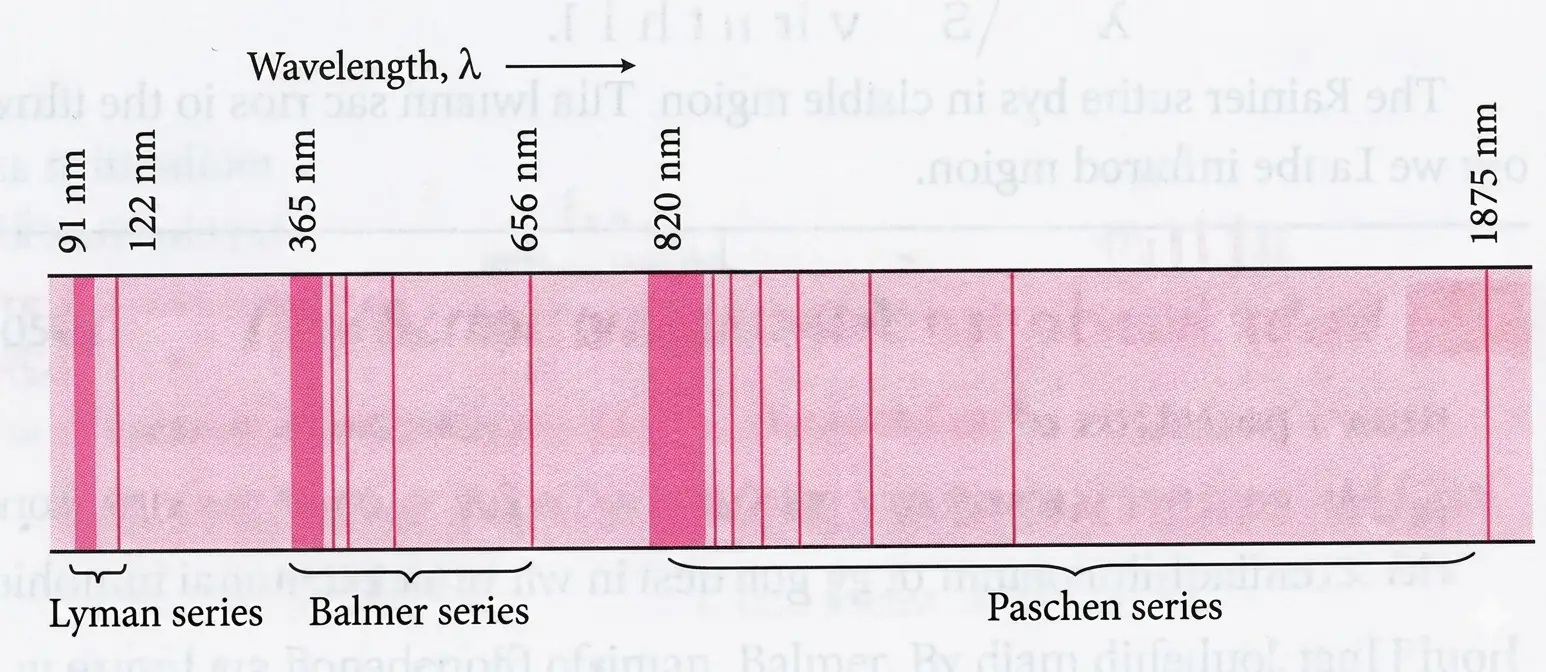
Hydrogen Spectral Series
Spectral series — A set of spectral lines in which the spacing between neighbouring lines decreases in a regular pattern.
Balmer series
- Discovery: Balmer observed the first hydrogen series in 1885, in the visible region.
- Line pattern: As wavelength decreases, the lines get closer together and weaker in intensity.
- First lines: is red at ; is blue-green at ; is violet at .
For a transition from the higher level to the lower level , .
| Series | Lower level | Allowed higher levels | Region stated |
|---|---|---|---|
| Lyman | Ultraviolet | ||
| Balmer | Visible | ||
| Paschen | Infrared | ||
| Brackett | Infrared | ||
| Pfund | Infrared |
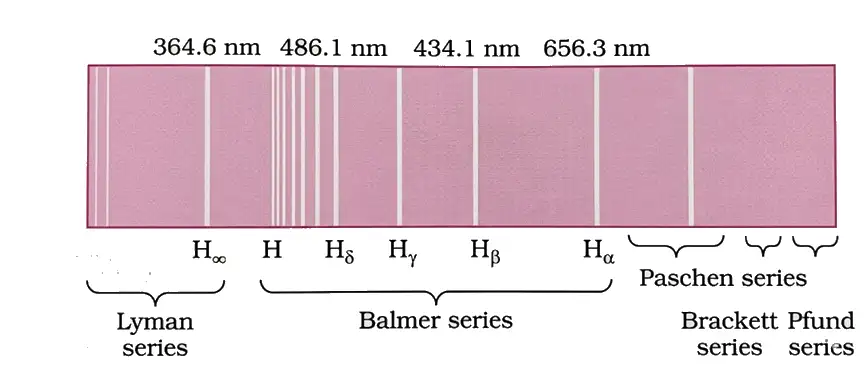
- The Balmer series uses and lies in the visible region.
- The Lyman series is ultraviolet; the Paschen and Brackett series are infrared.
- In each series, the higher level takes successive integer values greater than .
Quick recap
- Excited atomic gases emit characteristic bright-line spectra at specific wavelengths.
- Absorption lines occur at the same wavelengths as the gas’s emission lines.
- Hydrogen spectral lines form series with regular patterns and decreasing spacing.
- The Rydberg formula relates wavelength to the initial and final energy-level numbers.
- The Lyman series is ultraviolet, Balmer is visible, and Paschen and Brackett are infrared.
Bohr Model of the Hydrogen Atom
Bohr’s Postulates
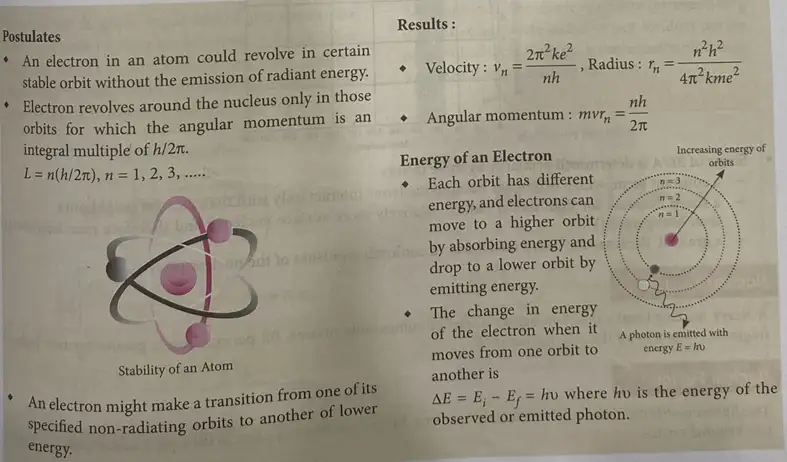
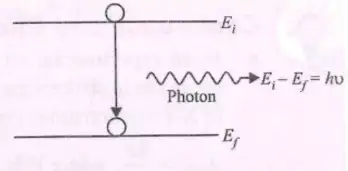
Allowed Orbits in a Hydrogen-like Atom
Combining the force balance with angular-momentum quantisation gives the allowed orbit radius.
- Dependence: The orbit radius varies as .
- Hydrogen: For , the radius of the first orbit is the Bohr radius, .
Hydrogen Energy Levels
Use this relation to calculate the energy of an allowed hydrogen orbit.
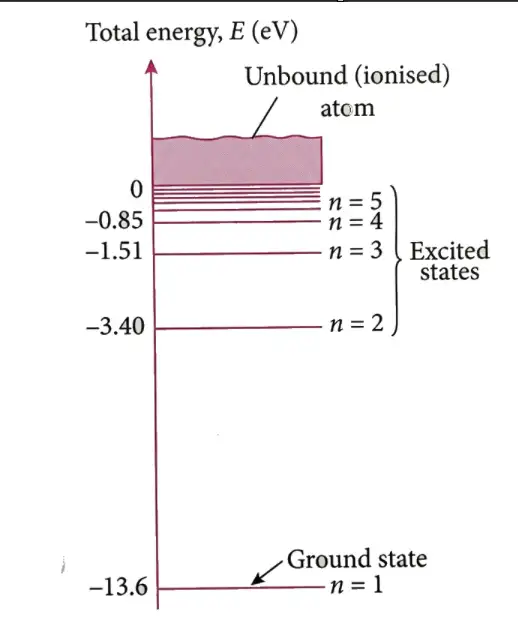
What is meant by energy quantisation in the Bohr model?
How much energy is needed to ionise ground-state hydrogen?
Quick recap
- Stable Bohr orbits do not emit radiant energy.
- Allowed angular momenta are , where .
- A transition to a lower orbit emits a photon with energy .
- For a hydrogen-like atom, .
- Hydrogen energy levels follow .
- The ground state is ; ionising it requires .
The line Spectra of the Hydrogen Atom
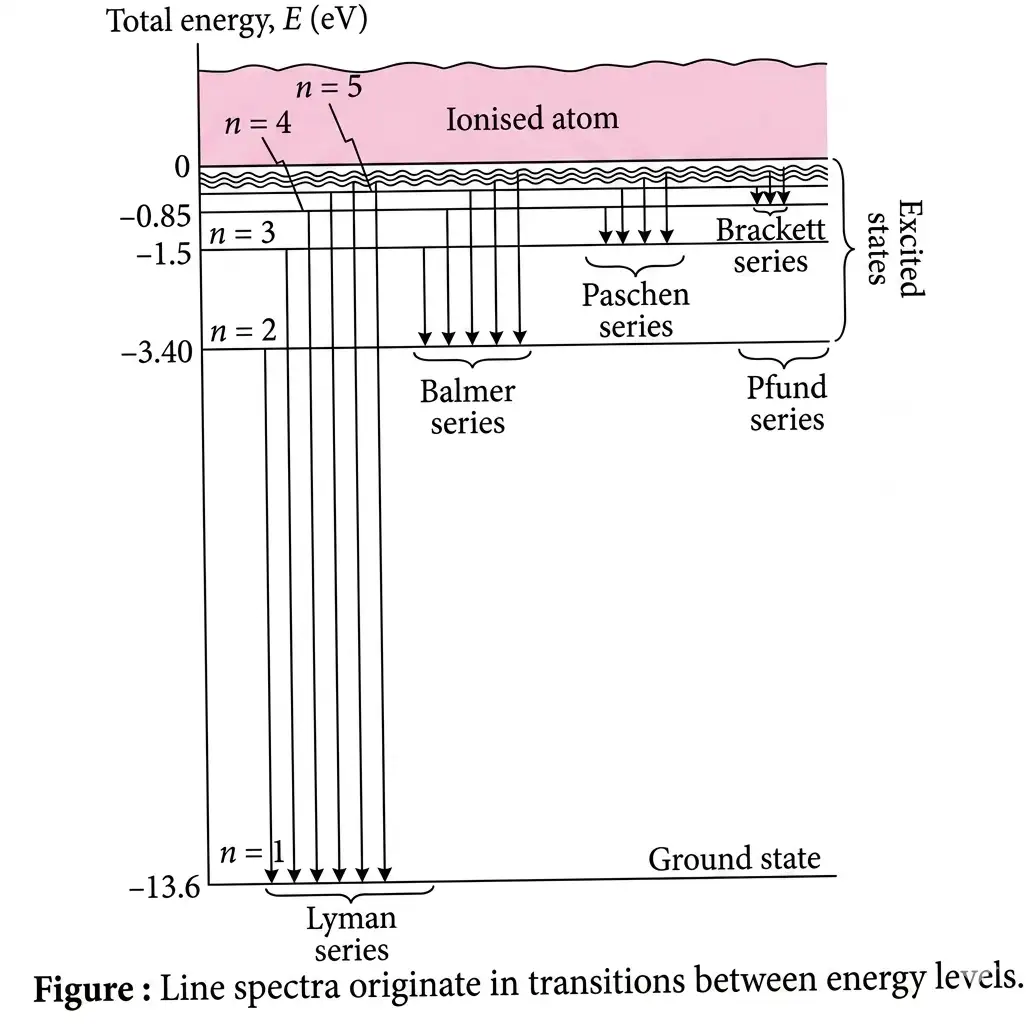
Hydrogen Line Spectrum
Hydrogen spectral line — A spectral line is emitted when an electron moves from a higher energy level to a lower one, releasing a photon of definite energy.
- Transition: An electron falls from level to level , where .
- Photon energy: The emitted photon carries the energy difference between the two levels.
- Discrete spectrum: Since and are integers, only particular frequencies are emitted.
Gives the photon energy and frequency for a transition from to .
The frequency follows by dividing the photon-energy expression by .
| Series | Final level | Initial levels |
|---|---|---|
| Lyman | ||
| Balmer | ||
| Paschen | ||
| Brackett | ||
| Pfund |
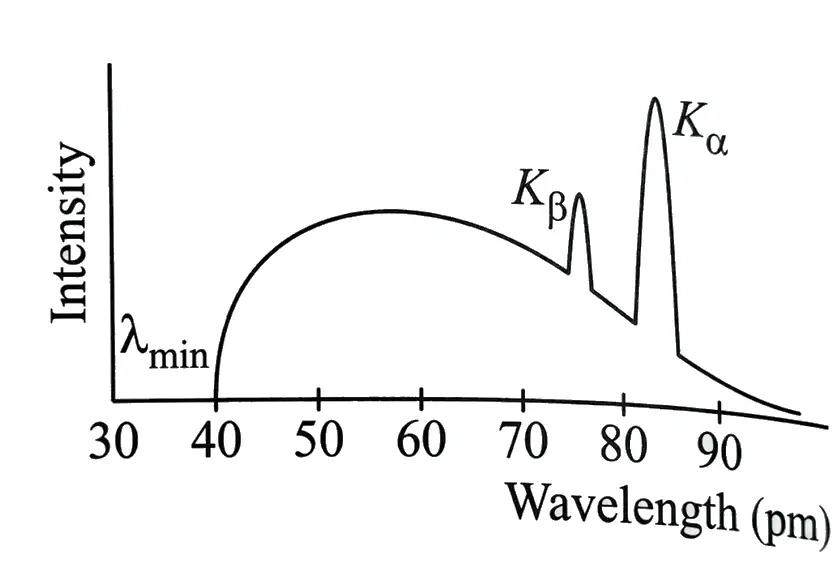
Continuous and Characteristic X-rays
Cut-off wavelength — The cut-off wavelength is the minimum wavelength in the X-ray spectrum produced when energetic electrons strike a metal target in a Coolidge tube.
The cut-off wavelength depends on accelerating potential , not on the target material.
Use in volts to obtain the wavelength in nanometres.
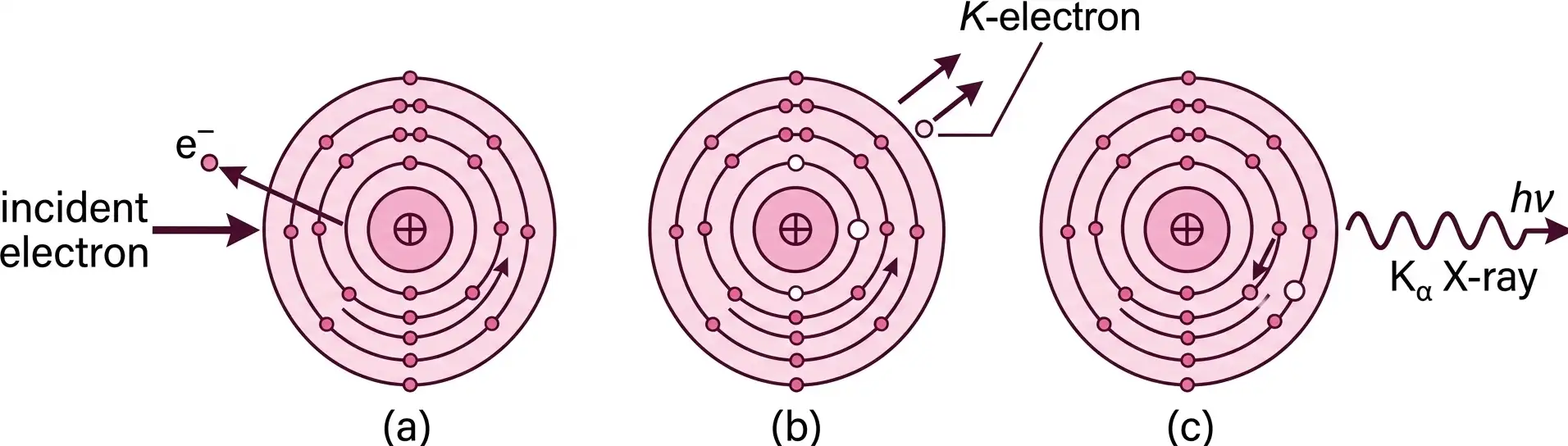
Production of Characteristic X-rays
Characteristic X-ray — An X-ray photon emitted when an electron from a higher shell fills a vacancy in an inner shell of a target atom.
Formation of a characteristic K X-ray
- An incident energetic electron strikes a target atom.
- It ejects a deeply bound K-shell electron (), creating a vacancy.
- An electron from a higher shell falls into the vacancy and emits an X-ray photon.
| Line | Transition |
|---|---|
| L shell () to K shell () | |
| M shell () to K shell () |
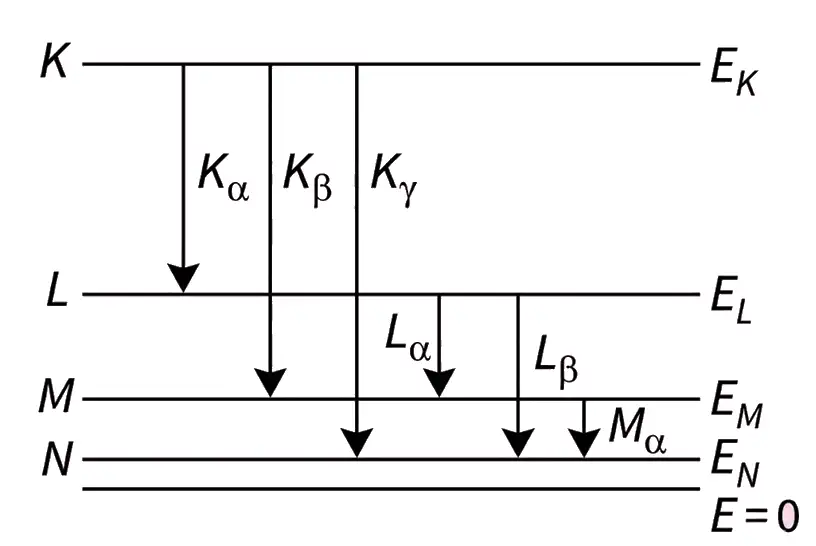
X-ray Wavelengths from Energy Levels
- Reference: Take the atom's ground-state energy as .
- Vacancy energies: , , , and denote the atom's energies when an electron is removed from the corresponding shell.
- K-type X-rays: These are emitted when an electron from a higher energy state fills a vacancy in the K shell.
| X-ray line | Wavelength |
|---|---|
What determines the series of a hydrogen spectral line?
Does the minimum X-ray wavelength depend on the target material?
Quick recap
- The Rydberg formula gives the photon energy and frequency for a hydrogen transition from to .
- The final level identifies the series: Lyman , Balmer , Paschen , Brackett , and Pfund .
- In a Coolidge tube, the minimum X-ray wavelength is and is independent of target material.
- Characteristic X-rays are produced when an electron fills an inner-shell vacancy.
- is an L-to-K transition; is an M-to-K transition.
- X-ray wavelength is determined by the energy difference, using .
De-Broglie’s Explanation of Bohr’s Second Postulate of Quantisation
De Broglie Explanation of Angular-Momentum Quantisation
Bohr’s second postulate — An electron in a stationary orbit can have only quantised angular momentum.
Here, is a positive integer and is Planck’s constant.
Standing-wave explanation
- De Broglie hypothesis: A moving electron has wave nature, with wavelength .
- Standing waves: Only resonant waves that fit around the orbit persist; other wave patterns do not form a stable standing wave.
- Orbit condition: The orbital circumference must contain an integer number of wavelengths.
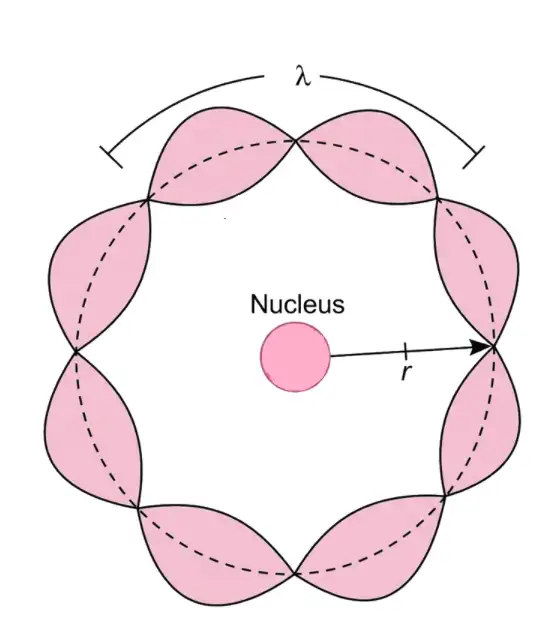
For the th orbit, only an integer number of de Broglie wavelengths fits around its circumference.
From the wave condition to Bohr’s postulate
- Use the de Broglie relation: .
- For an electron moving at speed , its momentum is .
- Substitute into to obtain .
- Rearrange to get : Bohr’s angular-momentum quantisation.
- Quantised orbits arise because only resonant electron standing waves can persist.
- The integer counts de Broglie wavelengths around the orbit.
Limitations of Bohr’s Theory
- Multi-electron spectra: Bohr’s spectral formula works for one-electron species such as H, He, Li and Be, but not for multi-electron atoms or ions.
- Fine structure: It cannot explain why a spectral line separates into closely spaced lines. Sommerfeld explained this by proposing some electron orbits are elliptical.
- Chemical bonding: It does not explain how atoms bind into molecules, why bonds form, or why molecules become more stable.
- Field effects: It cannot fully explain spectral-line splitting in a magnetic field (Zeeman effect) or an electric field (Stark effect).
- Electron distribution: It does not explain how electrons are distributed among different orbits.
- Electron–electron forces: The model accounts for the attraction between the nucleus and an electron, but neglects interactions among electrons in multi-electron atoms.
- Line intensities: It cannot explain why some visible hydrogen spectral frequencies have stronger emission intensities than others.
This relation applies to hydrogen-like, single-electron species.
Moseley’s Law
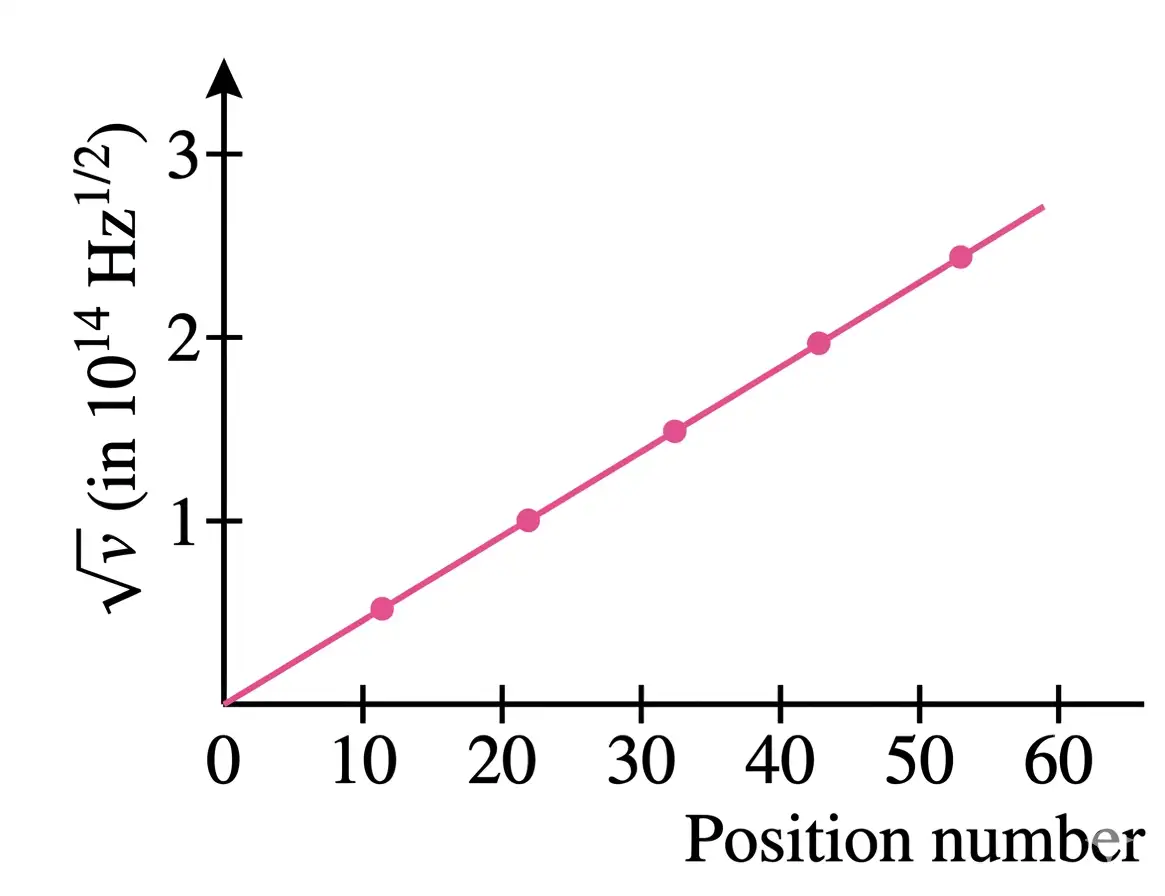
Moseley’s law — The square root of the frequency of an X-ray spectral line varies linearly with an effective atomic number.
Here, and are constants; for Bohr-model estimates, .
- Effective nuclear charge: Bohr’s model gives reasonable X-ray results when is replaced by , with .
- Transition: For the transition from to , the emitted photon energy is .
The relation follows from the transition energy, with the Rydberg constant.
Bragg’s Law
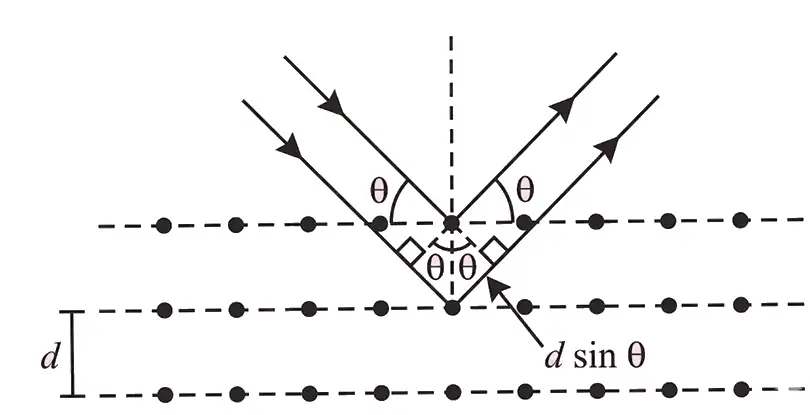
Bragg’s law — It gives the condition for strong diffraction of X-rays reflected from successive parallel crystal planes.
is the diffraction order, is the perpendicular spacing between adjacent planes, is the glancing angle, and is the X-ray wavelength.
- Use: Measure angles of strong reflection using monochromatic X-rays to determine interplanar spacing and obtain information about a solid’s structure.
How does de Broglie’s hypothesis explain Bohr’s angular-momentum quantisation?
State two limitations of Bohr’s theory.
Quick recap
- Electron waves form stable orbits only when an integer number of wavelengths fits around the circumference.
- The standing-wave condition derives Bohr’s quantisation: .
- Bohr’s model describes one-electron spectra but has several limitations, including fine structure and field effects.
- Moseley’s law relates the square root of X-ray frequency linearly to .
- Bragg’s law, , gives the condition for strong X-ray diffraction from crystal planes.
NEET Physics — ALL CHAPTERS
1
Basic Mathematics
2
Units and Measurement
3
Motion in a Straight Line
4
Motion in a Plane
5
Laws of Motion
6
Work, Energy and Power
7
System of Particles and Rotational Motion
8
Gravitation
9
Mechanical Properties of Solids
10
Mechanical Properties of Fluids
11
Thermal Properties of Matter
12
Thermodynamics
13
Kinetic Theory
14
Oscillations
15
Waves
16
Electric Charges and Fields
17
Electrostatic Potential and Capacitance
18
Current Electricity
19
Moving Charges and Magnetism
20
Magnetism and Matter
21
Electromagnetic Induction
22
Alternating Current
23
Electromagnetic Waves
24
Ray Optics and Optical Instruments
25
Wave Optics
26
Dual Nature of Radiation and Matter
27
Atoms
28
Nuclei
29
Semiconductor Electronics: Materials, Devices and Simple Circuits