NEET UG . NEET Physics . Physics . Units and Measurement
Chapter 2: Units and Measurement
Ch 2
NEET Physics
NEET UG
The International System of Units
Units and Systems of Units
Unit — An internationally accepted reference standard used to express a physical quantity.
Types of units
- Measurement: A measured physical quantity is expressed as a numerical value together with a unit.
- Base units: Units assigned to fundamental quantities.
- Derived units: Units formed by combining base units; for example, speed uses units of length divided by time.
- System of units: A complete set of base units and derived units.
Earlier Systems and the SI
| System | Fundamental units for length, mass and time | Metric? |
|---|---|---|
| CGS (Gaussian) | Centimetre, gram, second | Yes |
| FPS (British) | Foot, pound, second | No |
| MKS | Metre, kilogram, second | Yes |
International System of Units (SI) — The internationally accepted system of measurement, named from the French Système International d’Unités.
SI overview
- Recommendation: The General Conference on Weights and Measures recommended SI for international use in 1971 in France.
- Use: It provides a common scheme of symbols, units and abbreviations for scientific, technical, industrial and commercial work.
- Structure in this lecture: SI is based on seven base units and two supplementary units.
Seven SI Base Quantities and Units
| Base quantity | Unit | Symbol | Definition given in the lecture |
|---|---|---|---|
| Length | metre | Distance light travels in vacuum in of a second. | |
| Mass | kilogram | Defined using the fixed Planck constant , where ; the metre and second are defined in terms of and . | |
| Time | second | Duration of periods of radiation corresponding to the transition between the two hyperfine levels of the ground state of a caesium-133 atom. | |
| Electric current | ampere | Defined using the fixed elementary charge , where ; the second is defined in terms of . | |
| Thermodynamic temperature | kelvin | Defined using the fixed Boltzmann constant , where ; the kilogram, metre and second are defined in terms of , and . | |
| Amount of substance | mole | Amount containing as many elementary entities as there are atoms in of carbon-12. | |
| Luminous intensity | candela | Intensity in a given direction of a source emitting monochromatic radiation of frequency , with radiant intensity in that direction. |
Supplementary Units: Plane and Solid Angles
Angle definitions
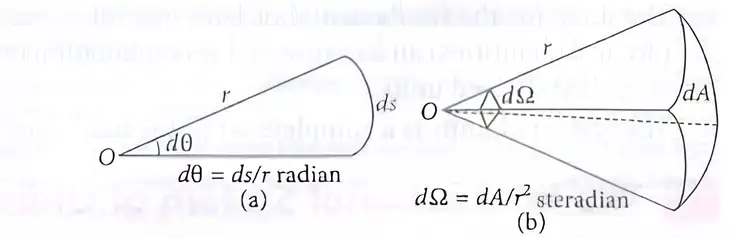
- Plane angle: The ratio of arc length to the radius of a circle.
- Radian: The plane angle at a circle’s centre subtended by an arc whose length equals the radius.
- Solid angle: The ratio of the area intercepted on a sphere to the square of its radius.
- Steradian: The solid angle at a sphere’s centre subtended by an area equal to the square of the sphere’s radius.
Arc length divided by radius; unit: radian ().
Area intercepted on a spherical surface divided by radius squared; unit: steradian ().
Advantages of SI
- Coherent: Derived units follow directly from base units without extra numerical factors.
- Rational: Unit definitions are arranged to avoid unnecessary numerical factors in equations.
- Absolute: Units do not depend on the particular object or place of measurement.
- Metric: SI uses the metric system.
Writing SI Units Correctly
Unit names and symbols
- Unit names: Even when named after a person, write the unit name in lowercase: ampere, newton.
- Symbols named after people: Use a capital letter, e.g. newton is and ampere is .
- Other unit symbols: Generally use lowercase, e.g. kilogram is and metre is .
- Punctuation: Do not place a full stop or other punctuation after a unit symbol; write , not punctuated symbols.
Errors in Measurement
Error of measurement — The difference between a measured value and the true value of a physical quantity.
| Type | Meaning / source |
|---|---|
| Systematic error | Tends consistently in one direction: positive or negative. |
| Random error | Varies irregularly in sign and size because of unpredictable experimental fluctuations or observer-related reading variations. |
| Least-count error | Error associated with an instrument’s resolution or smallest measurable value. |
Mean Value and Measurement Errors
Repeated measurements
- Mean value: For repeated measurements , the arithmetic mean is the best estimate and helps reduce random error.
- Absolute error: The magnitude of the difference between an individual measurement and the mean value.
- Mean absolute error: The mean of the magnitudes of the individual absolute errors.
- Relative error: Mean absolute error divided by the mean value.
- Percentage error: Relative error expressed as a percentage.
For measurements of a quantity .
The magnitude of each deviation is used when calculating mean absolute error.
The denominator is the mean measured value.
Combination of Errors
| Quantity formed | Maximum error rule |
|---|---|
| Sum or difference: | |
| Product or quotient: or | |
| Power: | |
| General form: |
Using combination rules
- Addition/subtraction: Add the absolute errors, whether the measured quantities are added or subtracted.
- Multiplication/division: Add the relative errors of the factors or terms.
- Powers: Multiply relative error by the power; in a general expression, each exponent weights its corresponding relative error.
- Percentage form: For , percentage error in is the sum of , and times the respective percentage errors.
Do not add absolute errors for products or quotients: add relative errors instead. For repeated readings, use the magnitudes when finding mean absolute error.
State the seven SI base quantities and their units.
How are the maximum relative errors combined for a product or quotient?
Quick recap
- A measurement is a numerical value expressed with a unit; units are base or derived.
- CGS uses centimetre–gram–second, FPS uses foot–pound–second, and MKS uses metre–kilogram–second.
- SI is the internationally accepted system, with seven base units and, in this lecture, two supplementary angle units.
- Plane angle is arc length divided by radius; solid angle is spherical area divided by radius squared.
- Write unit names in lowercase; symbols named after people are capitalised, and unit symbols take no punctuation.
- Mean absolute error is the average magnitude of deviations; relative error is its ratio to the mean, and percentage error is that ratio times .
- For sums and differences add absolute errors; for products, quotients and powers combine relative errors.
Significant Figures
Counting Significant Figures
- Significant figures: Digits in a measurement whose values are known with certainty, including the first uncertain digit.
- Accuracy: A greater number of significant figures generally indicates greater precision in a measurement.
Arithmetic with Significant Figures
- Arithmetic rules: Addition and subtraction results are rounded to the least precise number of decimal places.
- Products and quotients: The result has as many significant figures as the input with the fewest significant figures.
Rounding Off Uncertain Digits
- Rounding: When the first dropped digit is greater than 5, increase the preceding digit by 1; when it is less than 5, leave it unchanged.
- Digit 5: If 5 is the first dropped digit and is followed only by zeros or nothing, leave an even preceding digit unchanged and increase an odd preceding digit by 1.
Least Count
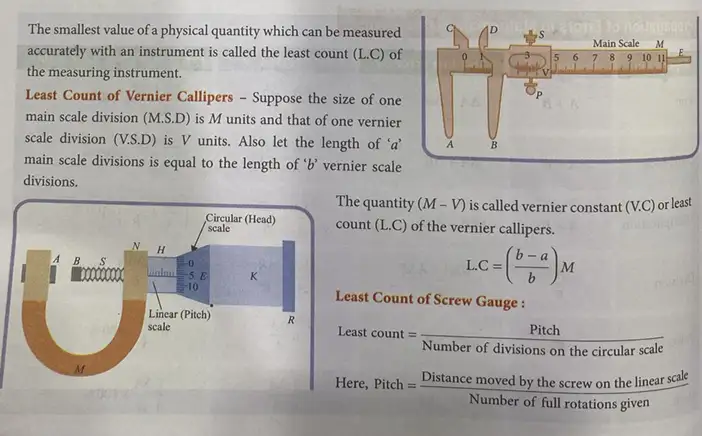
Least Count of Vernier Callipers
Use this when main-scale divisions have the same length as vernier-scale divisions.
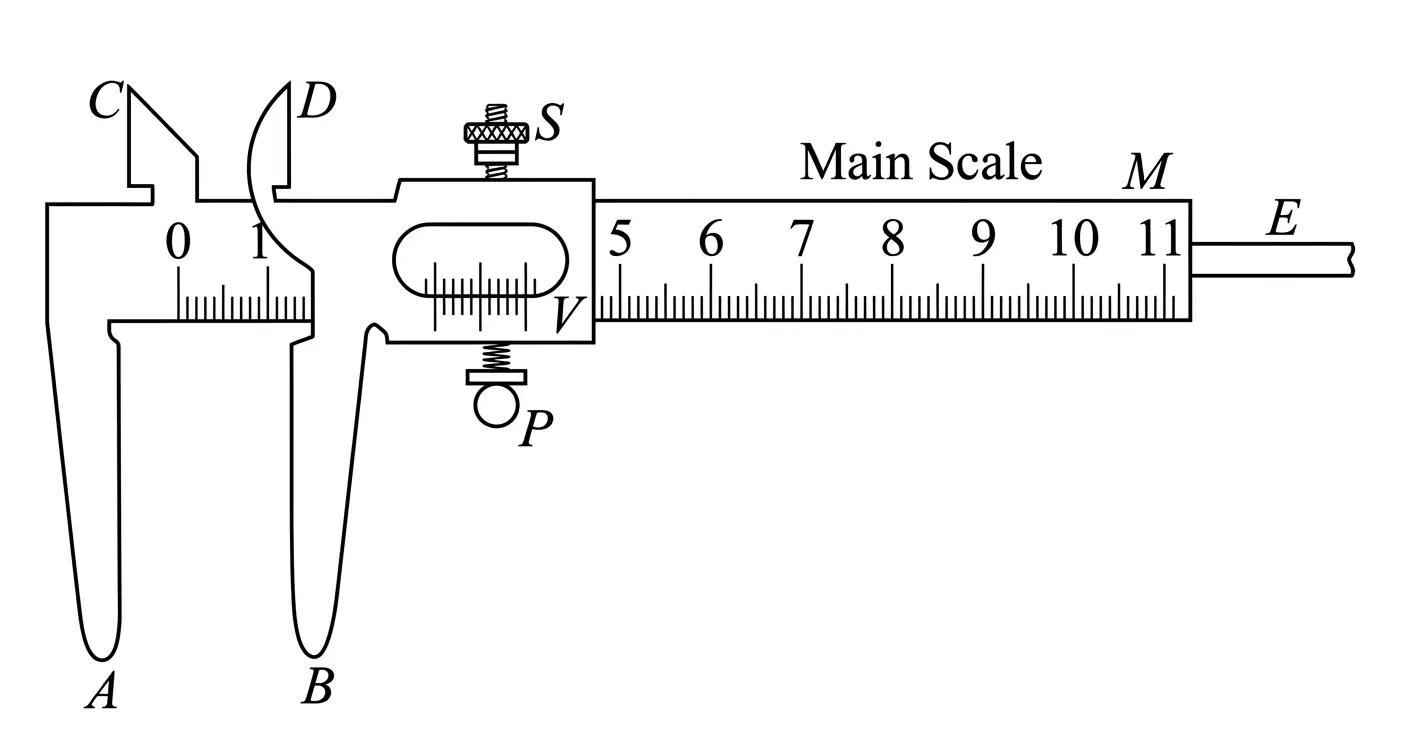
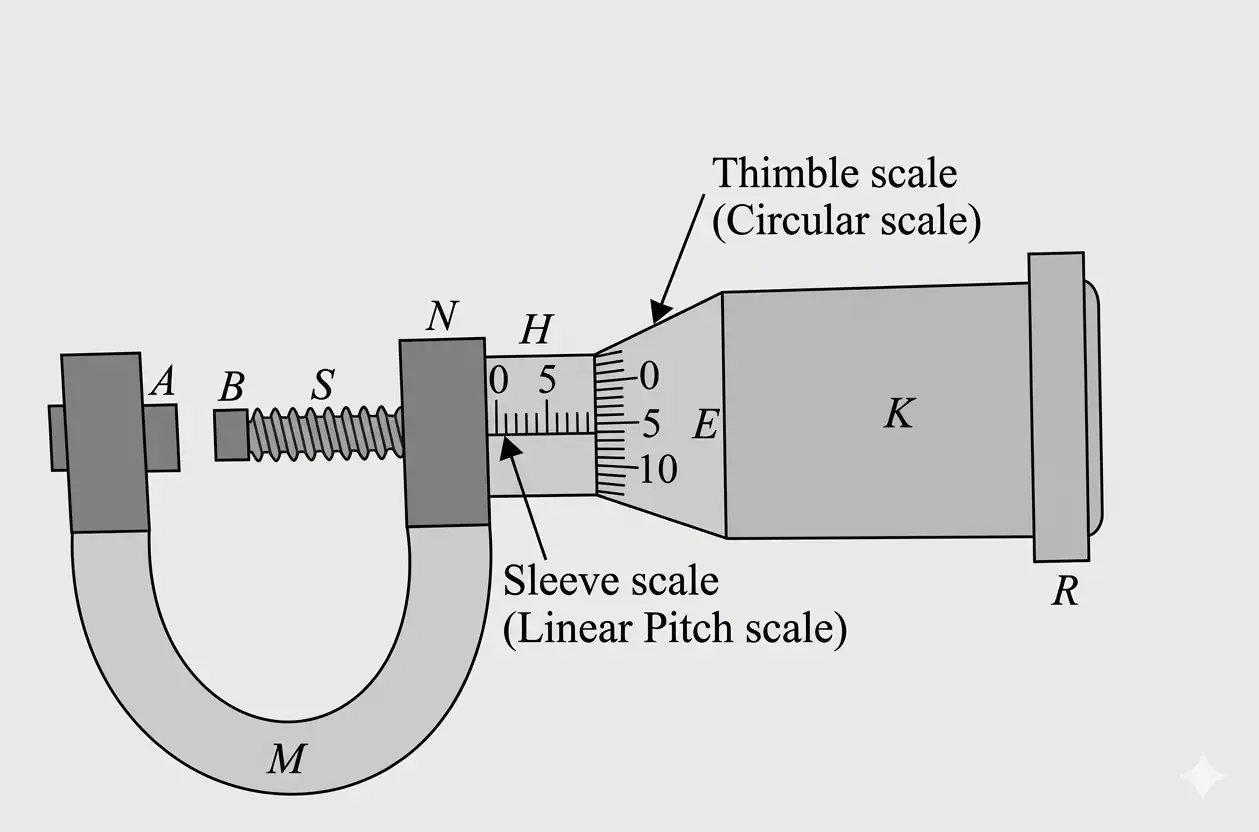
Least Count of a Screw Gauge
Here, is the distance moved on the linear scale and is the number of complete rotations.
Here, is the number of divisions on the circular scale.
State the rounding rules for addition/subtraction and multiplication/division.
Write the least-count formulas for vernier callipers and a screw gauge.
Quick recap
- Significant figures are reliably known digits; leading zeros and powers of ten do not count.
- Zeros between non-zero digits and trailing zeros after a decimal point are significant.
- Addition/subtraction uses the fewest decimal places; multiplication/division uses the fewest significant figures.
- For a dropped , keep the preceding even digit unchanged and increase a preceding odd digit by .
- Vernier least count is .
- Screw-gauge least count equals pitch divided by the number of circular-scale divisions.
Dimensions of Physical Quantities
Meaning of Dimensions
- Dimension: The exponent of a base quantity in the expression for a physical quantity is its dimension in that base quantity.
- Force: Since force equals mass multiplied by acceleration, its dimensions are .
- Energy: Its dimensions are , with exponents 1 for mass, 2 for length, and −2 for time.
Quick recap
- A dimension is the exponent of a base quantity in a physical quantity’s expression.
- Mass, length and time are represented by , and .
- Force equals mass multiplied by acceleration: .
- Acceleration has dimensions , so force has dimensions .
- Energy has dimensions .
Dimension Formulae and Dimensional Equations
Dimensional Formulae
Dimensional formula — An expression showing a physical quantity in terms of powers of base dimensions, such as mass, length and time.
Common dimensional formulae
- Form: Dimensional formulae can be written using powers such as .
- Volume: .
- Speed or velocity: .
- Force: .
- Mass density: Density is mass divided by volume, so .
The source prints mass density as , which is a typo. Since density is mass per volume, its correct dimensional formula is .
Dimensional Equations and Dimensionless Quantities
Dimensional equation — An equation equating a physical quantity's dimensional symbol with its dimensional formula; for example, .
Dimensionless quantities
- Meaning: A dimensionless quantity has no dimensions; its dimensional formula is .
- Pure numbers: Numbers without physical dimensions are dimensionless.
- Ratios: Ratios of quantities with the same dimensions are dimensionless, such as substance density divided by water density.
- Functions: Exponential, logarithmic and trigonometric functions are dimensionless when their arguments are dimensionless; examples include , and .
What is the difference between a dimensional formula and a dimensional equation?
Quick recap
- A dimensional formula expresses a physical quantity as powers of base dimensions.
- Volume has dimensions ; speed has dimensions .
- Force has dimensions ; density has dimensions .
- The source's printed density formula is a typo.
- A dimensional equation equates the quantity's dimensional symbol with its dimensional formula.
- Pure numbers, ratios of like quantities and functions of dimensionless arguments are dimensionless.
Dimensional Analysis and Its Applications
Meaning and Uses of Dimensional Analysis
- Dimensional analysis: Uses dimensions of physical quantities to investigate relations among them and to convert quantities between systems of units.
- Applications: It can help derive relations between quantities, though it cannot determine dimensionless constants or functions such as trigonometric factors.
Checking Dimensional Consistency
Dimensions must match term by term.
Examples
- Work: , consistent with the dimension of work.
- Displacement equation: In , ; the numerical factor is dimensionless.
Conversion Between Unit Systems
Subscripts 1 and 2 refer to the initial and new systems.
Example: Newton to dyne
- Force dimensions: .
- Base-unit conversion: and ; the second is unchanged.
- Result: .
Deriving a Relationship Between Quantities
Pendulum time period by dimensional analysis
- Assume the time period depends on bob mass, string length and gravitational acceleration.
- Write the dimensions of each quantity.
- Equate the powers of M, L and T.
- Solve for the powers and substitute them into the assumed relation.
- The dimensional result leaves K unknown; dimensions cannot determine its value.
Limitations of Dimensional Analysis
State the principle of homogeneity of dimensions.
What relation for a simple pendulum follows from dimensional analysis?
Convert one newton into dynes.
Quick recap
- Dimensional analysis checks consistency, converts units, derives possible relations and finds dimensions of constants.
- Homogeneity requires dimensions to match for every term in an equation.
- For , unit conversion uses the corresponding base-unit ratios raised to powers , and .
- .
- For a pendulum, dimensional analysis gives , but not the value of .
- Dimensional analysis cannot determine numerical constants or distinguish quantities with identical dimensions.
NEET Physics — ALL CHAPTERS
1
Basic Mathematics
2
Units and Measurement
3
Motion in a Straight Line
4
Motion in a Plane
5
Laws of Motion
6
Work, Energy and Power
7
System of Particles and Rotational Motion
8
Gravitation
9
Mechanical Properties of Solids
10
Mechanical Properties of Fluids
11
Thermal Properties of Matter
12
Thermodynamics
13
Kinetic Theory
14
Oscillations
15
Waves
16
Electric Charges and Fields
17
Electrostatic Potential and Capacitance
18
Current Electricity
19
Moving Charges and Magnetism
20
Magnetism and Matter
21
Electromagnetic Induction
22
Alternating Current
23
Electromagnetic Waves
24
Ray Optics and Optical Instruments
25
Wave Optics
26
Dual Nature of Radiation and Matter
27
Atoms
28
Nuclei
29
Semiconductor Electronics: Materials, Devices and Simple Circuits