NEET UG . NEET Physics . Physics . Mechanical Properties of Solids
Chapter 9: Mechanical Properties of Solids
Ch 9
NEET Physics
NEET UG
Stress and Strain
Elastic and Plastic Behaviour
- Elasticity: The property of regaining original size and shape after the deforming force is removed.
- Plasticity: The inability to regain the original configuration; plastic and bakelite are examples of plastic substances.
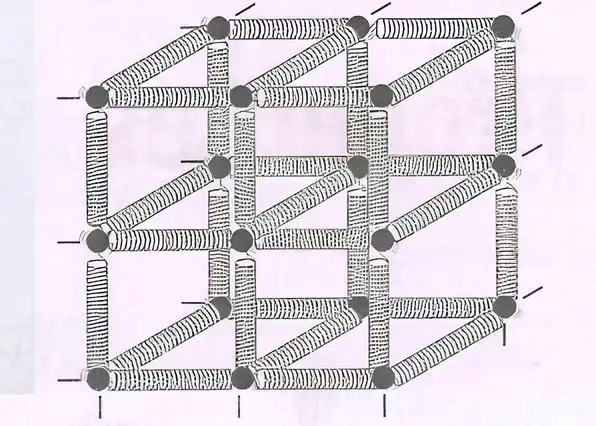
Elastic Behaviour of Solids
Stress
Here, is the restoring force and is the area over which it acts.
| Type | Loading | Description |
|---|---|---|
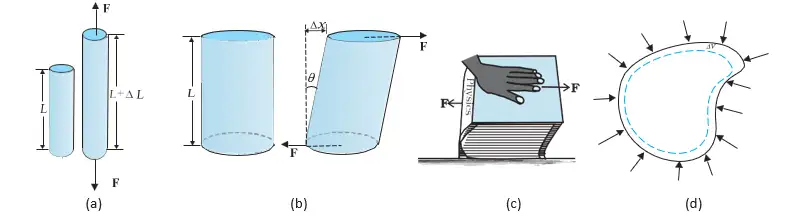
| Longitudinal | Force along the body's length | Restoring force per unit area along the length. |
| Tensile | Equal outward forces normal to a cylinder's cross-section | Longitudinal stress that stretches the cylinder. |
| Compressive | Forces that compress the body | Longitudinal stress produced during compression. |
| Tangential (shearing) | Force parallel to a cross-sectional area | Restoring force per unit area due to tangential loading. |
Strain
is the change in length and is the original length.
is the relative displacement of opposite faces, is their separation, and is the shear angle.
is the change in volume and is the original volume.
Hydraulic Stress and Shape Change
- Hydraulic stress: Stress acts normal to the surface at every point.
- Effect: It changes volume, giving volume strain , but does not change the body's shape.
Quick recap
- Elasticity is the tendency to recover the original shape and size after removing the deforming force.
- Stress is restoring force per unit area: ; it is a tensor with SI unit .
- Longitudinal stress may be tensile or compressive; tangential stress is shearing stress.
- Longitudinal strain is and shearing strain is .
- Volume strain is ; hydraulic stress changes volume without changing shape.
Hooke’s Law
Hooke’s Law
Hooke’s law — For small deformations, stress is directly proportional to strain.
Key Points
- Discoverer: Robert Hooke, an English physicist, discovered the law of elasticity in 1676.
- Condition: Hooke’s law applies to small deformations.
- Modulus of elasticity: The proportionality constant is called the modulus of elasticity.
- SI unit of : .
- Dimension of : .
Here, denotes stress and denotes strain.
Quick recap
- Robert Hooke, an English physicist, discovered Hooke’s law in 1676.
- For small deformations, stress is directly proportional to strain.
- The proportionality constant is the modulus of elasticity, .
- The relation is , so .
- The SI unit of is ; its dimension is .
Stress-Strain Curve
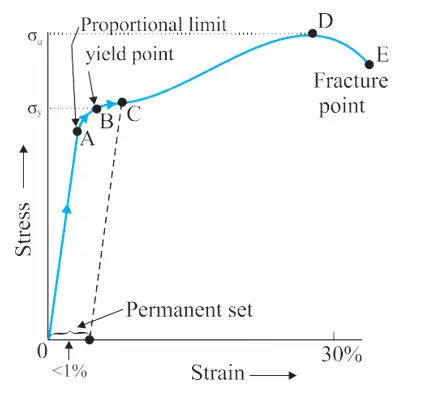
Stress-Strain Curve of a Metallic Wire
Behaviour as stress increases
- O to A: Stress is proportional to strain; the wire obeys Hooke’s law and returns to its original shape when stress is removed.
- A to B: Stress is no longer proportional to strain, but the wire can still regain its original shape.
- Point B: The yield point, or elastic limit. Beyond B, removing stress leaves a permanent set.
- B to D: Strain increases rapidly for relatively small increases in stress; D is the ultimate tensile strength.
- Point E: The fracture point, where the wire breaks; the stress there is the breaking stress.
In the linear region from O to A, stress is proportional to strain.
Ductility and brittleness
- Ductile material: A larger separation between D and E indicates greater ductility.
- Brittle material: A smaller separation between D and E indicates greater brittleness.
Elastic Behaviour and Elastomers
Elastic after-effect — The temporary delay in an elastic object regaining its original configuration after the deforming forces are removed.
Elastic fatigue — The reduction in a body’s elasticity caused by repeated alternate deforming forces.
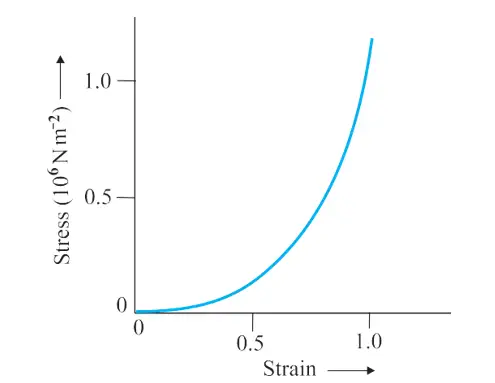
Elastomer — A material that can undergo large strains when stretched; examples include rubber and the elastic tissue of the aorta.
Factors Affecting Elasticity
| Factor | Effect on elasticity |
|---|---|
| Increasing temperature | Generally decreases elasticity. |
| Annealing (alternate heating and cooling) | Decreases elasticity. |
| More elastic impurity | Increases the material’s elasticity. |
| More plastic (less elastic) impurity | Decreases the material’s elasticity. |
Elastic Relaxation Time
Elastic relaxation time — The time taken by a body to restore its original form after the deforming force is removed.
| Material | Relaxation time |
|---|---|
| Phosphor bronze, silver and gold | Negligibly small. |
| Quartz | Minimum. |
| Glass | High. |
What is the yield point, and what happens beyond it?
How can the ductility of a material be inferred from the stress–strain curve?
Quick recap
- From O to A, stress is proportional to strain and Hooke’s law applies.
- B is the yield point; beyond it, deformation leaves a permanent set.
- D marks ultimate tensile strength; E marks fracture and breaking stress.
- A larger D–E separation indicates greater ductility; a smaller one indicates greater brittleness.
- Elastic after-effect is a temporary recovery delay; elastic fatigue follows repeated alternate deformation.
- Higher temperature and annealing generally reduce elasticity; impurity effects depend on whether the impurity is more elastic or more plastic.
- Elastic relaxation time is negligible for phosphor bronze, silver and gold, minimum for quartz, and high for glass.
Elastic Moduli
Modulus of elasticity — The ratio of stress to the corresponding strain; it is a characteristic property of a material.
Young’s Modulus
Young’s modulus — The ratio of longitudinal stress to the longitudinal strain it produces.
For a rod of length and cross-sectional area , stretched by force through extension :
- Ideal rigid body: It has because it undergoes no strain for an applied stress.
- Elasticity: A larger Young’s modulus means greater resistance to deformation; steel is more elastic than rubber.
Shear Modulus
Shear modulus — The ratio of shearing stress to the corresponding shearing strain.
For lateral displacement across height , the shear strain is approximately for small angles.
- Small-angle approximation: For very small angular displacement, .
- Approximate relation: For most materials, .
Bulk Modulus
Bulk modulus — The ratio of normal stress to the resulting volumetric strain; it applies to solids, liquids and gases.
For pressure and volume change , the negative sign accounts for volume decreasing as pressure increases.
- Material trend: Bulk modulus is much larger for solids and liquids than for gases: .
- Compressibility: It is the reciprocal of bulk modulus and measures how readily volume changes under pressure.
Using the lecture’s notation, compressibility is the reciprocal of bulk modulus.
| Type | Condition | Bulk modulus |
|---|---|---|
| Isothermal | Temperature remains constant | |
| Adiabatic | No heat exchange | , where |
- Comparison: Since , ; therefore .
Poisson’s Ratio
Poisson’s ratio — Within the elastic limit, it is the negative ratio of lateral strain to longitudinal strain.
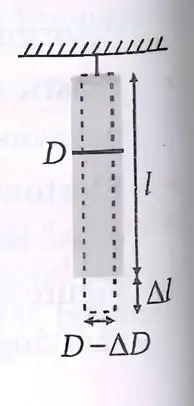
For original diameter and length , the negative sign indicates that lateral and longitudinal strains have opposite signs.
Elastic Potential Energy
Elastic potential energy — The work done against internal restoring forces during deformation, stored as energy in the body.
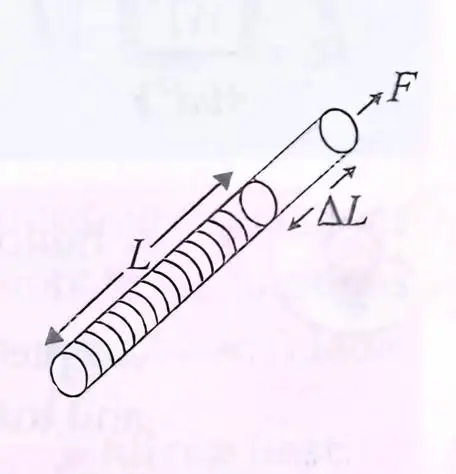
If the force increases from zero to , the average force is ; the stretched wire has volume .
For a linearly elastic material, energy density can also be written using Young’s modulus and strain .
| Substance | Density () | Young’s modulus | Ultimate strength | Yield strength |
|---|---|---|---|---|
| Aluminium | 2710 | 70 | 110 | 95 |
| Copper | 8890 | 110 | 400 | 200 |
| Iron (wrought) | 7800–7900 | 190 | 330 | 170 |
| Steel | 7860 | 200 | 400 | 250 |
| Glass | 2190 | 65 | 50 | — |
| Concrete | 2320 | 30 | 40 | — |
| Wood | 525 | 13 | 50 | — |
| Bone | 1900 | 9.4 | 170 | — |
| Polystyrene | 1050 | 3 | 48 | — |
Why is steel considered more elastic than rubber?
State the relationship between adiabatic and isothermal bulk moduli of a gas.
Write the elastic potential energy per unit volume of a stretched wire.
Quick recap
- A modulus of elasticity is the ratio of stress to corresponding strain.
- Young’s modulus describes longitudinal deformation; shear modulus describes angular deformation.
- Bulk modulus measures resistance to volume change, with .
- For gases, and , so the adiabatic value is larger.
- Compressibility is ; Poisson’s ratio is the negative ratio of lateral to longitudinal strain.
- Elastic energy density is .
Applications of Elastic Behaviour of Materials
Elasticity in Bridges
- Elastic strength: Bridge materials use their elastic strength to withstand loads.
- Long-term safety: Bridges may be declared unsafe after long use.
Estimating the Maximum Height of a Mountain
- Base stress: For a mountain of height , rock density and gravitational acceleration , the pressure (and stress) at its base is .
- Elastic limit: Typical rock has an elastic limit of . The base stress must remain below this limit; otherwise, the rock begins to flow.
- Estimate: Using and gives a maximum height of about .
- Comparison: Mount Everest is nearly high.
The stress at the mountain base must be less than the elastic limit of rock.
Bending of a Beam
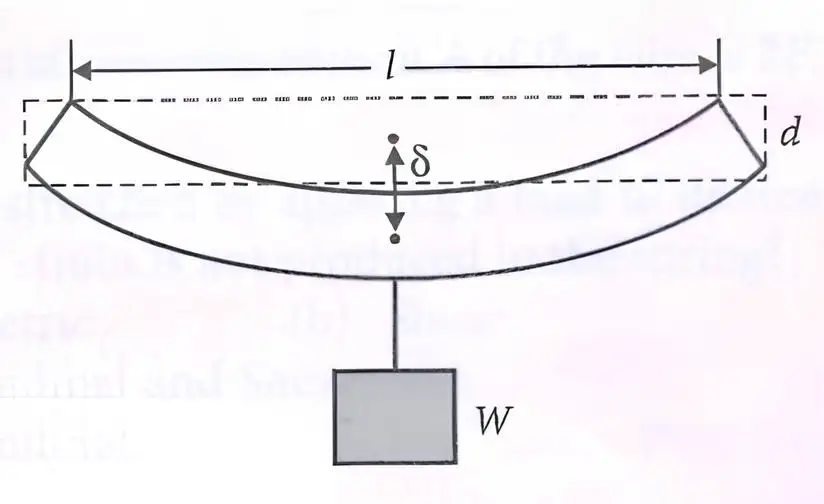
- Setup: A beam supported at both ends and loaded at its centre bends, or sags.
- Dimensions and variables: The beam has length , breadth and depth ; central load produces deflection . is Young’s modulus.
- Dependence: Deflection increases with and , and decreases with , and .
For a beam supported at both ends and loaded at the centre:
Strength of Hollow Shafts
- Comparison: A hollow shaft is stronger against twisting than a solid shaft of the same mass, length and material.
- Unit twist: The torque required to produce a unit twist measures resistance to twisting.
- Symbols: is the modulus of rigidity, is shaft length, is the solid shaft radius, and and are the inner and outer radii of the hollow shaft.
- Equal mass: For the same material and length, equal mass gives .
Compare solid and hollow shafts of the same length and material.
For equal mass, the hollow shaft requires more torque to produce a unit twist.
Estimate the maximum height of a mountain using the elastic limit of rock.
Why is a hollow shaft stronger than a solid shaft of the same mass, length and material?
Quick recap
- Bridges rely on the elastic strength of their materials and may be declared unsafe after long use.
- Mountain base stress is and must stay below the rock’s elastic limit.
- The estimated maximum mountain height is about ; Everest is nearly high.
- For a centrally loaded beam supported at both ends, .
- A hollow shaft is stronger against twisting than an equal-mass solid shaft.
- For equal mass, .
NEET Physics — ALL CHAPTERS
1
Basic Mathematics
2
Units and Measurement
3
Motion in a Straight Line
4
Motion in a Plane
5
Laws of Motion
6
Work, Energy and Power
7
System of Particles and Rotational Motion
8
Gravitation
9
Mechanical Properties of Solids
10
Mechanical Properties of Fluids
11
Thermal Properties of Matter
12
Thermodynamics
13
Kinetic Theory
14
Oscillations
15
Waves
16
Electric Charges and Fields
17
Electrostatic Potential and Capacitance
18
Current Electricity
19
Moving Charges and Magnetism
20
Magnetism and Matter
21
Electromagnetic Induction
22
Alternating Current
23
Electromagnetic Waves
24
Ray Optics and Optical Instruments
25
Wave Optics
26
Dual Nature of Radiation and Matter
27
Atoms
28
Nuclei
29
Semiconductor Electronics: Materials, Devices and Simple Circuits