NEET UG . NEET Physics . Physics . Dual Nature of Radiation and Matter
Chapter 26: Dual Nature of Radiation and Matter
Ch 26
NEET Physics
NEET UG
Electron Emission
Cathode Rays and the Electron
Identification and Charge of the Electron
- Electron: J.J. Thomson named the negatively charged particles electrons in 1897 and proposed that they are fundamental, universal constituents of matter.
- Millikan: In 1913, the oil-drop experiment showed that droplet charge is an integral multiple of the elementary charge; this established that charge is quantised.
- Electron properties: The elementary charge has magnitude . Combining with the measured gives the electron mass.
Electron Emission and Work Function
Work function — The minimum energy required for an electron to escape from a metal surface; it is usually expressed in electron volts (eV).
Methods of Electron Emission
What is work function?
Name the three types of electron emission and the energy source for each.
Quick recap
- Cathode rays are negatively charged particles; their is independent of the cathode material and gas.
- J.J. Thomson identified electrons in 1897; Millikan’s 1913 experiment established charge quantisation.
- Electron emission occurs when an electron gains enough energy to overcome the metal’s attractive forces.
- Work function is the minimum escape energy; .
- Thermionic, field and photoelectric emission use heat, a strong electric field and suitable-frequency light, respectively.
Photoelectric Effect
Early Observations
- Hertz: In 1887, he observed that ultraviolet light enhanced sparks across a detector gap.
- Hallwachs and Lenard: Their investigations from 1886 to 1902 established that light can cause electron emission from metals.
Photoelectric Emission and Threshold Frequency
| Metals | Light that can cause emission |
|---|---|
| Zinc, cadmium, magnesium | Ultraviolet light (short wavelength) |
| Alkali metals: Li, Na, K, Rb | Visible light can cause emission |
What is the threshold frequency?
Quick recap
- Photoelectric effect is the emission of electrons from a material exposed to suitable light.
- Emitted electrons are called photoelectrons; their motion can produce photocurrent.
- No electrons are emitted when incident-light frequency is below the material’s threshold frequency.
- Hertz observed ultraviolet-enhanced sparks; Hallwachs and Lenard later investigated the effect.
- Some metals require ultraviolet light, while alkali metals can emit electrons under visible light.
Experimental Study of Photoelectric Effect
Photoelectric Cell and Stopping Potential
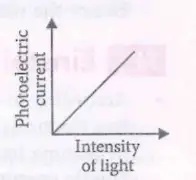
Effect of Light Intensity on Photocurrent
For fixed frequency and accelerating potential.
Effect of Collector Potential on Photocurrent
Here is the magnitude of the electron charge.
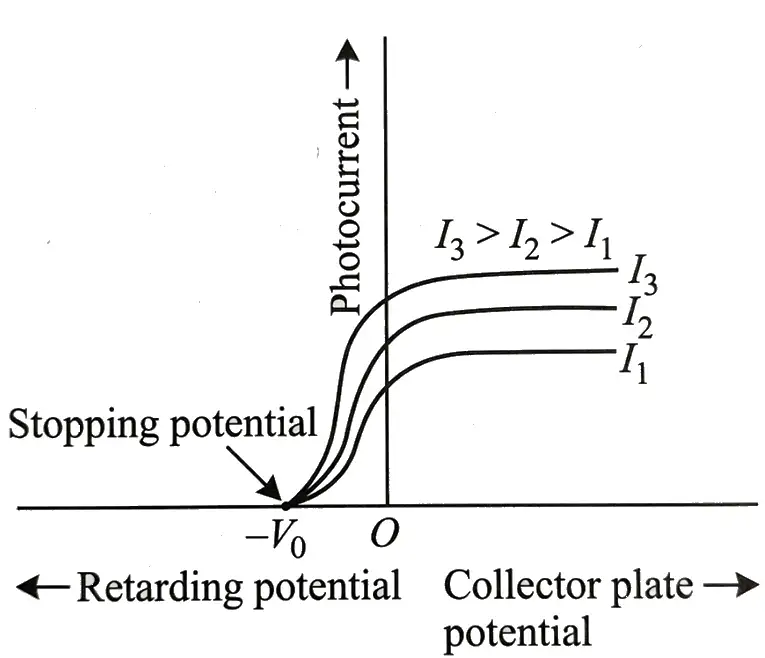
- For a fixed frequency, stopping potential is independent of light intensity.
- Greater intensity increases saturation current, not the maximum kinetic energy of photoelectrons.
Effect of Frequency on Stopping Potential
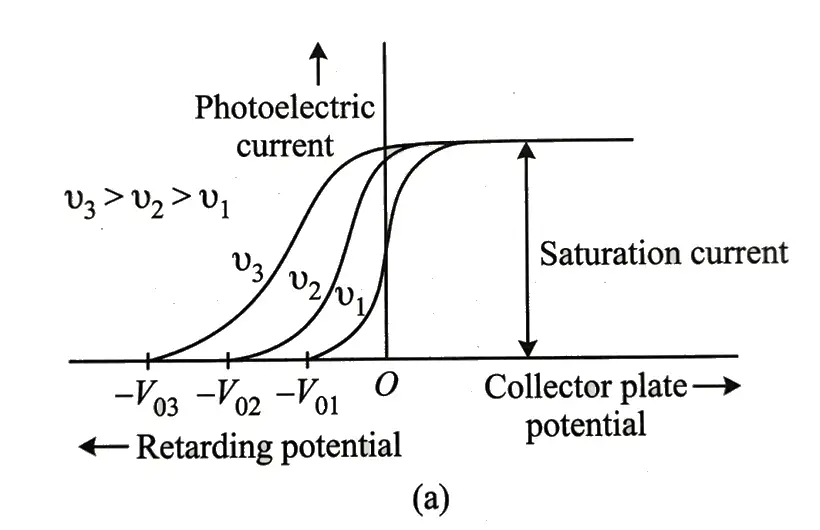
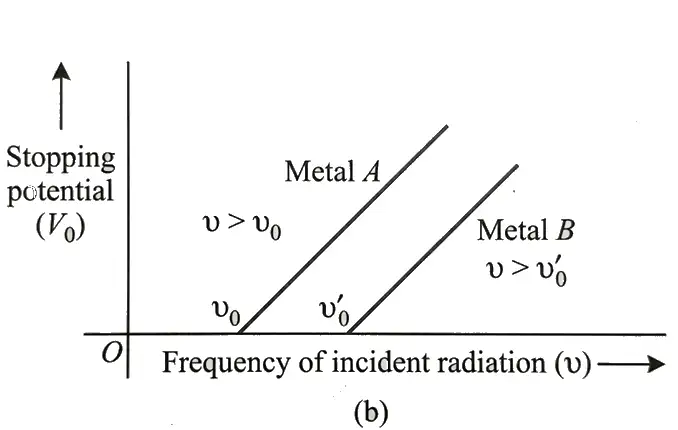
What happens to saturation current and stopping potential when light intensity increases at fixed frequency?
What is the relation between maximum kinetic energy and stopping potential?
Quick recap
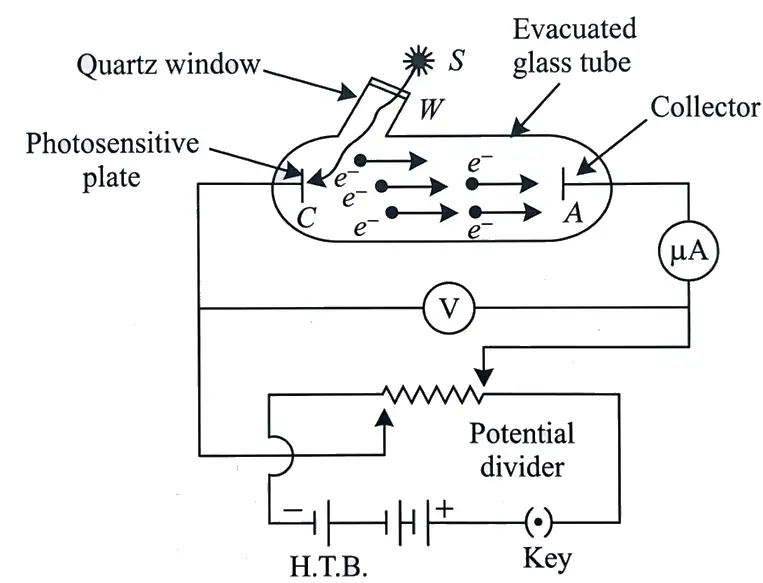
- A photoelectric cell uses an emitting electrode and a collecting electrode in an evacuated tube.
- Photocurrent is proportional to light intensity when frequency and accelerating potential are fixed.
- Saturation current is the maximum current when all emitted photoelectrons are collected.
- Stopping potential reduces photocurrent to zero and gives .
- At fixed frequency, stopping potential is independent of intensity.
- Stopping potential increases linearly with frequency; it is zero at the threshold frequency.
Photoelectric Effect and Wave Theory of Light
Wave Picture of Light and Photoelectric Emission
Wave picture of light — Light is an electromagnetic wave whose energy is continuously distributed through the region occupied by the wave.
- Fields: Light consists of electric and magnetic fields; greater intensity means greater amplitudes of both fields.
- Continuous absorption: In the wave picture, free electrons at the metal surface absorb radiant energy continuously.
- Intensity prediction: A more intense wave should transfer more energy to each electron, so the maximum kinetic energy of photoelectrons should increase with intensity.
- Threshold prediction: A sufficiently intense beam acting for long enough should give electrons enough energy to escape, whatever the frequency; therefore, no threshold frequency should exist.
| Prediction | Reason |
|---|---|
| Photoelectron maximum kinetic energy increases with intensity. | Greater intensity means more energy is absorbed by each electron. |
| No threshold frequency exists. | A sufficiently intense beam, acting for long enough, should enable electrons to escape at any frequency. |
- Limitation: These predictions contradict the observed features of photoelectric emission, so the wave picture cannot explain its most basic features.
Quick recap
- Light in the wave picture is an electromagnetic wave with energy continuously distributed through space.
- Free electrons at a metal surface are assumed to absorb radiant energy continuously.
- Greater intensity corresponds to greater electric- and magnetic-field amplitudes.
- Wave theory predicts that photoelectron maximum kinetic energy increases with intensity.
- It predicts that sufficiently intense light of any frequency can eject electrons, so no threshold frequency should exist.
- These predictions contradict observations, limiting wave theory's explanation of photoelectric emission.
Einstein’s Photoelectric Equation: Energy Quantum of Radiation
Einstein’s Photoelectric Equation
Energy transfer during photoemission
- Photon absorption: A surface electron absorbs the incident photon’s energy, , completely.
- Energy balance: Part of this energy frees the electron from the metal; the remainder becomes the emitted electron’s kinetic energy.
- Maximum kinetic energy: The most energetic photoelectrons have kinetic energy .
Work function () — The minimum energy required to liberate an electron from a metal surface.
Threshold frequency and wavelength
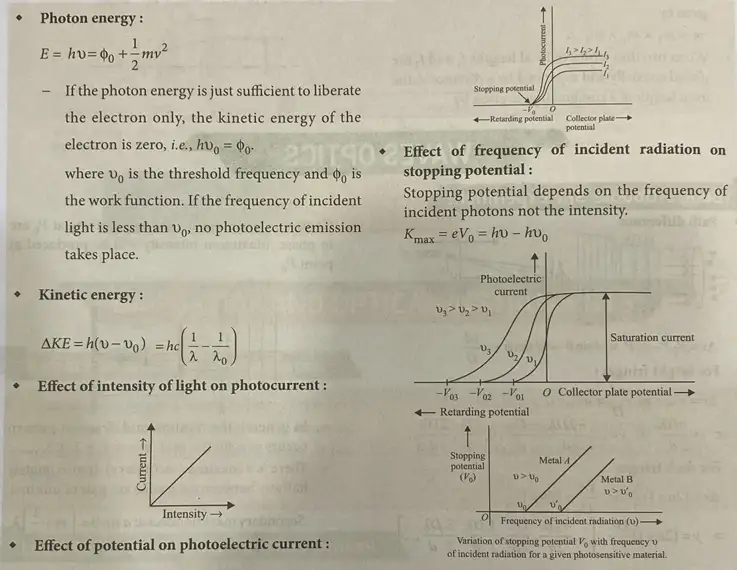
- Threshold frequency (): The minimum frequency that can just liberate an electron; at this threshold, the emitted electron has zero kinetic energy.
- Threshold wavelength (): The longest wavelength that can cause photoemission, related to threshold frequency by .
- Threshold energy: At the threshold, photon energy equals the metal’s work function.
Determining Planck’s Constant and Work Function
Stopping potential versus frequency
- Stopping potential (): The stopping potential satisfies .
- Linear relation: Substituting Einstein’s equation gives a straight-line relation between and frequency .
- Slope: The graph’s slope is , so it is independent of the material used.
- Intercepts: The frequency-axis intercept is ; the potential-axis intercept is .
Use the slope to determine Planck’s constant.
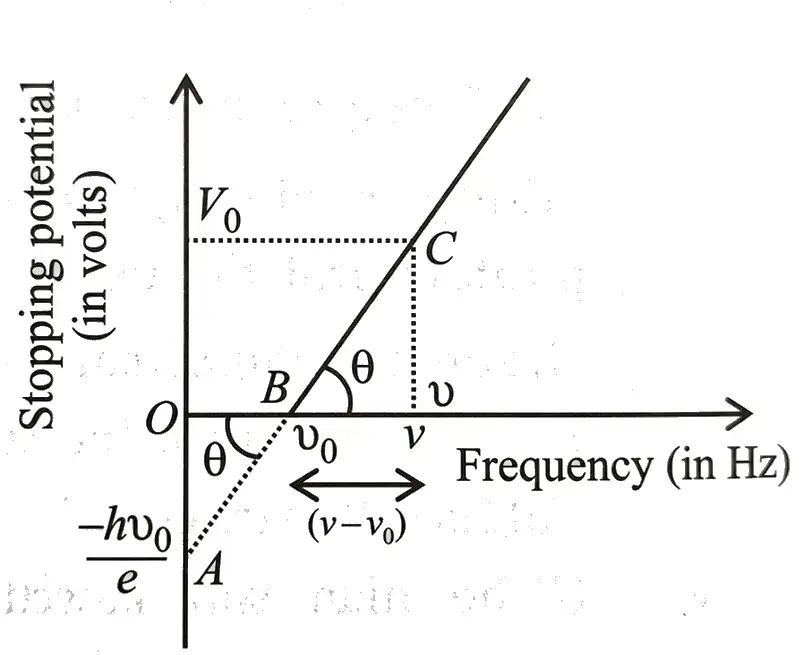
How can Planck’s constant be found from a stopping-potential versus frequency graph?
How can the work function be found from the graph?
Do not treat the stopping-potential graph’s slope as : its slope is , so multiply by to obtain Planck’s constant.
Quick recap
- A photon transfers energy completely to a surface electron.
- The energy balance is .
- At threshold, and .
- The maximum kinetic energy is .
- The – graph is a straight line with slope .
- The frequency-axis intercept gives ; the potential-axis intercept gives .
Particle Nature of Light: The Photon
Photon — A photon is a discrete quantum of electromagnetic radiation, which behaves like a particle when radiation interacts with matter.
Energy and momentum of a photon
Here, is Planck's constant, is frequency, is wavelength and is the speed of light.
A photon has momentum despite having zero rest mass.
Photon properties
- Energy and intensity: Photon energy depends on frequency, not radiation intensity.
- Speed: Photons travel through space at the speed of light, .
- Frequency and colour: Frequency determines a photon's energy and colour and remains unchanged as it travels through different media.
- Charge: Photons are not deflected by electric or magnetic fields, showing that they are electrically neutral.
- Mass: Photons are massless particles; their rest mass is zero.
- Interactions: In photon-particle collisions, energy and momentum are conserved, but the number of photons may not be conserved.
Do not confuse intensity with photon energy: increasing intensity does not increase the energy of each photon; photon energy is set by frequency.
State the energy and momentum of a photon.
Which quantities are conserved in a photon-particle collision?
Quick recap
- Radiation behaves as photons in interactions with matter.
- A photon's energy is and its momentum is .
- Photon energy depends on frequency, not radiation intensity.
- Photons travel at speed , have zero rest mass, and are electrically neutral.
- Photons are not deflected by electric or magnetic fields; frequency, energy and colour remain unchanged across media.
- Energy and momentum are conserved in photon collisions, but photon number may change.
Wave Nature of Matter
de Broglie Hypothesis
- Proposal: In 1924, Louis de Broglie proposed that moving particles of matter can display wave-like properties.
- Symmetry: He reasoned that matter and energy should have symmetrical physical characters, just as radiation shows both wave and particle properties.
- Recognition: De Broglie received the 1929 Nobel Prize in Physics for his discovery of the wave nature of the electron.
de Broglie Wavelength
Use for a particle with momentum ; for non-relativistic motion, .
Electron Accelerated Through a Potential
For an electron accelerated from rest through potential , the wavelength is in nanometres when is in volts.
State de Broglie’s relation and define the de Broglie wavelength.
Quick recap
- De Broglie proposed in 1924 that moving matter can show wave-like properties.
- Waves associated with moving particles are called matter waves or de Broglie waves.
- The de Broglie wavelength is .
- For an electron accelerated from rest, when is in volts.
- De Broglie received the 1929 Nobel Prize in Physics for the discovery of the wave nature of the electron.
NEET Physics — ALL CHAPTERS
1
Basic Mathematics
2
Units and Measurement
3
Motion in a Straight Line
4
Motion in a Plane
5
Laws of Motion
6
Work, Energy and Power
7
System of Particles and Rotational Motion
8
Gravitation
9
Mechanical Properties of Solids
10
Mechanical Properties of Fluids
11
Thermal Properties of Matter
12
Thermodynamics
13
Kinetic Theory
14
Oscillations
15
Waves
16
Electric Charges and Fields
17
Electrostatic Potential and Capacitance
18
Current Electricity
19
Moving Charges and Magnetism
20
Magnetism and Matter
21
Electromagnetic Induction
22
Alternating Current
23
Electromagnetic Waves
24
Ray Optics and Optical Instruments
25
Wave Optics
26
Dual Nature of Radiation and Matter
27
Atoms
28
Nuclei
29
Semiconductor Electronics: Materials, Devices and Simple Circuits