NEET UG . NEET Physics . Physics . Oscillations
Chapter 14: Oscillations
Ch 14
NEET Physics
NEET UG
Periodic and Oscillatory Motions
Periodic and Oscillatory Motions
Key features and examples
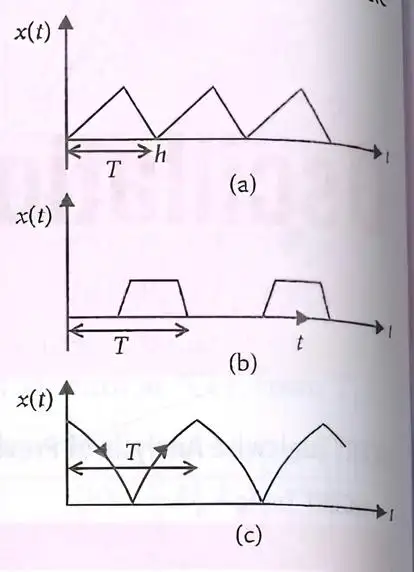
- Repeat interval: A periodic motion returns to the same state after a fixed time.
- Examples: Earth’s revolution around the Sun, Mercury’s orbit and the recurring appearance of Halley’s comet.
- Other examples: Vibrating strings, drum membranes, speaker diaphragms, atoms vibrating in solids and alternating voltage.
- Figure: Different displacement–time waveforms can all be periodic if they repeat after the same interval .
Oscillatory or vibratory motion — Periodic, bounded motion in which a body repeatedly moves to and fro about a fixed point called the mean position.
Features and examples
- Mean position: The central reference point about which the body moves.
- Extreme positions: The limits of motion on either side of the mean position.
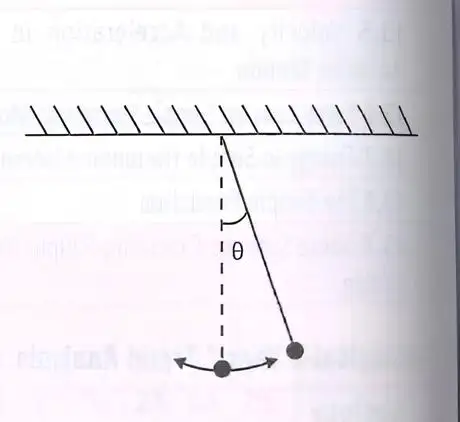
- Examples: A pendulum, vibrating strings and vibrating membranes.
- Distinction: Every oscillatory motion is periodic, but periodic motion need not be oscillatory; planetary revolution is periodic but is not motion to and fro about a fixed point.
Time Period, Frequency and Angular Frequency
Time period — The smallest time interval after which the motion repeats; it is denoted by .
Time-period facts
- SI unit: Second ().
- Examples: Mercury’s orbital period is 88 Earth days; Halley’s comet appears about every 76 years.
Frequency — The number of oscillations per unit time; it is denoted by .
Frequency and time period are reciprocals.
Frequency facts
- SI unit: Hertz (), where , or one oscillation per second.
- Example: A heartbeat frequency of corresponds to a period of .
Angular frequency — The angular rate of oscillation, denoted by .
Its SI unit is radians per second.
Displacement and Periodic Functions
Displacement — A time-varying quantity describing change in position, angle, pressure, or an electric or magnetic field.
Displacement in oscillatory motion
- Sign: Displacement can be positive or negative relative to the mean position.
- Pendulum example: The angle measured from the vertical can serve as the displacement variable.
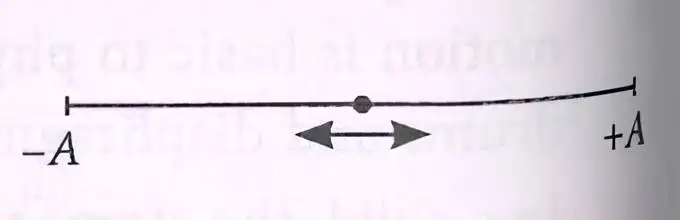
- Amplitude: The maximum displacement from the mean position, denoted by .
- Common forms: A periodic displacement may be represented by a sine or cosine function.
Examples of periodic displacement functions with amplitude .
Periodic function — A function that repeats its values after a fixed time interval.
The function repeats after its period .
Examples and properties
- Periodic examples: , , and each have period .
- Non-periodic examples: and do not repeat at a fixed interval.
- Superposition: Any periodic function can be expressed as a suitable sum of sine and cosine functions with different periods and coefficients.
Do not treat all periodic motion as oscillatory: oscillatory motion must be bounded and move to and fro about a mean position.
State the relation between frequency and time period, and give the SI unit of frequency.
What is the condition for a function to be periodic?
Quick recap
- Periodic motion repeats identically after a fixed interval .
- Oscillatory motion is bounded to-and-fro motion about a mean position.
- The time period is measured in seconds; frequency is measured in hertz and .
- Angular frequency is rad s.
- Displacement can be positive or negative; amplitude is its maximum value from the mean position.
- A periodic function satisfies ; sine and cosine functions are standard examples.
Simple Harmonic Motion
Definition and Condition for SHM
Displacement, Amplitude and Phase
| Time | Position |
|---|---|
Period and Speed
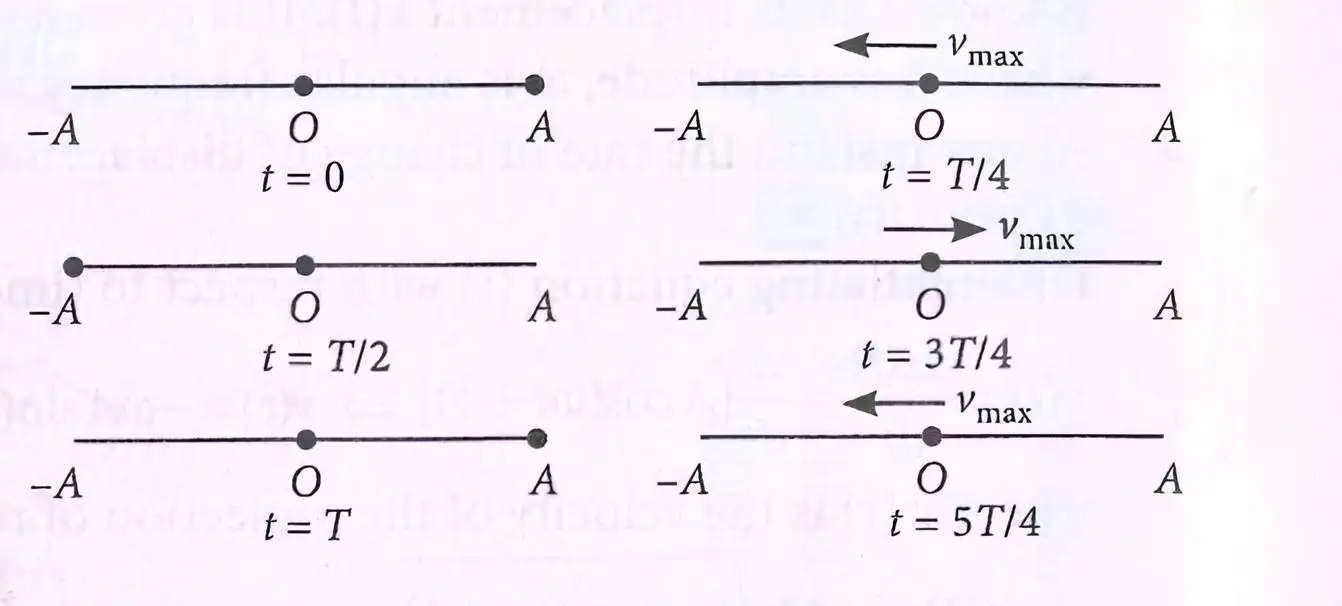
- Period () is the time taken for one complete cycle; the motion repeats after each interval .
- Initial position: the period remains the same regardless of which position is chosen as .
- Speed is maximum at the mean position () and zero at the extremes ().
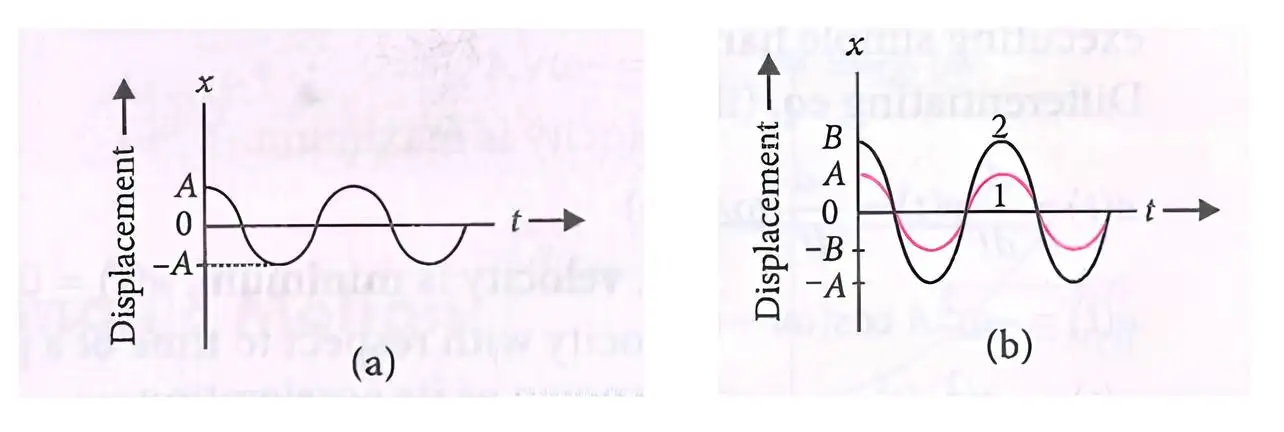
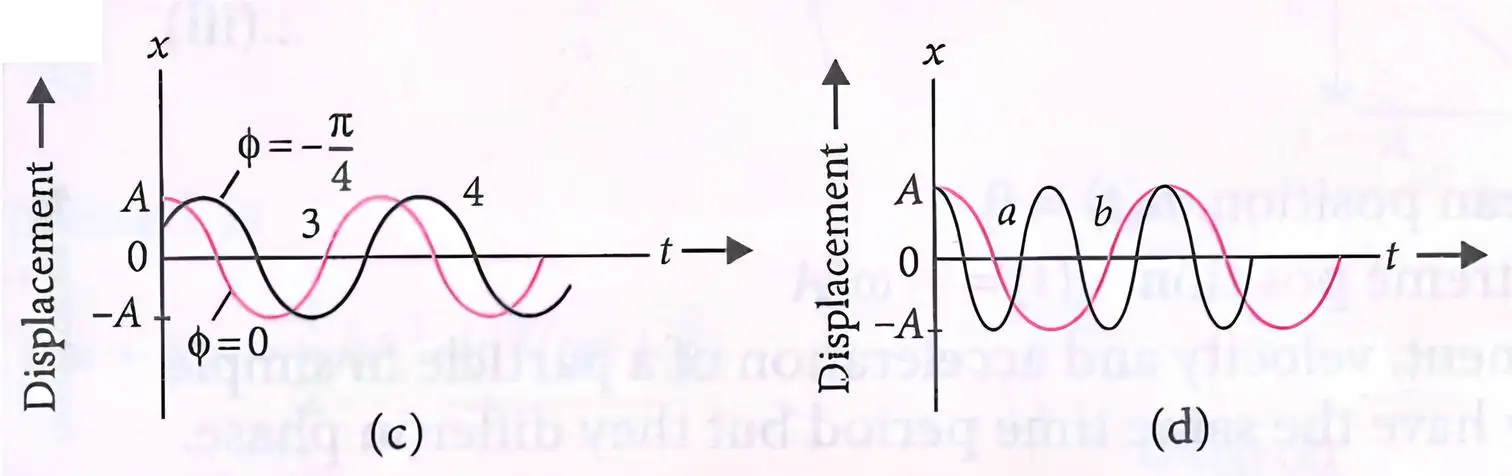
Reading Displacement–Time Graphs
- Amplitude change alters the maximum displacement; curves with different amplitudes can have the same period.
- Phase change shifts the curve along the time axis; for example, and have the same amplitude but different starting phases.
- Period change changes the time for one complete cycle; a shorter period means more rapid oscillation.
Use to relate the angular frequency of SHM to its period.
State the condition for a particle to perform SHM.
Where are the speed and displacement of an SHM particle respectively maximum?
What is the relation between angular frequency and period?
Quick recap
- SHM is periodic to-and-fro motion about a mean position under a restoring force.
- Its acceleration points towards a fixed point and is proportional to, and opposite in direction to, displacement: .
- The displacement is , and the particle moves between and .
- The period is the time for one cycle and does not depend on the chosen initial position.
- Speed is greatest at the mean position and zero at the extremes.
- Angular frequency and period are related by .
Simple Harmonic Motion and Uniform Circular Motion
Circular Motion and Its Projections
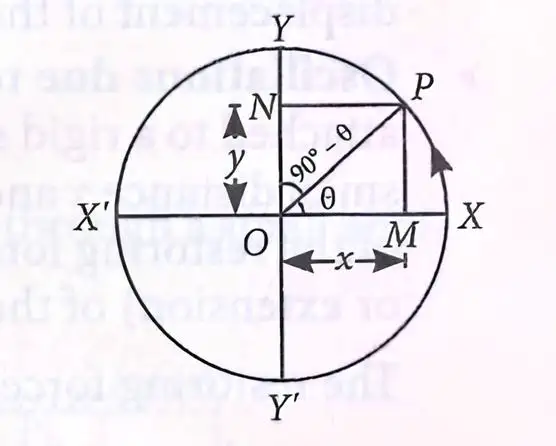
Projection of uniform circular motion — The projection of a particle moving uniformly on a circle onto a diameter executes simple harmonic motion (SHM).
Circular-motion setup
- Motion: A particle moves anticlockwise on a circle of radius with angular speed .
- Axes: Take the circle's centre as the origin; use two perpendicular diameters as the - and -axes.
- Starting point: At , the particle is at on the positive -axis. After time , its angular displacement is .
SHM Along the Two Diameters
Coordinate projections
- -projection: The foot of the perpendicular from to the -axis has coordinate .
- -projection: The foot of the perpendicular from to the -axis has coordinate .
- SHM on each axis: Both projections execute SHM, each with amplitude and angular frequency .
- Phase difference: The two SHMs differ in phase by ; the -projection is ahead of the -projection.
- Uniform circular motion projected onto either perpendicular diameter is SHM.
- Both projected SHMs have the same amplitude and angular frequency .
- The - and -projections have a phase difference of .
Quick recap
- A particle in uniform circular motion has radius and angular speed .
- With the particle starting on the positive -axis, its angular position is .
- The -projection follows .
- The -projection follows .
- Each projection is SHM with amplitude and angular frequency .
- The two perpendicular projections differ in phase by .
Velocity and Acceleration in Simple Harmonic Motion
Displacement in SHM
- Displacement: The distance from the mean position at any instant is given by .
- Parameters: Here, is the amplitude, the angular frequency, and the phase angle.
Velocity in SHM
This gives the speed for a known displacement; the velocity sign depends on the direction of motion.
| Position | Velocity |
|---|---|
| Mean position, | Maximum speed: |
| Extreme positions, | Velocity is zero |
Acceleration in SHM
| Position | Acceleration |
|---|---|
| Mean position, | |
| Positive extreme, | |
| Negative extreme, |
Phase Relations
Do not assume velocity is always negative from the minus sign in its equation; its sign changes with the particle’s direction of motion.
Where are the speed and acceleration magnitudes maximum in SHM?
Quick recap
- Displacement in SHM is .
- Velocity is , with maximum speed .
- Speed is greatest at the mean position and zero at the extremes.
- Acceleration obeys and points toward the mean position.
- Acceleration is zero at the mean position and has greatest magnitude at the extremes.
- Displacement, velocity, and acceleration share a time period but differ in phase.
Force Law for Simple Harmonic Motion
Force Law of SHM
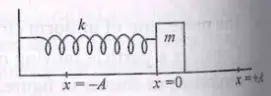
Oscillations Due to a Spring
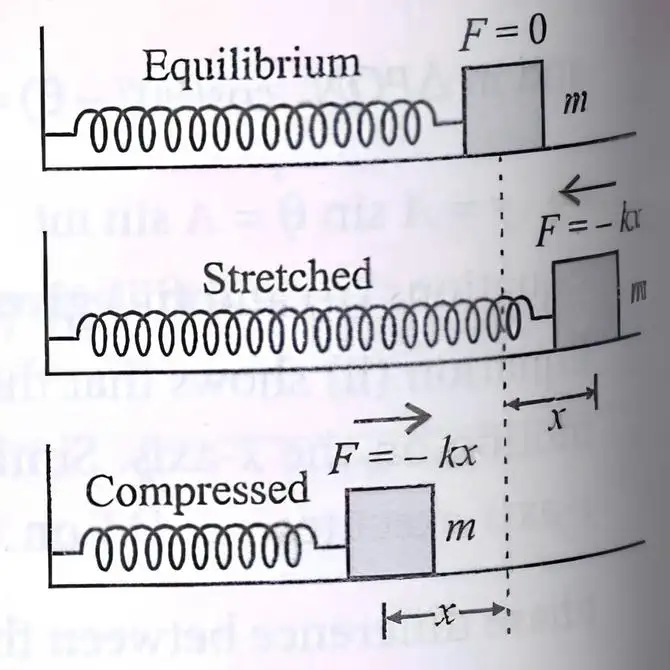
Equating the acceleration forms and gives the angular frequency.
Using , the time period depends on the mass and spring constant.
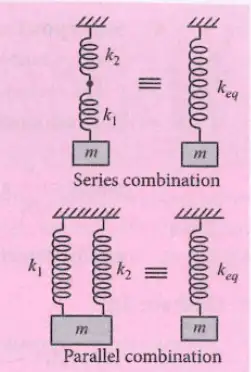
Springs in Combination
| Point | Series | Parallel |
|---|---|---|
| Equivalent spring constant | ||
| Time period for mass |
State the force law for SHM and explain the negative sign.
Find the time period of a mass attached to a spring.
Quick recap
- The SHM force is proportional to displacement and opposite in direction: .
- A massless spring and mass give acceleration , so the motion is SHM.
- For a spring-mass system, and .
- For springs in series, .
- For springs in parallel, ; use in the time-period formula.
Energy in Simple Harmonic Motion
Potential and Kinetic Energy
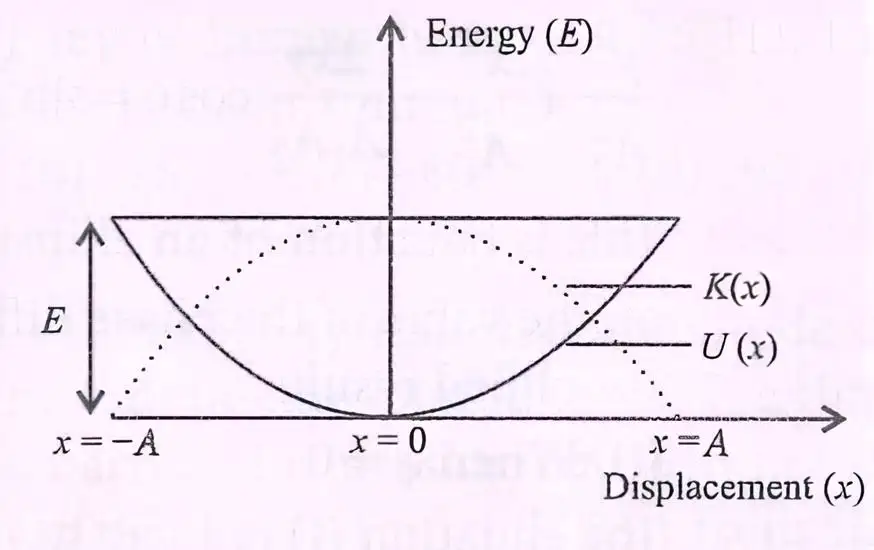
Potential Energy
- Potential energy in SHM is proportional to the square of displacement from equilibrium.
- Position dependence: is parabolic; it is minimum at and maximum at the turning points .
Here, is the force constant, is the amplitude, and is the phase constant.
Kinetic Energy
- Kinetic energy depends on the square of velocity and is greatest at equilibrium, where speed is maximum.
- At turning points: velocity and kinetic energy are zero; kinetic energy varies parabolically with position.
Here, is the oscillator's mass and is its angular frequency.
Conservation of Total Mechanical Energy
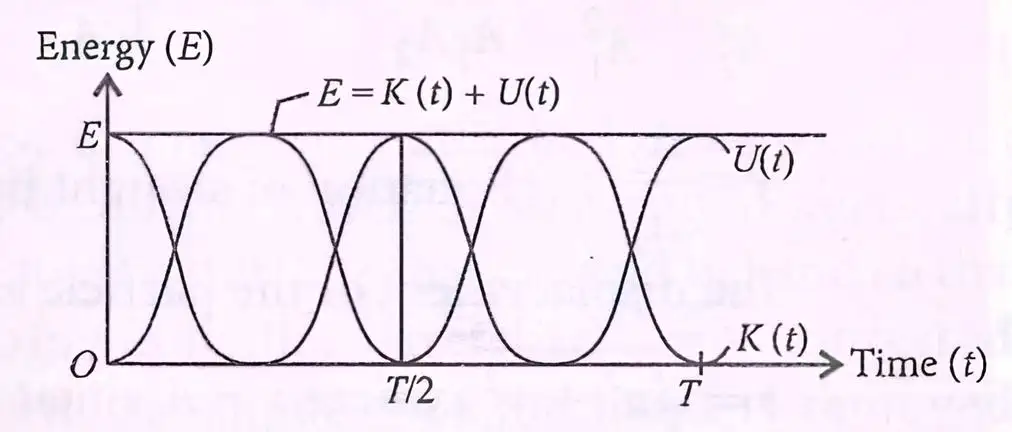
Total mechanical energy — The sum of kinetic and potential energies; in SHM it remains constant as energy shifts between the two forms.
The total is independent of time because .
Energy Exchange
- At equilibrium: is minimum and is maximum.
- At the turning points: is maximum and .
- Conservative force: constant total mechanical energy is expected for motion under a conservative force.
Quick recap
- Potential energy is and varies parabolically with displacement.
- Kinetic energy is and is greatest at equilibrium.
- At the turning points, , velocity and kinetic energy are zero.
- Potential and kinetic energies continuously exchange as the oscillator moves.
- Total energy is constant: .
The Simple Pendulum
The Simple Pendulum
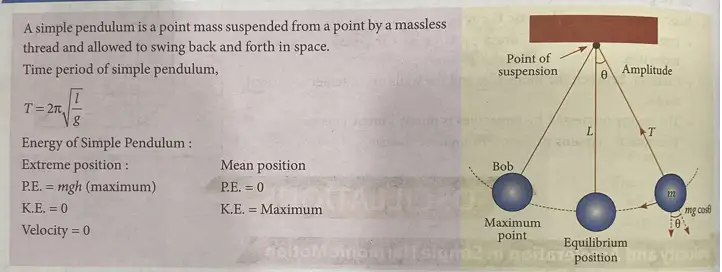
Using and the small-angle approximation gives the angular SHM equation.
Comparing with gives . The result applies to small oscillations.
- Period: For small oscillations, depends on and , not on the bob’s mass.
- Condition: The formula is based on ; it is not exact for large angular displacements.
Superposition of Two Perpendicular SHMs
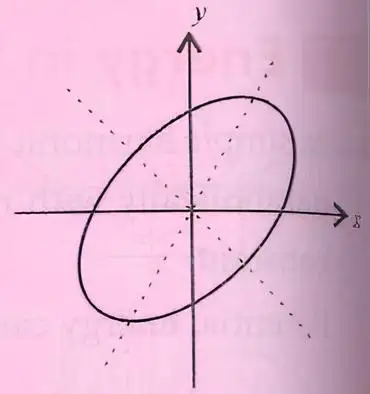
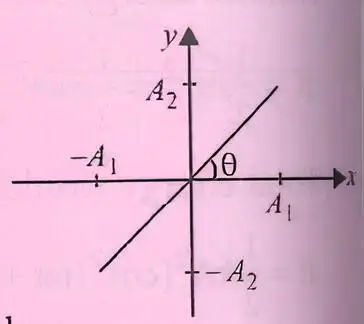
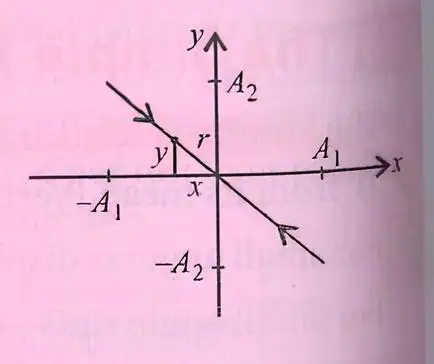
| Phase difference | Path | Resultant motion |
|---|---|---|
| ; a straight line through the origin. | SHM along the line, with amplitude and angular frequency . | |
| ; a straight line through the origin with negative slope. | SHM along the line, with amplitude and angular frequency . | |
| ; an ellipse. | If , the path is a circle: . |
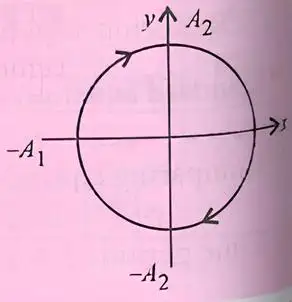
Derive the time period of a simple pendulum for small oscillations.
What path results when two equal-amplitude perpendicular SHMs have phase difference ?
Quick recap
- For small angles, a pendulum’s restoring torque is approximately .
- The simple pendulum’s angular frequency is and its period is .
- Two perpendicular SHMs trace a path set by their phase difference and amplitudes.
- Phase difference gives a positive-slope straight line; phase difference gives a negative-slope straight line.
- Phase difference gives an ellipse, which becomes a circle for equal amplitudes.
NEET Physics — ALL CHAPTERS
1
Basic Mathematics
2
Units and Measurement
3
Motion in a Straight Line
4
Motion in a Plane
5
Laws of Motion
6
Work, Energy and Power
7
System of Particles and Rotational Motion
8
Gravitation
9
Mechanical Properties of Solids
10
Mechanical Properties of Fluids
11
Thermal Properties of Matter
12
Thermodynamics
13
Kinetic Theory
14
Oscillations
15
Waves
16
Electric Charges and Fields
17
Electrostatic Potential and Capacitance
18
Current Electricity
19
Moving Charges and Magnetism
20
Magnetism and Matter
21
Electromagnetic Induction
22
Alternating Current
23
Electromagnetic Waves
24
Ray Optics and Optical Instruments
25
Wave Optics
26
Dual Nature of Radiation and Matter
27
Atoms
28
Nuclei
29
Semiconductor Electronics: Materials, Devices and Simple Circuits