Transverse and Longitudinal Waves
Wave — A wave is a travelling disturbance that transfers energy from one place to another without transporting matter overall.
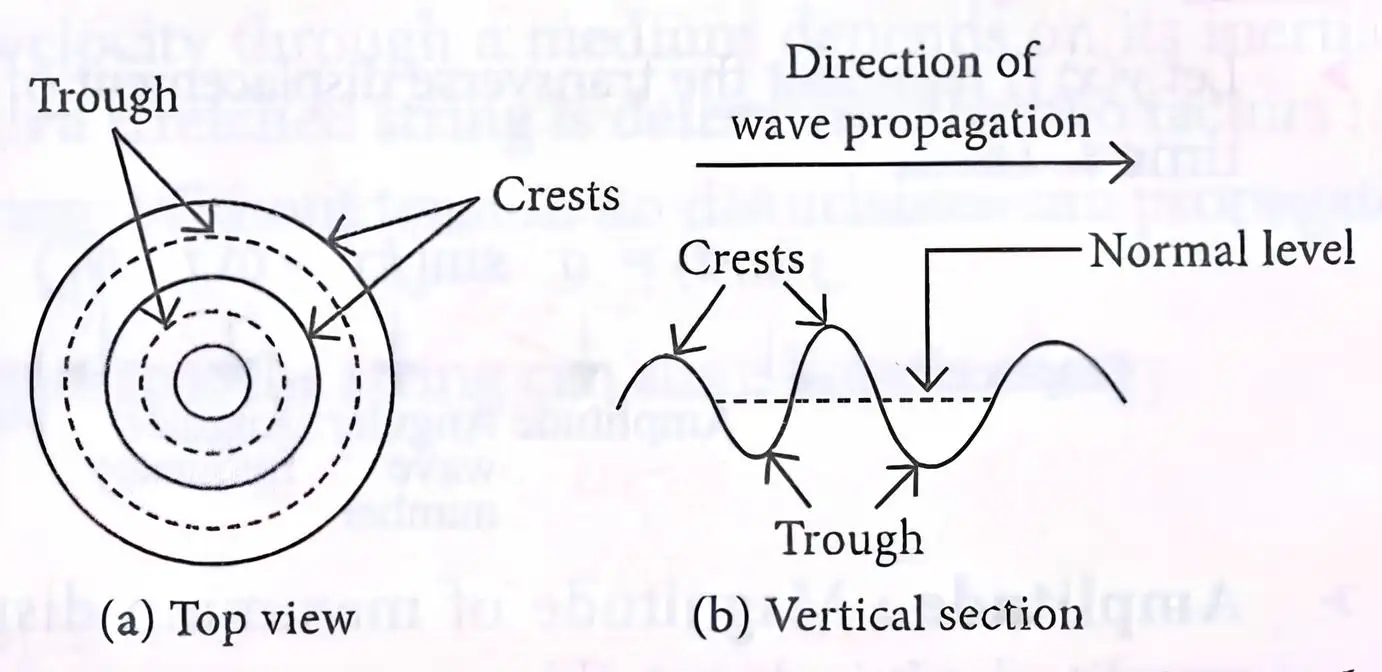
Types of Waves
| Type | Medium required | Nature and examples |
|---|---|---|
| Mechanical waves | Yes | Governed by Newton's laws; occur in material media. They are either transverse or longitudinal. Examples: water, sound and seismic waves. |
| Electromagnetic waves (non-mechanical waves) | No | Oscillating electric and magnetic fields; light from the Sun and stars travels through near-vacuum. |
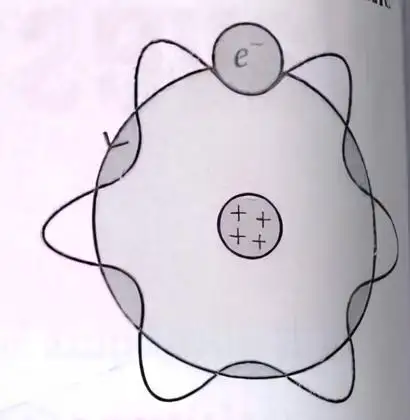
| Matter waves (de Broglie waves) | Associated with moving microscopic particles | Associated with electrons, protons, neutrons, atoms and molecules; important in the quantum-mechanical description of matter. |
Matter Waves
- Moving particles: Matter waves are associated with microscopic particles in motion.
- Example: A fast-moving electron in an electron microscope has an associated matter wave; an electron revolving around a nucleus also has one.
- Importance: Matter waves become important in the quantum-mechanical description of matter.
Transverse and Longitudinal Waves
| Point | Transverse wave | Longitudinal wave |
|---|---|---|
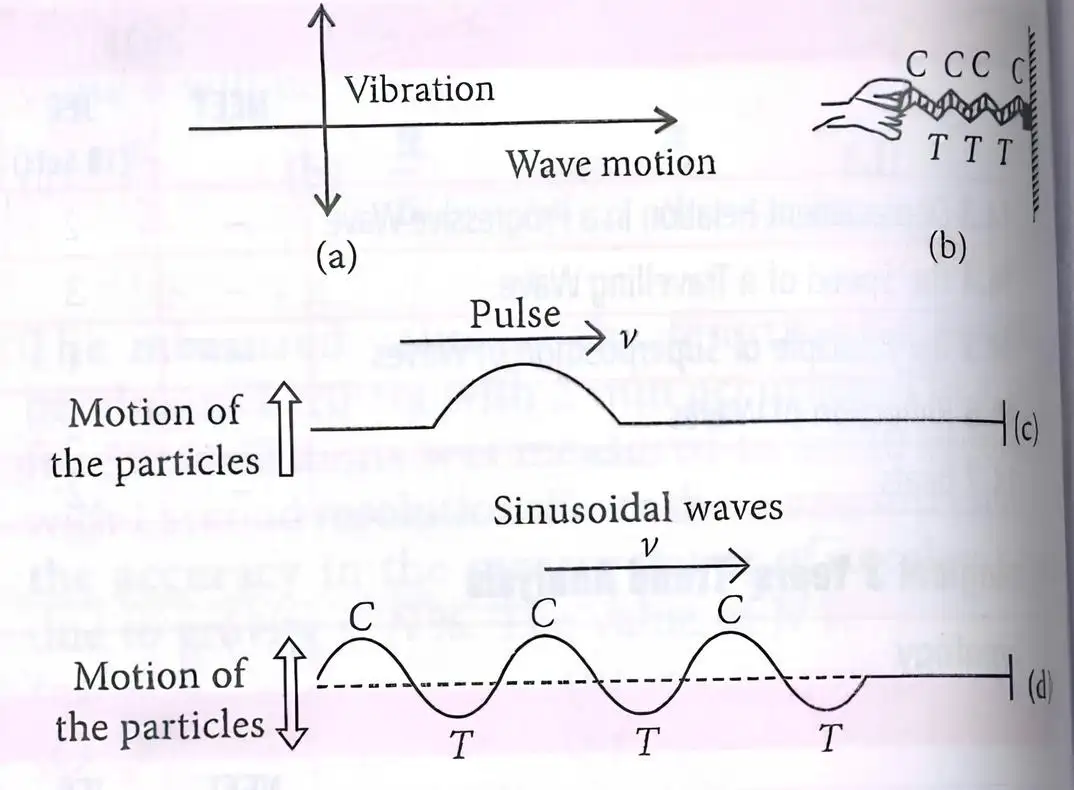
| Particle vibration | Perpendicular to the direction of wave motion or energy propagation | Parallel to the direction of wave motion |
| Wave pattern | Crests and troughs | Compressions and rarefactions |
| Other name | — | Pressure wave or compressional wave |
| Examples | Wave along a stretched string | Sound in air; waves along a spring |

Surface Waves in Water
- Combined motion: Ocean-surface waves involve both transverse and longitudinal particle motion; the particle motion is complicated.
- Wave speeds: Transverse and longitudinal waves generally travel at different speeds in the same medium.
| Type | Wavelength | Restoring force |
|---|---|---|
| Capillary waves | Short; appear as ripples | Surface tension of water |
| Gravity waves | Several metres to several hundred metres | Gravity |
Distinguish between transverse and longitudinal waves.
What are capillary and gravity waves, and what provides their restoring force?
Quick recap
- Waves transfer energy without transporting matter overall.
- Mechanical waves require a material medium and are either transverse or longitudinal.
- Electromagnetic waves are non-mechanical and can travel through a vacuum.
- Matter waves are associated with moving microscopic particles and are important in quantum mechanics.
- Transverse vibration is perpendicular to wave travel; longitudinal vibration is parallel.
- Water-surface waves combine both types of particle motion; capillary and gravity waves have different restoring forces.
Displacement Relation in a Progressive Wave
Displacement Equation
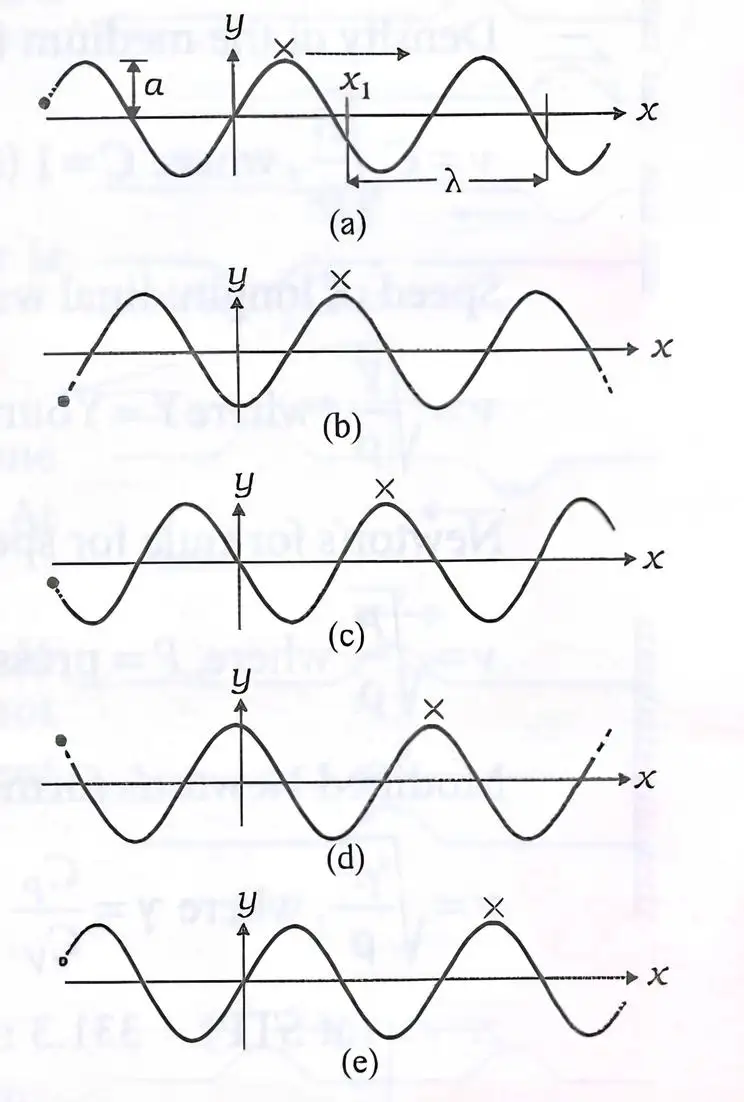
Progressive wave displacement — For a harmonic wave travelling in the positive -direction, the displacement at position and time is represented by a sinusoidal function.
Here, is displacement, is amplitude, is angular wave number, is angular frequency, and is initial phase.
Wave Quantities
Amplitude — The maximum magnitude of a particle’s displacement from its equilibrium position; denoted by .
Phase — The argument of the sine or cosine in the displacement equation; for this wave it is .
Wavelength — The minimum distance between two points having the same phase; denoted by .
Time period — The time taken by a medium particle to complete one to-and-fro vibration about its mean position; denoted by .
Frequency — The number of oscillations completed per unit time by a medium particle; denoted by and measured in hertz () or .
Frequency is the reciprocal of the time period.
Angular frequency — The rate of change of phase with time; denoted by and measured in .
The phase changes by during one period.
Angular wave number — The number of radians of phase change per unit distance; denoted by .
One wavelength corresponds to a phase change of .
Direction of Propagation
- Wave travel: The medium particles oscillate about their mean positions while the wave pattern moves.
- Positive direction: In the given wave, crests move towards increasing as time passes.
Write the displacement relation for a harmonic wave travelling in the positive x-direction and identify its parameters.
Quick recap
- A positive-x harmonic wave has displacement .
- Amplitude is maximum displacement; wavelength is the minimum same-phase separation.
- Frequency and period are related by .
- Angular frequency is .
- Angular wave number is .
- For the stated wave, the wave profile advances in the positive -direction.
The Speed of a Travelling Wave
Speed of a Travelling Wave
Wave speed — The speed of a travelling wave is the distance moved by a fixed-phase point, such as a crest, per unit time.
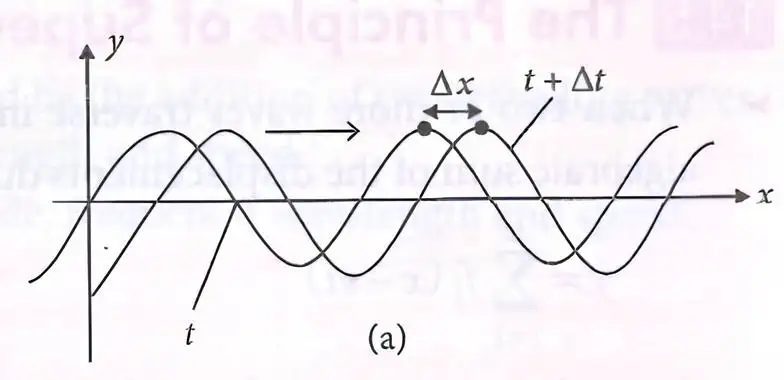
Fixed-phase derivation
- Phase condition: A point of fixed phase satisfies .
- Phase remains fixed: For a shift , .
- Instantaneous speed: In the limit of vanishing intervals, .
Using and , the general relation is obtained.
Transverse Wave on a Stretched String
Factors controlling the speed
- Tension, : Measures the string’s elasticity; without tension, a disturbance cannot propagate along it. Its dimensions are .
- Linear mass density, : Mass per unit length; it represents the string’s inertia and ability to store kinetic energy. Its dimensions are .
- Dimensional check: The ratio has dimensions , so its square root has the dimensions of speed.
The speed depends only on the string’s tension and linear mass density, not on the wave frequency.
Do not assume the string’s wave speed is set by its frequency: the source sets frequency, while and determine the speed.
Longitudinal Waves and Speed of Sound
Dependence on medium properties
- Bulk modulus, : Measures the medium’s resistance to compression and represents its elasticity.
- Density, : Represents the medium’s inertia.
- General relation: Experimentally, the proportionality constant is .
The speed depends on the medium’s bulk modulus and density.
For a solid rod, the elastic property is Young’s modulus .
Speed of Sound in an Ideal Gas
Newton’s expression relates sound speed to gas pressure and density .
The corrected expression includes the ratio of specific heat capacities, ; for air, .
| Point | Newton’s formula | Laplace correction |
|---|---|---|
| Expression | ||
| Factor included | No specific-heat ratio | Includes |
- For air at STP, the speed of sound is .
Quick recap
- A travelling wave’s speed is the speed of motion of any fixed-phase point.
- For a progressive wave, .
- On a stretched string, ; wave speed is independent of frequency.
- Longitudinal-wave speed depends on the medium’s elasticity and density.
- In a solid rod, .
- For an ideal gas, the Laplace-corrected sound speed is ; for air at STP it is .
The Principle of Superposition of Waves
Principle of Superposition
- Principle: When two or more waves travel through the same medium, the displacement of each particle is the algebraic sum of the displacements due to the individual waves.
Resultant of Two Harmonic Waves
The amplitude magnitude is greatest for in-phase waves and zero for waves in antiphase.
Constructive and Destructive Interference
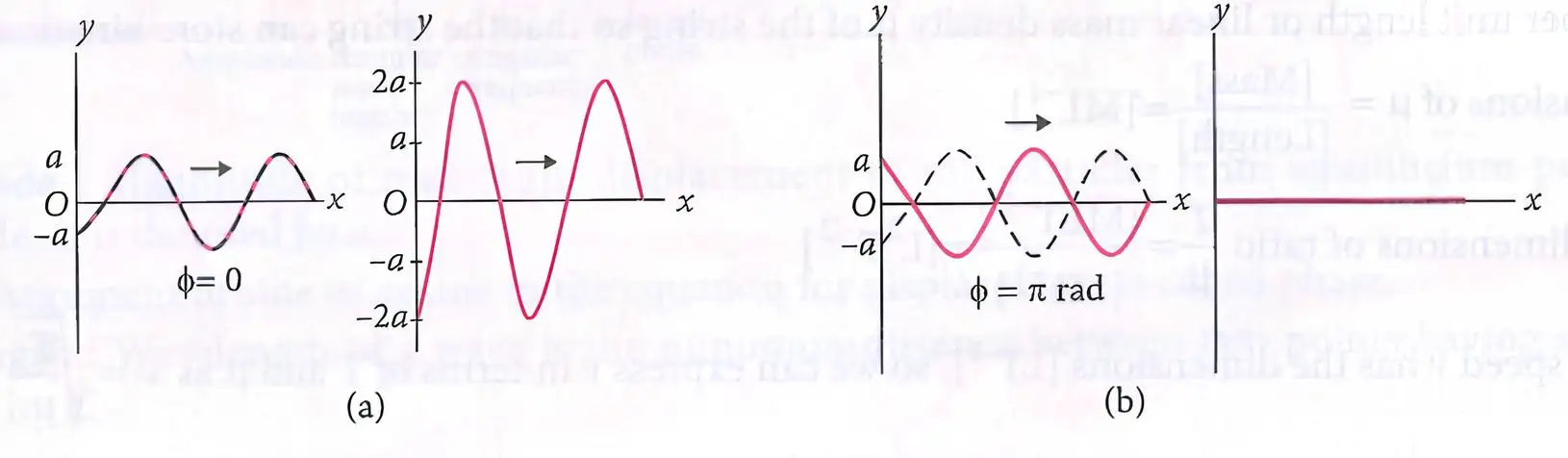
Do not add wave amplitudes as ordinary positive numbers in every case: displacement is added algebraically, so phase determines whether waves reinforce or cancel.
State the principle of superposition of waves.
What happens when two equal-amplitude waves have a phase difference of ?
Quick recap
- Superposition gives the algebraic sum of the individual displacements.
- For equal-amplitude harmonic waves, the resultant amplitude depends on their phase difference.
- The resultant wave has the form .
- Phase differences equal to even multiples of produce constructive interference.
- Odd multiples of produce destructive interference.
Reflection of Waves
Reflection at a Boundary
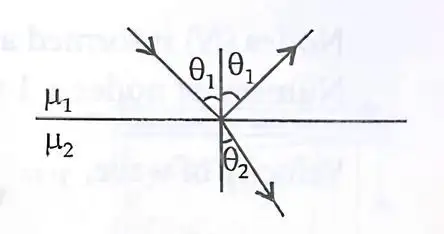
Reflection and transmission — When a wave reaches a boundary between two media, part is reflected back into the first medium and part is transmitted (refracted) into the second.
Reflection at Fixed and Free Ends
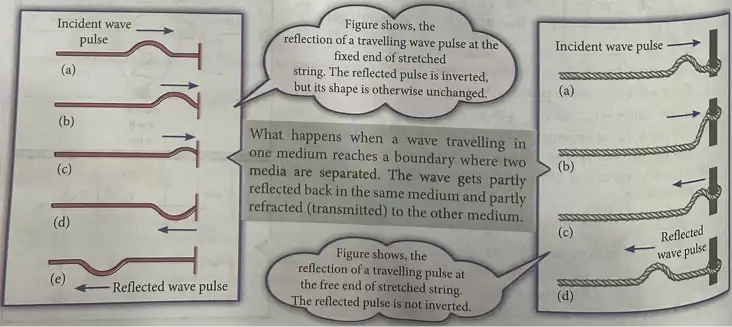
| End | Reflected pulse | Phase change | Boundary condition |
|---|---|---|---|
| Fixed | Inverted relative to the incident pulse | radians | Displacement at the end is always zero |
| Free | Not inverted relative to the incident pulse | Zero | End is free to move transversely |
Wave Equations at the Ends
- Fixed end: The incident and reflected waves superpose so their resultant displacement at the boundary remains zero.
- Free end: The reflected wave has the same phase as the incident wave; at the boundary, the displacement can reach twice the incident amplitude.
For propagation along a string, the reflected-wave sign distinguishes fixed-end inversion from free-end reflection.
Standing Waves and Normal Modes
Standing wave — A stationary pattern formed by superposition of two waves with equal amplitude, frequency, wavelength and speed travelling in opposite directions.
The two oppositely travelling waves combine to give a position-dependent amplitude that oscillates in time.
Nodes and Antinodes
- Nodes: Points where the amplitude is always zero; they occur when .
- Node positions: , for integer .
- Antinodes: Points where the amplitude is maximum; they occur when .
- Antinode positions: , for integer .
- Spacing: Successive nodes are separated by ; a node and its nearest antinode are separated by .
Normal modes — The normal modes are the allowed patterns of vibration of a system, each associated with a natural frequency.
Stationary Waves on a String Fixed at Both Ends
Modes and String Properties
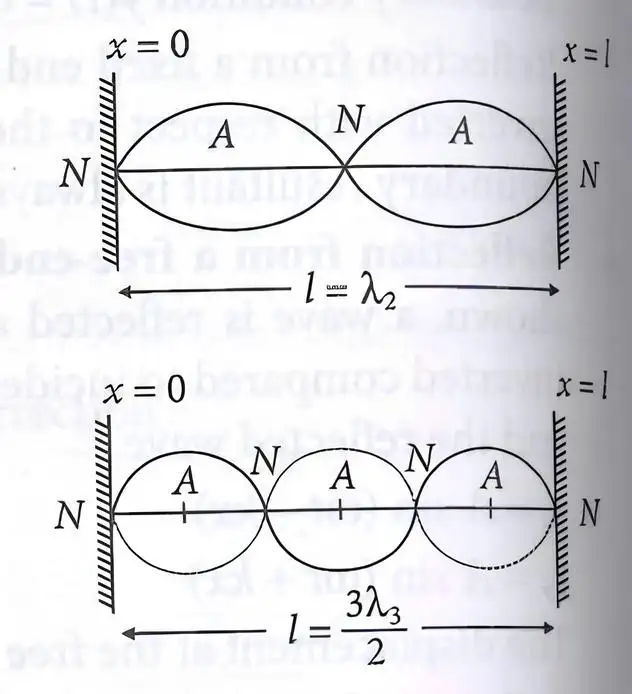
- Boundary pattern: Both fixed ends are nodes; antinodes form between them.
- Mode count: For mode number , there are antinodes and nodes.
- Wave speed: For tension and linear mass density , the speed is .
- Allowed wavelength: The string length contains half-wavelengths: .
Here and is mass per unit length.
| Mode | Wavelength | Frequency | Name |
|---|---|---|---|
| Fundamental frequency; first harmonic | |||
| Second harmonic; first overtone | |||
| Third harmonic; second overtone |
Measure from one fixed end; for nodes and for antinodes.
Laws of Vibration of a Stretched String
For a string of length , tension and linear mass density .
| Law | Relationship |
|---|---|
| Length law: fixed and | |
| Tension law: fixed and | |
| Mass law: fixed and |
For material density and string diameter , the linear density is the material density times the cross-sectional area. These laws can be tested using a sonometer.
Standing Waves in Organ Pipes
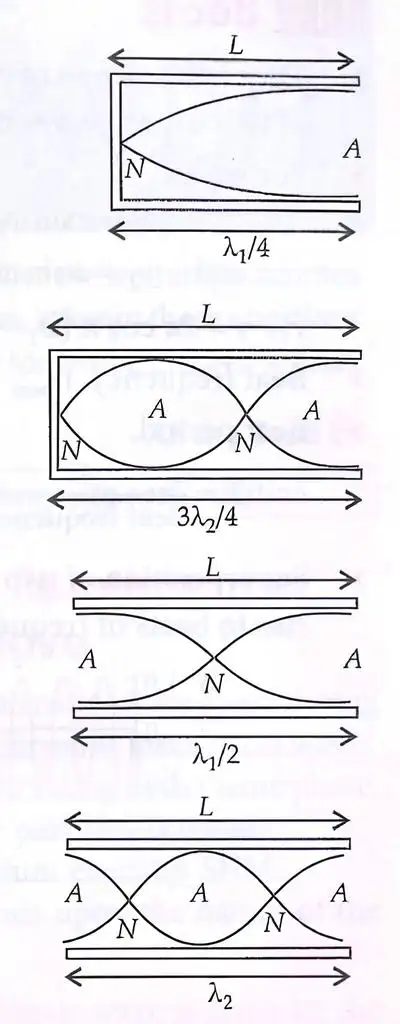
Organ pipe — A musical instrument in which blowing air produces sound through superposition of incident and reflected longitudinal waves.
| Feature | Closed pipe | Open pipe |
|---|---|---|
| Ends | One end closed, one end open | Both ends open |
| Allowed frequencies | , | , |
| Wavelengths | ||
| Harmonics present | Odd harmonics only: | All harmonics: |
| Overtone numbering | th overtone is the th harmonic | th overtone is the th harmonic |
| Overtone frequency ratio | ||
| Node and antinode positions | Taking at the closed end: nodes at ; antinodes at | Taking at an open end: antinodes at ; nodes at |
End Correction
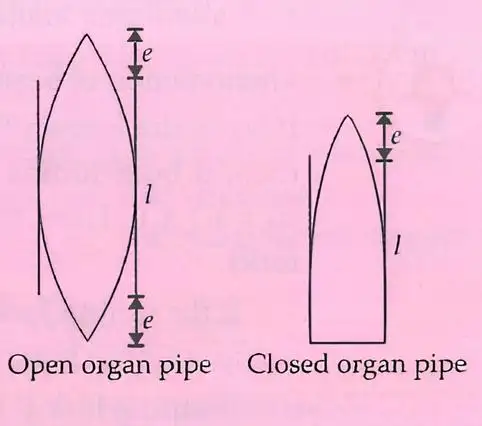
End correction — The open-end pressure node lies slightly beyond the physical end of the pipe; the distance beyond the end is the end correction .
The correction depends on pipe radius (or diameter ). A closed pipe has one open end; an open pipe has two.
| Point | Travelling wave | Standing wave |
|---|---|---|
| Propagation | Disturbance travels through the medium with a definite velocity. | The pattern remains confined to the region where it is formed. |
| Particle amplitudes | Particles have similar motion, with phase varying from point to point. | Different particles generally have different amplitudes; nodes remain at rest. |
| Mean-position crossing | Particles do not all cross their mean positions simultaneously. | All particles cross their mean positions simultaneously. |
| Extreme positions and phase | Nearby particles have different phases. | Particles between successive nodes reach extremes together and move in phase. |
| Energy transfer | Energy is transmitted from one region to another. | Energy remains confined within each region between successive nodes. |
How do reflection at a fixed end and a free end differ?
State the frequencies and harmonic content of closed and open organ pipes.
Quick recap
- At a fixed end, reflection inverts the wave; at a free end, it does not.
- Standing waves form by superposing equal waves travelling in opposite directions.
- Nodes have zero amplitude; antinodes have maximum amplitude.
- A fixed string supports frequencies , with .
- Closed pipes support odd harmonics; open pipes support both odd and even harmonics.
- End correction is and is included in effective pipe length.
- Travelling waves transfer energy; standing-wave energy remains confined to regions between nodes.
Beats
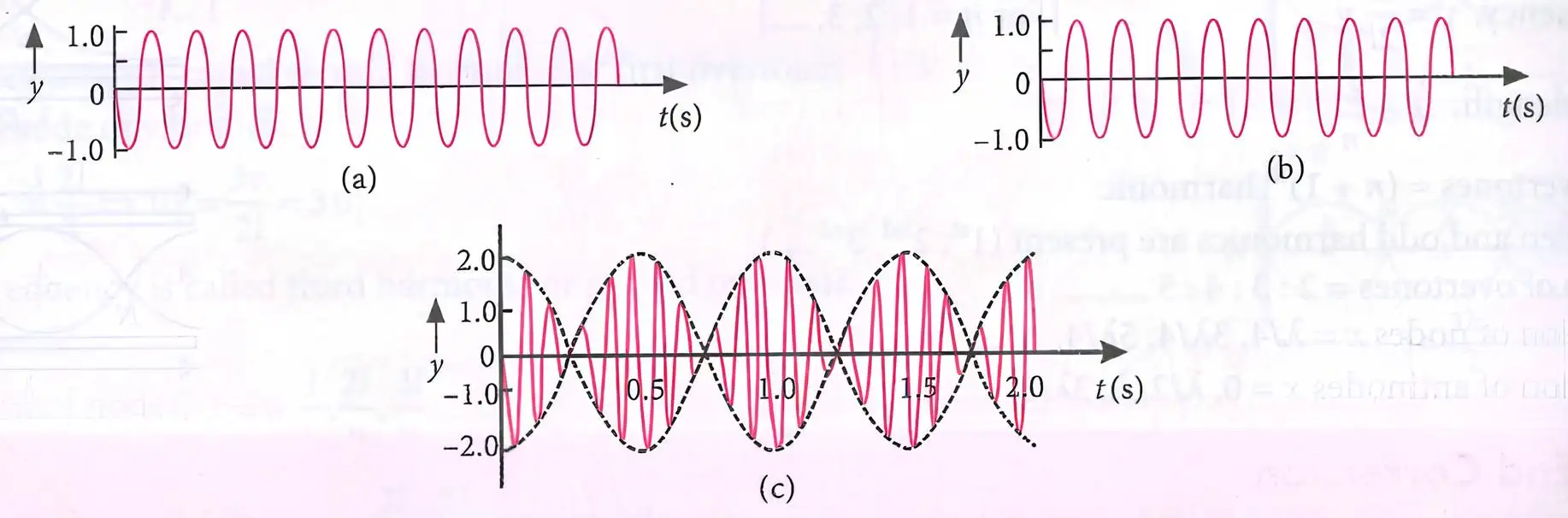
Beats — Beats are regular variations in sound intensity at a fixed position, caused by superposition of two sound waves with slightly different frequencies.
Superposition of Two Waves
- Component waves: For equal amplitudes , the waves are and .
- Resultant wave: The rapid oscillation is modulated by a slowly varying amplitude envelope.
The number of beats per second is the magnitude of the frequency difference.
Time between successive maxima of loudness; it is the reciprocal of beat frequency.
Example
- Frequencies: Waves of and produce beats at .
Finding an Unknown Tuning-Fork Frequency
- Initial relation: If fork has known frequency , fork has unknown frequency , and together they produce beats per second, then .
- Resolve the sign: Alter the frequency of fork by loading it with wax or filing it, then observe whether the beat frequency increases or decreases.
| Change to fork | Beat frequency | Unknown frequency |
|---|---|---|
| Load with wax (frequency decreases) | Increases | |
| Load with wax (frequency decreases) | Decreases | |
| File the fork (frequency increases) | Increases | |
| File the fork (frequency increases) | Decreases |
What is the beat frequency for two waves of frequencies and ?
Quick recap
- Beats arise from superposing two sound waves with slightly different frequencies.
- For equal amplitudes, the resultant wave has a varying amplitude envelope.
- Beat frequency is ; beat period is its reciprocal.
- Waves at and produce beats.
- Wax lowers a tuning fork's frequency; filing raises it, helping determine the correct sign in .
NEET Physics — ALL CHAPTERS
1
Basic Mathematics
2
Units and Measurement
3
Motion in a Straight Line
4
Motion in a Plane
5
Laws of Motion
6
Work, Energy and Power
7
System of Particles and Rotational Motion
8
Gravitation
9
Mechanical Properties of Solids
10
Mechanical Properties of Fluids
11
Thermal Properties of Matter
12
Thermodynamics
13
Kinetic Theory
14
Oscillations
15
Waves
16
Electric Charges and Fields
17
Electrostatic Potential and Capacitance
18
Current Electricity
19
Moving Charges and Magnetism
20
Magnetism and Matter
21
Electromagnetic Induction
22
Alternating Current
23
Electromagnetic Waves
24
Ray Optics and Optical Instruments
25
Wave Optics
26
Dual Nature of Radiation and Matter
27
Atoms
28
Nuclei
29
Semiconductor Electronics: Materials, Devices and Simple Circuits