NEET UG . NEET Physics . Physics . Work Energy and Power
Chapter 6: Work, Energy and Power
Ch 6
NEET Physics
NEET UG
Notions of Work and Kinetic Energy : The Work-Energy Theorem
Scalar Product (Dot Product)
For vectors expressed in Cartesian components:
Properties and useful results
- Commutative: .
- Distributive: .
- Unit vectors: ; dot products of different unit vectors are zero.
- Self-product: , so .
- Perpendicular vectors: For non-zero perpendicular vectors, ; in components, .
Use the dot product to find the angle between non-zero vectors:
Work and Kinetic Energy
For force and displacement :
Kinetic energy — The kinetic energy of a body of mass moving at speed is .
Deriving the work-energy theorem
- For constant acceleration along the displacement, start with the kinematic relation:
- Multiply by and use :
- In vector form, the force-displacement product is the work done:
The change in a particle’s kinetic energy equals the work done on it by the net force. Here and are the initial and final kinetic energies.
State the work-energy theorem.
Quick recap
- The dot product is and is a scalar.
- In components, .
- A vector dotted with itself gives its magnitude squared; perpendicular vectors have zero dot product.
- Work by a constant force is .
- Kinetic energy is .
- The net work on a body equals its change in kinetic energy: .
Work
Meaning and Measurement of Work
Work — Work is done on a body when a force acts and the point of application moves with a component of displacement along the force.
- Requirements: A force must act on the body, and its point of application must move.
- Along the force: When force and displacement are in the same direction, work equals force multiplied by displacement.
Here, is the force magnitude and is the displacement along the force.
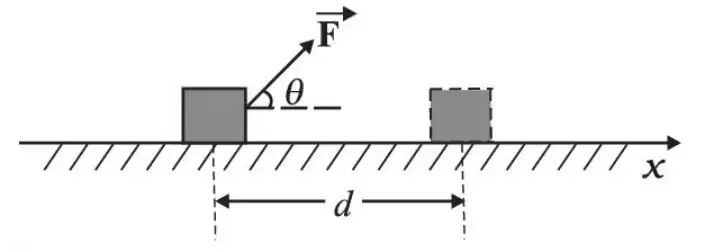
Force at an Angle to Displacement
- Effective component: Only the force component along displacement, , contributes to work.
- Dot product: Work is the scalar product of force and displacement; is the angle between them.
For force magnitude , displacement magnitude , and angle between them:
Positive and Negative Work
- Scalar quantity: Work has magnitude and sign, but no direction.
- Positive work: The force component along displacement does positive work; the force and acceleration are along the velocity, so the body's velocity increases.
- Negative work: The force component opposite displacement does negative work; acceleration is against the velocity, so the body's velocity decreases.
- Zero work: A force perpendicular to displacement has no component along it and does no work.
| Angle | Work | Effect on velocity |
|---|---|---|
| Positive | Velocity increases when acceleration is along velocity | |
| Zero | This force does no work | |
| Negative | Velocity decreases when acceleration is against velocity |
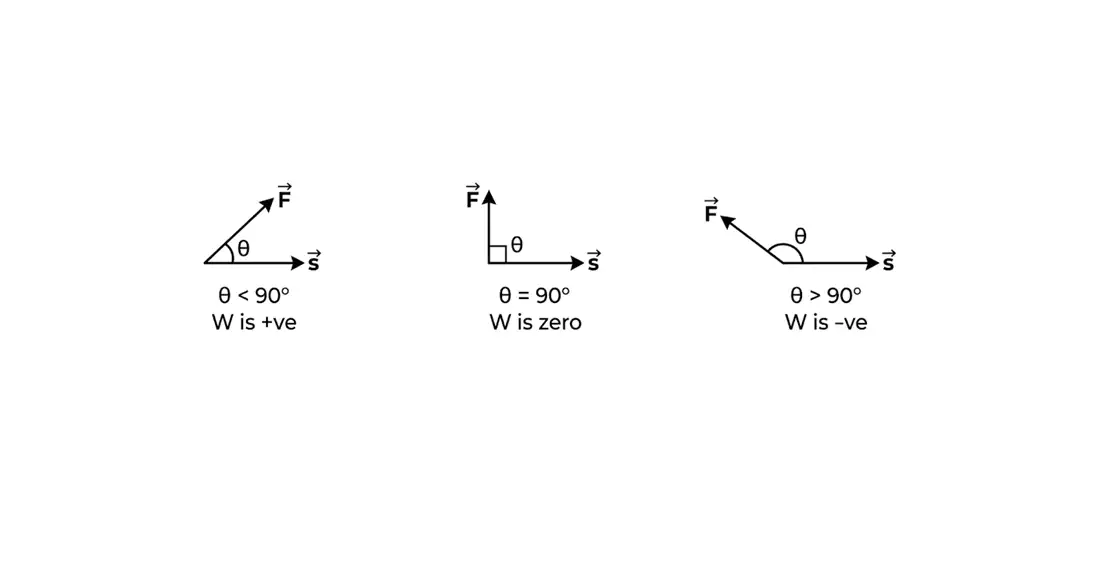
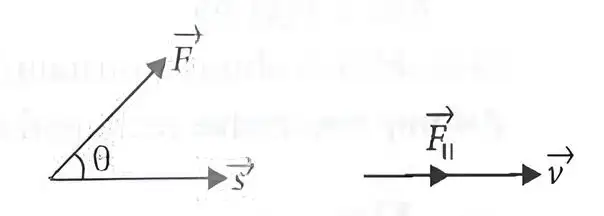
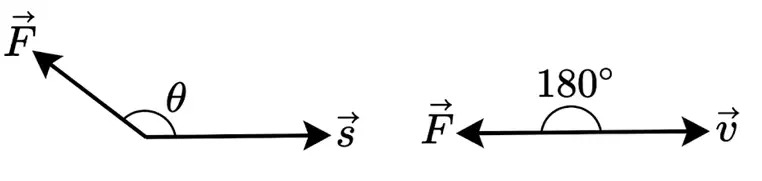
For an inclined force, do not use the full force magnitude: only , its component along displacement, contributes to work.
State the expression for work done by a constant force at an angle to displacement.
Quick recap
- Work requires a force and displacement of its point of application.
- For parallel force and displacement, .
- For an inclined constant force, .
- Work is a scalar and can be positive, negative, or zero.
- Positive work is associated with acceleration along velocity and increasing velocity; negative work with acceleration against velocity and decreasing velocity.
Kinetic Energy
Kinetic energy — The energy a body possesses because of its motion; it equals the work required to bring it from rest to its present velocity.
Key Properties
- Work and kinetic energy: Work done in giving a body its present velocity from rest is a measure of its kinetic energy; the work needed to stop it has the same magnitude.
- Non-relativistic condition: For speeds much less than the speed of light, kinetic energy is .
- Non-negative: Since mass and are non-negative, kinetic energy cannot be negative.
- Frame dependence: Kinetic energy depends on the frame of reference because the measured velocity depends on the frame.
- Variable force: The expression for kinetic energy remains valid even if the applied force varies in magnitude, direction, or both.
For a body of mass and speed much less than the speed of light.
Kinetic Energy and Linear Momentum
Using linear momentum , kinetic energy can also be written in terms of momentum.
Rearranging the relation gives the magnitude of momentum.
Dependence on Momentum and Mass
- Fixed mass: .
- Fixed momentum: .

Quick recap
- Kinetic energy is the energy a body has because of its motion.
- At speeds much less than the speed of light, .
- Work done to accelerate a body from rest to its present velocity equals its kinetic energy.
- Kinetic energy is non-negative, frame-dependent, and the formula remains valid for variable forces.
- Using , and .
- At fixed mass, ; at fixed momentum, .
Work Done by a Variable Force
Work by a Variable Force
Small Displacements and Total Work
- Variable force: A force may vary with position, so its work is found by adding contributions over small displacements.
- Small displacement: Over a sufficiently small displacement, the force can be treated as nearly constant.
- Small work: For displacement , the work contribution is .
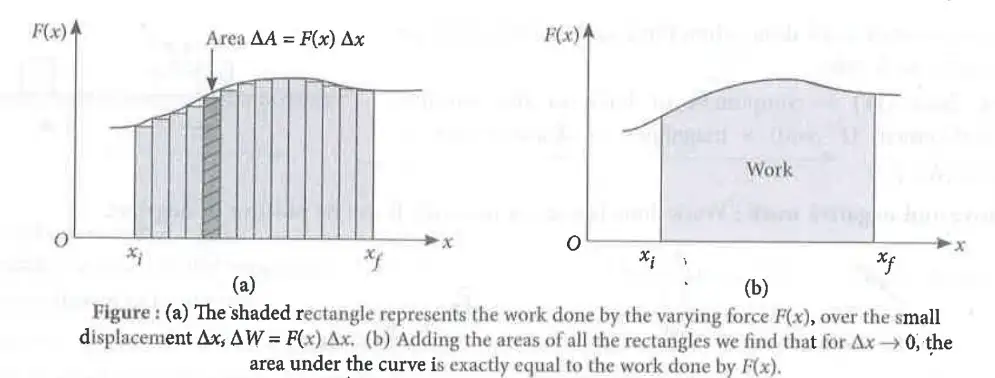
Add the work contributions from successive small intervals to estimate the total work.
As the displacement intervals become infinitesimally small, the sum becomes an integral. Work equals the area under the force–position curve.
Geometrical Interpretation of Work
Signed Area
- Graphical meaning: Work is the signed area between the force–displacement curve and the displacement axis.
- Above the axis: Area represents positive work.
- Below the axis: Area represents negative work.

How is work done by a one-dimensional variable force calculated?
Quick recap
- For a sufficiently small displacement, .
- The finite-sum estimate is .
- In the limit of infinitesimal intervals, .
- Work equals the signed area under the force–displacement graph.
- Area above the displacement axis represents positive work; area below represents negative work.
The Work-Energy Theorem for a Variable Force
Deriving the Work-Energy Theorem for a Variable Force
Work-energy theorem — The net work done by a force equals the change in the object's kinetic energy.
- Scope: The derivation applies to motion in one dimension.
- Kinetic energy: For an object of mass and speed , .
- Newton’s second law: The force is related to acceleration by .
- Rate of change: Using connects the rate of change of kinetic energy to the force and displacement.
- Work by a variable force: .
- Conclusion: The work-energy theorem is the integral form of Newton’s second law.
Quick recap
- For one-dimensional motion, .
- Newton’s second law gives the rate relation .
- Since , the differential work relation is .
- The work done by a variable force is .
- The net work equals the kinetic-energy change: .
- The work-energy theorem is the integral form of Newton’s second law.
The Concept of Potential Energy
Gravitational Potential Energy
Potential Energy and Conservative Forces
Do not confuse the work done by a force with the change in potential energy: they have opposite signs.
Quick recap
- Near Earth’s surface, raising an object by height gives .
- Gravitational force along the upward coordinate is .
- Potential energy is defined for conservative forces.
- A conservative force is related to potential energy by .
- Work by a conservative force depends only on the initial and final positions.
- The change in potential energy is the negative of the work done by the force.
The Conservation of Mechanical Energy
Conservation of Mechanical Energy
- Mechanical energy: The total mechanical energy of a system is the sum of its kinetic and potential energies, while each may change during motion.
- Conservation: When only conservative forces do work, the total mechanical energy remains constant.
A Ball Dropped from a Height
- Energy transfer: As a ball falls, gravitational potential energy is converted into kinetic energy.
- Conservation: In the absence of non-conservative forces, the sum of the ball’s kinetic and potential energies remains constant throughout its fall.
Motion in a Vertical Circle
- Centripetal force: For a body of mass moving in a vertical circle of radius , tension at angle from the lowest point is .
- Tension at key points: At the lowest point, ; at the highest point, .
- Minimum speed: To maintain the string taut at the highest point, ; the corresponding minimum speed at the lowest point is .
- Other results: At the horizontal position, the minimum speed is ; the minimum drop height for a complete vertical loop is .
Quick recap
- Mechanical energy is and remains constant when only conservative forces do work.
- A conservative force has ; its work around a closed path is zero.
- For a ball dropped from height , the ground speed is .
- In vertical circular motion, tension depends on speed and position: .
- Minimum speeds for a loop are at the top and at the bottom.
- The minimum fall height for completing a vertical loop of radius is .
The Potential Energy of a Spring
Work Done by a Spring
Work during stretching or compression
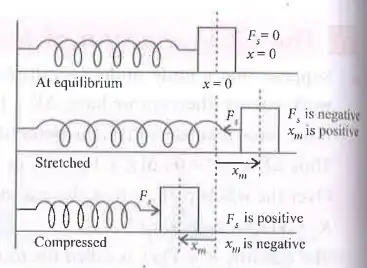
- Restoring force: For displacement from equilibrium, the spring force is .
- Work by the spring: From equilibrium to displacement , the spring does negative work because its force opposes the displacement.
- Sign: The negative work means the spring’s stored potential energy increases as it is stretched or compressed.
Potential Energy Stored in a Spring
Spring potential energy — The energy stored in a spring when it is stretched or compressed by displacement from equilibrium.
Here, is the spring constant and is the displacement from equilibrium.
Conservative nature of spring force
- Conservative force: The spring force does zero net work over any cyclic process.
- Energy change: The work done by the spring is the negative change in spring potential energy.
Spring–Block Energy and Maximum Speed
Energy conversion
- Conversion: In a spring–block system, kinetic energy and spring potential energy convert into each other.
- Total energy: If no non-conservative forces do work, the total mechanical energy remains constant: .
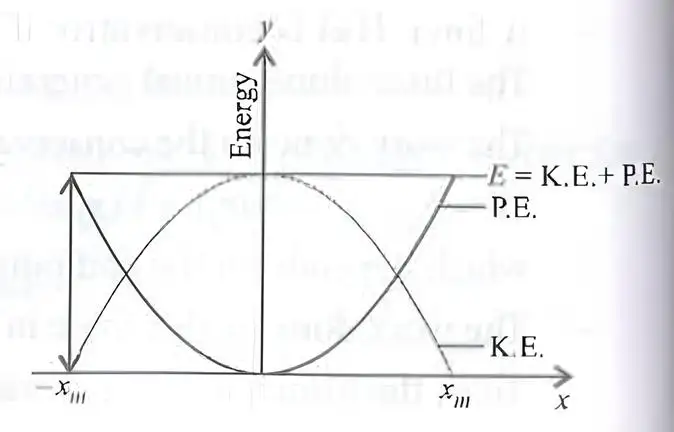
is the amplitude of the block’s motion.
Non-Conservative Forces and Mechanical Energy
Work–energy relation
- Forces: If conservative and non-conservative forces both act, their combined work equals the change in kinetic energy.
- Conservative work: The work done by a conservative force equals the negative change in potential energy.
- Mechanical energy: The change in total mechanical energy equals the work done by non-conservative forces.
- Path dependence: Non-conservative work depends on the particular path taken.
What is the potential energy stored in a spring displaced by ?
How is mechanical energy related to non-conservative work?
Quick recap
- Spring force is restoring: .
- Work by a spring from equilibrium to is .
- Spring potential energy is .
- For an ideal spring–block system, remains constant.
- Maximum block speed is .
- Non-conservative work changes mechanical energy: , and depends on path.
Power
Meaning of Power
- Power: Power describes how quickly work is done or energy is transferred.
- Unit: The SI unit of power is the watt (W); one horsepower is approximately 746 W.
Instantaneous and Average Power
Use for power at a particular instant; is instantaneous velocity.
Here, is the net work done and is the time taken.
Units of Power and Electrical Energy
| Quantity | Conversion |
|---|---|
| Power | |
| Energy |
Work–Time and Power–Time Graphs
The slope of the work–time curve is ; the area under the power–time curve gives work.
How is instantaneous power related to force and velocity?
What does the area under a power–time graph represent?
Quick recap
- Power is the rate of work done or energy transferred.
- Instantaneous power is ; average power is .
- Power is a scalar; .
- , so kWh measures energy.
- The slope of a work–time graph gives instantaneous power.
- The area under a power–time graph gives work done.
Collisions
Collision and Conservation Laws
Collision — A collision occurs when bodies physically interact, or when one body's path changes due to another body's influence.
What happens during a collision
- Momentum: The total momentum of an isolated system is conserved in every type of collision.
- Kinetic energy: It may change during a collision; whether it is conserved distinguishes elastic from inelastic collisions.
- Interaction forces: The forces between colliding bodies are internal action–reaction forces.
| Property | Elastic | Inelastic |
|---|---|---|
| Momentum | Conserved | Conserved |
| Kinetic energy | Conserved | Not conserved |
| Coefficient of restitution | ; for a perfectly inelastic collision |
Coefficient of Restitution
Coefficient of restitution — The ratio of relative speed of separation to relative speed of approach along the line of impact.
For initial velocities and final velocities along the same line:
Values of
- : Perfectly elastic collision; separation speed equals approach speed.
- : Perfectly inelastic collision.
- : Inelastic collision.
Elastic Collision in One Dimension
Conservation relations
- Momentum: .
- Kinetic energy: .
- Relative speeds: Combining the two conservation laws gives ; relative speed of approach equals relative speed of separation.
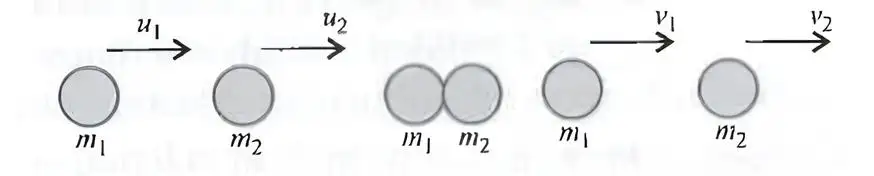
Use these results for a one-dimensional elastic collision:
| Condition | Final velocities |
|---|---|
| (target lighter) | |
| (target heavier) | |
| ; the velocities are exchanged. | |
| and |
Inelastic Collision in One Dimension
Equations and final velocities
- Momentum conservation: .
- Restitution relation: .
Solving momentum conservation and the restitution relation gives:
Setting gives a common final velocity: the bodies move together after collision.
The kinetic-energy loss depends on the relative initial velocity and is zero when .
Elastic Collision in Two Dimensions
Momentum and energy equations
- Setup: After an oblique collision, the masses leave the initial path at angles and with speeds and .
- Momentum along : .
- Momentum along : .
- Kinetic energy: .
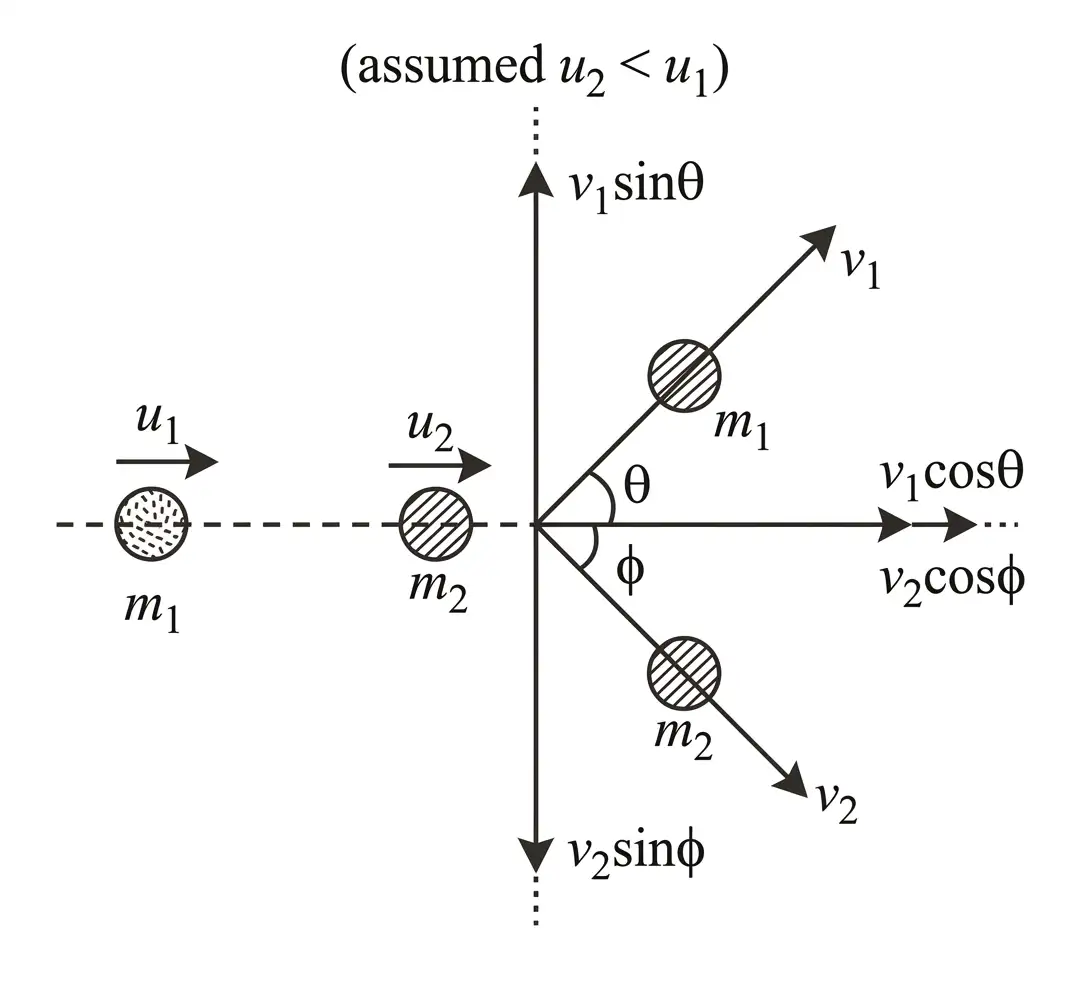
Equal masses, one body initially at rest
- Conditions: Let , , and .
- Momentum components: and .
- Energy comparison: Momentum components give , while energy conservation gives .
- Result: Therefore , so ; the final velocities are perpendicular.
State the conservation laws for an elastic collision.
In an elastic collision between equal masses, with one initially at rest, what is the angle between their final velocities?
Quick recap
- Total momentum is conserved in every collision; kinetic energy is conserved only in elastic collisions.
- The coefficient of restitution is the ratio of relative separation speed to relative approach speed.
- For one-dimensional elastic collisions, relative speed of approach equals relative speed of separation.
- The one-dimensional inelastic final velocities follow from momentum conservation and the restitution relation.
- Kinetic-energy loss is .
- For equal masses in a two-dimensional elastic collision, with one initially at rest, the final velocities are perpendicular.
NEET Physics — ALL CHAPTERS
1
Basic Mathematics
2
Units and Measurement
3
Motion in a Straight Line
4
Motion in a Plane
5
Laws of Motion
6
Work, Energy and Power
7
System of Particles and Rotational Motion
8
Gravitation
9
Mechanical Properties of Solids
10
Mechanical Properties of Fluids
11
Thermal Properties of Matter
12
Thermodynamics
13
Kinetic Theory
14
Oscillations
15
Waves
16
Electric Charges and Fields
17
Electrostatic Potential and Capacitance
18
Current Electricity
19
Moving Charges and Magnetism
20
Magnetism and Matter
21
Electromagnetic Induction
22
Alternating Current
23
Electromagnetic Waves
24
Ray Optics and Optical Instruments
25
Wave Optics
26
Dual Nature of Radiation and Matter
27
Atoms
28
Nuclei
29
Semiconductor Electronics: Materials, Devices and Simple Circuits