NEET UG . NEET Physics . Physics . Thermal Properties of Matter
Chapter 11: Thermal Properties of Matter
Ch 11
NEET Physics
NEET UG
Temperature and Heat
Temperature and Heat
Heat — Energy transferred between two or more systems, or between a system and its surroundings, because of a temperature difference.
Quick recap
- Temperature indicates a body’s relative hotness or coldness.
- Hot and cold are relative descriptions.
- Heat is energy transferred because of a temperature difference.
- Heating may raise temperature, cause expansion, or change a substance’s state.
- During boiling or freezing, heat flows while temperature remains constant.
Measurement of Temperature
Thermometers and Temperature-Dependent Properties
- Thermometers: Measure temperature using a physical property that changes with temperature.
- Liquid thermometers: Mercury or alcohol is commonly used because its volume changes nearly linearly with temperature over a wide range.
Temperature Scales and Fixed Points
- Fixed points: A standard temperature scale is defined using two reference temperatures.
- Water reference points: The ice point and steam point are convenient fixed points, corresponding to the freezing and boiling points of water.
Celsius–Fahrenheit Conversion
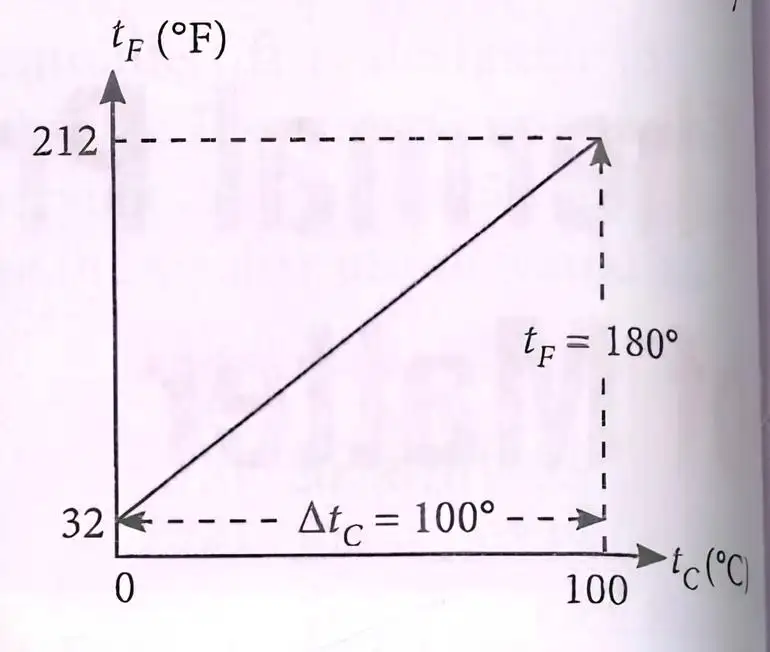
State the ice and steam points on the Celsius and Fahrenheit scales.
Quick recap
- A thermometer measures temperature using a temperature-dependent property.
- Glass thermometers commonly use the volume change of mercury or alcohol.
- The ice and steam points define the familiar Celsius and Fahrenheit scales.
- The Celsius interval from ice point to steam point is ; the Fahrenheit interval is .
- Conversion relation: .
Ideal-Gas Equation and Absolute Temperature
Gas Laws and the Ideal-Gas Equation
Behaviour of low-density gases
- Common behaviour: At low densities, all gases show the same expansion behaviour for a given quantity of gas.
- State variables: A gas is described by pressure , volume and absolute temperature .
- Boyle’s law: For a fixed quantity of gas at constant temperature, the product remains constant.
- Charles’ law: For a fixed quantity of gas at constant pressure, the ratio remains constant.
For a fixed amount of gas at constant temperature.
For a fixed amount of gas at constant pressure.
Combining the gas laws
- Combined relationship: For a fixed quantity of gas, Boyle’s and Charles’ laws imply that is constant.
- Ideal-gas equation: For a gas sample containing moles, .
- Universal gas constant: ; is the number of moles.
- Temperature unit: Use absolute temperature in kelvins in the ideal-gas equation.
For a gas sample containing moles.
Absolute Zero and the Kelvin Scale
Absolute zero
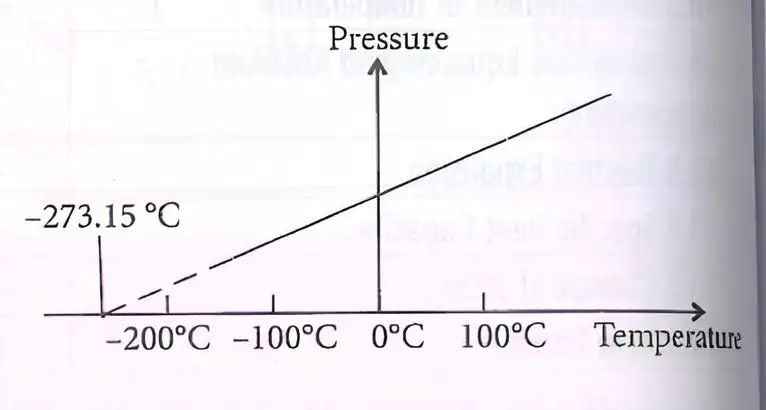
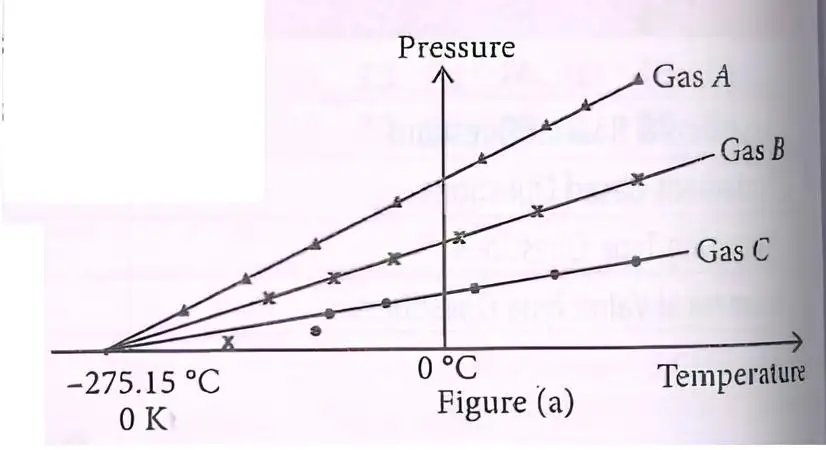
- Constant-volume graph: For a low-density gas kept at constant volume, pressure varies with temperature; extrapolated pressure–temperature lines meet at .
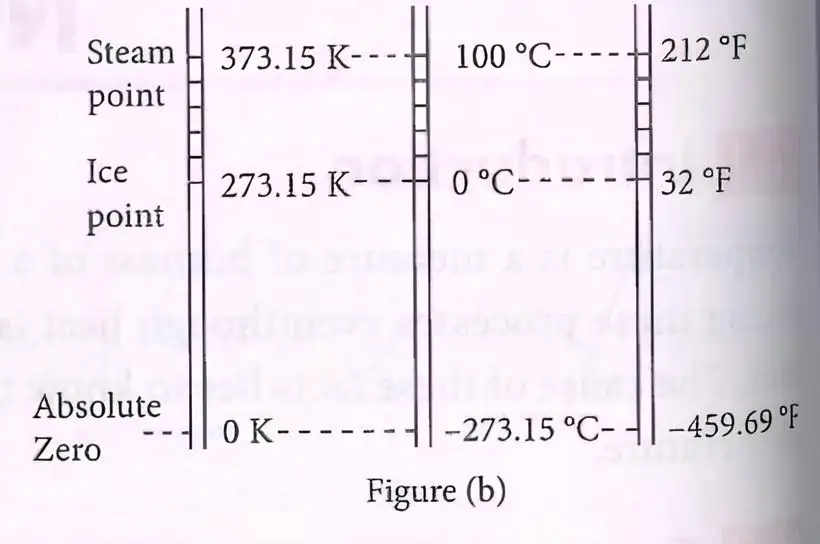
- Absolute zero: This common extrapolated temperature is the zero point of the Kelvin (absolute) scale: .
- Kelvin–Celsius relation: Add to a Celsius temperature to obtain its value in kelvins.
- Equal unit size: A temperature interval of equals an interval of .
is temperature in kelvins and is temperature in degrees Celsius.
Converting Between Temperature Scales
Fixed-point conversion rule
- General rule: The fraction of the interval from the lower fixed point to a reading is the same on every temperature scale.
- Fixed points: Celsius: to ; Fahrenheit: to ; Réaumur: to ; Kelvin: to .
, and are readings on the Celsius, Fahrenheit and Réaumur scales; is the Kelvin reading.
State the ideal-gas equation and identify its symbols.
What is absolute zero, and how is it related to the Kelvin scale?
Quick recap
- Low-density gases show the same expansion behaviour for a given quantity of gas.
- Boyle’s law applies at constant temperature; Charles’ law applies at constant pressure.
- The ideal-gas equation is , where .
- At constant volume, pressure–temperature lines for low-density gases extrapolate to .
- Absolute zero is ; convert Celsius to kelvins using .
- Temperature-scale conversion uses the same fraction of each scale’s lower-to-upper fixed-point interval.
Thermal Expansion
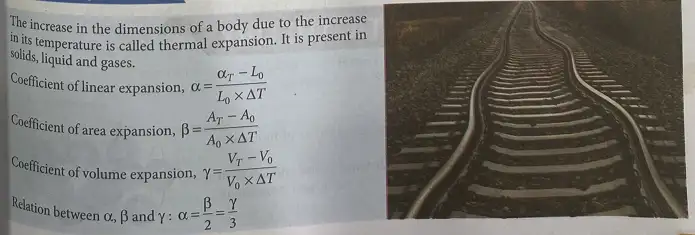
Thermal expansion — The increase in a body's dimensions when its temperature rises is called thermal expansion.
Expansion in different states
- Solids: Can expand in length, area and volume.
- Liquids: Expand in volume only because they have no fixed shape.
- Gases: Expand in volume; their state depends on volume, pressure and temperature, so heating may occur at constant volume or constant pressure.
- Material dependence: Thermal expansion differs with the substance and its state.
Thermal Expansion in Solids
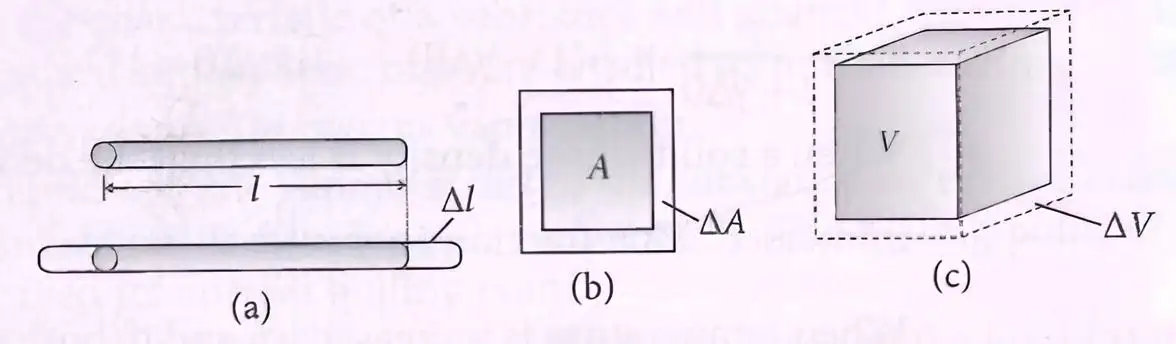
| Type | Dimension that increases | Common name |
|---|---|---|
| Linear expansion | Length | Linear |
| Area expansion | Surface area | Superficial |
| Volume expansion | Volume | Cubical |
Expansion Coefficients for Solids
Coefficient of linear expansion — The increase in length per unit original length per degree rise in temperature is the coefficient of linear expansion, .
Use for the length change of a solid over temperature rise .
Coefficient of area expansion — The increase in surface area per unit original area per degree rise in temperature is the coefficient of area expansion, .
Use for the surface-area change over temperature rise .
Coefficient of volume expansion — The increase in volume per unit original volume per degree rise in temperature is the coefficient of volume expansion, .
Use for the volume change over temperature rise .
Relations and units
- Relation for an isotropic solid: ; equivalently, and .
- Units: All three coefficients have the same unit, or .
- Dependence: The coefficients depend on the nature of the solid material.
Anomalous Expansion of Water
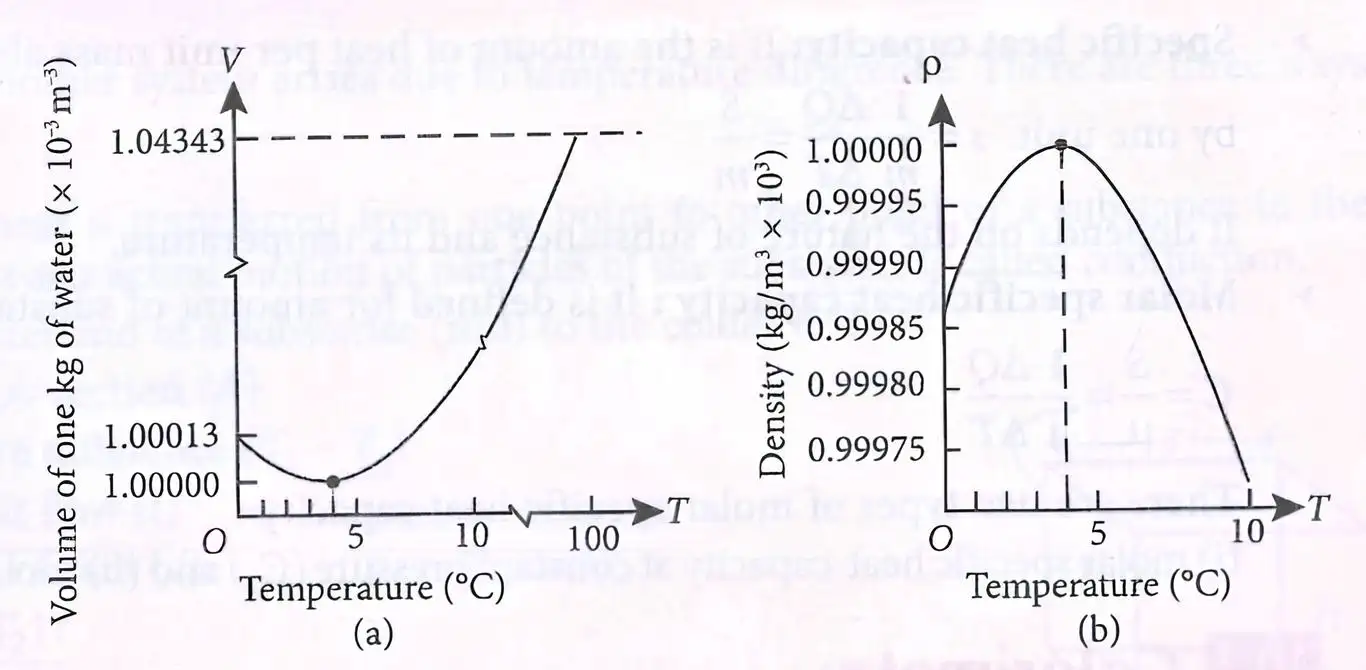
Anomalous expansion — Water's unusual behaviour from to —contracting on heating and expanding on cooling—is called anomalous expansion.
Water and temperature
- From to : Heating makes water contract, so its volume-expansion coefficient is negative.
- Above : Water expands on heating, like most substances.
- At : Water has minimum volume and maximum density.
Ideal Gas at Constant Pressure
Volume expansion coefficient of an ideal gas
- Condition: Pressure is constant, and the gas obeys .
- Result: The fractional volume increase equals the fractional absolute-temperature increase; hence the volume-expansion coefficient is .
Thermal Stress
Thermal stress — When a rod's ends are fixed and thermal expansion is prevented, the supports create compressive stress in the rod; this is thermal stress.
For a completely restrained rod of cross-sectional area and Young's modulus , heated by .
Effect of Expansion on Density
Density change on heating
- Reason: Heating increases volume while mass remains constant, so density decreases.
- Approximation: For small , use .
Here, is the initial density and the density after temperature rise .
Floating Body and Immersed Fraction
Temperature dependence of immersion
- Initial fraction immersed: For a floating solid less dense than its liquid, .
- Heating: Both solid and liquid densities decrease; the immersed fraction may increase, decrease or stay unchanged, depending on their expansion coefficients.
- Comparison: If , then and a greater fraction of the solid is immersed.
For temperature increase , with and the solid and liquid volume-expansion coefficients.
Thermal Expansion and a Pendulum Clock
Effect on clock rate
- Temperature rises → pendulum length increases.
- Greater length → time period increases.
- Longer time period → clock runs slow and loses time.
For a temperature rise and small .
If the time-period increase is , the loss over elapsed interval is given below.
State the relation between the linear, area and volume expansion coefficients of a solid.
Why does water show anomalous expansion, and at what temperature is its density maximum?
What thermal stress develops in a completely restrained rod heated by ?
Quick recap
- Thermal expansion affects length, area and volume in solids; liquids and gases expand in volume.
- For solids, , and the coefficients have units or .
- Water contracts on heating from to and has maximum density at .
- At constant pressure, an ideal gas has volume-expansion coefficient .
- A restrained heated rod develops thermal stress and force .
- Heating lowers density; it can also change a floating body's immersed fraction according to the relative expansion coefficients.
- A pendulum clock runs slow on heating because its length and time period increase.
Specific Heat Capacity
Heat Capacity and Specific Heat Capacity.
Heat capacity — Heat capacity is the heat required to raise the temperature of an entire substance by one unit.
Here, changes the temperature by ; is mass and is specific heat capacity.
Specific heat capacity — Specific heat capacity is the heat absorbed or released per unit mass to change temperature by one unit.
It is related to heat capacity by . Its value depends on the substance and its temperature.
Use this relation when a mass changes temperature by .
Molar Specific Heat Capacity
Molar specific heat capacity — Molar specific heat capacity is the heat absorbed or released per mole of a substance to change its temperature by one unit.
Here, is the amount of substance in moles and is its heat capacity.
| Type | Condition |
|---|---|
| Pressure remains constant. | |
| Volume remains constant. |
- is for the whole sample; is per unit mass; is per mole.
Quick recap
- Heat capacity: .
- Specific heat capacity is heat per unit mass per unit temperature change.
- Specific heat capacity depends on the substance and its temperature.
- Molar specific heat capacity is heat capacity per mole: .
- Molar heat capacities are defined at constant pressure () or constant volume ().
Calorimetry
Calorimetry — A method used to determine the specific heat or latent heat of a substance by measuring heat exchange.
Calorimeter — A device used to measure heat exchange.
Principle of Calorimetry
- Basis: Calorimetry follows the law of conservation of energy.
- Heat transfer: When a hotter body contacts a colder body, heat flows from the hotter body to the colder one.
- Condition: The heat balance applies when no heat escapes to the surroundings.
For an insulated system, heat lost by the hot body equals heat gained by the colder body.
Quick recap
- Calorimetry measures heat exchange to determine specific heat or latent heat.
- A calorimeter is the device used to measure heat exchange.
- Calorimetry is based on conservation of energy.
- With no heat escaping, heat lost by the hot body equals heat gained by the colder body.
Change of State
Changes Between States
- States of matter: Matter normally exists as a solid, liquid or gas.
- Change of state: A transition of a substance from one physical state to another is called a change of state.
Melting and Boiling Points
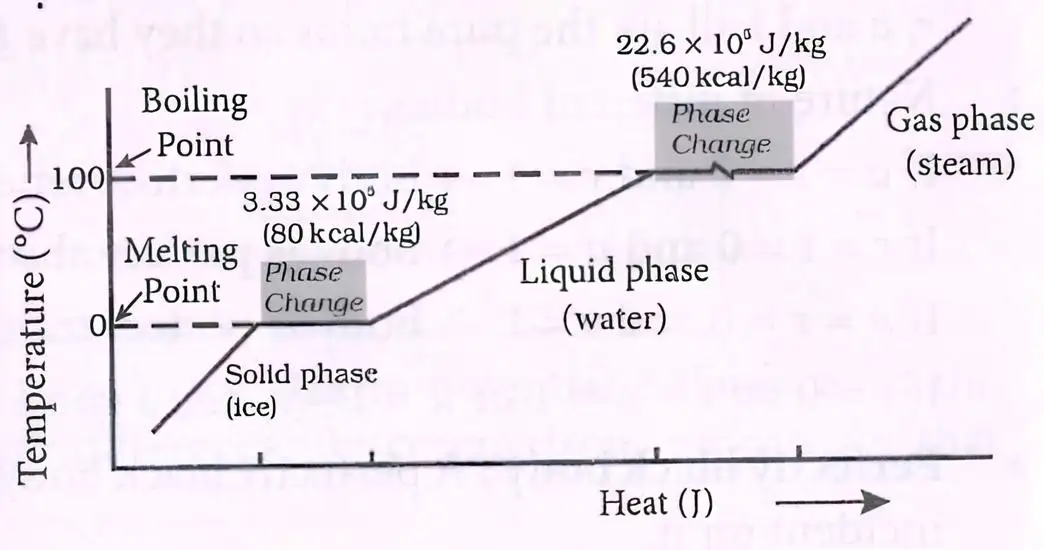
- Melting point: The temperature at which a substance’s solid and liquid states coexist in thermal equilibrium; it depends on pressure.
- Boiling point: The temperature at which a substance’s liquid and vapour states coexist; it also depends on pressure.
- Normal points: The melting or boiling point measured at standard atmospheric pressure is called the normal melting or boiling point.
Latent Heat
Here, is the heat transferred and is the mass of the substance.
| Type | State change | Example |
|---|---|---|
| Latent heat of fusion | Unit mass of solid changes into liquid at constant temperature. | Ice: |
| Latent heat of vaporisation | Unit mass of liquid changes into vapour at constant temperature. | Water: |
Heating Curve of Water
Triple Point of Water
Define latent heat and write its formula and SI unit.
What is the triple point of water? State its temperature and pressure.
Quick recap
- Matter can change between solid, liquid and gas; sublimation skips the liquid state.
- Melting and boiling points depend on pressure; normal values are measured at standard atmospheric pressure.
- Latent heat changes a substance’s state without changing its temperature.
- Use ; the SI unit of latent heat is .
- Ice has latent heat of fusion ; water has latent heat of vaporisation .
- Water’s triple point is at and about .
Heat Transfer
Modes of Heat Transfer
Heat transfer — Transfer of heat from one system to another occurs because of a temperature difference.
| Mode | How heat is transferred | Where it occurs |
|---|---|---|
| Conduction | Through a substance without actual motion of its particles. | Solids and stationary materials |
| Convection | By the actual motion of heated particles. | Liquids and gases |
| Radiation | By thermal radiation, without heating the intervening medium. | Can occur through a vacuum |
Conduction
Conduction — Heat transfer from a hotter to a colder region of a substance, without actual motion of the substance's particles.
Factors affecting heat conducted
- Directly proportional: Heat transferred increases with cross-sectional area , temperature difference and time .
- Inversely proportional: Heat transferred decreases as the slab thickness increases.
- Thermal conductivity: The material property measures how readily heat is conducted.
For a slab of thickness with end temperatures and , where .
In one-dimensional conduction, heat flows opposite to the direction of increasing temperature.
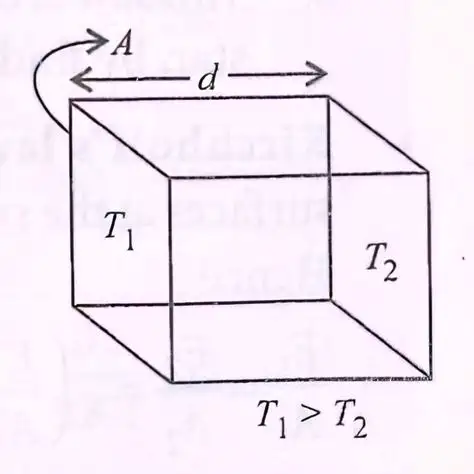
The negative sign in Fourier's law does not mean heat flow is negative; it indicates that heat flows down the temperature gradient.
Convection
Convection — Heat transfer from one place to another due to the actual motion of heated particles in liquids or gases.
Applications
- Examples: Convection helps form trade winds, monsoons, and land and sea breezes.
Radiation and Radiative Properties
Radiation — Heat transfer by thermal radiation without heating the intervening medium.
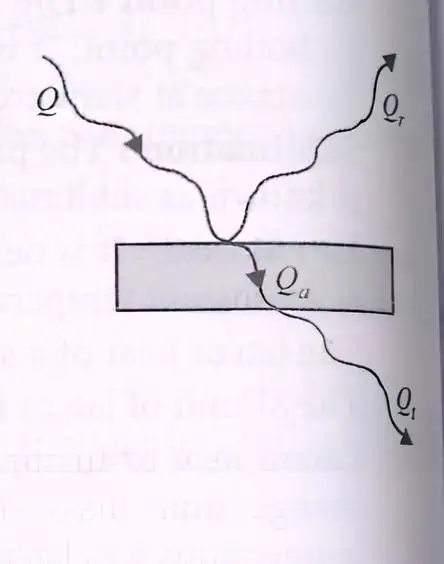
Incident radiation
- Energy split: Incident thermal radiation is partly absorbed, reflected, and transmitted by a body.
- Conservation: The total incident energy equals the sum of these three components.
Here , and are the absorbed, reflected and transmitted energies.
| Property | Definition | Meaning |
|---|---|---|
| Absorptance | Fraction absorbed | |
| Reflectance | Fraction reflected | |
| Transmittance | Fraction transmitted |
These are dimensionless ratios; their sum is unity.
| Body | Condition | Property |
|---|---|---|
| Perfect reflector | All incident radiation is reflected. | |
| Perfect absorber | All incident radiation is absorbed. | |
| Perfect transmitter | All incident radiation is transmitted. |
If no radiation is transmitted, reflectance and absorptance are complementary.
For an opaque body, a good reflector is a poor absorber because .
Perfectly black body — A body that completely absorbs radiation of every wavelength incident on it.
A perfect black body neither reflects nor transmits radiation.
Laws of Thermal Radiation
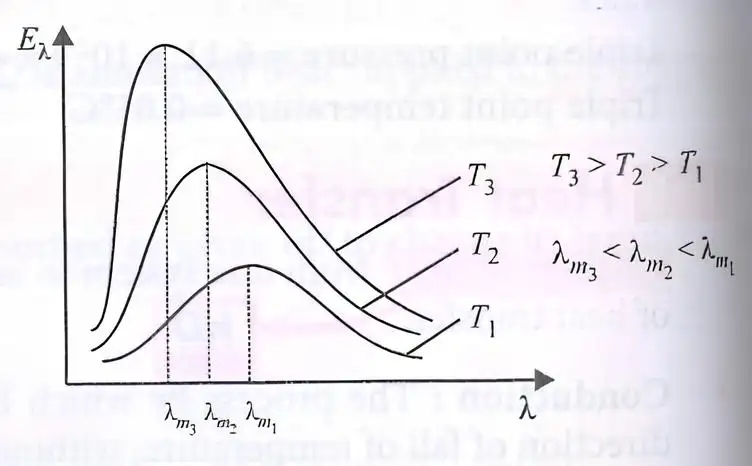
Wien's displacement law — For a body at absolute temperature , the wavelength of maximum spectral intensity is inversely proportional to .
Wien's constant is . As temperature rises, the peak shifts to shorter wavelengths.
Use of Wien's law
- Astrophysics: The temperature of a distant star can be estimated from the peak wavelength of its radiation: .
Kirchhoff's law — At a given temperature, the ratio of emissive power to absorptive power is the same for all surfaces and equals the emissive power of a perfect black body.
All surfaces are compared at the same temperature; denotes emissive power and absorptive power.
Stefan's law — The radiant energy emitted per unit area per unit time by a perfect black body is proportional to the fourth power of its absolute temperature.
is Stefan's constant: , with dimensions .
For an ordinary body, is its emissivity.
Total energy emitted by an ordinary body of area in time .
For a body at temperature surrounded by a body at temperature , this gives the net energy radiated in time .
Steady-State Thermal Conduction
Thermal resistance — The opposition a material offers to steady heat flow; for a rod, it depends on its length, area and thermal conductivity.
For a rod of length , cross-sectional area and conductivity .
In steady state, heat current is analogous to electric current, with temperature difference playing the role of potential difference.
| Quantity | Electrical circuit | Thermal conduction |
|---|---|---|
| Driving difference | Potential difference | Temperature difference |
| Flow | Electric current | Thermal current (heat flow rate) |
| Opposition | Electrical resistance | Thermal resistance |

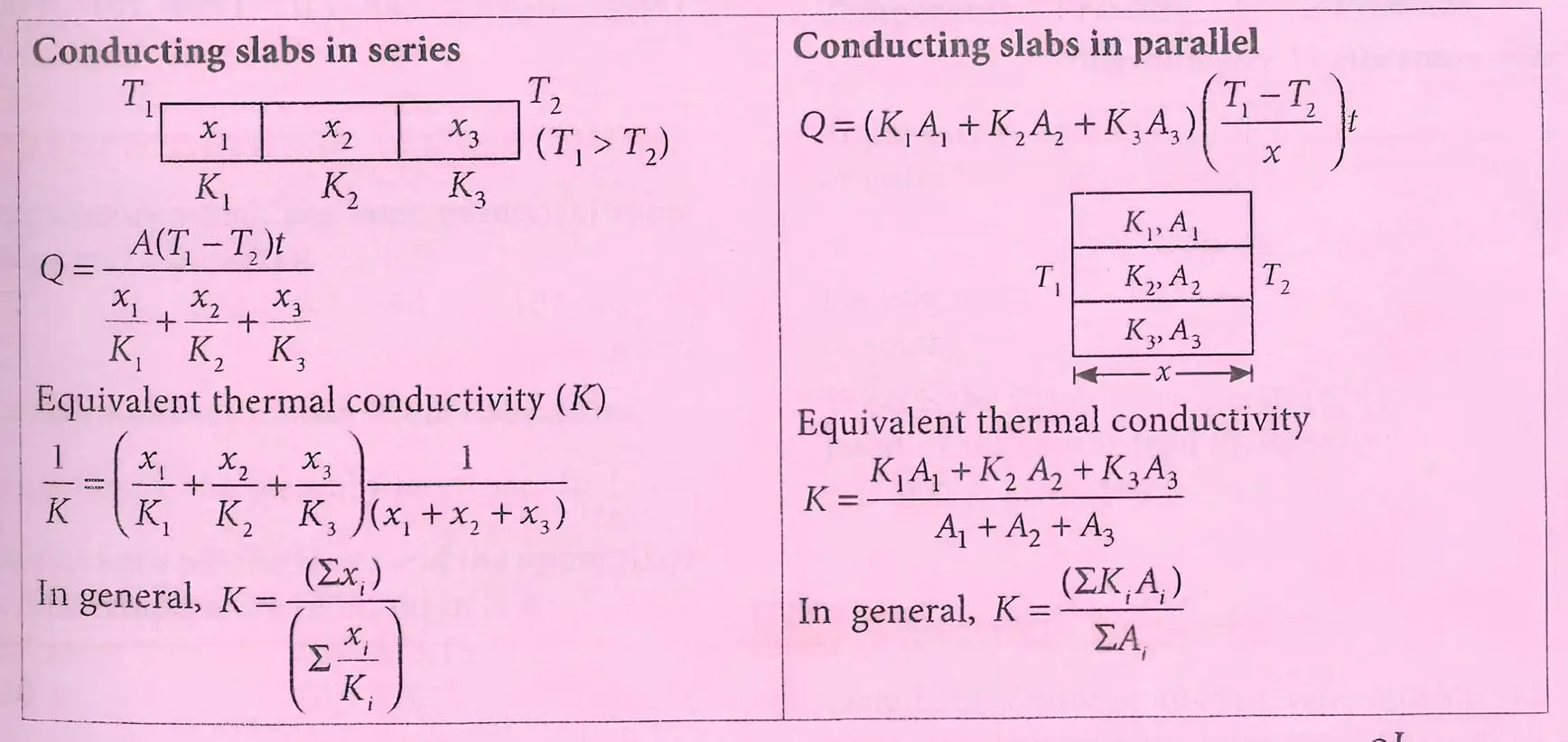
Combining thermal resistances
- Series: Each layer carries the same heat current, so their thermal resistances add.
- Parallel: Each path has the same temperature difference, so their thermal conductances add.
For layers in series or parallel, respectively.
For series layers with common area , or parallel slabs with common thickness , respectively.
Growth of an Ice Layer
For growth from thickness to , where is density, is latent heat, is thermal conductivity and is the atmospheric temperature as specified in the relation.
The time intervals for growth from to , from to , from to , and so on follow this ratio.
State Wien's displacement law and explain how it can be used to estimate a star's temperature.
Write the steady-state heat-flow relation for a rod and define its thermal resistance.
Quick recap
- Heat transfer occurs by conduction, convection or radiation; each mode differs in how energy moves.
- For conduction through a slab, , and heat flows down the temperature gradient.
- Radiative fractions satisfy ; a perfect black body has .
- Wien's law gives , while Stefan's law gives black-body emission proportional to .
- Kirchhoff's law equates the emissive-to-absorptive power ratio for surfaces at the same temperature.
- In steady conduction, and ; thermal resistances combine like electrical resistances.
- Ice-layer growth time depends on the difference of squared thicknesses; successive equal-thickness intervals have ratio .
Newton’s Law of Cooling
Statement and Conditions
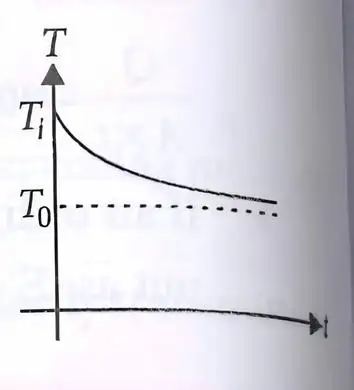
Let be the body's heat content, its temperature and the surrounding temperature. The positive heat-loss rate is ; this convention makes the cooling rate positive when the body cools.
Exponential Cooling
is a positive constant.
Straight-Line Graph
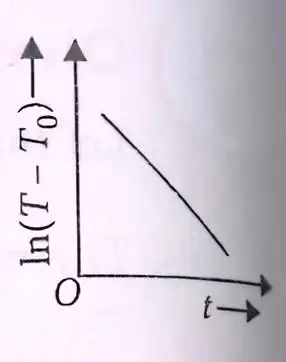
Plotting against gives a straight line with negative slope.
- Line parameters: Comparing with , the slope is and the intercept is .
Approximate Shortcut
This approximate relation avoids calculating an exponential. and are the body's temperatures at the beginning and end of interval , respectively; is the surrounding temperature.
Keep the sign convention clear: if is heat content, then during cooling, while the positive heat-loss rate is .
Quick recap
- For a body–surroundings temperature difference not more than , heat-loss rate is proportional to the temperature difference.
- For heat content , positive heat loss is represented by .
- Body temperature approaches the surrounding temperature exponentially: .
- The plot of against time is a straight line with slope .
- The approximate interval formula uses the average of the initial and final body temperatures.
NEET Physics — ALL CHAPTERS
1
Basic Mathematics
2
Units and Measurement
3
Motion in a Straight Line
4
Motion in a Plane
5
Laws of Motion
6
Work, Energy and Power
7
System of Particles and Rotational Motion
8
Gravitation
9
Mechanical Properties of Solids
10
Mechanical Properties of Fluids
11
Thermal Properties of Matter
12
Thermodynamics
13
Kinetic Theory
14
Oscillations
15
Waves
16
Electric Charges and Fields
17
Electrostatic Potential and Capacitance
18
Current Electricity
19
Moving Charges and Magnetism
20
Magnetism and Matter
21
Electromagnetic Induction
22
Alternating Current
23
Electromagnetic Waves
24
Ray Optics and Optical Instruments
25
Wave Optics
26
Dual Nature of Radiation and Matter
27
Atoms
28
Nuclei
29
Semiconductor Electronics: Materials, Devices and Simple Circuits