Atomic Masses and Composition of Nucleus
The Nucleus
- Nucleus: The atom’s positive charge and nearly all its mass are concentrated in its central nucleus.
- Relative volume: A nucleus occupies about times the volume of its atom; therefore, an atom is almost empty.
Atomic Mass and Its Unit
Average atomic mass — The weighted average of the masses of all isotopes of an element.
One atomic mass unit is one-twelfth of the mass of a carbon-12 atom.
- Carbon-12 mass: .
- Energy equivalent: .
Composition and Notation of the Nucleus
Nucleons — Protons and neutrons present in an atomic nucleus.
The atomic number counts protons; the mass number counts all nucleons.
- Neutron number: .
- Nuclear mass: The total mass of the protons and neutrons making up the nucleus.
- Nuclide notation: Write a nuclear species as , where is the element’s chemical symbol.
| Nucleon | Symbol | Charge | Mass | Rest energy |
|---|---|---|---|---|
| Proton | ||||
| Neutron |
Isotopes, Isobars, Isotones and Isomers
| Type | Same quantity | Different quantity | Example / note |
|---|---|---|---|
| Isotopes | Atomic number | Mass number | Atoms of the same element; hydrogen and lithium have isotopes. |
| Isobars | Mass number | Atomic number | and ; and . |
| Isotones | Neutron number | Atomic number | and both have . |
| Isomers | Atomic number and mass number | Energy state | Nuclei with the same and but different energy states. |
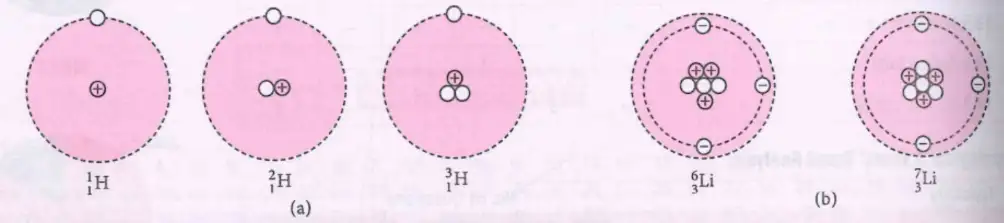
Do not confuse mass number with atomic number: , whereas counts protons only.
Quick recap
- The nucleus holds the atom’s positive charge and nearly all its mass; its volume is about of the atom’s volume.
- Average atomic mass is the isotope-mass weighted average; .
- Nucleons are protons and neutrons; counts protons, , and .
- A nuclide is written as .
- Isotopes share ; isobars share ; isotones share ; isomers share and but differ in energy state.
Size of the Nucleus
Nuclear Size
Use this relation to find the radius of a nucleus with mass number .
Nuclear Density
Using the nucleon mass and gives a density independent of .
Density Distribution
- Distribution: Nuclear matter is not uniformly distributed; density is greatest at the centre and decreases towards the edges.
- Boundary: Because density falls gradually at the edges, the nucleus does not have a sharp boundary.
- Compactness: The very high density shows that nuclear matter is highly compact.
Quick recap
- Nuclear volume is proportional to the mass number .
- Nuclear radius follows , where .
- Nuclear density is approximately and is independent of .
- Density is greatest at the centre and decreases towards the edges.
- The nucleus has no sharp boundary and is highly compact.
Mass-Energy and Nuclear Binding Energy
Mass–Energy Equivalence
Mass–energy equivalence — Mass is a form of energy and can be converted into other forms of energy, and vice versa.
Here, is energy, is mass, and is the speed of light.
Nuclear Binding Energy and Mass Defect
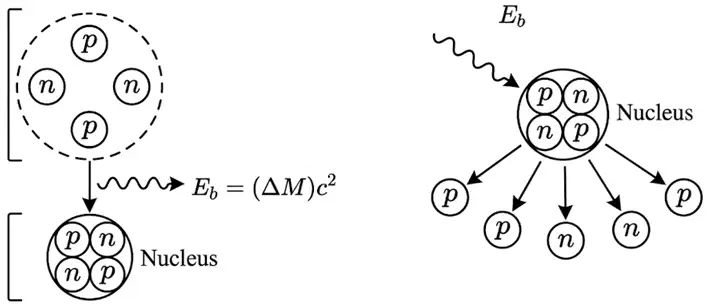
Binding energy — The energy that binds the nucleons together in a nucleus; this energy must be supplied to separate the nucleus into its nucleons.
Mass defect — The difference between the sum of the masses of the separate nucleons and the mass of the nucleus.
is the number of protons, is the mass number, and and are the proton and neutron masses.
The binding energy equals the mass defect converted into energy.
Binding Energy per Nucleon and Stability
Binding energy per nucleon — The average energy needed to separate one nucleon from a nucleus.
is the mass number.
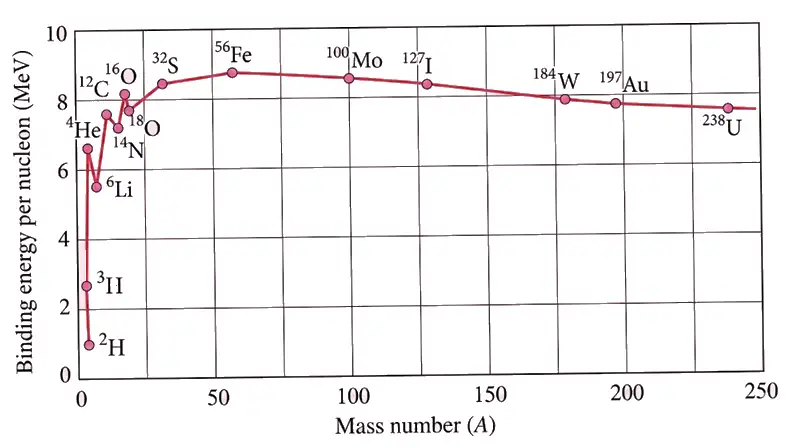
Stability from the binding-energy curve
- Peak: Binding energy per nucleon is greatest near ; nuclei around this mass number are among the most stable.
- Iron-56: The nucleus lies close to the peak and has a binding energy per nucleon of about .
- Low or high mass numbers: Their binding energy per nucleon is lower, so their nucleons are easier to separate and the nuclei are less stable.
Energy Release in Fission and Fusion
| Process | Change | Binding-energy comparison |
|---|---|---|
| Nuclear fission | A heavy nucleus splits into two lighter nuclei of comparable masses. | The fragments have greater binding energy per nucleon than the original nucleus. |
| Nuclear fusion | Two light nuclei combine to form a heavier nucleus. | The final nucleus has greater binding energy per nucleon than the original nuclei. |
Why are nuclei near mass number especially stable?
Quick recap
- Mass–energy equivalence: Mass can be converted to energy according to .
- Mass defect: The nucleus has less mass than the sum of its separate nucleons.
- Binding energy: ; it holds the nucleons together.
- Stability: Greater binding energy per nucleon generally means a more stable nucleus.
- Peak: Binding energy per nucleon is greatest near ; is close to the peak.
- Energy release: Fission and fusion can release energy when the products have greater binding energy per nucleon.
Nuclear Force
Role and Strength of Nuclear Force
- Role: Nuclear force binds nucleons together and balances the electrostatic repulsion between protons.
- Strength and range: It is extremely strong but acts only over a few femtometres, about 4.2 × 10⁻¹⁵ m.
Properties of Nuclear Force
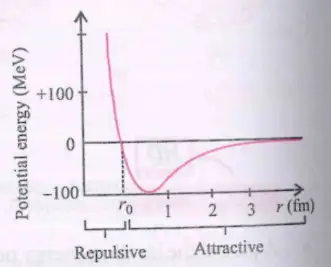
- Short-range: Nuclear force is strongly attractive over a small range.
- Charge independence: It acts with the same magnitude between proton–proton, proton–neutron and neutron–neutron pairs.
- Saturation: Each nucleon interacts mainly with its nearest neighbouring nucleons, rather than with all nucleons in the nucleus.
Nuclear Potential Energy and Separation
Quick recap
- Nuclear force binds nucleons and counteracts proton–proton electrostatic repulsion.
- It acts over a short range of a few femtometres, about .
- Nuclear force is charge independent: its magnitude is equal for proton–proton, proton–neutron and neutron–neutron pairs.
- It is saturated: a nucleon interacts mainly with its nearest neighbours.
- The force is attractive for and strongly repulsive for , where .
Radioactivity
Radioactivity and Its Types
Radioactivity — The spontaneous disintegration of certain unstable nuclei (radionuclides), accompanied by emission of particles and sometimes gamma rays.
Three types of radioactive decay
- Alpha decay: Emission of a helium nucleus, .
- Beta decay: Emission of an electron () or positron (); a positron has the electron’s mass and opposite charge.
- Gamma decay: Emission of one or more high-energy photons, typically with energies of hundreds of keV or more.
Discovery
- 1896Radioactivity was discovered by Antoine Henri Becquerel.
Alpha Decay
Alpha decay — The spontaneous decay of a heavy nucleus by emission of an alpha particle.
The released energy is shared by the daughter nucleus and the alpha particle.
Energy example
- Uranium-238: Alpha decay releases .
- Proton emission: Releasing a proton from requires ; it cannot occur spontaneously without external energy.
Beta Decay
Beta decay — The spontaneous decay of a nucleus by emission of an electron or a positron.
| Decay | Nucleon change | Nuclear change |
|---|---|---|
| Atomic number increases by 1; mass number stays unchanged. | ||
| Atomic number decreases by 1; mass number stays unchanged. |
Do not change the mass number in beta decay: a neutron changes into a proton or vice versa, so the total number of nucleons remains the same.
Gamma Decay
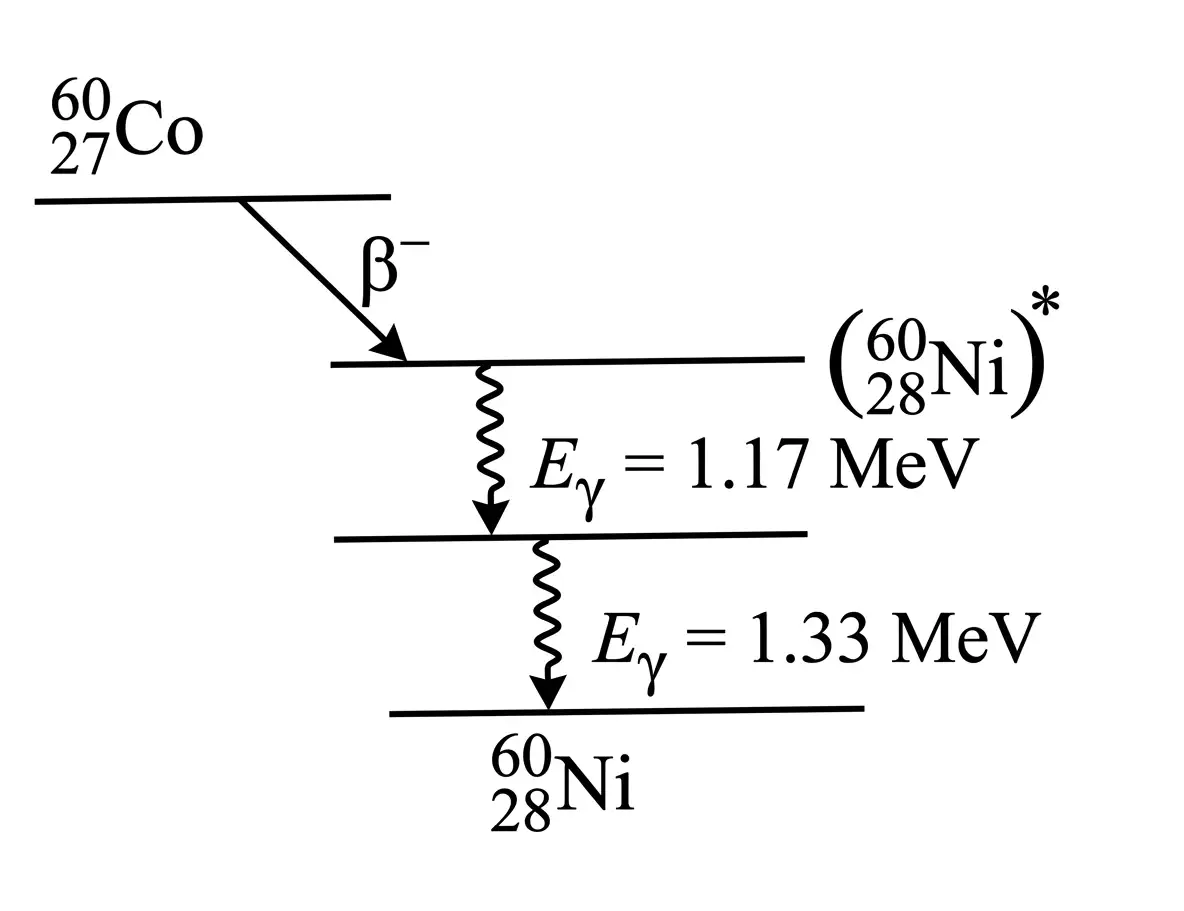
Gamma decay — An excited nucleus emits one or more gamma-ray photons as it moves to a lower-energy state, often its ground state.
Cobalt-60 decay scheme
- undergoes decay to excited .
- The excited nickel-60 nucleus de-excites by emitting gamma photons of and .
How do the mass and atomic numbers change in alpha and beta decay?
Quick recap
- Radioactivity is spontaneous nuclear disintegration; it was discovered by Antoine Henri Becquerel in 1896.
- Alpha decay emits and changes by and by .
- The alpha-decay Q-value is ; released energy is shared by the products.
- Beta-minus decay converts a neutron into a proton; beta-plus decay converts a proton into a neutron.
- The mass number remains unchanged in beta decay, while the atomic number changes by one.
- Gamma decay removes nuclear excitation energy through photon emission without changing the nuclide.
Nuclear Energy
Nuclear Reaction Energy and Conservation Laws
| Conserved quantity | Conservation rule |
|---|---|
| Nucleon number | Total nucleons in the parent nuclei equal the total in the product nuclei. |
| Electric charge | Total atomic number of the parent nuclei equals that of the products. |
| Energy | Energy required or released corresponds to the reactant–product mass difference. |
| Linear momentum | Total product momentum equals total parent momentum. |
Nuclear Fission
Thermonuclear Fusion and the Sun
Net Effect of the Solar Cycle
- Cycle count: The first three reactions occur twice for every occurrence of the fourth reaction.
- Net result: Four hydrogen nuclei form helium-4, with two neutrinos, six photons and released.
- Atomic form: Including electrons, four hydrogen atoms yield a helium atom and the same energy output.
Controlled Thermonuclear Fusion
What does the sign of the nuclear reaction -value indicate?
What is the net energy released when four hydrogen nuclei form helium in the Sun?
Why must fusion fuel be confined in a controlled fusion reactor?
Quick recap
- The -value is the reactant–product rest-mass difference expressed as energy.
- Nuclear reactions conserve nucleon number, electric charge, energy and linear momentum.
- Fission splits a heavy nucleus into smaller nuclei and releases energy.
- Thermonuclear fusion joins light nuclei after they overcome Coulomb repulsion.
- The solar proton–proton cycle converts hydrogen into helium and releases per helium-4 nucleus.
- Controlled fusion requires confining plasma heated to about .
NEET Physics — ALL CHAPTERS
1
Basic Mathematics
2
Units and Measurement
3
Motion in a Straight Line
4
Motion in a Plane
5
Laws of Motion
6
Work, Energy and Power
7
System of Particles and Rotational Motion
8
Gravitation
9
Mechanical Properties of Solids
10
Mechanical Properties of Fluids
11
Thermal Properties of Matter
12
Thermodynamics
13
Kinetic Theory
14
Oscillations
15
Waves
16
Electric Charges and Fields
17
Electrostatic Potential and Capacitance
18
Current Electricity
19
Moving Charges and Magnetism
20
Magnetism and Matter
21
Electromagnetic Induction
22
Alternating Current
23
Electromagnetic Waves
24
Ray Optics and Optical Instruments
25
Wave Optics
26
Dual Nature of Radiation and Matter
27
Atoms
28
Nuclei
29
Semiconductor Electronics: Materials, Devices and Simple Circuits