NEET UG . NEET Physics . Physics . Laws of Motion
Chapter 5: Laws of Motion
Ch 5
NEET Physics
NEET UG
Aristotle’s Fallacy
External Forces and Motion
External force — A push or pull from outside a body that can change its state of rest or motion.
How forces affect motion
- Starting or stopping: An external force can set a body at rest in motion or bring a moving body to rest.
- Changing motion: A force can change a body's speed or direction.
- Types: Forces may act through contact or from a distance.
| Force type | Example |
|---|---|
| Contact | A kick moves a stationary football; breeze or wind makes branches or objects move. |
| Contact | Flowing water exerts force on a boat, moving it along the river. |
| Non-contact | A bar magnet attracts an iron nail from a distance. |
| Non-contact | Gravity makes a released stone accelerate downward. |
Aristotle’s Fallacy
| Point | Aristotle’s claim | Correct idea |
|---|---|---|
| Uniform motion | An external force is needed to keep a body moving. | No external force is needed to maintain uniform motion when opposing forces such as friction are absent. |
| Force in everyday situations | Continued motion seems to require continued force. | A force is usually needed in practice to overcome friction and other opposing forces. |
Galileo’s insight
- Ideal situation: Galileo considered motion without frictional forces.
- Conclusion: In this ideal case, a body can continue in uniform motion without an external force.
- Why motion seems to stop: In ordinary situations, friction opposes motion; an applied force is needed to counter it.
Do not confuse the force needed to overcome friction in everyday motion with a force needed to maintain uniform motion in a frictionless situation.
Quick recap
- External forces can start, stop, or change a body's motion.
- Contact forces act through contact; non-contact forces act from a distance.
- Aristotle’s fallacy was the claim that continuous force is required to keep a body moving.
- Friction opposes motion, so everyday movement often needs an applied force to counter it.
- Galileo’s insight: without friction, uniform motion can continue without an external force.
The Law of Inertia
Motion on Inclined and Horizontal Planes
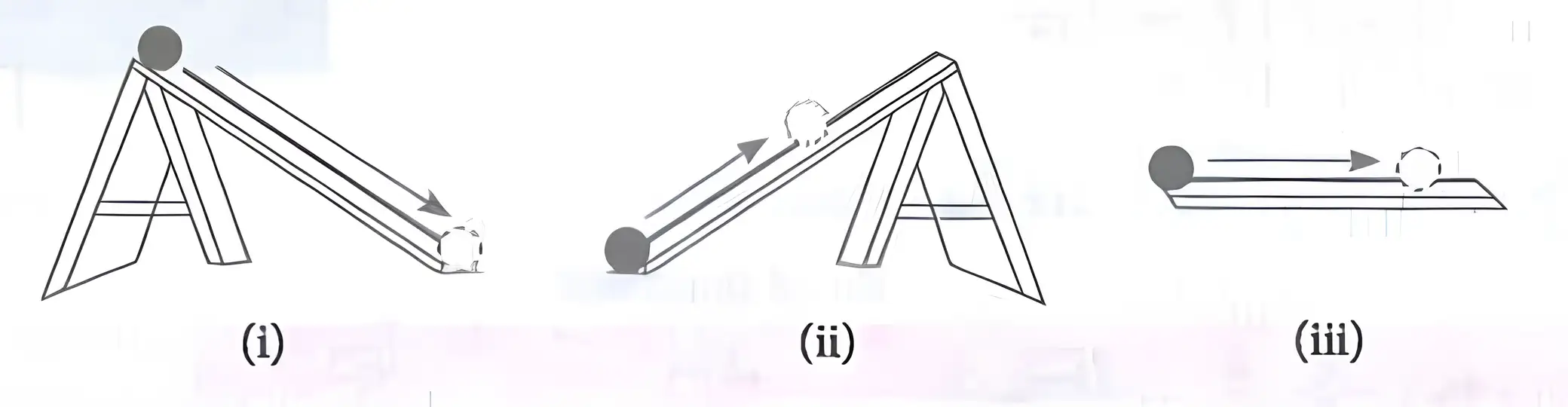
Double Inclined Plane

Inertia and the Law of Inertia
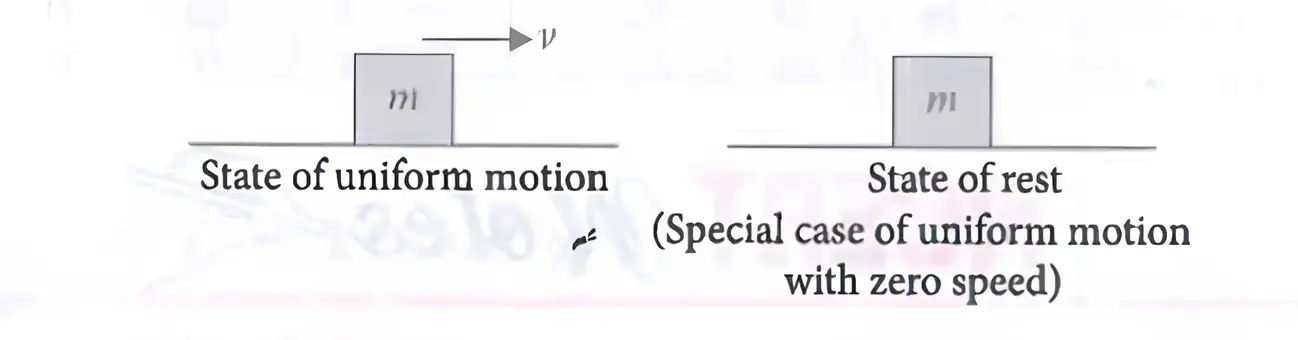
When the net external force is zero, the body's state of rest or uniform velocity remains unchanged.
State the law of inertia.
Quick recap
- An object moving down an incline accelerates; moving up, it slows down.
- On a frictionless horizontal plane, an object continues with constant velocity.
- Without friction, a ball on a double incline rises to its starting height, regardless of the incline's shape.
- Inertia is resistance to a change in the state of rest or uniform motion.
- With zero net external force, rest or uniform velocity remains unchanged.
Newton’s First Law of Motion
Newton’s First Law
Inertia
Inertia is directly proportional to mass.
| Type | Meaning | Example |
|---|---|---|
| Inertia of rest | Resistance to changing a state of rest. | Shaking a mango tree branch can make the mangoes fall. |
| Inertia of motion | Resistance to changing a state of uniform motion. | When a bus or train stops suddenly, a seated passenger tends to fall forward. |
| Inertia of direction | Resistance to changing the direction of motion. | Rotating vehicle wheels throw mud outward; mudguards help stop it. |
Momentum
Here, is momentum, is mass, and is velocity.
State Newton’s first law of motion.
Define momentum and write its formula.
Quick recap
- Newton’s first law describes how a body behaves when the net external force is zero.
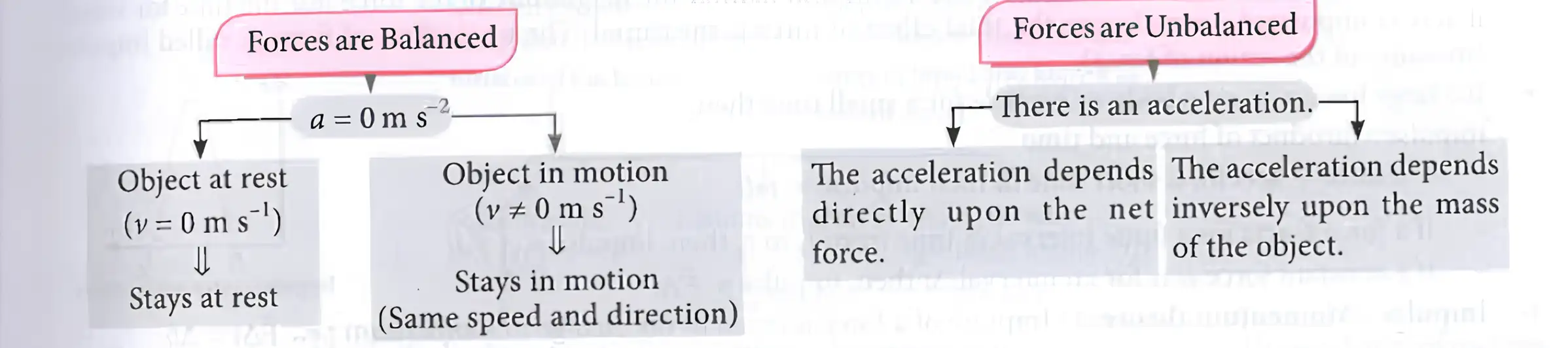
- A non-zero net external force changes a body’s state of rest or uniform motion.
- Inertia is resistance to a change in state and is measured by mass.
- The three types of inertia are rest, motion, and direction.
- Momentum is the product of mass and velocity: .
Newton’s Second Law of Motion
Newton’s Second Law and Momentum
Force, Mass and Acceleration
General Momentum Relation
Do not use as the most general form when mass changes; the general law is .
Quick recap
- Newton’s second law connects net force with the rate of change of linear momentum.
- The change in momentum is in the direction of the net force.
- For constant mass, and .
- The proportionality constant is in SI units.
- For changing mass, use .
Newton’s Third Law of Motion
Newton’s Third Law
Newton’s third law — For every action force, there is an equal-magnitude, opposite-direction reaction force.
Action–reaction pairs
- Pair: If body exerts force on body , then exerts force on .
- Direction: The two forces act along the same line, in opposite directions, and have equal magnitude.
- Different bodies: Action and reaction act on different bodies, so they cannot cancel or balance each other.
- Occurrence: The law applies whether bodies are at rest or moving; forces may arise through contact or at a distance.
- Force pairs: A single isolated force cannot occur; forces arise as action–reaction pairs.
| Point | Action–reaction forces | Balanced forces |
|---|---|---|
| Bodies acted on | Act on two different bodies | Act on the same body |
| Can they cancel on one body? | No | Yes; their resultant on that body is zero |
Pseudo Force
Pseudo force — An apparent force introduced to apply Newton’s laws in a non-inertial (accelerating) reference frame; it is not caused by a physical interaction.
Key properties
- Cause: It arises because the reference frame accelerates relative to an inertial frame, not because of an interaction.
- Direction: It is opposite to the acceleration of the reference frame.
- Magnitude: For a body of mass in a frame with acceleration , its magnitude is .
- Third law: Newton’s third law does not apply to pseudo forces because they do not form interaction pairs.
For a frame accelerating with , the pseudo force on a body of mass points opposite to .
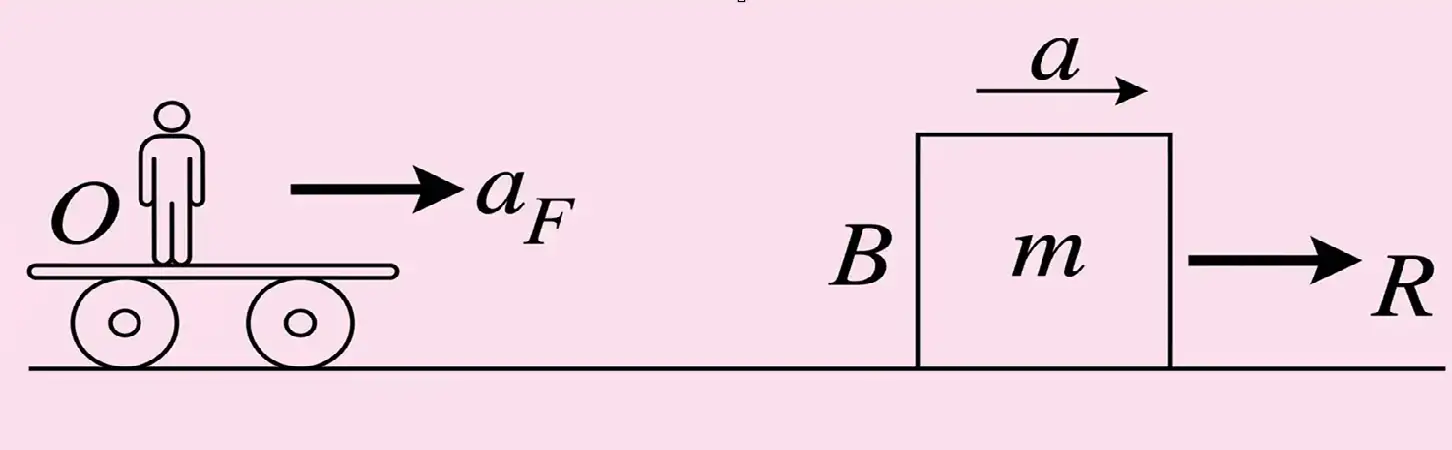
Motion and force in a non-inertial frame
- Relative acceleration: If the object’s inertial-frame acceleration is and the observer’s frame accelerates with , then the object’s acceleration relative to the observer is .
- Applying Newton’s second law: Include the pseudo force along with the real external forces to find acceleration relative to the non-inertial frame.
Here, is acceleration measured relative to the accelerating frame.
Why do action and reaction forces not cancel each other?
What is the direction and magnitude of pseudo force in an accelerating frame?
Quick recap
- Action and reaction are equal and opposite forces acting on different bodies.
- Action–reaction forces act along the same line and cannot cancel each other on one body.
- Newton’s third law applies to bodies at rest or in motion and to contact or distance forces.
- Pseudo force is an apparent, non-interaction force used in an accelerating reference frame.
- Pseudo force is , opposite to the reference frame’s acceleration.
- In a non-inertial frame, use .
Conservation of Momentum
Conservation of Momentum
Law of conservation of momentum — The total linear momentum of a system remains constant when no external force acts on it.
System momentum
- Total momentum: The system’s momentum is the vector sum of the momenta of all its particles.
- Isolated system: When the net external force is zero, the system’s total momentum is constant.
- Interactions: Internal forces may change individual particle momenta, but do not change the system’s total momentum.
Newton’s second law for a system relates the net external force to the rate of change of its total momentum.
For an isolated system, , so total momentum is constant.
Impulse
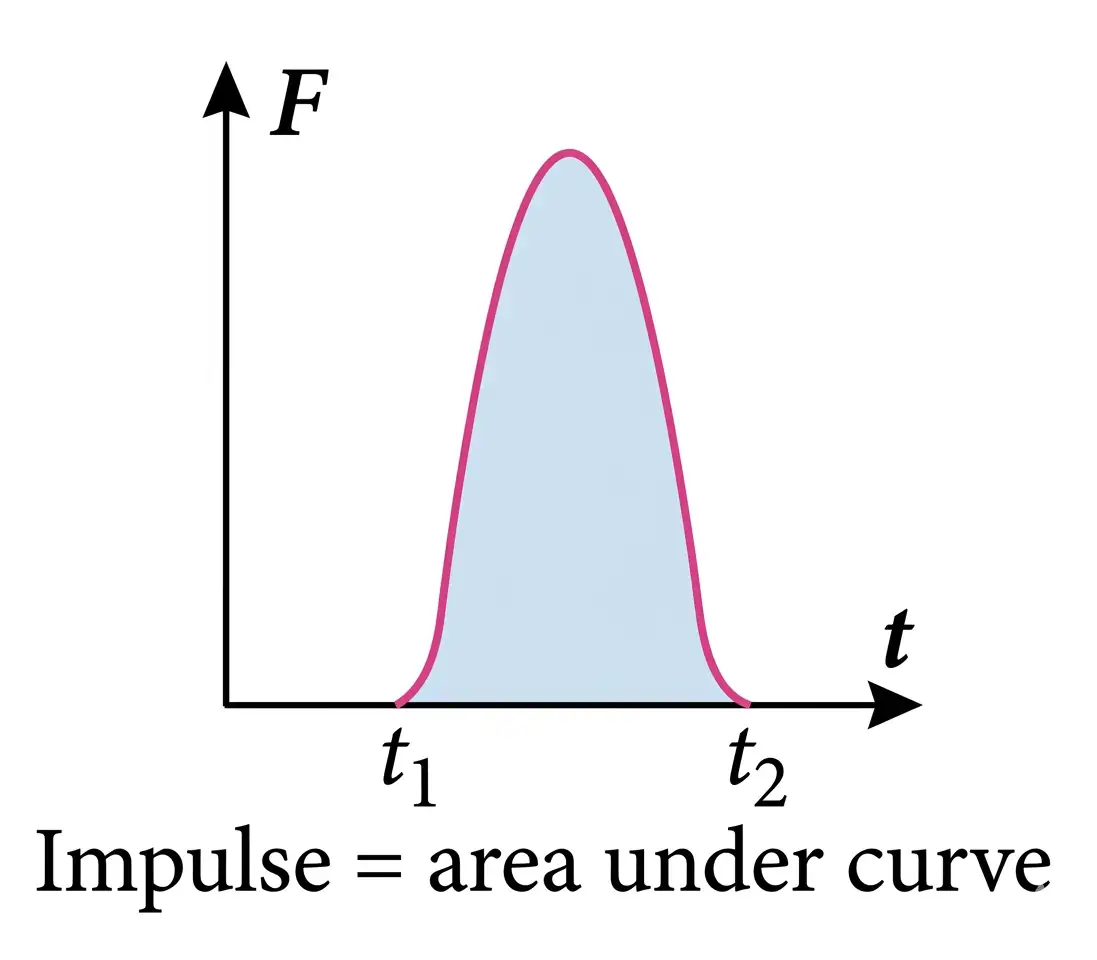
Impulse — Impulse measures the total effect of a force acting over a time interval, especially when the force is large and short-lived.
For a constant force acting over a time interval, impulse is the product of force and duration.
For a force that varies with time, integrate the force over the interval from to .
Impulse–Momentum Theorem
Impulse–momentum theorem — The impulse of a force equals the change in momentum of the body.
For a constant force, the impulse equals the change in momentum.
Quick recap
- Total momentum is the vector sum of the momenta of all particles in a system.
- With zero net external force, a system’s total momentum remains constant.
- Newton’s second law for a system is .
- Impulse measures the total effect of a force over a time interval.
- For a varying force, impulse is ; it is the area under the force–time graph.
- Impulse equals the change in momentum: .
Equilibrium of a Particle
Equilibrium under Two or More Forces
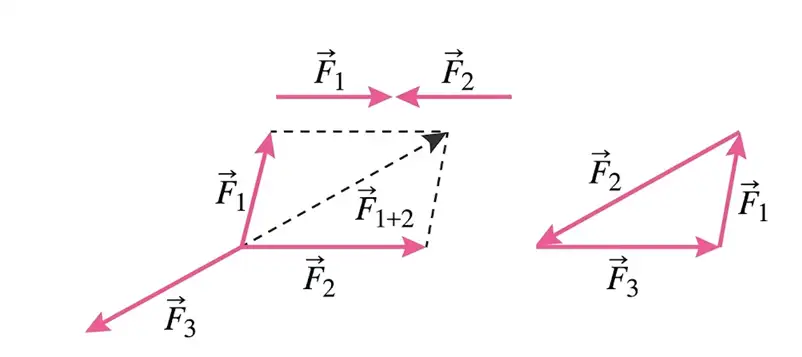
Concurrent forces — Forces acting on a body at the same point are called concurrent forces.
Lami’s Theorem
Here, is between and , is between and , and is between and .
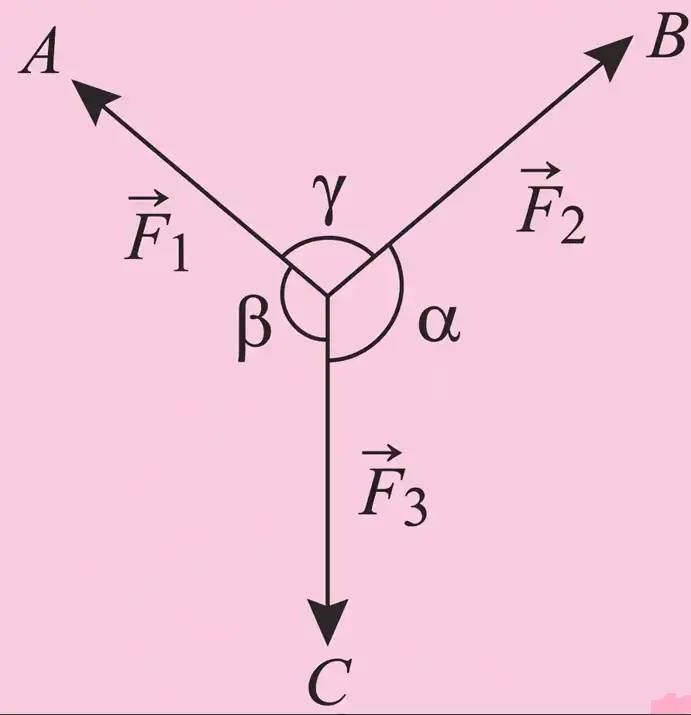
State the condition for equilibrium of a system of concurrent forces.
State Lami’s theorem and define its angles.
Quick recap
- A particle is in equilibrium when the vector resultant of all forces is zero.
- Two forces in equilibrium are equal in magnitude and opposite in direction.
- Concurrent forces act at the same point; equilibrium requires their vector sum to vanish.
- Equilibrium forces can be drawn as the sides of a closed polygon taken in order.
- Lami’s theorem relates three concurrent equilibrium forces to the sines of the angles between the other two forces.
Common Forces in Mechanics
Common forces
- Contact forces act when bodies touch; examples include friction, normal reaction, buoyant force, spring force and tension.
- Gravitational force is a common non-contact force.
Friction
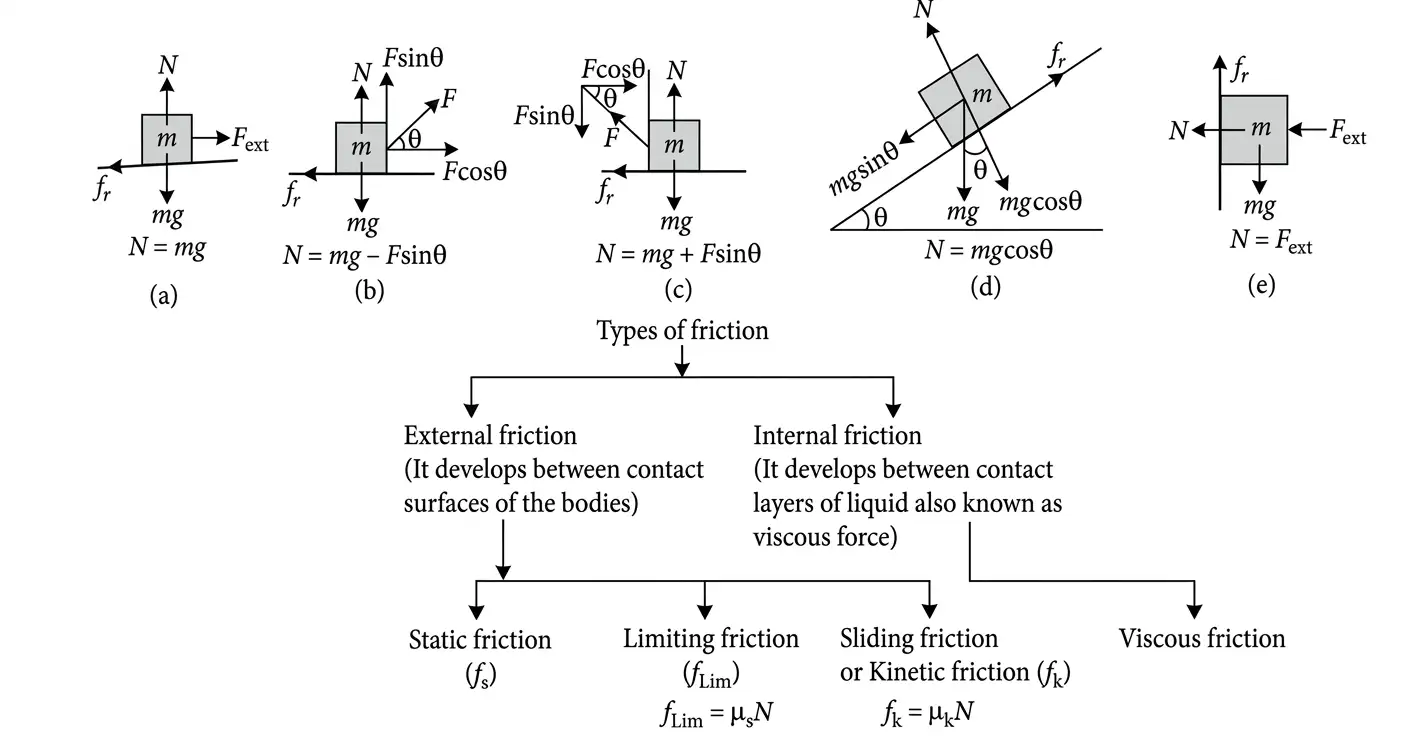
Friction — A contact force that opposes relative sliding or rolling, or the tendency of such motion, between surfaces.
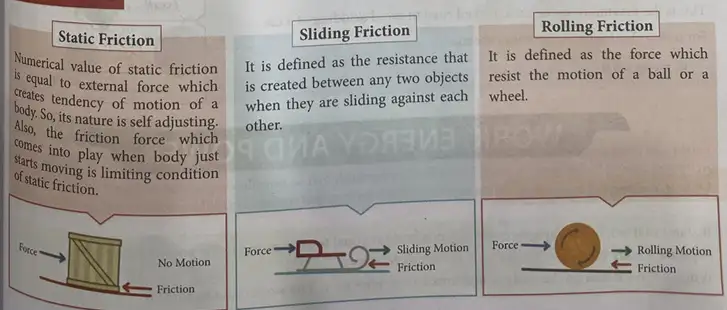
Friction and normal reaction
- Normal reaction acts perpendicular to the contact surfaces; friction acts parallel to them.
- Direction: friction opposes relative motion or the tendency of relative motion between surfaces.
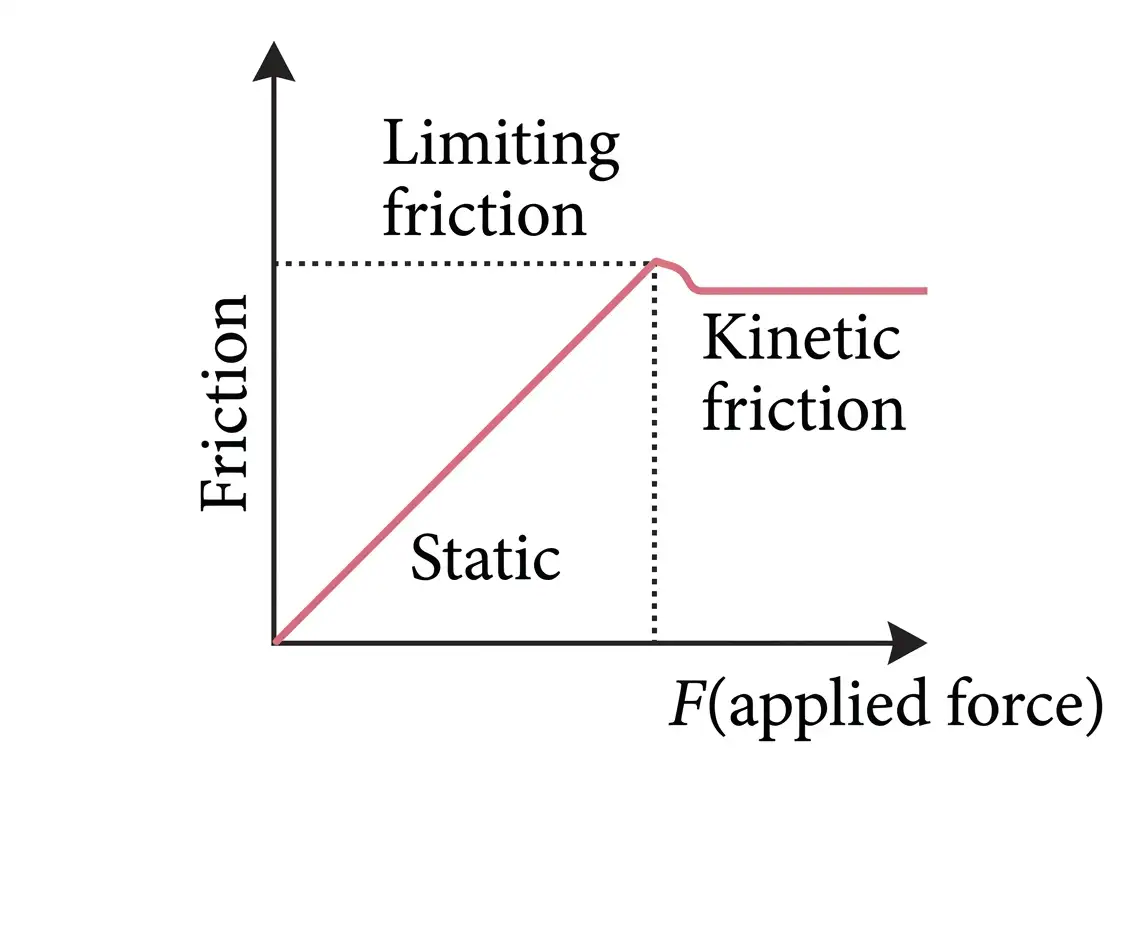
- Dependence: limiting and kinetic friction are proportional to normal reaction; static friction adjusts to the applied force up to its maximum.
| Type | Condition | Key relation or property |
|---|---|---|
| Static friction | Surfaces do not slide; motion is only tending to start. | Self-adjusts to match the applied force while the body remains at rest; it cannot exceed limiting friction. |
| Limiting friction | The body is just about to slide. | Maximum static friction: . Depends on surface materials and roughness; independent of apparent contact area if is unchanged. |
| Kinetic friction | Surfaces slide relative to each other. | ; it is slightly less than limiting friction. |
| Rolling friction | A body rolls over a surface. | Much smaller than static or kinetic friction, often by 2–3 orders of magnitude. |
is the applied force, is the normal reaction and is the coefficient of static friction.
Angle of Friction
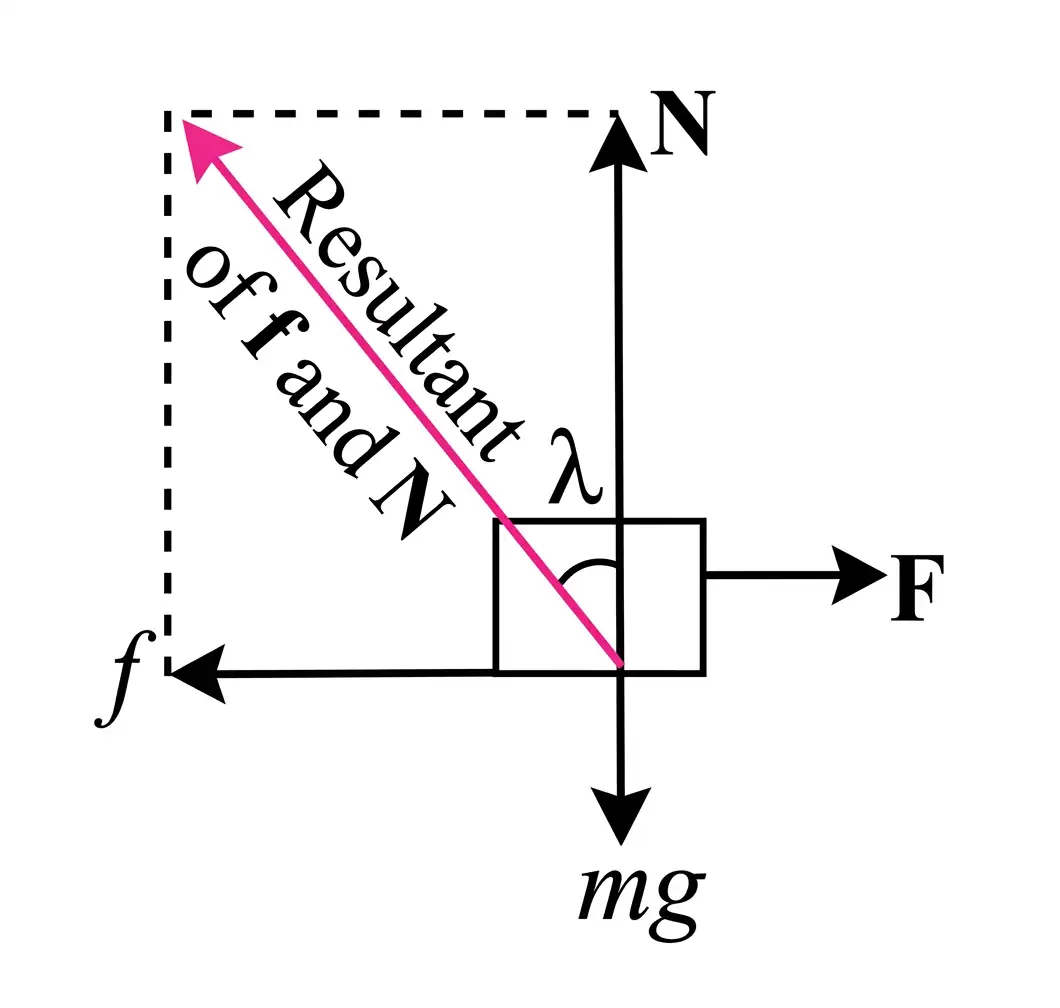
Angle of friction — The angle between the normal reaction and the resultant of the normal reaction and limiting friction.
At the limiting condition, is the coefficient of static friction.
Angle of Repose
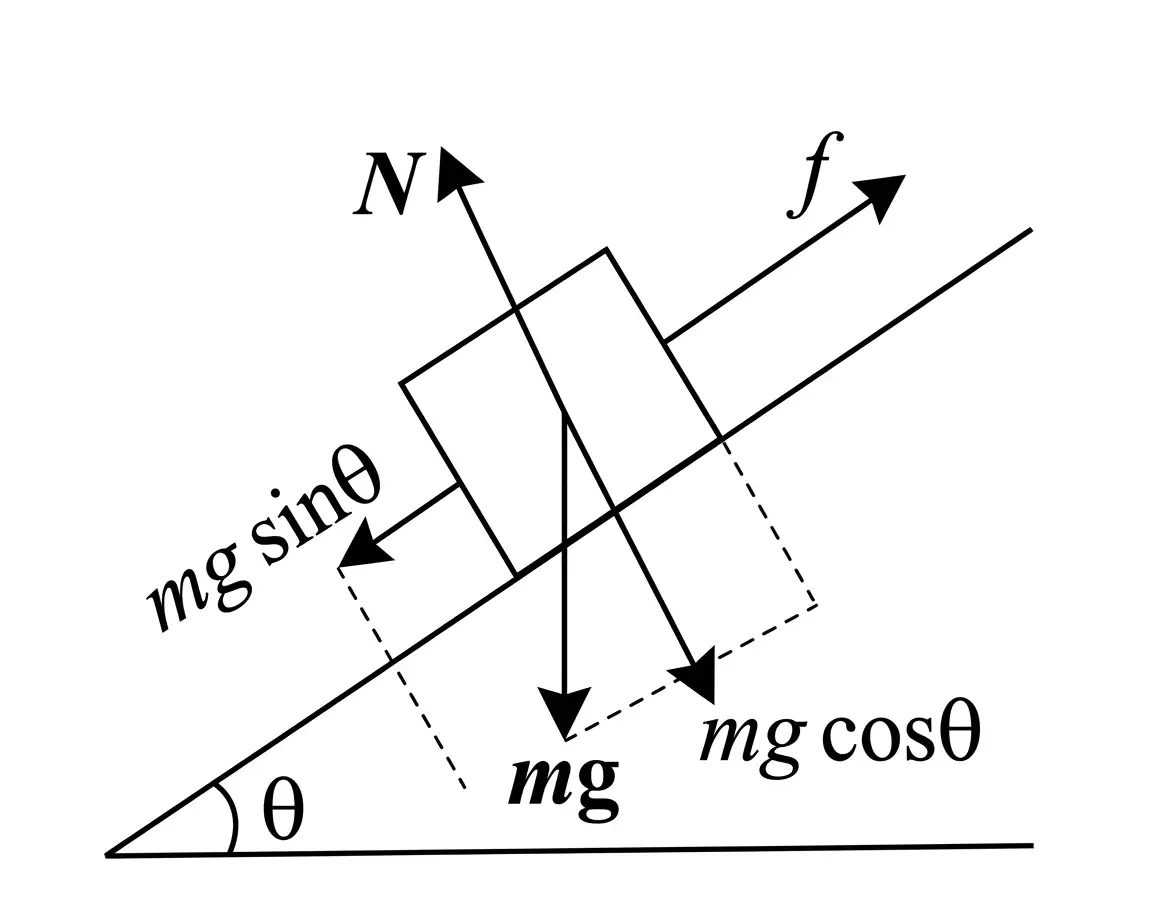
Angle of repose (angle of sliding) — The greatest inclination of a plane to the horizontal at which a body on it is just about to slide down.
At impending downward motion, weight's downslope component is balanced by limiting friction; the normal reaction balances its perpendicular component.
- Equality: angle of repose equals angle of friction, so .
- Use: measuring the angle of repose can determine the coefficient of static friction.
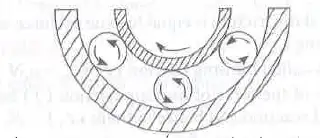
Rolling Friction
- Origin: rolling surfaces deform slightly, creating a finite contact area; the parallel component of the contact force opposes motion.
- Contact point: in ideal rolling, the point in contact is momentarily at rest relative to the plane.
- Magnitude: static and kinetic friction can be 2–3 orders of magnitude greater than rolling friction.
- Reduction: bearings between moving machine parts help reduce friction.
Tension in a String
Tension — The pulling force that develops along a string when its ends are pulled in opposite directions.
Ideal string and tension rules
- Ideal string: assumed massless, perfectly smooth and inextensible.
- Direction: tension acts along the string and pulls away from the attached object.
- Magnitude: tension is the same at every point of an ideal string.
- String or chain: tension is only extensional; a rod can exert either extensional or compressional force.
- Massless string: its net force is zero; for a massless string, .

How does friction change as an applied force increases?
What is the relation between angle of repose and coefficient of static friction?
State the direction and magnitude of tension in an ideal string.
Quick recap
- Friction opposes relative motion or its tendency; static friction adjusts up to its limiting value.
- Limiting friction is ; kinetic friction is and is slightly smaller.
- The angle of friction satisfies .
- Angle of repose, also called angle of sliding, satisfies and equals the angle of friction.
- Rolling friction is much smaller than sliding friction; bearings help reduce friction.
- Tension in an ideal string acts along it, is uniform throughout, and the massless string has zero net force.
Circular Motion
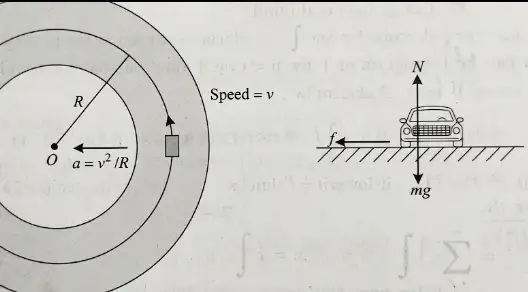
Car Turning on a Level Road
Centripetal force on a level road — The friction force between the tyres and the road supplies the centripetal force needed to turn the car.
Safe turning
- Friction limit: The available friction satisfies ; at the limiting safe speed, it provides the required centripetal force.
- Normal force: On a level road, .
- Speed condition: The car can turn safely when its speed does not exceed the maximum value.
Use for the maximum safe turning speed when friction coefficient is , turn radius is , and gravitational acceleration is .
Car Turning on a Banked Road
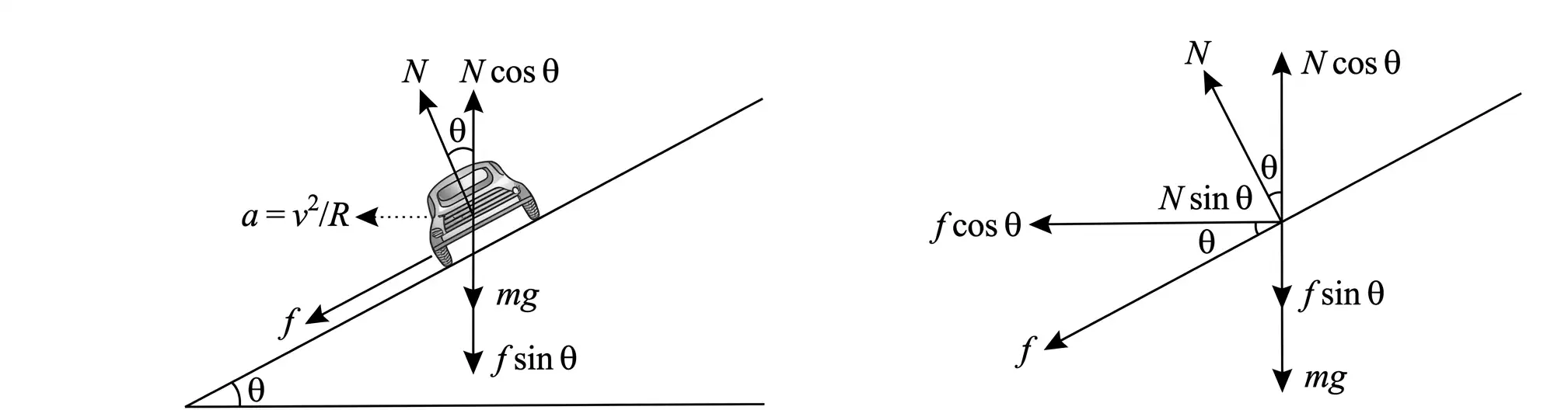
Banked road — A banked road is tilted at an angle so that components of the normal reaction and friction can help provide centripetal force.
Forces and safe speed
- Centripetal force: The inward components are and .
- Maximum permissible speed: Depends on the road angle , friction coefficient , turn radius , and .
- Smooth road: With no friction, the normal force alone supplies the required centripetal force.
Use when friction is present; is the coefficient of static friction.
Set for a frictionless road.
Cyclist Leaning While Turning
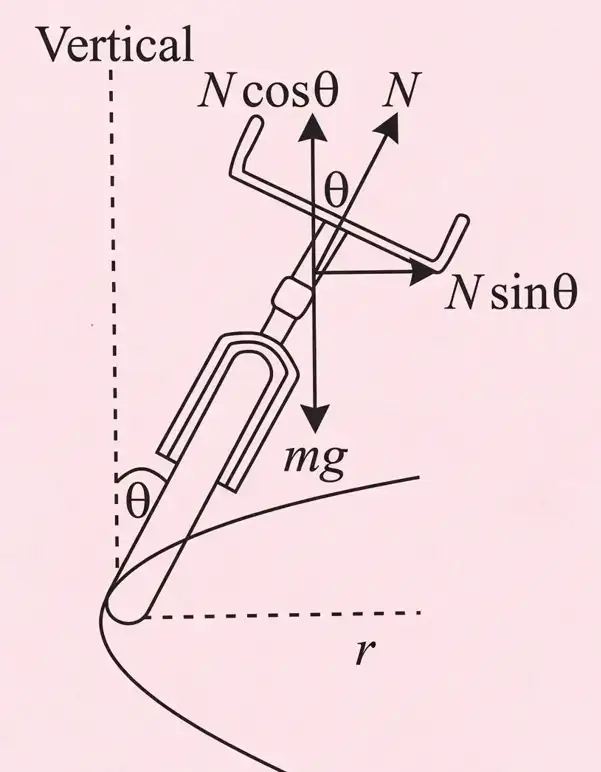
Cyclist leaning — A cyclist leans while turning so the forces on the cyclist support circular motion without toppling.
Force balance
- Inward force: The horizontal component of the normal reaction provides centripetal force.
- Vertical balance: The vertical component of the normal reaction balances the cyclist’s weight.
- Lean angle: The angle is measured from the vertical.
For a turn of radius , the speed is related to the lean angle by this expression.
What provides the centripetal force for a car turning on a level road?
Quick recap
- On a level road, tyre-road friction supplies the centripetal force; .
- For a banked road with friction, .
- On a smooth banked road, .
- A cyclist’s normal force has an inward component for centripetal force and a vertical component balancing weight.
- For a cyclist turning at radius , .
Solving Problem in Mechanics
Systematic Approach to Mechanics Problems
- System: Choose a convenient body or assembly to analyse and draw a schematic diagram of its parts and connections.
- Free-body diagram: Show all external forces on the chosen system, then apply Newton’s laws to determine unknowns.
Minimum Force to Pull a Body Up an Inclined Plane
The force is minimum when the denominator of the expression for is maximum.
Quick recap
- Choose a system, then draw its FBD with all forces acting on it.
- Do not put forces exerted by the system on its surroundings in its FBD.
- For interaction forces on two different systems, Newton’s third law gives equal and opposite forces.
- For a pull at angle , the normal reaction is .
- The force required to pull up the plane is .
- The minimum occurs at , giving .
NEET Physics — ALL CHAPTERS
1
Basic Mathematics
2
Units and Measurement
3
Motion in a Straight Line
4
Motion in a Plane
5
Laws of Motion
6
Work, Energy and Power
7
System of Particles and Rotational Motion
8
Gravitation
9
Mechanical Properties of Solids
10
Mechanical Properties of Fluids
11
Thermal Properties of Matter
12
Thermodynamics
13
Kinetic Theory
14
Oscillations
15
Waves
16
Electric Charges and Fields
17
Electrostatic Potential and Capacitance
18
Current Electricity
19
Moving Charges and Magnetism
20
Magnetism and Matter
21
Electromagnetic Induction
22
Alternating Current
23
Electromagnetic Waves
24
Ray Optics and Optical Instruments
25
Wave Optics
26
Dual Nature of Radiation and Matter
27
Atoms
28
Nuclei
29
Semiconductor Electronics: Materials, Devices and Simple Circuits