NEET UG . NEET Physics . Physics . Gravitation
Chapter 8: Gravitation
Ch 8
NEET Physics
NEET UG
Kepler’s Laws
Law of Orbits
Kepler’s law of orbits — Every planet moves around the Sun in an elliptical orbit, with the Sun at one focus.
- Ellipse: An oval-shaped orbit with two foci; the Sun is at one focus, not at the centre.
- Semi-major axis: The longest half-diameter of the ellipse; it is used in the law of periods.
Law of Areas
Kepler’s law of areas — The line joining a planet to the Sun sweeps out equal areas in equal time intervals.
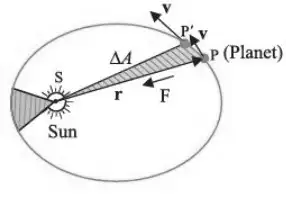
For a short time interval , the swept area is determined by the radius vector and the planet’s velocity.
Areal velocity is the area swept per unit time. Since angular momentum is conserved for a central force, it is constant.
- Symbols: is the planet’s angular momentum and is its mass.
- Consequence: A planet moves faster when nearer the Sun and slower when farther away, while sweeping equal areas in equal times.
Law of Periods
Kepler’s law of periods — The square of a planet’s orbital period is proportional to the cube of the semi-major axis of its orbit.
is the time period of revolution and is the semi-major axis of the elliptical orbit.
State Kepler’s law of areas and its connection to angular momentum.
State Kepler’s law of periods.
Quick recap
- Planets follow elliptical orbits with the Sun at one focus.
- The Sun–planet line sweeps equal areas in equal time intervals.
- Areal velocity is constant because angular momentum is conserved for a central force.
- A planet moves faster near the Sun and slower farther away.
- The square of the orbital period is proportional to the cube of the semi-major axis: .
Universal Law of Gravitation
Newton’s Universal Law of Gravitation
Universal law of gravitation — Every particle attracts every other particle with a force proportional to the product of their masses and inversely proportional to the square of their separation.
Gravitational-force magnitude
- Masses: The force is directly proportional to the product of the masses, .
- Separation: The force is inversely proportional to the square of the distance, .
- Constant: is the universal gravitational constant; it has the same value everywhere for all matter.
Use for two particles of masses and separated by distance .
Characteristics of Gravitational Force
- Attractive: The force acts along the line joining the particles and pulls them towards each other.
- Action–reaction pair: Each particle experiences an equal-magnitude force in the opposite direction; the forces act on different bodies.
- Medium-independent: The force does not depend on the nature of the surrounding medium.
- Range: The law applies at interplanetary as well as interatomic distances.
- Conservative: Work depends only on the initial and final positions, not on the path; gravity does zero net work over a closed path.
and are the mutual forces on particles 1 and 2, respectively.
Vector Form of the Force
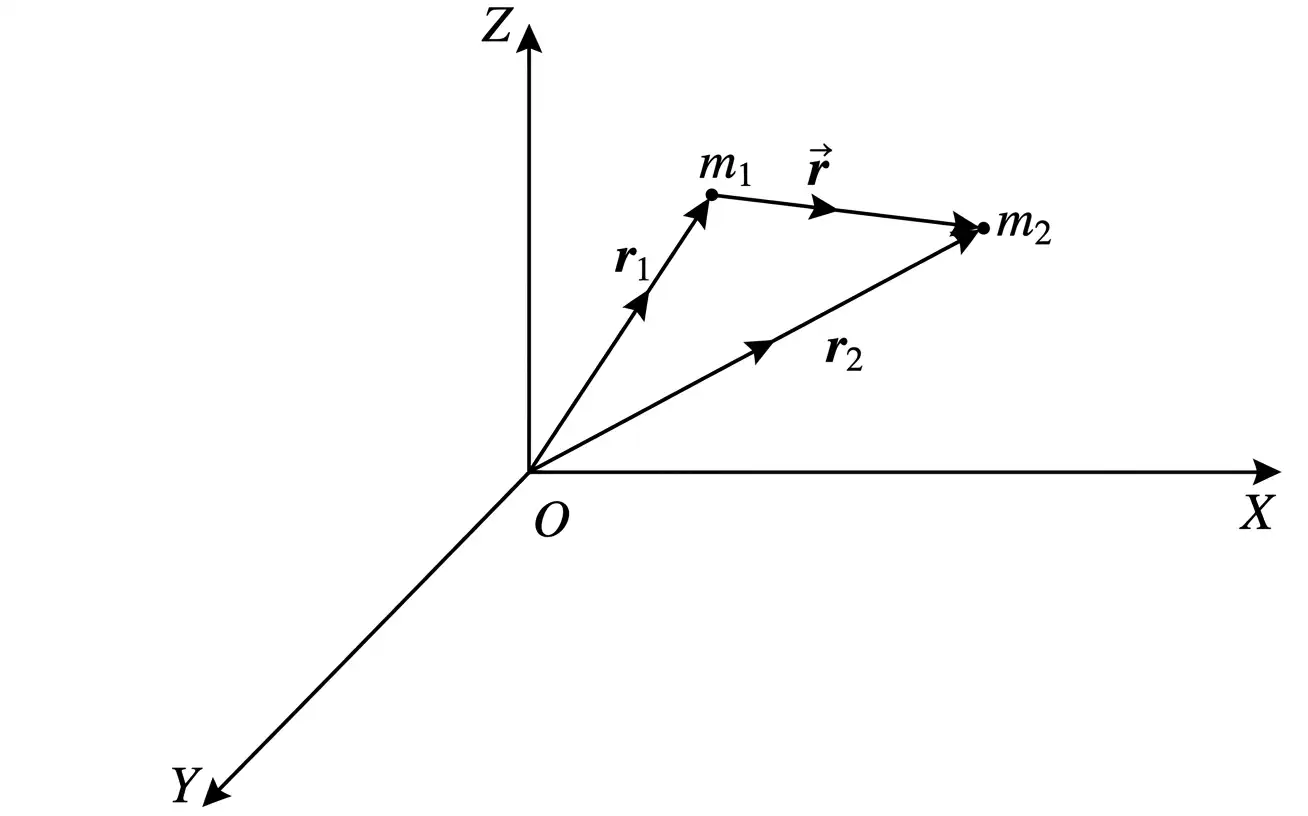
- Relative displacement: If the particles have position vectors and , then the displacement from particle 1 to particle 2 is .
- Direction: The unit vector points from particle 1 to particle 2. Therefore, the force on particle 1 due to particle 2 points along , toward particle 2.
- Force on particle 2: The force on particle 2 due to particle 1 points along .
Here, and .
The minus sign gives the force direction opposite to .
Superposition of Gravitational Forces
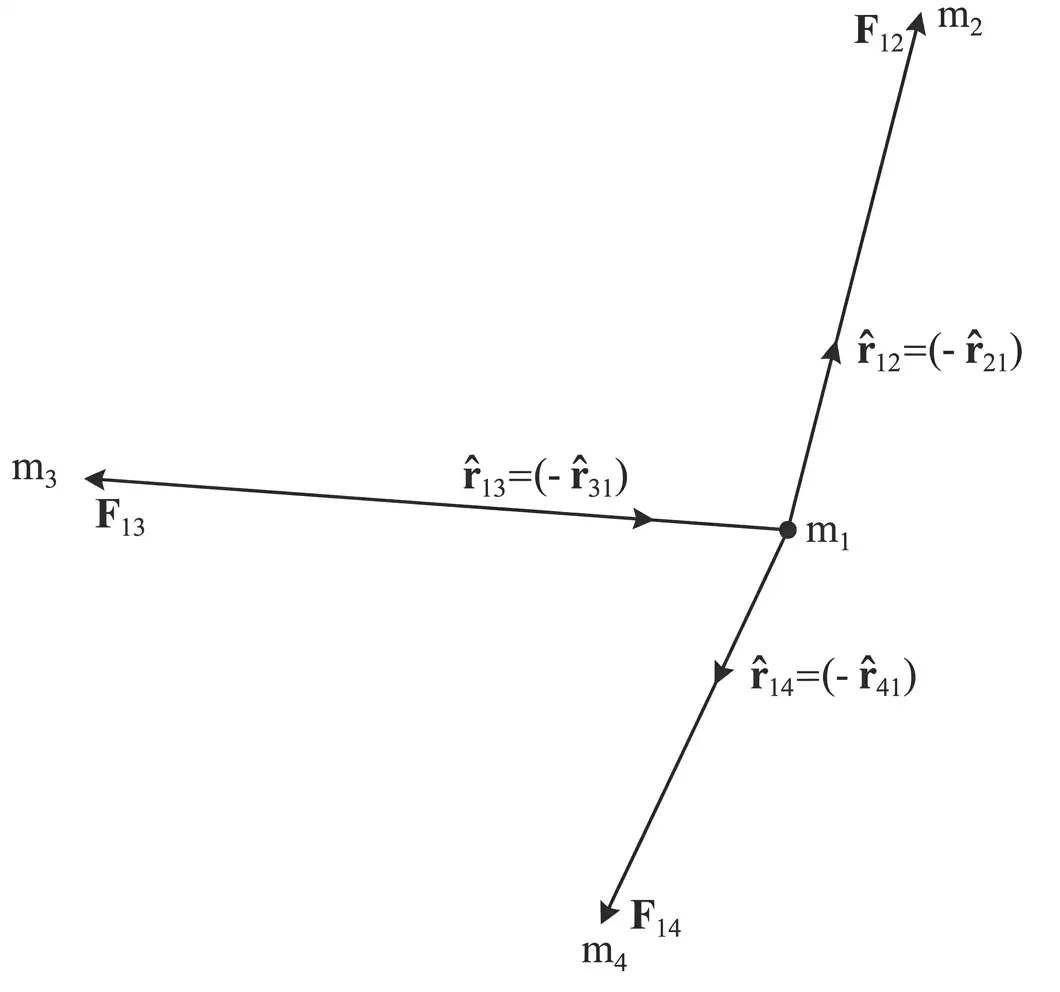
Principle of superposition — The net gravitational force on a point mass is the vector sum of the forces exerted on it by all other point masses.
- Net force: Add the individual forces as vectors, taking their directions into account.
- Example: The force on due to , , and is the sum of the three individual attractions.
Each unit vector points from toward the mass exerting that force.
State Newton’s universal law of gravitation and write its mathematical form.
Why is gravitational force conservative?
Quick recap
- The magnitude of gravitational force is .
- Gravity is always attractive and acts along the line joining the particles.
- Mutual gravitational forces are equal in magnitude and opposite in direction.
- Gravitational force is independent of the medium and applies across very large and very small distances.
- Gravity is conservative, so its net work over a closed path is zero.
- For multiple masses, the net force is the vector sum of the individual forces.
The Gravitational Constant
Universal gravitational constant, — The proportionality constant in Newton’s law of universal gravitation; its value was first determined by Henry Cavendish in 1798.
Cavendish’s torsion-balance experiment
Principle and setup
- Arrangement: Two small masses, and , are attached to the ends of a light rod of length ; large spheres of mass are placed nearby.
- Gravitational torque: Attraction between each large sphere and its neighbouring small mass produces a torque on the rod.
- Torsion: The rod twists the suspension, which exerts a restoring torque. At equilibrium, gravitational torque equals restoring torque.
- Measurement: Moving the large spheres to the opposite sides reverses the gravitational torque, turning the rod; the angle of rotation, , can be measured.
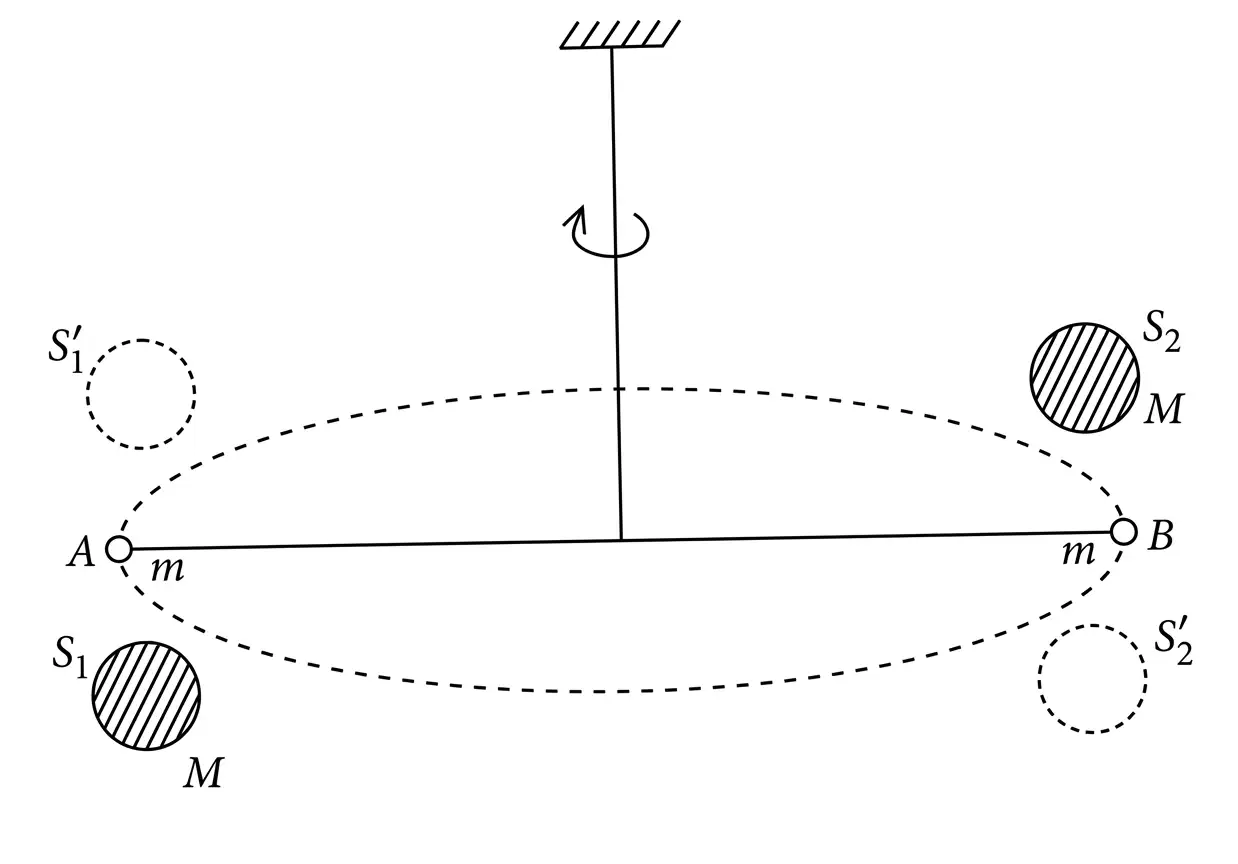
Measuring the quantities on the right gives the experimental value of .
Cavendish’s measurement has since been refined.
Quick recap
- Henry Cavendish first determined in 1798 using a torsion balance.
- The large spheres attract the small masses and twist the light rod.
- At equilibrium, gravitational torque equals the torsion restoring torque.
- The rotation angle helps determine from .
- The accepted value is .
Acceleration Due to Gravity of the Earth
Acceleration Due to Gravity
Acceleration due to gravity — The acceleration of a body falling towards Earth due to Earth's gravitational pull is called acceleration due to gravity, denoted by .
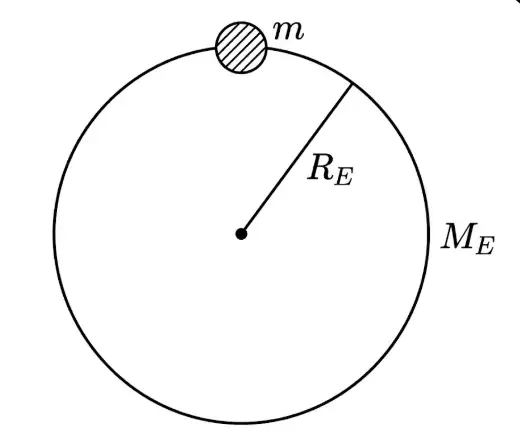
Finding at Earth's Surface
- Gravitational force: A body of mass at Earth's surface is attracted with force .
- Weight: The body's weight is ; at Earth's surface, this is the gravitational force, so .
- Earth values: Using , and gives .
Here, is Earth's mass and is Earth's radius.
Relationship Between and
- Uniform Earth density: If Earth has uniform density , its mass is .
- Surface gravity: Substituting this mass into gives .
This relation applies when Earth is treated as a sphere of uniform density .
Gravitational Field and Intensity
Gravitational field — The space around a material body in which its gravitational pull can be experienced is its gravitational field.
Gravitational field intensity — The gravitational force per unit test mass at a point, without disturbing the original field, is the field intensity, denoted by .
At distance from the centre of a mass , the negative sign indicates that the field points towards the attracting mass.
Derive the expression for acceleration due to gravity at Earth's surface.
Quick recap
- Acceleration due to gravity at Earth's surface is approximately .
- At Earth's surface, .
- For uniform Earth density, .
- A gravitational field is the region where a body's gravitational pull can be experienced.
- Field intensity is gravitational force per unit test mass.
- For a mass , the field intensity at distance is ; the negative sign indicates attraction.
Acceleration due to Gravity Below and Above the Surface of Earth
Effect of Altitude
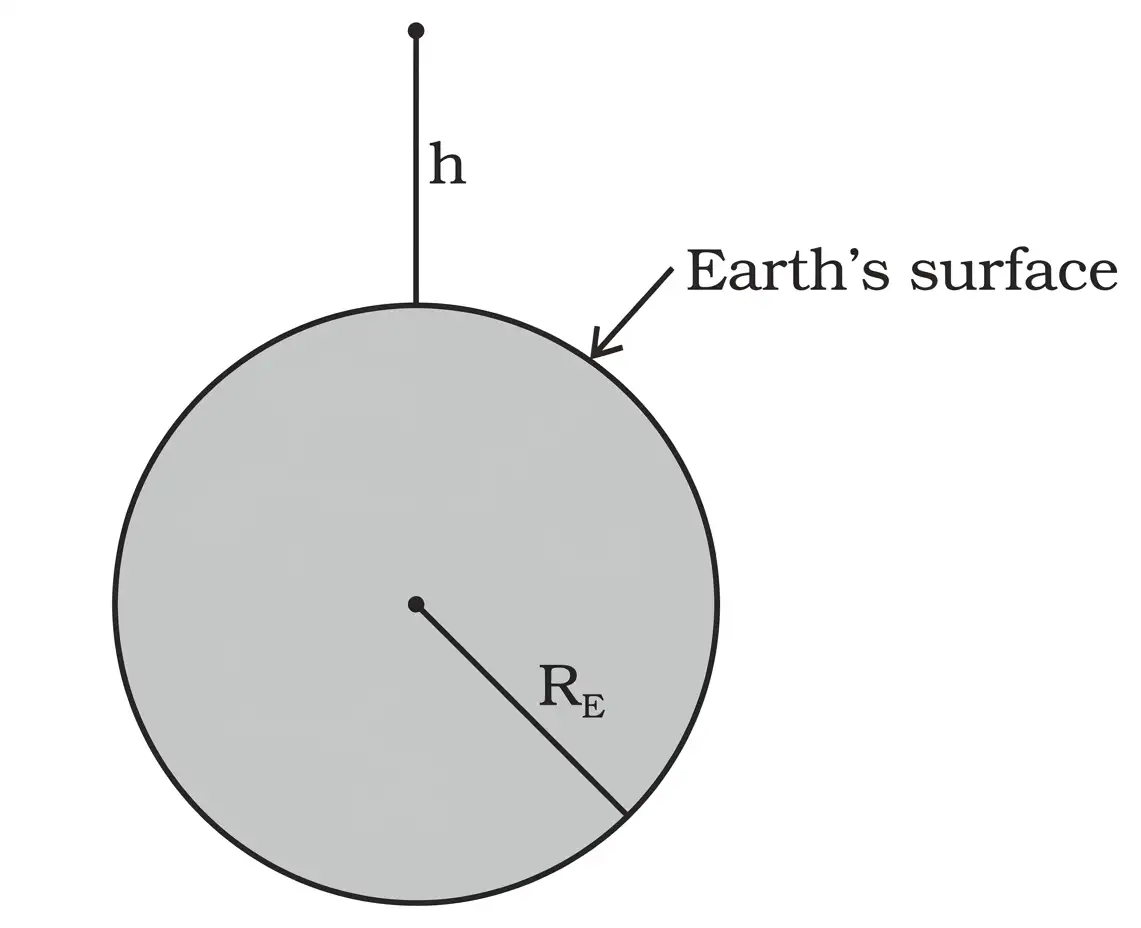
Acceleration due to gravity at altitude — At height above Earth's surface, gravity depends on the distance from Earth's centre.
- Force: A mass at altitude experiences .
- Acceleration: Dividing force by gives , where .
- Small altitude: For , binomial expansion gives ; gravity decreases as altitude increases.
The approximation applies when the altitude is much smaller than Earth's radius.
Effect of Depth
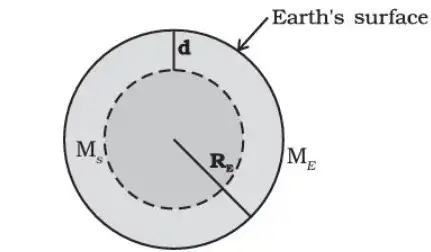
Acceleration due to gravity at depth — At depth below Earth's surface, only the mass within radius contributes to the gravitational field.
- Enclosed mass: For uniform Earth density, the inner sphere's mass satisfies .
- Force: The force at depth is .
- Outer layers: The surrounding spherical layers exert no net gravitational force at the point; the inner sphere acts as if its mass were concentrated at its centre.
- Depth dependence: Gravity decreases linearly with depth and becomes zero at Earth's centre.
Using .
Other Variations in Acceleration Due to Gravity
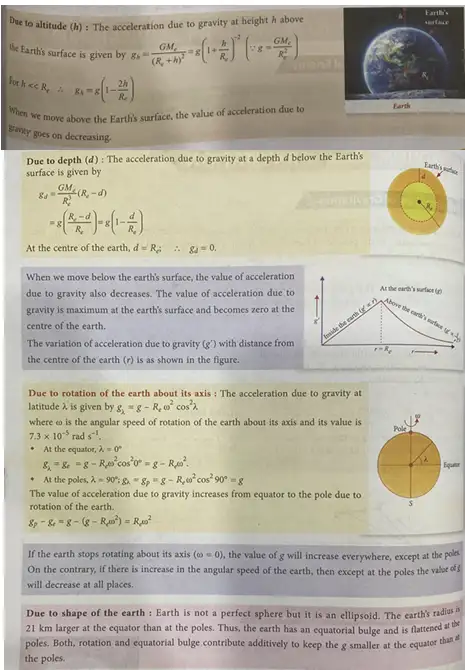
- Altitude: Gravity decreases as height above Earth’s surface increases; for small heights, .
Effect of Earth's Rotation
- Latitude formula: At latitude , effective gravity is , where is Earth's angular speed.
- Equator: At , ; gravity is minimum.
- Poles: At , ; gravity is maximum.
- Difference: , so gravity increases from the equator towards the poles.
Effect of Earth's Shape
- Shape: Earth is an ellipsoid, not a perfect sphere; its equatorial radius is about greater than its polar radius.
- Equatorial bulge: Earth is bulged at the equator and flattened at the poles.
- Combined effect: Rotation and the equatorial bulge both make gravity smaller at the equator than at the poles.
Gravitational Field and Potential of Continuous Mass Distributions
Gravitational potential — Gravitational potential is the work done per unit mass in bringing a test mass from infinity to a point without acceleration.
- Field–potential relation: In a radial field, ; in vector form, .
- Sign convention: With outward taken as positive, gravitational field points inward and has a negative radial component.
Use the radial form when field and potential depend only on distance .
Uniform Ring
Field and potential on the axis
- Setup: A uniform ring has mass and radius ; field and potential are evaluated at axial distance .
- Direction and sign: For positive , the gravitational field points towards the ring's centre; potential is negative and tends to zero at infinity.
The negative field sign denotes direction towards the ring for positive .
Uniform Disc
Field and potential on the axis
- Setup: For a uniform disc of mass and radius , field and potential are evaluated at axial distance .
- Direction: For positive , the gravitational field points towards the disc.
- Potential: The axial potential is given by the expression below.
Thin Spherical Shell
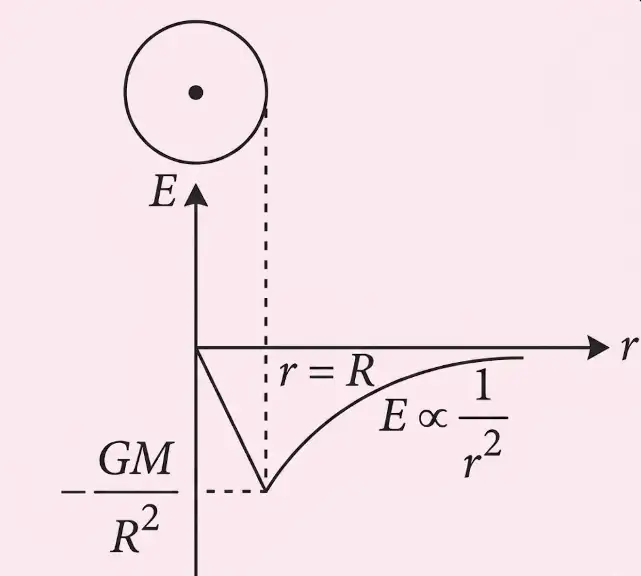
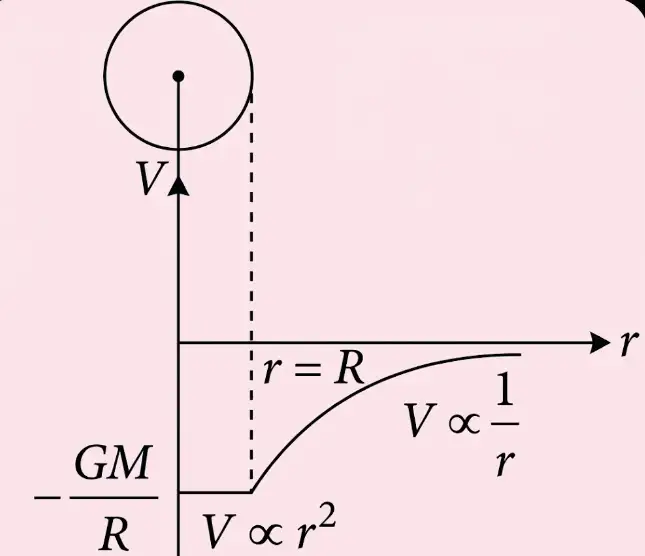
Field and potential of a thin shell
- Inside: The field is zero, but potential remains constant at .
- Surface: The field is and potential is .
- Outside: The shell acts as though its entire mass were concentrated at its centre.
| Region | Field | Potential |
|---|---|---|
| Inside, | ||
| Surface, | ||
| Outside, |
Uniform Solid Sphere
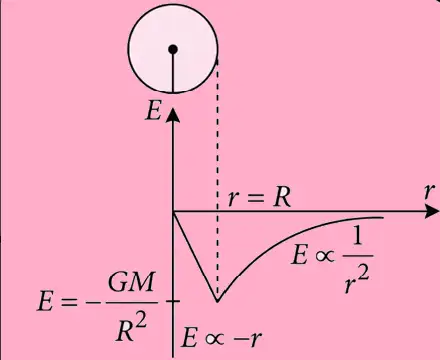
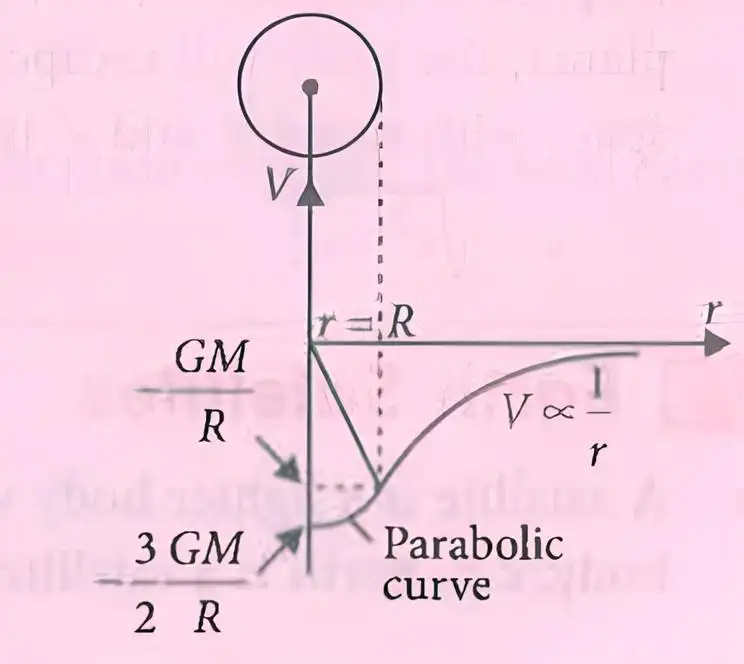
Field and potential of a solid sphere
- Inside: For a uniform sphere, field magnitude is proportional to distance from the centre.
- Outside: The sphere acts as though its entire mass were concentrated at its centre.
- Potential: Inside, potential varies quadratically with , is continuous at the surface, and outside varies as .
| Region | Field | Potential |
|---|---|---|
| Inside, | ||
| Surface, | ||
| Outside, | ||
| Centre, |
How does acceleration due to gravity vary at small altitude and at depth?
Compare the field inside a thin shell with that inside a uniform solid sphere.
Quick recap
- For small altitude, gravity decreases as .
- At depth , gravity decreases linearly: ; it is zero at Earth's centre.
- Rotation and Earth's equatorial bulge both make gravity smaller at the equator than at the poles.
- The radial gravitational field and potential satisfy .
- A thin shell has zero field but constant negative potential inside.
- A uniform solid sphere has a linearly varying field and a quadratic potential inside.
Gravitational Potential Energy
Potential Energy Between Two Masses
For masses and separated by distance , with zero potential energy at infinity:
Potential Energy in Earth's Gravitational Field
For a body of mass at height , its distance from Earth's centre is .
At the surface, the body's distance from Earth's centre is .
The change is the potential energy at height minus the potential energy at the surface. Using :
When is much smaller than Earth's radius, the change in potential energy reduces to the familiar near-surface expression.
Quick recap
- Gravitational potential energy is defined relative to zero at infinity.
- For two masses, ; the potential energy is negative under this reference convention.
- At height above Earth, .
- At Earth's surface, .
- Raising a mass by height increases its potential energy by .
- For , the change is approximately .
Escape Speed
Definition and Formula
Use this formula for a planet of mass and radius .
- Earth’s escape speed is .
What Happens at Different Projection Speeds
For projection speed , the speed in interstellar space is:
What is Earth’s escape speed?
Quick recap
- Escape speed is the minimum launch speed needed to leave a planet’s gravitational field without returning.
- For a planet, ; it is independent of the projected body’s mass.
- In terms of average density, .
- Earth’s escape speed is .
- Below escape speed a body may rise, orbit, or fall back; above it, the body escapes with speed .
Earth Satellites
Satellites and Their Motion
Satellite — A satellite is a comparatively lighter body that revolves continuously in an orbit around a much larger body. For example, Earth is a satellite of the Sun, and the Moon is a satellite of Earth.
Direction of motion
- Velocity is tangent to the satellite’s circular orbit.
- Acceleration is directed towards the centre of the circular orbit.
Orbital Speed
Orbital speed — The minimum speed required to place a satellite in a given orbit around Earth.
For an orbit at height above Earth’s surface; .
For a low orbit, where .
Key point
- Mass independence The orbital speed does not depend on the satellite’s mass.
Time Period
Time period — The time taken by a satellite to complete one revolution around Earth.
For a circular orbit at height above Earth’s surface.
For a low orbit, where .
Height from the Time Period
Use this relation to find the orbital height when the time period is known.
Quick recap
- A satellite revolves around a much larger body; Earth is a satellite of the Sun, and the Moon is a satellite of Earth.
- A satellite’s velocity is tangent to its orbit, while its acceleration is directed towards the centre.
- Orbital speed at height is and is independent of satellite mass.
- For a low orbit, orbital speed is and the time period is .
- The time period and orbital height are related by the given circular-orbit formulas.
Energy of an Orbiting Satellite
Energy in a Circular Orbit
- Orbital energy: A satellite in orbit has kinetic energy and gravitational potential energy; together, these determine its mechanical energy.
Energy Relations and Near-Surface Orbits
- Energy components: In a circular orbit, a satellite’s kinetic energy is positive and its gravitational potential energy is negative.
- Total energy: The satellite’s mechanical energy is the sum of its kinetic and potential energies and is negative for a bound orbit.
Binding Energy
- Meaning: Binding energy is the energy required to take a satellite from its orbit to infinity.
- Value: It equals the magnitude of the satellite’s total energy: .
Elliptical Orbits
- Changing energies: In an elliptical orbit, the satellite’s distance from Earth changes, so its kinetic and potential energies vary along the orbit.
- Total energy: The sum of kinetic and potential energies remains constant and is negative for a bound orbit.
- Speed and distance: The satellite moves fastest at its closest point to Earth and slowest at its farthest point.
Quick recap
- For a circular orbit, and .
- The total energy of a circular orbit is .
- For a circular orbit, and .
- For , the total energy is approximately .
- Binding energy is the positive energy needed to take the satellite to infinity: .
- In an elliptical orbit, and vary, while total energy remains constant and negative.
NEET Physics — ALL CHAPTERS
1
Basic Mathematics
2
Units and Measurement
3
Motion in a Straight Line
4
Motion in a Plane
5
Laws of Motion
6
Work, Energy and Power
7
System of Particles and Rotational Motion
8
Gravitation
9
Mechanical Properties of Solids
10
Mechanical Properties of Fluids
11
Thermal Properties of Matter
12
Thermodynamics
13
Kinetic Theory
14
Oscillations
15
Waves
16
Electric Charges and Fields
17
Electrostatic Potential and Capacitance
18
Current Electricity
19
Moving Charges and Magnetism
20
Magnetism and Matter
21
Electromagnetic Induction
22
Alternating Current
23
Electromagnetic Waves
24
Ray Optics and Optical Instruments
25
Wave Optics
26
Dual Nature of Radiation and Matter
27
Atoms
28
Nuclei
29
Semiconductor Electronics: Materials, Devices and Simple Circuits