NEET UG . NEET Physics . Physics . Thermodynamics
Chapter 12: Thermodynamics
Ch 12
NEET Physics
NEET UG
Thermal Equilibrium
Scope of Thermodynamics
Thermodynamics — The branch of physics that studies heat, temperature, and their interconversion with other forms of energy.
- Macroscopic science: Thermodynamics describes bulk systems without examining the molecular constitution of matter.
- State variables: A gas can be specified by pressure, volume, temperature, internal energy, and entropy.
| Point | Mechanics | Thermodynamics |
|---|---|---|
| Focus | Motion of particles or bodies under forces and torques | Changes in a system’s internal macroscopic state |
| System motion | May study the motion of the system as a whole | Does not focus on the motion of the system as a whole |
Bullet Stopping in Wood
- Energy conversion: When a moving bullet pierces wood and stops, its kinetic energy is converted into heat, raising the temperature of the bullet and nearby wood.
- Temperature: It relates to the bullet’s internal, disordered motion—not its motion as a whole.
Thermodynamic and Thermal Equilibrium
Thermodynamic equilibrium — A system is in thermodynamic equilibrium when its characterising macroscopic variables do not change with time.
- Variables considered: Pressure, temperature, volume, mass, and composition must remain unchanged with time.
Thermal equilibrium — Two systems are in thermal equilibrium when there is no net flow of heat between them in thermal contact.
Quick recap
- Thermodynamics studies heat, temperature, and their conversion with other forms of energy.
- It describes bulk systems using macroscopic variables rather than molecular details.
- A gas state may be specified by pressure, volume, temperature, internal energy, and entropy.
- Mechanics focuses on motion; thermodynamics focuses on changes in internal macroscopic state.
- A bullet stopping in wood converts kinetic energy into heat; temperature relates to its internal disordered motion.
- Thermodynamic equilibrium requires pressure, temperature, volume, mass, and composition to remain constant with time.
- Thermal equilibrium means no net heat flows between systems in thermal contact.
Zeroth Law of Thermodynamics
Zeroth Law and Thermal Equilibrium
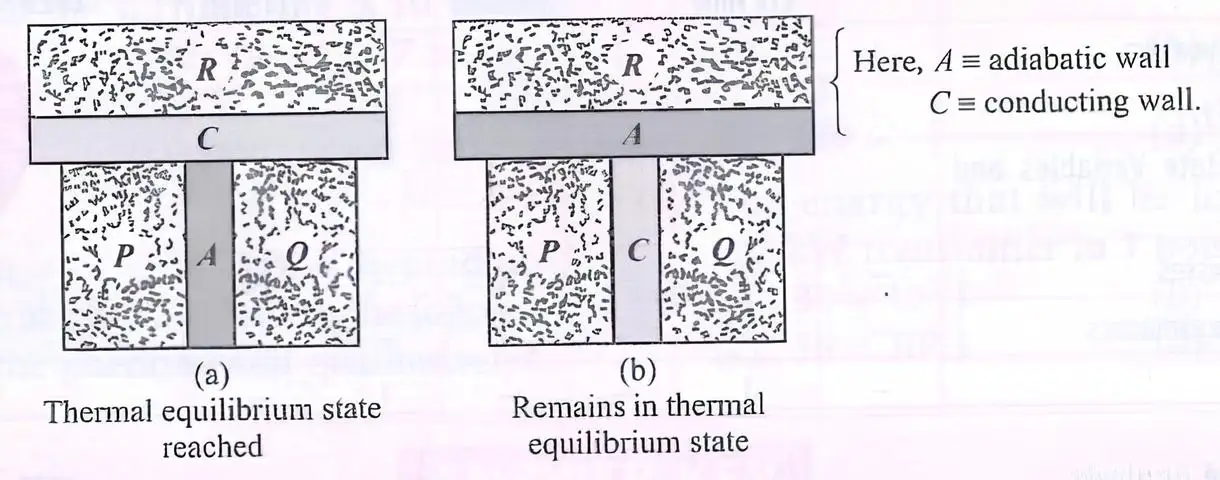
- If and are in thermal equilibrium, and and are in thermal equilibrium, then and are in thermal equilibrium.
Quick recap
- The zeroth law describes the transitive relationship of thermal equilibrium.
- Systems in thermal equilibrium have no net heat exchange.
- If and are separately in equilibrium with , they are in equilibrium with each other.
- The law provides the basis for the concept of temperature.
Heat ,Internal Energy and Work
Heat
- Energy transfer: Thermodynamics tracks energy exchanged between a system and its surroundings and changes in the system’s internal state.
Internal Energy
- Energy accounting: Thermodynamics distinguishes the energy stored within a system from energy transferred across its boundary.
Work and Energy Transfer
- Work: Work transfers energy by means other than a temperature difference, such as moving a piston or raising a connected weight.
- Heat and work: Both are modes of energy transfer that can change a system’s internal energy.
- Sign convention: Work done by an expanding gas is positive; work done on a gas during compression is negative.
Quick recap
- Heat is energy transferred because of a temperature difference.
- Internal energy is the sum of molecular kinetic and potential energies.
- Internal energy includes molecular motion but excludes the system’s overall motion.
- For an ideal gas, internal energy depends only on temperature; for a real gas, it depends on temperature and volume.
- Work transfers energy by means other than heat, and both heat and work can change internal energy.
First Law of Thermodynamics
Statement and Mathematical Form
First law of thermodynamics — Energy supplied to a system as heat is partly used to increase its internal energy and partly transferred as work done by the system.
Here, is heat supplied to the system, is the change in internal energy, and is work done by the system.
Energy and path dependence
- Rearranged form: .
- Path dependence: Heat transferred, , and work done, , generally depend on the process path.
- State change: Their difference, , is path-independent and equals the change in internal energy.
For work done by the system against constant pressure, . If internal energy does not change, then .
Combining the first law with constant-pressure work gives this relation.
Sign Conventions
| Quantity or process | Sign | Meaning |
|---|---|---|
| Heat absorbed by system | Heat enters the system. | |
| Heat rejected by system | Heat leaves the system. | |
| Temperature rises | Internal energy increases. | |
| Temperature falls | Internal energy decreases. | |
| Gas expands | Work is done by the system. | |
| Gas is compressed | Work is done on the system. |
With this convention, work done by the gas is positive; work done on the gas during compression is negative.
Quick recap
- The first law applies conservation of energy to heat and work transfers.
- Use for heat supplied and work done by the system.
- Internal-energy change, , is path-independent.
- Heat and work individually generally depend on the process path.
- At constant pressure, work done by the system is .
- Absorbed heat, rising internal energy, and expansion work are positive; their opposite cases are negative.
Specific Heat Capacity
Specific Heat Capacity
Use this to calculate the specific heat capacity from heat transfer and temperature change.
Molar Specific Heat of Solids
Here, is heat capacity and is the amount of substance in moles.
The result applies at constant volume for solids near room temperature; carbon is an exception.
Specific Heat Capacity of Water
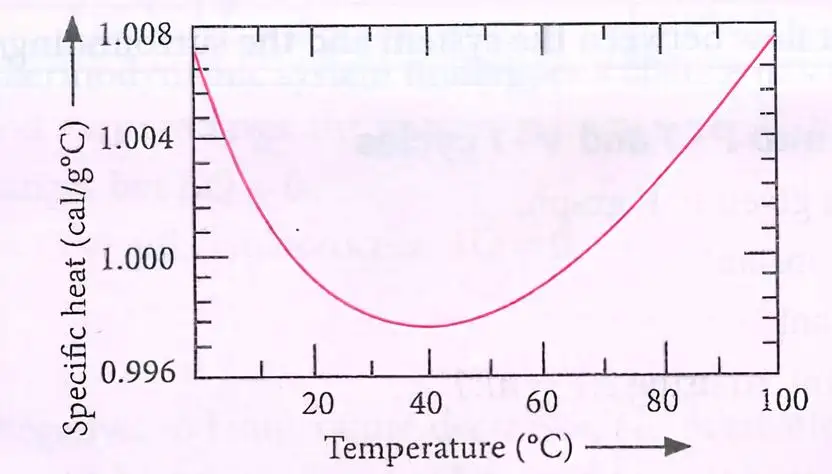
- Calorie: One calorie is the heat required to raise the temperature of of water from to .
Heat Capacities at Constant Volume and Pressure
At constant pressure, the extra heat goes into expansion work as well as changing internal energy.
Mayer’s Relation
For one mole of an ideal gas.
State Mayer’s relation and its condition.
Quick recap
- Specific heat capacity is heat required per unit mass per unit temperature rise: .
- Molar heat capacity is heat capacity per mole: .
- For a solid near room temperature, the molar heat capacity is ; carbon is an exception.
- Water’s specific heat varies slightly with temperature and has a minimum near .
- At constant volume, heat changes internal energy; at constant pressure, gas expansion also requires heat.
- For one mole of an ideal gas, Mayer’s relation is .
Thermodynamic State Variables and Equation of State
Thermodynamic State Variables
- Equilibrium state: Thermodynamic state variables describe the macroscopic condition of a system in equilibrium.
- Classification: State variables are either extensive, depending on system size, or intensive, independent of system size.
Equation of State
Use this equation of state for an ideal gas.
Products of State Variables
- Product rule: The product of an intensive variable and an extensive variable is extensive.
- Example: Pressure is intensive and volume is extensive, so their product, energy, is extensive.
- Ideal gas: In \PV=\\mu RT\, the product \PV\ is extensive, as it scales with the amount of gas.
Quick recap
- State variables describe the equilibrium state of a system.
- An equation of state relates a system’s state variables.
- Extensive variables depend on system size; intensive variables do not.
- Pressure and temperature are intensive; volume is extensive.
- For an ideal gas, .
- An intensive variable multiplied by an extensive variable gives an extensive quantity.
Thermodynamic Processes
Basic Types of Processes
Quasi-static process — An idealised process carried out infinitely slowly, so the system remains in equilibrium at every stage.
Quasi-static process
- Equilibrium: The system remains in thermal and mechanical equilibrium with its surroundings throughout.
- Variables: Pressure, volume and temperature change slowly enough for the system to pass through equilibrium states.
Cyclic process — A series of changes after which the system returns to its initial state; a non-cyclic process does not return to that state.
The system ends at its initial state.
A cyclic process does not keep the temperature constant throughout. For an ideal gas, the final temperature equals the initial temperature, but it may vary during the cycle.
Special Thermodynamic Processes
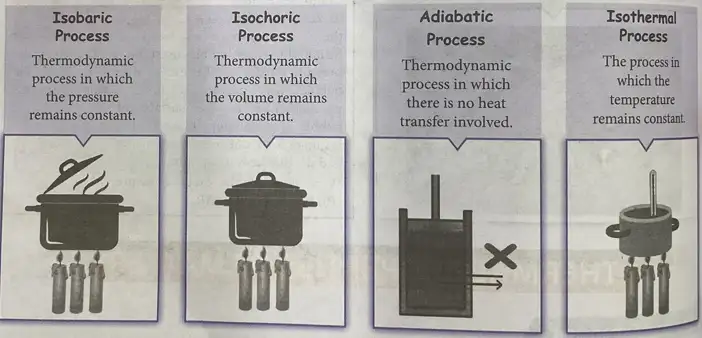
| Process | Constant quantity or condition |
|---|---|
| Isothermal | Temperature: constant |
| Isobaric | Pressure: constant |
| Isochoric (isometric) | Volume: constant |
| Adiabatic | No heat exchange: |
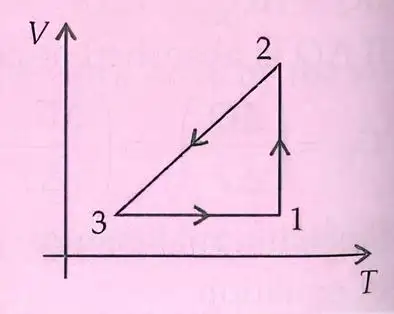
Converting Cycles Between Graphs
Pressure–temperature and volume–temperature graphs
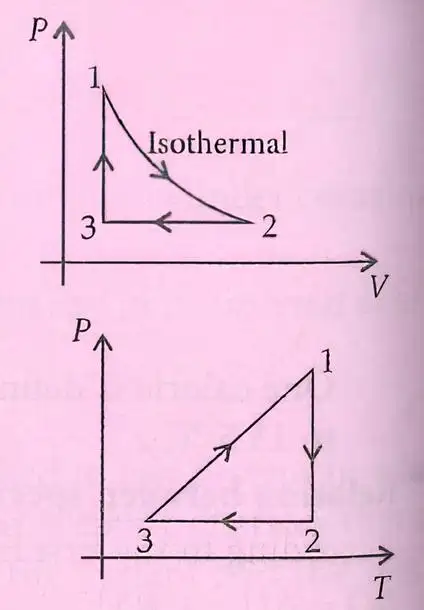
- Cycle segments: In the given cycle, is isothermal, is isobaric, and is isochoric.
- Isochoric segment: From , when is constant; the pressure–temperature graph is a straight line through the origin.
- Isobaric segment: From , when is constant; the volume–temperature graph is a straight line through the origin.
- Other segment: The segment has constant volume.
Isothermal Process
Isothermal process — A process in which the system's temperature remains constant.
Properties and first law
- Temperature and internal energy: and, for an ideal gas, .
- Heat and work: From , ; supplied heat is converted into work done by the gas.
- Equation of state: Boyle's law applies: , so .
- P–V curve: The curve is a rectangular hyperbola. Isotherms at higher temperatures lie above those at lower temperatures and do not intersect.
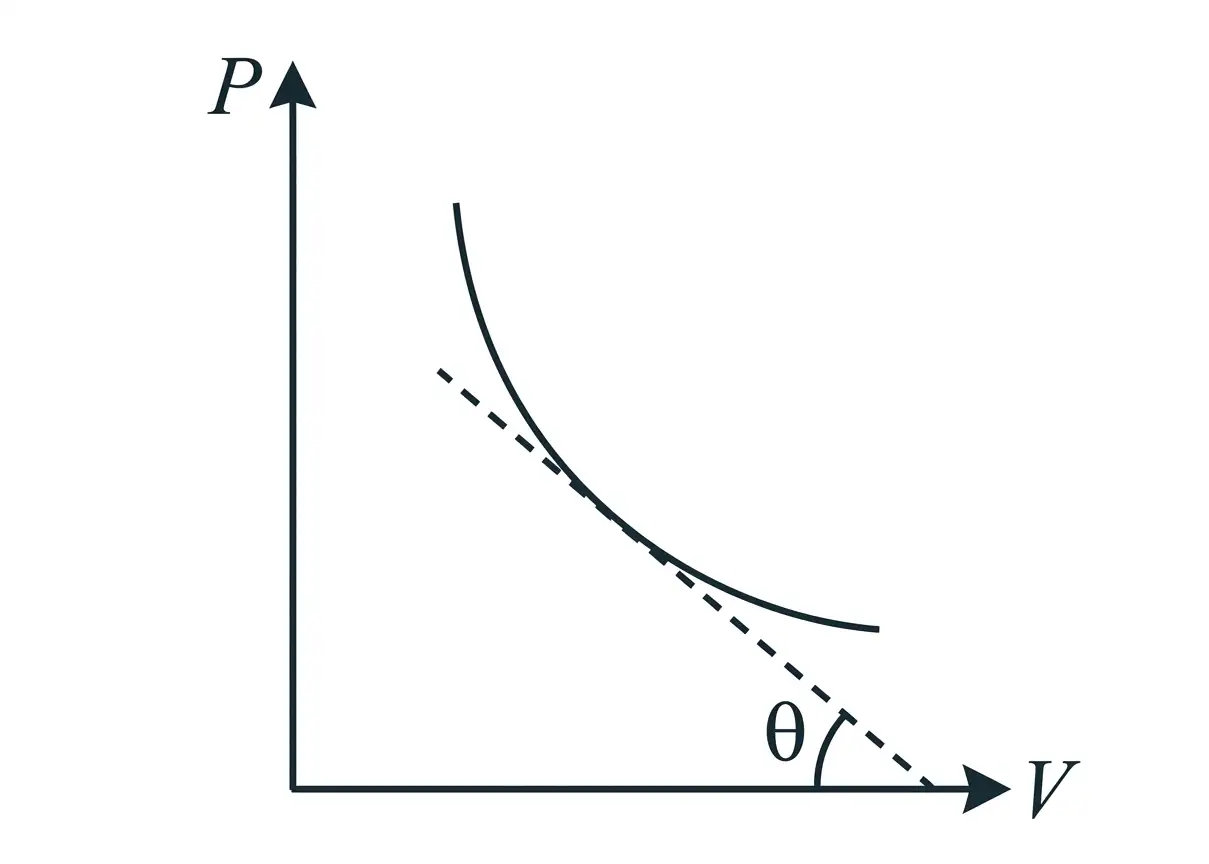
- Slope: Differentiating gives .
- Work on the graph: The area under the curve represents work; expansion gives positive work, while compression gives negative work.
- Molar heat capacity: It is infinite in the isothermal limit because heat can be exchanged while .
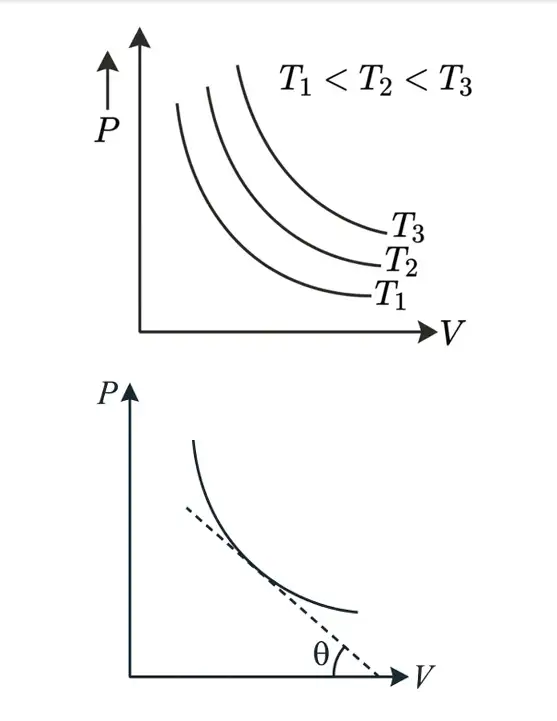
For moles of an ideal gas at constant temperature.
Adiabatic Process
Adiabatic process — A process in which no heat is exchanged between the system and its surroundings.
Properties and first law
- Heat transfer: , while , and can all change.
- First law: .
- Expansion: Positive work by the gas makes internal energy and temperature decrease; adiabatic expansion cools the gas.
- Compression: Negative work by the gas raises internal energy and temperature; adiabatic compression heats the gas.
- Poisson's law: , where .
- P–V slope: ; since , an adiabatic curve is steeper than an isothermal curve at the same state.
- Molar heat capacity: It is zero because no heat is transferred while the temperature changes.
Work done by the gas between initial and final states.
Adiabatic work comparisons
- Dependence: For the same conditions, is proportional to the amount of gas and to , and inversely proportional to .
- Gas types: Since , the corresponding work magnitudes follow .
Isobaric Process
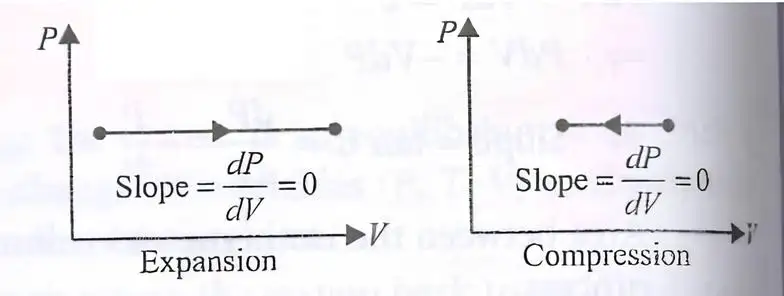
Isobaric process — A process in which pressure remains constant.
| Change | |||
|---|---|---|---|
| Expansion (heating) | Positive | Positive | Positive: heat enters |
| Compression (cooling) | Negative | Negative | Negative: heat leaves |
For constant pressure; the gas-work sign convention is used.
For a gas with degrees of freedom.
Isochoric or Isometric Process
Isochoric (isometric) process — A process in which volume remains constant.
Properties
- P–V graph: The constant-volume path is vertical, with .
- Heating: Pressure, temperature, internal energy and heat supplied increase; and .
- Cooling: Pressure, temperature and internal energy decrease; and .
- Molar heat capacity: For degrees of freedom, .
No work is done because the volume does not change.
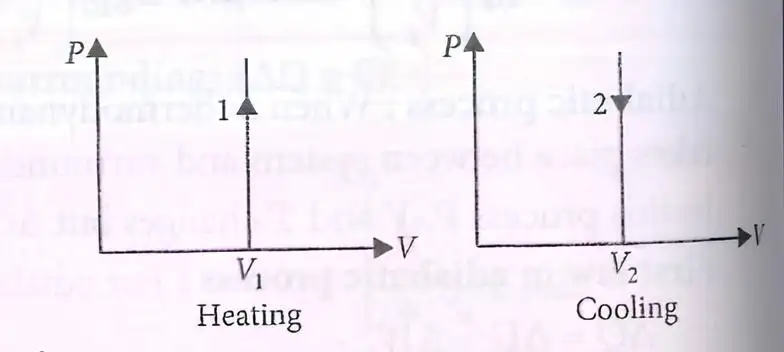
Polytropic Process
Polytropic process — A process described by , where is the polytropic index and can take any real value.
| Index or relation | Result |
|---|---|
| General relations | ; ; |
| Isobaric: | |
| Isothermal: | |
| Adiabatic: |
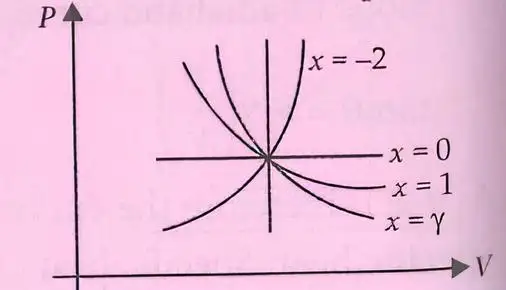
Work done by the gas; valid for .
Molar heat capacity of a polytropic process
- Heat and internal energy: and .
- First law: Using and the polytropic work relation gives the process heat capacity below.
For , where for an ideal gas.
Quick recap
- Quasi-static: An infinitely slow process keeps the system in equilibrium at every stage.
- Cycle: The system returns to its starting state, so net internal-energy change is zero.
- Isothermal: is constant, is constant, and heat supplied equals work done by the gas.
- Adiabatic: , is constant, and expansion cools while compression heats.
- Isobaric and isochoric: Constant pressure gives ; constant volume gives .
- Polytropic: is constant; , and give isobaric, isothermal and adiabatic cases.
Second Law of ThermodynamicS
Second Law of Thermodynamics
Second law of thermodynamics — A law that rules out processes allowed by the first law alone, including complete conversion of heat into work in a cyclic engine.
Consequences
- Heat engines: No heat engine can have efficiency ; its efficiency must be less than .
- Refrigerators: A refrigerator cannot have an infinite coefficient of performance.
Statements of the Second Law
| Kelvin–Planck statement | Clausius statement | |
|---|---|---|
| Process ruled out | A process whose sole result is absorbing heat from a reservoir and converting it completely into work. | A process whose sole result is transferring heat from a cooler body to a hotter body. |
| Key implication | A cyclic heat engine cannot convert all absorbed heat into work. | Heat does not flow from cold to hot as the sole result of a process. |
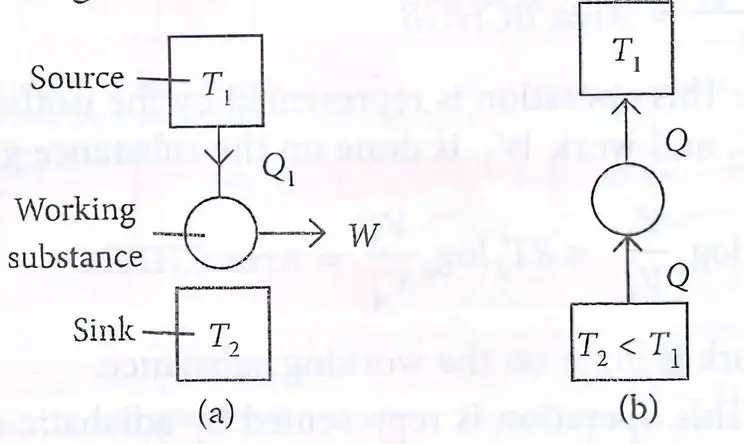
- Kelvin–Planck forbids complete heat-to-work conversion as the sole result.
- Clausius forbids heat transfer from cold to hot as the sole result.
Quick recap
- The second law excludes processes that the first law alone does not prohibit.
- No heat engine can have efficiency equal to .
- No refrigerator can have an infinite coefficient of performance.
- Kelvin–Planck rules out complete conversion of absorbed heat into work as the sole result.
- Clausius rules out heat transfer from a cooler body to a hotter body as the sole result.
Reversible and Irreversible Processes
Reversible Processes
- Classification: Thermodynamic processes are classified according to whether the system and surroundings can be restored to their initial states by reversing the process.
Irreversible Processes
State the conditions for a reversible process.
Give one example and two causes of an irreversible process.
Quick recap
- A reversible process can be retraced by infinitesimal changes in external conditions.
- Reversibility requires near-equilibrium conditions, infinitely slow change, no friction and no energy loss.
- A complete reversible cycle is an ideal case; actual processes have losses.
- Natural processes are irreversible because they are not quasi-static and may involve dissipative effects.
- Spontaneous expansion into an evacuated space is a standard example of an irreversible process.
Carnot Engine
Carnot engine — A theoretical ideal heat engine with maximum efficiency, free from practical imperfections, which cannot be realised in practice.
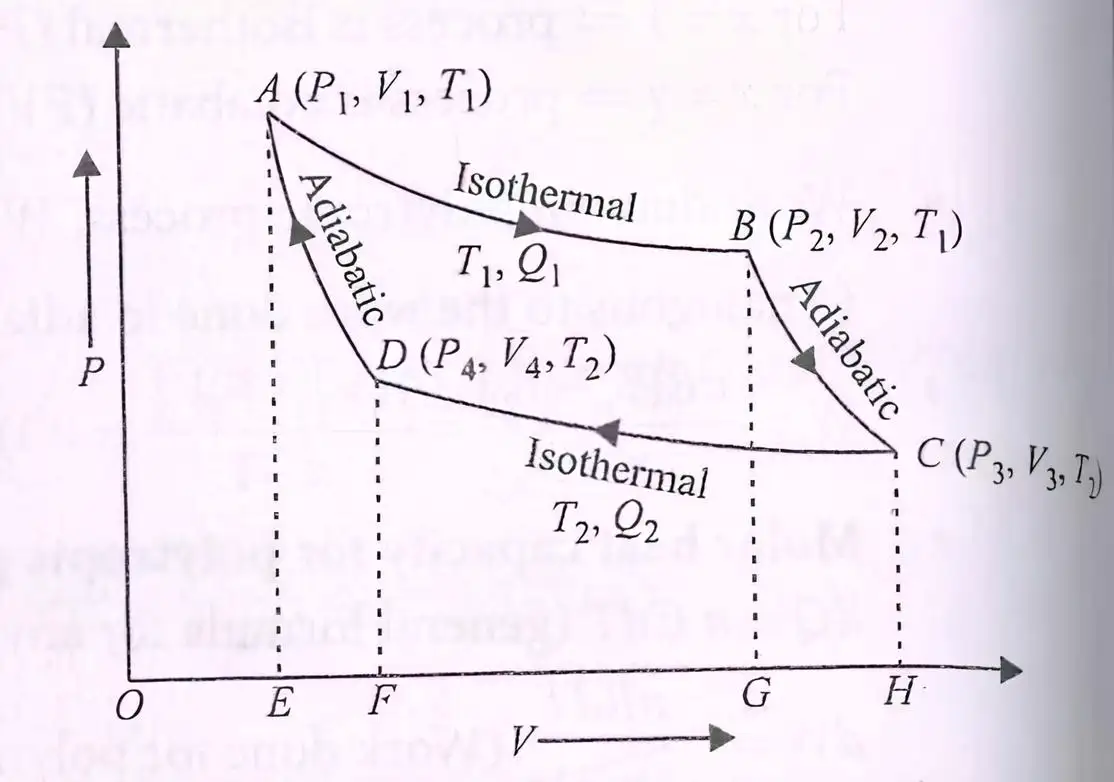
| Process | Heat transfer | Work and temperature change |
|---|---|---|
| Isothermal expansion | Absorbs from the source at | Gas does work ; temperature remains |
| Adiabatic expansion | No heat transfer | Gas does work ; temperature falls from to |
| Isothermal compression | Rejects to the sink at | Work is done on the gas; temperature remains |
| Adiabatic compression | No heat transfer | Work is done on the gas; temperature rises from to |
Work and heat in each process
- Isothermal expansion : The gas absorbs heat from the source and does work at constant temperature .
- Adiabatic expansion : No heat enters or leaves; the gas does work as its temperature decreases from to .
- Isothermal compression : The gas rejects heat to the sink at constant temperature ; work is done on the gas.
- Adiabatic compression : No heat is exchanged; work done on the gas raises its temperature from to .
For the ideal gas on .
The gas does this work during expansion ; the same magnitude is required to compress it along .
On , is the heat rejected and is the work done on the gas.
Along either adiabatic branch, temperature and volume satisfy this relation.
Net work per cycle
- Adiabatic branches: The expansion work and compression work have equal magnitudes and opposite signs, so their net contribution is zero.
- Net work: The work output equals heat absorbed minus heat rejected and is represented by the area enclosed by the cycle on the P–V diagram.
For one complete cycle.
Efficiency of a Carnot engine
Efficiency is the ratio of net work output to heat supplied.
Why the efficiency depends only on temperatures
- Adiabatic : Applying gives .
- Adiabatic : The same relation gives .
- Volume ratios: Equating these relations gives , hence .
- Substitution: Using the isothermal heat expressions in the efficiency equation cancels the logarithmic volume factors.
Here and are the absolute temperatures of the source and sink, respectively.
Carnot theorem
- Equal efficiency: All reversible heat engines operating between the same two temperatures have equal efficiency.
- Maximum efficiency: No heat engine operating between the same temperatures can be more efficient than a Carnot engine.
State the efficiency of a Carnot engine operating between source temperature and sink temperature .
Quick recap
- A Carnot cycle consists of two isothermal and two adiabatic processes.
- The engine absorbs from the source at and rejects to the sink at .
- Isothermal heat transfer is and .
- Adiabatic work magnitude is ; the two adiabatic works cancel over a cycle.
- Net work is , and Carnot efficiency is .
- Reversible engines between the same temperatures have equal efficiency; none exceeds Carnot efficiency.
NEET Physics — ALL CHAPTERS
1
Basic Mathematics
2
Units and Measurement
3
Motion in a Straight Line
4
Motion in a Plane
5
Laws of Motion
6
Work, Energy and Power
7
System of Particles and Rotational Motion
8
Gravitation
9
Mechanical Properties of Solids
10
Mechanical Properties of Fluids
11
Thermal Properties of Matter
12
Thermodynamics
13
Kinetic Theory
14
Oscillations
15
Waves
16
Electric Charges and Fields
17
Electrostatic Potential and Capacitance
18
Current Electricity
19
Moving Charges and Magnetism
20
Magnetism and Matter
21
Electromagnetic Induction
22
Alternating Current
23
Electromagnetic Waves
24
Ray Optics and Optical Instruments
25
Wave Optics
26
Dual Nature of Radiation and Matter
27
Atoms
28
Nuclei
29
Semiconductor Electronics: Materials, Devices and Simple Circuits