NEET UG . NEET Physics . Physics . Electromagnetic Waves
Chapter 23: Electromagnetic Waves
Ch 23
NEET Physics
NEET UG
Displacement Current
Maxwell’s Idea
- Maxwell’s insight: A changing electric field produces a magnetic field, just as an electric current does.
- Displacement current: Maxwell introduced this additional current to resolve an inconsistency in Ampere’s circuital law for a charging capacitor.
- Maxwell’s equations: Four equations describing electric and magnetic fields and their sources—charge and current densities.
- Electromagnetic waves: Hertz experimentally demonstrated their existence in 1885; their technological use by Marconi and others transformed communication.
Displacement current — The effective current associated with a changing electric flux; it produces a magnetic field even where no conduction current flows.
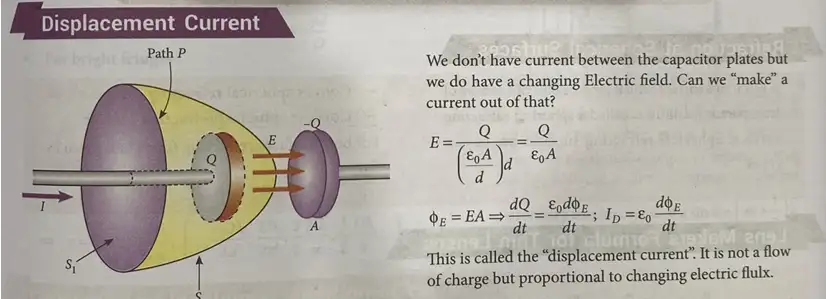
Inconsistency of Ampere’s Circuital Law
- Charging capacitor: Conduction current flows in the connecting wire, but no conduction current crosses the gap between the plates.
- Problem: Applying the original Ampere’s law to different surfaces bounded by the same loop gives different results.
- Consequence: The naive result would make the magnetic field discontinuous, contrary to the physical continuity of the field.
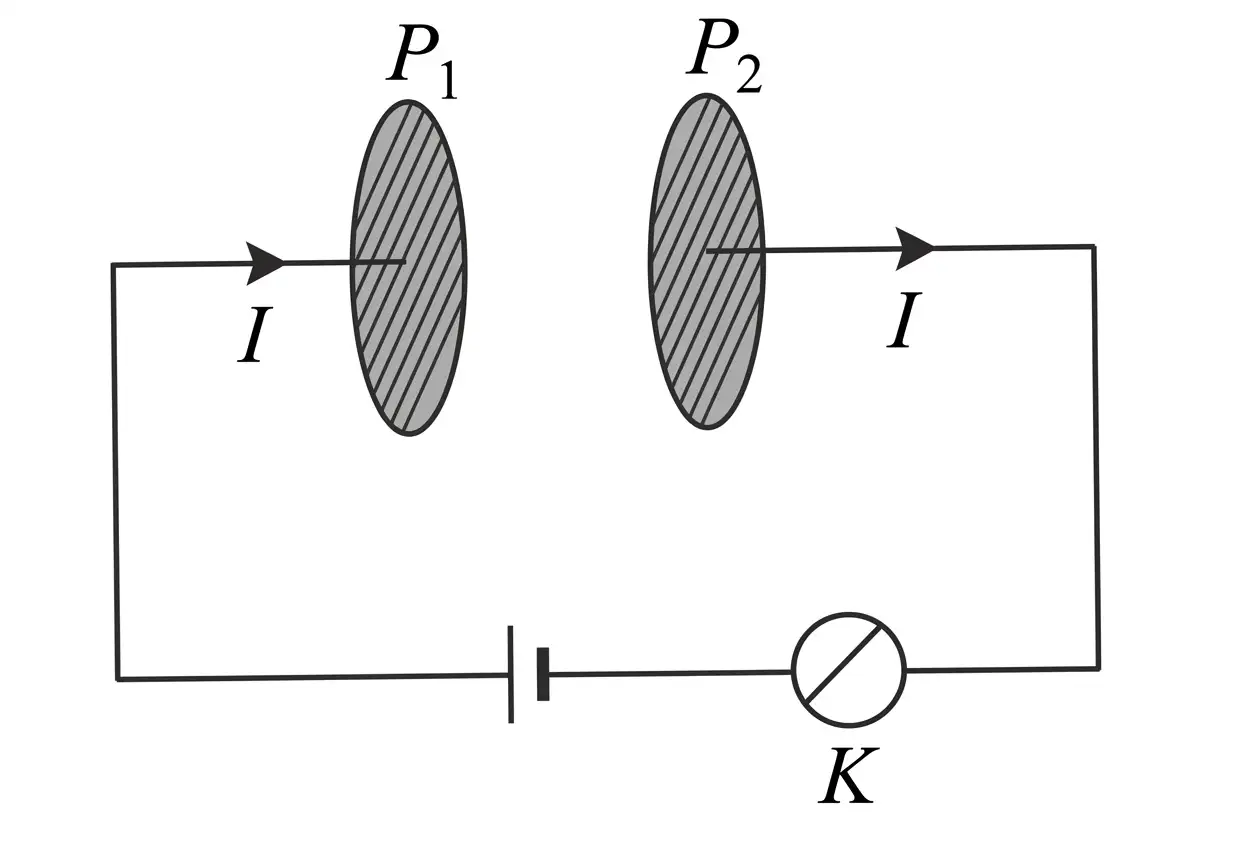
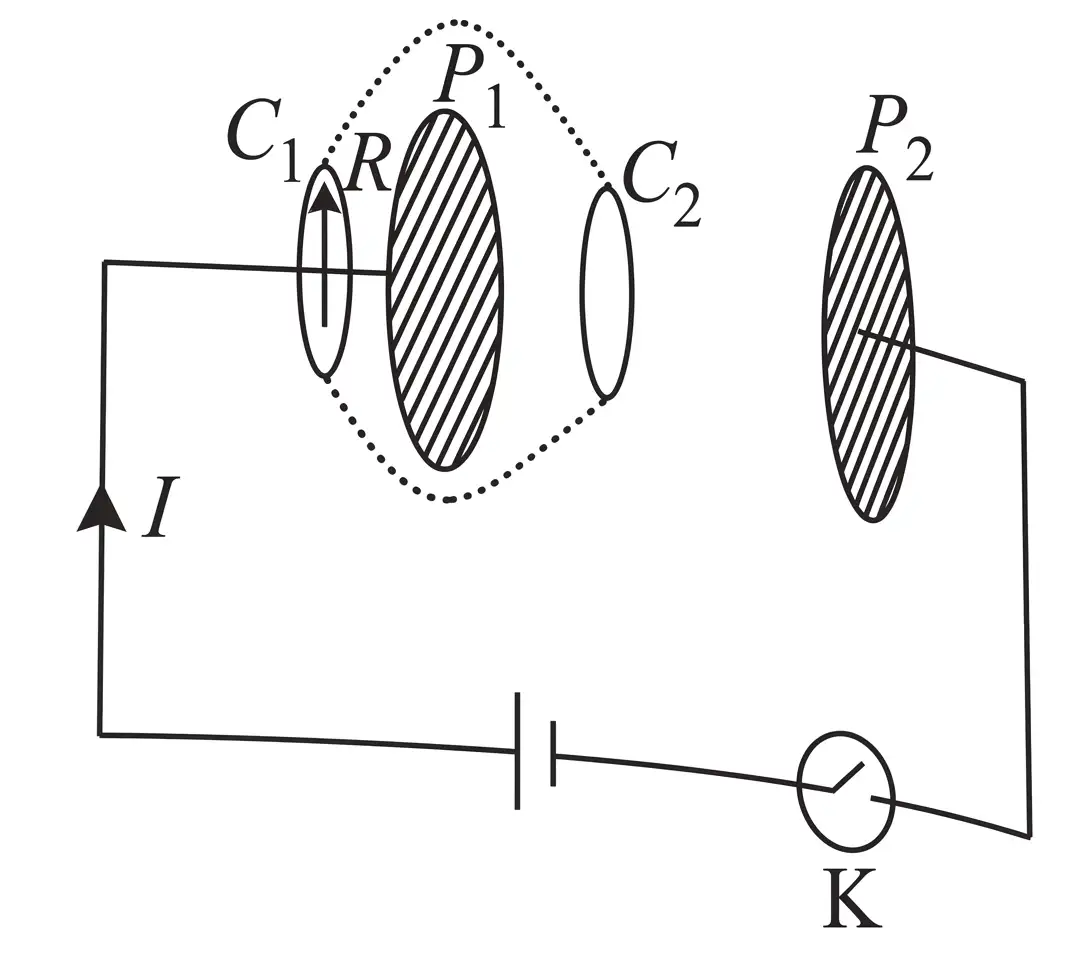
| Surface | Conduction current through surface | Result from original law |
|---|---|---|
| C₁ (cuts the wire) | ||
| C₂ (passes through the capacitor gap) | The original law would predict zero circulation. |
- Contradiction: The same loop cannot have different magnetic-field circulation depending on which surface is chosen.
- Maxwell’s correction: Add a displacement-current term for the surface through the changing electric field in the capacitor gap.
Maxwell’s Modified Ampere’s Law
Here, is the electric flux through the surface.
For a uniform electric field perpendicular to area .
Magnetic-field circulation depends on the sum of conduction current and displacement current.
Consistency of the Modified Law
| Surface | Current contribution | Magnetic-field circulation |
|---|---|---|
| C₁ (wire) | Displacement current is zero; conduction current is . | |
| C₂ (capacitor gap) | Conduction current is zero; displacement current is . |
- In the wire region: No changing electric flux contributes, so the circulation is due to .
- In the capacitor gap: Changing electric flux gives a displacement current, so the magnetic field also exists between the plates.
- Result: The modified law gives consistent magnetic-field circulation for either surface.
For an ideal charging capacitor, , so . Therefore, the displacement current has the same magnitude as the conduction current.
- Kirchhoff’s current law: Since during ideal capacitor charging, current continuity is maintained even though no conduction current crosses the gap.
Maxwell’s Equations
- Purpose: Maxwell’s four equations summarise the basic laws of electricity and magnetism and explain how electromagnetic waves can be produced.
The net electric flux through a closed surface equals the enclosed charge divided by . Electric field lines are not closed continuous curves because they can begin or end on charges.
The net magnetic flux through any closed surface is zero; magnetic field lines form closed continuous curves.
The induced emf equals the negative rate of change of magnetic flux. A changing magnetic field produces an electric field; the negative sign expresses Lenz’s law.
The circulation of the magnetic field depends on conduction current and changing electric flux. A changing electric field produces a magnetic field.
For open space such as the capacitor gap, ; only the changing electric flux contributes.
What is displacement current, and what is its expression?
Why did Maxwell modify Ampere’s circuital law?
What do Maxwell’s third and fourth equations show?
Quick recap
- A changing electric field produces a magnetic field and is represented by displacement current.
- For a charging capacitor, the original Ampere’s law gave inconsistent results for different surfaces.
- Displacement current is .
- For an ideal charging capacitor, displacement current equals conduction current: .
- Maxwell’s four equations are Gauss’s law for electricity, Gauss’s law for magnetism, Faraday’s law, and modified Ampere’s law.
- Hertz experimentally demonstrated electromagnetic waves in 1885.
Electromagnetic Waves
Production by Changing Fields
Electromagnetic wave — A wave of oscillating electric and magnetic fields, perpendicular to each other and to the direction of propagation.
How Changing Fields Produce Waves
- Changing fields: A time-varying magnetic field produces a perpendicular electric field; a time-varying electric field produces a perpendicular magnetic field.
- Propagation: The changing fields continually regenerate each other, carrying energy through space.
- Frequency: The wave frequency equals the frequency of the original field variations.
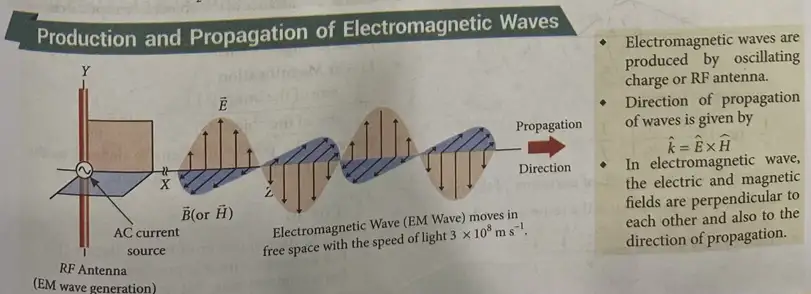
Production by Accelerated Charges
- Stationary charge: Produces an electrostatic field only.
- Uniform motion: A charge in uniform motion (steady current) produces a magnetic field but does not radiate electromagnetic waves.
- Acceleration: An accelerated charge radiates electromagnetic waves.
- Oscillating charge: Its oscillating electric field produces an oscillating magnetic field; the fields regenerate each other as the wave travels.
- Frequency and energy: The wave frequency equals the charge’s oscillation frequency; radiated energy comes from the accelerating charge.
How an Oscillating Charge Produces a Wave
- Oscillating charge → oscillating electric field
- Changing electric field → oscillating magnetic field
- Changing magnetic field → regenerates electric field
- Regenerating fields → electromagnetic wave carries energy outward
Hertz’s Experiment
- Demonstration: Heinrich Hertz was the first to experimentally produce and detect electromagnetic waves.
- Transmitter: Metal plates and spheres connected by rods form a spark-gap arrangement; induction coils create a high potential difference.
- Spark and oscillations: The voltage ionises air between the spheres, allowing discharge and producing a spark. Small circuit inductance and capacitance give a high resonant frequency.
- Wave production: Oscillating charges create an electric field across the gap and a perpendicular magnetic field; together they radiate electromagnetic waves.
- Detector: A changing magnetic flux through a loop induces an emf, producing a spark across the detector gap.
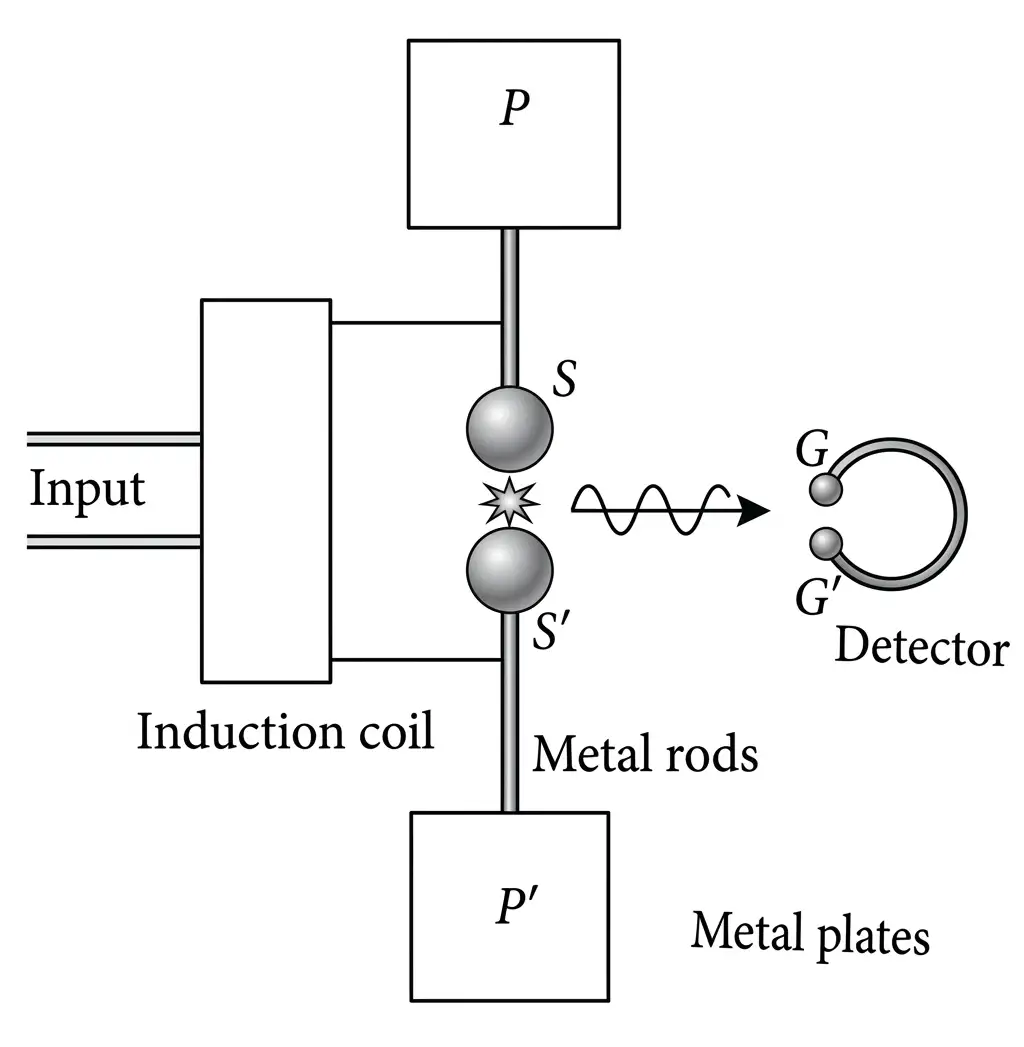
Small circuit inductance and capacitance produce a high oscillation frequency.
Nature and Properties of Electromagnetic Waves
- Transverse nature: The electric field, magnetic field and propagation direction are mutually perpendicular.
- Wave orientation: For propagation along the -direction, the electric field may point along and the magnetic field along .
- Phase: The electric and magnetic fields oscillate in phase and have the same frequency and wavelength.
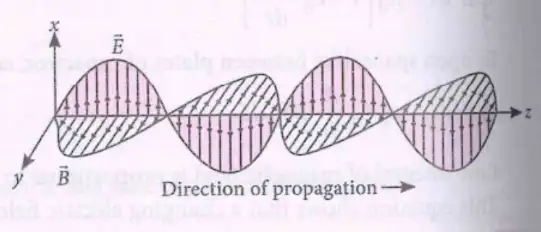
For a wave travelling along , both fields have the same phase; is the wave number, the angular frequency, the wavelength, the frequency and the period.
In vacuum, the ratio of electric-field magnitude to magnetic-field magnitude is the speed of light.
and are the permeability and permittivity of free space; and are the permeability and permittivity of the material medium. Light is an electromagnetic wave, and all electromagnetic waves travel at speed in vacuum.
Energy and Momentum
- Energy: A travelling electromagnetic wave carries energy, shared equally between its electric and magnetic fields.
- Momentum: Electromagnetic waves carry momentum and exert pressure when they strike a surface.
If energy is transferred to a surface, the momentum delivered has magnitude .
Energy Density
Energy density — The energy carried by an electromagnetic wave per unit volume.
- Electric contribution: In free space, the electric-field energy density is .
- Magnetic contribution: In free space, the magnetic-field energy density is .
- Equal sharing: For a plane wave, the electric and magnetic contributions are equal, so each accounts for half the total energy density.
Using root-mean-square fields, the total energy density is the sum of the electric and magnetic parts.
How are the electric field, magnetic field and propagation direction oriented in an electromagnetic wave?
How did Hertz detect the electromagnetic waves produced by his spark-gap arrangement?
How is energy density divided in a plane electromagnetic wave?
Quick recap
- Changing electric and magnetic fields regenerate each other and carry energy as an electromagnetic wave.
- Accelerated charges radiate; the wave frequency matches the charge’s oscillation frequency.
- Hertz generated waves using a spark-gap arrangement and detected them through an induced spark in a loop.
- Electromagnetic waves are transverse, with electric and magnetic fields in phase and mutually perpendicular.
- In vacuum, ; in a medium, , where the symbols denote the corresponding permeability and permittivity.
- Waves carry energy and momentum; their energy is shared equally by electric and magnetic fields.
Electromagnetic Spectrum
Electromagnetic spectrum
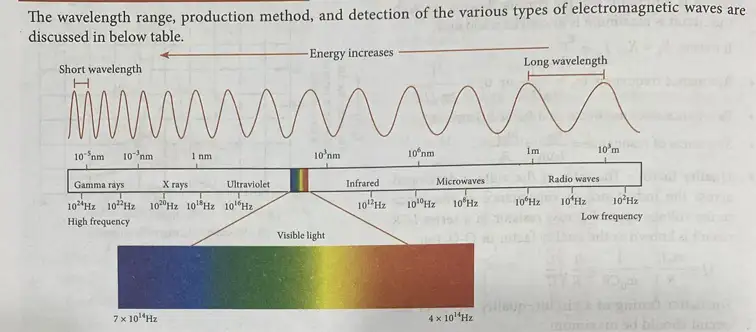
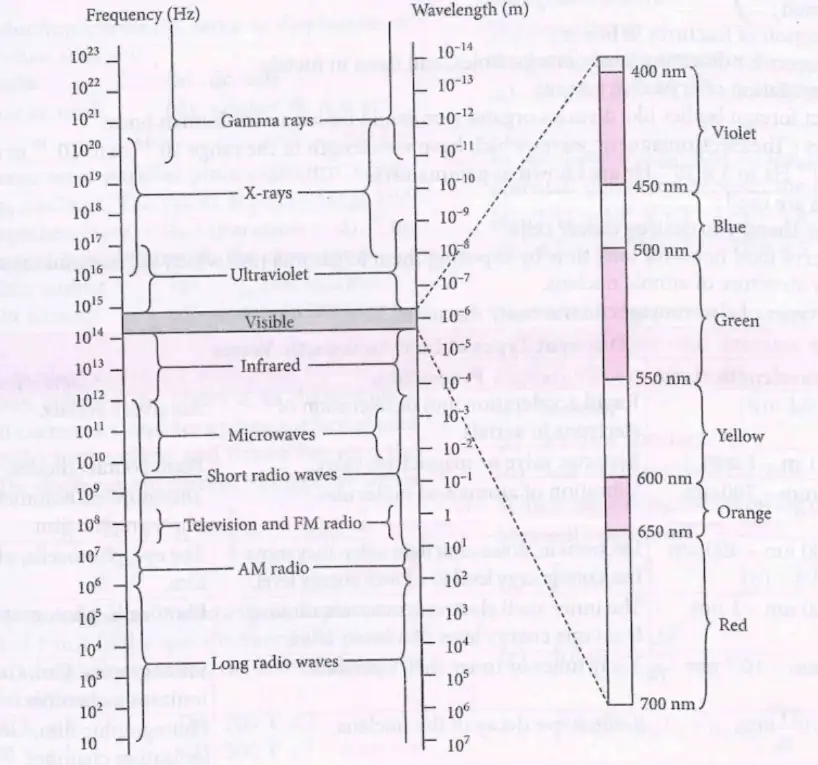
Ranges, production and detection
| Type | Range stated in lecture | Production | Detection |
|---|---|---|---|
| Radio | Frequency: –; wavelength: | Rapid acceleration and deceleration of electrons in aerials. | Receiver aerials. |
| Microwave | Wavelength: – | Klystron valve or magnetron valve. | Point-contact diodes. |
| Infrared | Frequency: –; wavelength: – | Vibration of atoms and molecules. | Thermopiles, bolometer, infrared photographic film. |
| Visible light | Wavelength: – (table: –); frequency: – | Atomic electrons emit light when moving to a lower energy level. | Eye, photocells, photographic film. |
| Ultraviolet | Wavelength: – in text; – in table. Frequency: – | Inner-shell electrons moving to a lower energy level. | Photocells, photographic film. |
| X-rays | Wavelength: – in text; – in table | X-ray tubes or inner-shell electrons. | Photographic film, Geiger tubes, ionization chamber. |
| Gamma rays | Wavelength: –; frequency: –. Table: | Radioactive decay of the nucleus. | Photographic film, Geiger tubes, ionization chamber. |
Radio waves and microwaves
- Radio waves: Frequency range is –; used in radio, television and cellular-phone communication.
- Microwaves: The shortest-wavelength radio waves; much longer in wavelength than visible light but far shorter than radio-broadcast waves.
- Microwave radar: Used for aircraft navigation and for measuring the speed of moving balls or automobiles.
Infrared waves
Infrared waves — Electromagnetic waves with frequencies from to .
Uses and greenhouse effect
- Uses: Infrared lamps for physical therapy; detectors in Earth satellites; infrared LEDs in remote switches; solar water heaters and cookers.
- Greenhouses: Infrared trapping maintains a suitable, nearly constant temperature for plant growth.
- Earth’s warming: The surface absorbs sunlight and re-emits energy as infrared radiation; greenhouse gases, especially carbon dioxide and water vapour, trap some of it.
Greenhouse effect — The trapping of infrared radiation by greenhouse gases such as carbon dioxide and water vapour, contributing to Earth’s average temperature.
How the greenhouse effect occurs
- Visible sunlight passes through the atmosphere.
- Earth’s surface absorbs sunlight and radiates energy as infrared waves.
- Greenhouse gases absorb and trap some of this infrared radiation.
- The trapped energy helps maintain Earth’s average temperature.
Visible light
Visible rays — Electromagnetic waves that can be detected by the human eye.
- Range: Wavelength – and frequency –.
- Uses: Electric bulbs, tube lights, lasers and cinema screens.
Ultraviolet rays
Ultraviolet rays — Electromagnetic waves beyond visible light, with the lecture giving wavelength – and frequency –.
Uses
- Sterilisation: Used for surgical instruments and killing germs in water purifiers.
- Other uses: LASIK eye surgery, mineral checking through fluorescence, and burglar alarms.
X-rays
X-rays — Electromagnetic waves beyond the ultraviolet region; the lecture gives a wavelength range of –.
Uses
- Medical: Detecting bone fractures and locating foreign bodies such as stones or bullets in the body.
- Engineering: Finding faults, cracks, holes and flaws in metals.
- Scientific: Investigating crystal structure.
Gamma rays
Gamma rays — Electromagnetic waves with wavelengths – and frequencies –.
Uses
- Cancer therapy: Used to destroy cancer cells.
- Food preservation: Irradiation kills harmful microorganisms and helps preserve food for longer.
- Nuclear physics: Used to study the structure of the atomic nucleus.
What is the greenhouse effect?
State two uses of microwaves and two uses of ultraviolet rays.
Quick recap
- The spectrum order is radio waves → microwaves → infrared → visible light → ultraviolet → X-rays → gamma rays.
- Moving toward gamma rays, frequency and energy increase while wavelength decreases.
- Radio waves are used for communication; microwaves are used in radar and speed detection.
- Infrared radiation is used for heating and is involved in the greenhouse effect.
- Visible light has a wavelength range of about –.
- Ultraviolet, X-rays and gamma rays are used in sterilisation, detection, treatment and scientific investigation.
NEET Physics — ALL CHAPTERS
1
Basic Mathematics
2
Units and Measurement
3
Motion in a Straight Line
4
Motion in a Plane
5
Laws of Motion
6
Work, Energy and Power
7
System of Particles and Rotational Motion
8
Gravitation
9
Mechanical Properties of Solids
10
Mechanical Properties of Fluids
11
Thermal Properties of Matter
12
Thermodynamics
13
Kinetic Theory
14
Oscillations
15
Waves
16
Electric Charges and Fields
17
Electrostatic Potential and Capacitance
18
Current Electricity
19
Moving Charges and Magnetism
20
Magnetism and Matter
21
Electromagnetic Induction
22
Alternating Current
23
Electromagnetic Waves
24
Ray Optics and Optical Instruments
25
Wave Optics
26
Dual Nature of Radiation and Matter
27
Atoms
28
Nuclei
29
Semiconductor Electronics: Materials, Devices and Simple Circuits