NEET UG . NEET Physics . Physics . Mechanical Properties of Fluids
Chapter 10: Mechanical Properties of Fluids
Ch 10
NEET Physics
NEET UG
Pressure
Fluids
- Fluids: Liquids and gases can flow and have no definite shape of their own.
- Volume: Liquids have a fixed volume, while gases fill the entire volume of their container.
- Importance: Fluids mediate processes in living beings, including plants.
Pressure
Pascal’s law — A pressure change applied to an enclosed fluid at rest is transmitted undiminished throughout the fluid and to the container walls.
Pressure in a Fluid at Rest
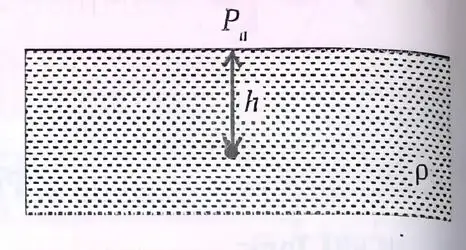
Absolute pressure at depth below the surface.
Absolute and Gauge Pressure
- Atmospheric pressure: Pressure exerted by the atmosphere; represented by .
- Absolute pressure: Total pressure relative to a vacuum: .
- Gauge pressure: Pressure above atmospheric pressure: .
- Hydrostatic dependence: Pressure depends on , and , not on the liquid’s total amount, vessel shape or cross-sectional area.
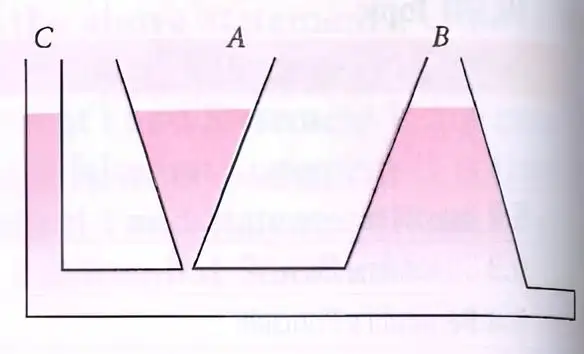
Hydrostatic Paradox
- Result: For the same liquid and fill height, pressure at the base is the same in vessels of different shapes.
- Reason: Base pressure is determined by , not by the liquid’s volume or weight; those can differ between vessels.
Measuring Pressure
Atmospheric Pressure and Barometer
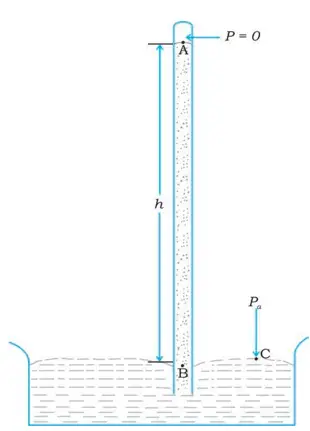
- Barometer: A mercury barometer measures atmospheric pressure.
- Barometer column: At the top point , pressure is approximately zero because only low-pressure mercury vapour is present; points and have equal pressure, .
- Pressure units: .
- Torr: ; a pressure equivalent to of mercury is called one torr.
- Other use: Millimetres of mercury and torr are used in medicine and physiology; bar and millibar are common in meteorology.
Conversion used for barometric pressure.
Open-Tube Manometer
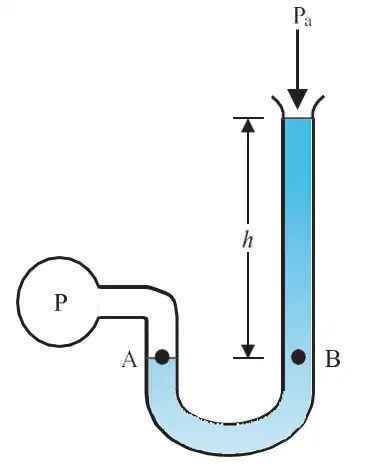
- Purpose: Measures pressure difference between a gas and the atmosphere; the reading is gauge pressure.
- Principle: The pressure difference is balanced by the hydrostatic pressure of the manometer liquid.
- Choice of liquid: Use a low-density liquid for small pressure differences and a high-density liquid for large differences.
Here is the manometer-liquid density and is the level difference.
Hydraulic Machines
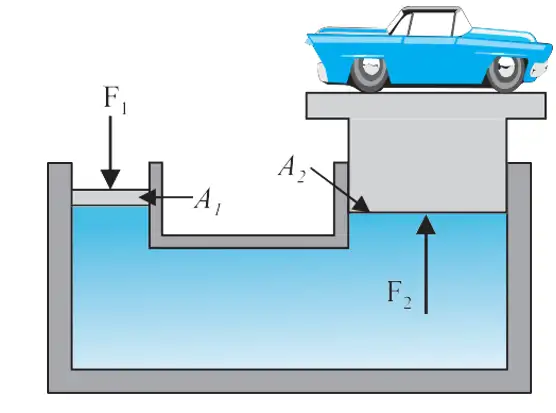
Hydraulic Lift
- Principle: A hydraulic lift works by Pascal’s law: pressure applied to an enclosed liquid is transmitted to a larger piston.
- Force multiplication: A small force on a small-area piston can produce a larger force on a larger-area piston.
- Applications: Hydraulic lifts raise heavy loads; hydraulic brakes also use Pascal’s law.
Equal pressure at the two pistons gives the output force.
Pressure in Accelerated Fluids
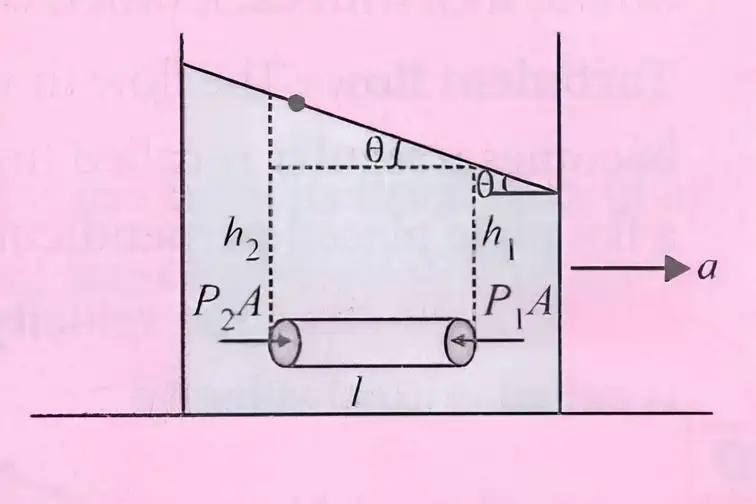
Horizontal Acceleration of a Container
- Free surface: In a horizontally accelerated fluid, the free surface is perpendicular to the effective acceleration (the net acceleration in the container’s frame).
- Pressure variation: Pressure increases vertically downward and decreases in the direction of the container’s acceleration.
- Equal-pressure lines: The locus joining points at equal pressure is called an equipressure line.
- Tilt relation: For horizontal acceleration and free-surface tilt , .
For the fluid element in the derivation, is its horizontal length and is the vertical difference between the two pressure points.
Archimedes’ Principle and Buoyancy
Archimedes’ principle — A body partially or wholly immersed in a fluid experiences an upward buoyant force equal to the weight of the fluid it displaces.
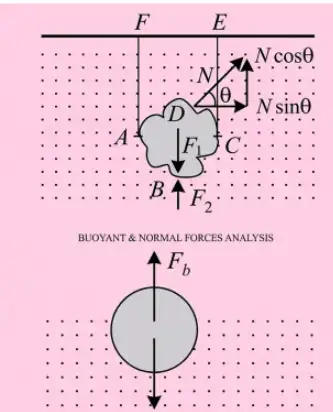
Buoyant Force
- Cause: Hydrostatic pressure is greater on the lower surface than on the upper surface, giving a net upward force.
- Magnitude: Buoyant force equals the weight of displaced fluid.
- Immersed volume: The displaced-fluid volume equals the volume of the body immersed in the fluid.
and are the hydrostatic forces on the lower and upper faces; is immersed volume and is liquid density.
Laws of Floatation
Floatation condition — A floating body is in equilibrium when its buoyant force equals its weight.
is the immersed volume (also the displaced-fluid volume); and are the body’s total volume and density.
| Density relation | Outcome | Immersion |
|---|---|---|
| The body floats with part above the surface. | ||
| The body can remain fully immersed in neutral equilibrium. | ||
| The body sinks; it cannot displace enough fluid to balance its weight. | when fully immersed |
For a fully immersed body sinking in a fluid, the net downward force is its weight minus buoyancy.
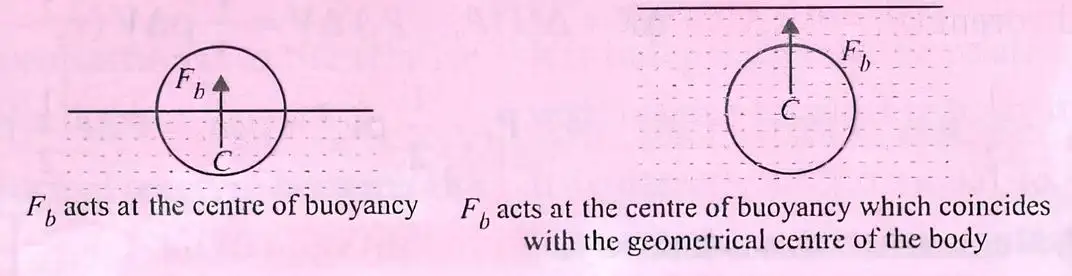
Centre of Buoyancy
Centre of buoyancy — The point through which the buoyant force acts vertically upward; it is the centre of mass of the displaced fluid.
Why do vessels with different shapes but the same liquid height have equal base pressure?
State Pascal’s law and give one application.
State Archimedes’ principle and the condition for floatation.
Quick recap
- Pressure is normal force per unit area: ; its SI unit is the pascal.
- At depth , absolute pressure is , while gauge pressure is .
- Pressure at the same depth does not depend on vessel shape or liquid quantity: hydrostatic paradox.
- Barometers measure atmospheric pressure; open-tube manometers measure gauge pressure.
- Pascal’s law enables force multiplication in hydraulic lifts and brakes.
- Accelerated fluids have tilted free surfaces, with for horizontal acceleration.
- Buoyancy equals displaced-fluid weight; floating equilibrium requires buoyancy to equal body weight.
Streamline Flow
Types of Fluid Flow
- Streamline flow: Fluid particles follow smooth paths, with velocity at each point directed along the streamline.
- Laminar flow: The fluid moves in layers of different velocities that do not mix.
- Turbulent flow: Above the critical velocity, fluid-particle motion becomes irregular.
Equation of Continuity
For incompressible flow, the product of cross-sectional area and fluid speed is constant.
Quick recap
- A streamline is tangent to the fluid velocity at every point.
- Laminar flow is steady and layered, with no mixing between layers.
- Turbulent flow is irregular and occurs above critical velocity.
- Critical velocity marks the upper speed limit for streamlined flow.
- Mass flow rate remains constant through a pipe.
- For incompressible flow, is constant; narrower sections have greater speed.
Bernoulli’s Principle
Bernoulli’s Principle
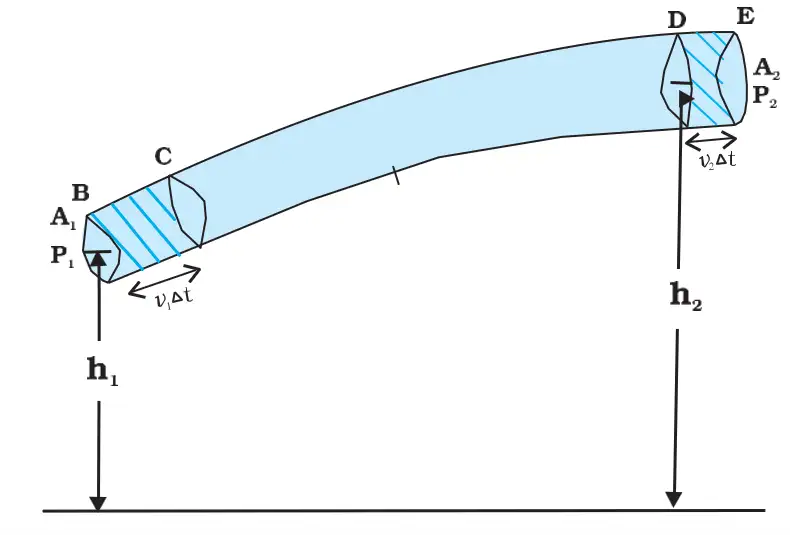
Deriving Bernoulli’s Equation
- In time , the same volume passes both ends; the net pressure work is:
- This work changes the fluid’s kinetic and potential energies:
- Apply the work–energy theorem, then divide by :
- Rearranging gives the same total at points 1 and 2:
Torricelli’s Law and Efflux
For a container open to the atmosphere.
For a hole at height above the ground in a tank with surface height .
The range is maximum for .
is the pressure at the fluid surface and is atmospheric pressure.
Magnus Effect
- Magnus effect: A spinning ball deviates from its usual path because air speeds differ on its two sides.
- Pressure difference: The different air speeds create unequal pressures, producing a net force that can lift the ball.
Venturimeter
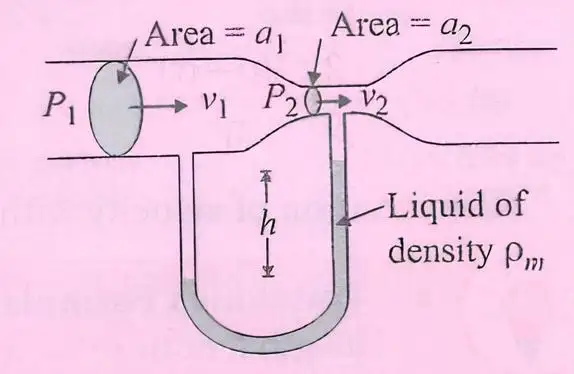
is the volume of fluid flowing per second.
For the area labels used above.
Venturi-Based Devices
- Examples: Filter pumps (aspirators), Bunsen burners, atomisers, and perfume or insecticide sprayers use the pressure drop associated with fast fluid flow.
Blood Flow, Vascular Flutter, and Heart Attack
State Bernoulli’s equation and its conditions.
At what hole height is the horizontal range of efflux maximum, and what is that maximum range?
Quick recap
- Bernoulli’s equation states that remains constant for steady, incompressible, non-viscous flow.
- For an open tank, efflux speed is ; horizontal range is maximum when the hole is halfway up the tank.
- A spinning ball can experience upward dynamic lift because different air speeds create a pressure difference.
- A venturimeter uses pressure differences in a narrow and wide pipe section to measure flow.
- In a narrowed artery, faster blood flow lowers internal pressure and may lead to repeated collapse and reopening.
Viscosity
Viscosity and Solid Friction
Viscosity — The property of a fluid by which it opposes relative motion between adjacent layers; it is also called fluid friction or internal friction.
| Point | Viscosity | Solid friction |
|---|---|---|
| Origin | Internal friction between fluid layers | External friction due to contact with another body |
| Area | Viscous force is proportional to the contact area of the layers | Friction is independent of the area of solid surfaces in contact |
| Relative velocity | Viscous force is proportional to the relative velocity of the layers | Friction is independent of the relative velocity of the contacting bodies |
| Normal reaction | Does not depend on the normal reaction between layers | Is proportional to the normal reaction between surfaces |
Newton’s Law of Viscosity
Newton’s law of viscosity — For fluid layers in streamlined motion, the viscous force is proportional to the contact area and the velocity gradient between layers.
Stokes’ Law
Stokes’ law — A sphere moving uniformly through a viscous liquid experiences a retarding force proportional to the liquid’s viscosity, the sphere’s radius, and its speed.
Terminal Velocity
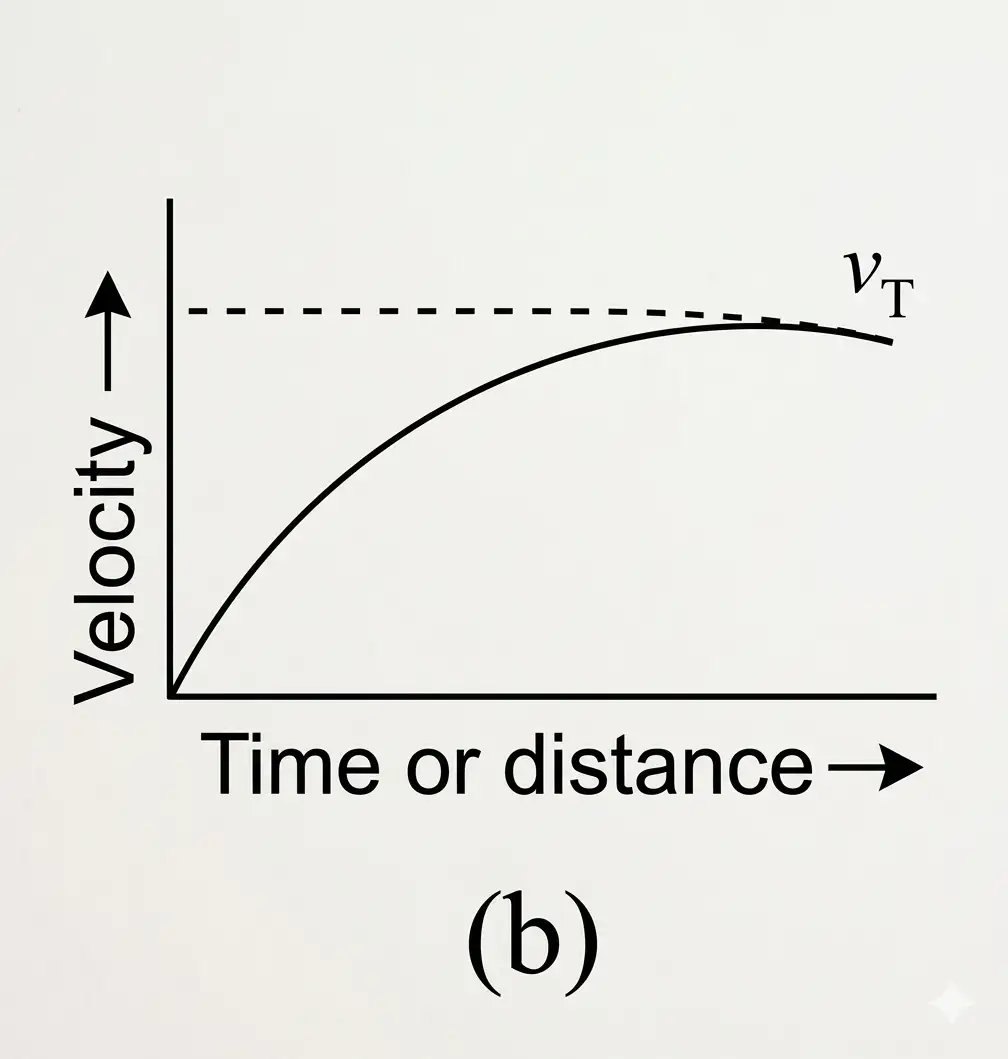
Terminal velocity — The constant speed reached by a sphere falling through a liquid when the forces on it balance and its acceleration becomes zero.
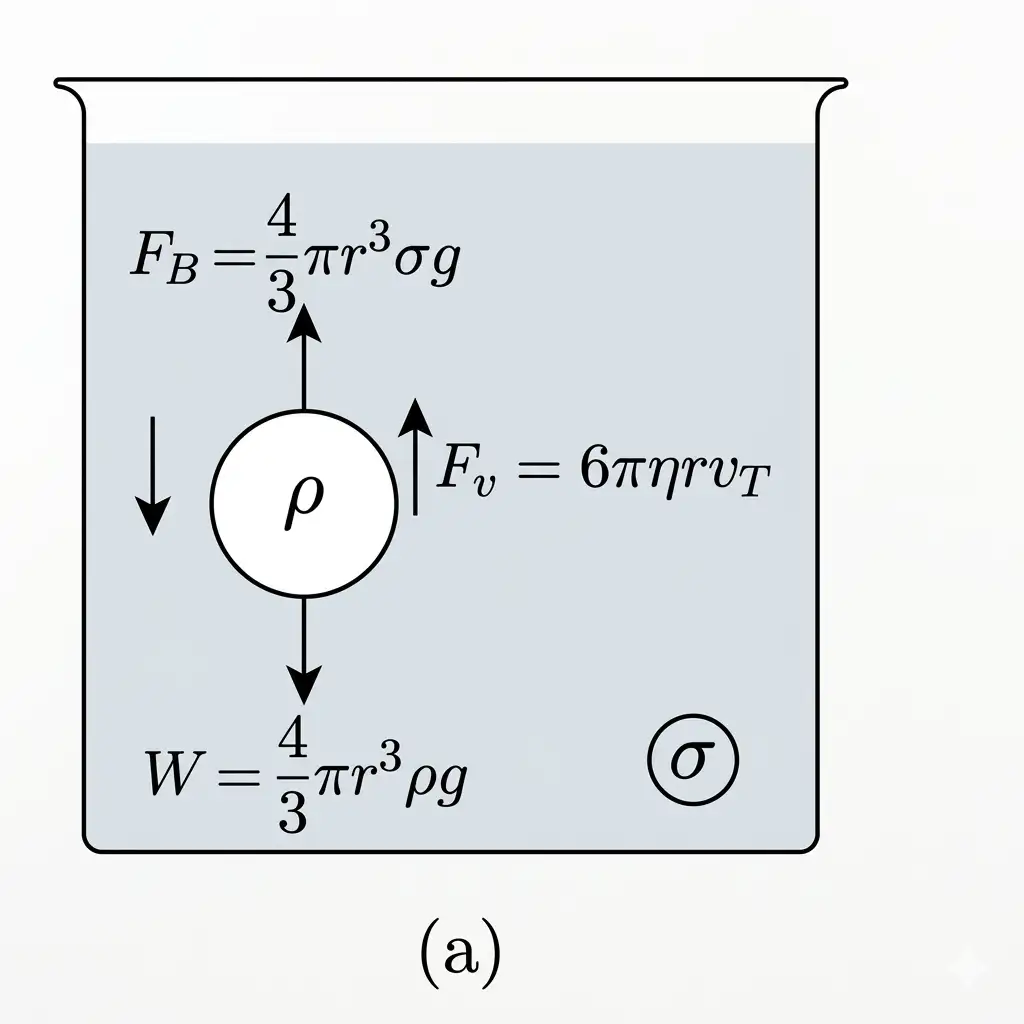
Forces on a falling sphere
- Weight acts downward; buoyant force and viscous drag act upward as the sphere falls.
- At terminal speed the upward forces balance the weight: .
- Symbols: is sphere radius, is sphere density, is liquid density, and is liquid viscosity.
For a sphere denser than the liquid, terminal speed depends on the square of its radius and inversely on viscosity.
Poiseuille’s Formula and Liquid Resistance
Poiseuille’s formula — For streamlined flow through a horizontal capillary tube, it gives the volume of liquid flowing per second under a pressure difference.
Here, is the pressure difference, is tube length, is tube radius, and is liquid viscosity.
Resistance increases with viscosity and tube length, and decreases strongly as the tube radius increases.
| Connection | Equivalent resistance | Pressure difference | Flow rate |
|---|---|---|---|
| Series | Same flow through both tubes: | ||
| Parallel | Same pressure difference across both tubes: | Total flow: |
State Newton’s law of viscosity.
Write the expression for terminal velocity of a sphere falling through a viscous liquid.
Quick recap
- Viscosity is internal friction that resists relative motion between adjacent fluid layers.
- Newton’s law gives ; Stokes’ law gives .
- At terminal velocity, buoyancy plus viscous drag balances the sphere’s weight.
- A falling sphere’s terminal speed is .
- Poiseuille’s formula gives flow rate through a capillary; liquid resistance varies as .
- For tubes in series, resistances add; for parallel tubes, the pressure difference is common and flow rates add.
Surface Tension
Surface Tension and Surface Energy
Surface tension — The tendency of a liquid’s free surface to minimise its area, behaving like a stretched membrane; quantitatively, it is force per unit length along the interface.
Here, acts across an imaginary line of length on the liquid surface.
Units and factors affecting surface tension
- SI unit: ; dimensions: .
- Temperature: Surface tension decreases as temperature rises.
- Impurities: Highly soluble impurities generally increase surface tension; sparingly soluble impurities decrease it.
Surface energy — The extra potential energy stored when molecules are brought from the liquid interior to its surface against the inward cohesive force.
For a soap film, the moving arm is pulled inward. The applied force does work that becomes surface energy; is the increase in the film’s total area.
Surface energy units
- SI unit: Joule (); dimensions: .
- Meaning of the relation: Surface tension is numerically equal to the increase in surface energy per unit increase in area.
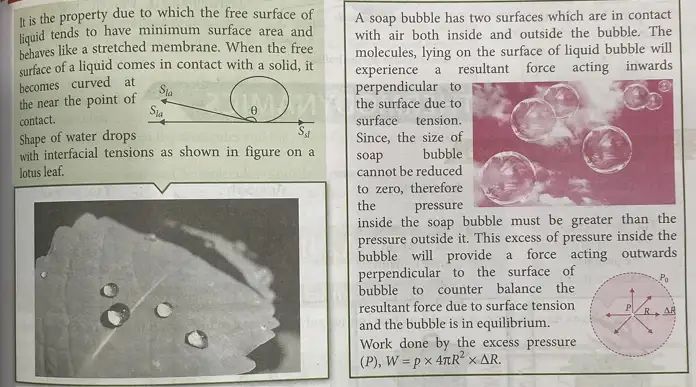
Angle of Contact
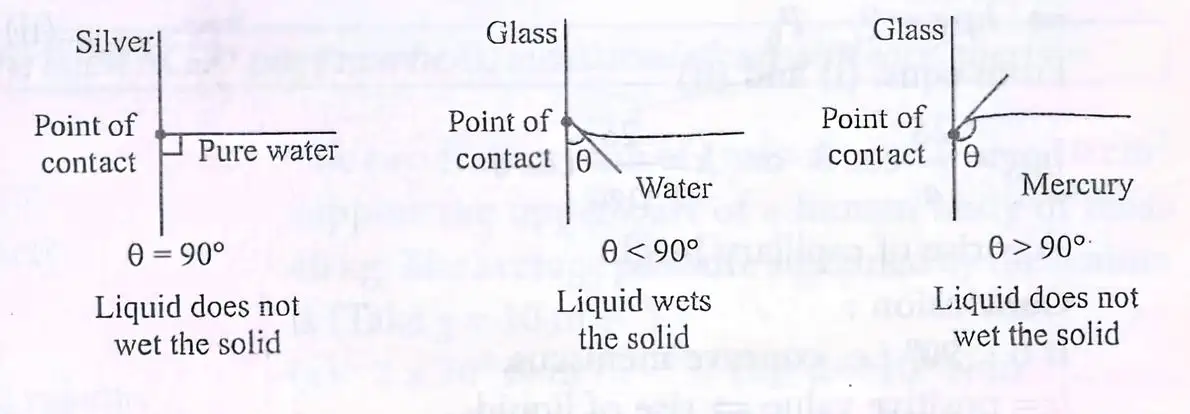
Angle of contact — The angle inside the liquid between the solid surface and the tangent to the liquid surface at their point of contact.
Contact-angle properties
- Depends on: The materials forming the solid–liquid pair.
- Orientation: It does not change when the solid’s inclination changes.
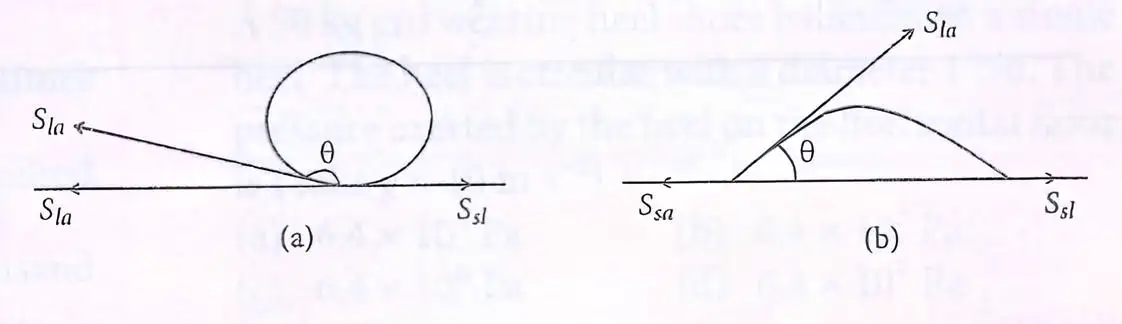
- Wetting: A pair with is wetting; the liquid tends to spread and form a concave meniscus.
- Non-wetting: A pair with tends to form a convex meniscus.
For the interface shown, the tensions satisfy this relation, where , and refer to the liquid–air, solid–liquid and solid–air interfaces.
Excess Pressure in Drops and Bubbles
Pressure–energy balance
- Principle: A small increase in radius requires pressure work, which is stored as an increase in surface energy.
- Pressure work: For radius increased by , the volume change is approximately .
- Surface energy: Neglecting , the area increase of one spherical surface is approximately .
| System | Liquid–air surfaces | Excess pressure |
|---|---|---|
| Liquid drop | One | |
| Soap bubble | Two (inner and outer) | |
| Air bubble in a liquid | One |
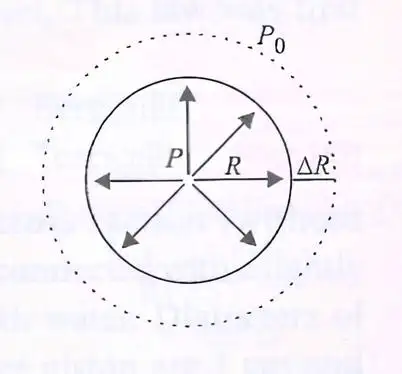
Do not use for a liquid drop: it has one surface, so . The result applies to a soap bubble with two surfaces.
Capillary Rise and Fall
Capillary pressure and height
- Meniscus pressure: For a tube of radius , the pressure difference across the curved meniscus has magnitude .
- Height balance: The pressure difference supports a liquid column of height , so .
- Variables: is liquid density and is gravitational acceleration; is measured relative to the outside liquid level.
The sign of follows the sign of .
| Case | Meniscus and angle | Result |
|---|---|---|
| Rise | Concave meniscus; | , so |
| Fall | Convex meniscus; | , so |
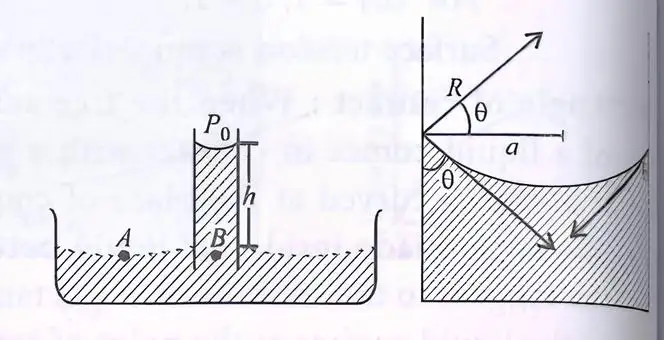
Derive the excess pressure inside a soap bubble.
State the formula for capillary height and explain its sign.
Quick recap
- Surface tension is force per unit length and has SI unit .
- Surface tension equals the increase in surface energy per unit increase in area.
- Contact angle depends on the solid–liquid pair; indicates wetting.
- Excess pressure is for one surface and for a soap bubble’s two surfaces.
- Capillary height is ; its sign gives rise or fall.
NEET Physics — ALL CHAPTERS
1
Basic Mathematics
2
Units and Measurement
3
Motion in a Straight Line
4
Motion in a Plane
5
Laws of Motion
6
Work, Energy and Power
7
System of Particles and Rotational Motion
8
Gravitation
9
Mechanical Properties of Solids
10
Mechanical Properties of Fluids
11
Thermal Properties of Matter
12
Thermodynamics
13
Kinetic Theory
14
Oscillations
15
Waves
16
Electric Charges and Fields
17
Electrostatic Potential and Capacitance
18
Current Electricity
19
Moving Charges and Magnetism
20
Magnetism and Matter
21
Electromagnetic Induction
22
Alternating Current
23
Electromagnetic Waves
24
Ray Optics and Optical Instruments
25
Wave Optics
26
Dual Nature of Radiation and Matter
27
Atoms
28
Nuclei
29
Semiconductor Electronics: Materials, Devices and Simple Circuits