QUESTION PAPER
2022 BOARD EXAM
CBSE Class 12 PCM Chemistry Board Paper 2022 — Set 1
2022
Chemistry
Class 12 PCM
CBSE EXAMINATION PAPER-2022
CHEMISTRY
(Solved)
General Instructions :
Read the following instructions carefully and follow them :
- This question paper contains 17 questions. All questions are compulsory.
- This question paper is divided into 3 sections.
- Section A – questions number 1 to 2 are case based questions
- Section B – questions number 3 to 4 are short answer
- Section C – questions number 5 to 17 are long answer
- There is no overall choice given in the question paper. However, an internal choice has been provided in few questions.
- Use of calculator is NOT allowed.
Section A
Read the passage given below and answer the questions that follow:
Aldehydes, ketones and carboxylic acids are some of the important classes of organic compounds containing carbonyl group. These are highly polar molecules due to higher electro-negativity of oxygen relative to carbon in the carbonyl group. Aldehydes are prepared by dehydrogenation or controlled oxidation of primary alcohols and controlled reduction of acyl halides. Ketones are prepared by oxidation of secondary alcohols and hydration of alkynes.
Aldehydes and ketones undergo nucleophilic addition reactions onto the carbonyl group but carboxylic acid does not undergo nucleophilic addition reaction. The alpha (a) hydrogens of aldehydes and ketones are acidic. Therefore aldehydes and ketones having at least one a-hydrogen undergo Aldol condensation.
Aldehydes are easily oxidised by mild oxidising agents such as Tollens' reagent and Fehling's reagent. Carboxylic acids are prepared by the oxidation of primary alcohols, aldehydes and by hydrolysis of nitriles. Aromatic carboxylic acids are prepared by side-chain oxidation of alkyl benzenes. Carboxylic acids are considerably more acidic than alcohols and most of simple phenols.
(1) Arrange the following in the increasing order of their reactivity towards nucleophilic addition reaction.: CH₃COCH₃, CH₃, CHO, HCHO, C₆H₅COCH₃,
(2) Give a simple chemical test to distinguish betweco Ethanal and Propanone.
(3) Why carboxylic acid does not give nucleophilic addition reactions like aldehydes and ketones?
(4) Write the products in the following
(5) Why a-hydrogen of aldehydes and ketones are acidic in nature?
(6) Write the major products of the following reactions:
Section B
Define rate of reaction. Write two factors that affect the rate of reaction.
write the Nernst equation for the following cell reaction :
Zn(s) + Cu² 9aq) → Zn²+(aq) + Cu(s) (1)
How will the Eᶜₑₗₗ be affected when concentration of
(i) Cu² + ions is increased and
(ii) Zn² + ions is increased ? (1)
Section C
Following ions of 3d-transition series are given:Ti4+, Vat3+, Cr 3+, Mn³+
(Atomic number: Ti = 22 V = 23 Cr = 24 Mn = 25 )
Identify the ion which is :
(i) colourless in aqueous solution. (1)
(ii) a strong oxidising agent. (1)
(iii)colourless in aqueous solution. (1)
Give Suitable reason in each .
(i)On the basis of crystal field theory, write the electronic configuration for d4 ion if Δ0<P.(1)
(ii) Using valence bond theory, predict the hybridization and magnetic character of [Ni(CN),₄] ²⁻ (Atomic number of Ni = 28). (1)
(iii)Write the formula of the following complex using IUPAC norma Dichloridobis (ethane-1,2- diamine) cobalt (III). (1)
When a co-ordination compound NiCI₂, 6H₂O mixed with AgNO₃, 2 moles of AgCl are precipitated per mole of the compound.
(i) Write Structural formula of the complex.(1)
(ii) Write Secondary valency of Ni' in the complex(1)
(iii) Write IUPAC name of the complex.
A first order reaction is 50% complete in 40 minutes. Calculate the time required for the completion of 90% of reaction.
[Given: log 20.3010, log 10=1]
Illustrate the following reactions giving suitable example in each case:
(i) Gabriel phthalimide synthesis.(1)
(ii) Carbylamine reaction.(1)
(iii) Hoffmann bromamide degradation reaction.(1)
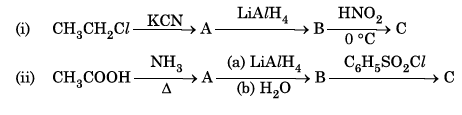
Write the structures of A, B and C in the following reactions:
Account for the following :
(i) Transition elements have higher enthalpies of atomisation.(1)
(ii) Separation of a mixture of Lanthanoid elements is difficult.(1)
(iii) Account for the following: The E°ₘ²+ₘ value for copper is positive.(1)
Define transition elements. Which of the d-block elements may not be regarded as the transition elements ? Why transition metals generally form coloured compounds?
An organic compound 'X' with the molecular formula C₅H₁₀ O forms 2,4-DNP derivative, does not reduce Tollens' reagent but gives positive iodoform test on heating with I2, in the presence of NaOH. Compound 'X' gives ethanoic acid and propanoic acid on vigorous oxidation. Write the:
(i) Structure of the compound X.(1)
(ii) Structure of the product obtained when compound 'X' reacts with 2,4-DNP reagent.(1)
(iii) Structures of the products obtained when compound X is heated with I₂, in the presence of NaOH.(1)
Write any three differences between physisorption and chemisorption..
Define the following terms with a suitable example in each:
(i) Lyophilic sol. (1)
(ii) Macromolecular colloid. (1)
(iii) Coagulation. (1)
(a)The standard Gibbs energy (△ArG°) for the following cell reaction is -300 kJ mol ⁻¹ :
Zn(s) + 2Ag +(aq) → Zn2+ (aq) + 2Ag(s)
Calculate E° for the reaction. (Given: 1F 96500 mol⁻¹) (2)
(b) Calculate λₘºfor MgCl2 if λº values for Mg2+ ion and Cl ⁻ion are 106 S cm²mol⁻¹ and 76.3 S cm²mol⁻¹ respectively.(1)
Arrange the following compounds as directed :
(i) In decreasing order of basic strength in aqueous solution :
C₂H₅NH₂, (C₂H₅)₂ NH, (C₂H₅)₃N (1)
(ii) In increasing order of solubility in water :
(C₂H₅)NH, C₂H₅ NH₂ , C₂H₆ NH₂ (1)
(iii) In decreasing order of Their pKb values:
C₆H₅ NH₂, C₂H₅ NH₂,NH₃ (1)
Paper Details
CBSE Board Exam 2022
Class
Class 12 PCM
Subject
Chemistry
Year
2022
Set
Set 1
Other Years — Chemistry