SOLUTIONS
2022 BOARD EXAM
CBSE Class 12 PCM Chemistry Board Paper 2022 — Set 5 Solutions
2022
Chemistry
Class 12 PCM
CBSE EXAMINATION PAPER-2022
CHEMISTRY
(Solved)
General Instructions :
Read the following instructions carefully and follow them :
- This question paper contains 17 questions. All questions are compulsory.
- This question paper is divided into 3 sections.
- Section A – questions number 1 to 2 are case based questions
- Section B – questions number 3 to 4 are short answer
- Section C – questions number 5 to 17 are long answer
- There is no overall choice given in the question paper. However, an internal choice has been provided in few questions.
- Use of calculator is NOT allowed.
Section A
Read the passage give below and answer the question that follow :
Oxidation-reduction reactions are commonly known as redox reactions. They involve transfer of electrons from one species to another. In a spontaneous reaction, energy is released which can be used to do useful work. The reaction is split into two half reactions. Two different containers are used and a wire is used to drive the electrons from one side to the other and a Voltaic/Galvanic cell is created. It is an electrochemical cell that uses spontaneous redox reactions to generate electricity. A salt bridge also connects to the half cells. The reading of the voltmeter gives the cell voltage or cell potential or electromotive force. If E°cell is positive the reaction is spontaneous and if it is negative the reaction is non-spontaneous and is referred to as electrolytic cell. Electrolysis refers to the decomposition of a substance by an electric current. One mole of electric charge when passed through a cell will discharge half a mole of a divalent metal ion such as Cu2+. This was first formulated by Faraday in the form of laws of electrolysis.
The conductance of material is the property of materials due to which a material allows the flow of ions through itself and thus conducts electricity. Conductivity if represented by k and it depends upon nature and concentration of electrolyte, temperature etc. A more common term molar conductivity of a solution at a given concentration is conductance of the volume of solution containing one mole of electrolyte kept between two electrodes with the unit area of cross-section and distance of unit length. Limiting molar conductivity of weak electrolytes cannot be obtained graphically.
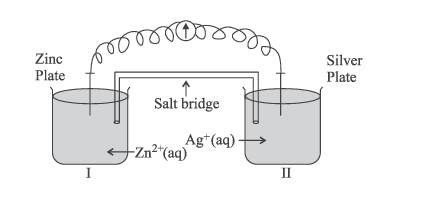
(1) Is silver plate the anode or cathode?
(2) What will happen if the salt bridge is removed?
Therefore, salt bridge is essential for the cell to function properly.
(3) (i) Why does conductivity of a solution decreases with dilution? (ii)What will happen to the concentration of Zn² +and Ag+ when Ecell = 0.
(ii) When Ecell = 0, the concentrations of Zn²+ and Ag+ ions are equal and no net reaction occurs as the cell is in equilibrium.
(4) When does electrochemical cell behaves like an electrolytic cell?
(5) The molar conductivity of a 1.5 M solution of an electrolyte is found to be 138.9 S cm² mol . Calculate the conductivity of this solution.-1
Section B
Arrange the following in the increasing order of their property indicated:
(a) Ethanal, Propanone, Propanal, Butanone (reactivity towards nucleophilic addition). (1)
(b) 4-Nitrobenzoic acid, benzoic acid, 3,4-Dinitrobenzoic acid, 4-Methoxy benzoic acid (Acid strength) (1)
Butanone < Propanone < Propanal < Ethanal.
(b) Acid strength of benzoic acid derivatives depends on electron withdrawing or donating effects of substituents. Electron withdrawing groups increase acidity by stabilizing the conjugate base, while electron donating groups decrease acidity.
So, increasing order of acid strength is:
4-Methoxy benzoic acid < Benzoic acid < 4-Nitrobenzoic acid < 3,4-Dinitrobenzoic acid.
Explain the following reactions:
(a) Wolff Kishner reduction. (1)
(b) Cannizzaro reaction. (1)
(b) Cannizzaro reaction: This reaction occurs with aldehydes that do not have alpha-hydrogen atoms, when heated with concentrated alkali solution. During the reaction, one molecule of aldehyde is reduced to an alcohol while another molecule is oxidized to a carboxylic acid salt, in a process called disproportionation. This reaction does not occur with ketones.
Section C
Observe the graph shown in figure and answer the following questions:
(i) What is the order of the reaction?(1)
(ii) What is the slope of the curve? (1)
(iii) Write the relationship between k and t1/2 ( half life period)
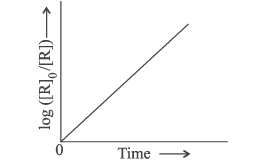
(b) The slope of the curve is -k/2.303, where k is the rate constant of the reaction. The negative sign indicates the concentration decreases over time.
(c) The relationship between the rate constant (k) and the half-life period (t1/2) for a first order reaction is given by t1/2 = 0.693/k. This means the half-life is independent of the initial concentration and inversely proportional to the rate constant.
(i) Write the IUPAC name of the following complex: K₂ [PdCl₄ ]. (1)
(ii) Using crystal field theory, rite the electronic configuration of d 5 ion, if Delta Δ0> P. (1)
(iii) What are Homoleptic complexes? (1)
(ii) For a d 5 ion with Δ0 > P (Delta naught greater than pairing energy), the complex is low spin. Using crystal field theory, electronic configuration is (t2g)5(eg)0, meaning all five electrons pair up in the lower energy t2g orbitals.
(iii) Homoleptic complexes are coordination compounds in which the central metal ion is bonded to only one type of ligand. For example, [Co(NH3)6]3+ is homoleptic because it contains only ammine ligands.
b (i)Why chelate complexes are more stable than complexes with unidentate ligands? (1)
(ii) What is "spectrochemical series"? What is the difference between a weak field ligand and a strong field ligand? (2)
(ii) Spectrochemical series is a list of ligands arranged in the order of increasing strength of the crystal field splitting they produce in a coordination complex. It helps to predict the electronic arrangement and properties of complexes.
Difference between weak field and strong field ligands:
- Weak field ligands produce a small crystal field splitting energy (Δ0) and typically lead to high spin complexes where electrons occupy higher energy orbitals before pairing.
- Strong field ligands produce a large crystal field splitting energy (Δ0) causing pairing of electrons in lower energy orbitals which leads to low spin complexes.
Examples: H2O is a weak field ligand while CN- is a strong field ligand.
a (i) Define coagulation. (1)
(ii) State Hardy-Schulze rule. (1)
(iii) What is Electrophoresis? (1)
(b) Hardy-Schulze rule states that the coagulating power of an electrolyte is directly proportional to the valency of the ion responsible for neutralizing the charged colloidal particles. Higher valency ions cause coagulation more effectively.
(c) Electrophoresis is the movement of charged colloidal particles towards the oppositely charged electrode under the influence of an electric field. It is used to separate colloidal particles based on their charge.
Write three differences between Physisorption and Chemisorption.
(a) Write any two consequences of Lanthanoid Contraction. (2)
(b) Name the element of 3d series which exhibits the largest number of oxidation states. Give reason. (1)
1. The atomic and ionic sizes of elements succeeding the lanthanoids (from element 72 onwards) are smaller than expected, which leads to the similarity in properties of the elements of 4d and 5d series.
2. It causes an increase in the density and hardness of elements in the 5d series compared to the 4d series due to smaller atomic sizes.
(b) The element of the 3d series which exhibits the largest number of oxidation states is Manganese (Mn).
Reason: Manganese has the electronic configuration [Ar] 3d5 4s2. It can lose different numbers of electrons from 3d and 4s orbitals, showing oxidation states from +2 to +7 due to the variable availability of 3d and 4s electrons, which leads to a wide range of oxidation states.
Give reasons for the following statements:
(a) Copper does not displace hydrogen from acids.(1)
(b) Transition metals: and most of their compounds show paramagnetic behaviour. (1)
(c)Zn, Cd and Hg are soft metals. (1)
(b) Transition metals and most of their compounds show paramagnetic behaviour because they have partially filled d orbitals with unpaired electrons. These unpaired electrons create a magnetic moment that causes paramagnetism.
(c) Zn, Cd and Hg are soft metals because their electronic configuration is (n-1)d10ns2, meaning they have completely filled d orbitals which results in weaker metallic bonding. This makes these metals softer compared to other transition metals which have incomplete d orbitals and stronger bonds.
Account for the following:
(a) pkb of aniline is more than that of methylamine. (1)
(b) Aniline does not undergo Friedel-Crafts reaction. (1)
(c) Primary amines have higher boiling points than tertiary amines. (1)
(b) Aniline does not undergo Friedel-Crafts reaction because the lone pair on nitrogen strongly attaches to the Lewis acid catalyst (like AlCl3) used in the reaction, forming a complex. This deactivates the catalyst and the benzene ring, preventing the usual electrophilic substitution needed for Friedel-Crafts reaction.
(c) Primary amines have higher boiling points than tertiary amines as primary amines can form stronger intermolecular hydrogen bonds due to having two N-H bonds. Tertiary amines have no N-H bonds and cannot hydrogen bond with each other effectively, resulting in lower boiling points.
(i) Arrange the following compounds in the increasing order of their basic strength in aqueous solution: CH₃ NH₂, (CH₃) ₃N, (CH₃)₂ NH. (1)
(ii) What is Hinsberg's reagent ? (1)
(iii) What is the role of pyridine in the acylation reaction of amines? (1)
Explanation: In aqueous solution, basic strength depends on the availability of lone pair of electrons on nitrogen for protonation. In trimethylamine ((CH₃)₃N), steric hindrance reduces the ability to accept proton making it least basic. Methylamine (CH₃NH₂) has moderate basic strength while dimethylamine ((CH₃)₂NH) is more basic due to electron-donating effect of two methyl groups.
(ii) Hinsberg's reagent is benzenesulfonyl chloride (C₆H₅SO₂Cl). It is used to distinguish primary, secondary and tertiary amines.
(iii) Pyridine acts as a base in the acylation reaction of amines. It neutralizes the hydrogen chloride (HCl) formed during the reaction and thus prevents the protonation of amine, allowing the reaction to proceed smoothly.
A compound 'A' on reduction with iron scrap and hydrochloric acid gives compound 'B' with molecular formula C6H7N. Compound 'B' on reaction with CHCl3, and alcoholic KOH produces an obnoxious smell of carbylamine due to the formation of 'C'. Identify 'A', 'B' and 'C' and write the chemical reactions involved.
Complete the following:
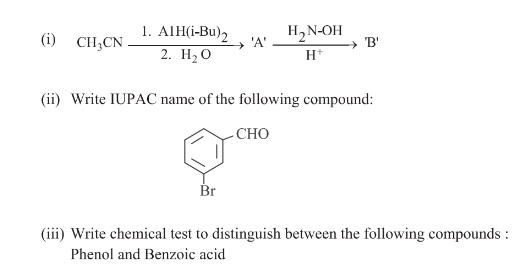
Since the question is incomplete and does not provide any specific statements or terms to complete, it is important to clarify the context to proceed. Please provide the statements or items that need to be completed so that a detailed and accurate answer can be given. If this is a part of a question where certain terms, reactions, or concepts are to be completed, please list them clearly.
Convert the following:
(i) Benzoic acid to Benzaldehyde. (1)
(ii) Propan-1-ol to 2-Bromopropanoic acid. (1)
(iii) Acetaldehyde to But - 2-enal
(ii) Propan-1-ol to 2-Bromopropanoic acid: First, propan-1-ol is oxidized to propanal using PCC or mild oxidizing agents. Propanal is then converted to 2-bromopropanoic acid by treating with bromine (Br2) in the presence of acetic acid which brominates the alpha position and then oxidation of the aldehyde to acid using an oxidizing agent like KMnO4 or CrO3.
(iii) Acetaldehyde to But-2-enal: Acetaldehyde undergoes an aldol condensation reaction to form But-2-enal. Two molecules of acetaldehyde react in the presence of dilute NaOH as a base to form 3-hydroxybutanal (aldol product), which upon heating undergoes dehydration to form But-2-enal (cinnamaldehyde).
Answer the following questions.
(a) Identify the order of reaction from the following unit for its rate constant Lmol ⁻¹ s ⁻¹. (1)
(b) The conversion of molecules A to B follows second order kinetics. If the concentration of A is increased to three times, how will it affect the rate of formation of B?(1)
(c) Write the expression of the integrated rate equation for zero-order reaction. (1)
(b) Since the conversion of A to B follows second order kinetics, the rate equation is rate = k [A]2. If the concentration of A is increased to three times, that is [A] becomes 3[A], then the new rate = k (3[A])2 = 9 k [A]2. Thus, the rate of formation of B increases by 9 times.
(c) The integrated rate equation for zero-order reaction is [A] = [A]0 - k t, where [A] is the concentration of the reactant at time t, [A]0 is the initial concentration and k is the rate constant. This equation shows that concentration decreases linearly with time in zero-order reactions.
Paper Details
CBSE Board Exam 2022
Class
Class 12 PCM
Subject
Chemistry
Year
2022
Set
Set 5
Other Years — Chemistry