QUESTION PAPER
2024 BOARD EXAM
CBSE Class 12 PCM Chemistry Board Paper 2024 — Set 4
2024
Chemistry
Class 12 PCM
CBSE EXAMINATION PAPER-2024
CHEMISTRY
(Solved)
General Instructions :
Read the following instructions carefully and follow them :
- This question paper contains 39 questions. All questions are compulsory.
- This question paper is divided into 5 sections.
- Section A – questions number 1 to 5 are case based questions
- Section B – questions number 6 to 21 are multiple choice questions
- Section C – questions number 22 to 27 are very short answer
- Section D – questions number 28 to 34 are short answer
- Section E – questions number 35 to 39 are long answer
- There is no overall choice given in the question paper. However, an internal choice has been provided in few questions.
- Use of calculator is NOT allowed.
Section A
20. The nature of bonding, structure of the coordination compound can be explained to some extent by valence bond theory. The central metal atom/ion makes available a number of vacant orbitals equal to its coordination number. The appropriate atomic orbitals (s, p and d) of the metal hybridise to give a set of equivalent orbitals of definite geometry such as square planar, tetrahedral, octahedral and so on. A strong covalent bond is formed only when the orbitals overlap to the maximum extent. The d-orbitals involved in the hybridisation may be either inner d-orbitals i.e. (n—l) d or outer d-orbitals i.e. nd. The complexes formed are called inner orbital complex (low spin complex) and outer orbital complex (high spin complex) respectively. Further, the complexes can be paramagnetic or diamagnetic in nature. The drawbacks of this theory are that this involves number of assumptions and also does not explain the colour of the complex.
Answer the following questions :
The following questions are case-based questions. Read the case carefully a answer the questions that follow.
The nature of bonding, structure of the coordination compound can be explained to some extent by valence bond theory. The central metal atom/ion makes available a number of vacant orbitals oqual to its coordination number. The appropriate atomic orbitals (s, p and d) of the metal hybridise to give a set of equivalent orbitals of definite geometry such as square planar, tetrahedral, octahedral and so on. A strong covalent bond is formed only when the orbitals overlap to the maximum extent. The d-orbitals involved in the hybridisation may be either inner d-orbitals ie. (n-1) d or outer d-orbitals i.e. nd. The complexes formed are called inner orbital complex (low spin complex) and outer orbital complex (high spin complex) respectively. Further, the complexes can be paramagnetic or diamagnetic in nature. The drawbacks of this theory are that this involves number of assumptions and also does not explain the colour of the complex.
Answer the following questions:
(1) Predict whether (CoF₆)³⁻ is diamagnetic or paramagnetic and why? [Atomic number: Co=27]
(2) What is the coordination number of Co in [Co(en)₂, Cl₂]⁺ ?
(3) (i) Write the IUPAC name of the given complex [Pt(NH₃)₂ Cl₂]²⁺ (ii) Explain [Co(NH₃)₆]³⁺ is an inner orbital or outer orbital complex.
(4) Using valence bond theory, deduce the shape and hybridisation of [Ni(NH₃)₆]²⁺ Atomic nomber of Ni =28]
In a galvanic cell, chemical energy of a redox reaction is converted into electrical energy, whereas in an electrolytic cell the redox reaction occurs on passing electricity. The simplest galvanic cell is in which Zn rod is placed in a solution of ZnSO₄, and Cu rod is placed in a solution of CuSO₄. The two rods are connected by a metallic wire through a voltmeter. The two solutions are joined by a salt bridge. The difference between the two electrode potentials of the two electrodes is known as electromotive force. In the process of electrolysis, the decomposition of a substance takes place by passing an electric current. One mole of electric charge when passed through a cell will discharge half a mole of a divalent metal ion such as Cu²⁺ This was first formulated by Faraday in the form of laws of electrolysis.
(1) What is the function of a salt bridge in a galvanic cell?
(2) When does galvanic cell behave like an electrolytic cell?
(3) How much charge in terms of Faraday is required for the following: (1) 1 mal of MnO⁻₄ to M n²⁺ (ii) 1 mol of H₂O to O₂
(4) Can copper sulphate solution be stored in a pot made of zinc ? Explain with the help of the value of E° cell. (E° Cu²⁺ / Cu = 0.34V ) (E° Zn²⁺ / Zn = - 0.76V )
Section B
The molar ionic conductivities of Ca²⁺ and Cl– are 119.0 and 76.3 S cm² mol⁻¹ respectively. The value of limiting molar conductivity of CaCl₂ will be
Which of the following acids represents Vitamin C?
Rosenmund reduction is used for the preparation of Aldehydes. The catalyst used in this reaction is.
Which alkyl halide from the given options will undergo SN1 reaction faster?
From the elements of 3d series given below, which element shows the maximum number of oxidation states?
The correct Mathematical expression of Arrhenius equation is
Identify the tertiary amine from the following:
Nucleophilic addition of Grignard reagent to ketones followed by hydrolysis with dilute acids forms
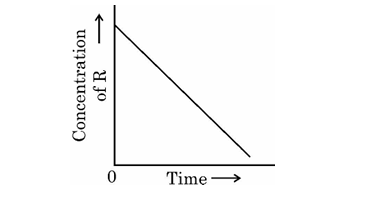
In a given graph of zero order reaction, the slope and intercept are:
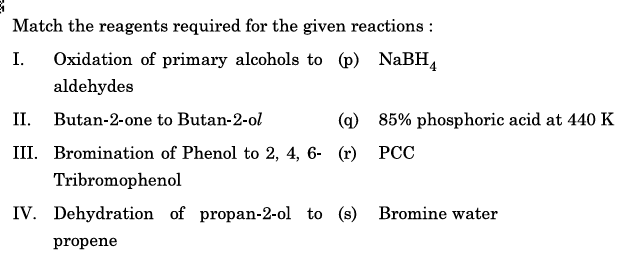
Match the reagents required for the given reactions
Assertion (A): p-nitrophenol is less acidic than phenol. Reason
(R): Nitro group is electron withdrawing and helps in the stabilization of p-nitrophenoxide ion.
Assertion (A): Benzoic acid does not undergo Friedel–Crafts reaction. Reason
(R): Carboxyl group is deactivating and the catalyst aluminium chloride gets bonded to the carboxyl group.
Assertion (A): Fructose is a reducing sugar.
Reason (R): Fructose does not reduce Fehling solution and Tollen's reagent.
Assertion (A): For a Daniell cell, Zn/Zn²⁺ (1 M)| | Cu²⁺ (1 M)/Cu with E° cell = 1.1 V, if the external opposing potential is more than 1.1 V, the electrons flow from Cu to Zn. Reason
(R): Cell acts like a galvanic cell.
The general electronic configuration of d-block elements is :
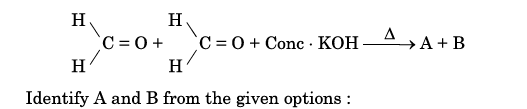
Consider the following reaction :
Section C
Define the following terms:
(a) Order of a reaction
(b) Activation energy
(a) Which compound in the given pair would undergo substitution reaction at a faster rate and why? (a) CH₃ — CH₂ — I and CH₃ — CH₂ — Br.
(b) Arrange the following compounds in the increasing order of their boiling points:
Butane, 1-Bromobutane, 1-Iodobutane, 1-Chlorobutane.
Write the stepwise mechanism of nucleophilic addition reactions in the carbonyl compounds
How will you convert with following :
(i) Toluene to benzoic acid
(ii) Ethanol to 3- Hydroxybutanal
(a) What happens when glucose reacts with bromine water? write chemical equation.
(b) Two bases are mentioned below, identify which is present in DNA and which one is present in RNA:
(i) Thymine (ii) Uracil
Section D
(a) Draw the geometrical isomers of the given complex :
[Pt(en)₂Cl₂]²⁺
(b) Write the electronic configuration for d4 ion if Δₒ< P on the basis of crystal field theory.
(c) What is meant by a unidentate ligand ? Give an example.
Calculate emf of the following cell at 25∘C :
Sn/Sn²⁺(0.001M) ∣∣ H⁺(0.01M)∣H₂( g)(1 bar ) ∣ Pt₍ₛ₎
Given : E∘(Sn²⁺/Sn)=−0.14 V,E∘H+/H₂=0.00 V(log10=1)
Write chemical equations for the following reactions : (Do any three)
(a) Hydroboration — oxidation reaction
(b) Williamson Synthesis
(c) Friedel-Crafts Alkylation of Anisole
(d) Reimer-Tiemann Reaction
(a) Give chemical tests to distinguish between the following pairs of compounds :
(i) Phenol and Benzoic acid
(ii) Propanal and Propanone
(b) Which one of the given compounds is a stronger acid and why ?
CH₂FCH₂CH₂COOH or CH₃CHFCH₂COOH
Explain the following terms :
(a) Essential amino acids
(b) Peptide bond
(c) Denaturation
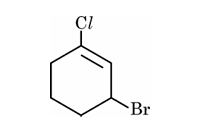
(a) Write the IUPAC name of the given compound :
(b) The presence of —N0₂ group at ortho or para position increases the reactivity of haloarenes towards nucleophilic substitution reactions.
Give reason to explain the above statement.
(c) What happens when ethyl chloride is treated with alcoholic potassium hydroxide ?
Show that the time required for 99.9% completion in a first order reaction is 10 times of half-life (t₁/₂) of the reaction [log 2 = 0.3010, log 10 = 1].
Section E
Attempt any five of the following:
(a) Why is Zinc not regarded as a transition element?
(b) What is Lanthanoid contraction?
(c) Why is first ionization enthalpy of chromium lower than that of Zn ?
(d) Explain how transition elements behave as catalysts.
(e) Compounds of transition metals are generally coloured. Give reason.
(f) Out of KMn04 and K2Mn04, which one is paramagnetic and why ?
(g) Complete the following ionic equation: Cr₂O₇²⁻ + 14H⁺ + 6e⁻ →
(i) Define reverse osmosis.
(ii) Why are aquatic species more comfortable in cold water in comparison to warm water ?
(iii) A solution containing 2 g of glucose (M = 180 g mol ⁻¹) in 100 g of water is prepared at 303 K. If the vapour pressure of pure water at 303 K is 32.8 mm Hg, what would be the vapour pressure of the solution ?
(i) Predict whether Van't Hoff factor will be less or greater than one, when Ethanoic acid is dissolved in benzene.
(ii) Define ideal solution.
(iii) Calculate the mass of CaCl₂ (molar mass 111 g mol⁻¹) to be dissolved in 500 g of water to lower its freezing point by 2K, assuming that CaCl₂ undergoes complete dissociation. (Kf for water = 1.86 K kg mol⁻¹)
An amide 'A' with molecular formula C₇H₇0N undergoes Hoffmann Bromamide degradation reaction to give amine 'B'. B' on treatment with nitrous acid at 273-278 K form 'C' and on treatment with chloroform and ethanolic potassium hydroxide forms 'D'. 'C' on treatment, with ethanol gives 'E'. Identify 'A', 'B', 'C' 'D' and 'E.' and write the sequence of chemical equations
(i) (1)What is Hinsberg's reagent ?
(2) Arrange the following compounds in the increasing order of their basic strength in gaseous phase : C₂H₅NH₂, (C₂H₅)₃ N ,(C₂H₅)₂ NH
(ii) Give reasons for the following :
(1) Methyl amine is more basic than aniline.
(2) Aniline readily reacts with bromine water to give 2, 4, 6tribromoaniline.
(3) Primary amines have higher boiling points than tertiary amines.
Paper Details
CBSE Board Exam 2024
Class
Class 12 PCM
Subject
Chemistry
Year
2024
Set
Set 4
Other Years — Chemistry