SOLUTIONS
2025 BOARD EXAM
CBSE Class 12 PCM Chemistry Board Paper 2025 — Set 1 Solutions
2025
Chemistry
Class 12 PCM
CBSE EXAMINATION PAPER-2025
CHEMISTRY
(Solved)
General Instructions :
Read the following instructions carefully and follow them :
- This question paper contains 45 questions. All questions are compulsory.
- This question paper is divided into 5 sections.
- Section A – questions number 1 to 9 are case based questions
- Section B – questions number 10 to 25 are multiple choice questions
- Section C – questions number 26 to 31 are very short answer
- Section D – questions number 32 to 39 are short answer
- Section E – questions number 40 to 45 are long answer
- There is no overall choice given in the question paper. However, an internal choice has been provided in few questions.
- Use of calculator is NOT allowed.
Section A
The following questions are case based questions. Read the passage carefully and answer the questions that follow.
The rate of a chemical reaction is expressed either in terms of decrease in the concentration of reactants or increase in the concentration of a product per unit time. Rate of the reaction depends upon the nature of reactants, concentration of reactants, temperature, presence of catalyst, surface area of the reactants and presence of light. Rate of reaction is directly related to the concentration of reactant. Rate law states that the rate of reaction depends upon the concentration terms on which the rate of reaction actually depends, as observed experimentally. The sum of powers of the concentration of the reactants in the Rate law expression is called order of reaction while the number of reacting species taking part in an elementary reaction which must collide simultaneously in order to bring about a chemical reaction is called molecularity of the reaction.
Answer the following questions :
(1) (i) What is a rate determining step ? (ii) Define complex reaction.
(ii) A complex reaction is one that involves more than one elementary step, with intermediates formed during the process. In such reactions, the rate is primarily determined by the slowest step, while the molecularity of the complex reaction may not hold significance as it does for elementary reactions. Thus, the order of the complex reaction correlates to the slowest step's molecularity and is defined by the reaction's rate law.
(2) What is the effect of temperature on the rate constant of a reaction ?
(3) The conversion of molecule X to Y follows second order kinetics. If concentration of X is increased 3 times, how will it affect the rate of formation of Y ?
(4) Why is molecularity applicable only for elementary reactions whereas order is applicable for elementary as well as complex reactions ?
Phenols undergo electrophilic substitution reactions readily due to the strong activating effect of OH group attached to the benzene ring. Since, the OH group increases the electron density more to 0— and — positions therefore OH group is ortho, para-directing. Reimer-Tiemann reaction is one of the examples of aldehyde group being introduced on the aromatic ring of phenol, ortho to the hydroxyl group. This is a general method used for the ortho-formylation of phenols.
Answer the following questions :
(1) Why phenol does not undergo protonation readily ?
(2) Which is a stronger acid — phenol or cresol ? Give reason.
(3) What happens when phenol reacts with (i) Br₂/CS₂ (ii) Conc. HNO₃
(4) Write the IUPAC name of the product formed in the Reimer-Tiemann reaction.
Section B
In case of association, abnormal molar mass of solute will
Standard electrode potential for Snx⁴⁺/Sn²⁺ couple is +0.15 V and that for the Cr³⁺/Cr couple is —0.74 V. The two couples in their standard states are connected to make a cell. The cell potential will be
The magnetic moment is associated with its spin angular momentum and orbital angular momentum . Spin only magnetic moment value of Cr³⁺ ion (Atomic no. : Cr=24) is_____ .
The correct answer is 3.87 B.M. because chromium (Cr³⁺) has an electronic configuration of [Ar] 3d³. This results in three unpaired electrons. Using the formula µ = √n(n+2), where n is the number of unpaired electrons, we get µ = √3(3+2) = √15, which approximates to 3.87 B.M. This aligns with the calculated and observed magnetic moment for Cr³⁺ ions, confirming 3.87 B.M. as the correct answer.
Acidified KMnO₄ oxidises sulphite to
The correct IUPAC name of [Pt(NH₃)₂Cl₂]²⁺ is
Arrange the following compounds in increasing order of their boiling points:

Alkyl halides undergoing nucleophilic bimolecular substitution reaction involve
Which is the correct order of acid strength from the following?
The acid formed when propyl magnesium bromide is treated with CO₂ followed by acid hydrolysis is
The best reagent for converting propanamide into propanamine is ________________.
Which of the following statements is not true about glucose?
The statement 'It does not give Schiff's test' is not true about glucose. According to the context, despite having the aldehyde group, glucose does not give Schiff’s test, indicating it behaves differently because it does not possess a free -CHO group due to its cyclic structure.
An unripe mango placed in a concentrated salt solution to prepare pickle, shrivels because____________.
Assertion (A): [Cr(H₂O)₆]Cl₂ and [Fe(H₂O)₆]Cl₂ are examples of homoleptic complexes.
Reason (R) : All the ligands attached to the metal are the same.
Both Assertion (A) and Reason (R) are true, and Reason (R) is the correct explanation of the Assertion (A). Homoleptic complexes are defined as those in which a metal is bound to only one kind of donor group, which applies to both [Cr(H₂O)₆]Cl₂ and [Fe(H₂O)₆]Cl₂, as they both have ligands (water) that are the same.
Assertion (A) : | The boiling points of alkyl halides decrease in the order : RI > RBr > RCI > RF. |
Reason (R) : | The boiling points of alkyl chlorides, bromides and iodides are considerably higher than that of the hydrocarbon of comparable molecular mass. |
Both Assertion (A) and Reason (R) are true, but Reason (R) is not the correct explanation of the Assertion (A). The order of boiling points is influenced by molecular weight and polarity, with RI having the highest boiling point due to its larger atomic size and ability to form stronger dipole-dipole interactions compared to RBr, RCl, and RF. However, the reason provided discusses the boiling points of alkyl halides in relation to hydrocarbons rather than directly explaining the order of boiling points among the alkyl halides.
Assertion (A): | The boiling point of ethanol is higher than that of methoxymethane. |
Reason (R) : | There is intramolecular hydrogen bonding in ethanol. |
Assertion (A) is true, but Reason (R) is false. The boiling point of ethanol is indeed higher than that of methoxymethane due to intermolecular hydrogen bonding in ethanol, not intramolecular hydrogen bonding. Therefore, while the assertion is correct, the reason does not accurately explain it.
Assertion (A) : | All naturally occurring a-amino acids except glycine areoptically active. |
Reason (R) : Most naturally occurring amino acids have L-configuration
Both Assertion (A) and Reason (R) are true, and Reason (R) is the correct explanation of the Assertion (A) because all a-amino acids, except glycine, are indeed optically active due to their asymmetric carbon atom, and this is related to their L-configuration.
Section C
Complete and balance the following chemical equations:
(a)2MnO₄⁻(aq) + 10I⁻(aq) + 16H⁺(aq) →
(b) Cr₂O²⁻₇(aq) +6Fe²⁺(aq) +14H⁺(aq)→
Identify A and B in each of the following reaction sequence:
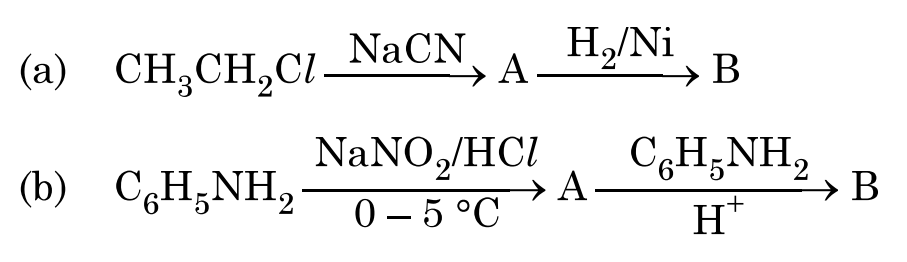
(a) CH3CH2ClNaCNAH2/NiB
Step 1 (NaCN):
Ethyl chloride reacts with NaCN → substitution of Cl by CN:
CH3CH2Cl→CH3CH2CN(A = Propanenitrile)
Step 2 (H₂/Ni):
Nitrile group reduced to primary amine:
CH3CH2CN→CH3CH2CH2NH2(B = Propylamine)
(b) C6H5NH2 NaNO2/HCl (0–5°C)AH+B
Step 1 (NaNO₂/HCl, 0–5°C):
Diazotization of aniline:
C6H5NH2→C6H5N2+Cl−(A = Benzene diazonium chloride)
Step 2 (Hydrolysis with H⁺):
Benzene diazonium chloride → phenol:
C6H5N2+Cl−→C6H5OH(B = Phenol)
(a) CH₃CH₂Cl → NaCN → A → H₂/Ni → B
A = CH₃CH₂CN (Propanenitrile)
B = CH₃CH₂CH₂NH₂ (Propylamine)
Substitution (Cl → CN), then reduction (CN → NH₂)
(b) C₆H₅NH₂ → NaNO₂/HCl (0–5°C) → A → H⁺ → B
A = C₆H₅N₂⁺Cl⁻ (Diazonium salt)
B = C₆H₅OH (Phenol)
Diazotization, then hydrolysis
Write the reactions involved when D-glucose is treated with following reagents:
(a) HCN
(b) Br₂ water
Give reasons :
(a) Cooking is faster in pressure cooker than in an open pan.
(b) on mixing liquid X and Y , volume of the resulting solution decreases . what type of deviation from raoult's law is shown by the resulting solution ? what change in temperature would you observe after mixing liquids X and Y?
Would you expect benzaldehyde to be more reactive or less reactive in nucleophilic addition reactions than propanal ? Justify your answer.
Section D
A solution of glucose (molar mass =180 g mol⁻¹) in water has a boiling point of 100.20 ºC. Calculate the freezing point of the same solution. Molal constants for water Kf and Kb are 1.86 K kg mol⁻¹and 0.512 K kg mol⁻¹ respectively.
(a) State the following :
(i) Kohlrausch law of independent migration of ions and
(ii) Faraday's first law of electrolysis.
(b) Using E°ᵥₐₗᵤₑₛ of X and Y given below, predict which is better for coating the surface of iron to prevent corrosion and why ?
Given E°ₓ²⁺/ₓ = –2.36 V,
E°ᵧ²⁺/ᵧ = –0.14 V,
E°Fₑ²⁺/Fₑ = –0.44 V
(ii) Faraday's first law of electrolysis states that the mass of a substance released or deposited at an electrode during electrolysis is directly proportional to the quantity of electricity passed through the electrolyte.
(b) Given E° values: E° X2+/X = −2.36 V, E° Y2+/Y = −0.14 V, E° Fe2+/Fe = −0.44 V.
To protect iron from corrosion, a metal with more negative electrode potential than iron is used so it corrodes preferentially.
Since X has the lowest E° value (−2.36 V), it is better for coating iron as it will act as a sacrificial anode and prevent corrosion.
Y has E° closer to Fe and thus is less effective.
Therefore, metal X is better for coating iron surface to prevent corrosion.
A certain reaction is 50% complete in 20 minutes at 300 K and the same reaction is 50% complete in 5 minutes at 350 K. Calculate the activation energy if it is a first order reaction.
[R=8.314 J K⁻¹ mol⁻¹; log 4 =0.602]
The elements of 3d transition series are given as :
Sc, Ti, V, Cr, Mn, Fe, Co, Ni, Cu, Zn
Answer the following :
(a) Copper has exceptionally positive E°ₘ₂₊/ₘ value, why ?
(b) Which element is a strong reducing agent in +2 oxidation state and why ?
(c) Zn²⁺ salts are colourless. Why ?
(b) Manganese in +2 oxidation state (Mn2+) is a strong reducing agent because the half-filled d5 configuration of Mn2+ is stable, and it easily loses electrons to form higher oxidation states like +3, +4, +7, thereby acting as a strong reducing agent.
(c) Zn2+ salts are colourless because Zn2+ has a completely filled d10 electronic configuration, so there are no d-d electron transitions that can absorb visible light, resulting in colourless compounds.
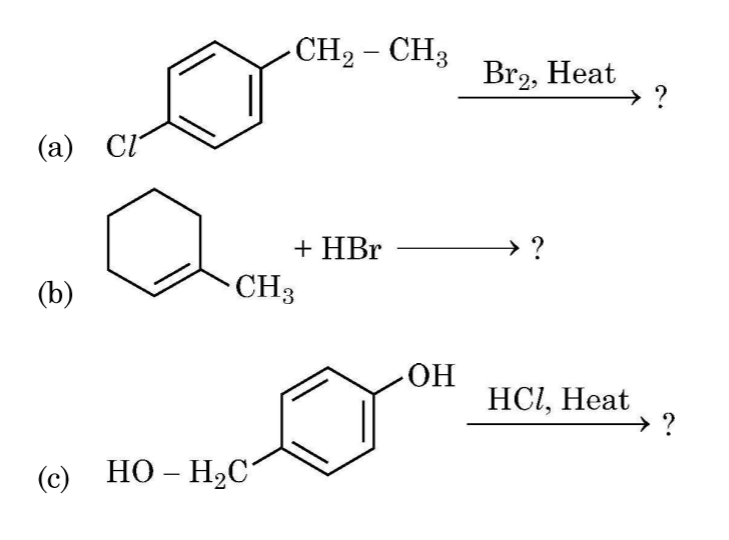
Draw the structure of the major monohalo product for each of the following reaction:
How do you convert :
(a) Chlorobenzene to biphenyl
(b) Propene to I-lodopropane
(c) 2-bromobutane to but-2-ene.
(b) Propene to I-lodopropane: Propene reacts with hydrogen iodide (HI) in the presence of an acid catalyst. The HI adds across the double bond following Markovnikov's rule, giving I-lodopropane with the iodine atom attached to the more substituted carbon.
(c) 2-bromobutane to but-2-ene: 2-bromobutane undergoes dehydrohalogenation when treated with a strong base like alcoholic KOH. This elimination reaction removes HBr and forms a double bond, resulting in but-2-ene.
(a) Arrange the following compounds in increasing order of their boiling point :
(CH₃)₂NH, CH₃CH₂NH₂, CH₃CH₂0H.
(b) Give plausible explanation for each of the following :
(i) Aromatic primary amines cannot be prepared by Gabriel Phthalimide synthesis.
(iI) Amides are less basic than amines.
(CH₃)₂NH (Dimethylamine) < CH₃CH₂NH₂ (Ethylamine) < CH₃CH₂OH (Ethanol).
Explanation:
Boiling point depends on intermolecular forces. Ethanol has hydrogen bonding due to -OH group, so it has the highest boiling point. Ethylamine also exhibits hydrogen bonding but less strong than ethanol, so it comes next. Dimethylamine has weaker hydrogen bonding because of steric hindrance and less polarity, so it has the lowest boiling point.
(b) Explanation:
(i) Aromatic primary amines cannot be prepared by Gabriel Phthalimide synthesis because the nucleophilic substitution reaction required in this method is hindered by the resonance stabilization of the aromatic amine group, making the reaction ineffective for aromatic amines.
(ii) Amides are less basic than amines because in amides the lone pair of electrons on nitrogen is delocalized over the oxygen atom through resonance, reducing the availability of the lone pair to accept protons, whereas in amines the lone pair is localized and more available for protonation, making amines more basic.
(a) What is the difference between native protein and denatured protein ?
(b) Which one of the following is a disaccharide ? Glucose, Lactose, Amylose, Fructose
(c) Which vitamin is responsible for the coagulation of blood ?
(b) Lactose is the disaccharide among the options given. It consists of two monosaccharides, β-D-galactose and β-D-glucose, linked by a β(1→4) glycosidic bond.
(c) Vitamin K is responsible for the coagulation of blood. It helps in the synthesis of proteins needed for blood clotting.
Section E
(a) Write the cell reaction and calculate the e.m.f. of the following cell at 298 K:
Sn(s)|Sn²⁺(0.004 M)||H⁺(0.02 M)|H₂(g)(1 Bar)|Pt(s)
(Given: E°(ₛₙ₂₊/ₛₙ=-0.14 V, E°H₊|H₂₍ᵍ₎ₚₜ= 0.00 V)
(b) Account for the following observations:
(i) On the basis of E° values, O₂ gas should be liberated at anode but it is Cl₂ gas which is liberated in the electrolysis of aqueous NaCl;
(ii) Conductivity of CH₃COOH decreases on dilution.
To find the cell reaction and e.m.f. for the described electrochemical cell, we start with the half-cell reactions. The oxidation half-reaction occurs at the Sn electrode: Sn(s) → Sn²⁺(aq) + 2 e⁻; with a standard potential E° = -0.14 V. The reduction half-reaction at the hydrogen electrode is: 2 H⁺(aq) + 2 e⁻ → H₂(g); with E° = 0.00 V. Next, we apply the Nernst equation to calculate the e.m.f. using these concentrations:
E(cell) = E°(cell) - (0.0591/n) log([Sn²⁺]/[H⁺]²)
We plug in the values (n = 2, [Sn²⁺] = 0.004 M, [H⁺] = 0.02 M) and find the logarithmic term. The standard e.m.f. of the cell, E°(cell) = 0.00 V - (-0.14 V) = 0.14 V, gives us an overall e.m.f. considering concentration effects. During the electrolysis of aqueous NaCl, the theoretical expectation is that water (H₂O) would oxidize to produce O₂ gas due to its lower E° value compared to Cl⁻ ions. However, this is not the case because of the higher overpotential for oxygen evolution compared to chlorine. Thus, Cl⁻ is preferentially oxidized to form Cl₂ gas. Furthermore, in the case of acetic acid (CH₃COOH), dilution causes the concentration of ionizable molecules to decrease; as a result, the degree of ionization increases but the overall conductivity declines due to reduced concentration of mobile ions (H⁺ and CH₃COO⁻) for conduction, leading to the observed decrease in conductivity.
Identify oxidation and reduction reactions - Write half-reactions for Sn and H⁺ - Apply Nernst equation for e.m.f. calculation - Use proper concentrations - Calculate standard e.m.f. from potentials - Explain overall cell reaction. Electrolysis of NaCl: O₂ should evolve, but Cl₂ does due to overpotential; CH₃COOH conductivity reduces on dilution as fewer ions are present overall despite increased ionization.
(a) Write the anode and cathode reactions and the overall cell reaction occurring in a lead storage battery during its use.
(b) Calculate the potential for half-cell containing 0.01 M K₂Cr₂07(aq), 0.01 M Cr³⁺ (aq) and 1.0 x 10⁻⁴ M H⁺ (aq).
The half cell reaction is
Cr₂0²⁻₇(aq)+14H⁺(aq) + 6e⁻→2Cr³⁺(aq) + 7H₂0(l)
and the standard electrode potential is given as E⁰= 1.33 V.
[Given : log 10 = 1].
Anode reaction (oxidation): Pb(s) + SO42-(aq) → PbSO4(s) + 2e-
Cathode reaction (reduction): PbO2(s) + SO42-(aq) + 4H+(aq) + 2e- → PbSO4(s) + 2H2O(l)
Overall cell reaction: Pb(s) + PbO2(s) + 2H2SO4(aq) → 2PbSO4(s) + 2H2O(l)
(b) Calculation of electrode potential:
Given half cell reaction: Cr2O72-(aq) + 14H+(aq) + 6e- → 2Cr3+(aq) + 7H2O(l)
Standard electrode potential, E° = 1.33 V
Using Nernst equation:
E = E° - (0.059 / n) * log Q
where n = 6 (number of electrons), Q = reaction quotient
Q = [Cr3+]2 / [Cr2O72-] * [H+]14
Given concentrations:
[Cr2O72-] = 0.01 M
[Cr3+] = 0.01 M
[H+] = 1.0 x 10⁻⁴ M
Calculating log Q:
log Q = log ([Cr3+]2 / [Cr2O72-] * [H+]14)
= log (0.012 / 0.01 * (1.0 x 10-4)14)
= log (0.0001 / 0.01 * 10-56) = log (0.01 * 10-56) = log 10-58 = -58
Now calculate E:
E = 1.33 - (0.059 / 6) * (-58) = 1.33 + 0.059 * 9.67 = 1.33 + 0.57 = 1.90 V
So, the potential of the half cell under given conditions is 1.90 V.
Answer the following :
(a) Low spin tetrahedral complexes are not known.
(b) c0²⁺ is easily oxidised to C0³⁺ in the presence of a strong ligand [At. No. of co = 27]
(c) What type of isomerism is shown by the complex [Co(NH₃)₆] [Cr(CN)₆]?
(d) Why a solution[Ni(H₂O)₆]²⁺ is green while a solution of [Ni(CN)₄]²⁻is colourless.
(At. No. of Ni = 28)
(e) Write the IUPAC name of the following complex : [Co(NH₃)₅(C0₃)]Cl
(b) Co2+ is easily oxidised to Co3+ in the presence of strong ligands because strong field ligands increase the crystal field splitting which stabilizes the higher oxidation state (Co3+) due to greater ligand field stabilization energy.
(c) The complex [Co(NH3)6][Cr(CN)6] shows ionisation isomerism because exchanging the anion and cation parts forms different compounds having different properties.
(d) [Ni(H2O)6] 2+ is green because water is a weak field ligand causing smaller crystal field splitting and d-d transitions absorb visible light. [Ni(CN)4] 2- is colourless because CN- is a strong field ligand causing large crystal field splitting which leads to pairing of electrons and no d-d transitions in visible region, so no colour.
(e) The IUPAC name of [Co(NH3)5(CO3)]Cl is pentaamminecarbonatocobalt(III) chloride.
(a) What is meant by 'Chelate effect' ? Give an example.
(b) Write the hybridization and magnetic behaviour of[Fe(CN)₆]⁴⁻ (Atomic number : Fe= 26)
(c) If PtCl₂ • 2NH₃ does not react with AgN0₃, what will be its formula ?
Example: Ethane-1,2-diamine (en) forms a chelate complex with Ni2+, such as [Ni(en)3]2+.
(b) In [Fe(CN)6]4-, iron is in +2 oxidation state as CN- is a strong field ligand causing pairing of electrons. The electronic configuration of Fe2+ is 3d6. Due to strong field CN ligands, the hybridization is d2sp3 which is octahedral. All the electrons are paired, so the complex is diamagnetic.
(c) PtCl2 • 2NH3 does not react with AgNO3, which means Cl ions are not free but coordinated to Pt. This indicates the complex formula is [PtCl2(NH3)2] with no counter ions. Hence, the formula of the compound is [PtCl2(NH3)2].
(a)Carry out the following conversions:
(i) Ethanal to But-2-enal;
(ii) Propanoic acid to ethane.
(b) An alkene A with molecular formula C5H10 on ozonolysis gives a mixture of two compounds B and C. Compound B gives positive Fehling test and also reacts with iodine and NaOH solution. Compound C does not give Fehling solution test but forms iodoform. Identify the compounds A, B and C.
Step 1: Ethanal undergoes aldol condensation in the presence of dilute NaOH. Two ethanal molecules react to form 3-hydroxybutanal.
Step 2: The 3-hydroxybutanal undergoes dehydration by heating to form But-2-enal (an alpha,beta-unsaturated aldehyde).
Overall reaction: 2 CH3CHO --(dil NaOH, heat)--> CH3CH=CHCHO
(ii) Conversion of Propanoic acid to Ethane:
Step 1: Propanoic acid is converted to propanoyl chloride by treating with SOCl2.
Step 2: Propanoyl chloride is converted to ethane by reaction with zinc and dilute acid (Zn / H2SO4) which reduces the acyl chloride to alkane, removing one carbon atom.
Another easier method is by reducing acid to alkane using Zn and heat but this method retains the carbon chain length. To reduce the acid to alkane with removal of one carbon, catalytic decarboxylation can be done using soda lime (NaOH + CaO) and heat:
CH3CH2COOH --(NaOH + CaO, heat)--> C2H6 + CO2 + H2O
(b) Identification of compounds A, B and C:
Given: A is an alkene C5H10, on ozonolysis yields compounds B and C.
Compound B gives positive Fehling test and reacts with iodine and NaOH solution indicating the presence of an aldehyde group and an alpha-hydroxy ketone or methyl ketone.
Compound C does not give Fehling test but forms iodoform test (yellow precipitate) indicating presence of methyl ketone.
Ozonolysis of alkene breaks C=C bond giving aldehyde or ketone products.
Possible A: 2-methylbut-2-ene (C5H10)
Ozonolysis of 2-methylbut-2-ene yields methyl ethyl ketone (C4H8O) and ethanal (C2H4O).
Here, B is ethanal (positive Fehling and iodoform test), C is methyl ethyl ketone (positive iodoform, no Fehling).
Alternatively, A could be pent-2-ene.
Hence,
A: pent-2-ene (C5H10)
B: ethanal (gives positive Fehling and iodine test)
C: propanone (gives iodoform test, no Fehling)
This fits the test data and molecular weights.
Summary:
(a)(i) Ethanal to But-2-enal by aldol condensation using dilute NaOH and heat.
(a)(ii) Propanoic acid to ethane by decarboxylation using soda lime.
(b) A: pent-2-ene; B: ethanal; C: propanone.
(a) Identification of compounds:
Compound (A) has the molecular formula C8H18O2 and undergoes acid hydrolysis to give a carboxylic acid (B) and an alcohol (C). Given that oxidation of (C) with chromic acid produces (B), and (C) on dehydration gives But-1-ene, (C) must be Butan-1-ol (CH3CH2CH2CH2OH). The carboxylic acid (B) produced by oxidation of (C) is Butanoic acid (CH3CH2CH2COOH).
Thus, (A) is an ester formed from Butanoic acid and Butan-1-ol. The molecular formula fits Butyl butanoate (CH3CH2CH2COOCH2CH2CH2CH3).
(b) Chemical reactions involved:
1. Hydrolysis of ester (A) with dilute H2SO4:
CH3CH2CH2COOCH2CH2CH2CH3 + H2O --(H2SO4/dil)--> CH3CH2CH2COOH (B) + CH3CH2CH2CH2OH (C)
2. Oxidation of alcohol (C) with chromic acid:
CH3CH2CH2CH2OH + [O] --(CrO3/H2SO4)--> CH3CH2CH2COOH (B)
3. Dehydration of alcohol (C) gives But-1-ene:
CH3CH2CH2CH2OH --(conc H2SO4, heat)--> CH2=CHCH2CH3 + H2O
Summary:
(A) - Butyl butanoate (C8H18O2)
(B) - Butanoic acid (C4H8O2)
(C) - Butan-1-ol (C4H10O)
The reactions show hydrolysis of ester to acid and alcohol, oxidation of alcohol to acid, and dehydration of alcohol to alkene.
Paper Details
CBSE Board Exam 2025
Class
Class 12 PCM
Subject
Chemistry
Year
2025
Set
Set 1
Other Years — Chemistry