SOLUTIONS
2025 BOARD EXAM
CBSE Class 12 PCM Chemistry Board Paper 2025 — Set 2 Solutions
2025
Chemistry
Class 12 PCM
CBSE EXAMINATION PAPER-2025
CHEMISTRY
(Solved)
General Instructions :
Read the following instructions carefully and follow them :
- This question paper contains 40 questions. All questions are compulsory.
- This question paper is divided into 5 sections.
- Section A – questions number 1 to 3 are case based questions
- Section B – questions number 4 to 20 are multiple choice questions
- Section C – questions number 21 to 26 are very short answer
- Section D – questions number 27 to 34 are short answer
- Section E – questions number 35 to 40 are long answer
- There is no overall choice given in the question paper. However, an internal choice has been provided in few questions.
- Use of calculator is NOT allowed.
Section A
Amines have a lone pair of electrons on nitrogen atom due to which they behave as Lewis base. Greater the value of Kb or smaller the value of pKb, stronger is the base. Amines are more basic than alcohols, ethers, esters, etc. The basic character of aliphatic amines should increase with the increase of alkyl substitution. But it does not occur in a regular manner as a secondary aliphatic amine is unexpectedly more basic than a tertiary amine in aqueous solutions. Aromatic amines are weaker bases than ammonia and aliphatic amines. Electron releasing groups such as —CH3' —OCH3, —NH2, etc., increase the basicity while electron-withdrawing substituents such as —N02, —CN, halogens etc., decrease the basicity of amines. The effect of these substitute is more at p- than at m position.
(1) Why pKb of aniline is more than that of methylamine ?
(2) Arrange the following in the increasing order of their basic character. Give reason :
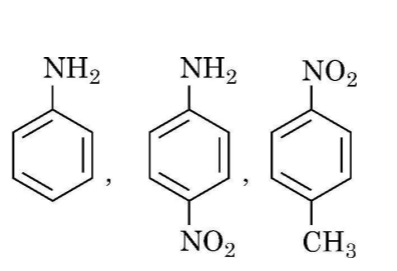 [2 Marks]
(3) Why ammonolysis of alkyl halides is not a good method toprepare pure amines ?
(4) (CH₃)₃N, (CH₃)₂NH, NH₃, CH₃NH₂Arrange the following in the increasing order of their basic character in an aqueous solution .
The spontaneous flow of the solvent through a semipermeable membrane from a pure solvent to a solution or from a dilute solution to a concentrated solution is called osmosis. The phenomenon of osmosis can be demonstrated by taking two eggs of the same size. In an egg, the membrane below the shell and around the egg material is semipermeable. The outer hard shell can be removed by putting the egg in dilute hydrochloric acid. After removing the hard shell, one egg is placed in distilled water and the other in a saturated salt solution. After some time, the egg placed in distilled water swells-up while the egg placed in salt solution shrinks. The external pressure applied to stop the osmosis is termed as osmotic pressure (a colligative property). Reverse osmosis takes place when the applied external pressure becomes larger than the osmotic pressure.
(1) Define reverse osmosis. Name one SPM which can be used in the process of reverse osmosis .
(2) Which one of the following will have higher osmotic pressure in1 M KCI or 1 M urea solution. Justify your answer.
(3) What do you expect to happen when red blood corpuscles (RBC's) are placed in 0.5% NaCl solution ?
(4) Why osmotic pressure is a colligative property ?
This means osmotic pressure increases with solute concentration, as explained in the case of eggs swelling or shrinking due to osmosis.
It is one of the properties like lowering of vapour pressure, elevation of boiling point, and depression of freezing point that depend only on solute quantity, not type.
Section B
The charge required for the reduction of 1 mol of Mn0⁻₄ to Mn0₂ is
The correct answer is 3F. The reduction of MnO₄⁻ to MnO₂ involves a change in the oxidation state of manganese from +7 in MnO₄⁻ to +4 in MnO₂, requiring the transfer of 3 electrons per Mn atom. This means that for one mole of MnO₄⁻, 3 moles of electrons are needed. Since 1 mole of electrons corresponds to one Faraday (F), the total charge required for the reduction of 1 mole of MnO₄⁻ to MnO₂ is 3F.
Which among the following is false statement?
The false statement is 'Molecularity of a reaction may be zero.' This is incorrect because molecularity refers to the number of reactant molecules involved in an elementary reaction, and it is always a positive integer (1 for unimolecular, 2 for bimolecular, etc.). It can never be zero, as that would imply that the reaction occurs without any reactant molecules, which is not possible in chemical reactions.
The number of molecules that react with each other in an elementary reaction is a measure of the:
The correct answer is 'molecularity of the reaction' because molecularity refers to the number of reacting species (atoms, ions, or molecules) that must collide simultaneously to initiate a chemical reaction, which is specifically defined for elementary reactions.
The element having [Ar]3d¹⁰4s¹ electronic configuration is:
The complex ions [Co(NH₃)₅(NO₂)]²⁺ and [Co(NH₃)₅(ONO)]²⁺ are called:
The correct option is 'Linkage isomers' because the two complex ions differ in how the nitrite ligand (NO₂) coordinates to the cobalt ion; it can bind either through the nitrogen atom or the oxygen atom, resulting in different linkage in the coordination complex.
The diamagnetic species is:
[At. No. Co = 27,Fe = 26, Ni = 28]
[Ni(CN)₄]²⁻ is the correct answer as it is diamagnetic. In this complex, nickel is in the +2 oxidation state with an electronic configuration of 3d⁸. The configuration allows for paired electrons in the d-orbitals, resulting in no unpaired electrons. This is supported by the context which states that this species is tetrahedral and diamagnetic, contrasting with other options that are all paramagnetic due to having unpaired electrons.
Which is the correct IUPAC name for
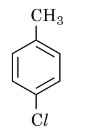
The correct IUPAC name is 1-Chloro-4-Methylbenzene. This name indicates that there is a chlorine atom (−Cl) attached to the benzene ring at position 1 and a methyl group (−CH₃) attached at position 4. This naming aligns with IUPAC rules, where substituents are numbered to give the lowest locants, and alphabetical order is used to determine the priority when both substituents are at equal positions. Hence, "chloro" comes before "methyl" in the name.
What will be formed after oxidation reaction of secondary alcohol with chromic anhydride (CrO₃)?
The correct answer is 'Ketone' because secondary alcohols are oxidized to ketones when treated with chromic anhydride (CrO₃), as indicated in the provided context.
The conversion of phenol to salicylic acid can be accomplished by:
The correct answer is Kolbe's reaction.In this reaction, phenol is first treated with sodium hydroxide (NaOH) to form sodium phenoxide, which is then heated with carbon dioxide (CO₂) under pressure (around 125°C and 6–7 atm). This introduces a –COOH group at the ortho position of the aromatic ring, forming sodium salicylate, which upon acidification gives salicylic acid.
Which of the following is/are examples of denaturation of protein?
The correct options are Curdling of milk and Coagulation of egg white, which are examples of denaturation of proteins as explained in the context. Denaturation occurs when proteins lose their secondary and tertiary structures due to changes in temperature or pH, while the primary structure remains intact. The context specifically mentions curdling of milk due to lactic acid from bacteria and coagulation of egg white upon boiling as common examples.
Nucleotides are joined together by:
The correct answer is 'Phosphodiester linkage' because nucleotides are linked together via phosphodiester bonds that form between the 5' and 3' carbon atoms of the pentose sugar in the nucleotide structure. This linkage is essential in forming the backbone of nucleic acids such as DNA and RNA.
Scurvy is caused due to deficiency of:
Scurvy is caused by a deficiency of Vitamin C, also known as Ascorbic acid, which is highlighted in the context as leading to bleeding gums. The other options listed do not cause Scurvy.
Assertion (A) : In a first order reaction, if the concentration of the reactant is doubled, its half-life is also doubled.
Reason (R) : The half-life of a reaction does not depend upon the initial concentration of the reactant in a first order reaction.
Assertion (A) is false, but Reason (R) is true. The half-life of a first order reaction is independent of the initial concentration of the reactant, meaning that doubling the concentration does not affect the half-life.
Assertion (A) : In a first order reaction, if the concentration of the reactant is doubled, its half-life is also doubled
Reason (R) : The half-life of a reaction does not depend upon the initial concentration of the reactant in a first order reaction.
Assertion (A) is false, because in a first order reaction, the half-life is constant and does not change with the concentration of the reactant; it is independent of initial concentration. Reason (R) is true, as it accurately describes that the half-life for first order reactions remains the same regardless of changes in reactant concentration.
Assertion (A) : Cu cannot liberate H₂ on reaction with dilute mineral acids.
Reason (R) : Cu has positive electrode potential .
Both Assertion (A) and Reason (R) are true and reason is the correct explanation of assertion. CU lies below hydrogen in electrochemical series and has positive electrode potential. Hence cannot liberate hydrogen from acids.
Assertion (A) : Aromatic primary amines cannot be prepared by Gabriel Phthalimide synthesis.
Reason (R) : Aryl halides do not undergo nucleophilic substitution reaction with the anion formed by phthalimide.
Both Assertion (A) and Reason (R) are true, and Reason (R) is the correct explanation of Assertion (A). Aromatic primary amines cannot be synthesized through the Gabriel Phthalimide method because aryl halides do not react with the nucleophilic anion derived from phthalimide, thereby confirming Assertion (A) with Reason (R).
Assertion (A) : Vitamin D cannot be stored in our body.
Reason (R) : Vitamin D is fat soluble vitamin and is not excreted from the body in urine.
Assertion (A) is false, but Reason (R) is true. Vitamin D is a fat-soluble vitamin, meaning it can actually be stored in the body, primarily in the liver and adipose tissues, which contradicts Assertion (A). Reason (R) is true as fat-soluble vitamins are not readily excreted in urine, but it does not support the incorrect assertion.
Section C
The rate constant for a zero order reaction A→ P is 0.0030 mol L⁻¹s⁻¹. How long will it take for the initial concentration of A to fall from 0.10 M to 0.075 M ?
The integrated rate law for zero order reaction is: [A] = [A]0 - kt.
Given:
Initial concentration, [A]0 = 0.10 M
Final concentration, [A] = 0.075 M
Rate constant, k = 0.0030 mol L⁻¹ s⁻¹
Substitute values in the equation: 0.075 = 0.10 - 0.0030 * t
0.10 - 0.075 = 0.0030 * t
0.025 = 0.0030 * t
t = 0.025 / 0.0030 = 8.33 seconds.
Therefore, it will take 8.33 seconds for the concentration of A to fall from 0.10 M to 0.075 M.
The decomposition of NH₃ on platinum surface is zero order reaction. what are the rates of production of N₂ and H₂ if k = 2.5 x 10⁻⁴ mol L⁻¹ s⁻¹ ?
Step 1: Write the balanced reaction: 2 NH₃ → N₂ + 3 H₂.
Step 2: Rate of reaction (r) = k since it is zero order.
Step 3: The rate of disappearance of NH₃ = k = 2.5 x 10⁻⁴ mol L⁻¹ s⁻¹.
Step 4: Using stoichiometry, rate of production of N₂ = (1/2) * rate of NH₃ = (1/2)* 2.5 x 10⁻⁴ = 1.25 x 10⁻⁴ mol L⁻¹ s⁻¹.
Step 5: Rate of production of H₂ = (3/2) * rate of NH₃ = (3/2)* 2.5 x 10⁻⁴ = 3.75 x 10⁻⁴ mol L⁻¹ s⁻¹.
Answer: Rate of formation of N₂ is 1.25 x 10⁻⁴ mol L⁻¹ s⁻¹ and rate of formation of H₂ is 3.75 x 10⁻⁴ mol L⁻¹ s⁻¹.
Define the following terms :
(a) Pseudo first order reaction
(b) Half-life period of reaction(t½)
(b) Half-life period of reaction (t½): It is the time required for the concentration of a reactant to decrease to half of its initial value during the reaction.
Examine the following observations :
(a) Transition elements generally form coloured compounds.
(b) Zinc is not regarded as a transition element.
(b) Zinc is not a transition element because its 3d orbitals are fully filled (3d10) in both ground and common oxidation states. Since it does not have partially filled d orbitals, it does not exhibit typical properties of transition elements such as variable oxidation states and coloured compounds.
Name the following coordination compounds according to IUPAC norms :
(a) [Co(NH₃)₄(H₂O)Cl]Cl₂
(b) [CrC1₂(en)₂ ] Cl
(b) The complex ion is [CrCl₂(en)₂]+ with one chloride ion as counter ion. The ligands are ethane-1,2-diamine abbreviated as en and chloro. Alphabetically, chloro comes before ethane-1,2-diamine. The oxidation state of chromium is +3. So, the name is dichloridobis(ethane-1,2-diamine)chromium(III) chloride.
(a) In the following pair of halogen compounds, which compound undergoes SₙI reaction faster and why ?
(b) Arrange the following compounds in increasing order of their reactivity towards Sₙ2 displacement :
2—Bromo—2—methylbutane, I—Bromopentane, 2—Bromopentane.
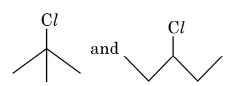
(b) For SN2 reactions, steric hindrance plays a major role. Primary alkyl halides react faster than secondary, which react faster than tertiary. Among the compounds given, 2-Bromo-2-methylbutane is tertiary and most hindered, 2-Bromopentane is secondary, and 1-Bromopentane (I-Bromopentane) is primary. So, the increasing order of reactivity is: 2-Bromo-2-methylbutane < 2-Bromopentane < I-Bromopentane.
Section D
At 25 ⁰C the saturated vapour pressure of water is 24 mm Hg. Find the saturated vapour pressure of a 5% aqueous solution of urea at the same temperature. (Molar mass of urea = 60 g mol⁻¹)
Step 1: Calculate moles of urea = 5 / 60 = 0.0833 mol
Step 2: Calculate moles of water = 95 / 18 = 5.28 mol
Step 3: Calculate mole fraction of water, Xwater = moles of water / (moles of water + moles of urea) = 5.28 / (5.28 + 0.0833) = 0.9845
Step 4: Use Raoult's law: vapour pressure of solution = Xwater * vapour pressure of pure water = 0.9845 * 24 = 23.63 mm Hg
Answer: The saturated vapour pressure of 5% aqueous urea solution at 25 deg C is approximately 23.63 mm Hg.
The electrical resistance of a column of 0.05 M NaOH solution of area 0.8 cm² and length 40 cm is 5 x 10³ ohm. Calculate its resistivity, conductivity and molar conductivity.
(a) Resistivity (\rho):
Resistivity \rho = R * A / l = (5 x 103) * (0.8 * 10-4) / 0.4 = 1 ohm m.
(b) Conductivity (\kappa):
Conductivity \kappa = 1 / \rho = 1 / 1 = 1 S m-1.
(c) Molar conductivity (\Lambdam):
First, convert concentration to mol/m3: c = 0.05 mol L-1 = 0.05 * 1000 = 50 mol m-3.
Molar conductivity \Lambdam = \kappa / c = 1 / 50 = 0.02 S m2 mol-1 = 20 S cm2 mol-1 (since 1 m2 = 104 cm2).
Summary:
Resistivity = 1 ohm m, Conductivity = 1 S m-1, Molar conductivity = 20 S cm2 mol-1.
Complete and balance the following chemical equations:
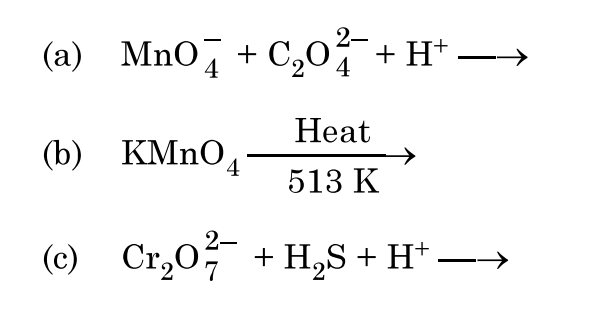
1. Write the unbalanced equation.
2. Separate the reaction into oxidation and reduction half-reactions.
3. Balance all atoms except hydrogen and oxygen.
4. Balance oxygen atoms by adding H2O molecules.
5. Balance hydrogen atoms by adding OH- ions (since the medium is basic).
6. Balance the charge by adding electrons (e-) to the appropriate side.
7. Equalize the number of electrons in both half-reactions by multiplying as needed.
8. Add the two half-reactions together and cancel common species including electrons.
9. Verify that atoms and charges are balanced on both sides.
Following these steps ensures the final equation obeys the law of conservation of mass and charge, with only coefficients changed and subscripts intact.
Using valence bond theory, explain the hybridization and magnetic character of the following :
(a) [Co(NH₃)₆]³⁺
(b) [Ni(CO)₄]
[At. no. : Co = 27, Ni = 28]
(b) In [Ni(CO)₄], Ni is in 0 oxidation state with 3d₈ 4s₂ electronic configuration. CO is a strong field ligand leading to pairing of electrons. Hybridization occurs involving one 3d, one 4s and two 4p orbitals resulting in dsp² hybridization giving a square planar geometry. It is diamagnetic because all electrons are paired.
(a) Define the following :
(i) Enantiomers
(ii) Racemic mixture
(b) Why is chlorobenzene resistant to nucleophilic substitution reaction ?
(a)(ii) A racemic mixture is an equimolar mixture of two enantiomers of a chiral compound which shows no optical activity because the rotations caused by each enantiomer cancel each other.
(b) Chlorobenzene is resistant to nucleophilic substitution because the lone pair of electrons on chlorine delocalises into the benzene ring through resonance, making the C-Cl bond stronger and less reactive. Also, the aromatic ring is electron-rich, repelling nucleophiles and stabilising the molecule, thus hindering the attack of nucleophiles and making nucleophilic substitution difficult.
Explain the following reactions and write chemical equation involved:
(a) Wolf-Kishhner reducation
(b) Etard reaction
(c) Cannizzaro reaction
COR + NH2NH2 → RCH=NNH2 (Hydrazone)
RCH=NNH2 + KOH/heat → RH + N2 + H2O
(b) Etard Reaction: This reaction is used to oxidize methyl groups attached to aromatic rings into aldehydes. Chromyl chloride (CrO2Cl2) reacts with toluene to form an intermediate complex which on hydrolysis gives benzaldehyde.
C6H5CH3 + CrO2Cl2 → complex → C6H5CHO + other products
(c) Cannizzaro Reaction: This reaction involves aldehydes with no alpha hydrogen. When treated with concentrated alkali, one molecule of aldehyde is reduced to alcohol and another is oxidized to carboxylic acid salt.
2 RCHO + OH- → RCH2OH + RCOO-
Example: 2 C6H5CHO + OH- → C6H5CH2OH + C6H5COO-
These reactions demonstrate redox processes involving aldehydes under different conditions.
Write the structures of A, B and C in the following sequence of reactions:
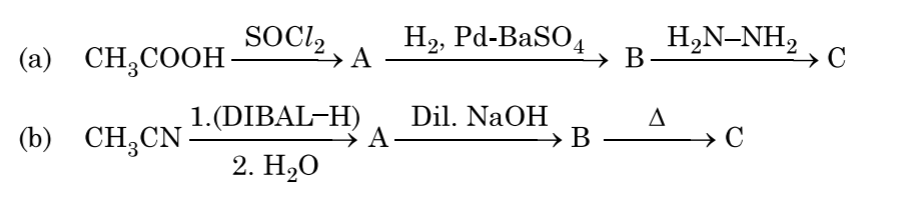
(a) Structure of A: A is the initial organic compound, which in this reaction sequence is typically an alkyl halide such as bromobenzene (C6H5Br). So, structure A is bromobenzene where a bromine atom is attached to the benzene ring.
(b) Structure of B: B is the Grignard reagent formed by reacting A with magnesium in dry ether. For bromobenzene, this forms phenylmagnesium bromide (C6H5MgBr). Its structure contains the phenyl group bonded to magnesium which is also bonded to bromine.
(c) Structure of C: C is the product formed when the Grignard reagent B reacts with a compound such as an aldehyde or ketone followed by hydrolysis with water or acid. For example, if B reacts with formaldehyde (HCHO), after hydrolysis, C would be benzyl alcohol (C6H5CH2OH). The structure of C shows a benzene ring attached to a -CH2OH group.
Hence, the sequence: A (bromobenzene) —Mg/ether→ B (phenylmagnesium bromide) —reacts with aldehyde + hydrolysis→ C (benzyl alcohol).
Define the following terms :
(a) Glycosidic linkage
(b) Invert sugar
(c) Oligosaccharides
(b) Invert sugar is a mixture of glucose and fructose obtained by the hydrolysis of sucrose. When sucrose is treated with acid or enzyme invertase, it breaks down into equal parts of glucose and fructose. This sugar mixture is called invert sugar because it inverts the direction of rotation of plane-polarized light from dextrorotatory (sucrose) to levorotatory (invert sugar).
(c) Oligosaccharides are carbohydrates composed of 2 to 10 monosaccharide units linked together by glycosidic linkages. They are intermediate in size between monosaccharides and polysaccharides and are commonly found on the surface of cells, playing important roles in cell recognition and signaling.
Section E
(a) Give the IUPAC name of CH₃−CH=CH−CHO.
(b) Give a simple chemical test to distinguish between propanal and propanone.
(c) How will you convert the following :
(i) Toluene to benzoic acid
(ii) Ethanol to propan—2—ol
(iii) Propanal to 2—hydroxy propanoic acid
(b) To distinguish between propanal and propanone, perform the Tollen's test. Aldehydes like propanal react with Tollen's reagent to give a silver mirror on the inner surface of the test tube, while ketones like propanone do not give this test.
(c) (i) Toluene to benzoic acid: Oxidize toluene using KMnO4 in alkaline medium with heat. The methyl group is oxidized to the carboxylic acid group, forming benzoic acid.
(ii) Ethanol to propan-2-ol: First convert ethanol to bromoethane using PBr3, then carry out a Grignard reaction with formaldehyde followed by acidic hydrolysis to get propan-2-ol.
(iii) Propanal to 2-hydroxy propanoic acid: React propanal with HCN to form cyanohydrin, then hydrolyze the nitrile group (-CN) using dilute acid to get 2-hydroxy propanoic acid (lactic acid).
Complete each synthesis by giving missing starting material, reagent or products:
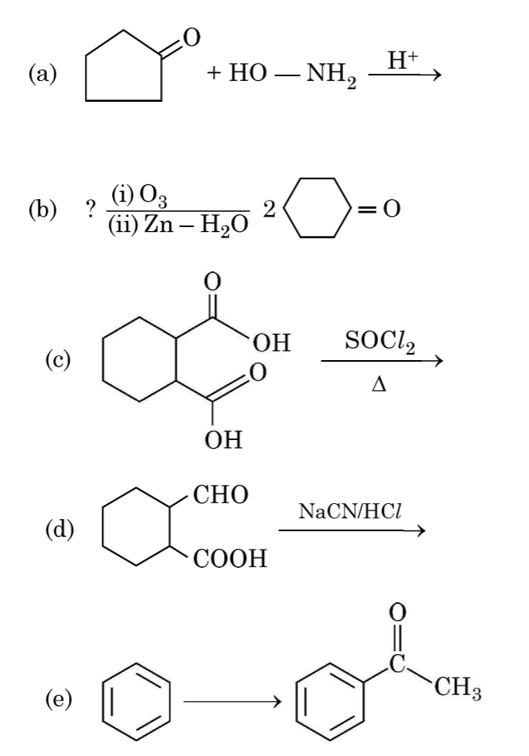
2. Cyclohexanol to cyclohexanone: Cyclohexanol is a secondary alcohol that can be oxidized to a ketone using reagents like chromic acid (H2CrO4) or PCC. The product is cyclohexanone.
3. p-Fluorotoluene to p-fluorobenzaldehyde: p-Fluorotoluene is an aromatic compound and can be converted to p-fluorobenzaldehyde by side chain oxidation using reagents such as KMnO4 or chromyl chloride (Etard reaction). The methyl group oxidizes to the aldehyde group.
4. Ethanitrile to ethanal: Ethanitrile (CH3CN) can be partially hydrolyzed or reduced to ethanal using reagents like diisobutylaluminium hydride (DIBAL-H) at low temperature. This reduces the nitrile group to an aldehyde.
In summary, these syntheses involve careful selection of reagents to convert functional groups stepwise. The reaction conditions and reagents determine whether oxidation or reduction occurs.
Understanding the role of each reagent helps in predicting the products and completing the synthesis steps.
(a) Calculate the standard Gibbs energy (ΔᵣG⁰) of the following reaction at 25 ⁰C: Au(S) + ca²⁺(1M)→ Au³⁺ (1M) +Ca(s)
E⁰Au³⁺/Au= + 1.5 V,E⁰Ca²⁺/Ca=- 2.87 v
Predict whether the reaction will be spontaneous or not at 25 ⁰C. [1 F = 96500 C mol⁻¹]
(b) Tarnished silver contains Ag2S. Can this tarnish be removed by placing tarnished silverware in an aluminium pan containing an inert electrolytic solution such as NaCl ? The standard electrode potential for half reaction :
Ag₂S(s) +2e⁻ →2Ag(s) +S²⁻ is -0.71V
and for Al³⁺ +3e⁻ →2Al(s) is -1.66 V
Given standard electrode potentials:
E0Au³⁺/Au = +1.5 V and E0Ca²⁺/Ca = -2.87 V
The overall cell reaction can be seen as Au oxidizing to Au3+ (oxidation) and Ca2+ reducing to Ca(s) (reduction)
Calculate E0cell = E0cathode - E0anode = E0reduction - E0oxidation
Since Au is oxidized, its oxidation potential = -1.5 V and Ca2+ is reduced, its reduction potential = -2.87 V
E0cell = (-2.87) - (-1.5) = -1.37 V
Using ΔG0 = -nFE0cell, where n is the number of electrons transferred,
In Au oxidation, Au changes from 0 to +3 oxidation state, so n=3
F = 96500 C mol-1
ΔG0 = -3 * 96500 * (-1.37) = +397,965 J = +398 kJ
A positive ΔG0 indicates the reaction is non-spontaneous at 25 degC.
(b) Tarnished silver contains Ag2S which can be removed by placing the silverware in an aluminium pan with inert electrolyte like NaCl.
Half reactions given:
Ag2S(s) + 2e- → 2Ag(s) + S2-; E0 = -0.71 V
Al3+ + 3e- → Al(s); E0 = -1.66 V
The more negative E0 for Al means aluminium is more easily oxidized than silver sulfide reduction.
Al will lose electrons, reducing Ag2S to Ag and removing the tarnish.
Thus, tarnish can be removed by this method due to the difference in electrode potentials favoring the reaction.
(a) Define the following :
(i) Cell potential
(ii) Fuel cell
(b) Calculate emf of the following cell at 25⁰C :
Zn(s) I Zn²⁺₍₀.₁ₘ₎IlCd²⁺₍₀.₀₁ₘ₎I Cd(s)
Given : E⁰cd²⁺/cd = -0.40V
E⁰Zn²⁺/Zn =-0.76V
[log 10=1]
(ii) Fuel cell is a device that converts chemical energy of a fuel, usually hydrogen or hydrocarbons, directly into electrical energy through electrochemical reactions without combustion.
(b) To calculate emf of the cell Zn(s) | Zn2+(0.1M) || Cd2+(0.01M) | Cd(s) at 25 deg C:
Given: E0Cd2+/Cd = -0.40 V and E0Zn2+/Zn = -0.76 V
Standard cell potential, E0cell = E0cathode - E0anode = (-0.40) - (-0.76) = 0.36 V
The overall cell reaction involves 2 electrons, so n = 2.
Using Nernst equation:
Ecell = E0cell - (0.059/2) * log([Zn2+]/[Cd2+])
Substituting values:
Ecell = 0.36 - (0.059/2) * log(0.1/0.01) = 0.36 - 0.0295 * log(10) = 0.36 - 0.0295 * 1 = 0.3305 V
Therefore, emf of the cell under given conditions is approximately 0.33 V.
An organic compound 'A', molecular formula C₂H₆0 oxidises with Cr0₃ to form a compound 'B'. Compound 'B' on warming with iodine and aqueous solution of NaOH gives a yellow precipitate of compound 'C'. When compound 'A' is heated with conc. H₂S0₄ at 413 K gives a compound 'D', which on reaction with excess HI gives compound 'E'. Identify compounds 'A', 'B', 'C', 'D' and 'E' and write chemical equations involved.
(a) Compound A with molecular formula C2H6O is ethanol (CH3CH2OH).
(b) On oxidation with CrO3, ethanol (A) forms compound B which is ethanal (acetaldehyde, CH3CHO).
Equation: CH3CH2OH + [O] --CrO3--> CH3CHO + H2O
(c) Compound B (ethanal) on warming with iodine and NaOH gives a yellow precipitate (compound C) of iodoform (CHI3) indicating a methyl ketone or aldehyde with methyl group.
Equation: CH3CHO + 3I2 + 4NaOH --> CHI3 (yellow ppt) + HCOONa + 3NaI + 3H2O
(d) When compound A (ethanol) is heated with concentrated H2SO4 at 413 K, dehydration occurs producing compound D which is ethene (CH2=CH2).
Equation: CH3CH2OH --conc H2SO4, 413 K--> CH2=CH2 + H2O
(e) Compound D (ethene) on reaction with excess HI gives compound E which is ethyl iodide (C2H5I).
Equation: CH2=CH2 + HI --> CH3CH2I
Summary:
A - Ethanol (CH3CH2OH)
B - Ethanal (CH3CHO)
C - Iodoform (CHI3)
D - Ethene (CH2=CH2)
E - Ethyl iodide (CH3CH2I)
These reactions show typical oxidation, haloform test, dehydration and addition reaction of ethanol and its derivatives.
(a) Write chemical equations of the following reactions :
(i) Phenol is treated with conc. HNO3
(ii) Propene is treated with B H followed by oxidation by H202/OH-.
(iii) Sodium t-butoxide is treated with CH3 Cl.
(b) Give a simple chemical test to distinguish between butan—1—ol and butan—2—ol.
(c) Arrange the following in increasing order of acid strength : phenol, ethanol, water.
(i) When phenol is treated with concentrated nitric acid, nitration occurs mainly at the ortho and para positions forming a mixture of 2-nitrophenol and 4-nitrophenol. The reaction can be written as:
C6H5OH + HNO3 (conc.) -> o-nitrophenol + p-nitrophenol + H2O
(ii) Propene reacts with borane (B H3) to give an organoborane intermediate which on oxidation with hydrogen peroxide (H2O2) in alkaline medium (OH-) gives propanol. The hydroboration-oxidation reaction gives anti-Markovnikov addition of water.
CH3-CH=CH2 + B H3 -> organoborane intermediate
Organoborane + H2O2/OH- -> CH3-CH2-CH2OH
(iii) Sodium t-butoxide reacts with methyl chloride (CH3 Cl) via nucleophilic substitution to give t-butyl methyl ether.
((CH3)3CO-)Na+ + CH3Cl -> (CH3)3COCH3 + NaCl
(b)
To distinguish between butan-1-ol and butan-2-ol, use Lucas test. When treated with Lucas reagent (ZnCl2 in concentrated HCl), butan-2-ol reacts faster forming turbidity due to formation of alkyl chloride, while butan-1-ol reacts slowly. Thus, appearance of turbidity immediately indicates butan-2-ol, while delayed turbidity or no turbidity indicates butan-1-ol.
(c)
The increasing order of acid strength among phenol, ethanol and water is:
ethanol < water < phenol
This is because phenol has resonance stabilization of its phenoxide ion, making it more acidic than water and ethanol. Water is more acidic than ethanol due to better stabilization of its conjugate base.
Paper Details
CBSE Board Exam 2025
Class
Class 12 PCM
Subject
Chemistry
Year
2025
Set
Set 2
Other Years — Chemistry