SOLUTIONS
2024 BOARD EXAM
CBSE Class 12 PCM Chemistry Board Paper 2024 — Set 1 Solutions
2024
Chemistry
Class 12 PCM
CBSE EXAMINATION PAPER-2024
CHEMISTRY
(Solved)
General Instructions :
Read the following instructions carefully and follow them :
- This question paper contains 49 questions. All questions are compulsory.
- This question paper is divided into 5 sections.
- Section A – questions number 1 to 15 are case based questions
- Section B – questions number 16 to 31 are multiple choice questions
- Section C – questions number 32 to 37 are very short answer
- Section D – questions number 38 to 44 are short answer
- Section E – questions number 45 to 49 are long answer
- There is no overall choice given in the question paper. However, an internal choice has been provided in few questions.
- Use of calculator is NOT allowed.
Section A
Batteries and fuel cells are very useful forms of galvanic cell. Any battery or cell that we use as a source of electrical energy is basically a galvanic cell. However, for a battery to be of practical use it should be reasonably light, compact and its voltage should not vary appreciably during its use. There are mainly two types of batteries secondary batteries. primary batteries and In the primary batteries, the reaction occurs only once and after use over a period of time the battery becomes dead and cannot be reused again, whereas the secondary batteries are rechargeable. Production of electricity by thermal plants is not a very efficient method and is a major source of pollution. To solve this problem, galvanic cells are designed in such a way that energy of combustion of fuels is directly converted into electrical energy, and these are known as fuel cells. One such fuel cell was used in the Apollo space programme.
Answer the following questions :
Batteries and fuel cells are very useful forms of galvanic cell. Any battery or cell that we use as a source of electrical energy is basically a galvanic cell. However, for a battery to be of practical use it should be reasonably light, compact and its voltage should not vary appreciably during its use. There are mainly two types of batteries secondary batteries. primary batteries and In the primary batteries, the reaction occurs only once and after use over a period of time the battery becomes dead and cannot be reused again, whereas the secondary batteries are rechargeable. Production of electricity by thermal plants is not a very efficient method and is a major source of pollution. To solve this problem, galvanic cells are designed in such a way that energy of combustion of fuels is directly converted into electrical energy, and these are known as fuel cells. One such fuel cell was used in the Apollo space programme. Answer the following questions :
Batteries and fuel cells are very useful forms of galvanic cell. Any battery or cell that we use as a source of electrical energy is basically a galvanic cell. However, for a battery to be of practical use it should be reasonably light, compact and its voltage should not vary appreciably during its use. There are mainly two types of batteries secondary batteries. primary batteries and In the primary batteries, the reaction occurs only once and after use over a period of time the battery becomes dead and cannot be reused again, whereas the secondary batteries are rechargeable. Production of electricity by thermal plants is not a very efficient method and is a major source of pollution. To solve this problem, galvanic cells are designed in such a way that energy of combustion of fuels is directly converted into electrical energy, and these are known as fuel cells. One such fuel cell was used in the Apollo space programme. Answer the following questions :
Batteries and fuel cells are very useful forms of galvanic cell. Any battery or cell that we use as a source of electrical energy is basically a galvanic cell. However, for a battery to be of practical use it should be reasonably light, compact and its voltage should not vary appreciably during its use. There are mainly two types of batteries secondary batteries. primary batteries and In the primary batteries, the reaction occurs only once and after use over a period of time the battery becomes dead and cannot be reused again, whereas the secondary batteries are rechargeable. Production of electricity by thermal plants is not a very efficient method and is a major source of pollution. To solve this problem, galvanic cells are designed in such a way that energy of combustion of fuels is directly converted into electrical energy, and these are known as fuel cells. One such fuel cell was used in the Apollo space programme. Answer the following questions :
Batteries and fuel cells are very useful forms of galvanic cell. Any battery or cell that we use as a source of electrical energy is basically a galvanic cell. However, for a battery to be of practical use it should be reasonably light, compact and its voltage should not vary appreciably during its use. There are mainly two types of batteries secondary batteries. primary batteries and In the primary batteries, the reaction occurs only once and after use over a period of time the battery becomes dead and cannot be reused again, whereas the secondary batteries are rechargeable. Production of electricity by thermal plants is not a very efficient method and is a major source of pollution. To solve this problem, galvanic cells are designed in such a way that energy of combustion of fuels is directly converted into electrical energy, and these are known as fuel cells. One such fuel cell was used in the Apollo space programme. Answer the following questions :
The following questions are case-based questions. Read the case carefully and answer the questions that follow.
Batteries and fuel cells are very useful forms of galvanic cell. Any battery or cell that we use as a source of electrical energy is basically a galvanic cell. However, for a battery to be of practical use it should be reasonably light, compact and its voltage should not vary appreciably during its use. There are mainly two types of batteries primary batteries and secondary batteries.
In the primary batteries, the reaction occurs only once and after use over a period of time the battery becomes dead and cannot be reused again, whereas the secondary batteries are rechargeable.
Production of electricity by thermal plants is not a very efficient method and is a major source of pollution. To solve this problem, galvanic cells are designed in such a way that energy of combustion of fuels is directly converted into electrical energy, and these are known as fuel cells. One such fuel cell was used in the Apollo space programme.
(1) How do primary batteries differ from secondary batteries ?
(2) The cell potential of Mercury cell is 1·35 V, and remains constant during its life. Give reason.
(3) Write the reactions involved in the recharging of the lead storage battery.
(4) Write two advantages of fuel cells over other galvanic cells.
Fuel cells produce electricity by converting energy of fuel combustion directly into electrical energy, so they are more efficient. They are pollution free as stated in the case, unlike batteries or thermal plants which may cause pollution. Also, fuel cells can continuously operate by feeding reactants, making them suitable for long-term use as used in Apollo space programme.
The Valence Bond Theory (VBT) explains the formation, magnetic behaviour and geometrical shapes of coordination compounds whereas" The Crystal Field Theory" for coordination compounds is based on the effect of different crystal fields (provided by ligands taken as point charges), on the degeneracy of d-orbital energies of the central metal atom/ion. The splitting of the d-orbitals provides different electronic arrangements in strong and weak crystal fields. The crystal field theory attributes the colour of the coordination compounds to d-d transition of the electron. Coordination compounds find extensive applications in metallurgical processes, analytical and medicinal chemistry
(1) What is crystal field splitting energy ?
(2) Give reason for the violet colour of the complex [Ti(H₂O)₆]³⁺ on the basis of crystal field theory.
(3) Explain why [Fe(CN)₆]³⁻ is an inner orbital complex, whereas [Fe(H₂O)₆]³⁺ is an outer orbital complex. [Atomic No. : Fe = 26]
(4) [Cr(NH₃)₆]³⁺ is paramagnetic while [Ni(CN)₄]²⁻ is diamagnetic. Explain why. [Atomic No. : Cr = 24, Ni = 28]
The complex [Ni(CN)4]2- has Ni2+ with electronic configuration 3d8. CN- is a strong field ligand causing pairing of electrons in dsp2 hybrid orbitals in square planar geometry, resulting in all electrons paired and making it diamagnetic.
This explanation uses Valence Bond Theory as stated in the passage to justify the magnetic behaviour based on ligand field strength and orbital hybridisation.
Section B
Which one of the following first row transition elements is expected to have the highest third ionization enthalpy ?
Two among the three components of DNA are β-D-2-deoxyribose and a heterocyclic base. The third component is :
For an electrolyte undergoing association in a solvent, the vant factor :
The correct answer is 'is always less than one'. This is because when an electrolyte associates, the number of particles in solution decreases compared to the number expected based on the formula units, leading to a lower van 't Hoff factor (v) which is a measure of the degree of dissociation or association in the solution.
For the reaction X + 2Y → P, the differential form equation of the rate law is :
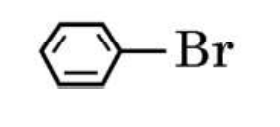
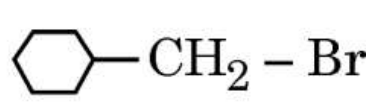
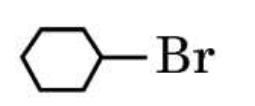
The compound which undergoes SN_1 reaction most rapidly is
;
-
(A)
-
(B)
-
(C)
-
(D)
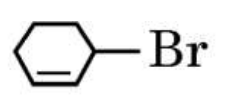
The SN1 reaction proceeds via the formation of a carbocation intermediate. Tertiary carbocations are the most stable due to greater alkyl group electron donation and steric hindrance that stabilizes the positive charge. Hence, tertiary alkyl halides like (CH3)3CBr undergo SN1 reactions most rapidly compared to primary or secondary alkyl halides.
Acetic acid reacts with PCl₅ to give :
The formation of cyanohydrin from an aldehyde is an example of :
The correct answer is 'nucleophilic addition' because the reaction involves a nucleophile (cyanide ion) attacking the electrophilic carbonyl carbon of the aldehyde, leading to the formation of cyanohydrin.
In the Arrhenius equation, when log k is plotted against 1/T, a straight line is obtained whose :
The Arrhenius equation is k = A * exp(-Ea/(RT)). Taking the logarithm base 10 on both sides, we get log k = log A - Ea/(2.303 R) * 1/T. This equation is in the form of a straight line y = mx + c, where y = log k, x = 1/T, slope m = -Ea/(2.303 R), and intercept c = log A. Hence, the plot of log k versus 1/T gives a straight line with slope -Ea/(2.303 R) and intercept log A.
The reaction of an alkyl halide with sodium alkoxide forming ether is known as :
The correct answer is Williamson synthesis. In Williamson synthesis, an alkyl halide reacts with a sodium alkoxide to produce an ether. This reaction is a common method for synthesizing ethers from alcohols and alkyl halides.
The correct order of the ease of dehydration of the following alcohols by the action of conc. H₂SO₄ is :
Which functional groups of glucose interact to form cyclic hemiacetal leading to pyranose structure ?
Assertion (A) : When NaCl is added to water a depression in freezing point is observed.
Reason (R) : NaCl undergoes dissociation in water.
Assertion (A) : Separation of Zr and Hf is difficult.
Reason (R) : Zr and Hf have similar radii due to lanthanoid contraction.
Both Assertion (A) and Reason (R) are true, and Reason (R) is the correct explanation of Assertion (A). The similar ionic radii of Zr and Hf, resulting from the lanthanoid contraction, indeed make their separation challenging.
Assertion (A) : The pKₐ of ethanoic acid is lower than that of Cl -CH₂- COOH.
Reason (R) : Chlorine shows electron withdrawing ( I) effect which increases the acidic character of Cl -CH 2- COOH.
Assertion (A) is false, but Reason (R) is true. The pKₐ of Cl-CH₂-COOH is actually lower than that of ethanoic acid due to the electron-withdrawing effect of chlorine, which does increase the acidic character of Cl-CH₂-COOH. Therefore, while Reason (R) correctly describes the influence of chlorine on acidity, Assertion (A) is incorrect.
Assertion (A) : Aniline is a stronger base than ammonia.
Reason (R) : The unshared electron pair on nitrogen atom in aniline becomes less available for protonation due to resonance.
Which of the following compounds will give a ketone on oxidation with chromic anhydride (CrO₃) ?
Section C
Calculate the potential of Iron electrode in which the concentration of
Fe2+ ion is 0·01 M.
(E°Fe2+/Fe = 0·45 V at 298 K)
[Given : log 10 = 1]
E = E° - (0.0592 / n) * log [Fe2+]
Here, E° = 0.45 V, n = 2, and [Fe2+] = 0.01 M
So, E = 0.45 - (0.0592 / 2) * log 0.01
= 0.45 - 0.0296 * (-2) since log 0.01 = -2
= 0.45 + 0.0592
= 0.5092 V
Therefore, the potential of the iron electrode is approximately 0.51 V.
Define molecularity of the reaction. State any one condition in which a bimolecular reaction may be kinetically of first order
(b) Condition when a bimolecular reaction is kinetically first order: If one reactant is in large excess so that its concentration remains nearly constant during the reaction, the rate depends effectively only on the concentration of the other reactant. Thus, the reaction appears to follow first order kinetics even though it is bimolecular in molecularity.
What happens when D-glucose is treated with the following reagents?
(a) HI (b) Conc. HNO₃
(b) When D-glucose is treated with concentrated HNO₃, it undergoes oxidation to form saccharic acid (a dicarboxylic acid) by oxidizing both the aldehyde group and the primary alcoholic group. This shows the presence of a primary alcoholic group in glucose.
Draw the structures of major monohalo products in each of the following reactions:
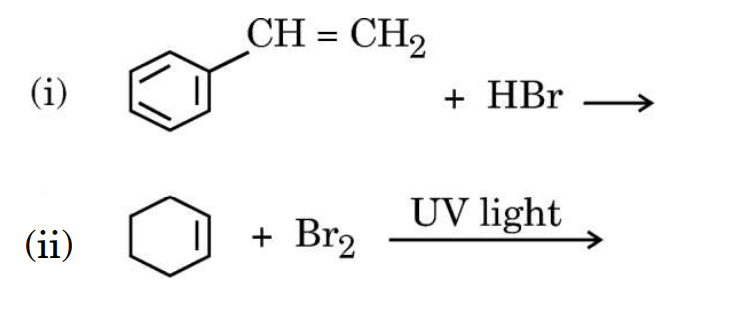
(i) Styrene + HBr
The reaction of styrene (vinyl benzene) with Hydrogen Bromide (H Br) follows Markovnikov's Rule.
Major Product: 1-bromo-1-phenylethane * Mechanism: The proton (H⁺) adds to the terminal carbon to form the more stable carbocation. In this case, it forms a benzylic carbocation, which is highly stabilized by resonance with the benzene ring. The bromide ion (Br⁻) then attacks this stable carbocation.
Structure: A benzene ring attached to a -CH(Br)CH₃ group.
(ii) Cyclohexene + Br₂ (in UV light)
The presence of UV light (or heat) changes the reaction pathway from electrophilic addition to Free Radical Substitution.
Major Product: 3-bromocyclohexene
Mechanism: Instead of adding across the double bond, the bromine undergoes homolytic fission to form radicals. These radicals prefer to abstract a hydrogen from the allylic position (the carbon atom adjacent to the double bond). The resulting allylic radical is resonance-stabilized, making this the favored path.
Structure: A cyclohexene ring with a Bromine atom attached to one of the carbons adjacent to the double bond.
Give reasons for the following:
(i) Grignard reagent should be prepared under anhydrous conditions.
(ii) Alkyl halides give alcohol with aqueous KOH whereas in the presence of alcoholic KOH, alkenes are formed.
(ii) When alkyl halides are treated with aqueous KOH, nucleophilic substitution occurs where OH- replaces the halogen atom, forming an alcohol. However, with alcoholic KOH, elimination reaction takes place where a proton is removed along with the halogen, leading to the formation of alkenes due to the absence of sufficient water to promote substitution.
Write the chemical equation when :
(i) Butan-2-one is treated with Zn(Hg) and conc. HCl.
(ii) Two molecules of benzaldehyde are treated with conc. NaOH.
Equation: CH3-CO-CH2-CH3 + Zn(Hg), HCl → CH3-CH2-CH2-CH3
(ii) When two molecules of benzaldehyde (C6H5CHO) are treated with conc. NaOH, benzaldehyde undergoes Cannizzaro reaction to give benzyl alcohol (C6H5CH2OH) and benzoic acid (C6H5COOH).
Equation: 2 C6H5CHO + NaOH → C6H5CH2OH + C6H5COONa
Here, one molecule of benzaldehyde is reduced and the other is oxidized in presence of alkali.
Section D
When a certain conductivity cell was filled with 0·05 M KCl solution, it has a resistance of 100 ohm at 25ºC. When the same cell was filled with 0·02 M AgNO₃ solution, the resistance was 90 ohm. Calculate the conductivity and molar conductivity of AgNO3 solution.
(Given : Conductivity of 0·05 M KCl solution = 1·35 * 10 ⁻² ohm-1cm⁻¹)
Cell constant, G* = k * R = 1.35 * 10-2 * 100 = 1.35 cm-1
(b) Now, calculate the conductivity of 0.02 M AgNO3 solution using G* and its resistance (R = 90 ohm).
Conductivity, k = G* / R = 1.35 / 90 = 0.015 ohm-1 cm-1
(c) Calculate molar conductivity, Λm = k / concentration
Concentration of AgNO3 = 0.02 M, so
Λm = 0.015 / 0.02 = 0.75 ohm-1 cm2 mol-1
Final answers:
Conductivity of AgNO3 solution = 0.015 ohm-1 cm-1
Molar conductivity of AgNO3 solution = 0.75 ohm-1 cm2 mol-1
The following initial rate data were obtained for the reaction : 2NO (g) + Br₂ (g) → 2NOBr (g)
(a) What is the order with respect to NO and Br₂ in the reaction ?
(b) Calculate the rate constant (k).
(iii) Determine the rate of reaction when concentration of NO and Br₂ are 0·4 M and 0·2 M, respectively.
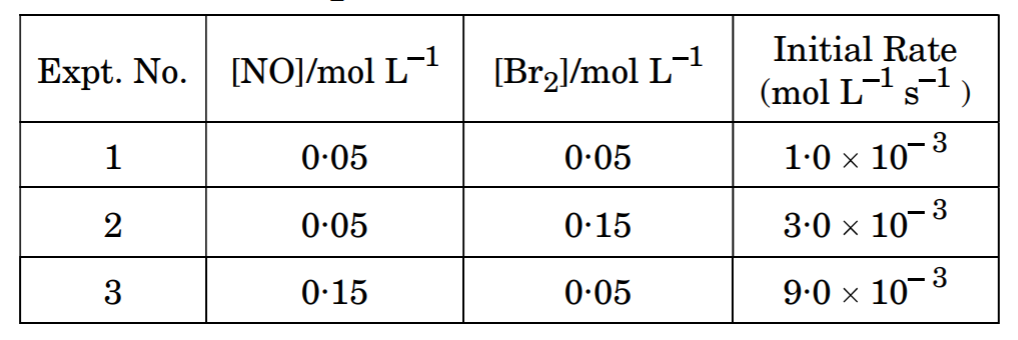
(b) The rate law is Rate = k [NO]2 [Br₂]1. Using initial rate data, say Rate = R, [NO] = a, [Br₂] = b, then k = R / (a2 * b). Substitute values from any experiment to calculate k.
(iii) Substitute [NO] = 0.4 M and [Br₂] = 0.2 M into the rate law with the calculated k to find the new rate: Rate = k * (0.4)2 * (0.2). This gives the rate of reaction under the given concentrations.
(a) Write the formula for the following coordination compound : Potassium tetrahydroxidozincate (II)
(b) Arrange the following complexes in the increasing order of conductivity of their solution : [Cr(NH₃)₅Cl]Cl₂, [Cr(NH₃)₃Cl₃], [Cr(NH₃)₆]C₃
(c) Identify the type of isomerism exhibited by the following complexes :
(i) [Co(NH₃)₅NO₂]²⁺
(ii) [Co(en)₃]Cl₃
(b) Conductivity depends on number of ions produced in solution. For the given complexes:
1. [Cr(NH₃)₅Cl]Cl₂: One complex cation [Cr(NH₃)₅Cl]2+ and 2 Cl- ions outside, total 3 ions.
2. [Cr(NH₃)₃Cl₃]: Neutral complex, no ions outside.
3. [Cr(NH₃)₆]Cl₃: One complex cation [Cr(NH₃)₆]3+ and 3 Cl- ions outside, total 4 ions.
Thus, increasing order of conductivity is: [Cr(NH₃)₃Cl₃] < [Cr(NH₃)₅Cl]Cl₂ < [Cr(NH₃)₆]Cl₃.
(c) Type of isomerism:
(i) [Co(NH₃)₅NO₂]2+: This complex shows linkage isomerism because NO₂ ligand can bind through N or O.
(ii) [Co(en)₃]Cl₃: This complex shows optical isomerism due to chiral nature of tris(ethane-1,2-diamine)cobalt(III) complex.
(a) Which of the following is an allylic halide ?
(i) CH₃ -CH=CH-Br
(ii) CH₂=CH-CH (Br)-CH₃
(b) Out of chlorobenzene and 2,4,6-trinitrochlorobenzene, which is more reactive towards nucleophilic substitution and why ?
(c) Which isomer of C₄H₉Cl has the lowest boiling point ?
(b) 2,4,6-Trinitrochlorobenzene is more reactive towards nucleophilic substitution than chlorobenzene because the nitro groups are strong electron withdrawing groups which make the benzene ring electron deficient, stabilizing the negative charge in the intermediate Meisenheimer complex, thus facilitating nucleophilic substitution. Chlorobenzene has no such electron withdrawing groups and is less reactive.
(c) Among isomers of C₄H₉Cl, the one with the lowest boiling point is the most branched isomer. The isomer is 2-chloro-2-methylpropane (tert-butyl chloride) because branching reduces surface area and intermolecular forces, thus lowering boiling point.
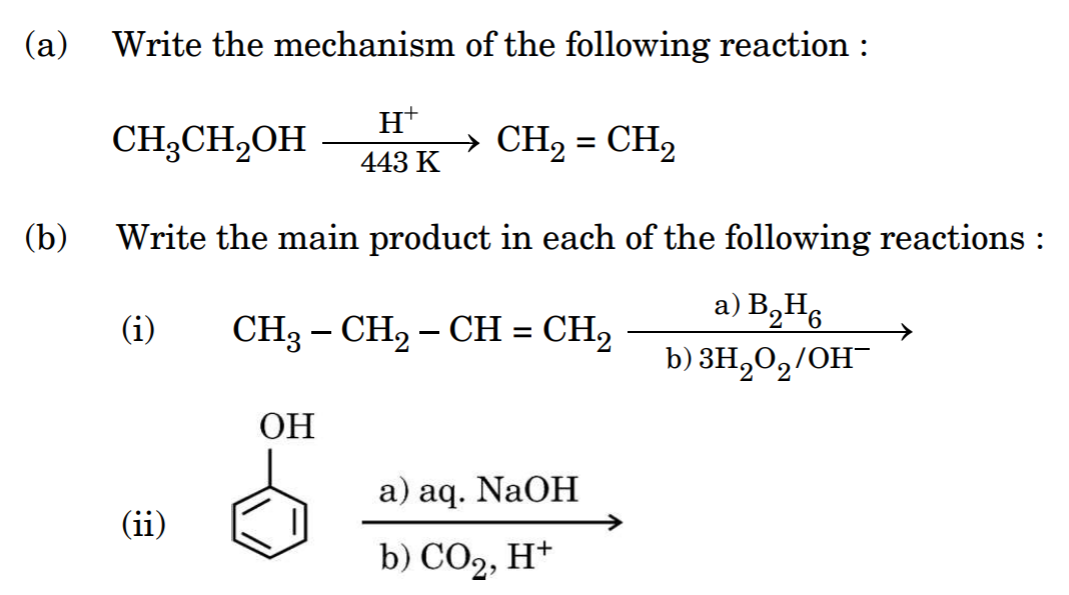
(a) Write the mechanism of the following reaction
(b) Write the main product in each of the following reactions :
(a) (i) Styrene + HBr: Yields 1-bromo-1-phenylethane via Markovnikov addition, forming a stable
benzylic carbocation.
(ii) Cyclohexene + Br₂ (UV): Yields 3-bromocyclohexene via allylic radical substitution (UV light prevents addition across the double bond).
(b) (i) Hydroboration-Oxidation: Yields Butan-1-ol. It follows Anti-Markovnikov addition of water across the double bond.
(ii) Kolbe’s Reaction: Phenol reacts with NaOH and CO₂ followed by acidification to yield 2-hydroxybenzoic acid (Salicylic acid).
All these reactions are governed by the stability of intermediates (carbocations or radicals) and specific regioselectivity rules like Markovnikov or Anti-Markovnikov addition.
Answer the following: (any three)
(a) What is peptide linkage ?
(b) What type of bonds hold a DNA double helix together ?
(c) Which one of the following is a polysaccharide ? Sucrose, Glucose, Starch, Fructose
(d) Give one example each for water-soluble vitamins and fat-soluble vitamins.
(b) Hydrogen bonds hold the two strands of the DNA double helix together. These bonds form between complementary nitrogenous bases: adenine pairs with thymine by two hydrogen bonds and cytosine pairs with guanine by three hydrogen bonds.
(c) Out of sucrose, glucose, starch, and fructose, starch is a polysaccharide. It is made of many glucose units linked together and serves as an energy storage molecule in plants.
(d) An example of a water-soluble vitamin is vitamin C, and an example of a fat-soluble vitamin is vitamin A.
Compound (A) (C₆H₁₂O₂) on reduction with LiAlH₄ gives two compounds (B) and (C). The compound (B) on oxidation with PCC gives compound (D) which upon treatment with dilute NaOH and subsequent heating gives compound (E). Compound (E) on catalytic hydrogenation gives compound (C). The compound (D) is oxidized further to give compound (F) which is found to be a monobasic acid (Molecular weight = 60). Identify the compounds (A), (B), (C), (D), (E) and (F).
(A): Ethyl acetate (CH3COOCH2CH3)
(B): Ethanol (CH3CH2OH)
(C): Ethanol (CH3CH2OH) (since both alcohols are same here)
(D): Acetaldehyde (CH3CHO)
(E): Crotonaldehyde (CH3CH=CHCHO) formed by aldol condensation
(F): Acetic acid (CH3COOH)
This explains the sequence of reactions where reduction of ester (A) gives two alcohols (B) and (C), oxidation of primary alcohol (B) with PCC gives aldehyde (D), which on aldol condensation with base forms (E). Hydrogenation of (E) gives back alcohol (C). Further oxidation of (D) provides the acid (F).
Section E
(i) At the same temperature, CO₂ gas is more soluble in water than O₂ gas. Which one of them will have higher value of Kₕ and why?
(ii) How does the size of blood cells change when placed in an aqueous solution containing more than 0.9% (mass/volume) sodium chloride?
(iii) 1 molal aqueous solution of an electrolyte A₂B₃ is 60% ionized. Calculate the boiling point of the solution.
(Given : Kb for H₂O = 0·52 K kg mol ⁻¹)
Explanation: The higher the solubility, the lower the Kh, because Kh = P/C where P is pressure and C concentration in solution.
(b) Normal sodium chloride concentration in blood plasma is about 0.9%. When blood cells are placed in an aqueous solution containing more than 0.9% sodium chloride (hypertonic solution), water moves out from the cells by osmosis. As a result, the cells shrink or become crenated (shrunken in size). This happens because the external solution has higher osmotic pressure compared to inside the cells.
(c) Given: molality, m = 1 mol/kg; electrolyte A2B3 ionizes 60%.
Number of ions formed per formula unit: 2 (A) + 3 (B) = 5 ions.
Degree of ionization, α = 0.60
van 't Hoff factor, i = 1 + (n - 1) * α = 1 + (5 - 1) * 0.60 = 1 + 4 * 0.60 = 3.4
Boiling point elevation, ΔTb = i * Kb * m = 3.4 * 0.52 * 1 = 1.768 K
Boiling point of pure water = 373 K (100°C)
Therefore, boiling point of solution = 100 + 1.768 = 101.77 °C
Final answer: The boiling point of the 1 molal A2B3 solution ionized 60% is approximately 101.77 °C.
(i) The vapour pressures of A and B at 25ºC are 75 mm Hg and 25 mm Hg, respectively. If A and B are mixed such that the mole fraction of A in the mixture is 0.4, then calculate the mole fraction of B in vapour phase.
(ii) Define colligative property. Which colligative property is preferred for the molar mass determination of macromolecules?
(iii) Why are equimolar solutions of sodium chloride and glucose not isotonic?
(i) Given: Vapour pressure of pure A, P_A0 = 75 mm Hg; Vapour pressure of pure B, P_B0 = 25 mm Hg; Mole fraction of A in liquid, x_A = 0.4; Mole fraction of B in liquid, x_B = 1 - x_A = 0.6.
Total vapour pressure, P_total = x_A*P_A0 + x_B*P_B0 = 0.4*75 + 0.6*25 = 30 + 15 = 45 mm Hg.
Mole fraction of A in vapour phase, y_A = (x_A*P_A0) / P_total = (0.4*75)/45 = 30/45 = 0.6667.
Mole fraction of B in vapour phase, y_B = (x_B*P_B0) / P_total = (0.6*25)/45 = 15/45 = 0.3333.
Therefore, mole fraction of B in vapour phase is 0.3333.
(ii) A colligative property is a property of a solution that depends only on the number of solute particles and not on their nature. Examples include vapor pressure lowering, boiling point elevation, freezing point depression, and osmotic pressure.
Osmotic pressure is preferred for the molar mass determination of macromolecules because it can be measured at very low concentrations, reducing errors, and is highly sensitive to the number of solute particles.
(iii) Equimolar solutions of sodium chloride and glucose are not isotonic because sodium chloride dissociates into two ions (Na+ and Cl-), effectively doubling the number of solute particles compared to glucose which does not dissociate. Hence, their osmotic pressures differ even at the same molar concentration, so they are not isotonic.
(i) Account for the following:
(1) The melting and boiling points of Zn, Cd and Hg are low.
(2) Of the d⁴ species, Cr²⁺ is strongly reducing while Mn³⁺ is strongly oxidizing.
(3) Eº value of Cu²⁺/Cu is +0.34 V.
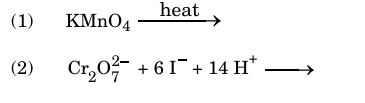
(ii) Complete and balance the following chemical equations:
(i) Answer:
(1) The melting and boiling points of Zn, Cd and Hg are low because they have weak metallic bonding due to their electronic configurations and atomic sizes. These metals have completely filled d10 subshells which do not contribute significantly to metallic bonding, resulting in low melting and boiling points.
(2) Cr2+ (d4) is strongly reducing because it has a tendency to lose an electron to achieve a more stable electronic configuration (d3), therefore it acts as a good reducing agent. Mn3+ (d4), on the other hand, is strongly oxidizing because it tends to gain an electron to form Mn2+ (d5), which is a stable half-filled configuration; thus, it acts as a strong oxidizing agent.
(3) The Eº value of Cu2+/Cu is +0.34 V indicating that Cu2+ ions have a strong tendency to gain electrons and get reduced to Cu metal. This positive value shows that copper ions are relatively stable in solution and copper metal is less reactive.
(ii) Complete and balance chemical equations:
(1) 2KMnO₄ ⁽ʰᵉᵃᵗ⁾⟶ K₂MnO₄ + MnO₂ + O₂
Potassium permanganate decomposes into potassium manganate, manganese dioxide, and oxygen gas.
(2) Cr₂O₇²⁻ + 6I⁻ + 14H⁺ ⟶ 2Cr³⁺ + 3I₂ + 7H₂O
Dichromate ions oxidize iodide ions to molecular iodine while being reduced to chromium(III) ions.
(i) Out of Cu₂Cl₂ and CuCl₂, which is more stable in aqueous solution and why?
(ii) Write the general electronic configuration of f-block elements.
(iii) Predict which of the following will be coloured in aqueous solution and why ? Sc³⁺ , Fe³⁺ , Zn²⁺
[Atomic number : Sc = 21, Fe = 26, Zn = 30]
(iv) How can you obtain potassium dichromate from sodium chromate ?
(v) Why do transition metals and their compounds show catalytic activities ?
(i) CuCl2 is more stable in aqueous solution than Cu2Cl2. This is because Cu(I) compounds like Cu2Cl2 tend to undergo disproportionation in water where Cu(I) oxidises to Cu(II) and reduces to Cu metal, making them less stable. Meanwhile, CuCl2 contains Cu(II) which is more stable in aqueous solution.
(ii) The general electronic configuration of f-block elements is [Noble gas] 4f1-14 5d0-1 6s2. This means electrons are filling the 4f orbitals, with variable occupancy of 5d and 6s orbitals.
(iii) Fe3+ will be coloured in aqueous solution because it has unpaired d electrons leading to d-d transitions that absorb visible light. Sc3+ and Zn2+ are colourless because Sc3+ has no d electrons (3d0) and Zn2+ has a full d shell (3d10), so no d-d transitions occur.
(iv) Potassium dichromate can be obtained from sodium chromate by acidifying sodium chromate solution with dilute sulfuric acid. The reaction is:
2Na2CrO4 + H2SO4 → K2Cr2O7 + Na2SO4 + H2O (Potassium dichromate formed as an orange solid)
(v) Transition metals and their compounds show catalytic activity because they can adopt multiple oxidation states and have partially filled d orbitals. This allows them to form temporary bonds with reactants, providing an alternative reaction pathway with lower activation energy, thus increasing reaction rates.
Answer any five questions of the following:
(a) N,N-diethyl-benzenesulphonamide is insoluble in alkali. Give reason.
(b) Aniline does not undergo Friedel-Crafts reaction. Why ?
(c) Write a simple chemical test to distinguish between methylamine and aniline.
(d) Write the chemical reaction involved in Gabriel phthalimide synthesis.
(e) How will you convert aniline to p-bromoaniline ?
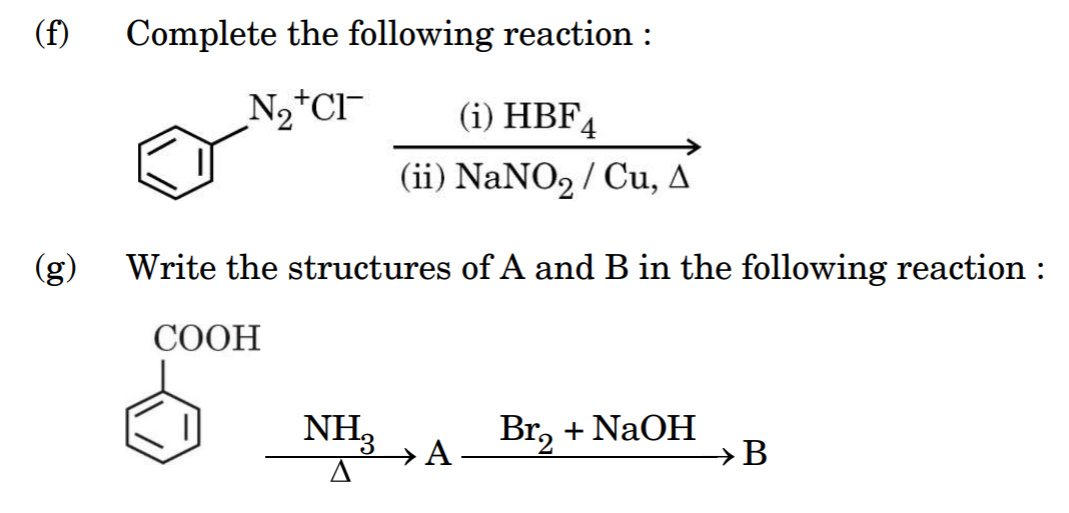
(b) Aniline does not undergo Friedel-Crafts reaction because the lone pair of electrons on the nitrogen atom of the amino group strongly interacts with the Lewis acid catalyst (like AlCl3), forming a complex. This deactivates the benzene ring and prevents the electrophilic substitution required for Friedel-Crafts reaction.
(c) To distinguish between methylamine and aniline, take a small amount of each solution and add nitrous acid (HNO2) at 0-5 deg C. Methylamine gives a diazonium salt which decomposes to form a yellow solution or precipitate (dimethyl diazene), whereas aniline forms a diazonium salt which is stable at low temperature and gives a clear solution.- This difference in the behavior with nitrous acid can distinguish methylamine from aniline.
(d) Gabriel phthalimide synthesis involves reacting phthalimide with potassium hydroxide (KOH) to form potassium phthalimide which then reacts with a primary alkyl halide (R-X) to form N-alkyl phthalimide, which upon hydrolysis gives a primary amine (R-NH2). The reactions are:
K-phthalimide + R-X → N-alkyl phthalimide
N-alkyl phthalimide + 2H2O + heat → R-NH2 + phthalic acid
(e) To convert aniline to p-bromoaniline, brominate aniline by adding bromine water at room temperature. Due to the activating -NH2 group, bromination occurs easily and substitutes bromine at the para position giving p-bromoaniline as the major product. The reaction is:
C6H5-NH2 + Br2 → p-Bromoaniline + HBr
Paper Details
CBSE Board Exam 2024
Class
Class 12 PCM
Subject
Chemistry
Year
2024
Set
Set 1
Other Years — Chemistry