SOLUTIONS
2023 BOARD EXAM
CBSE Class 12 PCM Chemistry Board Paper 2023 — Set 2 Solutions
2023
Chemistry
Class 12 PCM
CBSE EXAMINATION PAPER-2023
CHEMISTRY
(Solved)
General Instructions :
Read the following instructions carefully and follow them :
- This question paper contains 42 questions. All questions are compulsory.
- This question paper is divided into 5 sections.
- Section A – questions number 1 to 3 are case based questions
- Section B – questions number 4 to 21 are multiple choice questions
- Section C – questions number 22 to 30 are very short answer
- Section D – questions number 31 to 36 are short answer
- Section E – questions number 37 to 42 are long answer
- There is no overall choice given in the question paper. However, an internal choice has been provided in few questions.
- Use of calculator is NOT allowed.
Section A
The following questions are case based questions. Read the passage carefully and answer the questions that follow
The carbon – oxygen double bond is polarised in aldehydes and ketones due to higher electronegativity of oxygen relative to carbon. Therefore they undergo nucleophilic addition reactions with a number of nucleophiles such as HCN, NaHSO₃, alcohols, ammonia derivatives and Grignard reagents. Aldehydes are easily oxidised by mild oxidising agents as compared to ketones. The carbonyl group of carboxylic acid does not give reactions of aldehydes and ketones. Carboxylic acids are considerably more acidic than alcohols and most of simple phenols.
(1) Write the name of the product when an aldehyde reacts with excess alcohol in presence of dry HCl.
(2) Why carboxylic acid is a stronger acid than phenol ?
In contrast, the phenol ion has resonance but the negative charge is less delocalized.
Hence, carboxylic acids are more acidic than phenols as explained in the passage.
(3) (i) Arrange the following compounds in increasing order of their reactivity towards CH₃MgBr : (ii) Write a chemical test to distinguish between propanal and propanone.
 [2 Marks]
(ii) Chemical test: Propanal gives a positive Tollens test forming a silver mirror, whereas propanone does not. This distinguishes propanal (an aldehyde) from propanone (a ketone).
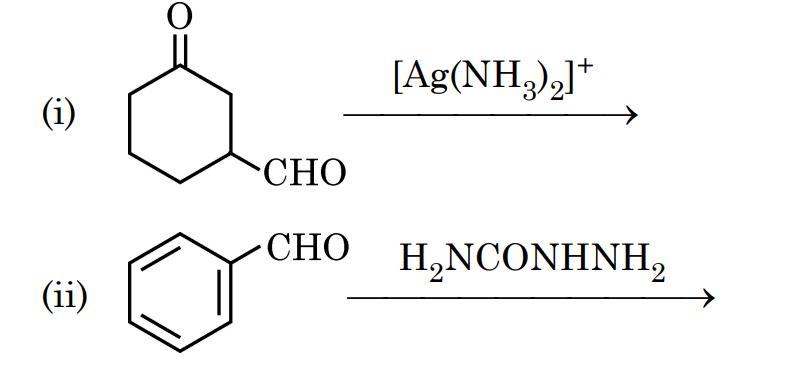
(4) Write the main product in the following :
 [2 Marks]
(i) Substrate: A cyclohexanone ring bearing an –CHO (aldehyde) side group.
Reagent: [Ag(NH3)2]+[Ag(NH3)2]+[Ag(NH3)2]+ = Tollens’ reagent.
What it does: Tollens’ reagent oxidizes aldehydes to carboxylic acids (or carboxylate in basic medium) but does not oxidize ketones.
So here:
The –CHO group → –COOH
The ketone (>C=O in ring) remains unchanged
Main product:
👉 Cyclohexanone ring with –COOH instead of –CHO
(i.e., the aldehyde side chain is oxidized to a carboxylic acid)
In words: Formyl group → Carboxylic acid group; ketone unchanged.
(ii)Substrate: Benzaldehyde (C₆H₅–CHO)
Reagent: H₂NCONHNH₂ (semicarbazide)
What it does:
Aldehydes react with semicarbazide to form semicarbazones.
So:
C6H5CHO+H2NCONHNH2→C6H5CH=N−NHCONH2+H2
Main product:
👉 Benzaldehyde semicarbazone
C6H5CH=N − NHCONH2
Carbohydrates are optically active polyhydroxy aldehydes and ketones. They are also called saccharides. All those carbohydrates which reduce Fehling’s solution and Tollen’s reagent are referred to as reducing sugars. Glucose, the most important source of energy for mammals, is obtained by the hydrolysis of starch. Vitamins are accessory food factors required in the diet. Proteins are the polymers of α-amino acids and perform various structural and dynamic functions in the organisms. Deficiency of vitamins leads to many diseases.
(1) The penta-acetate of glucose does not react with Hydroxylamine. What does it indicate ?
(2) Why cannot vitamin C be stored in our body ?
(3) Define the following as related to proteins : (i) Peptide linkage (ii) Denaturation
Denaturation: It is the process in which proteins lose their native structure and function due to external factors like heat or chemicals, as proteins are polymers of a-amino acids as mentioned in the passage.
(4) Define the following as related to carbohydrates : (i) Anomers (ii) Glycosidic linkage
(ii) Glycosidic linkage is a covalent bond that joins a carbohydrate molecule to another molecule, such as between two sugar units in disaccharides or polysaccharides, formed by a dehydration reaction. These definitions relate to carbohydrates, which are optically active and may reduce Fehling's and Tollens' reagents as mentioned in the case passage.
Section B
The conversion of an alkyl halide into an alkene by alcoholic KOH is classified as
The correct option is 'a dehydrohalogenation reaction' because the context states that alkyl halides react with alcoholic KOH to eliminate one molecule of halogen acid, forming alkenes. This process is specifically termed dehydrohalogenation, which involves the removal of halide and hydrogen, leading to the formation of a double bond in the alkene.
The oxidation state of Fe in [Fe(CO)₅] is
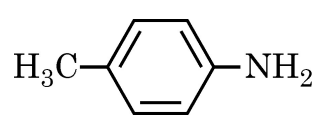
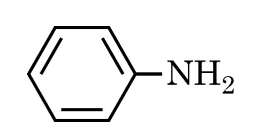
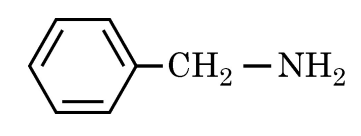
Among the following, which is the strongest base?
-
(A)
-
(B)
-
(C)
-
(D)
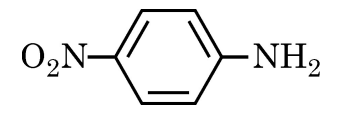
The strongest base is determined by its ability to accept protons (H+) or donate electron pairs. Among common strong bases, compounds like NaOH or KOH tend to be stronger than others. The relevant context provided does not explicitly mention specific bases, but in general, strong bases have low electronegativity which allows them to easily dissociate and accept protons.
The slope in the plot of ln[R] vs. time for a first order reaction is
The correct answer is -k/2.303. In a first order reaction, the natural logarithm of the concentration of the reactant [R] versus time yields a straight line where the slope is equal to -k, the rate constant. The factor 2.303 is used to convert the natural logarithm to logarithm base 10, which is standard in reaction kinetics.
An α-helix is a structural feature of
The correct answer is Polypeptides. An α-helix is a common secondary structure found in proteins (which are made of polypeptides). It is characterized by a right-handed coil, stabilized by hydrogen bonds between the backbone of the polypeptide chain.
Racemisation occurs in
Racemisation occurs in Sₙ1 reaction because this reaction involves the formation of a carbocation intermediate, which can lead to the production of both enantiomers, resulting in racemisation. In contrast, Sₙ2 reactions do not involve intermediates and therefore do not lead to racemisation.
Value of Henry’s constant Kₕ:
The correct answer is 'increases with decrease in temperature.' Henry's law states that the solubility of a gas in a liquid is inversely related to temperature. Therefore, as temperature decreases, more gas can dissolve in the liquid, resulting in an increase in Henry’s constant.
Which of the following solutions of KCl will have the highest value of molar conductivity?
Which of the following reactions are feasible?
The correct answer is 'Both (a) and (b)'. Both reactions involve the reaction between alkyl halides and sodium alkoxide, which are feasible under appropriate conditions. (CH₃)₃C–Cl can react with Na⁺ O–CH₂CH₃ to form an ether, while CH₃CH₂Br can react with Na⁺ O–C(CH₃)₃ to also form an ether. Both reactions are classified as nucleophilic substitutions, which are feasible in organic chemistry.
Which of the following is most reactive in nucleophilic addition reactions?
HCHO (formaldehyde) is the most reactive in nucleophilic addition reactions due to its structure, which has a highly polarized carbonyl group. The carbon atom in formaldehyde is more electrophilic and thus more susceptible to attack by nucleophiles compared to the other options, which have steric hindrance or less polarization in their carbonyl groups.
Which of the following does not give aldol condensation reaction?
-
(A)
- (B) CH₃–CHO
- (C) CH₃COCH₃
-
(D)
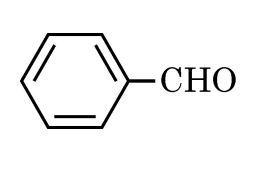
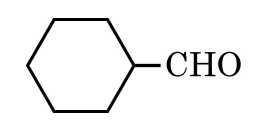
The option CH₃–CHO (acetaldehyde) does not undergo aldol condensation because it lacks a suitable alpha hydrogen to participate in the reaction. Aldol condensation requires the presence of at least one alpha hydrogen for the formation of an enolate ion and subsequent aldol product.
For the reaction 3A → 2B, rate of reaction + d[B]/dt is equal to
The correct option is –(2/3)d[A]/dt. This is because the stoichiometry of the reaction shows that for every 3 moles of A that react, 2 moles of B are produced. Hence, the rate of formation of B is related to the rate of consumption of A by the ratio of their coefficients in the balanced equation: d[B]/dt = -(2/3)d[A]/dt.
Which of the following characteristics of transition metals is associated with their catalytic activity?
The correct option is 'Variable oxidation states'. Transition metals exhibit variable oxidation states, which allow them to easily gain or lose electrons during reactions. This characteristic is essential for their role as catalysts in various chemical processes, as they can facilitate the conversion of reactants to products by providing alternate pathways with lower activation energies.
The formula of the complex dichloridobis(ethane–1, 2-diamine) platinum(IV) nitrate is
[Pt Cl₂(en)₂](NO₃)₂ is correct because it indicates that the platinum is in the +4 oxidation state, has 2 chloride ligands (Cl₂), 2 ethane-1,2-diamine ligands (en), and is coordinated with 2 nitrate ions (NO₃) as counterions, matching the IUPAC nomenclature for the complex.
Assertion (A) : Osmotic pressure is a colligative property.
Reason (R) : Osmotic pressure is proportional to the molality.
Both (A) and (R) are true, but (R) is not the correct explanation of (A). Osmotic pressure is indeed a colligative property, which depends on the number of solute particles in a solution rather than their identity. However, while osmotic pressure is related to the concentration of solute molecules, it is commonly expressed in terms of molarity rather than molality, thus making (R) inaccurate in directly explaining (A).
Assertion (A) : Conductivity decreases with decrease in concentration of electrolyte.
Reason (R) : Number of ions per unit volume that carry the current in a solution decreases on dilution.
Both (A) and (R) are true and (R) is the correct explanation of (A). As the concentration of an electrolyte decreases, the number of ions available to conduct electricity also decreases, which directly leads to a decrease in conductivity.
Assertion (A) : Copper is a non-transition element.
Reason (R) : Copper has completely filled d-orbitals in its ground state.
(A) is false, but (R) is true. Copper is actually a transition element as it is found in the d-block of the periodic table. Although it has a stable electronic configuration of 3d10 4s1, the d-orbitals are not completely filled in a traditional sense, thus making (R) true since it discusses the configuration correctly, but (A) incorrect.
Assertion (A) : Nucleophilic substitution of iodoethane is easier than chloroethane.
Reason (R) : Bond enthalpy of C-I bond is less than that of C-Cl bond.
Both (A) and (R) are true and (R) is the correct explanation of (A) because the C-I bond is weaker than the C-Cl bond due to lower bond enthalpy, making it easier for nucleophiles to attack iodoethane compared to chloroethane.
Section C
The vapour pressure of pure liquid X and pure liquid Y at 25 °C are 120 mm Hg and 160 mm Hg respectively. If equal moles of X and Y are mixed to form an ideal solution, calculate the vapour pressure of the solution.
Using Raoult's Law: Vapour pressure of solution, P = xXP0X + xYP0Y
Substitute values: P = (0.5)(120) + (0.5)(160) = 60 + 80 = 140 mm Hg
Therefore, the vapour pressure of the solution is 140 mm Hg.
Give reasons :
(i) Mercury cell delivers a constant potential during its life time.
(ii) In the experimental determination of electrolytic conductance, Direct Current (DC) is not used.
(ii) DC is not used in electrolytic conductance experiments because it causes electrolysis and electrode polarization, which affect the accuracy of conductance measurement. Alternating Current (AC) is used to avoid these problems.
Define fuel cell with an example. What advantages do the fuel cells have over primary and secondary batteries ?
(b) Advantages of fuel cells over batteries: Fuel cells can produce electricity continuously as long as fuel is supplied, unlike primary and secondary batteries which store limited energy. Fuel cells have higher efficiency and are pollution free. They do not require recharging like secondary batteries and produce less harmful waste compared to batteries.
(a) The conversion of molecule A to B followed second order kinetics. If concentration of A increased to three times, how will it affect the rate of formation of B ?
(b) Define Pseudo first order reaction with an example.
(b) A pseudo first order reaction occurs when one reactant concentration is in large excess and remains nearly constant, so the reaction behaves like first order with respect to the other reactant.
Example: The hydrolysis of ester in excess water where water concentration remains constant, making it pseudo first order with respect to ester.
Write the IUPAC names of the following :
(i) [Co(NH₃)₅(ONO)]²⁺
(ii) K₂[NiCl₄]
(ii) K₂[NiCl₄] is an ionic compound consisting of 2 K⁺ ions and the complex ion [NiCl₄]²⁺. The ligands are chloride ions, so name is 'tetrachlorido'. Nickel has oxidation state +2. Hence, the name is potassium tetrachloridonickelate(II).
(i) What is a chelate complex ? Give one example.
(ii) What are heteroleptic complexes ? Give one example.
(ii) Heteroleptic complexes are coordination compounds where the central metal ion is bonded to more than one kind of ligand. Example: [Co(NH3)4Cl2]+, which contains both NH3 and Cl ligands.
Write the chemical equation involved in the following reactions :
(a) Reimer-Tiemann reaction
(b) Acetylation of Salicylic acid
Phenol (C6H5OH) reacts with chloroform (CHCl3) in the presence of aqueous sodium hydroxide (NaOH) to form salicylaldehyde (C7H6O2). The chemical equation is:
C6H5OH + CHCl3 + 3NaOH → C6H4OHCHO (salicylaldehyde) + 3NaCl + 2H2O
(b) Acetylation of Salicylic acid:
Salicylic acid (C7H6O3) reacts with acetic anhydride (C4H6O3) in the presence of an acid catalyst to form acetylsalicylic acid (aspirin, C9H8O4) and acetic acid (CH3COOH). The equation is:
C7H6O3 + (CH3CO)2O → C9H8O4 + CH3COOH
Do the following conversions in not more than two steps :
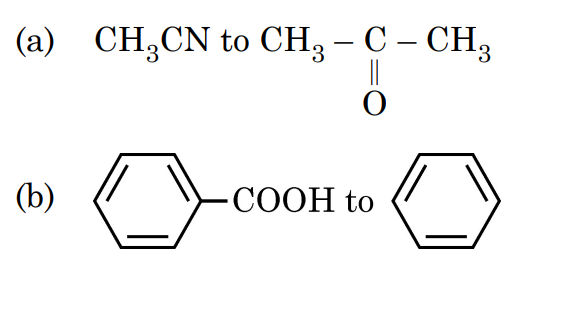
(a) CH₃CN → CH₃–CO–CH₃ (Acetone)
Use Grignard + hydrolysis on nitrile.
Step 1: Add Grignard reagent
CH₃CN + CH₃MgBr → (imine magnesium complex)
Step 2: Acidic hydrolysis
→ CH₃–CO–CH₃ (acetone)
So:
CH₃CN —(1) CH₃MgBr (2) H₃O⁺→ CH₃COCH₃
(b) Benzoic acid (C₆H₅COOH) → Benzene (C₆H₆)
Use soda lime decarboxylation (first convert to salt if counting strictly in steps).
Step 1: Convert to sodium salt
C₆H₅COOH + NaOH → C₆H₅COONa
Step 2: Heat with soda lime (NaOH/CaO)
C₆H₅COONa —(soda lime, Δ)→ C₆H₆ + Na₂CO₃
So:
C₆H₅COOH → C₆H₅COONa —(soda lime, Δ)→ C₆H₆
Nitrile + Grignard → Ketone and Carboxylate + soda lime → Decarboxylation → Alkane (or arene)
Write two differences between DNA and RNA.
1. Sugar present: DNA contains deoxyribose sugar, whereas RNA contains ribose sugar.
2. Strands: DNA is double-stranded; RNA is single-stranded.
3. Nitrogenous bases: DNA contains thymine (T), but RNA contains uracil (U) instead of thymine.
4. Function: DNA stores genetic information; RNA helps in protein synthesis.
Section D
(i) Write the mechanism of the following reaction :
(ii) Why ortho-nitrophenol is steam volatile while para-nitrophenol is not ?

(i) This reaction is acid-catalyzed intermolecular dehydration of ethanol to form diethyl ether.
Mechanism:
Step 1: Protonation of ethanol
CH3CH2OH+H+→CH3CH2OH2+
The –OH group gets protonated and becomes a good leaving group (water).
Step 2: Nucleophilic attack by another ethanol molecule (SN2 step)
CH3CH2OH+CH3CH2OH2+→CH3CH2−O+−CH2CH3+H2O
One ethanol molecule attacks the ethyl group of protonated ethanol, and water leaves, forming a protonated ether (oxonium ion).
Step 3: Deprotonation
CH3CH2−O+−CH2CH3→CH3CH2−O−CH2CH3+H+
Loss of a proton gives diethyl ether and regenerates the acid catalyst.
Conclusion:
At about 413 K, ethanol undergoes intermolecular dehydration in the presence of acid to form diethyl ether.
(ii) Ortho-nitrophenol is steam volatile because it forms intramolecular hydrogen bonding between the -OH and -NO2 groups, which reduces intermolecular forces and makes it easier to vaporize with steam. Para-nitrophenol, on the other hand, forms intermolecular hydrogen bonding resulting in strong molecular association that decreases its volatility and makes it less steam volatile.
Acid-catalyzed intermolecular dehydration of ethanol to form diethyl ethermechanism - Intramolecular hydrogen bonding in ortho-nitrophenol - Intermolecular hydrogen bonding in para-nitrophenol affects volatility
Answer any 3 of the following:
(a) Which isomer of C₅H₁₀ gives a single monochloro compound C₅H₉Cl in bright sunlight ?
(b) Arrange the following compounds in increasing order of reactivity towards SN2 reaction : 2-Bromopentane, 1-Bromopentane, 2-Bromo-2-methylbutane
(c) Why p-dichlorobenzene has higher melting point than those of ortho and meta-isomers ?
(d) Identify A and B in the following :
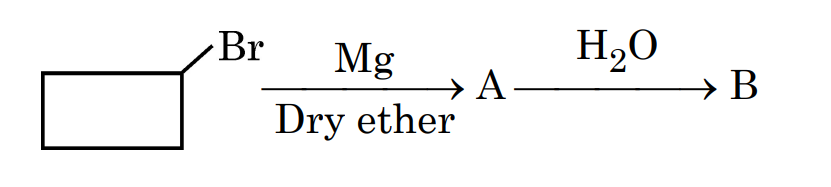
(a) The isomer of C5H10 that gives a single monochloro compound C5H9Cl in bright sunlight is cyclopentane. This is because all hydrogen atoms in cyclopentane are equivalent; hence substitution of one hydrogen by chlorine leads to only one monochloro derivative.
(b) Increasing order of reactivity towards SN2 reaction is: 2-Bromo-2-methylbutane < 2-Bromopentane < 1-Bromopentane. This is because SN2 reactions occur fastest with primary alkyl halides due to less steric hindrance, slower with secondary, and slowest with tertiary alkyl halides.
(c) p-Dichlorobenzene has a higher melting point than ortho and meta isomers because in p-isomer the molecules are more symmetrical and can pack more efficiently in the solid state, leading to stronger intermolecular forces and higher melting point.
(d) Given compound is bromocyclobutane.
Step 1 (with Mg in dry ether):
An alkyl bromide reacts with Mg in dry ether to form a Grignard reagent.
Cyclobutyl–Br(dry ether and Mg)→MgBr- Cyclobutyl
So,
A = Cyclobutyl magnesium bromide (Grignard reagent)
Step 2 (hydrolysis with water):
Grignard reagent on hydrolysis gives the corresponding alkane.
Cyclobutyl–MgBr+H2O→Cyclobutane+Mg(OH)Br
So,
B = Cyclobutane
A first order reaction is 50% complete in 30 minutes at 300 K and in 10 minutes at 320 K. Calculate activation energy (Eₐ) for the reaction. [R = 8.314 J K⁻¹ mol⁻¹]
[Given : log 2 = 0.3010, log 3 = 0.4771, log 4 = 0.6021]
Step 1: For a first order reaction, t1/2 = 0.693/k, so rate constant k = 0.693 / t1/2
At 300 K, k1 = 0.693 / 30 = 0.0231 min-1
At 320 K, k2 = 0.693 / 10 = 0.0693 min-1
Step 2: Use Arrhenius equation: ln(k2/k1) = Ea/R * (1/T1 - 1/T2)
Calculate ln(k2/k1): k2/k1 = 0.0693 / 0.0231 = 3
ln 3 = 2.303 * log 3 = 2.303 * 0.4771 = 1.098
Step 3: Calculate (1/T1 - 1/T2): (1/300 - 1/320) = (320 - 300) / (300 * 320) = 20 / 96000 = 0.0002083 K-1
Step 4: Rearranged formula: Ea = (R * ln(k2/k1)) / (1/T1 - 1/T2)
Ea = (8.314 * 1.098) / 0.0002083 = 43818 J/mol = 43.82 kJ/mol
Answer: The activation energy Ea for the reaction is approximately 43.8 kJ/mol.
When 19.5 g of F – CH₂ – COOH (Molar mass = 78 g mol⁻¹), is dissolved in 500 g of water, the depression in freezing point is observed to be 1°C. Calculate the degree of dissociation of F – CH₂ – COOH.
[Given : Kf for water = 1.86 K kg mol⁻¹]
Step 1: Calculate moles of solute
Moles = Mass / Molar mass = 19.5 / 78 = 0.25 mol
Step 2: Calculate molality (m)
Molality, m = moles of solute / mass of solvent in kg = 0.25 / 0.5 = 0.5 mol kg⁻¹
Step 3: Use freezing point depression formula
ΔT_f = i * K_f * m, where i = van't Hoff factor
1 = i * 1.86 * 0.5
i = 1 / (1.86 * 0.5) = 1.08
Step 4: Calculate degree of dissociation (α)
For F – CH₂ – COOH, which dissociates as HA → H+ + A-,
i = 1 + α (since it dissociates into 2 ions)
1.08 = 1 + α
α = 0.08
Answer: Degree of dissociation of F – CH₂ – COOH is 0.08 or 8%.
(a) Draw the geometrical isomers of [Co(en)₂Cl₂]²⁺. Which geometrical isomer of [Co(en)₂Cl₂]²⁺ is not optically active and why ?
(b) Write the hybridisation and magnetic behaviour of [CoF₆]³⁻.
[Given : Atomic number of Co = 27]
Cis-isomer: The two Cl ligands are adjacent to each other. This isomer is optically active because it lacks a plane of symmetry and can exhibit optical isomerism.
Trans-isomer: The two Cl ligands are opposite to each other. This isomer is not optically active because it has a plane of symmetry and does not form non-superimposable mirror images.
Reason: Trans-isomer has a plane of symmetry making it achiral and hence, not optically active.
(b) In [CoF₆]³⁻, Co has oxidation state +3 (Co3+). Electronic configuration of Co is [Ar] 3d7 4s2. For Co3+, configuration is 3d6. Fluoride (F-) is a weak field ligand causing high spin complex. Hence, hybridisation is sp³d². Magnetic behavior is paramagnetic due to presence of 4 unpaired electrons.
Summary:
Cis and trans isomers of [Co(en)₂Cl₂]²⁺ exist. Trans isomer is not optically active due to plane of symmetry.
[CoF₆]³⁻ is high spin octahedral with sp³d² hybridisation and is paramagnetic.
What happens when:
(i) Anisole is treated with CH₃Cl/anhydrous AlCl₃ ?
(ii) Phenol is oxidised with Na₂Cr₂O₇/H⁺ ?
(iii) (CH₃)₃ C - OH is heated with Cu/574K?
Write chemical equation in support of your answer.
C₆H₅OCH₃ + CH₃Cl + AlCl₃ → o-CH₃C₆H₄OCH₃ + p-CH₃C₆H₄OCH₃ + HCl
(b) Phenol when oxidised with sodium dichromate (Na₂Cr₂O₇) in acidic medium (H⁺) undergoes oxidation to form benzoquinone (p-benzoquinone).
C₆H₅OH + Na₂Cr₂O₇/H⁺ → C₆H₄O₂ (Benzoquinone) + H₂O
(c) When tert-butyl alcohol ((CH₃)₃ C - OH) is heated with copper at 574K, it undergoes dehydrogenation to give isobutylene (2-methylpropene).
(CH₃)₃COH → (heat, Cu, 574K) (CH₃)₂C=CH₂ + H₂
Section E
Account for the following :
(i) Eo value for Mn³⁺/ Mn²⁺ couple is much more positive than that for Cr³⁺/ Cr²⁺.
(ii) Sc³⁺ is colourless whereas Ti³⁺ is coloured in an aqueous solution.
(iii) Actinoids show wide range of oxidation states.
(ii) Sc³⁺ is colourless as it has electronic configuration with empty d-orbitals (3d0) in aqueous solution and no d-d transitions occur causing colour. Ti³⁺ has one d-electron (3d1) which allows d-d electronic transitions upon absorbing visible light, making Ti³⁺ coloured.
(iii) Actinoids show a wide range of oxidation states because 5f, 6d and 7s orbitals are very close in energy and can participate in bonding. This leads to the variable oxidation states from +3 to +6 and sometimes higher, unlike lanthanoids where 4f electrons are more buried and less involved in bonding causing fewer oxidation states.
Write the chemical equations for the preparation of KMnO₄ from MnO₂.
Potassium permanganate is prepared by fusing manganese dioxide (MnO2) with potassium hydroxide (KOH) in the presence of an oxidising agent like oxygen (O2) or potassium nitrate (KNO3). The process involves two main steps:
(a) Formation of Potassium Manganate (K2MnO4)
MnO2 is fused with KOH and oxygen which oxidises Mn(IV) to Mn(VI) forming K2MnO4:
2 MnO2 + 4 KOH + O2 → 2 K2MnO4 + 2 H2O
(b) Disproportionation of Potassium Manganate to Potassium Permanganate (KMnO4)
Potassium manganate (green colour) undergoes disproportionation in acidic medium or upon electrolysis to form potassium permanganate (purple colour):
3 K2MnO4 + 4 H+ → 2 KMnO4 + MnO2 + 2 H2O
In summary, manganese dioxide reacts under alkaline fused conditions with an oxidising agent to form manganate which then converts into permanganate by disproportionation. This method is the commercial preparation of KMnO4.
(I) Account for the following :
(i) Transition metals form alloys.
(ii) Ce⁴⁺ is a strong oxidising agent.
(II) Write one similarity and one difference between chemistry of Lanthanoids and Actinoids.
(III) Complete the following ionic equation : Cr₂O₇²⁻ + 2OH⁻ →
(ii) Ce4+ is a strong oxidising agent because it can easily gain electrons to get reduced to Ce3+ due to the stability of the 4f orbitals in Ce3+ state.
(II) Similarity: Both lanthanoids and actinoids mainly exhibit +3 oxidation state and have inner f-orbitals being filled.
Difference: Lanthanoids have mostly +3 oxidation state and less variable, whereas actinoids show multiple oxidation states ranging from +3 to +6 due to involvement of 5f, 6d and 7s electrons.
(III) The ionic equation can be completed as:
Cr2O72- + 2OH- → 2CrO42- + H2O. This shows dichromate ion reacting with hydroxide ion to form chromate ion and water in basic medium.
(I) Give reasons :
(i) Aniline on nitration gives good amount of m-nitroaniline, though – NH2 group is o/p directing in electrophilic substitution reactions.
(ii) (CH₃)₂ NH is more basic than (CH₃)₃N in an aqueous solution.
(iii) Ammonolysis of alkyl halides is not a good method to prepare pure primary amines.
(II) Write the reaction involved in the following :
(i) Gabriel phthalimide synthesis
(ii) Carbyl amine test
(i) Although the –NH2 group is an ortho/para directing group, aniline in acidic medium forms anilinium ion (C6H5NH3+), where the nitrogen's lone pair is protonated and less available for resonance. This decreases the activating effect of –NH2, making the meta position more reactive during nitration, hence more m-nitroaniline is formed.
(ii) (CH3)2NH (dimethylamine) is more basic than (CH3)3N (trimethylamine) in aqueous solution because in trimethylamine, the lone pair on nitrogen is sterically hindered by three methyl groups, making it less available to accept a proton. In dimethylamine, less hindrance allows easier protonation, resulting in higher basicity.
(iii) Ammonolysis of alkyl halides gives a mixture of primary, secondary, tertiary amines and quaternary ammonium salts due to multiple alkylations. Hence, pure primary amines cannot be prepared by this method.
(II) Reactions involved:
(i) Gabriel phthalimide synthesis:
Phthalimide + KOH → Potassium phthalimide + H2O
Potassium phthalimide + RCH2Br → N-alkyl phthalimide + KBr
N-alkyl phthalimide + 2NH2NH2 → Primary amine (RCH2NH2) + phthalhydrazide
(ii) Carbyl amine test:
Primary amine + CCl4 + KOH → isocyanide (R–NC) + KCl + H2O
The formation of isocyanide with a foul smell confirms the presence of primary amine.
(I) Write the structures of A, B and C in the following reactions :
(II) Why aniline does not undergo Friedal-Crafts reaction ?
(III) Arrange the following in increasing order of their boiling point : C₂H5OH, C₂H₅NH₂, (C₂H₅)₃N
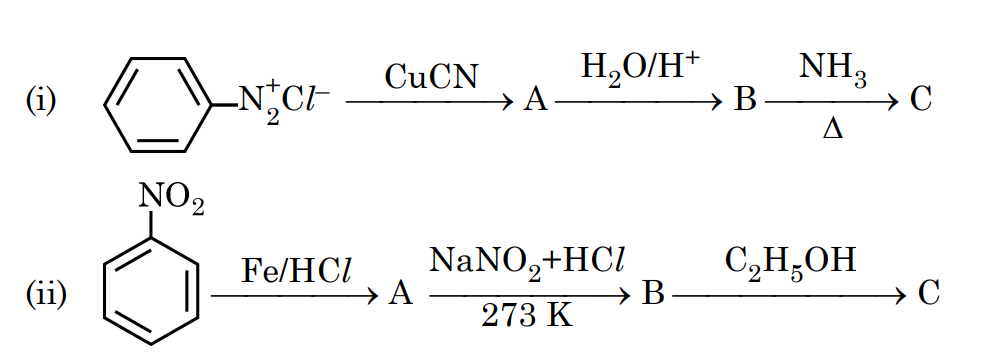
(I) Starting compound: Benzene diazonium chloride (C₆H₅–N₂⁺Cl⁻)
Step 1: With CuCN (Sandmeyer reaction)
Diazonium group is replaced by –CN.
C6H5–N2+Cl−→CuCNC6H5–CN
A = Benzonitrile (C₆H₅–CN)
Step 2: With H₂O / H⁺ (acidic hydrolysis of nitrile)
Nitrile hydrolyses to carboxylic acid.
C6H5–CN→H2O/H+C6H5–COOH
B = Benzoic acid (C₆H₅–COOH)
Step 3: With NH₃, Δ (heating)
Carboxylic acid + NH₃ on heating gives amide.
C6H5–COOH→NH3,ΔC6H5–CONH2
C = Benzamide (C₆H₅–CONH₂)
(ii)Starting compound: Nitrobenzene (C₆H₅–NO₂)
Step 1: With Fe/HCl (reduction)
Nitro group is reduced to amine.
C6H5–NO2→Fe/HClC6H5–NH2
A = Aniline (C₆H₅–NH₂)
Step 2: With NaNO₂ + HCl at 273 K (diazotization)
Aniline → benzene diazonium chloride.
C6H5–NH2→ 273 K NaNO2/HClC6H5–N2+Cl−
B = Benzene diazonium chloride (C₆H₅–N₂⁺Cl⁻)
Step 3: With C₂H₅OH (ethanol)
Diazonium salt is reduced to benzene.
C6H5–N2+Cl−→C2H5OHC6H6
C = Benzene (C₆H₆)
(II) Aniline does not undergo Friedel-Crafts reaction because the amino group (–NH₂) on the benzene ring is a strong activating group and also a Lewis base which reacts with the Lewis acid catalyst (like AlCl₃) used in Friedel-Crafts reaction, forming a complex. This complex formation deactivates the catalyst and prevents the electrophilic substitution from occurring on the aromatic ring.
(III) Increasing order of boiling points among C₂H₅OH (ethanol), C₂H₅NH₂ (ethylamine), and (C₂H₅)₃N (triethylamine) is: (C₂H₅)₃N < C₂H₅NH₂ < C₂H₅OH. This is because ethanol has stronger hydrogen bonding than ethylamine, and triethylamine, being a tertiary amine, has weaker hydrogen bonding and lower polarity, leading to lowest boiling point among the three.
(a) Conductivity of 2* 10⁻³ M methanoic acid is 8 * 10⁻⁵ S cm⁻¹. Calculate its molar conductivity and degree of dissociation if Λ°ₘ m for methanoic acid is 404 S cm² mol⁻¹.
(b) Calculate the ΔᵣG° and log Kc for the given reaction at 298 K :
Ni₍ₛ₎ + 2Ag⁺(aq) ⇌ Ni²⁺ (aq) + 2Ag ₍ₛ₎
Given: E° Ni²⁺/Ni = -0.25 V, E° Ag⁺/Ag = +0.80V
1F = 96500 C mol⁻¹.
Concentration, c = 2 * 10-3 mol L-1
Conductivity, \u03ba = 8 * 10-5 S cm-1
Molar conductivity at infinite dilution, \u03bbm0 = 404 S cm2 mol-1
Step 1: Calculate molar conductivity \u03bbm at given concentration
\u03bbm = \u03ba / c = (8 * 10-5 S cm-1) / (2 * 10-3 mol L-1) = 40 S cm2 mol-1
Step 2: Calculate degree of dissociation \u03b1
\u03b1 = \u03bbm / \u03bbm0 = 40 / 404 \approx 0.099
This means about 9.9% of methanoic acid molecules are dissociated in solution.
(b) Given reaction:
Ni (s) + 2Ag+ (aq) \u21cc Ni2+ (aq) + 2Ag (s)
Standard electrode potentials:
E0Ni2+/Ni = -0.25 V
E0Ag+/Ag = +0.80 V
Step 1: Calculate standard cell potential E0cell
Anode (oxidation): Ni \u2192 Ni2+ + 2e-, E0 = -0.25 V
Cathode (reduction): Ag+ + e- \u2192 Ag, E0 = +0.80 V
Since 2Ag+ ions involved, use 2 electrons overall.
E0cell = E0cathode - E0anode = 0.80 - (-0.25) = 1.05 V
Step 2: Calculate standard Gibbs free energy change \u0394rG0
\u0394rG0 = -n F E0cell
Here n = 2 (number of electrons)
F = 96500 C mol-1
\u0394rG0 = -2 * 96500 * 1.05 = -202650 J mol-1 = -202.65 kJ mol-1
Step 3: Calculate log Kc
\u0394rG0 = -RT ln Kc
ln Kc = -\u0394rG0 / RT
R = 8.314 J mol-1 K-1, T = 298 K
ln Kc = 202650 / (8.314 * 298) = 81.7
log Kc = ln Kc / 2.303 = 81.7 / 2.303 \approx 35.47
Final answers:
(a) Molar conductivity \u03bbm = 40 S cm2 mol-1, degree of dissociation \u03b1 = 0.099 (9.9%)
(b) \u0394rG0 = -202.65 kJ mol-1, log Kc = 35.47
Paper Details
CBSE Board Exam 2023
Class
Class 12 PCM
Subject
Chemistry
Year
2023
Set
Set 2
Other Years — Chemistry