QUESTION PAPER
2022 BOARD EXAM
CBSE Class 12 PCM Chemistry Board Paper 2022 — Set 3
2022
Chemistry
Class 12 PCM
CBSE EXAMINATION PAPER-2022
CHEMISTRY
(Solved)
General Instructions :
Read the following instructions carefully and follow them :
- This question paper contains 17 questions. All questions are compulsory.
- This question paper is divided into 3 sections.
- Section A – questions number 1 to 2 are case based questions
- Section B – questions number 3 to 4 are short answer
- Section C – questions number 5 to 17 are long answer
- There is no overall choice given in the question paper. However, an internal choice has been provided in few questions.
- Use of calculator is NOT allowed.
Section A
Read the following passage and answer the questions that follow :
The rate of reaction is concerned with decrease in concentration of reactants or increase in the concentration of products per unit time. It can be expressed as instantaneous rate at a particular instant of time and average rate over a large interval of time. A number of factors such as temperature, concentration of reactants, catalyst affect the rate of reaction. Mathematical representation of rate of a reaction is given by rate law:
Rate = k[A]ˣ [B]ʸ
x and y indicate how sensitive the rate is to the change in concentration of A and B. Sum of x + y gives the overall order of a reaction.
When a sequence of elementary reactions gives us the products, the reactions are called complex reactions. Molecularity and order of an elementary reaction are same. Zero order reactions are relatively uncommon but they occur under special conditions. All natural and artificial radioactive decay of unstable nuclei take place by first order kinetics.
(1) What is the effect of temperature on the rate constant of a reaction?
(2) For a reaction A + B →Product, the rate law is given by, Rate = k [A]² [B]¹ᐟ² What is the order of the reaction?
(3) How order and molecularity are different for complex reactions?
(4) A first order reaction has a rate constant 2 x 10 ⁻³ s ⁻¹ How long will 6g of this reactant take to reduce to 2g?
(5) The half life for radioactive decay of 14C is 6930 years. An archaeological artifact containing wood had only 75% of the 14 C found in a living tree. Find the age of the sample. [log 4 = 0.6021 log(3) = 0.4771 log(2) = 0.3010 log(10) =1]
Section B
(i) Why on dilution the ⋀m of CH₃COOH increases very fast, while that of CH₃COONa increases gradually?
(ii) What happens if external potential applied becomes greater than E°cell of electrochemical cell?
An organic compound (A) with molecular formula C₃H₇NO on heating with Br₂ and KOH forms a compound (B). Compound (B) on heating with CHCl₃ and alcoholic KOH produces a foul smelling compound (C) and on reacting with C₆H₅SO₂Cl forms a compound (D) which is soluble in alkali. Write the structures of (A), (B), (C), and (D).
Section C
Account for the following:
(i) Cu²⁺ salts are coloured while Zn ²⁺ salts are white.(1)
(ii) E° value for the Mn³+/Mn2+ couple is much more positive than that for Cr³⁺ /Cr ²⁺.(1)
(iii) Transition metals form alloys.
Calculate Δr,Gº and log Ke for the following cell:
Ni(s) +2 Ag+(aq) → Ni²+(aq) + 2Ag(s)
Given that E°cell = 1.05V, IF = 96,500 Cmol-1
Calculate the e.m.f. of the following cell at 298K:
Fe(s) Fe2+ (0.001 M) || H+ (0.01M) | H2(g) (1 bar) | Pt(s)
Given that E°cell = +0.44 V
[log 2=0.3010 log 3 =0.4771 log 10=1]
(a) Using valence bond theory, predict the hybridization and magnetic character of following: [CoF₆] ³⁻ [Atomic number of Co = 27].(1)
(b) Write IUPAC name of the following complex: [CoBr₂(en)₂]⁺.(1)
(c) How many ions are produced from the complex [Co(NH₃)₆]Cl₂ in solution?(1)
Differentiate between the following:
(i) Adsorption and Absorption.(1)
(ii) Lyophobic Sol and Lyophilic Sol. (1)
(iii) Multimolecular Colloid and Macromolecular colloid.(1)
(l) Define the following terms;
(i) Zeta Potential
(ii) Coagulation. (2)
(ll) Why a negatively charged sol is obtained when AgNO₃, solution is added to KI solution?(1)
Define transition metals. Why Zn, Cd and Hg are not called transition metals? How is the variability in oxidation states of transition metals different from that of p-block elements?
What happens when:
(i) Propanone is treated with CH3MgBr and then hydrolysed?(1)
(ii) Ethanal is treated with excess ethanol and acid? (1)
(iii) Methanal undergoes Cannizzaro reaction? (1)
Write the main product in the following reactions :
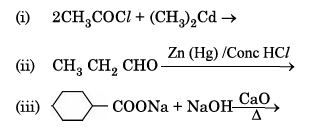
Give reasons:
(i) Ammonolysis of alkyl halides is not a good method to prepare pure primary amines.(1)
(ii) Aniline does not give Friedel-Crafts reaction.(1)
(iii) Although -NH₂, group is o/p directing in electrophilic substitution reactions, yet aniline on nitration gives good yield of m-nitroaniline.(1)
(a) (i) Which acid of the following pair would you expect to be stronger?
F-CH₂-COOH or CH₃-COOH. (1)
(ii) Arrange the following compounds in increasing order of their boiling points:
CH₃CH₂OH, CH₃-CHO, CH₃-COOH. (1)
(iii) Give simple chemical test to distinguish between Benzaldehyde and Acetophenone.(1)
(b) (i) Which will undergo faster nucleophilic addition reaction? Acetaldehyde or Propanone.(1)
(ii) What is the composition of Fehling's reagent?(1)
(iii) Draw structure of the semicarbazone of Ethanal.(1)
Predict the reagent for carrying out the following transformations.
(i) Benzoyl chloride to Benzaldehyde(1)
(ii) Ethanal to 3- hydroxy butanal .(1)
(iii) Ethanoic acid to 2- chloroethanoic acid.(1)
Paper Details
CBSE Board Exam 2022
Class
Class 12 PCM
Subject
Chemistry
Year
2022
Set
Set 3
Other Years — Chemistry