SOLUTIONS
2022 BOARD EXAM
CBSE Class 12 PCM Chemistry Board Paper 2022 — Set 2 Solutions
2022
Chemistry
Class 12 PCM
CBSE EXAMINATION PAPER-2022
CHEMISTRY
(Solved)
General Instructions :
Read the following instructions carefully and follow them :
- This question paper contains 17 questions. All questions are compulsory.
- This question paper is divided into 3 sections.
- Section A – questions number 1 to 2 are case based questions
- Section B – questions number 3 to 4 are short answer
- Section C – questions number 5 to 17 are long answer
- There is no overall choice given in the question paper. However, an internal choice has been provided in few questions.
- Use of calculator is NOT allowed.
Section A
Read the following passage and answer the questions that follow :
Amines constitute an important class of organic compounds derived by replacing one or more hydrogen atoms of ammonia molecule by alkyl/aryl groups. Amines are usually formed from nitro compounds, halides, amides, etc. They exhibit hydrogen bonding which influences their physical properties. Alkyl amines are found to be stronger bases than ammonia. In aromatic amines, electron releasing and withdrawing groups, respectively increase and decrease their basic character. Reactions of amines are governed by availability of the unshared pair of electrons on nitrogen. Influence of the number of hydrogen atoms at nitrogen atom on the type of reactions and nature of products is responsible for identification and distinction between primary, secondary and tertiary amines. Reactivity of aromatic amines can be controlled by acylation process.
(1) Why does aniline not give Friedel-Crafts reaction ?
(2) Arrange the following in the increasing order of their pKb values : C₆H₅NH₂, NH₃, C₂H₅NH₂, (CH₃)₃N
(3) How can you distinguish between CH₃CH₂NH₂ and (CH₃CH₂)₂NH by Hinsberg test ?
(4) How will you convert the following : (i) Benzoic acid to aniline (ii)Aniline to p-bromoaniline
(ii) Treat aniline with bromine water at room temperature to get p-bromoaniline directly due to the activating effect of amino group, as explained in the passage about reactions governed by availability of unshared electrons on nitrogen. This substitution occurs mainly at para position because of resonance effect.
(5) Write the structures of A and B in the following reactions :
Structure B is a tertiary amine where nitrogen is attached to three alkyl groups and no hydrogen atoms (R3N).
According to the passage, amines are formed by replacing hydrogen atoms of ammonia with alkyl/aryl groups, and the number of hydrogens on nitrogen helps distinguish primary, secondary and tertiary amines.
Section B
In the given reaction
( N2(g) + 3H₂(g) -> 2NH₃(g),
the rate of formation of NH3 is 3·6 x 10 ⁻⁴ mol L ⁻¹ s ⁻¹ . calculate the
(i) rate of reaction and (1)
(ii) rate of disappearance of H₂(g).(1)
The rate of reaction is defined based on the change in concentration of reactants or products per unit time, divided by their stoichiometric coefficients.
Given, rate of formation of NH3 = 3.6 x 10⁻⁴ mol L-1 s-1.
From the equation, 2 moles of NH3 are formed for every 1 mole of N2 reacted.
Therefore, rate of reaction = (1/2) * rate of formation of NH3 = (1/2) * 3.6 x 10-4 = 1.8 x 10⁻⁴ mol L-1 s-1.
(ii) Rate of disappearance of H2:
The stoichiometric ratio of H2 to NH3 is 3:2.
So, rate of disappearance of H2 = 3/2 * rate of formation of NH3 = 3/2 * 3.6 x 10-4 = 5.4 x 10⁻⁴ mol L-1 s-1.
(i) State Kohlrausch' law of law of independent migration of ions.
(ii)Calculate the degree of dissociation (α) of CH₃COOH if Λₘ and Λ°ₘ of CH₃ COOH) are 48 S cm² mol⁻¹ and 400 S cm² mol⁻¹ respectively.
(ii) Given:
Molar conductivity at concentration (Λₘ) = 48 S cm² mol⁻¹
Molar conductivity at infinite dilution (Λ°ₘ) = 400 S cm² mol⁻¹
Degree of dissociation (α) is given by:
α = Λₘ / Λ°ₘ
Thus,
α = 48 / 400 = 0.12
Therefore, the degree of dissociation of CH₃COOH is 0.12 or 12%.
Section C
Write the hybridisation and magnetic character of the following complexes :
(i) [NiCl4] ²⁻
(ii)[Co(NH₃)₆] ³⁺
(iii)[FeF6] ³⁻
[Atomic number : Ni = 28, Co = 27, Fe = 26]
(b) [Co(NH3)6] 3+ complex: Co atomic number is 27, electronic configuration is [Ar] 3d7 4s2. In +3 oxidation state it is 3d6. NH3 is a strong field ligand, causing pairing of electrons in the d orbitals. The complex has octahedral geometry with d2sp3 hybridisation (inner orbital complex). It is diamagnetic as all electrons are paired.
(c) [FeF6] 3- complex: Fe atomic number 26, in +3 oxidation state electronic configuration is 3d5. Fluoride (F-) is a weak field ligand and does not cause pairing of electrons. The complex is octahedral and involves sp3d2 hybridisation (outer orbital complex). It is paramagnetic with five unpaired electrons due to weak ligand field.
(i) Write the IUPAC name of the following complex : [Co(NH₃)₄(H₂O)Cl]Cl₂. (1)
(ii) What is the difference between an Ambidentate ligand and a Bidentate ligand ?(1)
(ii) Out of [Fe(NH₃)₆] ³⁺ and [Fe(C₂O₄)₃] ³⁻ , which complex is more stable and why ?(1)
(b) Difference between Ambidentate and Bidentate ligands:
Ambidentate ligand can coordinate to the metal through either of two different atoms but only one atom binds at a time. For example, the thiocyanate ion (SCN−) can bind through sulfur or nitrogen.
Bidentate ligand has two donor atoms that simultaneously coordinate to the metal ion forming a ring structure. Example is ethylenediamine (en).
(c) The complex [Fe(C₂O₄)₃] ⁻ is more stable than [Fe(NH₃)₆] ⁺ because C₂O₄− (oxalate ion) is a bidentate ligand forming chelate rings which increase the stability of the complex due to the chelate effect, while NH₃ is a monodentate ligand. Hence, the presence of chelating ligands makes [Fe(C₂O₄)₃] ⁻ more stable.
Calculate the emf of the following cell :
Zn (s)|Zn ²⁺ (0·01 M) || (0·001 M) Ag⁺ |Ag (s)
Given : EΘ Zn ²⁺ / Zn = - 0·76 V and
EΘ Ag⁺ / Ag = + 0·80 V
[log 2 = 0·3010, log 3 = 0·4771, log 10 = 1]
Zn/Zn2+ is the anode (oxidation), EZno = -0.76 V
Ag+/Ag is the cathode (reduction), EAgo = +0.80 V
So, Ecello = Ecathodeo - Eanodeo = 0.80 V - (-0.76 V) = 1.56 V
Step 2: Write the Nernst equation for the cell:
Ecell = Ecello - (0.059/2) * log(< [Zn2+] anode side / [Ag+]2 cathode side >)
Since the reaction is Zn (s) + 2Ag+ (aq) → Zn2+ (aq) + 2Ag (s), n = 2 electrons.
Step 3: Substitute the given values:
[Zn2+] = 0.01 M, [Ag+] = 0.001 M
Calculate reaction quotient Q = [Zn2+] / [Ag+]2 = 0.01 / (0.001)2 = 0.01 / 0.000001 = 10,000
Step 4: Calculate log Q:
log 10,000 = log(104) = 4 * log 10 = 4 * 1 = 4
Step 5: Calculate emf using Nernst equation:
Ecell = 1.56 V - (0.059 / 2) * 4 = 1.56 V - 0.118 * 2 = 1.56 V - 0.236 = 1.324 V
Answer: The emf of the cell under the given concentrations is 1.324 V.
Write the major products in the following :
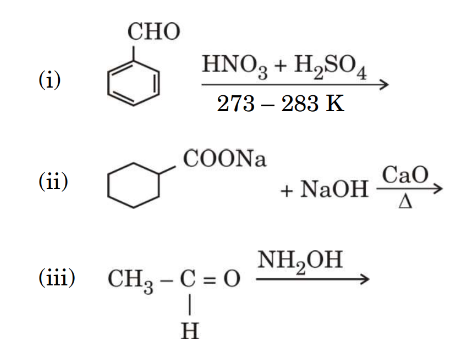
(b) Dinitration of 3-methylphenol: In dinitration, two nitro groups are introduced into the benzene ring. The first nitro group enters mainly at the position ortho to the -OH group (position 2), as in mononitration. The second nitro group usually enters at the position para to the -OH group (position 4), since both positions 2 and 4 are activated. Hence, the major product of dinitration is 2,4-dinitro-3-methylphenol. Minor isomers with nitro groups at other available ortho/para positions may also form but are generally not reported as major products.
Summary: The -OH group directs the nitration mainly to ortho and para positions relative to itself, over the methyl group. Hence, the positions 2 and 4 relative to -OH are the main substitution sites for nitro groups in mono and dinitration respectively.
(i) Oxidation of propanal is easier than propanone. Why ?
(ii) How can you distinguish between Acetophenone and Benzophenone ?
(iii) Draw the structure of the following derivative : 2,4-Dinitrophenylhydrazone of Propanone
(ii) Acetophenone and Benzophenone can be distinguished by their physical properties and chemical tests. Acetophenone is a methyl ketone and gives a positive iodoform test producing a yellow precipitate, whereas benzophenone does not give this test as it lacks the methyl group adjacent to the carbonyl. Also, their melting points and solubilities differ.
(iii) The structure of 2,4-Dinitrophenylhydrazone of propanone is formed by the reaction of propanone with 2,4-dinitrophenylhydrazine. It has the structure CH3-CO-CH3 reacting at the carbonyl group with NH-NH-C6H3-(NO2)2 (at positions 2 and 4), forming CH3-C=N-NH-C6H3-(NO2)2 (2,4-dinitrophenylhydrazone derivative). This structure has a double bond between the carbonyl carbon and the nitrogen of the hydrazone group, with two nitro groups attached to the benzene ring at positions 2 and 4.
A first order reduction takes 30 minutes for 75% decomposition. Calculate t1/2.
Given : [log 2 = 0·3, log 3 = 0·48, log 4 = 0·6, log 5 = 0·7]
For a first order reaction, the relation between concentration and time is given by:
log ( [A]_0 / [A] ) = kt / 2.303
Where [A]_0 is initial concentration, [A] is concentration at time t, k is the rate constant.
Given that 75% decomposition takes place in 30 minutes, so 25% of original concentration remains.
Therefore, [A] / [A]_0 = 0.25
Using the formula:
log (1 / 0.25) = kt / 2.303
log 4 = k * 30 / 2.303
Given log 4 = 0.6, so:
0.6 = k * 30 / 2.303
k = (0.6 * 2.303) / 30 = 0.04606 min-1
The half-life t1/2 for a first order reaction is:
t1/2 = 0.693 / k
= 0.693 / 0.04606 = 15.05 minutes
Answer: The half-life t1/2 of the reaction is approximately 15 minutes.
Write three differences between Lyophobic sol and Lyophilic sol.
(i) Write the dispersed phase and dispersion medium of 'milk'.
(ii) What is the cause of Brownian movement in colloidal particles ?
(iii) Why does physisorption decrease with increase in temperature ?
From the given EΘ values of the first row transition elements, answer the following questions :
(i) Why is Mn2+ / Mn value highly negative as compared to other elements ?
(ii) what is the reason for the irregularity in the above EΘ Values ?
(iii) Why is E Θ Cu² + / Cu value exceptionally positive ?

(ii) The irregularity in the EΘ values across first row transition metals is due to variations in electronic configurations, especially the extra stability of half-filled (d5) and fully filled (d10) subshells. Factors like ionization energy, hydration enthalpy, and lattice energy also contribute, leading to non-linear trends.
(iii) The EΘ value for Cu2+/Cu is exceptionally positive because copper metal has a completely filled 3d10 configuration, which is very stable. The stability of Cu metal makes it easier to form Cu2+ ions and thus shows a high positive electrode potential.
Write the equation involved in the following reactions :
(i) Rosenmund reduction
(ii) Etard reaction
(iii) Stephen reaction
The Rosenmund reduction is used to reduce acid chlorides to aldehydes. The reaction involves the reduction of an acid chloride using hydrogen gas in the presence of palladium on barium sulfate catalyst.
R-COCl + H2 (Pd/BaSO4) —> R-CHO + HCl
Here, R-COCl is an acid chloride and R-CHO is the corresponding aldehyde.
(ii) Etard reaction:
The Etard reaction oxidizes methyl groups attached to aromatic rings into aldehyde groups using chromyl chloride (CrO2Cl2).
C6H5-CH3 + CrO2Cl2 —> C6H5-CH=O + CrCl3
Toluene (C6H5-CH3) is oxidized to benzaldehyde (C6H5-CHO).
(iii) Stephen reaction:
The Stephen reaction reduces nitriles to aldehydes in the presence of stannous chloride (SnCl2) and hydrochloric acid (HCl) followed by hydrolysis.
R-CN + 2[H] (SnCl2/HCl) —> R-CH=NH · HCl (iminium salt)
Then,
R-CH=NH · HCl + H2O —> R-CHO + NH4Cl
Here, a nitrile (R-CN) is first converted to an iminium salt and then hydrolyzed to the aldehyde (R-CHO).
(i) Which acid of each pair would you expect to be stronger ? Give reason.
(ii) Distinguish between Pentan-2-one and Pentan-3-one.
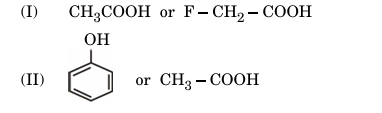
The strength of an acid depends on the stability of its conjugate base. More stable conjugate base means stronger acid. Electron withdrawing groups near the acidic proton stabilize the conjugate base through inductive effect, increasing acidity. Also, resonance stabilization increases acid strength. For example, in dicarboxylic acids, the acid with carboxyl groups closer together is stronger due to intramolecular hydrogen bonding and stronger electron withdrawing effect.
(ii) Distinguish between Pentan-2-one and Pentan-3-one.
Pentan-2-one and Pentan-3-one are positional isomers of pentanone with the carbonyl group at different positions in the pentane chain.
- Pentan-2-one has the carbonyl group (C=O) attached to the second carbon atom in the chain. Its structure is CH3-CO-CH2-CH2-CH3.
- Pentan-3-one has the carbonyl group attached to the third carbon atom. Its structure is CH3-CH2-CO-CH2-CH3.
These differences cause variation in physical and chemical properties such as boiling points and reactivity due to the position of the ketone group.
Account for the following :
(i) Transition metals and their compounds show catalytic activities.
(ii) Account for the following :Zn, Cd and Hg are non-transition elements.
(iii) Zr and Hf are of almost identical atomic radii.
(b) Zn, Cd and Hg are considered non-transition elements because their electronic configurations are (n-1)d10ns2. This means their d orbitals are completely filled in both the ground state and common oxidation states. Since transition elements require partly filled d orbitals to exhibit typical properties like variable oxidation states and formation of coloured compounds, Zn, Cd and Hg do not fit this criteria and are thus classified as non-transition elements.
(c) Zr and Hf have almost identical atomic radii due to the lanthanide contraction. Lanthanides, which are elements between them in the periodic table, have poor shielding effect because 4f electrons do not shield the nuclear charge effectively. This causes a greater attraction between the nucleus and outer electrons in Hf, decreasing its size and resulting in atomic radii similar to Zr.
How will you carry out the following conversions :
(i) Propanal to Propane.(1)
(ii) Ethanal to But- 2-enal.(1)
(iii) Ethanoic acid to ethanamide.(1)
(ii) Ethanal to But-2-enal: Ethanal (CH3CHO) can be converted into but-2-enal by an aldol condensation reaction. In the presence of dilute sodium hydroxide (NaOH), two molecules of ethanal undergo aldol condensation to form 3-hydroxybutanal which upon heating or dehydration gives but-2-enal (crotonaldehyde).
(iii) Ethanoic acid to Ethanamide: Ethanoic acid (CH3COOH) is converted into ethanamide (CH3CONH2) by first converting it into an acid chloride using reagents like thionyl chloride (SOCl2). The acid chloride then reacts with concentrated ammonia (NH3) to form ethanamide.
Paper Details
CBSE Board Exam 2022
Class
Class 12 PCM
Subject
Chemistry
Year
2022
Set
Set 2
Other Years — Chemistry