SOLUTIONS
2023 BOARD EXAM
CBSE Class 12 PCM Chemistry Board Paper 2023 — Set 4 Solutions
2023
Chemistry
Class 12 PCM
CBSE EXAMINATION PAPER-2023
CHEMISTRY
(Solved)
General Instructions :
Read the following instructions carefully and follow them :
- This question paper contains 41 questions. All questions are compulsory.
- This question paper is divided into 5 sections.
- Section A – questions number 1 to 3 are case based questions
- Section B – questions number 4 to 21 are multiple choice questions
- Section C – questions number 22 to 30 are very short answer
- Section D – questions number 31 to 36 are short answer
- Section E – questions number 37 to 41 are long answer
- There is no overall choice given in the question paper. However, an internal choice has been provided in few questions.
- Use of calculator is NOT allowed.
Section A
The following questions are case-based questions. Read the case carefully and answer the questions that follow.
Living systems are made up of various complex biomolecules like carbohydrates, proteins, nucleic acids, lipids, etc. Carbohydrates are optically active polyhydroxy aldehydes or ketones or molecules which provide such units on hydrolysis. They are broadly classified into three groups monosaccharides, oligosaccharides and polysaccharides. Monosaccharides are held together by glycosidic linkages to form disaccharides like sucrose, maltose or polysaccharides like starch and cellulose. Another biomolecule : proteins are polymers of -amino acids which are linked by peptide bonds. Ten amino acids are called essential amino acids. Structure and shape of proteins can be studied at four different levels i.e. primary, secondary, tertiary and quaternary, each level being more complex than the previous one.
(1) What is the difference between a glycosidic linkage and peptide linkage ?
(2) Which amino acids are called essential amino acids ?
(3) What are the common types of secondary structures of proteins ? Write any two forces which stabilise the secondary and tertiary structures of protein.
(4) Define denaturation of protein with an example. During denaturation which structures of protein lose their biological activity ?
Amines are usually formed from nitro compounds, halides, amides, imides, etc. They exhibit hydrogen bonding which influences their physical properties. In alkyl amines, a combination of electron releasing, steric and hydrogen bonding factors influence the stability of the substituted ammonium cations in protic polar solvents and thus affect the basic nature of amines. In aromatic amines, electron releasing and withdrawing groups, respectively increase and decrease their basic character. Influence of the number of hydrogen atoms at nitrogen atom on the type of reactions and nature of products is responsible for identification and distinction between primary, secondary and tertiary amines. Presence of amino group in aromatic ring enhances reactivity of the aromatic amines. Aryl diazonium salts provide advantageous methods for producing aryl halides, cyanides, phenols and arenes by reductive removal of the diazo group.
(1) Arrange the following in the increasing order of their pKb aqueous solution : C₂H₅NH₂,(C₂H₅)₂ NH (C₂H₅)₃N
(2) Aniline on nitration gives a substantial amount of m-nitroaniline, though amino group is o/p directing. Why ?
(3) An aromatic compound 'A' of molecular formula C₇H₆O₂ on treatment with aqueous ammonia and heating forms compound 'B'. Compound 'B' on heating with Br₂ and aqueous KOH gives a compound 'C' of molecular formula C₆H₇N. Write the structures of A, B, and C.
(4) Complete the following reactions giving main products :
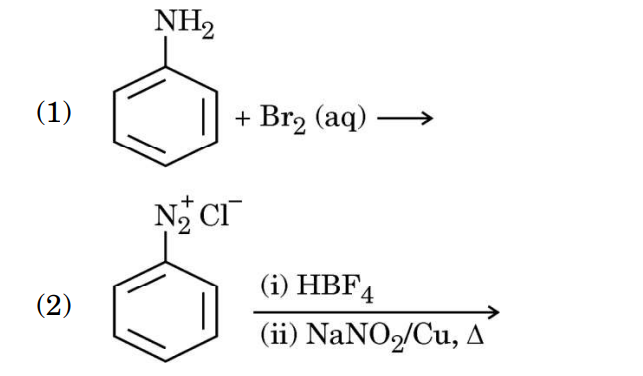 [3 Marks]
(1) Aniline + Br₂ (aq)
Aniline is a strongly activating and ortho/para-directing group. In bromine water, it reacts very fast and gives polybromination.
👉 Main product: 2,4,6-tribromoaniline (white precipitate)
So:
Aniline + Br₂ (aq) → 2,4,6-tribromoaniline
(2) Benzene diazonium chloride
Step (i) HBF₄ converts it to the stable diazonium tetrafluoroborate salt.
Step (ii) NaNO₂ / Cu, Δ replaces the diazonium group by –NO₂ (nitro group).
👉 Main product: Nitrobenzene
So:
C₆H₅–N₂⁺Cl⁻ → (HBF₄) → C₆H₅–N₂⁺BF₄⁻ → (NaNO₂/Cu, Δ) → Nitrobenzene (C₆H₅NO₂)
2,4,6-Tribromoaniline
Nitrobenzene
Section B
A compound undergoes complete tetramerization in a given organic solvent. The van'ts Hoff factor 'i' is:
The correct option is 4.0. Tetramerization refers to the process of forming a tetramer, which consists of four identical monomer units. Therefore, if the compound undergoes complete tetramerization, we can infer that it results in four times the amount of the original compound, leading to a value of 4.0.
The half-life for a zero order reaction equals:
(where R is the initial concentration)
For a zero order reaction, the half-life (t₁/₂) is given by the formula: t₁/₂ = [R]₀ / 2k, where [R]₀ is the initial concentration and k is the rate constant. This means the half-life depends directly on the initial concentration and inversely on the rate constant. Among the given options, R / 2k matches this expression and is therefore correct.
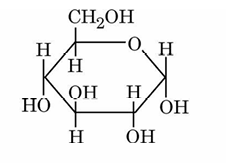
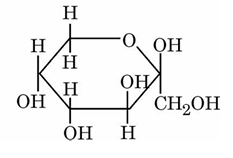
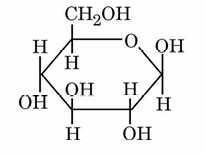
Which of the following structures represents -D-glucose ?
-
(A)
-
(B)
-
(C)
-
(D)
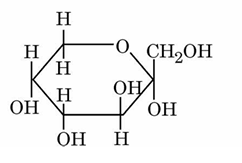
The ions of metals of Group 12 (Zn, Cd and Hg) have completely filled d orbitals and so they:
The correct answer is 'do not behave like transition metals'. This is because zinc, cadmium, and mercury have a full d10 configuration in their ground state and common oxidation states, meaning they do not possess incomplete d orbitals as defined by IUPAC for transition metals. Therefore, these elements are not regarded as transition metals despite being located at the end of the transition series.
[Co(NH₃)₅NO₃]SO₄ and [Co(NH₃)₅SO₄]NO₃ exhibit:
The correct answer is ionization isomerism. This is because these two complexes have the same formula but differ in the arrangement of their ions, where one of the counter ions can potentially act as a ligand. This is a classic example of ionization isomerism, wherein the counter ion (NO₃⁻ or SO₄²⁻) can displace a ligand in the coordination sphere.
Reaction of 1-phenyl-2-chloropropane with alcoholic KOH gives mainly:
The correct answer is 1-phenylpropene. The reaction of 1-phenyl-2-chloropropane with alcoholic KOH leads to elimination reactions, resulting in the formation of alkenes. The predominant product is 1-phenylpropene due to the elimination of HCl and the formation of a more stable alkene. The context suggests that the elimination pathway, favored by the use of alcoholic KOH, leads to alkenes rather than alcohols.
When diethyl ether is heated with excess of HI, it produces:
The correct answer is ethyl iodide. When diethyl ether is treated with excess hydrogen iodide (HI), it undergoes cleavage to form ethyl iodide (C2H5I) and ethanol (C2H5OH). The ether bond in diethyl ether is cleaved by the HI at high temperatures, resulting in the formation of ethyl iodide as well as ethanol.
The reduction of ethanenitrile with sodium and alcohol gives:
The correct option is 1-aminoethane. When ethanenitrile (which is an nitrile) is reduced with sodium in alcohol, it undergoes a process that converts the nitrile group (-C≡N) into an amine group (-NH2), resulting in the formation of 1-aminoethane.
How many Faradays are required to reduce 1 mol of MnO₄⁻ to Mn²⁺ ?
In a reaction, the initial concentration of the reactants increases four fold and the rate becomes sixteen times its initial value. The order of the reaction is:
On hydrolysis, which of the following carbohydrates gives only glucose?
Maltose is a disaccharide composed of two glucose molecules. Upon hydrolysis, it breaks down into two glucose units, thus giving only glucose. Sucrose and lactose, on the other hand, yield other monosaccharides (fructose from sucrose and galactose from lactose) upon hydrolysis.
Deficiency of which of the following vitamins causes Pernicious anaemia?
The correct answer is Vitamin B₁₂. According to the provided context, Vitamin B₁₂, also known as cyanocobalamine, is referred to as the anti-pernicious anaemia factor. This indicates that a deficiency in Vitamin B₁₂ is specifically linked to the development of pernicious anaemia.
This reaction is known as:

In which of the following does the central atom exhibit an oxidation state of +3?
[Fe(C₂O₄)₃]³⁻ is the correct option because in this complex, iron (Fe) is bonded to three oxalate (C₂O₄) ions. Since the overall charge of the complex is -3 and each oxalate ion has a -2 charge, the oxidation state of iron must be +3 to balance the charges (3 * -2 + +3 = -3). This aligns with the context, which explains that in complexes like [Co(NH3)6]3+, the central metal is in a +3 oxidation state.
Assertion (A) : When NaCl is added to water, a depression in freezing point is observed.
Reason (R) : The lowering of vapour pressure of a solution causes depression in the freezing point.
Both Assertion (A) and Reason (R) are true and Reason (R) is the correct explanation of the Assertion (A). When NaCl is dissolved in water, it lowers the vapour pressure of the solution, leading to a depression in the freezing point as outlined in the context regarding the effects of solute on the physical properties of the solvent.
Assertion (A) : ⋀ₘ for weak electrolytes shows a sharp decrease when the electrolytic solution is diluted. Reason (R) : For weak electrolytes, degree of dissociation increases with dilution of solution.
Both Assertion (A) and Reason (R) are true, and Reason (R) is the correct explanation of the Assertion (A) because the decrease in molar conductivity (m) for weak electrolytes upon dilution is attributed to the increased degree of dissociation, which leads to a higher concentration of ions in solution.
Assertion (A) : Zr and Hf have almost identical radii.
Reason (R) : Both Zr and Hf exhibit similar properties.
Both Assertion (A) and Reason (R) are true and Reason (R) is the correct explanation of the Assertion (A). The context indicates that Zr and Hf have very similar radii (160 pm and 159 pm respectively) due to lanthanoid contraction, which indeed contributes to their similar physical and chemical properties, validating the relationship between their radii and properties.
Assertion (A) : Monobromination of aniline can be conveniently done by protecting the amino group by acetylation.
Reason (R) : Acetylation decreases the activating effect of the amino group.
Both Assertion (A) and Reason (R) are true, and Reason (R) is the correct explanation of Assertion (A). Acetylation of aniline indeed protects the amino group, making it less reactive towards electrophilic substitution, thus facilitating monobromination at the aromatic ring.
Section C
An alkyl halide (A) of molecular formula C₆H₁₃Cl on treatment with alcoholic KOH gives two isomeric alkenes (B) and (C) of molecular formula C₆H₁₂. Both alkenes on hydrogenation give 2,3-dimethylbutane. Write the structures of (A), (B) and (C).
(a) The alkyl halide (A) has the formula C6H13Cl and upon treatment with alcoholic KOH undergoes dehydrohalogenation to give two isomeric alkenes (B) and (C) with formula C6H12.
(b) Both alkenes yield 2,3-dimethylbutane upon hydrogenation, which means these alkenes are isomers of 2,3-dimethyl-1-butene and 2,3-dimethyl-2-butene.
(c) Structure of (A) (the alkyl halide) is 2-chloro-2,3-dimethylbutane:
CH3-C(Cl)(CH3)-C(CH3) -CH2-CH3
(d) Structure of (B) is 2,3-dimethyl-1-butene:
CH2=CH-C(CH3)2-CH3
(e) Structure of (C) is 2,3-dimethyl-2-butene:
CH3-C=CH-C(CH3)2
Thus, dehydrohalogenation of (A) gives two isomeric alkenes (B) and (C) which on hydrogenation produce the same alkane 2,3-dimethylbutane.
What type of deviation from Raoult's Law is shown by a mixture of ethanol and acetone ? Give reason.
This happens because in pure ethanol, molecules are hydrogen bonded strongly. When acetone is added, its molecules insert themselves between ethanol molecules and break some hydrogen bonds. This reduces the intermolecular attraction in the mixture, resulting in higher vapor pressure than expected. Hence, the mixture shows positive deviation from Raoult's Law.
Define Azeotrope. What type of azeotrope is formed by negative deviation from Raoult's law? give an example .
Name the cell which :
(a) was used in the Apollo Space programme.
(b) is used in automobiles and inverters.
(c) is suitable for hearing aids and watches.
(d) does not give a steady potential and is used in transistors.
(b) The cell used in automobiles and in inverters is the Lead-acid cell. It is rechargeable and can provide high current.
(c) The cell suitable for hearing aids and watches is the Mercury cell or Button cell because it gives stable voltage and is small in size.
(d) The cell that does not give a steady potential and is used in transistors is the Dry cell. It has varying voltage and is commonly used in small electronic devices.
Write the mechanism of the following reaction:

This is acid-catalyzed hydration of ethene to form ethanol.
Mechanism:
Step 1: Protonation of ethene (formation of carbocation)
CH2=CH2+H+→CH3CH2+
The π-bond of ethene attacks H+, forming an ethyl carbocation.
Step 2: Nucleophilic attack by water
CH3CH2++H2O→CH3CH2OH2+
Water attacks the carbocation to form a protonated alcohol (oxonium ion).
Step 3: Deprotonation
CH3CH2OH2+→CH3CH2OH+H+
Loss of a proton gives ethanol and regenerates the acid catalyst.
This is acid-catalyzed hydration of ethene to form ethanol.
Write the products of the following reactions:
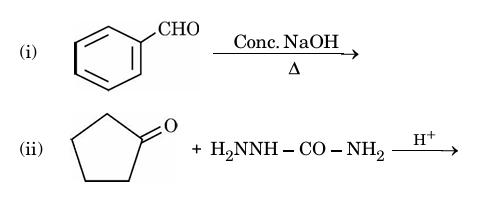
(i) Substrate: Benzaldehyde (C₆H₅–CHO)
Reagent: Conc. NaOH, heat
Benzaldehyde has no α-hydrogen, so it undergoes Cannizzaro reaction (disproportionation):
2 C6H5CHO(conc. NaOH) → C6H5CH2OH+C6H5COONa
Products: Benzyl alcohol (C₆H₅CH₂OH) and Sodium benzoate (C₆H₅COONa)
(ii) Substrate: Cyclopentanone
Reagent: H₂NNH–CO–NH₂ (semicarbazide), H⁺
Ketone + semicarbazide → Semicarbazone (condensation product)
Cyclopentanone+H2NNHCONH2 (H+) → Cyclopentanone semicarbazone + H20
Product: Cyclopentanone semicarbazone
(>C=O is converted to >C=NNHCONH₂)
(i) Benzyl alcohol + Sodium benzoate
(ii) Cyclopentanone semicarbazone
Do the following conversions:
(i) Toluene to Benzoic acid.
(ii) Benzaldehyde to 1-Phenylethanol.
(ii) Benzaldehyde to 1-Phenylethanol: Benzaldehyde (C6H5CHO) is reduced by NaBH4 or LiAlH4 which converts the aldehyde group (-CHO) into a primary alcohol group (-CH2OH), forming 1-Phenylethanol (C6H5CH(OH)CH3).
Write IUPAC name of the following coordination entities :
(a) [Co(NH₃)₄Cl(NO₂)]Cl
(b) [PtCl₂(en)₂]²⁺
(b) The complex cation contains two chloride ligands and two ethylenediamine (en) ligands bound to platinum. Ethylenediamine (en) is a bidentate ligand. The oxidation state is +2. The IUPAC name is diamminechloridoethylenediamineplatinum(II) or commonly dichlorido-bis(ethylenediamine)platinum(II).
The rate constant for the first order decomposition of N₂O₅ is given by the following equation :
log k = 23.6 - 2* 10⁴K/T
Calculate Eₐ for this reaction.
[R = 8.314 J K⁻¹ mol ⁻¹ ]
According to Arrhenius equation, log k = (log A) - Eₐ/(2.303RT)
Comparing, Eₐ/(2.303R) = 2 * 104
So, Eₐ = 2 * 104 * 2.303 * R
= 2 * 104 * 2.303 * 8.314 J/mol
= 3.83 * 105 J/mol or 383 kJ/mol
Therefore, the activation energy Eₐ is 383 kJ/mol.
Section D
(i) Write hydroboration-oxidation reaction with an example.
(ii) Write the products of the following reaction :
(iii) Why is p-nitrophenol more acidic than phenol?
(i) Hydroboration-oxidation reaction:
The hydroboration-oxidation is a two-step reaction that converts an alkene into an alcohol. In the first step, borane (BH3) adds across the double bond in an anti-Markovnikov manner to form trialkylborane. In the second step, oxidation with hydrogen peroxide (H2O2) in alkaline medium (OH-) replaces the boron atom with a hydroxyl group.
Example:
CH3-CH=CH2 + BH3 → CH3-CH2-CH2-B
Then,
CH3-CH2-CH2-B + H2O2/OH- → CH3-CH2-CH2-OH
✅ Products:
Phenol (C₆H₅OH)
Methyl bromide (CH₃Br)
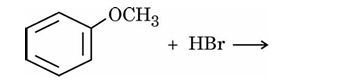
(ii) Products of the reaction:The given compound is anisole (methoxybenzene, C₆H₅–O–CH₃).
With HBr, aryl–alkyl ethers undergo cleavage at the alkyl–O bond (because Ar–O bond is resonance-stabilized and does not break easily).
So the reaction is:
C6H5–O–CH3+HBr→C6H5OH+CH3Br
(iii) Why is p-nitrophenol more acidic than phenol?
p-Nitrophenol is more acidic than phenol because the nitro group (-NO2) is an electron-withdrawing group by resonance and inductive effect. It stabilizes the negative charge on the oxygen atom of the phenolate ion formed after losing a proton. This delocalization increases the stability of the conjugate base, making p-nitrophenol more acidic than phenol.
Hydroboration-oxidation converts alkene to alcohol with anti-Markovnikov addition - HBr cleaves the ether at the alkyl–O bond, giving phenol and alkyl bromide. - Nitro group in p-nitrophenol stabilizes conjugate base increasing acidity
(i) What happens when phenol reacts with
(1) Conc. HNO₃, and
(2) CHCl₃ in presence of aqueous NaOH followed by acidification ? Write equations only.
(ii) Why does the reaction of CH3ONa with (CH₃)₃C-Br give 2-methylpropene and not (CH₃)₃C -OCH₃ ?
(2) Phenol reacts with CHCl₃ in presence of aqueous NaOH followed by acidification (Reimer-Tiemann reaction) to give salicylaldehyde: C₆H₅OH + CHCl₃ + 3NaOH → C₆H₄(OH)CHO + 3NaCl + 2H₂O
(ii) The reaction of CH3ONa with (CH₃)₃C-Br gives 2-methylpropene and not (CH₃)₃C-OCH₃ because (CH₃)₃C-Br is a tertiary alkyl halide where steric hindrance prevents nucleophilic substitution. Instead, elimination (E2 mechanism) occurs leading to the formation of 2-methylpropene by removal of a beta hydrogen atom.
Account for the following :
(a) Benzyl chloride is highly reactive towards SN1 reaction.
(b) (±)-Butan-2-ol is optically inactive, though it contains a chiral carbon atom.
(c) Chloroform is stored in closed dark coloured bottles.
(b) (±)-Butan-2-ol is optically inactive despite having a chiral carbon because it is a racemic mixture consisting of equal amounts of both enantiomers. The optical activities of the two enantiomers cancel each other, resulting in no overall optical activity.
(c) Chloroform is stored in closed dark coloured bottles to prevent its decomposition by light and air. Exposure to light causes chloroform to slowly decompose to form toxic and irritant phosgene gas, so dark bottles protect it from light and airtight conditions prevent its oxidation.
Answer any three of the following questions:
(a) Explain the type of hybridization in [Fe(CN)₆]³⁻ on the basis of valence bond theory. (Given : Atomic number of Fe = 26)
(b) Draw the geometrical isomers of [PtCl₂(en)₂]²⁺ ion.
(c) [NiCl4]²⁻ is paramagnetic while [Ni(CO)₄] is diamagnetic though both are tetrahedral. Why ?
(d) Name the type of isomerism when ambidentate ligands are attached to central metal ion. Give one example of ambidentate ligand.
(b) [PtCl2(en)2]2+ has two Cl and two ethylenediamine (en) ligands. It shows geometrical isomerism with cis-isomer where two Cl ligands are adjacent and trans-isomer where they are opposite.
(c) [NiCl4]2- is paramagnetic because Cl- is a weak field ligand, so Ni(II) does not pair electrons and uses sp3 hybridization. [Ni(CO)4] is diamagnetic because CO is a strong field ligand, causing pairing of electrons and dsp2 hybridization.
(d) The type of isomerism when ambidentate ligands attach to the central metal ion is linkage isomerism. An example of an ambidentate ligand is NO2-, which can bind through N or O atom.
If benzoic acid (M = 122 g mol ⁻¹ ) is associated into a dimer when dissolved in benzene and the osmotic pressure of a solution of 6.1 g of benzoic acid in 100 mL benzene is 6.5 atm at 27°C, then what is the percentage association of benzoic acid ? (Given : R = 0.0821 L atm K⁻¹ mol ⁻¹ )
Number of moles = mass / molar mass = 6.1 g / 122 g/mol = 0.05 mol.
Step 2: Calculate molarity of the solution:
Volume = 100 mL = 0.1 L
Molarity (C) = moles / volume = 0.05 mol / 0.1 L = 0.5 mol/L.
Step 3: Use the osmotic pressure formula:
Π = C_exp * R * T
Where T = 27°C = 300 K
Given Π = 6.5 atm, R = 0.0821 L atm K^-1 mol^-1
Calculate experimental molarity C_exp = Π / (R * T) = 6.5 / (0.0821 * 300) = 0.264 mol/L.
Step 4: Determine the degree of association (x):
C_exp = C * (1 - x) + C * x / 2 = C * (1 - x/2) because dimers formed have half the number of particles.
So, 0.264 = 0.5 * (1 - x/2)
Solve for x: (1 - x/2) = 0.264 / 0.5 = 0.528
x/2 = 1 - 0.528 = 0.472
x = 0.944 or 94.4%.
Step 5: Conclusion:
Percentage association of benzoic acid is 94.4%, meaning 94.4% of benzoic acid molecules form dimers in benzene solution.
The following data were obtained during the first order thermal decomposition of C₂H₅Cl, at a constant volume : C₂H₅Cl ⟶ C₂H₄ (g) + HCl (g)
Experiment, =1 Time = 0, Total pressure (atm) = 0.4
Experiment = 2, Time = 100, Total pressure (atm) = 0.6
Calculate the rate constant.
(Given: log 2 = 0.3010, log 3 = 0.4771, log 4 = 0.6021)
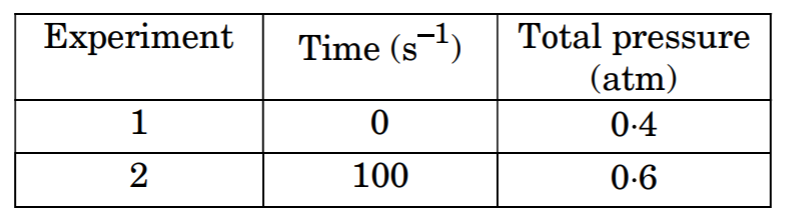
To calculate the rate constant for this first-order reaction, we need to relate the total pressure to the partial pressure of the reaction C₂H₅Cl ⟶ C₂H₄ (g) + HCl (g)
C₂H₅Cl ⟶ C₂H₄ (g) + HCl (g)
At constant volume and temperature, pressure ∝ number of moles.
tep 1: Write given data
At t=0 P0=0.4 atm
At t=100s Pt=0.6 atm
Let initial pressure of C₂H₅Cl =P0=0.4 atm.
Let x be the pressure due to decomposition at time t.
Pressure of C₂H₅Cl left = 0.4−x
Pressure of products formed = 2x (because 1 mole gives 2 moles of gases)
So total pressure at time t:
Pt=0.4−x+2x=0.4+x
Given: 0.4+x=0.6⇒x=0.2 atm
So, pressure of C₂H₅Cl left at 100 s:
P=0.4−0.2=0.2 atmP = 0.4 - 0.2 = 0.2 atm
Step 2: Use first order rate equation (in terms of pressure)
k=2.303/t log(P0/P)
Here:
P0=0.4 ,P=0.2, t=100 s
k=2.303 / 100 log(0.4/0.2)=2.303 /100 log(2)
Given: log 2= 0.3010
k=2.303 /100 0.3010 = 0.693 /100 = 6.93 *10⁻³ s⁻¹
k = 6.93 *10⁻³ s⁻¹
Section E
(i) Calculate the emf of the following cell at 298 K:
Al (s) | Al³⁺ (0.001M) || Ni²⁺ (0.1M) | Ni (s)
[Given: E° Al³⁺/Al = -1.66V, E° Ni²⁺/Ni =-0.25V, log 10 = 1]
(ii) With the help of a graph explain why it is not possible to determine Λ°ₘ for a weak electrolyte by extrapolating the molar conductivity (Λₘ) versus C¹ᐟ² curve as for strong electrolyte.
The cell reaction is: Al (s) | Al³⁺ (0.001M) || Ni²⁺ (0.1M) | Ni (s).
The standard electrode potentials are E° Al³⁺/Al = -1.66V and E° Ni²⁺/Ni = -0.25V.
Cell emf E°cell = E°cathode - E°anode = (-0.25) - (-1.66) = 1.41 V.
Using the Nernst equation:
Ecell = E°cell - (0.0592 / n) * log Q, where n = 3 (number of electrons transferred), Q = reaction quotient.
Q = [Al³⁺] / [Ni²⁺] = 0.001 / 0.1 = 0.01
log Q = log 0.01 = -2
Therefore,
Ecell = 1.41 - (0.0592 / 3) * (-2) = 1.41 + 0.03947 = 1.4495 V (approx).
(ii) Explanation regarding Λ°m determination for weak electrolytes:
For strong electrolytes, molar conductivity Λm varies linearly with sqrt(concentration) at low concentrations, allowing Λm to be extrapolated to zero concentration to find Λ°m.
However, for weak electrolytes, the plot of Λm versus sqrt(concentration) is nonlinear due to incomplete dissociation and association effects.
Graphically, Λm increases very slowly at low concentrations and does not approach a straight line; hence extrapolation is inaccurate.
This is because at low concentration weak electrolytes do not fully dissociate, so Kohlrausch’s law is not valid.
Therefore, Λ°m for weak electrolytes is determined using the degree of dissociation and alternative methods, not by direct extrapolation from conductivity data.
In summary, the lack of linearity in Λm versus sqrt(concentration) plots for weak electrolytes prevents direct determination of Λ°m by extrapolation.
(i) The molar conductivities of NH₄⁺ and Cl⁻ ion are 73.8 S cm² mol⁻¹ and 76.2 S cm² mol-1 respectively. The conductivity of 0.1 M NH₄Cl is 1.29 x 10⁻² S cm⁻¹. Calculate its molar conductivity and degree of dissociation.
(ii) Calculate the half-cell potential at 298 K for the reaction
Zn²⁺ + 2e⁻ ⟶Zn
if [Zn²⁺] = 0.1M and E° Zn²⁺/Zn = -0.76V.
Molar ionic conductivities: λNH4+ = 73.8 S cm2 mol-1, λCl- = 76.2 S cm2 mol-1
Concentration, C = 0.1 M
Conductivity, κ = 1.29 * 10-2 S cm-1
Step 1: Calculate molar conductivity (Λ)
Λ = κ / C = (1.29 * 10-2) / 0.1 = 0.129 S cm2 mol-1 = 129 S cm2 mol-1
Step 2: Calculate degree of dissociation (α)
Molar conductivity at infinite dilution,
Λ0 = λNH4+ + λCl- = 73.8 + 76.2 = 150 S cm2 mol-1
Degree of dissociation, α = Λ / Λ0 = 129 / 150 = 0.86
Therefore, molar conductivity of NH4Cl = 129 S cm2 mol-1 and degree of dissociation = 0.86 or 86%.
(ii) Given:
E° = -0.76 V, [Zn2+] = 0.1 M, T = 298 K
Reaction: Zn2+ + 2e- ⟶ Zn
Using Nernst equation:
E = E° - (RT / nF) * ln Q
Where, R = 8.314 J mol-1 K-1, T = 298 K, n = 2, F = 96500 C mol-1, Q = 1 / [Zn2+] = 1 / 0.1 = 10
Calculate (RT / nF):
(8.314 * 298) / (2 * 96500) = 0.01284 V
Now,
E = -0.76 - 0.01284 * ln 10 = -0.76 - 0.01284 * 2.303 = -0.76 - 0.02957 = -0.7896 V
Therefore, half-cell potential, E = -0.79 V (approx).
(i) Account for the following :
(1) Zn²⁺ salts are colourless while Ni²⁺ salts are coloured.
(2) Cr²⁺ is a strong reducing agent.
(3) Transition metals and their compounds show catalytic activities.
(ii) Write the ionic equations for the oxidizing action of MnO₄⁻ in acidic medium with:
(1) I⁻ ion, and ,
(2) Fe²⁺ ion.
(1) Zn2+ ions have a completely filled d10 electronic configuration which means there are no unpaired electrons to absorb visible light, so Zn2+ salts are colourless. Ni2+ ions have unpaired electrons (d8 configuration), leading to d-d transitions which absorb visible light and make Ni2+ salts coloured.
(2) Cr2+ ion has a low oxidation state and readily loses electrons to achieve a more stable state, thus it acts as a strong reducing agent.
(3) Transition metals and their compounds act as catalysts due to their ability to offer variable oxidation states and to form complexes, which help in providing an alternative reaction pathway with lower activation energy.
(ii) Ionic equations for oxidizing action of MnO4- in acidic medium :
(1) With I- ion:
MnO4- + 8H+ + 5I- -> Mn2+ + 4H2O + 5I2
(2) With Fe2+ ion:
MnO4- + 8H+ + 5Fe2+ -> Mn2+ + 4H2O + 5Fe3+
(i) Name two oxometal anions of the 3d series of the transition metals in which the metal exhibits the oxidation state equal to its group number.
(ii) What is the effect of increasing pH on a solution of K₂Cr₂O₇?
(iii) Why is Cu⁺ not stable in aqueous solution?
(iv) Name a member of Lanthanoid series which is well-known to exhibit +4 oxidation state.
(v) Name two elements of 3d series which show anomalous electronic configuration.
(ii) Increasing the pH of a solution of K2Cr2O7 (potassium dichromate) converts dichromate ions (Cr2O72-) into chromate ions (CrO42-). The color changes from orange (dichromate) to yellow (chromate) as the solution becomes more basic.
(iii) Cu+ is not stable in aqueous solution because it tends to disproportionate into Cu (metal) and Cu2+ ions. This happens due to the instability of Cu+ and its tendency to either lose an electron to form Cu2+ or gain an electron to form metallic Cu.
(iv) Cerium (Ce) is a member of the lanthanoid series that is well-known to exhibit the +4 oxidation state, besides the common +3 state.
(v) The two elements of the 3d series showing anomalous electronic configurations are chromium (Cr) and copper (Cu). Chromium has the configuration [Ar] 3d5 4s1 and copper has [Ar] 3d10 4s1 instead of the expected configurations due to extra stability from half-filled and fully filled d-subshells.
(a) Draw structure of the 2,4-dinitrophenylhydrazone of benzaldehyde.
(b) Which acid of the following pair is a stronger acid ?
(c) Write the chemical equation involved in Rosenmund’s reduction.
(d) Why are α-hydrogen atoms of aldehydes and ketones acidic in nature?
(e) Write a chemical test to distinguish between Benzaldehyde and Benzoic acid.

(a) The 2,4-dinitrophenylhydrazone of benzaldehyde is formed when benzaldehyde reacts with 2,4-dinitrophenylhydrazine. Its structure consists of a benzene ring attached to a CH=N-NH-C6H3(NO2)2 group where nitro groups are located at positions 2 and 4 on the phenylhydrazine moiety.
(b) The stronger acid is:
CF₃–C₆H₄–COOH (trifluoromethyl benzoic acid)
Reason (straight and honest):
The –CF₃ group is a very strong electron-withdrawing (−I) group. It stabilizes the conjugate base (carboxylate ion) by pulling electron density away, which increases acidity.
The –CH₃ group is electron-donating (+I), which destabilizes the conjugate base and therefore reduces acidity.
So: CF₃–C₆H₄–COOH > CH₃–C₆H₄–COOH in acidity.
(c) Rosenmund’s reduction is the reduction of acid chlorides to aldehydes using hydrogen gas in the presence of a palladium on barium sulfate catalyst poisoned with sulfur or quinoline.
General equation:
RCOCl + H2 --(Pd/BaSO4, poison)--> RCHO + HCl
(d) The α-hydrogen atoms of aldehydes and ketones are acidic because the enolate ion formed after removal of α-hydrogen is resonance stabilized. The negative charge can delocalize onto the electronegative oxygen atom of the carbonyl group, stabilizing the ion and making the α-hydrogen easier to remove.
(e) To distinguish between benzaldehyde and benzoic acid, the sodium bicarbonate test can be used. Benzoic acid reacts with NaHCO3 producing effervescence of CO2 gas, whereas benzaldehyde does not react and shows no effervescence.
Paper Details
CBSE Board Exam 2023
Class
Class 12 PCM
Subject
Chemistry
Year
2023
Set
Set 4
Other Years — Chemistry