QUESTION PAPER
2023 BOARD EXAM
CBSE Class 12 PCM Chemistry Board Paper 2023 — Set 1
2023
Chemistry
Class 12 PCM
CBSE EXAMINATION PAPER-2023
CHEMISTRY
(Solved)
General Instructions :
Read the following instructions carefully and follow them :
- This question paper contains 41 questions. All questions are compulsory.
- This question paper is divided into 5 sections.
- Section A – questions number 1 to 4 are case based questions
- Section B – questions number 5 to 22 are multiple choice questions
- Section C – questions number 23 to 30 are very short answer
- Section D – questions number 31 to 36 are short answer
- Section E – questions number 37 to 41 are long answer
- There is no overall choice given in the question paper. However, an internal choice has been provided in few questions.
- Use of calculator is NOT allowed.
Section A
The rate of reaction is concerned with decrease in concentration of reactants or increase in the concentration of products per unit time. It can be expressed as instantaneous rate at a particular instant of time and average rate over a large interval of time. Mathematical representation of rate of reaction is given by rate law. Rate constant and order of a reaction can be determined from rate law or its integrated rate equation.
The following questions are case-based questions. Read the case carefully and answer the questions that follow.
The rate of reaction is concerned with decrease in concentration of reactants or increase in the concentration of products per unit time. It can be expressed as instantaneous rate at a particular instant of time and average rate over a large interval of time. Mathematical representation of rate of reaction is given by rate law. Rate constant and order of a reaction can be determined from rate law or its integrated rate equation.
(1) What is average rate of reaction ?
(2) Write two factors that affect the rate of reaction.
(3) (1) What happens to rate of reaction for zero order reaction ? (2) What is the unit of k for zero order reaction ?
(4) (1) For a reaction P + 2Q→ Products Rate = k[P]¹ᐟ² [Q]¹. What is the order of the reaction ? (2) Define pseudo first order reaction with an example.
In coordination compounds, metals show two types of linkages, primary and secondary. Primary valencies are ionisable and are satisfied by negatively charged ions. Secondary valencies are non-ionisable and are satisfied by neutral or negative ions having lone pair of electrons. Primary valencies are non-directional while secondary valencies decide the shape of the complexes.
(1) If PtCl₂ . 2NH₃ does not react with AgNO₃, what will be its formula ?
(2) What is the secondary valency of [Co(en)₃]³⁺ ?
(3) (1) Write the formula of Iron(III)hexacyanidoferrate(II). (2) Write the IUPAC name of [Co(NH₃)₅Cl] Cl₂.
(4) Write the hybridization and magnetic behaviour of [Ni(CN)₄]²⁻ .[Atomic number : Ni = 28]
Section B
The colligative property used for the determination of molar mass of polymers and proteins is :
Low concentration of oxygen in the blood and tissues of people living at high altitude is due to :
The correct cell to represent the following reaction is : Zn + 2Ag⁺ → Zn²⁺ + 2Ag
ΔG and E°cell for a spontaneous reaction will be :
Which of the following is affected by catalyst?
The order of the reaction H2(g) + Cl2(g) (hv)→ 2HCl(g) is :
The most common and stable oxidation state of a Lanthanoid is :
The compounds [Co(SO₄)(NH₃)₅]Br and [Co(Br)(NH₃)₅]SO₄ represent :
The synthesis of alkyl fluoride is best obtained from :
In a reaction what is the correct order of reactivity of alcohal ?

CH₃CONH₂ on reaction with NaOH and Br₂ in alcoholic medium gives :
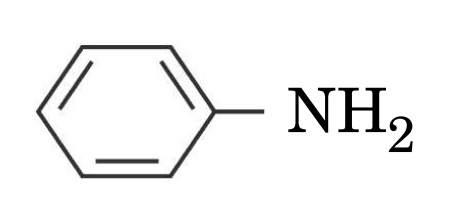
Which of the following is least basic?
- (A) NH₃
- (B) (CH₃)₃N
- (C) (CH₃)₂NH
-
(D) NH2
The glycosidic linkage involved in linking the glucose units in amylase part of starch is :
An α- helix is a structural feature of :
Assertion (A) -NH₂ group is o- and p-directing in electrophilic substitution reactions.
Reason (R) : Aniline cannot undergo Friedel-Crafts reaction.
Assertion (A) : Acetylation of aniline gives a monosubstituted product.
Reason (R) : Activating effect of -NHCOCH₃ group is more than that of amino group.
Assertion (A) : The molecularity of the reaction H₂ + Br₂ → 2HBr appears to be 2.
Reason (R) : Two molecules of the reactants are involved in the given elementary reaction.
Assertion (A) : Low spin tetrahedral complexes are rarely observed.
Reason (R) : Crystal field splitting energy is less than pairing energy for tetrahedral complexes.
Section C
(a) On diluting two electrolytes 'A' and 'B', the λₘ of 'A' increases 25 times while that of 'B' increases by 1.5 times. Which of the two electrolytes is strong? Justify your answer graphically.
(b) The electrical resistance of a column of 0.05 mol L⁻¹ NaOH solution of diameter 1 cm and length 50 cm is 5.55 × 10³ ohm. Calculate the conductivity.
Complete the following equation:
(a) 2MnO₄⁻ + 5NO₂⁻ + 6H⁺ →
(b) Cr₂O₇²⁻ + 14H⁺ + 6e⁻ → ?
Identify 'A' , and 'B' in the above reactions.
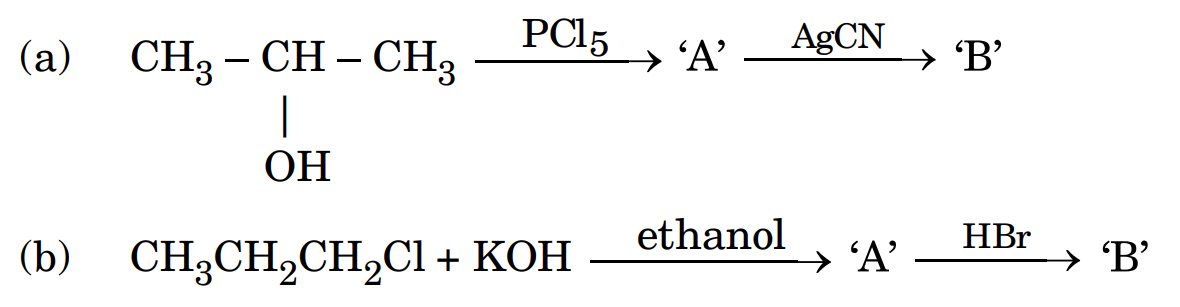
Account for the following:
(i) Phenol is a stronger acid than an alcohol.
(ii) The boiling point of alcohols decreases with increase in branching of alkyl chain.
(i) Write the mechanism of the following reaction :
(ii) Write the equation involved in Reimer-Tiemann reaction.

Explain briefly :
(a) Carbylamine reaction
(b) Gabriel phthalimide synthesis
(a) Write chemical reaction to show that open structure of D-glucose contains the straight chain.
(b) What type of linkage is responsible for the formation of protein ?
What is Henry's law? Give one application of it.
Section D
(a) Differentiate between Ideal solution and Non-ideal solution.
(b) 30 g of urea is dissolved in 846 g of water. Calculate the vapour pressure of water for this solution if vapour pressure of pure water at 298 K is 23.8 mm Hg.
Write main product formed when :
(a) Methyl chloride is treated with NaI/Acetone.
(b) 2,4,6-trinitrochlorobenzene is subjected to hydrolysis.
(c) 2,4,6-trinitrochlorobenzene is subjected to hydrolysis.
How do you convert the following : (Any three)
(a) Phenol to picric acid
(b) Propanone to 2-Methylpropan-2-ol
(c) Phenol to anisole
(d) Phenol to anisole
Explain why:
(i) Carboxyl group in benzoic acid is meta directing.
(ii) Sodium bisulphite is used for the purification of aldehydes and ketones.
(iii) Carboxylic acids do not give characteristic reactions of carbonyl group.
An organic compound 'A', having the molecular formula C₃H₈O on treatment with Cu at 573 K, gives 'B'. 'B' does not reduce Fehling's solution but gives a yellow precipitate of the compound 'C' with I₁/NaOH. Deduce the structures of A, B and C.
(a) What are the hydrolysis products of (i) Lactose, (ii) Maltose ?
(b) Give the basic structural difference between starch and cellulose.
Section E
(i) State Kohlrausch's law of independent migration of ions. Write an expression for the limiting molar conductivity of acetic acid according to Kohlrausch's law.
(ii) Calculate the maximum work and log Kc for the given reaction at 298 K:
Ni (s) + 2Ag⁺ (aq) ⇌ Ni²⁺ (aq) + 2Ag (s)
Given: E°Ni²⁺/Ni = -0.25 V, E°Ag⁺/Ag = +0.80 V,
1 F = 96500 C mol⁻¹.
(i) State Faraday's first law of electrolysis. How much charge, in terms of Faraday, is required for the reduction of 1 mol Cu²⁺ to Cu?
(ii) Calculate emf of the following cell at 298 K for
Mg (s) | Mg²⁺ (0.01 M) || Cu²⁺ (0 .01 M) | Cu (s)
[E°cell = + 2.71 V, 1 F = 96500 C mol⁻¹, log 10 = 1]
Assign reason for each of the following :
(i) Manganese exhibits the highest oxidation state of +7 among the 3d series of transition elements.
(ii) Transition metals and their compounds are generally found to be good catalysts in chemical reactions.
(iii) Cr²⁺ is reducing in nature while with the same d-orbital configuration (d⁴) Mn³⁺ is an oxidising agent.
(iv) Zn has lowest enthalpy of atomization.
(v) Cu⁺ is unstable in an aqueous solution.
(i) Carry out the following conversions :
(1) Ethanal to But-2-en-1-al
(2) Propanoic acid to 2-chloropropanoic acid
(ii) An alkene with molecular formula C₅H₁₀ on ozonolysis gives a mixture of two compounds 'B' and 'C'. Compound 'B' gives positive Fehling test and also reacts with iodine and NaOH solution. Compound 'C' does not give Fehling solution test but forms iodoform. Identify the compounds 'A', 'B' and 'C'.
(i) Distinguish with a suitable chemical test:
(1) CH₃COCH₂CH₃ and CH₃CH₂CH₂CHO
(2) Ethanal and Ethanoic acid
(ii) Write the structure of oxime of acetone.
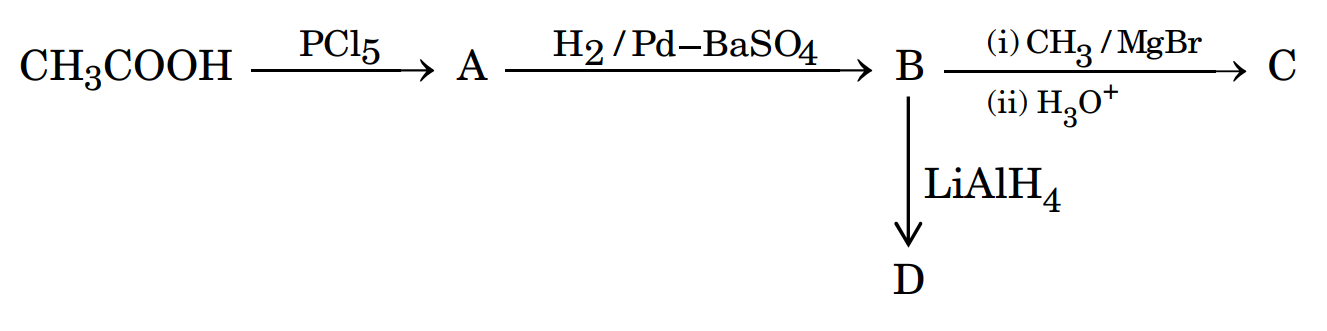
(iii) Identify A to D.
Paper Details
CBSE Board Exam 2023
Class
Class 12 PCM
Subject
Chemistry
Year
2023
Set
Set 1
Other Years — Chemistry