QUESTION PAPER
2023 BOARD EXAM
CBSE Class 12 PCM Chemistry Board Paper 2023 — Set 2
2023
Chemistry
Class 12 PCM
CBSE EXAMINATION PAPER-2023
CHEMISTRY
(Solved)
General Instructions :
Read the following instructions carefully and follow them :
- This question paper contains 42 questions. All questions are compulsory.
- This question paper is divided into 5 sections.
- Section A – questions number 1 to 3 are case based questions
- Section B – questions number 4 to 21 are multiple choice questions
- Section C – questions number 22 to 30 are very short answer
- Section D – questions number 31 to 36 are short answer
- Section E – questions number 37 to 42 are long answer
- There is no overall choice given in the question paper. However, an internal choice has been provided in few questions.
- Use of calculator is NOT allowed.
Section A
The following questions are case based questions. Read the passage carefully and answer the questions that follow
The carbon – oxygen double bond is polarised in aldehydes and ketones due to higher electronegativity of oxygen relative to carbon. Therefore they undergo nucleophilic addition reactions with a number of nucleophiles such as HCN, NaHSO₃, alcohols, ammonia derivatives and Grignard reagents. Aldehydes are easily oxidised by mild oxidising agents as compared to ketones. The carbonyl group of carboxylic acid does not give reactions of aldehydes and ketones. Carboxylic acids are considerably more acidic than alcohols and most of simple phenols.
(1) Write the name of the product when an aldehyde reacts with excess alcohol in presence of dry HCl.
(2) Why carboxylic acid is a stronger acid than phenol ?
(3) (i) Arrange the following compounds in increasing order of their reactivity towards CH₃MgBr : (ii) Write a chemical test to distinguish between propanal and propanone.
 [2 Marks]
(4) Write the main product in the following :
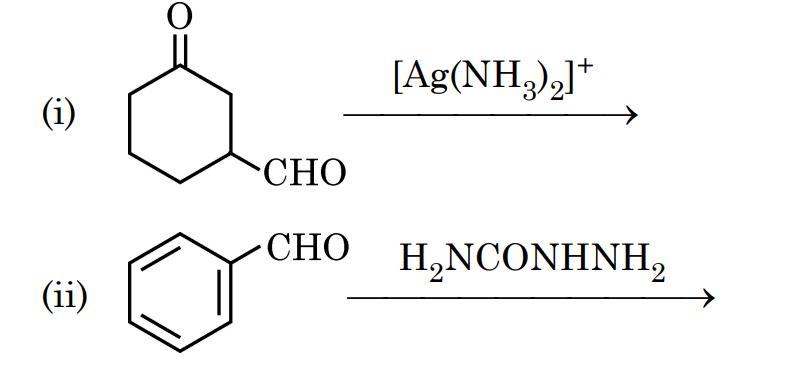 [2 Marks]
Carbohydrates are optically active polyhydroxy aldehydes and ketones. They are also called saccharides. All those carbohydrates which reduce Fehling’s solution and Tollen’s reagent are referred to as reducing sugars. Glucose, the most important source of energy for mammals, is obtained by the hydrolysis of starch. Vitamins are accessory food factors required in the diet. Proteins are the polymers of α-amino acids and perform various structural and dynamic functions in the organisms. Deficiency of vitamins leads to many diseases.
(1) The penta-acetate of glucose does not react with Hydroxylamine. What does it indicate ?
(2) Why cannot vitamin C be stored in our body ?
(3) Define the following as related to proteins : (i) Peptide linkage (ii) Denaturation
(4) Define the following as related to carbohydrates : (i) Anomers (ii) Glycosidic linkage
Section B
The conversion of an alkyl halide into an alkene by alcoholic KOH is classified as
The oxidation state of Fe in [Fe(CO)₅] is
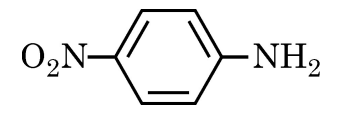
Among the following, which is the strongest base?
-
(A)
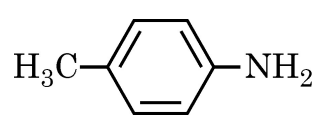
-
(B)
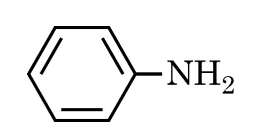
-
(C)
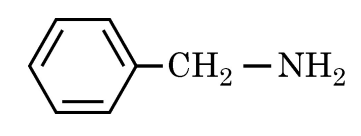
-
(D)
The slope in the plot of ln[R] vs. time for a first order reaction is
An α-helix is a structural feature of
Racemisation occurs in
Value of Henry’s constant Kₕ:
Which of the following solutions of KCl will have the highest value of molar conductivity?
Which of the following reactions are feasible?
Which of the following is most reactive in nucleophilic addition reactions?
Which of the following does not give aldol condensation reaction?
-
(A)
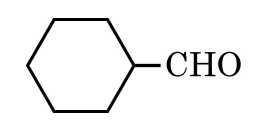
- (B) CH₃–CHO
- (C) CH₃COCH₃
-
(D)
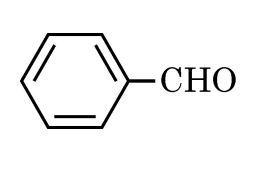
For the reaction 3A → 2B, rate of reaction + d[B]/dt is equal to
Which of the following characteristics of transition metals is associated with their catalytic activity?
The formula of the complex dichloridobis(ethane–1, 2-diamine) platinum(IV) nitrate is
Assertion (A) : Osmotic pressure is a colligative property.
Reason (R) : Osmotic pressure is proportional to the molality.
Assertion (A) : Conductivity decreases with decrease in concentration of electrolyte.
Reason (R) : Number of ions per unit volume that carry the current in a solution decreases on dilution.
Assertion (A) : Copper is a non-transition element.
Reason (R) : Copper has completely filled d-orbitals in its ground state.
Assertion (A) : Nucleophilic substitution of iodoethane is easier than chloroethane.
Reason (R) : Bond enthalpy of C-I bond is less than that of C-Cl bond.
Section C
The vapour pressure of pure liquid X and pure liquid Y at 25 °C are 120 mm Hg and 160 mm Hg respectively. If equal moles of X and Y are mixed to form an ideal solution, calculate the vapour pressure of the solution.
Give reasons :
(i) Mercury cell delivers a constant potential during its life time.
(ii) In the experimental determination of electrolytic conductance, Direct Current (DC) is not used.
Define fuel cell with an example. What advantages do the fuel cells have over primary and secondary batteries ?
(a) The conversion of molecule A to B followed second order kinetics. If concentration of A increased to three times, how will it affect the rate of formation of B ?
(b) Define Pseudo first order reaction with an example.
Write the IUPAC names of the following :
(i) [Co(NH₃)₅(ONO)]²⁺
(ii) K₂[NiCl₄]
(i) What is a chelate complex ? Give one example.
(ii) What are heteroleptic complexes ? Give one example.
Write the chemical equation involved in the following reactions :
(a) Reimer-Tiemann reaction
(b) Acetylation of Salicylic acid
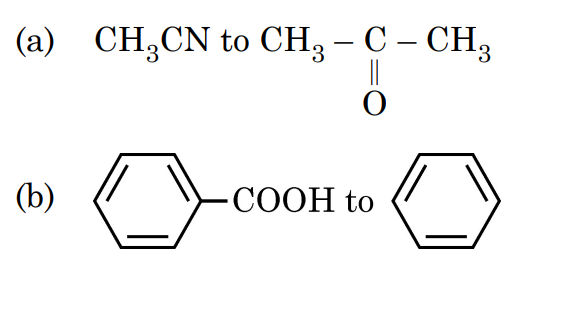
Do the following conversions in not more than two steps :
Write two differences between DNA and RNA.
Section D
(i) Write the mechanism of the following reaction :
(ii) Why ortho-nitrophenol is steam volatile while para-nitrophenol is not ?

Answer any 3 of the following:
(a) Which isomer of C₅H₁₀ gives a single monochloro compound C₅H₉Cl in bright sunlight ?
(b) Arrange the following compounds in increasing order of reactivity towards SN2 reaction : 2-Bromopentane, 1-Bromopentane, 2-Bromo-2-methylbutane
(c) Why p-dichlorobenzene has higher melting point than those of ortho and meta-isomers ?
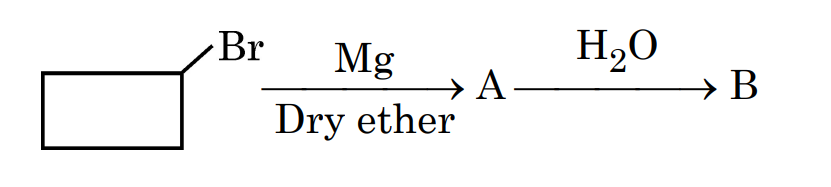
(d) Identify A and B in the following :
A first order reaction is 50% complete in 30 minutes at 300 K and in 10 minutes at 320 K. Calculate activation energy (Eₐ) for the reaction. [R = 8.314 J K⁻¹ mol⁻¹]
[Given : log 2 = 0.3010, log 3 = 0.4771, log 4 = 0.6021]
When 19.5 g of F – CH₂ – COOH (Molar mass = 78 g mol⁻¹), is dissolved in 500 g of water, the depression in freezing point is observed to be 1°C. Calculate the degree of dissociation of F – CH₂ – COOH.
[Given : Kf for water = 1.86 K kg mol⁻¹]
(a) Draw the geometrical isomers of [Co(en)₂Cl₂]²⁺. Which geometrical isomer of [Co(en)₂Cl₂]²⁺ is not optically active and why ?
(b) Write the hybridisation and magnetic behaviour of [CoF₆]³⁻.
[Given : Atomic number of Co = 27]
What happens when:
(i) Anisole is treated with CH₃Cl/anhydrous AlCl₃ ?
(ii) Phenol is oxidised with Na₂Cr₂O₇/H⁺ ?
(iii) (CH₃)₃ C - OH is heated with Cu/574K?
Write chemical equation in support of your answer.
Section E
Account for the following :
(i) Eo value for Mn³⁺/ Mn²⁺ couple is much more positive than that for Cr³⁺/ Cr²⁺.
(ii) Sc³⁺ is colourless whereas Ti³⁺ is coloured in an aqueous solution.
(iii) Actinoids show wide range of oxidation states.
Write the chemical equations for the preparation of KMnO₄ from MnO₂.
(I) Account for the following :
(i) Transition metals form alloys.
(ii) Ce⁴⁺ is a strong oxidising agent.
(II) Write one similarity and one difference between chemistry of Lanthanoids and Actinoids.
(III) Complete the following ionic equation : Cr₂O₇²⁻ + 2OH⁻ →
(I) Give reasons :
(i) Aniline on nitration gives good amount of m-nitroaniline, though – NH2 group is o/p directing in electrophilic substitution reactions.
(ii) (CH₃)₂ NH is more basic than (CH₃)₃N in an aqueous solution.
(iii) Ammonolysis of alkyl halides is not a good method to prepare pure primary amines.
(II) Write the reaction involved in the following :
(i) Gabriel phthalimide synthesis
(ii) Carbyl amine test
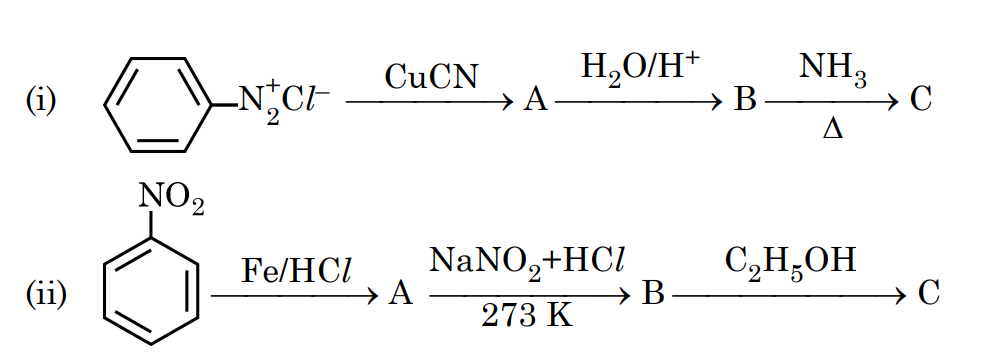
(I) Write the structures of A, B and C in the following reactions :
(II) Why aniline does not undergo Friedal-Crafts reaction ?
(III) Arrange the following in increasing order of their boiling point : C₂H5OH, C₂H₅NH₂, (C₂H₅)₃N
(a) Conductivity of 2* 10⁻³ M methanoic acid is 8 * 10⁻⁵ S cm⁻¹. Calculate its molar conductivity and degree of dissociation if Λ°ₘ m for methanoic acid is 404 S cm² mol⁻¹.
(b) Calculate the ΔᵣG° and log Kc for the given reaction at 298 K :
Ni₍ₛ₎ + 2Ag⁺(aq) ⇌ Ni²⁺ (aq) + 2Ag ₍ₛ₎
Given: E° Ni²⁺/Ni = -0.25 V, E° Ag⁺/Ag = +0.80V
1F = 96500 C mol⁻¹.
Paper Details
CBSE Board Exam 2023
Class
Class 12 PCM
Subject
Chemistry
Year
2023
Set
Set 2
Other Years — Chemistry