SOLUTIONS
2025 BOARD EXAM
CBSE Class 12 PCM Chemistry Board Paper 2025 — Set 5 Solutions
2025
Chemistry
Class 12 PCM
CBSE EXAMINATION PAPER-2025
CHEMISTRY
(Solved)
General Instructions :
Read the following instructions carefully and follow them :
- This question paper contains 39 questions. All questions are compulsory.
- This question paper is divided into 5 sections.
- Section A – questions number 1 to 3 are case based questions
- Section B – questions number 4 to 19 are multiple choice questions
- Section C – questions number 20 to 25 are very short answer
- Section D – questions number 26 to 33 are short answer
- Section E – questions number 34 to 39 are long answer
- There is no overall choice given in the question paper. However, an internal choice has been provided in few questions.
- Use of calculator is NOT allowed.
Section A
Alcohols undergo a number of reactions involving the cleavage of C – OH bond. However, phenols do not undergo reactions involving the cleavage of C – OH bond. Alcohols are weaker acids than water. Alcohols react with halogen acids to form the corresponding haloalkanes. Phenols are stronger acids than alcohols. A characteristic feature of phenols is that they undergo electrophilic substitution reactions such as halogenation, nitration, etc. Since – OH group is a strong activating group, phenol gives trisubstituted products during halogenation, nitration, etc.
(1) What happens when phenol is treated with the following ? (i) Br₂ water (ii) Conc. HNO₃
(2) Why do phenols not undergo reactions involving cleavage of C – OH bond ?
(3) Write the mechanism of alcohol reacting as nucleophile in are action with CH₃⊕ .
(4) How can you distinguish between Butan-1-ol and 2-Methylpropan-2-ol by using HCl in the presence of anhydrous ZnCl₂ ?
The a-amino acids are the building blocks of proteins. All a-amino acids exist as zwitter ion due to which they show amphoteric behaviour. All amino acids are joined through peptide bond. Proteins are broadly classified as globular proteins and fibrous proteins. Globular proteins are water soluble, whereas fibrous proteins are not. The complete structure of protein is discussed at four different levels i.e. primary, secondary, tertiary and quaternary structures. Protein loses its biological activity in denatured form.
(1) Define the following : (i) Peptide linkage (ii) Denatured protein
(2) Write the names of two different secondary structures of proteins.
(3) Why do amino acids show amphoteric behaviour ?
(4) How can you differentiate between Fibrous protein and Globular protein ?
Section B
Williamson synthesis of preparing unsymmetrical ether is:
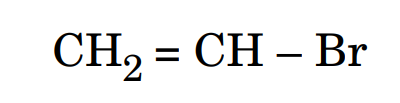
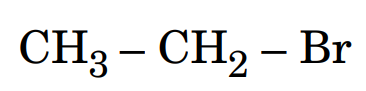
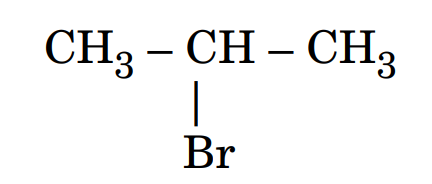
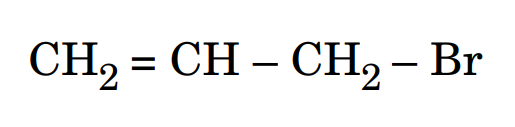
Which of the following compounds would be hydrolysed by aqueous KOH most easily?
-
(A)
-
(B)
-
(C)
-
(D)
According to Werner’s theory of coordination compounds:
The correct option is 'Primary valences are ionisable.' According to Werner’s theory, primary valences denote the ionisable part of the metal ion and are satisfied by negative ions, while secondary valences are non-ionisable.
Which of the following complex ion is not optically active?
A molecule is optically active if it cannot be superimposed on its mirror image. The trans isomer of [Co(en)₂Cl₂]⁺ has a plane of symmetry, meaning its mirror image can be superimposed on the original molecule, making it optically inactive.
Which of the following is the softest metal?
Among the given options (Fe, Zn, Cu, Sc), Zinc (Zn) is the softest metal. The context mentions that transition metals are generally very hard, with exceptions like Zn, Cd, and Hg, which do not display the typical hardness properties of transition elements. This indicates that zinc is comparatively softer than the other metals listed.
In the Hinsberg’s method for separation of primary, secondary and tertiary amines, the reagent used is:
-
(A)
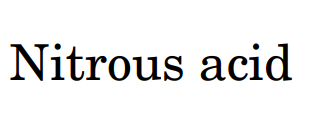
-
(B)
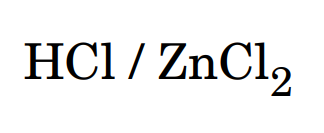
-
(C)
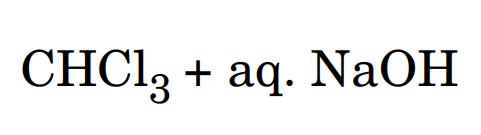
-
(D)
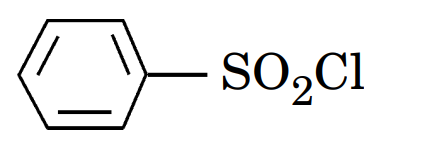
Which one of the following amines gives an alcohol on reaction with HNO₂?
-
(A)
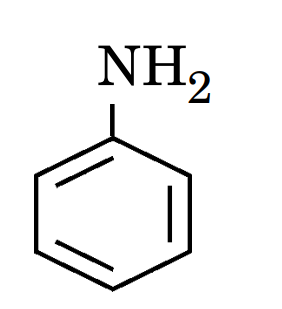
-
(B)
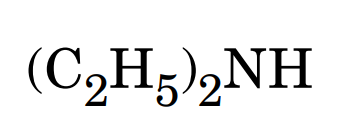
-
(C)
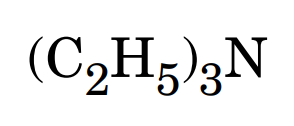
-
(D)
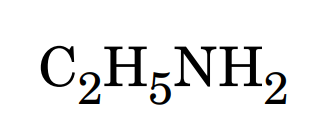
The freezing point of one molal KCl solution, assuming KCl to be completely dissociated in water, is: (Kf for water = 1·86 K kg mol⁻¹)
To calculate the depression in freezing point (ΔTf), we use the formula ΔTf = i * Kf * m, where i (van't Hoff factor for KCl) = 2 (since KCl dissociates into K+ and Cl-), Kf for water = 1.86 K kg mol⁻¹, and m = 1 molal. Thus, ΔTf = 2 * 1.86 * 1 = 3.72°C. The freezing point will decrease, so the final freezing point = 0°C - 3.72°C = -3.72°C.
A solution of acetone in ethanol:
The correct answer is 'shows a positive deviation from Raoult’s law.' This is because when acetone is added to ethanol, it disrupts the hydrogen bonding between ethanol molecules, leading to an increase in vapor pressure. This implies that the solution will exhibit positive deviation from Raoult's law, where the mixture's vapor pressure is higher than expected for an ideal solution.
Which of the following cell converts the energy of combustion of fuel into electrical energy?
The correct answer is 'Fuel cell' because, as stated in the context, fuel cells are designed specifically to convert the energy from the combustion of fuels like hydrogen, methane, and methanol directly into electrical energy.
The unit of rate and rate constant are same for a:
The correct option is 'Zero order reaction'. For a zero order reaction, the unit of rate (mol L⁻¹ s⁻¹) is the same as the unit of the rate constant (k), which is also expressed as mol L⁻¹ s⁻¹ according to the provided context.
Pyranose ring of glucose is formed due to the reaction between:
The correct option is C₁ and C₅. The pyranose ring structure of glucose, which is a six-membered ring, is formed when the hydroxyl group (-OH) on carbon atom 5 (C-5) reacts with the aldehyde group (C-1) to create a cyclic structure, leading to the absence of the aldehyde (-CHO) group in the cyclic form.
Assertion (A) : Actinoids show wide range of oxidation states.
Reason (R) : Actinoids are radioactive in nature .
Assertion (A) : Hydrolysis of an ester follows first order kinetics.
Reason (R) : The concentration of water does not get altered much during the reaction.
Both Assertion (A) and Reason (R) are true, but Reason (R) is not the correct explanation of the Assertion (A). The hydrolysis of an ester like ethyl acetate is indeed a second order reaction generally, but behaves as pseudo first order due to the large excess of water, which means its concentration remains almost constant throughout the reaction. Therefore, while both statements are true, the reason provided does not directly explain why the assertion holds.
Assertion(A): Boiling point of (CH3)3N is higher than that of CH₃CH₂CH₂NH₂.
Reason (R) : Hydrogen bonding is more extensive in CH₃CH₂CH₂NH₂.
Both Assertion (A) and Reason (R) are true, but Reason (R) is not the correct explanation of the Assertion (A). (CH3)3N (trimethylamine) has steric hindrance that reduces the ability to form hydrogen bonds compared to CH₃CH₂CH₂NH₂ (propylamine), which has more hydrogen bonding due to its structure, resulting in a higher boiling point for propylamine despite the assertion.
Assertion (A) : Phenol is strongly acidic as compared to ethanol.
Reason (R) : Phenoxide ion is more stable than ethoxide ion.
The correct answer is 'Both Assertion (A) and Reason (R) are true and Reason (R) is the correct explanation of the Assertion (A)'. Phenol is more acidic than ethanol due to the stability of the phenoxide ion, which is a result of the delocalization of the negative charge. In contrast, the negative charge in the ethoxide ion is localized, making it less stable. This greater stability of the phenoxide ion compared to the ethoxide ion explains why phenol is more acidic.
Section C
State Henry’s law. Why are aquatic species more comfortable in cold water as compared to warm water ?
Aquatic species are more comfortable in cold water because solubility of gases like oxygen increases as temperature decreases. So colder water holds more dissolved oxygen than warm water, which aquatic animals need to survive.
Observe the graph in the given figure and answer the following questions :
(a) Predict the order of reaction.
(b) What is the slope of the curve ?
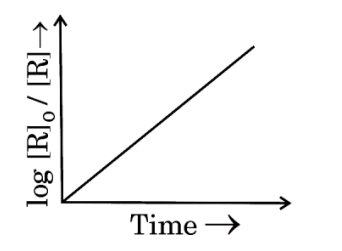
(b) The slope of the curve represents the rate constant k of the reaction. The slope is equal to -k, which means the slope has a negative value. This negative slope shows that the concentration decreases exponentially with time in a first order reaction.
Write IUPAC names of the following coordination compounds :
(i) [CoCl₂(en)₂]SO₄
(ii) K₃[Fe(C₂O₄)₃]
(ii) The complex ion is [Fe(C2O4)3]3-, where C2O42- is the oxalato ligand, a bidentate ligand. There are three oxalato ligands attached to Fe. The cation is K+, with three potassium ions balancing the charge. The oxidation state of Fe is +3. The IUPAC name is 'Potassium trioxalatoiron(III)'.
Differentiate between :
(i) Double salt and Complex compound
(ii) Didentate ligand and Ambidentate ligand
Complex compound is formed by a central metal ion bonded to ligands forming a coordinate bond, and it does not dissociate into the original salts in solution.
(ii) Didentate ligand is a ligand that attaches to the central metal atom through two donor atoms.
Ambidentate ligand is a ligand that has two different donor atoms but attaches to the metal through only one donor atom at a time.
Draw the structures of major monohalo products in each of the following reactions :
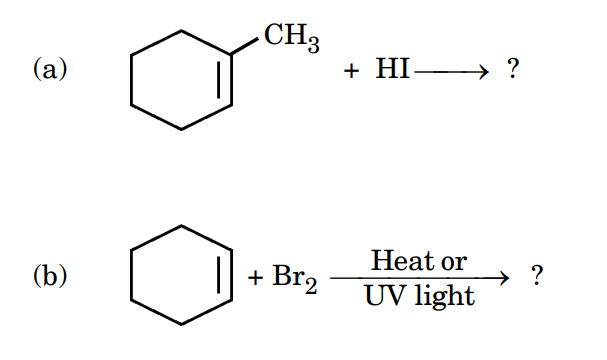
Explanation: SOCl2 replaces the -OH group in cyclohexanol with chlorine, forming chlorocyclohexane.
(ii) Example 2 reaction (if provided) ⟶ Corresponding monohalo product structure
Explanation: Briefly describe the substitution or reaction mechanism leading to the monohalo product.
Note: For each reaction, the -OH or halogenation site is replaced by a single halogen atom, producing the major monohalo product as specified.
How do you explain the following ?
(a) Presence of an aldehydic group in glucose.
(b) Presence of five – OH groups in glucose.
(b) Glucose has five –OH groups, one on each carbon except the aldehyde carbon. This is confirmed by acetylation of glucose with acetic anhydride, which produces glucose pentaacetate, showing five hydroxyl groups were present to react.
Section D
The rate of a reaction :
A + B ⎯⎯→productis given below as a function of different initial concentrations of A and B.
Calculate the order of the reaction with respect to A and B. Determine the rate constant of the reaction.
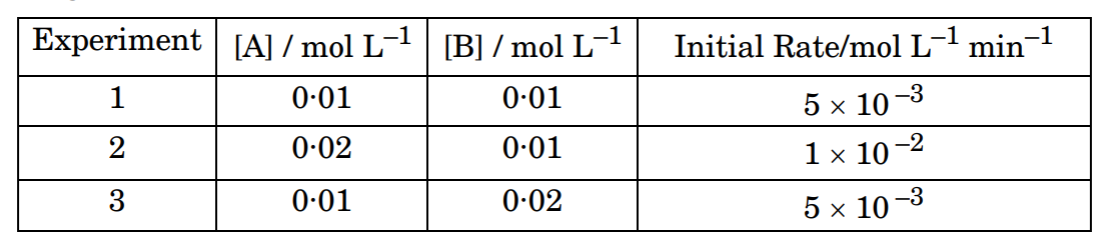
(a) The rate law is given as Rate = k [A]1/2[B]3/2.
Order with respect to A is 1/2 and order with respect to B is 3/2.
The overall order of the reaction = 1/2 + 3/2 = 2, which means the reaction is second order.
(b) Given Rate = k [A]3/2 [B]-1, the order with respect to A is 3/2 and with respect to B is -1 (negative order means rate decreases with increase in concentration of B).
The overall order = 3/2 + (-1) = 1/2.
Explanation:
The order of a reaction with respect to a reactant is the power to which its concentration is raised in the rate law. The overall order is the sum of these exponents and defines how the rate depends on total concentration.
To determine the rate constant, use any experimental data with known initial concentrations and initial rate. Rearrange the rate law to k = rate / ([A]x[B]y), and substitute values to find k.
Thus, identifying orders helps understand how changes in concentration affect the reaction rate and enables calculation of the rate constant, a vital parameter to quantify reaction speed under given conditions.
Give reasons for the following :
(a) The pH of aqueous NaCl increases when it is electrolysed.
(b) Unlike dry cell, mercury cell has a constant cell potential through its lifetime.
(c) Conductivity of solution decreases with dilution.
(b) Mercury cell has a constant cell potential because it uses liquid mercury as one electrode which maintains constant concentration of Hg2+ ions, resulting in stable emf throughout its life.
(c) The conductivity decreases on dilution because the number of ions per unit volume decreases, so fewer charge carriers are present, reducing the ability of the solution to conduct electricity.
Answer the following about the complexes [FeF₆]³⁻ and [Fe(CN)₆]⁴⁻ :
(i) Write the hybridization involved in each case.
(ii) Which of them is the outer orbital complex and which one is the inner orbital complex ?
(iii) Compare their magnetic behaviour.
[Atomic number : Fe = 26]
(ii) [FeF6]3- is an outer orbital complex because it involves sp3d2 hybridization using 4s and 4p orbitals and 4d orbital. [Fe(CN)6]4- is an inner orbital complex as it involves d2sp3 hybridization using 3d orbitals of Fe.
(iii) Magnetic behaviour: [FeF6]3- has five unpaired electrons (high spin), so it is paramagnetic with high magnetic moment. [Fe(CN)6]4- has all electrons paired (low spin), so it is diamagnetic with no magnetic moment. Thus, [FeF6]3- is paramagnetic and [Fe(CN)6]4- is diamagnetic.
(i) What happens to the colour of complex [Ti(H₂O)₆]³⁺ when heated gradually ?
(ii) Write the electronic configuration for d⁵ ion if Δₒ < P.
(iii) Write the hybridization and magnetic behaviour of the complex [Ni(CO)₄].
[Atomic number : Ni = 28]
(b) For a d5 ion with crystal field splitting energy (Δo) less than pairing energy (P), the configuration will be high spin. Therefore, the electronic configuration is t2g3 eg2 with five unpaired electrons.
(c) In the complex [Ni(CO)4], nickel has oxidation state zero and electronic configuration of Ni is 3d8 4s2. The hybridization is dsp2 resulting in a tetrahedral geometry. Since CO is a strong field ligand, it causes pairing of electrons, making the complex diamagnetic (all electrons are paired).
Write any two differences between SN_1 and SN_2 reactions. Which of the following compounds would undergo SN_1 reaction faster and why ?

SN1 reaction involves two steps with formation of a carbocation intermediate and its rate depends only on the concentration of the substrate. It is favoured by tertiary carbons because carbocation stability is important.
SN2 reaction is a one-step mechanism where the nucleophile attacks the substrate from the opposite side causing inversion of configuration. Its rate depends on both substrate and nucleophile concentrations and is faster with primary carbons due to less steric hindrance.
(b) Among the given compounds C6H5CH2Br, C6H5CH(CH3)Br, and C6H5C(CH3)2Br, the compound C6H5CH2Br undergoes SN1 reaction faster because it forms a more stable benzylic carbocation stabilized by resonance with the phenyl group. This stability increases the rate of SN1 reaction as it depends on carbocation intermediate formation.
A compound (A) with molecular formula C₄H₅N on reduction with DIBAL-H followed by hydrolysis, gives a compound (B). Compound (B) gives positive Tollens’ test but does not give iodoform test. Compound (B) can also be obtained when ethanal is treated with dilute NaOH followed by heating. Identify (A) and (B). Write the reactions of (A) with DIBAL-H followed by hydrolysis.
CH3CN + DIBAL-H (at low temperature) → intermediate imine aluminum complex
Intermediate + H2O (hydrolysis) → CH3CHO (acetaldehyde)
Thus, reduction of nitrile (A) with DIBAL-H followed by hydrolysis produces the aldehyde (B).
How will you obtain the following from aniline ? Give chemical equations only.
(a) Sulphanilic acid
(b) Phenylisocyanide
(c) Acetanilide
C6H5NH2 + H2SO4 (conc.) \u2192 C6H5NH3+ HSO4- (anilinium hydrogensulphate)
C6H5NH3+ HSO4- \u2192 C6H4SO3HNH2 (Sulphanilic acid) (heating at 453-473 K)
(b) Phenylisocyanide:
C6H5NH2 + CHCl3 + KOH \u2192 C6H5NC + KCl + 2H2O
(c) Acetanilide:
C6H5NH2 + (CH3CO)2O \u2192 C6H5NHCOCH3 + CH3COOH
Vapour pressure of pure water at 298 K is 24·8 mm Hg. Calculate the lowering in vapour pressure of an aqueous solution which freezes at– 0·3°C. (Kf of water = 1·86 K kg mol⁻¹)
Freezing point depression, ΔTf = 0.3 deg C = 0.3 K
Freezing point depression constant, Kf = 1.86 K kg mol-1
Step 1: Calculate molality (m) of the solution
The formula for freezing point depression is ΔTf = Kf * m
So, m = ΔTf / Kf = 0.3 / 1.86 = 0.1613 mol kg-1
Step 2: Calculate mole fraction of solute (X2)
Let the solvent be water with molality m means m moles of solute per 1 kg of solvent.
Number of moles of solvent (water) in 1 kg = 1000 g / 18 g mol-1 = 55.56 mol
Mole fraction of solute,
X2 = m / (m + moles of solvent) = 0.1613 / (0.1613 + 55.56) = 0.0029
Step 3: Calculate lowering in vapour pressure (ΔP)
Lowering in vapour pressure is given by Raoult's law,
ΔP = P0 * X2 = 24.8 * 0.0029 = 0.072 mm Hg
Answer: The lowering in vapour pressure of the solution is 0.072 mm Hg.
Section E
(i) Calculate Ecell of a galvanic cell in which the following reaction takes place at 25°C: Zn(s) + Pb²⁺(0.02 M) ⎯→Zn²⁺(0.1 M) + Pb(s)
[Given: Zn²⁺/Zn E = -0.76 V, Pb²⁺/Pb E° = -0.13 V;
log 2 = 0.3010, log 4 = 0.6021, log 5 = 0.6990].
(ii) State Faraday’s first law of electrolysis. How much electricity, in terms of Faraday, is required to reduce one mol of MnO₄⁻ to Mn²⁺ ion?
Ecell = E°cell - (0.059 / n) * log([Zn2+] / [Pb2+]) = 0.63 - (0.059 / 2) * log(0.1 / 0.02)
Calculate log(0.1/0.02) = log(5) = 0.6990
So, Ecell = 0.63 - 0.0295 * 0.6990 = 0.63 - 0.0206 = 0.6094 V ≈ 0.61 V
(ii) Faraday’s first law of electrolysis states that the mass of substance deposited or liberated at an electrode is proportional to the quantity of electricity passed through the electrolyte.
For the reduction of MnO4- to Mn2+, the balanced half reaction in acidic medium is:
MnO4- + 8H+ + 5e- → Mn2+ + 4H2O
This shows 5 moles of electrons are required to reduce 1 mole of MnO4- to Mn2+, so 5 Faradays of electricity are needed to reduce one mole of MnO4-.
(i) The resistance of a conductivity cell containing 0.001 M KCl solution at 298 K is 1000 ohm. What is the cell constant if conductivity of 0.001 M KCl solution at 298 K is 0.125 × 10⁻³ S cm⁻¹?
(ii) Calculate the Mg/Mg²⁺ E potential for the following half cell at 25°C: Mg/Mg²⁺(1 × 10⁻⁴ M); Mg²⁺/Mg E = +2.36 V.
(iii) What is the effect of temperature on the electrical conductance of a metallic conductor?
Resistance R = 1000 ohm
Conductivity κ = 0.125 × 10⁻³ S cm-1 = 0.125 × 10⁻³ S/cm
We know, Cell constant G* = Conductivity × Resistance = κ × R
So, G* = 0.125 × 10-3 × 1000 = 0.125 S/cm × ohm = 0.125 cm-1
Hence, the cell constant is 0.125 cm-1.
(ii) Given:
Standard electrode potential E0 (Mg2+/Mg) = -2.36 V (since Mg/Mg2+ has E0 = -2.36 V)
Concentration of Mg2+ ions, c = 1 × 10⁻⁴ M
Temperature T = 25°C = 298 K
The Nernst equation for this half cell is:
E = E0 - (0.0592 / n) log(1 / [Mg2+])
Here, n = 2 (change in electrons in the half reaction)
So,
E = -2.36 - (0.0592 / 2) log(1 / (1 × 10⁻⁴))
E = -2.36 - 0.0296 × log(104)
log(104) = 4, so
E = -2.36 - 0.0296 × 4 = -2.36 - 0.1184 = -2.4784 V
Therefore, the E potential of Mg/Mg2+ half cell at this concentration is -2.48 V (approx).
(iii) The electrical conductance of a metallic conductor increases with increase in temperature because the movement of free electrons becomes easier due to increased energy. However, resistance of metals usually increases with temperature due to increased lattice vibrations that scatter electrons. Thus, the overall effect is a decrease in conductivity with rise in temperature for metals, but the specific conductance may vary depending on material properties.
To conclude, temperature generally causes resistance of metallic conductors to increase, thereby decreasing electrical conductance.
Account for the following:
(I) Orange colour of Cr₂O₇²⁻ ion changes to yellow when treated with an alkali.
(II) Zn, Cd, and Hg are non-transition elements.
(III) E° value for Mn³⁺/Mn²⁺ couple is highly positive (+1.57 V) as compared to Cr³⁺/Cr²⁺.
(iii) What happens when:
(I) Manganate ion undergoes disproportionation reaction in acidic medium?
(II) KMnO₄ is heated?
(b) Zn, Cd, and Hg are not considered transition elements because they have completely filled d-sub shell in their common oxidation state (Zn: 3d10, Cd: 4d10, Hg: 5d10). Transition elements are defined as elements whose atoms or ions have partially filled d-orbitals. Since these elements do not have incompletely filled d-orbitals, they are not true transition metals.
(c) The E° value for the Mn3+/Mn2+ couple is highly positive (+1.57 V) compared to Cr3+/Cr2+ because Mn3+ is a strong oxidizing agent and has a greater tendency to gain an electron to form more stable Mn2+ state. On the other hand, Cr3+ is more stable due to half-filled t2g orbitals and thus has a lower reduction potential.
(d) (i) Manganate ion (MnO42-) undergoes disproportionation in acidic medium to form permanganate ion (MnO4-) in +7 oxidation state and manganese dioxide (MnO2) in +4 oxidation state according to: 3MnO42- + 4H+ → 2MnO4- + MnO2 + 2H2O.
(ii) On heating, KMnO4 decomposes to give K2MnO4 (manganate), MnO2 and oxygen gas according to: 2KMnO4 → K2MnO4 + MnO2 + O2. This reaction shows the disproportionation of Mn from +7 oxidation state in permanganate to +6 in manganate and +4 in manganese dioxide.
(i) What is ‘Misch metal’? Give its one use.
(ii) Write the formula of an oxoanion of chromium in which it shows the oxidation state equal to its group number.
(iii) Why does Vanadium pentoxide (V₂O₅) act as a catalyst?
(iv) Why do transition elements have high enthalpies of atomisation?
(v) How do you prepare Na₂Cr₂O₇ from Na₂CrO₄?
(i) Misch metal is an alloy consisting mainly of rare earth elements such as cerium, lanthanum, neodymium and others in approximately equal amounts. It is primarily used in making lighter flints due to its ferro-magnetic properties.
(ii) An oxoanion of chromium where oxidation state equals its group number 6 is chromate ion with formula CrO42-.
(iii) Vanadium pentoxide (V₂O₅) acts as a catalyst because it can easily change its oxidation states between +5 and +4, facilitating redox reactions such as the oxidation of SO₂ to SO3 in the contact process.
(iv) Transition elements have high enthalpies of atomisation because of the strong metallic bonding caused by the involvement of (n-1)d and ns electrons in bonding, resulting in large amounts of energy needed to break the bonds and form gaseous atoms.
(v) Na2Cr2O7 (sodium dichromate) is prepared from Na2CrO4 (sodium chromate) by acidification with a mineral acid like HCl or H2SO4. The reaction is: 2 Na₂CrO₄ + 2 H+ → Na2Cr2O7 + H2O.
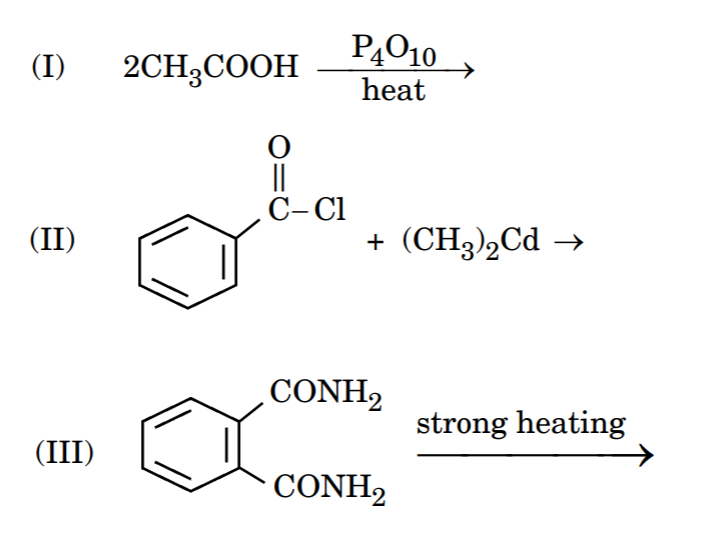
(i) Identify A, B and C in the following reactions :
(ii) Give reasons for the following :
(I) Carboxylic acids do not give the characteristic reactions of carbonyl group.
(II) Ethanoic acid is a stronger acid than ethanol.
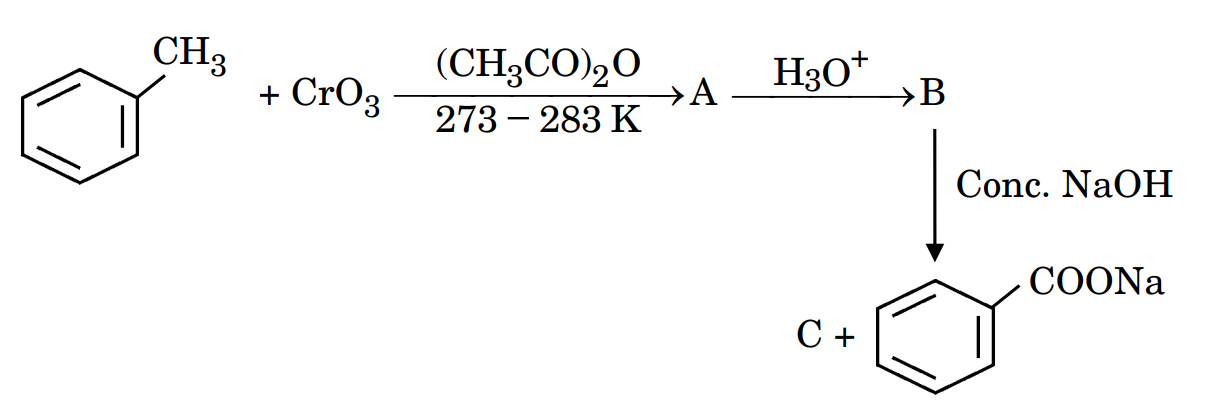
(i) Write the product(s) in the following reactions :
(ii) Write the reaction involved in the following reactions :
(I) Wolff-Kishner Reduction
(II) Decarboxylation Reaction
(I) Wolff-Kishner Reduction: In this reaction, a carbonyl compound (aldehyde or ketone) is reduced to the corresponding alkane. For example, acetone is reduced to propane.
General reaction: R-CO-R' \u2192 R-CH2-R' (alkane)
(II) Decarboxylation Reaction: This reaction involves the removal of a carboxyl group (-COOH) from a carboxylic acid as carbon dioxide (CO2) to give a hydrocarbon.
Example: Sodium benzoate when heated with soda lime gives benzene and sodium carbonate.
(ii) Reactions involved:
(I) Wolff-Kishner Reduction Reaction:
R-CO-R' + hydrazine (NH2-NH2) + KOH + heat \u2192 R-CH2-R' + N2 + H2O
This reaction reduces ketones or aldehydes to alkanes in strongly basic medium and high temperature.
(II) Decarboxylation Reaction:
R-COONa + NaOH + heat \u2192 R-H + Na2CO3
Carboxylic acid salt when heated with soda lime (NaOH + CaO) loses CO2 to form corresponding hydrocarbon.
Summary:
Wolff-Kishner reduction converts carbonyl groups into methylene groups (-CH2-), useful for removing oxygen from aldehydes or ketones.
Decarboxylation removes CO2 from carboxylic acids to form hydrocarbons.
Paper Details
CBSE Board Exam 2025
Class
Class 12 PCM
Subject
Chemistry
Year
2025
Set
Set 5
Other Years — Chemistry