SOLUTIONS
2023 BOARD EXAM
CBSE Class 12 PCM Chemistry Board Paper 2023 — Set 1 Solutions
2023
Chemistry
Class 12 PCM
CBSE EXAMINATION PAPER-2023
CHEMISTRY
(Solved)
General Instructions :
Read the following instructions carefully and follow them :
- This question paper contains 41 questions. All questions are compulsory.
- This question paper is divided into 5 sections.
- Section A – questions number 1 to 4 are case based questions
- Section B – questions number 5 to 22 are multiple choice questions
- Section C – questions number 23 to 30 are very short answer
- Section D – questions number 31 to 36 are short answer
- Section E – questions number 37 to 41 are long answer
- There is no overall choice given in the question paper. However, an internal choice has been provided in few questions.
- Use of calculator is NOT allowed.
Section A
The rate of reaction is concerned with decrease in concentration of reactants or increase in the concentration of products per unit time. It can be expressed as instantaneous rate at a particular instant of time and average rate over a large interval of time. Mathematical representation of rate of reaction is given by rate law. Rate constant and order of a reaction can be determined from rate law or its integrated rate equation.
The following questions are case-based questions. Read the case carefully and answer the questions that follow.
The rate of reaction is concerned with decrease in concentration of reactants or increase in the concentration of products per unit time. It can be expressed as instantaneous rate at a particular instant of time and average rate over a large interval of time. Mathematical representation of rate of reaction is given by rate law. Rate constant and order of a reaction can be determined from rate law or its integrated rate equation.
(1) What is average rate of reaction ?
It is calculated by dividing the difference in concentration by the difference in time, showing how fast the reactant is used or product is formed on average during that time.
This is explained in the case paragraph as the rate concerned with the decrease in reactant concentration or increase in product concentration per unit time over a period.
(2) Write two factors that affect the rate of reaction.
According to the case, these factors change how fast the concentration of reactants or products change over time, thus affecting the rate.
(3) (1) What happens to rate of reaction for zero order reaction ? (2) What is the unit of k for zero order reaction ?
The unit of rate constant k for zero order reaction is mole per liter per second (mol L-1 s-1). This is because rate = k and rate has the unit concentration/time as explained in the case.
Thus, the zero order reaction has constant rate and k unit as mol L-1 s-1.
(4) (1) For a reaction P + 2Q→ Products Rate = k[P]¹ᐟ² [Q]¹. What is the order of the reaction ? (2) Define pseudo first order reaction with an example.
(2) A pseudo first order reaction is a reaction which actually has order more than one but behaves like a first order reaction because the concentration of one reactant is in large excess and remains nearly constant. For example, in the hydrolysis of an ester in excess water, the reaction is second order but appears as first order with respect to the ester as water concentration is constant. This is useful as mentioned in the case where rate constants are determined from rate laws.
In coordination compounds, metals show two types of linkages, primary and secondary. Primary valencies are ionisable and are satisfied by negatively charged ions. Secondary valencies are non-ionisable and are satisfied by neutral or negative ions having lone pair of electrons. Primary valencies are non-directional while secondary valencies decide the shape of the complexes.
(1) If PtCl₂ . 2NH₃ does not react with AgNO₃, what will be its formula ?
(2) What is the secondary valency of [Co(en)₃]³⁺ ?
(3) (1) Write the formula of Iron(III)hexacyanidoferrate(II). (2) Write the IUPAC name of [Co(NH₃)₅Cl] Cl₂.
(2) The IUPAC name of [Co(NH3)5Cl]Cl2 is pentaamminechloridocobalt(III) chloride. The central metal is cobalt with oxidation state +3, five ammine and one chloride as ligands, and two chloride ions as counter ions.
(4) Write the hybridization and magnetic behaviour of [Ni(CN)₄]²⁻ .[Atomic number : Ni = 28]
Section B
The colligative property used for the determination of molar mass of polymers and proteins is :
Osmotic pressure is the correct answer because it is a colligative property that depends on the number of solute particles in a solution. This property is especially useful for determining the molar mass of large molecules like polymers and proteins, as it allows for the calculation based on the effect of solute concentration on the osmotic pressure.
Low concentration of oxygen in the blood and tissues of people living at high altitude is due to :
The correct answer is 'low atmospheric pressure.' At high altitudes, the atmospheric pressure is significantly lower than at sea level, which means that the amount of oxygen available in the air is also reduced. This leads to lower concentrations of oxygen in the blood and tissues.
The correct cell to represent the following reaction is : Zn + 2Ag⁺ → Zn²⁺ + 2Ag
The correct option is 'Zn | Zn²⁺ || Ag⁺ | Ag'. This representation correctly shows zinc on the left side as the anode (oxidizing agent) where it loses electrons to form Zn²⁺, while silver ions (Ag⁺) on the right side gain electrons to form solid silver (Ag) at the cathode. The notation follows the standard format of an electrochemical cell where the oxidation half-reaction is listed first.
ΔG and E°cell for a spontaneous reaction will be :
For a spontaneous reaction, ΔG must be negative. This aligns with the thermodynamic criteria where ΔG < 0 indicates that the process is spontaneous. Since E°cell is related to the change in Gibbs free energy (ΔG = -nFE°cell), a negative ΔG translates to a positive E°cell. Therefore, the correct option is 'negative, positive'.
Which of the following is affected by catalyst?
The order of the reaction H2(g) + Cl2(g) (hv)→ 2HCl(g) is :
The reaction between hydrogen and chlorine to form hydrochloric acid is a first-order reaction with respect to both H2 and Cl2, making the overall order of the reaction 2. Thus, the correct answer is 2.
The most common and stable oxidation state of a Lanthanoid is :
The compounds [Co(SO₄)(NH₃)₅]Br and [Co(Br)(NH₃)₅]SO₄ represent :
The correct answer is ionisation isomerism. This is because ionisation isomers differ in the arrangement of counter ions and can exchange ligands with counter ions, as shown in the provided example of isomers [Co(NH3)5(SO4)]Br and [Co(NH3)5Br]SO4, where the sulfate and bromide ions are interchangeably present.
The synthesis of alkyl fluoride is best obtained from :
The correct answer is 'Swartz reaction'. This reaction is specifically used to convert alkyl halides (like chlorides or bromides) into alkyl fluorides by using a fluoride ion source, making it the most suitable method for synthesizing alkyl fluorides among the options provided.
In a reaction what is the correct order of reactivity of alcohal ?

The correct order of reactivity of alcohols with HCl is 3° > 2° > 1°. This is because tertiary alcohols are the most reactive due to the stability of the carbocation formed during the reaction, followed by secondary alcohols and then primary alcohols, which are the least reactive.
CH₃CONH₂ on reaction with NaOH and Br₂ in alcoholic medium gives :
Which of the following is least basic?
- (A) NH₃
- (B) (CH₃)₃N
- (C) (CH₃)₂NH
-
(D) NH2
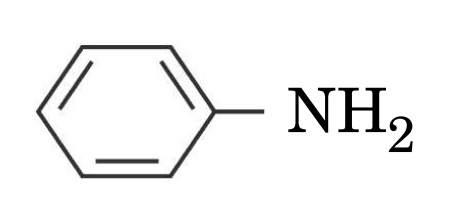
(CH3)2NH is the least basic among the options provided because it has a lower availability of a lone pair of electrons for donation compared to (CH3)3N and NH3. The steric hindrance in (CH3)2NH lessens its basicity, while NH3 is more basic due to having a lone pair readily available for bonding.
The glycosidic linkage involved in linking the glucose units in amylase part of starch is :
An α- helix is a structural feature of :
Assertion (A) -NH₂ group is o- and p-directing in electrophilic substitution reactions.
Reason (R) : Aniline cannot undergo Friedel-Crafts reaction.
Both Assertion (A) and Reason (R) are true, but Reason (R) is not the correct explanation of the Assertion (A). The -NH2 group is indeed o- and p-directing due to its strong electron-donating resonance effect, making it activate the aromatic ring for electrophilic substitutions. However, while it is true that aniline cannot undergo Friedel-Crafts reactions due to salt formation with aluminium chloride, this does not explain why the -NH2 group is directing; the directing effect is due to resonance, not the inability to undergo Friedel-Crafts reactions.
Assertion (A) : Acetylation of aniline gives a monosubstituted product.
Reason (R) : Activating effect of -NHCOCH₃ group is more than that of amino group.
Assertion (A) is true as acetylation of aniline indeed results in the formation of a monosubstituted product. However, Reason (R) is false because the activating effect of the -NHCOCH3 group is actually less than that of the amino (-NH2) group, as stated in the context. Therefore, the correct answer is that Assertion (A) is true, but Reason (R) is false.
Assertion (A) : The molecularity of the reaction H₂ + Br₂ → 2HBr appears to be 2.
Reason (R) : Two molecules of the reactants are involved in the given elementary reaction.
Both Assertion (A) and Reason (R) are true and Reason (R) is the correct explanation of the Assertion (A). The molecularity of a reaction refers to the number of reactant molecules involved in an elementary reaction, and since there are two molecules (H2 and Br2) reacting to form 2HBr, Assertion (A) is correct and is accurately explained by Reason (R).
Assertion (A) : Low spin tetrahedral complexes are rarely observed.
Reason (R) : Crystal field splitting energy is less than pairing energy for tetrahedral complexes.
Both Assertion (A) and Reason (R) are true, but Reason (R) is not the correct explanation of the Assertion (A). Low spin tetrahedral complexes are indeed rare because the crystal field splitting energy in tetrahedral complexes is smaller than that in octahedral complexes, leading to weak field ligands causing less pairing compared to octahedral arrangements. However, the rarity of low spin tetrahedral complexes is not directly explained by the relationship between crystal field splitting and pairing energy.
Section C
(a) On diluting two electrolytes 'A' and 'B', the λₘ of 'A' increases 25 times while that of 'B' increases by 1.5 times. Which of the two electrolytes is strong? Justify your answer graphically.
(b) The electrical resistance of a column of 0.05 mol L⁻¹ NaOH solution of diameter 1 cm and length 50 cm is 5.55 × 10³ ohm. Calculate the conductivity.
(b) Given: Concentration c = 0.05 mol L⁻¹, Diameter d = 1 cm, Length l = 50 cm, Resistance R = 5.55 * 103 ohm.
Cross-sectional area A = π * (d/2)2 = 3.1416 * (0.01/2)2 = 7.85 * 10-5 m2.
Conductivity κ = l / (R * A) = 0.50 m / (5550 ohm * 7.85 * 10-5 m2) = 1.15 * 10-3 S/m.
Therefore, conductivity of the NaOH solution is 1.15 * 10-3 S/m.
Complete the following equation:
(a) 2MnO₄⁻ + 5NO₂⁻ + 6H⁺ →
(b) Cr₂O₇²⁻ + 14H⁺ + 6e⁻ → ?
(b) Cr₂O₇²⁻ + 14H⁺ + 6e⁻ → 2Cr³⁺ + 7H₂O
Explanation:
In (a), permanganate ion (MnO₄⁻) acts as an oxidizing agent and is reduced to Mn²⁺, while nitrite ion (NO₂⁻) is oxidized to nitrate ion (NO₃⁻). The hydrogen ions balance the charge and participate in water formation.
In (b), dichromate ion (Cr₂O₇²⁻) gains 6 electrons (is reduced) in an acidic medium to form chromium ion (Cr³⁺) and water. This is a standard reduction half-equation.
Identify 'A' , and 'B' in the above reactions.
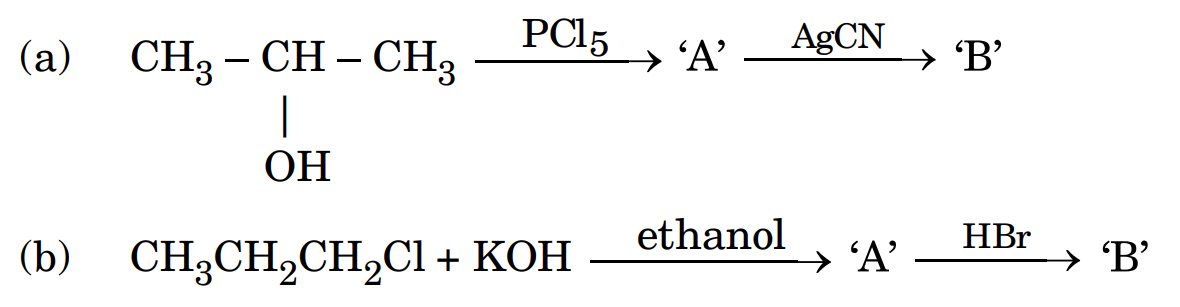
(a)
Starting compound: CH₃–CH(OH)–CH₃ (2-propanol)
PCl₅ converts alcohol → alkyl chloride
So A = CH₃–CH(Cl)–CH₃ (2-chloropropane)AgCN gives isocyanide (R–NC, not R–CN)
So from 2-chloropropane:
B = (CH₃)₂CH–NC (isopropyl isocyanide)
(b)
Starting compound: CH₃CH₂CH₂Cl (1-chloropropane)
Alcoholic KOH → elimination (E2) → alkene
So A = CH₃–CH=CH₂ (propene)HBr adds to propene (Markovnikov addition, no peroxide mentioned)
So Br goes to middle carbon:
B = CH₃–CH(Br)–CH₃ (2-bromopropane)
Brutally honest exam tip: remember AgCN gives isocyanide (R–NC), KCN gives nitrile (R–CN) — this is a very common trap.
Account for the following:
(i) Phenol is a stronger acid than an alcohol.
(ii) The boiling point of alcohols decreases with increase in branching of alkyl chain.
(ii) The boiling point of alcohols decreases with increase in branching of the alkyl chain because branching reduces the surface area of the molecule. This leads to weaker van der Waals forces between molecules. As a result, less energy is required to break these forces and boil the substance, causing a lower boiling point.
(i) Write the mechanism of the following reaction :
(ii) Write the equation involved in Reimer-Tiemann reaction.

(i) Mechanism: Dehydration of Ethanol to Ethene (Acid-catalyzed, 443 K)
Overall reaction:
CH₃CH₂OH —H⁺, 443 K→ CH₂=CH₂ + H₂O
This is an acid-catalyzed elimination (for 1° alcohol mainly E2-like, but written stepwise).
Step 1: Protonation of alcohol (makes good leaving group)
CH₃CH₂OH + H⁺ → CH₃CH₂OH₂⁺
(Oxygen gets protonated → forms oxonium ion)
Step 2: Loss of water
CH₃CH₂OH₂⁺ → CH₃CH₂⁺ + H₂O
(Water leaves, forming ethyl carbocation – very unstable, so next step is fast)
Step 3: Elimination of proton to form alkene
CH₃CH₂⁺ → CH₂=CH₂ + H⁺
(A base like H₂O removes a proton, double bond forms, H⁺ is regenerated)
So product: Ethene + Water
(ii) Reimer–Tiemann Reaction (Equation)
Reimer–Tiemann reaction introduces –CHO group into phenol (at ortho position mainly) using CHCl₃ + NaOH.
General equation:
Phenol + CHCl₃ + 3 NaOH → o-hydroxybenzaldehyde (salicylaldehyde) + 3 NaCl + 2 H₂O
In formula form:
C₆H₅OH + CHCl₃ + 3 NaOH → o-HOC₆H₄–CHO + 3 NaCl + 2 H₂O
(Para isomer also forms in small amount)
(i) Acid-catalyzed dehydration of ethanol proceeds via protonation of –OH, loss of water, and elimination of H⁺ to give ethene.
(ii) Reimer–Tiemann reaction:
C₆H₅OH + CHCl₃ + 3 NaOH → o-HOC₆H₄–CHO + 3 NaCl + 2 H₂O
Explain briefly :
(a) Carbylamine reaction
(b) Gabriel phthalimide synthesis
(b) Gabriel phthalimide synthesis: This is a method to prepare primary amines. Phthalimide reacts with potassium hydroxide to form potassium salt, which then reacts with an alkyl halide to give N-alkyl phthalimide. Hydrolysis of N-alkyl phthalimide gives the primary amine. This method avoids contamination by secondary and tertiary amines.
(a) Write chemical reaction to show that open structure of D-glucose contains the straight chain.
(b) What type of linkage is responsible for the formation of protein ?
(a) The open chain structure of D-glucose can be represented by its linear form: C6H12O6 in which the aldehyde group is at one end. The mutarotation process shows interconversion between cyclic and open chain forms in solution, proving the open chain structure exists.
(b) The linkage responsible for protein formation is the peptide linkage. It is formed by a condensation reaction between the carboxyl group of one amino acid and the amino group of another, creating a bond -CONH- between amino acid units.
What is Henry's law? Give one application of it.
Application: It is used in carbonated beverages where CO2 is dissolved in the drink under high pressure. When the bottle is opened, pressure decreases and CO2 comes out causing fizz.
Section D
(a) Differentiate between Ideal solution and Non-ideal solution.
(b) 30 g of urea is dissolved in 846 g of water. Calculate the vapour pressure of water for this solution if vapour pressure of pure water at 298 K is 23.8 mm Hg.
(b) Given: Mass of urea = 30 g, mass of water = 846 g, vapour pressure of pure water P0 = 23.8 mm Hg. Molar mass of urea (NH2CONH2) = 60 g/mol, molar mass of water = 18 g/mol. Moles of urea = 30 / 60 = 0.5 mol, moles of water = 846 / 18 = 47 mol. Mole fraction of water Xwater = 47 / (47 + 0.5) = 0.9895. According to Raoult's law, vapour pressure P = Xwater * P0 = 0.9895 * 23.8 = 23.53 mm Hg. Therefore, vapour pressure of water in the solution is 23.53 mm Hg.
Write main product formed when :
(a) Methyl chloride is treated with NaI/Acetone.
(b) 2,4,6-trinitrochlorobenzene is subjected to hydrolysis.
(c) 2,4,6-trinitrochlorobenzene is subjected to hydrolysis.
(b) When 2,4,6-trinitrochlorobenzene undergoes hydrolysis, the chlorine atom is substituted by a hydroxyl group because the nitro groups strongly activate the ring towards nucleophilic substitution. The main product is 2,4,6-trinitrophenol.
(c) This is the same as (b), so again the main product formed is 2,4,6-trinitrophenol due to nucleophilic substitution of chlorine by hydroxyl group during hydrolysis.
How do you convert the following : (Any three)
(a) Phenol to picric acid
(b) Propanone to 2-Methylpropan-2-ol
(c) Phenol to anisole
(d) Phenol to anisole
(b) Propanone to 2-Methylpropan-2-ol: React propanone with methyl magnesium iodide (a Grignard reagent) followed by acidic hydrolysis. The methyl group adds to the carbonyl carbon forming 2-methylpropan-2-ol.
(c) Phenol to anisole: React phenol with methyl iodide in presence of a base like K2CO3. This alkylation forms anisole (methoxybenzene) by replacing the hydrogen of the hydroxyl group with a methyl group.
Explain why:
(i) Carboxyl group in benzoic acid is meta directing.
(ii) Sodium bisulphite is used for the purification of aldehydes and ketones.
(iii) Carboxylic acids do not give characteristic reactions of carbonyl group.
(ii) Sodium bisulphite forms addition compounds with aldehydes and ketones by adding to the carbonyl group. These addition compounds are solid and can be separated easily, thus sodium bisulphite is used to purify aldehydes and ketones.
(iii) Carboxylic acids do not give characteristic reactions of the carbonyl group because the carbonyl carbon is strongly bonded to the -OH group, which forms hydrogen bonds. This reduces the reactivity of the carbonyl group and prevents addition reactions typical of aldehydes and ketones.
An organic compound 'A', having the molecular formula C₃H₈O on treatment with Cu at 573 K, gives 'B'. 'B' does not reduce Fehling's solution but gives a yellow precipitate of the compound 'C' with I₁/NaOH. Deduce the structures of A, B and C.
(a) What are the hydrolysis products of (i) Lactose, (ii) Maltose ?
(b) Give the basic structural difference between starch and cellulose.
(b) The basic structural difference between starch and cellulose is the type of glycosidic linkage and the arrangement of glucose units. Starch contains α-D-glucose units linked mainly by α(1→4) bonds and has a helical structure making it digestible by humans. Cellulose contains β-D-glucose units linked by β(1→4) bonds, resulting in a straight chain that forms strong fibers and is not digestible by humans. This difference in linkage affects their properties and biological functions.
Section E
(i) State Kohlrausch's law of independent migration of ions. Write an expression for the limiting molar conductivity of acetic acid according to Kohlrausch's law.
(ii) Calculate the maximum work and log Kc for the given reaction at 298 K:
Ni (s) + 2Ag⁺ (aq) ⇌ Ni²⁺ (aq) + 2Ag (s)
Given: E°Ni²⁺/Ni = -0.25 V, E°Ag⁺/Ag = +0.80 V,
1 F = 96500 C mol⁻¹.
Mathematically, the limiting molar conductivity of acetic acid (CH3COOH), which dissociates into H+ and CH3COO-, is written as:
Λm0(CH3COOH) = Λm0(H+) + Λm0(CH3COO-)
(ii) Calculation of maximum work and log Kc for the reaction:
Given redox reaction: Ni (s) + 2Ag+ (aq) ⇌ Ni2+ (aq) + 2Ag (s)
Standard electrode potentials: E°(Ni2+/Ni) = -0.25 V, E°(Ag+/Ag) = +0.80 V
The cell reaction involves oxidation of Ni to Ni2+ and reduction of Ag+ to Ag.
Calculate standard cell potential E°cell:
E°cell = E°cathode - E°anode = 0.80 V - (-0.25 V) = 1.05 V
Maximum work done (Wmax) = -n F E°cell, where n is number of electrons transferred per reaction (n=2), F = 96500 C mol-1
Wmax = -2 * 96500 * 1.05 = -202650 J/mol (negative sign indicates work done by the system)
Using the relation between Gibbs free energy and equilibrium constant:
ΔG° = -RT ln Kc, and ΔG° = Wmax
Therefore,
ln Kc = n F E°cell / RT
At T = 298 K, R = 8.314 J mol-1 K-1
ln Kc = (2 * 96500 * 1.05) / (8.314 * 298) = 81.76
Then,
log Kc = ln Kc / 2.303 = 81.76 / 2.303 = 35.5
Final answers:
Maximum work, Wmax = -202650 J/mol
Equilibrium constant, log Kc = 35.5
(i) State Faraday's first law of electrolysis. How much charge, in terms of Faraday, is required for the reduction of 1 mol Cu²⁺ to Cu?
(ii) Calculate emf of the following cell at 298 K for
Mg (s) | Mg²⁺ (0.01 M) || Cu²⁺ (0 .01 M) | Cu (s)
[E°cell = + 2.71 V, 1 F = 96500 C mol⁻¹, log 10 = 1]
For the reduction of 1 mole of Cu2+ to Cu, 2 moles of electrons are required because the copper ion has a charge of +2. The total charge required = n * F, where n = 2 and F = 1 Faraday (96500 C). Therefore, charge required = 2 Faradays.
(ii) Calculation of emf of the cell at 298 K:
Given cell: Mg (s) | Mg2+ (0.01 M) || Cu2+ (0.01 M) | Cu (s)
Standard emf, E°cell = +2.71 V
Using Nernst equation:
Ecell = E°cell - (RT/nF) * ln(Q)
At 298 K, RT/F = 0.0257 V, and n = 2 (number of electrons transferred)
Q = [Mg2+]/[Cu2+] = 0.01 / 0.01 = 1
ln(1) = 0, so Ecell = E°cell = +2.71 V.
Hence, emf of the cell at given concentrations is 2.71 V.
Assign reason for each of the following :
(i) Manganese exhibits the highest oxidation state of +7 among the 3d series of transition elements.
(ii) Transition metals and their compounds are generally found to be good catalysts in chemical reactions.
(iii) Cr²⁺ is reducing in nature while with the same d-orbital configuration (d⁴) Mn³⁺ is an oxidising agent.
(iv) Zn has lowest enthalpy of atomization.
(v) Cu⁺ is unstable in an aqueous solution.
(ii) Transition metals and their compounds are good catalysts: They have variable oxidation states and incompletely filled d orbitals, which facilitate the formation of intermediate complexes and accelerate reaction rates.
(iii) Cr2+ is reducing while Mn3+ is oxidising even with d4 configuration: Cr2+ (d4) tends to lose an electron to form Cr3+, so it acts as a reducing agent. Mn3+ (also d4) gains an electron to form Mn2+, acting as an oxidising agent. The difference in stability of oxidation states governs their behavior.
(iv) Zn has lowest enthalpy of atomization: Zinc has completely filled 3d10 and 4s2 orbitals, leading to weak metallic bonding and hence low energy required to convert solid Zn into atoms.
(v) Cu+ is unstable in aqueous solution: Cu+ tends to disproportionate into Cu2+ and metallic Cu due to its intermediate stability and tendency to attain a more stable oxidation state, so it is unstable in aqueous medium.
(i) Carry out the following conversions :
(1) Ethanal to But-2-en-1-al
(2) Propanoic acid to 2-chloropropanoic acid
(ii) An alkene with molecular formula C₅H₁₀ on ozonolysis gives a mixture of two compounds 'B' and 'C'. Compound 'B' gives positive Fehling test and also reacts with iodine and NaOH solution. Compound 'C' does not give Fehling solution test but forms iodoform. Identify the compounds 'A', 'B' and 'C'.
Ethanal (CH3CHO) undergoes aldol condensation under alkaline conditions to give But-2-en-1-al.
Reagents: Dilute NaOH (aq), heat
Explanation: Two molecules of ethanal condense, one acts as nucleophile and other as electrophile, forming beta-hydroxy aldehyde which on dehydration forms But-2-en-1-al (CH3CH=CHCHO).
(2) Conversion of Propanoic acid to 2-chloropropanoic acid:
This is achieved by Hell-Volhard-Zelinsky (HVZ) reaction.
Reagents: PCl3 and Cl2
Explanation: Propanoic acid reacts with PCl3 and Cl2 to form 2-chloropropanoyl chloride which hydrolyses to give 2-chloropropanoic acid.
(ii) Identification of compounds A, B, C from the alkene C5H10:
Let the alkene be 'A'. Ozonolysis of 'A' gives two compounds 'B' and 'C'.
Given that 'B' gives positivo Fehling test and reacts with iodine and NaOH (iodoform test positive). This indicates 'B' is an aldehyde with a methyl group next to carbonyl; the compound is Propanal.
'C' does not give Fehling test but forms iodoform, which means 'C' is a methyl ketone. The likely compound is Acetone (Propanone).
Hence,
'A' is 2-methylbut-2-ene (or suitable alkene that on ozonolysis gives Propanal and Acetone).
'B' is Propanal (CH3CH2CHO)
'C' is Acetone (CH3COCH3)
This fits the molecular formula and test results.
Therefore, alkene 'A' undergoes ozonolysis to produce aldehyde 'B' (propanal) and methyl ketone 'C' (acetone).
(i) Distinguish with a suitable chemical test:
(1) CH₃COCH₂CH₃ and CH₃CH₂CH₂CHO
(2) Ethanal and Ethanoic acid
(ii) Write the structure of oxime of acetone.
(iii) Identify A to D.
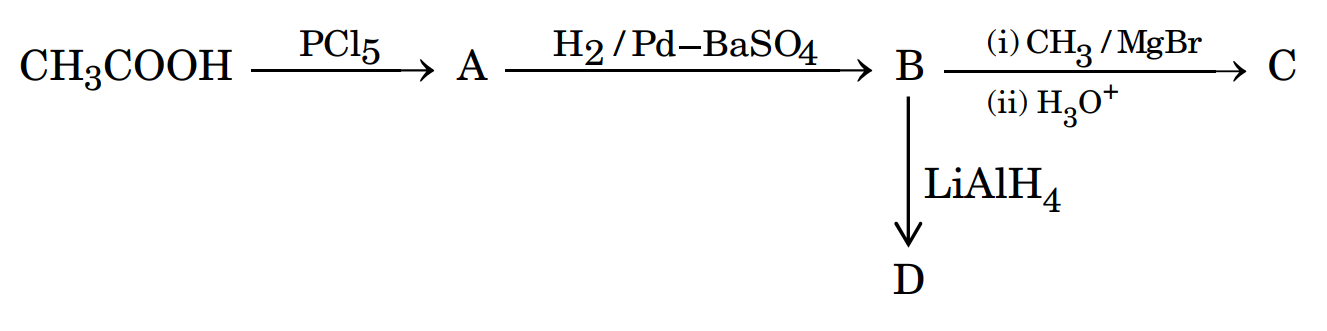
(i)(1) CH₃COCH₂CH₃ (butanone) and CH₃CH₂CH₂CHO (butanal) can be distinguished by the Tollen's test.
Butanal (an aldehyde) gives a silver mirror with Tollen's reagent, but butanone (a ketone) does not react.
(i)(2) Ethanal and ethanoic acid can be distinguished by sodium bicarbonate test.
Ethanoic acid reacts with sodium bicarbonate to release carbon dioxide gas (effervescence), whereas ethanal does not react.
(ii) Structure of oxime of acetone:
Acetone structure is CH₃-CO-CH₃.
The oxime of acetone is formed by the reaction of acetone with hydroxylamine (NH₂OH).
Its structure is CH₃-C=NOH-CH₃ where the =O group of acetone is replaced by =N-OH.
(iii) Identification of compounds A to D:
Step 1: With PCl₅
Carboxylic acid → acid chloride
So,
A = CH₃COCl (Acetyl chloride)
Step 2: A —H₂ / Pd–BaSO₄→ B
Pd–BaSO₄ is Rosenmund reduction → acid chloride → aldehyde
So,
B = CH₃CHO (Acetaldehyde)
From B, two reactions:
Step 3(a): B —(i) CH₃MgBr (ii) H₃O⁺→ C
Grignard reagent adds CH₃ to aldehyde → gives secondary alcohol
CH₃CHO + CH₃MgBr → after hydrolysis →
C = CH₃–CH(OH)–CH₃ (2-propanol / isopropyl alcohol)
Step 3(b): B —LiAlH₄→ D
LiAlH₄ reduces aldehyde → primary alcohol
CH₃CHO → CH₃CH₂OH
So,
D = CH₃CH₂OH (Ethanol)
These identifications are based on their functional groups and molecular formulas.
Paper Details
CBSE Board Exam 2023
Class
Class 12 PCM
Subject
Chemistry
Year
2023
Set
Set 1
Other Years — Chemistry