SOLUTIONS
2024 BOARD EXAM
CBSE Class 12 PCM Chemistry Board Paper 2024 — Set 5 Solutions
2024
Chemistry
Class 12 PCM
CBSE EXAMINATION PAPER-2024
CHEMISTRY
(Solved)
General Instructions :
Read the following instructions carefully and follow them :
- This question paper contains 37 questions. All questions are compulsory.
- This question paper is divided into 5 sections.
- Section A – questions number 1 to 3 are case based questions
- Section B – questions number 4 to 19 are multiple choice questions
- Section C – questions number 20 to 25 are very short answer
- Section D – questions number 26 to 32 are short answer
- Section E – questions number 33 to 37 are long answer
- There is no overall choice given in the question paper. However, an internal choice has been provided in few questions.
- Use of calculator is NOT allowed.
Section A
The following questions are case-based questions. Read the case carefully and answer the questions that follow:
The oxidation number of the central atom in a complex is defined as the charge it would carry if all the ligands are removed along with the electron pairs that are shared with the central atom. Similarly the charge on the complex is the sum of the charges of the constituent parts Le. the sum of the charges on the central metal ion and its surrounding ligands. Based on this, the complex is called neutral if the sum of the charges of the constituents is equal to zero. However, for an anion or cationic complex, the sum of the charges of the constituents is equal to the charge on the coordination sphere.
Based on the above information, answer the following questions:
(1) Define ambidentate ligand with an example.
(2) What type of isomerism is shown by [Co(NH₃)₅, CL]SO₄, and [Co(NH₃)₅ SO₄]CL?
(3) Find the coordination number and oxidation state of chromium in Na₃ (Cr(C₂O₄)₃].
Oxidation state of chromium: Sodium (Na) has +1 charge and there are 3 Na+ ions, giving +3 overall. The complex is neutral, so charge on complex ion is -3. Each oxalate ligand has -2 charge, so total charge from ligands = 3*(-2) = -6. Let oxidation state of Cr be x. Then, x + (-6) = -3 gives x = +3.
Hence, the coordination number is 6 and oxidation state of chromium is +3, as indicated based on the sum of charges from the case passage.
(4) Define Chelate effect. How it affects the stability of complex?
This effect increases stability because the ligand binds through multiple atoms, making the complex harder to break apart.
As per the case, the overall charge and bonding affect the complex stability, and chelate ligands help enhance this stability by forming multiple bonds with the metal ion.
Certain organic compounds are required in small amounts in our diet but their deficiency causes specific disease. These compounds are called vitamins. Most of the vitamins cannot be synthesized in our body but plants can synthesize almost all of them. So they are considered as essential food factors. However, the bacteria of the gut can produce some of the vitamins required by us. All the vitamins are generally available in our diet. The term 'vitamin' was coined from the words vital amine. since the earlier identified compounds had amino group. Vitamins are classified into two groups depending upon their solubility in water or fat namely fat soluble vitamins and water soluble vitamins.
Answer the following questions :
(1) What is the other name of vitamin B₆?
(2) Name the vitamin whose deficiency causes increased blood clotting time.
(3) Why can't vitamin C be stored in our body? Name the disease caused by the deficiency of this vitamin.
(4) Xerophthalmia is caused by the deficiency of which vitamin? Give two sources of this vitamin.
Section B
The specific sequence in which amino acids are arranged in a protein is called its
The correct answer is 'Primary structure' because the primary structure of a protein refers to the specific sequence of amino acids that make up the protein chain. This sequence is crucial as it determines the protein's unique characteristics and function.
The correct name of the given reaction is

The correct answer is Sandmeyer's reaction. This reaction involves the replacement of the diazonium group by a cyanide ion (CN-) in the presence of cuprous cyanide (CuCN) and is a well-known method for introducing functional groups into aromatic compounds.
Out of the following alkenes, the one which will produce tertiary butyl alcohol on acid catalysed hydration is
The correct option is (CH₃)₂C=CH₂. This alkene, also known as isobutylene, upon acid-catalyzed hydration follows Markovnikov's rule. The hydrogen attaches to the less substituted carbon (the double bond), and the hydroxyl group attaches to the more substituted carbon, resulting in the formation of tertiary butyl alcohol.
Auto-oxidation of chloroform in air and light produces a poisonous gas known as
The correct option is Phosgene. When chloroform undergoes auto-oxidation in the presence of air and light, it can produce phosgene, which is a highly toxic gas. Other options like tear gas, mustard gas, and phosphine are not products of chloroform's auto-oxidation.
Transition metals are known to make interstitial compounds. Formation of interstitial compounds makes the transition metal
The correct option is 'more hard'. Interstitial compounds are formed when small atoms fill the interstitial spaces between the larger metal atoms. This can lead to an increase in hardness and strength of the material, making it more difficult to deform compared to the pure metal.
Isotonic solutions have the same
The correct option is 'osmotic pressure' because isotonic solutions are defined as solutions that have the same osmotic pressure, which means they exert equal pressure across a semipermeable membrane, preventing water movement in or out of the cells.
Which of the following cell was used in Apollo space programme?
The correct answer is H₂-O₂ fuel cell. The Apollo space program utilized hydrogen-oxygen fuel cells to produce electricity and water for the spacecraft, making them essential for the missions.
The rate of a reaction increases sixteen times when the concentration of the reactant increases four times. The order of the reaction is
The order of the reaction can be calculated using the rate law. If the concentration is increased by a factor of 4 and the rate increases by a factor of 16, we can use the equation Rate ∝ [A]^n. Here, 4^n = 16. Solving for n gives us n = 2, meaning the order of the reaction is 2.0.
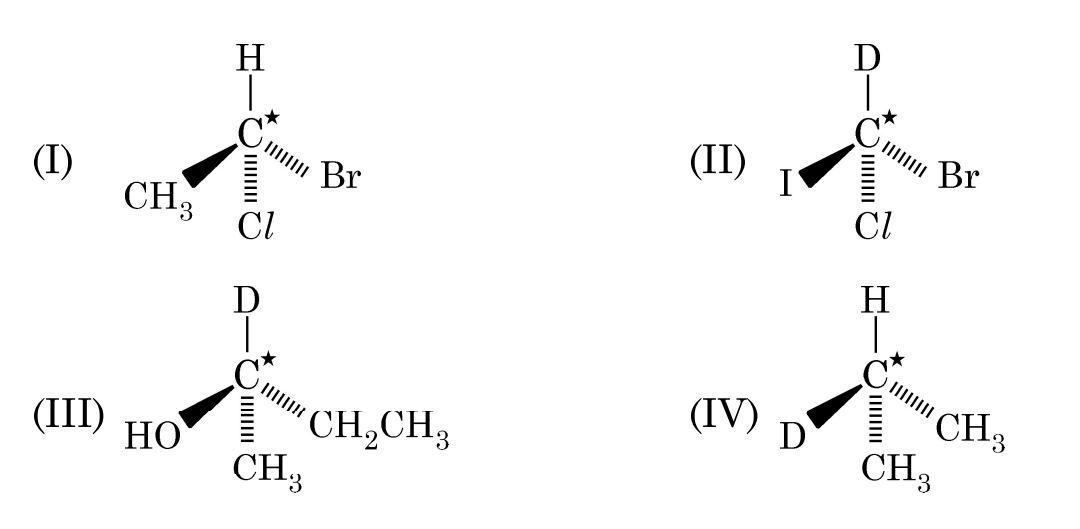
In which of the following molecules, C atom marked with asterisk is chiral?
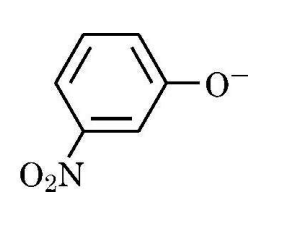
Which of the following species can act as the strongest base?
- (A) RO⁻
- (B) OH⁻
-
(C)
- (D) C₆H₅O⁻
RO⁻ is the strongest base among the options because it is an alkoxide ion, which is a conjugate base of an alcohol. It has a high tendency to accept protons due to the presence of a less electronegative oxygen atom compared to OH⁻ (hydroxide) and C₆H₅O⁻ (phenoxide), making it a stronger base.
Dilution affects both conductivity as well as molar conductivity. Effect of dilution on both is as follows
The correct option is 'conductivity decreases whereas molar conductivity increases on dilution.' When a solution is diluted, the concentration of ions decreases, which reduces conductivity. However, molar conductivity, which is the conductivity per unit concentration, increases because the ability of ions to move freely increases in a more dilute solution.
Van't Hoff factor for Na₂SO₄·10H₂O solution, assuming complete ionization is
The correct option is 13. Na₂SO₄ dissociates into 2 Na⁺ ions and 1 SO₄²⁻ ion, giving a total of 3 particles for each formula unit. Therefore, for Na₂SO₄, the van't Hoff factor (i) would normally be 3. Additionally, since Na₂SO₄·10H₂O includes water of hydration, it contributes an additional 10 water molecules, bringing the total van't Hoff factor to 3 + 10 = 13.
Assertion (A): Zr and Hf are of almost similar atomic radii.
Reason (R): This is due to Lanthanoid contraction.
Both Assertion (A) and Reason (R) are true, and Reason (R) is the correct explanation of the Assertion (A). The atomic radii of zirconium (Zr) and hafnium (Hf) are similar due to the lanthanoid contraction, which decreases the size of the lanthanide ions and subsequently affects the size of the elements in the same group of the periodic table.
Assertion (A): The units of rate constant of a zero order reaction and rate of reaction are the same
Reason (R): In a zero order reaction, the rate of reaction is independent of the concentration of reactants.
Both Assertion (A) and Reason (R) are true, but Reason (R) is not the correct explanation of the Assertion (A). In a zero order reaction, the rate is constant and the units of the rate constant (k) are the same as the units of rate of reaction (e.g., mol/L/s), but the independence of the rate from reactant concentration does not explain the equality of units.
Assertion (A): Inversion of configuration is observed in SN₂ reaction.
Reason (R): The reaction proceeds with the formation of a carbocation.
Assertion (A) is true, but Reason (R) is false. The S₂ reaction (bimolecular nucleophilic substitution) indeed leads to an inversion of configuration; however, it does not involve the formation of a carbocation, which is characteristic of S₁ reactions. Therefore, while the assertion about the S₂ reaction is correct, the reasoning does not support it.
Assertion (A): p-methoxyphenol is a stronger acid than p-nitrophenol.
Reason (R): Methoxy group shows +I effect whereas nitro group shows -I effect.
Assertion (A) is false, but Reason (R) is true. p-Nitrophenol is actually a stronger acid than p-methoxyphenol due to the electron-withdrawing -I effect of the nitro group, which stabilizes the negative charge of the phenoxide ion more effectively than the +I effect of the methoxy group destabilizes it.
Section C
State:
(a) Kohlrausch law of independent migration of ions.
(b) Faraday's first law of electrolysis.
(b) Faraday's first law of electrolysis: The mass of a substance deposited or liberated at an electrode during electrolysis is directly proportional to the quantity of electricity passed through the electrolyte. It means more the electricity, more the amount of substance produced at the electrode.
Disaccharides: Lactose and Maltose are disaccharides because they are made up of two monosaccharide units chemically bonded. Lactose consists of one galactose and one glucose unit, while Maltose consists of two glucose units joined together.
Carry out the following conversions:
(i) Nitrobenzene to Aniline
(ii) Aniline to Phenol.
(ii) Aniline to Phenol: Aniline is first diazotized by reacting with NaNO2 and HCl at 0-5 deg C to form benzenediazonium chloride. Then, on warming with water, diazonium group is replaced by hydroxyl group, producing Phenol (C6H5OH).
(i) Write a chemical test to distinguish between Dimethyl amine and Ethanamine.
(ii) Write the product formed when benzene diazonium chloride is treated with KI.
(ii) Benzene diazonium chloride reacts with KI to form iodobenzene and nitrogen gas as per the equation:
C6H5N2+Cl- + KI → C6H5I + N2↑ + KCl
The product is iodobenzene.
Show that in case of a first order reaction, the time taken for completion of 99% reaction is twice the time required for 90% completion of the reaction. (log 10 = 1)
For a first order reaction, the integrated rate law is given as:
ln([R]_0/[R]) = kt
where [R]_0 is the initial concentration and [R] is the concentration at time t.
Let t_90 be the time for 90% completion, so 10% reactant remains:
[R] = 0.1 [R]_0
ln([R]_0/0.1 [R]_0) = k t_90
ln(10) = k t_90
Using log 10 = 1, ln(10) = 2.303 * 1 = 2.303
So, k t_90 = 2.303
Let t_99 be the time for 99% completion, so 1% reactant remains:
[R] = 0.01 [R]_0
ln([R]_0/0.01 [R]_0) = k t_99
ln(100) = k t_99
ln(100) = 2.303 * 2 = 4.606
So, k t_99 = 4.606
Dividing the two equations:
(k t_99) / (k t_90) = 4.606 / 2.303 = 2
Therefore, t_99 / t_90 = 2
Hence, the time taken for 99% completion is twice the time taken for 90% completion for a first order reaction.
Resistance of a conductivity cell filled with 0.2 mol L⁻¹ KCI solution is 200 Ω. If the resistance of the same cell when filled with 0.05 mol L⁻¹ KCI solution is 620 Ω, calculate the conductivity and molar conductivity of 0.05 mol L⁻¹ KC/ solution. The conductivity of 0.2 mol L⁻¹ KCl solution is 0.0248 S cm⁻¹.
Resistance with 0.2 mol L-1 KCl, R1 = 200 Ω
Resistance with 0.05 mol L-1 KCl, R2 = 620 Ω
Conductivity of 0.2 mol L-1 KCl, κ1 = 0.0248 S cm-1
Step 1: Calculate Cell Constant (G*):
Cell constant G* = κ1 * R1 = 0.0248 * 200 = 4.96 cm-1
Step 2: Calculate Conductivity (κ2) of 0.05 mol L-1 KCl:
κ2 = G* / R2 = 4.96 / 620 = 0.008 S cm-1
Step 3: Calculate Molar Conductivity (λm):
Molarity, c = 0.05 mol L-1
λm = (κ2 / c) * 1000 = (0.008 / 0.05) * 1000 = 160 S cm2 mol-1
Final Answer:
Conductivity = 0.008 S cm-1
Molar conductivity = 160 S cm2 mol-1
Section D
Give the structure of the major product expected from the following reactions:
(a) Reaction of Ethanal with methyl-magnesium bromide followed by hydrolysis.
(b) Hydration of But-1-ene in the presence of dilute sulphuric acid.
(c) Reaction of phenol with bromine water.
(b) Hydration of But-1-ene in the presence of dilute sulphuric acid follows Markovnikov's rule where the H+ adds to the carbon with more hydrogens and OH attaches to the other carbon. The major product is Butan-2-ol (CH3-CH(OH)-CH2-CH3).
(c) Reaction of phenol with bromine water results in electrophilic aromatic substitution, where bromine substitutes at the ortho and para positions due to activating effect of OH group. The major product is 2,4,6-tribromophenol where three bromine atoms attach to the ortho and para positions of phenol ring, appearing as white precipitate.
Draw the structures of major product(s) in each of the following reactions
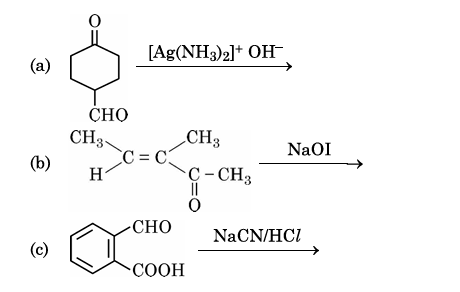
(b) Dinitration: When dinitration is carried out on 3-methylphenol under harsher conditions, two nitro groups attach preferentially at positions ortho and para to the -OH group since it is a strong activating group. Positions 2 and 4 (with respect to -OH) get nitrated leading to 2,4-dinitro-3-methylphenol as the major product. The methyl group at position 3 influences substitution pattern but the strong activation by -OH dominates.
In summary, mononitration mainly gives 2-nitro-3-methylphenol whereas dinitration forms 2,4-dinitro-3-methylphenol as the major products. The directing effect of -OH group determines substitution positions in these electrophilic aromatic substitution reactions. Structures can be drawn showing benzene ring with OH at position 1, methyl at position 3 and nitro groups at the substituted positions.
Calculate the emf of the following cell:
Ni(s) + 2Ag⁺(0.01 M)→ Ni²⁺ (0.1 M) 2Ag(s)
Given that E°cell= 1.05 V, log 10 =1
Given E°cell = 1.05 V and using the Nernst equation: Ecell = E°cell - (0.0592/n) * log Q.
Here, n = 2 (number of electrons transferred).
Reaction quotient Q = [Ni2+]/[Ag+]2 = 0.1 / (0.01)2 = 0.1 / 0.0001 = 1000.
Calculate log Q = log 1000 = 3.
Substitute values: Ecell = 1.05 - (0.0592/2) * 3 = 1.05 - 0.0888 = 0.9612 V.
Therefore, emf of the cell is approximately 0.96 V.
The rate constant of a reaction quadruples when the temperature changes from 300 K to 320 K. Calculate the activation energy for this reaction. [log2 =0.30, log 4=0.60, 2.303 R =19.15 J K⁻¹ mol⁻¹]
Using Arrhenius equation ratio form:
log(k2 / k1) = (Ea / 2.303 R) * (1 / T1 - 1 / T2)
Substitute values:
0.60 = (Ea / 19.15) * (1/300 - 1/320)
Calculate (1/300 - 1/320): (1/300) = 0.003333 and (1/320) = 0.003125
Difference = 0.000208
So,
0.60 = (Ea / 19.15) * 0.000208
Rearranging:
Ea = 0.60 * 19.15 / 0.000208 = 55240.87 J/mol = 55.24 kJ/mol
Therefore, the activation energy Ea is approximately 55.24 kJ/mol.
A compound X with molecular formula C₃H₉N reacts with C₆H₅SO₂CI to give a solid, insoluble in alkali. Identify 'X' and give the IUPAC name of the product. Write the reaction involved.
Write the IUPAC names of the following coordination compounds :
(a) [Co(NH₃)₄Cl(NO₂)]Cl
(b) [Ni(NH₃)₆]Cl₂
(c) K₃[Cr(C₂O₄)₃]
(d) [Co(en)₂Br₂]⁺
(b) The complex ion is [Ni(NH₃)₆]⁺ with 2 chloride ions outside the complex ion. The ligand is 6 ammine (NH₃). The metal oxidation state is +2. The name is Hexaammine nickel(II) chloride.
(c) The complex ion is [Cr(C₂O₄)₃]⁻ with 3 potassium ions outside. The ligand is 3 oxalato (C₂O₄) ligands. The metal oxidation state is +3. The name is Potassium trioxalatochromate(III).
(d) The complex ion is [Co(en)₂Br₂]⁺ with overall positive charge. The ligands are 2 ethane-1,2-diamine (en) which are bidentate, and 2 bromido (Br) ligands. The metal oxidation state is +4. The name is Diethane-1,2-diamine dibromidocobalt(IV) ion.
Account for the following:
(a) Haloalkanes react with AgCN to form isocyanide as main product.
(b) Allyl chloride shows high reactivity towardsSn1 reaction.
(c) Haloarenes are extremely lesa reactive towards nucleophilic substitution reactions.
(b) Allyl chloride shows high reactivity towards SN1 reactions because the carbocation intermediate formed after the departure of chloride ion is resonance stabilized. The positive charge is delocalized over the allyl group, making the carbocation more stable and favoring SN1 mechanism.
(c) Haloarenes are less reactive towards nucleophilic substitution due to the strong resonance between the aromatic ring and the halogen. This delocalizes the lone pair of electrons on halogen into the ring, making the C–X bond stronger and less reactive. Also, the planar structure and partial double bond character hinder nucleophilic attack.
Section E
Attempt any five of the following:
(a) Ce(III) is easily oxidised to Ce(IV). Comment.
(b) E°(Mn²⁺/Mn) is -1.18 V. Why is this value highly negative in comparison to neighboring d-block elements?
(c) Which element of the 3d series has the lowest enthalpy of atomisation and why?
(d) What happens when sodium chromate is acidified ?
(e) Zn, Cd and Hg are soft metals. Why?
(f) Why is permanganate titration not carried out in the presence of HCI?
(g) The lower oxides of transition metals are basic whereas the highest are amphoteric/acidic. Give reason.
(b) E°(Mn²⁺/Mn) is highly negative (-1.18 V) because manganese in metallic form is very stable and the Mn²⁺ ion has a half-filled d5 configuration which makes it relatively stable. Also, the large hydration energy of Mn²⁺ does not compensate enough for the energy required to form Mn atom leading to negative reduction potential compared to neighbors.
(c) The element with the lowest enthalpy of atomisation in the 3d series is manganese. This is because Mn has a half-filled d5 configuration giving extra stability to the atoms and the metallic bonding is weaker, so less energy is needed to break the metal atoms.
(d) When sodium chromate (Na2CrO4) is acidified, it forms sodium dichromate (Na2Cr2O7) as the yellow chromate ion (CrO42-) changes to the orange dichromate ion (Cr2O72-) in acidic medium: 2CrO42- + 2H+ → Cr2O72- + H2O.
(e) Zn, Cd and Hg are soft metals because they have completely filled d10 electron configuration which results in weak metallic bonding. The filled d-orbitals do not participate in bonding strongly, making these metals softer and with low melting points.
(f) Permanganate titration is not carried out in the presence of HCl because MnO4- oxidizes chloride ions (Cl-) to chlorine gas (Cl2), which interferes with the titration and gives erroneous results.
(g) Lower oxides of transition metals are basic because in these oxides metal is in lower oxidation states and the oxide ions (O2-) react with water to form hydroxides, showing basic behaviour. Highest oxides have metals in higher oxidation states and show amphoteric or acidic behaviour due to ability to react with both acids and bases or to act as oxidizing agents.
(i) Ishan's automobile radiator is filled with 1.0 kg of water. How many grams of ethylene glycol (Molar mass 62 g mol⁻¹) must Ishan add to get the freezing point of the solution lowered to-2.8 °C. Kf for water is 1.86 K kg mol⁻¹
(ii) What type of deviation from Raoult's law is shown by ethanol and acetone mixture ? Give reason.
Mass of water(m solvent) = 1.0 kg
Freezing point depression ΔT_f = 2.8 deg C (since freezing is lowered to -2.8 deg C)
Molal freezing point depression constant of water, K_f = 1.86 K kg mol-1
Molar mass of ethylene glycol = 62 g mol-1
Using formula for freezing point depression:
ΔT_f = K_f * molality (m)
=> molality m = ΔT_f / K_f = 2.8 / 1.86 = 1.505 mol kg-1
Molality is moles of solute per kg of solvent,
So, moles of ethylene glycol = molality * mass of solvent = 1.505 * 1.0 = 1.505 mol
Mass of ethylene glycol = moles * molar mass = 1.505 * 62 = 93.31 g
Therefore, Ishan must add approximately 93.31 grams of ethylene glycol.
(ii) The ethanol and acetone mixture shows negative deviation from Raoult's law.
Reason: This is because the intermolecular forces between ethanol and acetone molecules are stronger than the forces present in the pure components. This stronger interaction causes the total vapor pressure of the mixture to be less than the sum of vapor pressures of the individual components, hence negative deviation occurs.
(i) Boiling point of water at 750 mm Hg pressure is 99.68 °C. How much sucrose (Molar mass = 342 g mol⁻¹) is to be added to 500 g of water such that it boils at 100 °C? (K b for water = 0.52 K kg mol⁻¹).
(ii) State Henry's law and write its any one application
Given:
Initial boiling point T1 = 99.68 degC
Final boiling point T2 = 100 degC
Elevation in boiling point, Delta T b = T2 - T1 = 100 - 99.68 = 0.32 degC
Mass of water, m solvent = 500 g = 0.5 kg
Molal boiling point constant, K b = 0.52 K kg mol-1
Molar mass of sucrose = 342 g mol-1
Using the boiling point elevation formula:
Delta T b = K b * molality (m)
So, molality m = Delta T b / K b = 0.32 / 0.52 = 0.615 mol kg-1
Molality m = moles of solute / mass of solvent in kg
Moles of sucrose = molality * mass of solvent = 0.615 * 0.5 = 0.3075 mol
Mass of sucrose = moles * molar mass = 0.3075 * 342 = 105.1 g
Therefore, about 105.1 g of sucrose should be added to 500 g of water to raise its boiling point to 100 degC.
(ii) Henry's law:
Henry's law states that at a constant temperature, the amount of a gas dissolved in a liquid is directly proportional to the partial pressure of that gas above the liquid.
Mathematically, C = k H * P,
where C is the concentration of the dissolved gas, P is the partial pressure of the gas, and k H is Henry's constant.
Application:
One application of Henry's law is in carbonated beverages where carbon dioxide gas is dissolved in the liquid under high pressure. When the container is opened, pressure decreases and dissolved CO2 escapes as bubbles.
An organic compound (A) with the molecular formula C9H10 O forma 2, 4-DNP derivative, reduces Fehling solution and undergoes Cannizzaro reaction. On vigorous oxidation, it gives 1, 2-benzene dicarboxylic acid.
(i) Identify the compound (A) and write its IUPAC name.
(ii) Write the reaction of compound (A) with
(1) 2,4-Dinitrophenyl hydrazine and
(2) Fehling solution
(iii) Write the equation of compound (A) when it undergoes Cannizzaro reaction.
(b) Reactions of compound (A):
(1) Reaction with 2,4-Dinitrophenyl hydrazine:
2-hydroxybenzaldehyde + 2,4-Dinitrophenylhydrazine --(acidic medium)--> 2,4-Dinitrophenylhydrazone derivative + H2O
This confirms the presence of the aldehyde group by formation of an orange-red precipitate.
(2) Reaction with Fehling solution:
2-hydroxybenzaldehyde + Fehling solution --(warm)--> 2-hydroxybenzoic acid + Cu2O (red precipitate)
Here, the aldehyde group is oxidized to the corresponding acid, reducing Cu2+ to insoluble red Cu2O precipitate.
(c) Cannizzaro reaction of compound (A):
Since compound (A) has no alpha hydrogen, it undergoes Cannizzaro reaction in presence of concentrated NaOH:
2 C7H6O2 (2-hydroxybenzaldehyde) + NaOH --(conc.)--> C7H6O3- (2-hydroxybenzoate salt) + C7H8O2 (2-hydroxybenzyl alcohol)
This disproportionation reaction produces an alcohol and a salt of the corresponding acid.
(i) Account for the following:
(1) The alpha (a)-hydrogens of aldehydes and ketones are acidic in nature.
(2) Oxidation of aldehydes is easier than ketones
(ii) Arrange the following in:
(1) Decreasing reactivity towards nucleophilic addition reaction propanal, acetone, benzaldehyde.
(2) Increasing order of boiling point:
Propane, Ethanol, Dimethylether, Propanal
(iii) Give simple chemical test to distinguish between Benzoic acid and Benzaldehyde.
(2) Oxidation of aldehydes is easier than ketones: Aldehydes have a hydrogen atom attached to the carbonyl carbon, making them more susceptible to oxidation into carboxylic acids. Ketones have two alkyl groups attached to the carbonyl carbon, so they do not have this hydrogen and are resistant to oxidation under mild conditions.
(ii) (1) Decreasing reactivity towards nucleophilic addition: Propanal > Benzaldehyde > Acetone. Propanal is an aliphatic aldehyde with less steric hindrance, so it is most reactive. Benzaldehyde has resonance stabilization which reduces its reactivity, but still more reactive than acetone, a ketone, which has greater steric hindrance and electron-donating alkyl groups that reduce the partial positive charge on the carbonyl carbon.
(2) Increasing order of boiling point: Propane < Dimethylether < Propanal < Ethanol. Propane is nonpolar with weakest intermolecular forces. Dimethylether is polar but cannot hydrogen bond. Propanal has polar carbonyl group increasing intermolecular forces. Ethanol has -OH group and can form hydrogen bonds, thus highest boiling point.
(iii) Chemical test to distinguish Benzoic acid and Benzaldehyde: Benzoic acid gives a positive test with sodium bicarbonate (NaHCO3) by producing effervescence of CO2 gas due to acid-base reaction. Benzaldehyde does not react with NaHCO3. Also, Tollens test gives positive silver mirror for benzaldehyde but negative for benzoic acid.
Paper Details
CBSE Board Exam 2024
Class
Class 12 PCM
Subject
Chemistry
Year
2024
Set
Set 5
Other Years — Chemistry