SOLUTIONS
2024 BOARD EXAM
CBSE Class 12 PCM Chemistry Board Paper 2024 — Set 2 Solutions
2024
Chemistry
Class 12 PCM
CBSE EXAMINATION PAPER-2024
CHEMISTRY
(Solved)
General Instructions :
Read the following instructions carefully and follow them :
- This question paper contains 39 questions. All questions are compulsory.
- This question paper is divided into 5 sections.
- Section A – questions number 1 to 5 are case based questions
- Section B – questions number 6 to 21 are multiple choice questions
- Section C – questions number 22 to 27 are very short answer
- Section D – questions number 28 to 34 are short answer
- Section E – questions number 35 to 39 are long answer
- There is no overall choice given in the question paper. However, an internal choice has been provided in few questions.
- Use of calculator is NOT allowed.
Section A
Carbohydrates are essential for life in both plants and animals. Carbohydrates are used as storage molecules as starch in plants and glycogen in animals. Chemically they are polyhydroxy aldehydes or ketones. On the basis of their behaviour on hydrolysis, carbohydrates are classified as monosaccharides, oligosaccharides and polysaccharides. All
Carbohydrates are essential for life in both plants and animals. Carbohydrates are used as storage molecules as starch in plants and glycogen in animals. Chemically they are polyhydroxy aldehydes or ketones. On the basis of their behaviour on hydrolysis, carbohydrates are classified as monosaccharides, oligosaccharides and polysaccharides. All monosaccharides are reducing sugars, meaning they can be oxidized by Tollens' reagent and Fehling's solution. monosaccharides are reducing sugars, meaning they can be oxidized by Tollens' reagent and Fehling's solution. A monosaccharide like glucose is aldohexose and its molecular formula was found to be C6H12O6. After reacting with different reagents like HI, H2N OH, Bromine water, (CH3CO)2O, etc. its structure was found to contain one aldehyde group, one primary alcoholic group, ( CH2OH) and four secondary alcoholic groups ( CHOH). Despite having the aldehyde group, glucose does not give some of the reactions of aldehyde group like Schiff's test ,NaHSO3 addition. This explains the existence of glucose in two cyclic hemiacetal forms which differ only in the configuration of the hydroxyl group at C 1.
(1) What are reducing sugars ?
[1 Mark]All monosaccharides are reducing sugars as they have free aldehyde or ketone groups. For example, glucose is a reducing sugar because it contains a free aldehyde group in its open chain form as explained in the case passage.
(2) Name the polysaccharide which is known as 'animal starch'. Why is it called 'animal starch'?
[2 Marks](3) (i) Name the isomers of glucose which in the cyclic form differ only in the configuration of the OH group at C-1. (ii) Presence of which functional group was detected when glucose reacted with Br₂ water?
(ii) When glucose reacts with bromine water it indicates the presence of an aldehyde group (–CHO). The aldehyde group is oxidized to a carboxylic acid group confirming glucose is an aldose sugar. This reaction supports the open chain form of glucose in equilibrium with the cyclic forms.
(4) Classify the following into monosaccharide and disaccharide : Fructose, Sucrose, Lactose, Galactose
[1 Mark]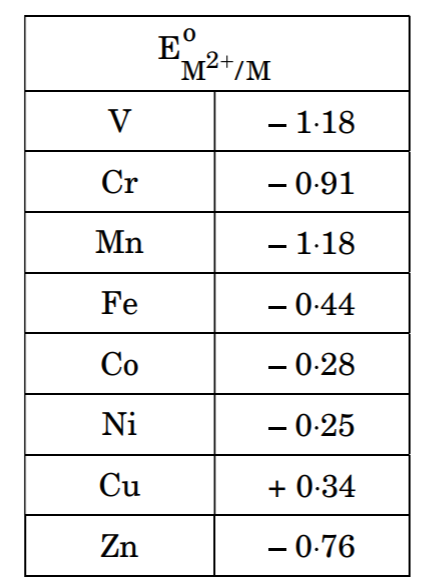
(1) On what basis can we say that Cu is a transition element but Zn is not ? (Atomic number : Cu = 29, Zn = 30)
[1 Mark](2) On what basis can we say that Cu is a transition element but Zn is not ? (Atomic number : Cu = 29, Zn = 30)
[1 Mark]Zn is not a transition metal as it has a full d10 configuration in both its atom and common ions, so it lacks these properties, as mentioned in the passage.
(3) (i) Why do E°M²+⁄M values show irregular trend from Vanadium to Zinc ? (ii) How is the variability in oxidation states of transition metals different from that of the non-transition elements ?
(ii) Transition metals exhibit variable oxidation states due to the involvement of both (n-1)d and ns electrons in bonding, unlike non-transition elements which usually show fixed oxidation states as they involve only valence s or p electrons. This is explained in the case where partly filled d-orbitals allow multiple oxidation states.
(4) (i) Of the d⁴ species, Cr²⁺ is strongly reducing while Mn³⁺ is strongly oxidizing. Why ? (Atomic number : Cr = 24, Mn = 25) (ii) Complete the following ionic equation : 2Mno₄⁻+H₂O+I⁻ →
Mn3+ is strongly oxidizing because it can gain electrons to form Mn2+ with d5 half-filled stable configuration. Stability of half-filled or fully filled d-orbitals influences their redox behaviour, as explained in the case passage.
(ii) The balanced ionic equation is : 2MnO4- + H2O + 3I- → 2MnO2 + 2OH- + 3I-
Section B
When MnO₂ is fused with KOH in air, it gives :
Ligand EDTA⁴⁻ is an example of a :
EDTA4- is a polydentate ligand because it has multiple binding sites (six in total) that can coordinate to a metal ion, allowing it to form stable complexes.
Which of the following ligand forms chelate complex ?
Which of the following contains sp² hybridised carbon bonded to X ?
- (A) CH₃ -CH₂ -X
- (B) CH₂=CH-X
- (C) CH₂=CH-CH₂ -X
-
(D)
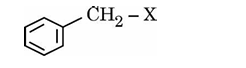
The correct option is CH2=CH-X because it contains a double bond between the two carbon atoms, which indicates that one of the carbon atoms is sp2 hybridized. The presence of the halogen X directly connected to one of these sp2 hybridized carbon atoms confirms that this compound has the required bonding structure.
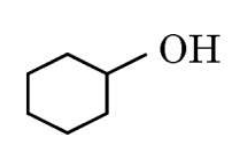
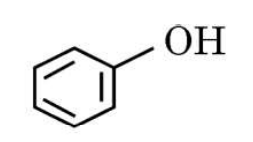
Which of the following is most acidic ?
-
(A)
-
(B)
-
(C)
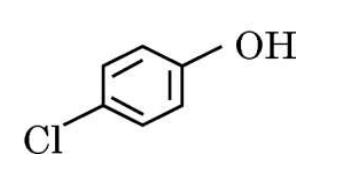
-
(D)
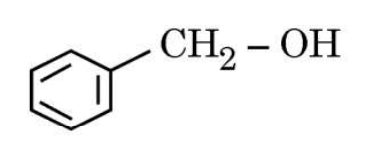
Ordinary alcohols like benzyl alcohol and cyclohexanol are much weaker acids (pKa ~16–18).
Phenol is more acidic (pKa ~10) because the phenoxide ion is resonance-stabilized.
In p-chlorophenol , the Cl substituent withdraws electron density (–I effect), stabilizing the phenoxide ion even more, so it’s more acidic than phenol.
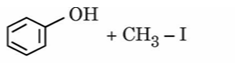
Anisole reacts with HI to give :
-
(A)
-
(B)

-
(C)

-
(D)

Anisole, which is an ether (methoxybenzene), reacts with hydroiodic acid (HI) to give iodoalkane (iodobenzene) and methanol. The reaction involves the cleavage of the C-O bond in the ether, leading to the formation of the alkyl iodide and alcohol.
Ethanol on heating with conc. H₂SO₄ at 413 K gives :
The correct answer is CH2=CH2 (ethene). When ethanol is heated with concentrated sulfuric acid, it undergoes dehydration to form ethene and water. This process involves the elimination of a water molecule from ethanol, resulting in the formation of an alkene (ethene).
An azeotropic solution of two liquids has boiling point lower than either of them when it :
The correct answer is 'shows negative deviation from Raoult's law'. This is because an azeotropic mixture exhibits a lower boiling point than the boiling points of the individual components due to the strong intermolecular attractions between the different species, leading to a negative deviation from Raoult's law.
The relative lowering of vapour pressure of an aqueous solution containing non-volatile solute is 0·0225. The mole fraction of the non-volatile solute is :
The correct option is 0·0225, because the relative lowering of vapor pressure is equal to the mole fraction of the solute in dilute solutions, according to Raoult's law. Thus, if the relative lowering of vapor pressure is 0.0225, the mole fraction of the solute would also be 0.0225.
During electrolysis of aqueous solution of NaCl :
H2(g) is liberated at the cathode during the electrolysis of an aqueous solution of NaCl because the cathode is the negative electrode where reduction occurs. In this case, water is reduced to hydrogen gas and hydroxide ions, leading to the liberation of H2(g).
The addition of catalyst during a chemical reaction alters which of the following quantities of the reaction ?
The correct answer is Activation energy. A catalyst lowers the activation energy of a reaction, thus speeding up the reaction without altering the overall enthalpy, internal energy, or entropy of the reaction.
For the elementary reaction P → Q, if the rate of disappearance of P increases by a factor of 8 upon doubling the concentration of P, the order of the reaction with respect to P is
Assertion (A) : Aliphatic primary amines can be prepared by Gabriel phthalimide synthesis.
Reason (R) : Alkyl halides undergo nucleophilic substitution with anion formed by phthalimide.
Both Assertion (A) and Reason (R) are true, and Reason (R) is the correct explanation of the Assertion (A). Gabriel phthalimide synthesis involves the nucleophilic substitution of alkyl halides with the anion of phthalimide to form primary amines, making both statements accurate and logically connected.
Assertion (A) : Uracil base is present in DNA.
Reason (R) : DNA undergoes self-replication.
Assertion (A) : Diazonium salts of aromatic amines are more stable than those of aliphatic amines.
Reason (R) : Diazonium salts of aliphatic amines show resonance.
Assertion (A) is true, but Reason (R) is false. Diazonium salts of aromatic amines are indeed more stable due to the stability provided by resonance in the aromatic system, while diazonium salts of aliphatic amines are less stable and do not benefit from the same level of resonance stabilization. Therefore, the reason provided does not correctly explain the assertion.
Assertion (A) : p-nitroaniline is a weaker base than p-toluidine.
Reason (R) : The electron withdrawing effect of NO₂ group in p-nitroaniline makes it a weaker base.
Both Assertion (A) and Reason (R) are true and Reason (R) is the correct explanation of the Assertion (A) because the electron-withdrawing -NO2 group decreases the electron density available on the nitrogen atom in p-nitroaniline, making it less capable of accepting protons compared to p-toluidine, which has a -CH3 group that is an electron-donating substituent.
Section C
A 6% solution of glucose (molar mass = 180 g mol⁻¹) is isotonic with 25% solution of an unknown organic substance. Calculate the molecular weight of the unknown organic substance.
Step 1: Calculate moles of glucose in 100 g solution = 6 g / 180 g/mol = 0.0333 mol.
Step 2: Mass of solvent (water) in glucose solution = 100 g - 6 g = 94 g = 0.094 kg.
Step 3: Molality of glucose solution = 0.0333 mol / 0.094 kg = 0.354 mol/kg.
Step 4: For unknown solution, mass of solute = 25 g, solvent = 75 g = 0.075 kg.
Step 5: Let molecular weight of unknown = M.
Step 6: Molality of unknown = (25 / M) mol / 0.075 kg = 333.33 / M mol/kg.
Step 7: Since solutions are isotonic, molality of glucose = molality of unknown.
So, 0.354 = 333.33 / M
Therefore, M = 333.33 / 0.354 = 942.5 g/mol.
Answer: Molecular weight of the unknown substance is approximately 943 g/mol.
A first order reaction has a rate constant 1.25 x 10⁻³ s⁻¹. How long will 5 g of this reactant take to reduce to 2.5 g ?
| log2=0.301, log 3-0.4771, log 4 = 0.6021]
For a first order reaction: The relation is ln([A]t/[A]0) = -kt.
Here [A]0 = 5 g and [A]t = 2.5 g.
So, ln(2.5/5) = ln(0.5) = -kt.
Using log base 10: ln(0.5) = 2.303 * log10(0.5) = 2.303 * (-0.301) = -0.693.
Therefore, -0.693 = -kt => t = 0.693 / k = 0.693 / (1.25 x 10⁻³) = 554.4 seconds.
Hence, it will take approximately 554 seconds for the reactant to reduce from 5 g to 2.5 g in this first order reaction.
What is lanthanoid contraction ? Actinoid contraction is greater from element to element than lanthanoid contraction. Why ?
(a) Lanthanoid contraction is the gradual decrease in the atomic or ionic radii of the lanthanoid elements (atomic numbers 57 to 71) as we move from one element to the next in the periodic table. Actinoid contraction is similar but occurs in the actinoid series (atomic numbers 89 to 103). The contraction is greater in actinoids than in lanthanoids because the 5f electrons in actinoids provide poor shielding effect, leading to a stronger attraction of the nucleus on the electrons and thus greater decrease in size from element to element.
Why do transition metals have high enthalpy of atomization ? Which element of 3d-series has lowest enthalpy of atomization ?
(b) Zinc, among the 3d-series elements, has the lowest enthalpy of atomization because it has a completely filled d10 electronic configuration with no unpaired electrons, resulting in weaker metallic bonds and lower energy required to separate its atoms.
(a) In the following pair of compounds, which compound undergoes SN_2 reaction faster and why ?
(b) Write the major product in the following:
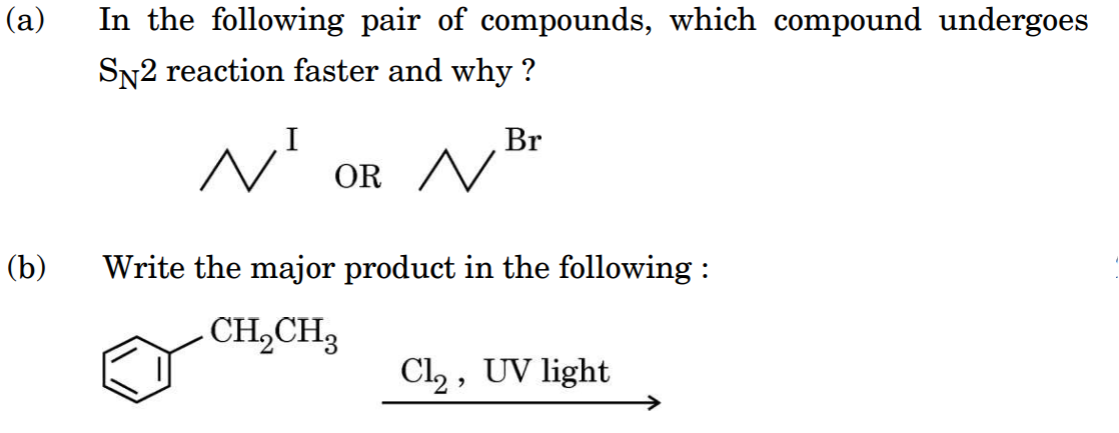
(a) Between the two given compounds (1-iodopropane and 1-bromopropane), 1-iodopropane undergoes the Sᴺ2 reaction faster. The carbon skeleton is the same in both, so steric factors are identical. The difference is the leaving group: I⁻ is a better leaving group than Br⁻ because the C–I bond is weaker and iodide is larger and more stable after leaving. A better leaving group lowers the activation energy, so substitution by Sᴺ2 is faster with the iodide.
(b) Ethylbenzene reacts with Cl₂ in UV light by a free-radical substitution at the benzylic position, because the benzylic radical formed is resonance-stabilized and hence most favorable. Therefore, chlorine replaces one hydrogen on the benzylic carbon to give 1-chloroethylbenzene (C₆H₅–CHCl–CH₃) as the major product.
Define the following terms :
(a) Denaturation of protein
(b) Invert sugar
(b) Invert sugar is a mixture of glucose and fructose formed when sucrose (cane sugar) is hydrolysed by acids or enzymes. The reaction splits sucrose into glucose and fructose, both of which are sweeter and easier to digest. It is called invert sugar because the optical rotation of the solution changes from positive to negative during the process.
Section D
Write the structures of A, B and C in the following reactions :
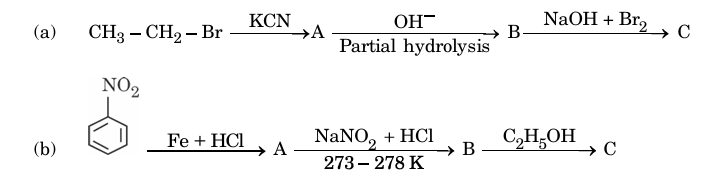
(a) Structure of A: A is the reactant organomagnesium compound, known as the Grignard reagent. Its general formula is R-MgX, where R is an alkyl or aryl group and X is a halogen.
Example: Phenylmagnesium bromide, C6H5-MgBr.
(b) Structure of B: B is the halide or electrophile reacting with the Grignard reagent. It is generally an alkyl halide such as RX.
Example: Bromobenzene, C6H5-Br.
(c) Structure of C: C is the product formed after the reaction of A and B followed by hydrolysis with water or deuterium oxide (D2O). This product is an alkane or corresponding hydrocarbon with the R groups joined.
Example: Biphenyl, C6H5-C6H5.
This reaction proceeds by nucleophilic attack of the Grignard reagent (A) on the alkyl halide (B) to form C after protonation.
Summary: A is the Grignard reagent (R-MgX), B is the alkyl or aryl halide (R-X), and C is the coupled hydrocarbon formed after addition and hydrolysis (R-R).
Write the reaction involved in the following :
(a) Wolff-Kishner reduction
(b) Decarboxylation reaction
(c) Cannizzaro reaction
Example: R-CO-R + NH2NH2 → R-CH=NNH2 → (heat with KOH) R-CH2-R
(b) Decarboxylation reaction: This reaction removes a carboxyl group (COOH) from a carboxylic acid as CO2, producing an alkane.
Example: R-CH2-COOH + NaOH + heat → R-CH3 + Na2CO3
(c) Cannizzaro reaction: This is a redox reaction where aldehydes without an alpha-hydrogen undergo simultaneous oxidation and reduction in presence of concentrated alkali to form a primary alcohol and a carboxylate salt.
Example: 2 R-CHO + NaOH → R-CH2OH + R-COONa
The vapour pressure of a solvent at 283 K is 100 mm Hg. Calculate the vapour pressure of a dilute solution containing 1 mole of a strong electrolyte AB in 50 moles of the solvent at 283 K (assuming complete dissociation of solute AB).
Vapour pressure of pure solvent, P0 = 100 mm Hg
Moles of solute AB = 1 mole
Moles of solvent = 50 moles
AB is a strong electrolyte and dissociates completely into A+ and B- ions, so van't Hoff factor i = 2
Step 1: Calculate total moles of particles in solution = moles of solvent + i * moles of solute = 50 + 2 * 1 = 52
Step 2: Calculate mole fraction of solvent, X_solvent = moles of solvent / total moles = 50 / 52 = 0.9615
Step 3: Apply Raoult's law for vapour pressure of solution:
P_solution = X_solvent * P0 = 0.9615 * 100 = 96.15 mm Hg
Therefore, the vapour pressure of the solution at 283 K is approximately 96.15 mm Hg.
The rate of a gaseous reaction triples when temperature is increased from 17ºC to 27ºC. Calculate the energy of activation for this reaction.
[Given : 2.303 R = 19.15 JK⁻¹ mol ⁻¹, log 3 = 0.48]
Step 1: Convert temperatures to Kelvin:
T1 = 17 + 273 = 290 K
T2 = 27 + 273 = 300 K
Step 2: Use Arrhenius equation in logarithmic form:
log(k2/k1) = (Ea/2.303R) * (1/T1 - 1/T2)
Given k2/k1 = 3, log 3 = 0.48, and 2.303R = 19.15 J K-1 mol-1
Step 3: Substitute values:
0.48 = (Ea/19.15) * (1/290 - 1/300)
(1/290 - 1/300) = (300 - 290) / (290*300) = 10 / 87000 = 0.00011494
Step 4: Calculate Ea:
0.48 = (Ea/19.15) * 0.00011494 => Ea = 0.48 * 19.15 / 0.00011494
Ea = 79971 J mol-1 or 79.97 kJ mol-1
Answer: The activation energy of the reaction is approximately 80 kJ mol-1.
Give the equations of reactions for the preparation of :
(a) Phenol from chlorobenzene
(b) Salicylaldehyde from phenol
(c) 2-Methoxyacetophenone from anisole
(d) Picric acid from phenol
C6H5Cl + NaOH (at 300 deg C and high pressure) → C6H5OH + NaCl
(b) Preparation of Salicylaldehyde from Phenol (Reimer-Tiemann Reaction):
C6H5OH + CHCl3 + NaOH → o-Hydroxybenzaldehyde (Salicylaldehyde) + other products
(c) Preparation of 2-Methoxyacetophenone from Anisole:
C6H5OCH3 + CH3COCl (Friedel-Crafts Acylation in presence of AlCl3) → 2-Methoxyacetophenone + HCl
(d) Preparation of Picric acid from Phenol:
C6H5OH + 3 HNO3 (dilute) → 2,4,6-Trinitrophenol (Picric acid) + 3 H2O
Explanation:
(a) Chlorobenzene reacts with NaOH at high temperature and pressure to give phenol.
(b) In Reimer-Tiemann reaction, phenol reacts with chloroform and NaOH to form salicylaldehyde at the ortho position.
(c) Anisole undergoes Friedel-Crafts acylation with acetyl chloride (CH3COCl) in presence of AlCl3 catalyst to give 2-methoxyacetophenone.
(d) Phenol nitrates on treatment with dilute nitric acid to give picric acid which is 2,4,6-trinitrophenol.
Give reasons for the following :
(a) Chlorine is ortho/para directing in electrophilic aromatic substitution reactions, though chlorine is an electron withdrawing group.
(b) Racemic mixture is optically inactive.
(c) Allyl chloride is hydrolysed more readily than n-propyl chloride.
(b) A racemic mixture contains equal amounts of two enantiomers which rotate plane-polarized light in opposite directions. Their effects cancel out, making the mixture optically inactive.
(c) Allyl chloride is hydrolysed more readily because the allylic carbocation formed during hydrolysis is resonance stabilized, making it more stable and easier to form than the primary carbocation formed from n-propyl chloride. Thus, the reaction rate is faster for allyl chloride.
Calculate emf of the following cell :
Zn (s) | Zn²⁺ (0 1 M) || Sn²⁺ (0·001 M) Sn (s)
Given: E°zn²⁺/zn = -0.76V, E°sn²⁺/sn = - 0.14 V
[log 10 = 1]
Zn/Zn²⁺ E° = -0.76 V (oxidation)
Sn/Sn²⁺ E° = -0.14 V (reduction)
Step 2: Calculate the standard emf of the cell:
E°cell = E°cathode - E°anode = (-0.14) - (-0.76) = 0.62 V
Step 3: Use Nernst equation to find emf under given concentrations:
Ecell = E°cell - (0.059 / 2) * log ([Zn²⁺] / [Sn²⁺])
Given [Zn²⁺] = 0.1 M, [Sn²⁺] = 0.001 M and log 10 = 1
Therefore, Ecell = 0.62 - (0.059 / 2) * log (0.1 / 0.001) = 0.62 - 0.0295 * log 100 = 0.62 - 0.0295 * 2 = 0.62 - 0.059 = 0.561 V
Answer: emf of the cell = 0.561 V
Section E
Answer any five of the following:
(a) How is the crystal field splitting energy for octahedral complex (Δo) related to that of tetrahedral complex (Δₜ) ?
(b) Write the IUPAC name of the following complex : [PtCl₂(en)₂] (NO₃)₂
(c) Write the geometry and magnetic behaviour of the complex [Ni(CO)4] on the basis of Valency Bond Theory (VBT).
(d) What type of isomerism is shown by the complex [Co(NH₃)₆] [Cr(CN)₆] ?
(e) For the coordination compound on the basis of crystal field theory, write the electronic configuration for d⁴ ion if Δo < P. Is the coordination compound a high spin or low spin complex ?
(f) Out of [Co(NH₃)₆]₃⁺ and [Co(NH₃)₄Cl₂]⁺, which complex is heteroleptic and why ?
(g) Draw the structures of optical isomers of [PtCl₂(en)₂]²⁺.
(b) The IUPAC name of the complex [PtCl₂(en)₂](NO₃)₂ is Dichlorobis(ethane-1,2-diamine)platinum(IV) nitrate.
(c) According to Valence Bond Theory, [Ni(CO)4] has dsp2 hybridisation resulting in a tetrahedral geometry. It is diamagnetic because CO is a strong field ligand causing pairing of all Ni electrons.
(d) The complex [Co(NH₃)₆] [Cr(CN)₆] shows ionisation isomerism because two different ions exchange ligands but have the same composition.
(e) For a d⁴ ion, if Δo < P, it means pairing energy is more than the crystal field splitting energy. The electronic configuration is t2g³ eg¹ resulting in four unpaired electrons. Therefore, the complex is a high spin complex.
(f) [Co(NH₃)₆]3+ is a homoleptic complex because it contains only one type of ligand (NH₃). [Co(NH₃)₄Cl₂]+ is a heteroleptic complex because it contains more than one type of ligand, NH₃ and Cl-.
(g) The complex [PtCl₂(en)₂]2+ shows optical isomerism. The two optical isomers are non-superimposable mirror images (enantiomers). They can be drawn as two different spatial arrangements of ethane-1,2-diamine and chloride ligands around Pt in an octahedral geometry.
(i) Draw structure of the 2,4-dinitrophenylhydrazone of benzaldehyde.
(ii) Arrange the following in increasing order of their reactivity towards HCN : CH3COCH3 , (CH₃)₃C- COCH₃ , CH₃CHO
(iii) How can you convert phenyl magnesium bromide to benzoic acid ?
(iv) Give a simple chemical test to distinguish between ethanoic acid and ethanal.
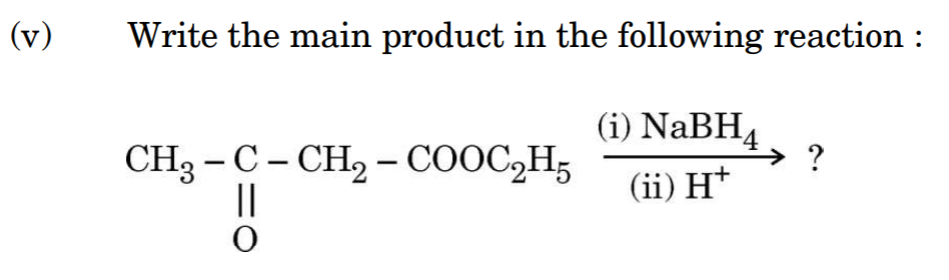
(v) Write the main product in the following reaction:
(i) The 2,4-dinitrophenylhydrazone of benzaldehyde is formed by the reaction of benzaldehyde with 2,4-dinitrophenylhydrazine. Its structure consists of a benzene ring attached to a CH=N-NH-C6H3(NO2)2 group where nitro groups are at the 2 and 4 positions of the phenyl ring.
(ii) The increasing order of reactivity towards HCN is: (CH3)3C-COCH3 < CH3COCH3 < CH3CHO. This is because steric hindrance decreases reactivity and aldehydes are more reactive than ketones.
(iii) Phenyl magnesium bromide reacts with carbon dioxide (dry ice) followed by acid hydrolysis to produce benzoic acid. The reaction is: C6H5MgBr + CO2 → C6H5COOMgBr → (acid work-up) → C6H5COOH.
(iv) Ethanoic acid gives effervescence with sodium bicarbonate due to formation of CO2 gas, whereas ethanal does not. This is the simple test to distinguish between them.
(v)The given compound is CH₃–CO–CH₂–COOC₂H₅ (ethyl acetoacetate type: it has a ketone and an ester group).
NaBH₄ is a selective reducing agent: it reduces ketones and aldehydes, but does not reduce esters under these conditions. So only the ketone (>C=O) group is reduced to a secondary alcohol, while the ester (–COOC₂H₅) remains unchanged.
Therefore, the main product after (i) NaBH₄ and (ii) H⁺ is:
CH₃–CH(OH)–CH₂–COOC₂H₅
i.e., ethyl 3-hydroxybutanoate (a β-hydroxy ester).
(i) Account for the following:
(1) Oxidation of aldehydes is easier as compared to ketones.
(2) The alpha (α) hydrogen atoms of aldehydes are acidic in nature.
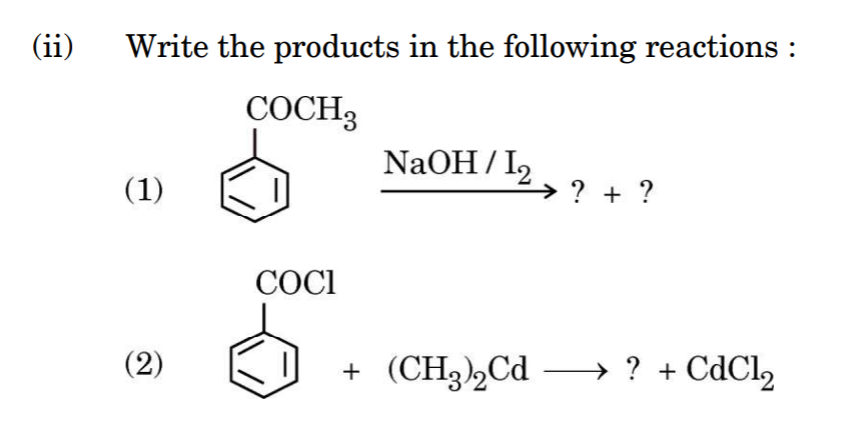
(ii) Write the main product in the following reaction :
(iii) Give a simple chemical test to distinguish between benzaldehyde and ethanal.
(i)(1) Oxidation of aldehydes is easier than ketones because aldehydes have a hydrogen atom attached to the carbonyl carbon which can be easily removed during oxidation, whereas ketones have two alkyl groups attached to the carbonyl carbon which makes them more resistant to oxidation.
(2) The alpha (α) hydrogen atoms of aldehydes are acidic because the hydrogen atoms on the carbon adjacent to the carbonyl group are polarized and can be easily removed due to resonance stabilization of the resulting enolate ion, making them more acidic.
(ii) 1) The first compound is acetophenone (C₆H₅–CO–CH₃). With NaOH / I₂, this is the iodoform (haloform) reaction because it contains the –CO–CH₃ (methyl ketone) group. In this reaction, the methyl group is converted into CHI₃ (iodoform) and the rest becomes a carboxylate salt.
So the products are:
C₆H₅–COONa (sodium benzoate) + CHI₃ (iodoform, yellow precipitate).
(2) The second compound is benzoyl chloride (C₆H₅–COCl). With (CH₃)₂Cd (dimethyl cadmium), acid chlorides are converted into ketones by replacing Cl with one alkyl group. Here, one CH₃ group is introduced, giving:
C₆H₅–CO–CH₃ (acetophenone) + CdCl₂.
(iii) To distinguish between benzaldehyde and ethanal, Tollens' test can be used. Benzaldehyde gives a positive Tollens' test producing a silver mirror, while most ketones do not. Alternatively, Fehling's test can be used where ethanal gives a red precipitate but benzaldehyde does not react significantly.
(i) The resistance of 0.05 M CH₃COOH solution is found to be 100 ohm. If the cell constant is 0.0354 cm ⁻¹, calculate the molar conductivity of the acetic acid solution.
(ii) State faraday's first law of electrolysis. how much charge is Faraday is required for the reduction of 1 mol of MnO⁻₄ to Mn²⁺ ?
First, calculate the conductivity (k) using the formula: k = Cell constant / Resistance = 0.0354 / 100 = 0.000354 S cm-1.
Then, calculate molar conductivity ( Λm ) using: Λm = k / c = 0.000354 / 0.05 = 0.00708 S cm2 mol-1.
Therefore, molar conductivity of acetic acid solution is 7.08 S cm2 mol-1.
(ii) Faraday's first law of electrolysis states: 'The amount of substance liberated or deposited at an electrode during electrolysis is directly proportional to the quantity of electricity passed through the electrolyte.'
Reduction reaction: MnO4- → Mn2+.
Number of electrons involved (n) = 5.
Charge required for 1 mole of electrons (Faraday constant, F) = 96500 C.
Therefore, total charge Q = n * F = 5 * 96500 = 482500 Coulombs.
Thus, 482500 C of charge is required for reduction of 1 mol of MnO4- to Mn2+.
(i) The conductivity of 0.0025 mol L ⁻¹ acetic acid is 5.25 *10 ⁻⁵ S cm⁻¹. Calculate its degree of dissociation if λ°ₘ for acetic acid is 390 S cm² mol⁻¹.
(ii) Write anode, cathode and overall reaction of lead storage battery.
Given:
Concentration (c) = 0.0025 mol L-1
Conductivity (\u03BA) = 5.25 * 10-5 S cm-1
Molar conductivity at infinite dilution (\u03BB0m) = 390 S cm2 mol-1
Step 1: Calculate molar conductivity (\u03BBm) at given concentration:
\u03BBm = \u03BA / c = (5.25 * 10-5) / 0.0025 = 0.021 S cm2 mol-1
Step 2: Calculate degree of dissociation \u03B1:
\u03B1 = \u03BBm / \u03BB0m = 0.021 / 390 = 5.38 * 10-5
Therefore, the degree of dissociation of acetic acid = 5.38 * 10-5 which is very small as expected for a weak acid.
(ii) Lead storage battery reactions:
Anode (oxidation): Pb (s) + HSO4- (aq) → PbSO4 (s) + H+ (aq) + 2e-
Cathode (reduction): PbO2 (s) + HSO4- (aq) + 3H+ (aq) + 2e- → PbSO4 (s) + 2H2O (l)
Overall reaction:
Pb (s) + PbO2 (s) + 2H2SO4 (aq) → 2PbSO4 (s) + 2H2O (l)
This is a reversible reaction which makes the lead storage battery rechargeable.
Paper Details
CBSE Board Exam 2024
Class
Class 12 PCM
Subject
Chemistry
Year
2024
Set
Set 2
Other Years — Chemistry