SOLUTIONS
2024 BOARD EXAM
CBSE Class 12 PCM Chemistry Board Paper 2024 — Set 4 Solutions
2024
Chemistry
Class 12 PCM
CBSE EXAMINATION PAPER-2024
CHEMISTRY
(Solved)
General Instructions :
Read the following instructions carefully and follow them :
- This question paper contains 39 questions. All questions are compulsory.
- This question paper is divided into 5 sections.
- Section A – questions number 1 to 5 are case based questions
- Section B – questions number 6 to 21 are multiple choice questions
- Section C – questions number 22 to 27 are very short answer
- Section D – questions number 28 to 34 are short answer
- Section E – questions number 35 to 39 are long answer
- There is no overall choice given in the question paper. However, an internal choice has been provided in few questions.
- Use of calculator is NOT allowed.
Section A
20. The nature of bonding, structure of the coordination compound can be explained to some extent by valence bond theory. The central metal atom/ion makes available a number of vacant orbitals equal to its coordination number. The appropriate atomic orbitals (s, p and d) of the metal hybridise to give a set of equivalent orbitals of definite geometry such as square planar, tetrahedral, octahedral and so on. A strong covalent bond is formed only when the orbitals overlap to the maximum extent. The d-orbitals involved in the hybridisation may be either inner d-orbitals i.e. (n—l) d or outer d-orbitals i.e. nd. The complexes formed are called inner orbital complex (low spin complex) and outer orbital complex (high spin complex) respectively. Further, the complexes can be paramagnetic or diamagnetic in nature. The drawbacks of this theory are that this involves number of assumptions and also does not explain the colour of the complex.
Answer the following questions :
The following questions are case-based questions. Read the case carefully a answer the questions that follow.
The nature of bonding, structure of the coordination compound can be explained to some extent by valence bond theory. The central metal atom/ion makes available a number of vacant orbitals oqual to its coordination number. The appropriate atomic orbitals (s, p and d) of the metal hybridise to give a set of equivalent orbitals of definite geometry such as square planar, tetrahedral, octahedral and so on. A strong covalent bond is formed only when the orbitals overlap to the maximum extent. The d-orbitals involved in the hybridisation may be either inner d-orbitals ie. (n-1) d or outer d-orbitals i.e. nd. The complexes formed are called inner orbital complex (low spin complex) and outer orbital complex (high spin complex) respectively. Further, the complexes can be paramagnetic or diamagnetic in nature. The drawbacks of this theory are that this involves number of assumptions and also does not explain the colour of the complex.
Answer the following questions:
(1) Predict whether (CoF₆)³⁻ is diamagnetic or paramagnetic and why? [Atomic number: Co=27]
(2) What is the coordination number of Co in [Co(en)₂, Cl₂]⁺ ?
Explanation: Coordination number equals total number of donor atoms bonded to the central metal. Here it is 6.
(3) (i) Write the IUPAC name of the given complex [Pt(NH₃)₂ Cl₂]²⁺ (ii) Explain [Co(NH₃)₆]³⁺ is an inner orbital or outer orbital complex.
(ii) [Co(NH3)6]3+ is an inner orbital complex because cobalt uses its (n-1)d orbitals for hybridisation forming low spin complexes as explained by valence bond theory in the case passage.
(4) Using valence bond theory, deduce the shape and hybridisation of [Ni(NH₃)₆]²⁺ Atomic nomber of Ni =28]
In a galvanic cell, chemical energy of a redox reaction is converted into electrical energy, whereas in an electrolytic cell the redox reaction occurs on passing electricity. The simplest galvanic cell is in which Zn rod is placed in a solution of ZnSO₄, and Cu rod is placed in a solution of CuSO₄. The two rods are connected by a metallic wire through a voltmeter. The two solutions are joined by a salt bridge. The difference between the two electrode potentials of the two electrodes is known as electromotive force. In the process of electrolysis, the decomposition of a substance takes place by passing an electric current. One mole of electric charge when passed through a cell will discharge half a mole of a divalent metal ion such as Cu²⁺ This was first formulated by Faraday in the form of laws of electrolysis.
(1) What is the function of a salt bridge in a galvanic cell?
(2) When does galvanic cell behave like an electrolytic cell?
(3) How much charge in terms of Faraday is required for the following: (1) 1 mal of MnO⁻₄ to M n²⁺ (ii) 1 mol of H₂O to O₂
(4) Can copper sulphate solution be stored in a pot made of zinc ? Explain with the help of the value of E° cell. (E° Cu²⁺ / Cu = 0.34V ) (E° Zn²⁺ / Zn = - 0.76V )
Section B
The molar ionic conductivities of Ca²⁺ and Cl– are 119.0 and 76.3 S cm² mol⁻¹ respectively. The value of limiting molar conductivity of CaCl₂ will be
Which of the following acids represents Vitamin C?
The correct answer is Ascorbic acid, as it is the chemical name for Vitamin C, which is vital for various bodily functions, including the maintenance of healthy skin, blood vessels, bones, and cartilage.
Rosenmund reduction is used for the preparation of Aldehydes. The catalyst used in this reaction is.
The correct answer is Pd-BaSO₄. In the Rosenmund reduction, palladium on barium sulfate (Pd-BaSO₄) is used as a catalyst to selectively reduce acyl chlorides to aldehydes in the presence of hydrogen.
Which alkyl halide from the given options will undergo SN1 reaction faster?
The correct option is (CH₃)₃C-Br, which is a tertiary alkyl halide. SN1 reactions generally proceed more quickly with tertiary substrates due to the stability of the carbocation formed during the reaction. In contrast, primary and secondary alkyl halides do not stabilize the carbocation as effectively, making (CH₃)₃C-Br the fastest to undergo an SN1 reaction.
From the elements of 3d series given below, which element shows the maximum number of oxidation states?
Manganese shows the maximum number of oxidation states in the 3d series, with a total of seven oxidation states ranging from -3 to +7, due to its electronic configuration and the ability to lose or share its 3d and 4s electrons.
The correct Mathematical expression of Arrhenius equation is
Identify the tertiary amine from the following:
The correct answer is CH₃–N(CH₃)–CH₃, which is a tertiary amine. Tertiary amines have the structure R₃N, where R represents alkyl groups. In this case, the nitrogen atom is bonded to three methyl groups (CH₃), which classifies it as tertiary. The other options represent primary or secondary amines based on their structures.
Nucleophilic addition of Grignard reagent to ketones followed by hydrolysis with dilute acids forms
The correct answer is 'Tertiary alcohol' because when a Grignard reagent adds to a ketone, it forms a tertiary alcohol after hydrolysis. According to the context provided, nucleophilic addition to ketones yields a tertiary alcohol, while primary alcohols are produced from aldehydes.
In a given graph of zero order reaction, the slope and intercept are:
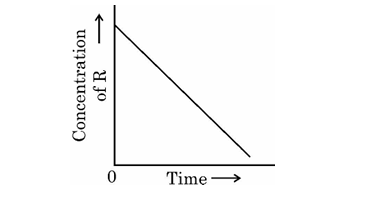
The correct option is 'Slope = -k, Intercept = [R]₀'. In a zero-order reaction, the concentration of the reactant [R] decreases linearly over time, so the graph of [R] vs. time has a slope equal to -k (where k is the rate constant) and the y-intercept is the initial concentration [R]₀.
Match the reagents required for the given reactions
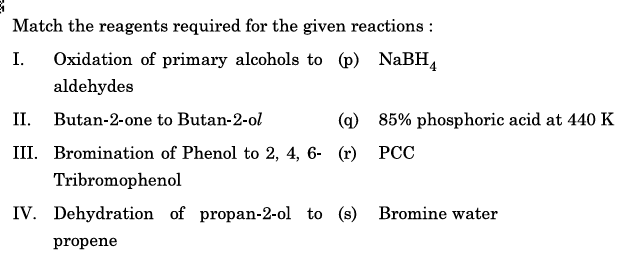
The correct option is I - (p), II - (s), III - (r), IV - (q). This matches the reagents to the specified reactions describing how different chemical species interact, such as Cu(II) oxidizing I-ions and the comparative behavior of bromine with iodide ions. The context indicates that certain reagents are required for specific interactions and these match correctly in the provided option.
Assertion (A): p-nitrophenol is less acidic than phenol. Reason
(R): Nitro group is electron withdrawing and helps in the stabilization of p-nitrophenoxide ion.
Assertion (A) is false, but Reason (R) is true. p-Nitrophenol is actually more acidic than phenol due to the strong electron-withdrawing effect of the nitro group, which stabilizes the p-nitrophenoxide ion. This contradicts the assertion.
Assertion (A): Benzoic acid does not undergo Friedel–Crafts reaction. Reason
(R): Carboxyl group is deactivating and the catalyst aluminium chloride gets bonded to the carboxyl group.
Both Assertion (A) and Reason (R) are true, but Reason (R) is not the correct explanation of the Assertion (A). While it's true that the carboxyl group is a deactivating group that prevents Friedel-Crafts reactions, the explanation that aluminium chloride bonds to the carboxyl group is inaccurate. The main reason for the lack of reaction is the electron-withdrawing nature of the carboxyl group, which decreases the electrophilicity of the aromatic ring.
Assertion (A): Fructose is a reducing sugar.
Reason (R): Fructose does not reduce Fehling solution and Tollen's reagent.
Assertion (A) is true, but Reason (R) is false. Fructose is indeed a reducing sugar as it can reduce Fehling's solution and Tollen's reagent under certain conditions, despite it being a ketose, which may not react as easily as aldoses.
Assertion (A): For a Daniell cell, Zn/Zn²⁺ (1 M)| | Cu²⁺ (1 M)/Cu with E° cell = 1.1 V, if the external opposing potential is more than 1.1 V, the electrons flow from Cu to Zn. Reason
(R): Cell acts like a galvanic cell.
The assertion is correct because when the external opposing voltage exceeds the cell's standard emf (1.1 V), the cell undergoes a reverse reaction and electrons flow from the copper electrode to the zinc electrode, opposite to the normal (spontaneous) direction. The reason states that the cell acts like a galvanic cell, which is true under normal operation (when external voltage is less than 1.1 V). However, when the external voltage is greater than 1.1 V, the cell acts like an electrolytic cell, not a galvanic cell. Therefore, although both the assertion and reason are true statements, the reason is not the correct explanation for the assertion.
The general electronic configuration of d-block elements is :
The correct option is (n-1)d¹⁰ ns¹⁻² because d-block elements, which include transition metals, typically have their outermost electrons filling the d subshell. The general configuration indicates that the d-subshell can hold a maximum of 10 electrons while the s-subshell can hold 2, leading to the configuration of (n-1)d¹⁰ ns¹⁻².
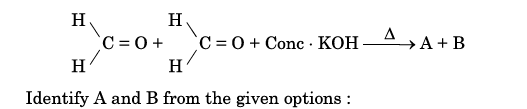
Consider the following reaction :
Section C
Define the following terms:
(a) Order of a reaction
(b) Activation energy
(b) Activation energy is the minimum amount of energy that reacting molecules must have to start a chemical reaction. It is the energy barrier that must be overcome for reactants to transform into products.
Step 1: Calculate freezing point depression, ΔTf = 273.15 K - 272.07 K = 1.08 K
Step 2: Use formula for molecular mass M = (Kf * w2 * 1000) / (ΔTf * w1)
Step 3: Substitute values: M = (1.86 * 18 * 1000) / (1.08 * 200) = (33480) / (216) = 155 g/mol
Answer: Molecular mass of the solute is 155 g/mol.
(a) Which compound in the given pair would undergo substitution reaction at a faster rate and why? (a) CH₃ — CH₂ — I and CH₃ — CH₂ — Br.
(b) Arrange the following compounds in the increasing order of their boiling points:
Butane, 1-Bromobutane, 1-Iodobutane, 1-Chlorobutane.
(b) Increasing order of boiling points is: Butane < 1-Chlorobutane < 1-Bromobutane < 1-Iodobutane. This is because boiling point increases with increasing molecular weight and polarizability of the halogen atom in the compound.
Write the stepwise mechanism of nucleophilic addition reactions in the carbonyl compounds
1. The carbonyl compound has a polar C=O bond where carbon is electrophilic due to oxygen's higher electronegativity.
2. A nucleophile, which is an electron-rich species, attacks the electrophilic carbon atom in the carbonyl group from a direction perpendicular to its plane.
3. The attack changes carbon's hybridisation from sp2 to sp3, breaking the double bond and forming a tetrahedral alkoxide intermediate.
4. In the intermediate, the oxygen bears a negative charge, which can be stabilized by protonation.
5. Finally, protonation of the alkoxide oxygen results in the formation of an alcohol.
This mechanism explains why nucleophilic addition is common in aldehydes and ketones.
How will you convert with following :
(i) Toluene to benzoic acid
(ii) Ethanol to 3- Hydroxybutanal
(ii) Conversion of Ethanol to 3-Hydroxybutanal: First, ethanol undergoes aldol condensation. Two molecules of ethanal (formed by oxidation of ethanol) undergo base-catalyzed aldol condensation to form 3-hydroxybutanal.
(a) What happens when glucose reacts with bromine water? write chemical equation.
(b) Two bases are mentioned below, identify which is present in DNA and which one is present in RNA:
(i) Thymine (ii) Uracil
C6H12O6 + Br2 + H2O → C6H12O7 + 2HBr.
(b) (i) Thymine is a nitrogenous base present in DNA.
(ii) Uracil is a nitrogenous base present in RNA.
Section D
(a) Draw the geometrical isomers of the given complex :
[Pt(en)₂Cl₂]²⁺
(b) Write the electronic configuration for d4 ion if Δₒ< P on the basis of crystal field theory.
(c) What is meant by a unidentate ligand ? Give an example.
1. Cis-isomer: Both Cl ligands are adjacent to each other.
2. Trans-isomer: Cl ligands are opposite to each other.
Because en is a bidentate ligand, it occupies two coordination positions, so the arrangement of Cl ligands defines the isomerism.
(b) For a d4 ion with crystal field splitting energy \u0394\u208a less than pairing energy P (\u0394\u208a < P), the complex is high spin. The electronic configuration is:
t2g3 eg1 (i.e., three electrons occupy lower energy t2g orbitals singly, and one electron occupies higher energy eg orbital unpaired).
(c) A unidentate ligand is a ligand that can coordinate to the central metal atom through only one donor atom (one coordination site).
Example: Cl- (chloride ion) is a unidentate ligand as it binds through one atom only.
Calculate emf of the following cell at 25∘C :
Sn/Sn²⁺(0.001M) ∣∣ H⁺(0.01M)∣H₂( g)(1 bar ) ∣ Pt₍ₛ₎
Given : E∘(Sn²⁺/Sn)=−0.14 V,E∘H+/H₂=0.00 V(log10=1)
Sn²⁺ + 2e⁻ → Sn; E° = -0.14 V (reduction)
2H⁺ + 2e⁻ → H₂; E° = 0.00 V (reduction)
In the cell notation, Sn electrode is on left and hydrogen electrode on right. Sn is being oxidized and H⁺ reduced.
Oxidation half-reaction: Sn → Sn²⁺ + 2e⁻ ; E°_ox = +0.14 V
Reduction half-reaction: 2H⁺ + 2e⁻ → H₂ ; E°_red = 0.00 V
Cell reaction: Sn + 2H⁺ → Sn²⁺ + H₂
Now use Nernst equation for the cell at 25 degC:
E = E°_cell - (0.0592/2) * log Q
Where, E°_cell = E°_red - E°_ox = 0.00 - (-0.14) = +0.14 V
Reaction quotient Q = [Sn²⁺] / [H⁺]^2 = 0.001 / (0.01)^2 = 0.001 / 0.0001 = 10
So, log Q = log 10 = 1
Therefore, E = 0.14 - (0.0592 / 2) * 1 = 0.14 - 0.0296 = 0.1104 V
Answer: The emf of the cell at 25 degC is approximately 0.11 V.
Write chemical equations for the following reactions : (Do any three)
(a) Hydroboration — oxidation reaction
(b) Williamson Synthesis
(c) Friedel-Crafts Alkylation of Anisole
(d) Reimer-Tiemann Reaction
Equation: CH3-CH=CH2 + BH3 → CH3-CH2-CH2BH2 (hydroboration)
Then, CH3-CH2-CH2BH2 + H2O2 / OH- → CH3-CH2-CH2OH + B(OH)3 (oxidation)
This forms 1-propanol by adding -OH group to the less substituted carbon.
(b) Williamson Synthesis: This reaction synthesizes ethers from an alkoxide ion and an alkyl halide.
Equation: C2H5ONa + CH3I → C2H5-O-CH3 + NaI
Here, ethoxide ion reacts with methyl iodide to form ethyl methyl ether.
(c) Friedel-Crafts Alkylation of Anisole: Anisole reacts with an alkyl halide in the presence of AlCl3 to give alkylated anisole.
Equation: C6H5OCH3 + CH3Cl + AlCl3 → CH3-C6H4-OCH3 + HCl
Alkyl group substitutes at the ortho and para positions of anisole.
(d) Reimer-Tiemann Reaction: Phenol reacts with chloroform and sodium hydroxide to form salicylaldehyde.
Equation: C6H5OH + CHCl3 + 3NaOH → C6H4(OH)CHO + 3NaCl + 2H2O
A formyl group is introduced at the ortho position of phenol to give salicylaldehyde.
(a) Give chemical tests to distinguish between the following pairs of compounds :
(i) Phenol and Benzoic acid
(ii) Propanal and Propanone
(b) Which one of the given compounds is a stronger acid and why ?
CH₂FCH₂CH₂COOH or CH₃CHFCH₂COOH
- Take dilute iron(III) chloride solution and add it to each compound. Phenol gives a violet or purple color with FeCl3 due to the formation of a phenol-Fe complex, whereas benzoic acid does not give any color.
- Add sodium bicarbonate (NaHCO3) solution to each. Benzoic acid reacts with NaHCO3 releasing carbon dioxide gas (effervescence), but phenol does not react.
(ii) To distinguish between Propanal and Propanone:
- Use Brady’s reagent (2,4-dinitrophenylhydrazine). Both aldehyde and ketone give a yellow/orange precipitate.
- Use Tollens’ test (ammoniacal silver nitrate solution). Propanal (aldehyde) gives silver mirror or black precipitate whereas propanone (ketone) gives no reaction.
(b) CH₂FCH₂CH₂COOH is a stronger acid than CH₃CHFCH₂COOH because the fluorine atom in CH₂FCH₂CH₂COOH is closer to the carboxyl group and exerts stronger electron-withdrawing inductive effect (-I effect). This stabilizes the conjugate base more effectively, increasing acidity. In the second compound, the fluorine is further away or less effectively positioned, so the acid strength is lower.
Explain the following terms :
(a) Essential amino acids
(b) Peptide bond
(c) Denaturation
(b) Peptide bond is a chemical bond formed between the carboxyl group (-COOH) of one amino acid and the amino group (-NH2) of another amino acid through a dehydration reaction. This bond links amino acids into polypeptides, forming proteins.
(c) Denaturation is the process in which the three-dimensional structure of a protein is altered by external factors like heat, pH changes, or chemicals, causing the protein to lose its natural shape and function. Denaturation is usually irreversible.
(a) Write the IUPAC name of the given compound :
(b) The presence of —N0₂ group at ortho or para position increases the reactivity of haloarenes towards nucleophilic substitution reactions.
Give reason to explain the above statement.
(c) What happens when ethyl chloride is treated with alcoholic potassium hydroxide ?
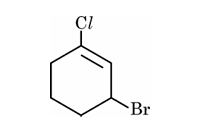
(a) The IUPAC name of the given compound is not specified in the question, so if the compound was given, the name would be based on the longest carbon chain and the positions of substituents according to IUPAC rules it is 3-Bromo-1-chlorocyclohex-1-ene.
(b) The presence of the electron withdrawing —NO2 group at ortho or para positions increases the reactivity of haloarenes towards nucleophilic substitution because —NO2 is a strong electron withdrawing group. It stabilizes the intermediate formed during nucleophilic aromatic substitution by delocalizing the negative charge through resonance. This makes it easier for the nucleophile to attack and replace the halogen atom, thus increasing the reactivity.
(c) When ethyl chloride is treated with alcoholic potassium hydroxide, an elimination reaction occurs resulting in the formation of ethene (an alkene). The OH- ion acts as a base, removing a beta hydrogen from ethyl chloride, and thereby eliminating HCl. The reaction can be written as C2H5Cl + KOH (alc) → C2H4 + KCl + H2O.
Show that the time required for 99.9% completion in a first order reaction is 10 times of half-life (t₁/₂) of the reaction [log 2 = 0.3010, log 10 = 1].
Step 1: Write the integrated rate equation for first order reaction:
log([R]0/[R]) = kt / 2.303
Step 2: Calculate half-life (t₁/₂):
At half-life, [R] = [R]0/2,
So, log([R]0/([R]0/2)) = kt₁/₂ / 2.303
log 2 = kt₁/₂ / 2.303
t₁/₂ = (2.303 / k) * log 2 = (2.303 / k) * 0.3010
Step 3: Calculate time for 99.9% completion (t):
At 99.9% completion, [R] = 0.1% of [R]0 = [R]0 * 0.001
log([R]0/([R]0 * 0.001)) = kt / 2.303
log(1/0.001) = kt / 2.303
log 1000 = kt / 2.303
Since log 10 = 1, log 1000 = 3
So, 3 = kt / 2.303
t = (2.303 / k) * 3
Step 4: Find the ratio t / t₁/₂:
t / t₁/₂ = [(2.303 / k) * 3] / [(2.303 / k) * 0.3010] = 3 / 0.3010 ≈ 10
Conclusion:
The time required for 99.9% completion of a first order reaction is 10 times its half-life, as shown.
Section E
Attempt any five of the following:
(a) Why is Zinc not regarded as a transition element?
(b) What is Lanthanoid contraction?
(c) Why is first ionization enthalpy of chromium lower than that of Zn ?
(d) Explain how transition elements behave as catalysts.
(e) Compounds of transition metals are generally coloured. Give reason.
(f) Out of KMn04 and K2Mn04, which one is paramagnetic and why ?
(g) Complete the following ionic equation: Cr₂O₇²⁻ + 14H⁺ + 6e⁻ →
(b) Lanthanoid contraction is the gradual decrease in the size of lanthanoid elements from La to Lu, despite increasing atomic number, due to poor shielding effect of 4f electrons.
(c) The first ionization enthalpy of chromium is lower than that of zinc because chromium has a 4s1 3d5 configuration that is less stable and the electron is removed easily, whereas zinc has a stable fully filled 3d10 4s2 configuration.
(d) Transition elements behave as catalysts because they can change their oxidation states easily, providing alternative reaction paths with lower activation energy, and their ability to adsorb reactant molecules on their surfaces.
(e) Compounds of transition metals are generally coloured due to d-d electronic transitions between different energy levels of d orbitals split by the ligand field.
(f) KMnO4 is paramagnetic because Mn is in +7 oxidation state with unpaired electrons, whereas K2MnO4 has Mn in +6 oxidation state which is diamagnetic due to no unpaired electrons.
(g) The completed ionic equation is: Cr2O72- + 14H+ + 6e- → 2Cr3+ + 7H2O.
(i) Define reverse osmosis.
(ii) Why are aquatic species more comfortable in cold water in comparison to warm water ?
(iii) A solution containing 2 g of glucose (M = 180 g mol ⁻¹) in 100 g of water is prepared at 303 K. If the vapour pressure of pure water at 303 K is 32.8 mm Hg, what would be the vapour pressure of the solution ?
(b) Aquatic species are more comfortable in cold water because cold water holds more dissolved oxygen than warm water. Oxygen is essential for their respiration. Also, cold water reduces their metabolic rate, requiring less oxygen, leading to better survival and comfort.
(c) Given: Mass of glucose = 2 g, Molar mass (M) = 180 g mol-1, Mass of water = 100 g, Temperature (T) = 303 K, Vapour pressure of pure water (P0) = 32.8 mm Hg.
Number of moles of glucose = 2 / 180 = 0.0111 mol.
Number of moles of water = 100 / 18 = 5.56 mol.
Mole fraction of glucose (Xglucose) = 0.0111 / (0.0111 + 5.56) = 0.00199.
Mole fraction of water (Xwater) = 1 - 0.00199 = 0.998.
Vapour pressure of solution, P = Xwater * P0 = 0.998 * 32.8 = 32.73 mm Hg.
So, vapour pressure of the solution is approximately 32.73 mm Hg.
(i) Predict whether Van't Hoff factor will be less or greater than one, when Ethanoic acid is dissolved in benzene.
(ii) Define ideal solution.
(iii) Calculate the mass of CaCl₂ (molar mass 111 g mol⁻¹) to be dissolved in 500 g of water to lower its freezing point by 2K, assuming that CaCl₂ undergoes complete dissociation. (Kf for water = 1.86 K kg mol⁻¹)
(ii) An ideal solution is one in which the intermolecular forces between the different components are equal to the forces between the molecules of each pure component. As a result, the solution obeys Raoult's law at all concentrations, exhibiting no volume change or heat change upon mixing.
(iii) Given:
Freezing point depression, ΔTf = 2 K
Mass of water, m solvent = 500 g = 0.5 kg
Kf for water = 1.86 K kg mol-1
Molar mass of CaCl2 = 111 g mol-1
Van't Hoff factor, i = 3 (CaCl2 dissociates into Ca2+ and 2Cl-)
Formula for freezing point depression:
ΔTf = i * Kf * molality (m)
=> molality, m = ΔTf / (i * Kf) = 2 / (3 * 1.86) = 0.358 mol kg-1
Molality = moles of solute / kg of solvent
Moles of CaCl2 = molality * kg solvent = 0.358 * 0.5 = 0.179 mol
Mass of CaCl2 = moles * molar mass = 0.179 * 111 = 19.87 g
Therefore, 19.87 g of CaCl2 must be dissolved in 500 g of water to lower its freezing point by 2 K assuming complete dissociation.
An amide 'A' with molecular formula C₇H₇0N undergoes Hoffmann Bromamide degradation reaction to give amine 'B'. B' on treatment with nitrous acid at 273-278 K form 'C' and on treatment with chloroform and ethanolic potassium hydroxide forms 'D'. 'C' on treatment, with ethanol gives 'E'. Identify 'A', 'B', 'C' 'D' and 'E.' and write the sequence of chemical equations
(a) Identification of compounds:
A is Benzamide (C6H5CONH2) - molecular formula C7H7ON
B is Aniline (C6H5NH2) - amine obtained after Hoffmann bromamide degradation
C is Benzene diazonium chloride (C6H5N2+Cl-) - formed on treatment of aniline with nitrous acid at 273-278 K
D is Phenyl isocyanide (C6H5NC) - formed by reaction of aniline with chloroform and ethanolic KOH (Carbylamine test)
E is Ethyl benzoate (C6H5COOC2H5) - formed when benzene diazonium salt reacts with ethanol
(b) Sequence of reactions:
1. Hoffmann Bromamide degradation:
C6H5CONH2 + Br2 + 4NaOH → C6H5NH2 + Na2CO3 + 2NaBr + 2H2O
2. Formation of diazonium salt:
C6H5NH2 + HNO2 + HCl (273-278 K) → C6H5N2+Cl- + 2H2O
3. Carbylamine test (formation of isocyanide):
C6H5NH2 + CHCl3 + 3KOH → C6H5NC + 3KCl + 3H2O
4. Reaction of diazonium salt with ethanol:
C6H5N2+Cl- + C2H5OH → C6H5OC2H5 + N2 + HCl
Summary:
A: Benzamide
B: Aniline
C: Benzene diazonium chloride
D: Phenyl isocyanide
E: Ethyl benzoate
The above sequence explains the identity of compounds and their respective reactions in the given process.
(i) (1)What is Hinsberg's reagent ?
(2) Arrange the following compounds in the increasing order of their basic strength in gaseous phase : C₂H₅NH₂, (C₂H₅)₃ N ,(C₂H₅)₂ NH
(ii) Give reasons for the following :
(1) Methyl amine is more basic than aniline.
(2) Aniline readily reacts with bromine water to give 2, 4, 6tribromoaniline.
(3) Primary amines have higher boiling points than tertiary amines.
(2) Increasing order of basic strength in gaseous phase is: (C2H5)3N < C2H5NH2 < (C2H5)2NH. This is because in gaseous phase, steric hindrance affects the availability of the lone pair on nitrogen atom and tertiary amines are less basic than the secondary and primary amines.
(ii) (1) Methyl amine is more basic than aniline because methyl group is an electron releasing group which increases electron density on nitrogen and thus its ability to accept a proton. In aniline, the lone pair on nitrogen is delocalized into the benzene ring through resonance, decreasing its availability to accept a proton.
(2) Aniline reacts readily with bromine water to give 2,4,6-tribromoaniline because the amino group (-NH2) activates the benzene ring toward electrophilic substitution by donating electron density, especially at ortho and para positions, leading to rapid bromination.
(3) Primary amines have higher boiling points than tertiary amines because primary amines can form more hydrogen bonds due to the presence of two N-H bonds, whereas tertiary amines cannot form hydrogen bonds as there is no N-H bond. This increases intermolecular forces and thus raises the boiling point of primary amines.
Paper Details
CBSE Board Exam 2024
Class
Class 12 PCM
Subject
Chemistry
Year
2024
Set
Set 4
Other Years — Chemistry