SOLUTIONS

2022 BOARD EXAM

CBSE Class 12 PCM Chemistry Board Paper 2022 — Set 3 Solutions

2022

Chemistry

Class 12 PCM

CBSE EXAMINATION PAPER-2022

CHEMISTRY

(Solved)

Time allowed : 3 hours

Maximum Marks : 43

General Instructions :

Read the following instructions carefully and follow them :

  1. This question paper contains 17 questions. All questions are compulsory.
  2. This question paper is divided into 3 sections.
  3. Section A – questions number 1 to 2 are case based questions
  4. Section B – questions number 3 to 4 are short answer
  5. Section C – questions number 5 to 17 are long answer
  6. There is no overall choice given in the question paper. However, an internal choice has been provided in few questions.
  7. Use of calculator is NOT allowed.

Section A

Question 1. Read the following passage and answer the questions that follow. The rate of reaction is concerned with the decrease in concentration of reactants or increase in the concentration of products per unit time. It can be expressed as instantaneous rate at a particular instant of time and average rate over a large interval of time. A number of factors such as temperature, concentration of reactants, catalyst affect the rate of reaction. Mathematical representation of rate of a reaction is given by rate law: Rate = k[A]^m[B]^n, where m and n indicate how sensitive the rate is to the change in concentration of A and B. Sum of m + n gives the overall order of the reaction. When a sequence of elementary reactions gives us the products, the reactions are called complex reactions. Molecularity and order of an elementary reaction are the same. Zero order reactions are relatively uncommon but they occur under special conditions. All natural and artificial radioactive decay of unstable nuclei take place by first order kinetics.
Question 2.

Read the following passage and answer the questions that follow :

The rate of reaction is concerned with decrease in concentration of reactants or increase in the concentration of products per unit time. It can be expressed as instantaneous rate at a particular instant of time and average rate over a large interval of time. A number of factors such as temperature, concentration of reactants, catalyst affect the rate of reaction. Mathematical representation of rate of a reaction is given by rate law:

Rate = k[A]ˣ [B]ʸ

x and y indicate how sensitive the rate is to the change in concentration of A and B. Sum of x + y gives the overall order of a reaction.

When a sequence of elementary reactions gives us the products, the reactions are called complex reactions. Molecularity and order of an elementary reaction are same. Zero order reactions are relatively uncommon but they occur under special conditions. All natural and artificial radioactive decay of unstable nuclei take place by first order kinetics.

(1)

What is the effect of temperature on the rate constant of a reaction?

[1 Mark]
Answer: Temperature affects the rate constant (k) by increasing it on raising the temperature. As stated in the passage, temperature is one of the factors affecting the rate of reaction. When temperature increases, the value of k increases, which means the reaction happens faster. This is because higher temperature provides more energy to reactant molecules to collide effectively, increasing reaction rate.
Key Points: Temperature affects rate constant k - Increasing temperature increases k - Higher k means faster reaction

(2)

For a reaction A + B →Product, the rate law is given by, Rate = k [A]² [B]¹ᐟ² What is the order of the reaction?

[1 Mark]
Answer: The order of the reaction is the sum of the exponents of the reactants in the rate law. Here, order with respect to A is 2 and order with respect to B is 1/2. Therefore, overall order = 2 + 1/2 = 2.5. So, the reaction is of order 2.5 as explained in the passage.
Key Points: Rate law expresses reaction rate dependence on reactant concentration - Order of reaction is sum of exponents in rate law - For given rate law, order = 2 + 1/2 = 2.5

(3)

How order and molecularity are different for complex reactions?

[1 Mark]
Answer: Order and molecularity differ for complex reactions because order is determined experimentally and can be zero, fractional or any value, while molecularity refers to the number of reacting species in an elementary step and is always a whole number. Molecularity applies only to elementary reactions, whereas order is defined for overall complex reactions as explained in the passage.
Key Points: Order is determined experimentally for complex reactions - Molecularity applies only to elementary reactions - Molecularity is always a whole number while order can vary

(4)

A first order reaction has a rate constant 2 x 10 ⁻³ s ⁻¹ How long will 6g of this reactant take to reduce to 2g?

[1 Mark]
Answer: Given: k = 2 x 10⁻³ s-1, initial amount = 6 g, final amount = 2 g. For a first order reaction, time t is calculated by the formula t = (1 / k) * ln(initial amount / final amount). Substituting the values, t = (1 / 2 x 10⁻³) * ln(6 / 2) = 500 * ln(3). Calculating ln(3) ≈ 1.0986, t ≈ 500 * 1.0986 = 549.3 seconds. So, it will take about 549.3 seconds to reduce from 6 g to 2 g according to the first order kinetics given in the passage.
Key Points: First order reaction rate constant and time relation - Use formula t = (1 / k) * ln(initial amount / final amount) - Apply given data to calculate time

(5)

The half life for radioactive decay of 14C is 6930 years. An archaeological artifact containing wood had only 75% of the 14 C found in a living tree. Find the age of the sample.

[log 4 = 0.6021 log(3) = 0.4771 log(2) = 0.3010 log(10) =1]

[2 Marks]
Answer: Given: Half-life (t1/2) of 14C = 6930 years, remaining amount = 75% = 0.75 of original, so fraction remaining = 0.75.
Since radioactive decay follows first order kinetics, we use: t = (t1/2 / 0.3010) * log(initial amount / remaining amount).
Therefore, t = (6930 / 0.3010) * log(1 / 0.75) = 23023.25 * log(4/3).
Using log(3)=0.4771 and log(4)=0.6021, log(4/3) = 0.6021 - 0.4771 = 0.125.
So, age t = 23023.25 * 0.125 = 2878 years.
Hence, the age of the archaeological sample is approximately 2878 years.
Key Points: Radioactive decay follows first order kinetics - Half life formula used for calculation - Logarithmic calculation to find age

Section B

Question 3.

(i) Why on dilution the ⋀m of CH₃COOH increases very fast, while that of CH₃COONa increases gradually?

(ii) What happens if external potential applied becomes greater than E°cell of electrochemical cell?

[2 Marks]
Answer: (i) On dilution, the molar conductivity (⋀m) of CH3COOH increases very fast because it is a weak electrolyte and partially ionised in solution. Dilution shifts its ionisation equilibrium towards more ions, increasing the number of charge carriers drastically, which raises molar conductivity sharply. In contrast, CH3COONa is a strong electrolyte that ionises completely even at higher concentrations. Therefore, dilution only reduces ion interactions and increases ion mobility slightly, causing a gradual increase in molar conductivity.
(ii) If the external potential applied becomes greater than the standard electrode potential (E°cell) of the electrochemical cell, the direction of the reactions in the cell reverses. Instead of spontaneous redox reactions generating electrical energy, external electrical energy forces the non-spontaneous reaction to occur, making the cell act as an electrolytic cell where electrolysis takes place.
Key Points: CH3COOH is a weak electrolyte, partial ionisation increases on dilution - CH3COONa is a strong electrolyte, fully ionised, so gradual increase - External potential > E°cell reverses cell reaction, cell acts as electrolytic cell
Question 4.

An organic compound (A) with molecular formula C₃H₇NO on heating with Br₂ and KOH forms a compound (B). Compound (B) on heating with CHCl₃ and alcoholic KOH produces a foul smelling compound (C) and on reacting with C₆H₅SO₂Cl forms a compound (D) which is soluble in alkali. Write the structures of (A), (B), (C), and (D).

[2 Marks]
Answer: Answer:
(a) Compound (A) is an amide with molecular formula C3H7NO. The structure is CH3-CH2-CONH2 (propionamide).
(b) On heating (A) with Br2 and KOH, Hoffmann bromamide reaction occurs forming an amine (B). The product is ethylamine CH3-CH2-NH2.
(c) On heating (B) with CHCl3 and alcoholic KOH, the amine reacts to form a foul smelling isocyanide (C), which is ethyl isocyanide CH3-CH2-NC.
(d) When (B) reacts with C6H5SO2Cl (benzenesulfonyl chloride), it forms sulfonamide (D) which is soluble in alkali. The structure is CH3-CH2-NH-SO2-C6H5.
Summary of structures:
(A) Propionamide: CH3-CH2-CONH2
(B) Ethylamine: CH3-CH2-NH2
(C) Ethyl isocyanide: CH3-CH2-NC
(D) Ethyl benzenesulfonamide: CH3-CH2-NH-SO2-C6H5
This sequence involves Hoffmann bromamide degradation converting amide (A) to amine (B), which forms isocyanide (C) with chloroform and alcoholic KOH, and reacts with benzenesulfonyl chloride to give sulfonamide (D).
Key Points: Compound (A) is propionamide C3H7NO - Heating with Br2 and KOH converts (A) to ethylamine (B) via Hoffmann bromamide reaction - (B) with CHCl3 and alcoholic KOH forms ethyl isocyanide (C) with foul smell - (B) reacts with benzenesulfonyl chloride to form sulfonamide (D) soluble in alkali

Section C

Question 5.

Account for the following:

(i) Cu²⁺ salts are coloured while Zn ²⁺ salts are white.(1)

(ii) E° value for the Mn³+/Mn2+ couple is much more positive than that for Cr³⁺ /Cr ²⁺.(1)

(iii) Transition metals form alloys.

[3 Marks]
Answer: (i) Cu2+ salts are coloured because Cu2+ has an incomplete d-orbital (3d9). When light falls on Cu2+ ions, d-d transitions occur between different d-orbitals, absorbing some wavelengths and reflecting others, giving characteristic colours. Zn2+ has a completely filled d-orbital (3d10), so d-d transitions cannot occur and thus Zn2+ salts are white or colourless.
(ii) The E° value for Mn3+/Mn2+ is more positive because Mn3+ is less stable and tends to get reduced to Mn2+ readily. The half-filled 3d5 configuration of Mn2+ is very stable. For Cr3+/Cr2+, the stability difference is less, so E° is lower.
(iii) Transition metals form alloys because their atoms have similar sizes and their d-orbitals allow bonding with different metals. The metallic bonding is non-directional and involves the overlapping of d-orbitals, allowing atoms of different metals to mix and form homogeneous solid solutions called alloys.
Key Points: Cu2+ has incomplete d-orbitals causing colour - Zn2+ has full d-orbitals making salts colourless - Higher stability of Mn2+ makes Mn3+/Mn2+ potential more positive - Transition metals have similar atomic radii and d-orbital bonding enabling alloy formation
Question 6.

Calculate Δr,Gº and log Ke for the following cell:

Ni(s) +2 Ag+(aq) → Ni²+(aq) + 2Ag(s)

Given that E°cell = 1.05V, IF = 96,500 Cmol-1

[3 Marks]
Answer: The cell reaction is: Ni(s) + 2Ag+(aq) → Ni2+(aq) + 2Ag(s). Given data: Standard cell potential, E°cell = 1.05 V; Faraday's constant, F = 96,500 C mol-1; Number of electrons transferred, n = 2 (because Ni goes from 0 to +2 and 2Ag+ gain 2 electrons).
(a) Calculate ΔrGº:
Use the formula ΔrGº = - n F E°cell
ΔrGº = - 2 * 96,500 * 1.05 = -202,650 J mol-1 = -202.65 kJ mol-1
(b) Calculate log Ke:
Use the relation ΔrGº = - R T ln Ke, where R = 8.314 J mol-1 K-1, T = 298 K.
ln Ke = - ΔrGº / (R T) = 202,650 / (8.314 * 298) = 202,650 / 2477.572 ≈ 81.74
Therefore, log Ke = ln Ke / 2.303 = 81.74 / 2.303 ≈ 35.5
Final answers:
ΔrGº = -202.65 kJ mol-1, log Ke = 35.5.
This shows the reaction is spontaneous and favors product formation at standard conditions.
Key Points: Standard cell reaction equation - Use formula ΔrGº = - n F E°cell to calculate Gibbs energy change - Use relation between ΔrGº and equilibrium constant to find log Ke
Question 7.

Calculate the e.m.f. of the following cell at 298K:

Fe(s) Fe2+ (0.001 M) || H+ (0.01M) | H2(g) (1 bar) | Pt(s)

Given that E°cell = +0.44 V

[log 2=0.3010 log 3 =0.4771 log 10=1]

[3 Marks]
Answer: To calculate the e.m.f. of the given cell, we can use the Nernst equation, which is: E = E° - (RT/nF) ln Q. Here, E° = 0.44 V and T = 298 K. The standard conditions give us R = 8.314 J/(mol·K) and F = 96500 C/mol. For the cell reaction: Fe(s) → Fe²⁺(0.001 M) + 2e⁻, n = 2. First, calculate Q = [Fe²⁺]/[H⁺]² = 0.001/(0.01)² = 0.01. Substituting E°, Q, R, T, and n into the Nernst equation: E = 0.44 - (8.314 × 298)/(2 × 96500) ln(0.01). Calculating: E = 0.44 - 0.00412 × 4.605 = 0.44 - 0.01896 ≈ 0.421 V. Thus, the e.m.f. of the cell at 298 K is approximately 0.421 V.
Key Points: Use Nernst equation for calculation-Identify oxidation and reduction reactions-Calculate reaction quotient Q based on concentrations-Substitute values for E°, R, T, F, and n into Nernst equation-Approximate final answer
Question 8.

(a) Using valence bond theory, predict the hybridization and magnetic character of following: [CoF₆] ³⁻ [Atomic number of Co = 27].(1)

(b) Write IUPAC name of the following complex: [CoBr₂(en)₂]⁺.(1)

(c) How many ions are produced from the complex [Co(NH₃)₆]Cl₂ in solution?(1)

[3 Marks]
Answer: (a) In the complex [CoF6]3-, cobalt is in +3 oxidation state with electronic configuration 3d6. Fluoride ion (F-) is a weak field ligand so pairing of electrons does not occur. Hence, outer orbital hybridization sp3d2 occurs involving 4d orbitals. This leads to an octahedral geometry. Because there are unpaired electrons, the complex is paramagnetic.
(b) In the complex [CoBr2(en)2]+, 'en' stands for ethylenediamine, a bidentate ligand. There are two bidentate en ligands and two bromide ligands. The IUPAC name is diamminebromidocobalt(III) ion . Actually, 'en' is called 'ethylenediamine' in IUPAC, so the name is dibromoethylenediaminecobalt(III) ion. Since 'en' is a bidentate ligand, the correct name would be dibromoethylenediaminecobalt(III). However, according to IUPAC, the correct order is: bromo first, then ethylenediamine. Therefore, the correct IUPAC name is bromido-bis(ethylenediamine)cobalt(III) ion.
(c) The complex [Co(NH3)6]Cl2 dissociates in solution into one complex cation [Co(NH3)6]3+ and two chloride ions Cl-. Therefore, the total number of ions produced is 3.
Key Points: [CoF6]3- has Co+3 with weak field ligand F- - Outer orbital sp3d2 hybridisation - Complex is paramagnetic - IUPAC name of [CoBr2(en)2]+ is bromido-bis(ethylenediamine)cobalt(III) ion - [Co(NH3)6]Cl2 produces 3 ions in solution
Question 9.

Differentiate between the following:

(i) Adsorption and Absorption.(1)

(ii) Lyophobic Sol and Lyophilic Sol. (1)

(iii) Multimolecular Colloid and Macromolecular colloid.(1)

[3 Marks]
Answer: (i) Adsorption is the process in which particles of a substance accumulate only on the surface of another substance. In absorption, the substance penetrates into the bulk or interior of the other substance.
(ii) Lyophobic sols are sols that do not have affinity for the dispersion medium and are not stable easily, while Lyophilic sols have affinity for the dispersion medium and are stable.
(iii) Multimolecular colloids consist of aggregates of many small molecules forming particles of colloidal size, whereas Macromolecular colloids consist of large molecules themselves that form the colloidal particles.
Key Points: Adsorption is surface phenomenon - Absorption is bulk phenomenon - Lyophobic sols are unstable and have no affinity - Lyophilic sols are stable with affinity - Multimolecular colloids are aggregates of molecules - Macromolecular colloids are large molecules themselves
Question 10.

(l) Define the following terms;

(i) Zeta Potential

(ii) Coagulation. (2)

(ll) Why a negatively charged sol is obtained when AgNO₃, solution is added to KI solution?(1)

[3 Marks]
Answer: (a) Zeta Potential: Zeta potential is the electrical potential at the boundary layer between the dispersion medium and the stationary layer of fluid attached to the dispersed particle. It is a measure of the stability of colloidal dispersions; higher zeta potential means greater repulsion between particles and better stability.
(b) Coagulation: Coagulation is the process in which the colloidal particles come together to form larger aggregates and settle down, resulting in the destruction of the colloidal state. It occurs when the repulsive forces between particles are overcome, often by adding electrolytes.
(c) Reason why negatively charged sol is obtained when AgNO₃ is added to KI solution: When AgNO₃ solution is added to KI solution, Ag+ ions react with I- ions to form AgI precipitate. The surface of AgI particles adsorbs excess I- ions, giving the sol a negative charge and resulting in a negatively charged sol.
Key Points: Definition of zeta potential - Definition of coagulation - Formation of negatively charged AgI sol due to adsorption of I- ions
Question 11.

Define transition metals. Why Zn, Cd and Hg are not called transition metals? How is the variability in oxidation states of transition metals different from that of p-block elements?

[3 Marks]
Answer: Transition metals are defined by IUPAC as metallic elements with an incomplete d subshell in either their neutral state or in their ions. These metals exhibit multiple oxidation states, paramagnetism, and the ability to form colored ions. Examples of transition metals include iron, copper, and nickel. However, zinc (Zn), cadmium (Cd), and mercury (Hg) possess a d10 electron configuration in their ground and common oxidation states, meaning they have fully filled d orbitals. Thus, they do not exhibit the variability in oxidation states typically associated with transition metals. Instead, their oxidation states are more stable and generally lower than that of transition metals. Moreover, the oxidation state variability of transition metals differs from that of p-block elements where oxidation states typically change by increments of two, due to the differing electron configurations; transition metals change by one unit owing to their partially filled d orbitals allowing for the loss of electrons from both s and d orbitals.
Key Points: Definition of transition metals; Incomplete d subshell; Properties: variable oxidation states, colored ions; Zn, Cd, Hg have full d10 configuration; Not exhibiting transition properties; p-block variability differs in oxidation states.
Question 12.

What happens when:

(i) Propanone is treated with CH3MgBr and then hydrolysed?(1)

(ii) Ethanal is treated with excess ethanol and acid? (1)

(iii) Methanal undergoes Cannizzaro reaction? (1)

[3 Marks]
Answer: (i) When propanone (CH3-CO-CH3) is treated with methylmagnesium bromide (CH3MgBr), the nucleophilic CH3- group from CH3MgBr attacks the carbonyl carbon of propanone, forming a tertiary alcohol after hydrolysis. The product is 2-methyl-2-propanol.
(ii) When ethanal (CH3-CHO) is treated with excess ethanol and acid, it forms an acetal through a nucleophilic addition-elimination reaction. The aldehyde reacts with two molecules of ethanol to form 1,1-diethoxyethane, an acetal which is stable under neutral and basic conditions.
(iii) Methanal (HCHO) undergoes Cannizzaro reaction in the presence of concentrated alkali because it has no alpha hydrogen. Two molecules of methanal react, one being oxidized to methanoate ion (HCOO-) and the other reduced to methanol (CH3OH). This is a disproportionation reaction.
Key Points: Propanone reacts with CH3MgBr to give tertiary alcohol after hydrolysis - Ethanal reacts with excess ethanol and acid to form acetal - Methanal undergoes Cannizzaro reaction to give methanol and methanoate ion
Question 13.

Write the main product in the following reactions :
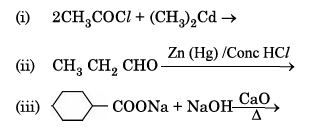
[3 Marks] Diagram 1 – CBSE Class 12 PCM Chemistry 2022 Set 3 Solutions
Answer: In the reactions involving the generation of free radicals, the primary product formed typically stems from the propagation steps that occur after the initial chain initiation. For instance, when chlorine reacts with methyl radicals under UV light, the major product formed is chloromethane (CH3Cl) as free radicals interact with one another to create stable compounds. The chain process involves methyl and chlorine radicals engaging through multiple steps, eventually leading to the formation of various products. However, chloromethane is the principal product due to its stability and lower energy compared to other possible products. This reaction exemplifies the process of halogenation where the free radical mechanism plays a crucial role in determining the major product. It is also important to note that besides the main product, minor side reactions can yield additional products, but these are often negligible in organic reaction results due to their lower yields. The presence of free radicals and subsequent termination steps contribute to the overall outcome of the reactions as radicals can further react or combine to produce other species.
Key Points: Formation of free radicals; Propagation steps yielding principal products; Chloromethane as major product; Stability and energy considerations; Presence of minor side reactions
Question 14.

Give reasons:

(i) Ammonolysis of alkyl halides is not a good method to prepare pure primary amines.(1)

(ii) Aniline does not give Friedel-Crafts reaction.(1)

(iii) Although -NH₂, group is o/p directing in electrophilic substitution reactions, yet aniline on nitration gives good yield of m-nitroaniline.(1)

[3 Marks]
Answer: (i) Ammonolysis of alkyl halides is not a good method to prepare pure primary amines because the reaction produces a mixture of primary, secondary, tertiary amines and quaternary ammonium salts due to multiple substitutions of the alkyl halide with ammonia and the formed amines. This makes it difficult to isolate pure primary amines.
(ii) Aniline does not give Friedel-Crafts reaction because the amino group (-NH₂) reacts with the Lewis acid catalyst like AlCl₃ to form an anilinium salt. This salt formation deactivates the aromatic ring towards electrophilic substitution by withdrawing electron density, thus preventing Friedel-Crafts alkylation or acylation.
(iii) Although the -NH₂ group is generally ortho/para directing due to its electron donating nature, aniline on nitration gives a good yield of meta-nitroaniline because under strong acidic nitration conditions, the amino group gets protonated to form anilinium ion, which is a deactivating and meta directing group. Therefore, nitration mainly occurs at the meta position leading to m-nitroaniline.
Key Points: Ammonolysis produces mixture of amines-not pure primary amines - Aniline forms salt with Lewis acid deactivating ring - Protonation of -NH₂ in acidic nitration leads to meta substitution
Question 15.

(a) (i) Which acid of the following pair would you expect to be stronger?

F-CH₂-COOH or CH₃-COOH. (1)

(ii) Arrange the following compounds in increasing order of their boiling points:

CH₃CH₂OH, CH₃-CHO, CH₃-COOH. (1)

(iii) Give simple chemical test to distinguish between Benzaldehyde and Acetophenone.(1)

[3 Marks]
Answer: (a) (i) F-CH₂-COOH (fluoroacetic acid) is stronger than CH₃-COOH (acetic acid) because the electronegative fluorine atom withdraws electron density from the carboxyl group, stabilizing the conjugate base and increasing acidity.
(ii) Increasing order of boiling points is CH₃-CHO (acetaldehyde) < CH₃CH₂OH (ethanol) < CH₃-COOH (acetic acid). This order is due to the nature of intermolecular forces; aldehydes have dipole-dipole forces, alcohols have hydrogen bonding, and carboxylic acids form stronger hydrogen bonded dimers.
(iii) Tollens test can distinguish between Benzaldehyde and Acetophenone. Benzaldehyde gives a silver mirror with Tollens reagent as it is easily oxidized, while Acetophenone does not give any reaction with Tollens reagent as it is a ketone and resistant to oxidation.
Key Points: Electron withdrawing group increases acidity - Boiling point depends on types of intermolecular forces - Tollens test positive for aldehydes only
Question 16.

(b) (i) Which will undergo faster nucleophilic addition reaction? Acetaldehyde or Propanone.(1)

(ii) What is the composition of Fehling's reagent?(1)

(iii) Draw structure of the semicarbazone of Ethanal.(1)

[3 Marks]
Answer: (i) Acetaldehyde will undergo faster nucleophilic addition reaction than propanone. This is because acetaldehyde is an aldehyde which has less steric hindrance around its carbonyl carbon compared to propanone, a ketone. Therefore, nucleophiles can attack the carbonyl carbon of acetaldehyde more easily.

(ii) Fehling's reagent is composed of two solutions: Fehling's solution A which contains copper sulfate (CuSO4) and Fehling's solution B which contains a mixture of sodium potassium tartrate (Rochelle salt) and sodium hydroxide (NaOH). When mixed just before use, they form a complex that is used to test for reducing sugars.

(iii) The structure of semicarbazone of Ethanal is formed when ethanal reacts with semicarbazide. The structural formula is CH3-CH=NNH-C(=O)-NH2. This shows the C=O group of ethanal replaced by the =NNH-C(=O)-NH2 group forming the semicarbazone.
Key Points: Acetaldehyde reacts faster due to less steric hindrance- Fehling's reagent consists of CuSO4, sodium potassium tartrate and NaOH- Semicarbazone of ethanal structure is CH3-CH=NNH-C(=O)-NH2
Question 17.

Predict the reagent for carrying out the following transformations.

(i) Benzoyl chloride to Benzaldehyde(1)

(ii) Ethanal to 3- hydroxy butanal .(1)

(iii) Ethanoic acid to 2- chloroethanoic acid.(1)

[3 Marks]
Answer: (a) Transformation: Benzoyl chloride to Benzaldehyde
Reagent: Zn(Hg) / Dilute HCl (Clemmensen reduction)
Explanation: Benzoyl chloride can be reduced to benzaldehyde using zinc amalgam and dilute hydrochloric acid, which selectively reduces the acid chloride to an aldehyde without further reduction to alcohol.

(b) Transformation: Ethanal to 3-hydroxy butanal
Reagent: 1. NaCN / H2O (Cyanide ion)
Explanation: Ethanal undergoes nucleophilic addition with cyanide ion (NaCN) to give a cyanohydrin intermediate. On hydrolysis, the cyanohydrin gives 3-hydroxy butanal.

(c) Transformation: Ethanoic acid to 2-chloroethanoic acid
Reagent: PCl5 / Cl2 / Red P (for chlorination of alpha position)
Explanation: Ethanoic acid on treatment with chlorine in presence of red phosphorus undergoes substitution of the alpha hydrogen by chlorine to form 2-chloroethanoic acid.
Key Points: Benzoyl chloride reduced with Zn(Hg)/HCl to benzaldehyde - Ethanal to 3-hydroxy butanal via cyanohydrin formation using NaCN/H2O - Ethanoic acid chlorinated at alpha position with Cl2/Red P to 2-chloroethanoic acid

Paper Details

CBSE Board Exam 2022

Class

Class 12 PCM

Subject

Chemistry

Year

2022

Set

Set 3

Other Years — Chemistry

2022 Set-1

2022 Set-2

2022 Set-3

2022 Set-4

2022 Set-5

2023 Set-1

2023 Set-2

2023 Set-3

2023 Set-4

2023 Set-5

2024 Set-1

2024 Set-2

2024 Set-3

2024 Set-4

2024 Set-5

2025 Set-1

2025 Set-2

2025 Set-3

2025 Set-4

2025 Set-5

2025 Set-6

CBSE Class 12 Chemistry 2022 Set 3 Solutions | Prepzy