SOLUTIONS
2025 BOARD EXAM
CBSE Class 12 PCM Chemistry Board Paper 2025 — Set 6 Solutions
2025
Chemistry
Class 12 PCM
CBSE EXAMINATION PAPER-2025
CHEMISTRY
(Solved)
General Instructions :
Read the following instructions carefully and follow them :
- This question paper contains 39 questions. All questions are compulsory.
- This question paper is divided into 5 sections.
- Section A – questions number 1 to 3 are case based questions
- Section B – questions number 4 to 19 are multiple choice questions
- Section C – questions number 20 to 25 are very short answer
- Section D – questions number 26 to 33 are short answer
- Section E – questions number 34 to 39 are long answer
- There is no overall choice given in the question paper. However, an internal choice has been provided in few questions.
- Use of calculator is NOT allowed.
Section A
The Crystal Field Theory (CFT) of coordination compounds is based on the effect of different crystal fields (provided by the ligands taken as point charges) on the degeneracy of d-orbital energies of the central metal atom/ion. The splitting of the d-orbitals provides different electronic arrangements in strong and weak crystal fields. In tetrahedral coordination entity formation, the d-orbital splitting is smaller as compared to the octahedral entity.
Answer the following questions :
(1) On the basis of CFT, explain why [Ti(H₂O)₆]Cl₃ complex iscoloured ? What happens on heating the complex [Ti(H₂O)₆]Cl₃ ? Give reason.[Atomic no. : Ti = 22]
When [Ti(H₂O)₆]Cl₃ is heated, the gain of energy can lead to further excitation of the electrons. In some cases, this heating can cause the water ligands to be released and replaced with different ligands or even result in changes in the oxidation state of titanium, which may result in a different colour or a complex that is less stable.
(2) What is crystal field splitting energy ?
(3) On the basis of Δ₀ and P (pairing energy), how can youdifferentiate between a strong field ligand and a weak fieldligand ?
(4) Why are low spin tetrahedral complexes rarely observed ?
Amines are usually formed from amides, imides, halides, nitro compounds, etc. They exhibit hydrogen bonding which influences their physical properties. In alkyl amines, a combination of electron releasing, steric and H-bonding factors influence the stability of the substituted ammonium cations in protic polar solvents and thus affect the basic nature of amines. Alkyl amines are found to be stronger bases than ammonia. Amines being basic in nature, react with acids to form salts. Aryldiazonium salts, undergo replacement of the diazonium group with a variety of nucleophiles to produce aryl halides, cyanides, phenols and arenes.
Answer the following questions :
(1) How can you convert the following ? (i) Ethanoic acid to methanamine (ii) Propanenitrile to 1-aminopropane
(2) Why is pKb value of aniline more than that of methylamine ?
(3) Arrange the following in increasing order of their basic strength in aqueous solution : CH₃ -NH₂ , (CH₃)₂NH , (CH₃)₃N
(4) Give the structures of A and B in the following reaction :
 [1 Mark]
Structure of B: It depends on the nucleophile replacing the diazonium group. For example, if the nucleophile is a halide ion, B will be an aryl halide where the diazonium group is replaced by the halogen atom.
This follows from the passage explaining that arenediazonium salts undergo replacement of the diazonium group with various nucleophiles to form aryl halides, cyanides, phenols, or arenes.
Section B
Which of the following transition metal ion is not coloured?
Which of the following solutions will have the highest boiling point in water?
During electrolysis of dilute H₂SO₄, using platinum electrodes, the gas evolved at the anode is:
The activation energy (Eₐ) of a reaction can be determined from the slope of which of the following plots?
Which of the following represents the fraction of molecules with energies equal to or greater than Eₐ?
The number of moles of AgCl precipitated when excess AgNO₃ solution is mixed with one mole of [Co(NH₃)₃Cl₃] is:
According to the provided context, 1 mole of [Co(NH₃)₃Cl₃] will yield 3 moles of AgCl precipitated upon reaction with excess AgNO₃. Therefore, the correct answer is 3.
Which of the following haloalkanes react with aqueous KOH most rapidly by SN_1 reaction?
The reaction R – OH + Na ⟶ RO⁻Na⁺ + 1/2 H₂ (g) suggests that alcohols are:
At low temperature, phenol reacts with Br₂ in CS₂ to form:
When alkyl iodide is treated with large excess of ammonia, the major product obtained is:
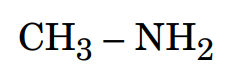
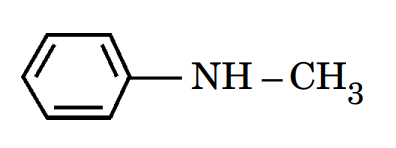
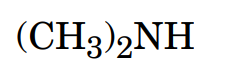
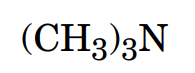
An amine ‘X’ reacts with Hinsberg reagent and the product obtained is soluble in alkali. The amine ‘X’ is:
-
(A)
-
(B)
-
(C)
-
(D)
α-helix structure refers to:
Assertion (A) : A mixture of o-nitrophenol and p-nitrophenol can be separated by steam distillation.
Reason (R) : o-nitrophenol is steam volatile due to intermolecular hydrogen bonding
The assertion is correct because o-nitrophenol and p-nitrophenol can be separated by steam distillation. However, the reason given is incorrect. o-Nitrophenol is steam volatile due to intramolecular hydrogen bonding (within the same molecule), not intermolecular hydrogen bonding. In contrast, p-nitrophenol forms intermolecular hydrogen bonds between molecules, making it less volatile.
Assertion (A) : Cooking time is reduced in pressure cooker.
Reason (R) : Boiling point of water inside the pressure cooker is elevated.
Assertion (A) : Actinoids show irregularities in their electronic configurations.
Reason (R) : Actinoids are radioactive in nature.
Assertion (A) : Vitamin K can be stored in our body.
Reason (R) : Vitamin K is a water soluble vitamin.
Section C
What is meant by positive deviation from Raoult’s law ? Give an example. What type of azeotrope is formed by positive deviation ?
State a condition under which a bimolecular reaction is kinetically first order reaction. Give an example. For which type of reactions, do order and molecularity have the same value ?
Example: The hydrolysis of methyl acetate in presence of large amount of water where water concentration is constant and reaction appears first order:
CH3COOCH3 + H2O (→) CH3COOH + CH3OH.
(b) Order and molecularity have the same value only for elementary reactions because molecularity is defined for elementary steps and corresponds to the number of reacting species involved, which equals the order of elementary reactions.
Write the IUPAC name of the complex [Pt(en)₂Cl2]²⁺. Draw the structure of geometrical isomer of this complex which is optically inactive.
(i) Write the formula of the following coordination compound : Pentaamminecarbonatocobalt(III)chloride
(ii) Write the IUPAC name of the linkage isomer of the complex [Co(NH₃)₅(NO₂)]Cl₂.
(ii) The given complex [Co(NH₃)₅(NO₂)]Cl₂ contains NO₂ ligand bonded through oxygen (nitrito-O). The linkage isomer is when NO₂ binds through nitrogen forming nitro ligand. Hence, the IUPAC name of the linkage isomer is Pentaammine(nitro)cobalt(III) chloride.
Why are haloarenes less reactive towards nucleophilic substitution reaction ? How does the presence of nitro (–NO2) group at ortho- and para-positions in haloarenes increase the reactivity towards nucleophilic substitution reaction ?
(b) The presence of an electron withdrawing nitro group (–NO2) at ortho- and para-positions stabilizes the negative charge formed in the intermediate during nucleophilic substitution, thereby increasing the reactivity of haloarenes towards nucleophilic substitution at those positions.
The two strands in DNA are not identical but complementary. Explain. What products would be formed when DNA is hydrolysed ?
(b) When DNA is hydrolyzed, it breaks down into three main products:
- Nitrogenous bases (A, T, G, C)
- Deoxyribose sugar
- Phosphate groups
Hydrolysis breaks the bonds between these components in the nucleotide, releasing them separately.
Section D
0.3 g of acetic acid (Molar mass = 60 g mol⁻¹ ) dissolved in 30 g of benzene shows a depression in freezing point equal to 0.45°C. Calculate the percentage association of acid if it forms a dimer in the solution.
(Given : Kf for benzene = 5.12 K kg mol⁻¹)
Step 2: Calculate the molality of the solution, molality = moles of solute / mass of solvent in kg = 0.005 / 0.03 = 0.1667 mol kg-1.
Step 3: Calculate the expected freezing point depression if no association occurs: ΔTf = Kf * molality = 5.12 * 0.1667 = 0.853°C.
Step 4: Actual depression given is 0.45°C, which is less due to association.
Step 5: Degree of association α = (expected ΔTf - observed ΔTf) / expected ΔTf = (0.853 - 0.45) / 0.853 = 0.472.
Step 6: Percentage association = α * 100 = 47.2%.
Note: Since acetic acid forms dimers, the number of particles decreases, leading to a lower freezing point depression.
Answer: The percentage association of acetic acid is 47.2%.
Write the name of the cell which is generally used in inverters. Write the reactions taking place at anode and cathode of this cell, when it is in use.
Reactions at Anode (negative electrode):
Pb(s) + SO42-(aq) → PbSO4(s) + 2e-
Reactions at Cathode (positive electrode):
PbO2(s) + SO42-(aq) + 4H+(aq) + 2e- → PbSO4(s) + 2H2O(l)
During discharge, the lead and lead dioxide electrodes react with sulfuric acid to form lead sulfate and water while producing electric energy. This process is reversible during charging.
Explain why electrolysis of an aqueous solution of NaCl gives H2gas at cathode and Cl2 gas at anode ? Write overall reaction.
(Given : E°Na⁺ /Na + = – 2.71 V , E°H₂O/H₂=-0.83V ,
E°Cl₂/2Cl=1.36V , E°H⁺/O₂/H₂O=+1.23V
During electrolysis of aqueous NaCl, both Na+ and H+ ions and Cl- and OH- ions are present due to water dissociation.
At cathode (reduction): Na+ has a very negative reduction potential (-2.71 V) compared to water (-0.83 V), so water is reduced preferentially producing H2 gas and OH- ions.
Half reaction at cathode: 2H2O + 2e- → H2(g) + 2OH-
At anode (oxidation): Cl- is oxidized to Cl2 gas because chloride ions have lower oxidation potential (1.36 V) compared to water (1.23 V).
Half reaction at anode: 2Cl- → Cl2(g) + 2e-
Overall reaction:
2NaCl + 2H2O → 2NaOH + Cl2(g) + H2(g)
Thus, hydrogen gas is produced at cathode by water reduction, and chlorine gas is produced at anode by oxidation of chloride ions. Sodium ions remain in solution combining with OH- to form NaOH.
The following data were obtained during the first order thermal decomposition of N₂O₅(g) at constant volume :
2N₂O₅(g)→2N₂O₄(g)+O₂(g)
Calculate rate constant.
[ Given : log 2 = 0.3010, log 10 = 1 ]
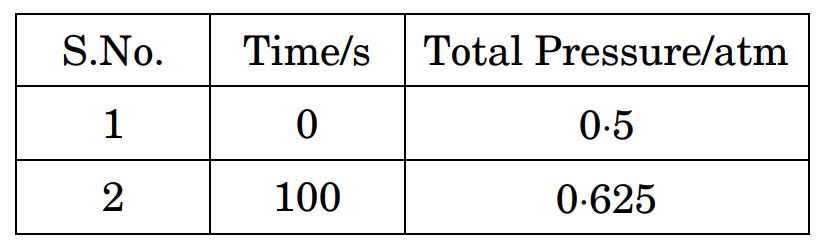
Step 1: Use the integrated rate law for first order reaction: ln([N₂O₅]$_0$/[N₂O₅]) = kt
Step 2: Initial concentration [N₂O₅]$_0$ = 0.24 * 10-2 mol L-1
Concentration after 60 min [N₂O₅] = 0.20 * 10-2 mol L-1
Time t = 60 min
Step 3: Calculate ln([N₂O₅]$_0$/[N₂O₅]) = ln(0.24 * 10-2 / 0.20 * 10-2) = ln(1.2)
Using log 10 = 1 and log 2 = 0.3010, log 1.2 = log (12/10) = log 12 - log 10 = (log 2 + log 6) - 1 but since log 6 is not given, approximate log 1.2 = 0.07918, so ln(1.2) = 2.303 * 0.07918 = 0.182
Step 4: Calculate rate constant k = ln([N₂O₅]$_0$/[N₂O₅]) / t = 0.182 / 60 = 0.00303 min-1
Answer: Rate constant k = 3.03 * 10-3 min-1.
A compound (A) with molecular formula C₄H₉I which is a primary alkyl halide, reacts with alcoholic KOH to give compound (B). Compound (B) reacts with HI to give (C) which is an isomer of (A). When (A) reacts with Na metal in the presence of dry ether, it gives a compound (D), C₈H₁₈, which is different from the compound formed when n-butyl iodide reacts with sodium. Write the structures of (A), (B), (C) and (D). Write thechemical equation when compound (A) is reacted with alcoholic KOH.
Write structure of the products of the following reactions :
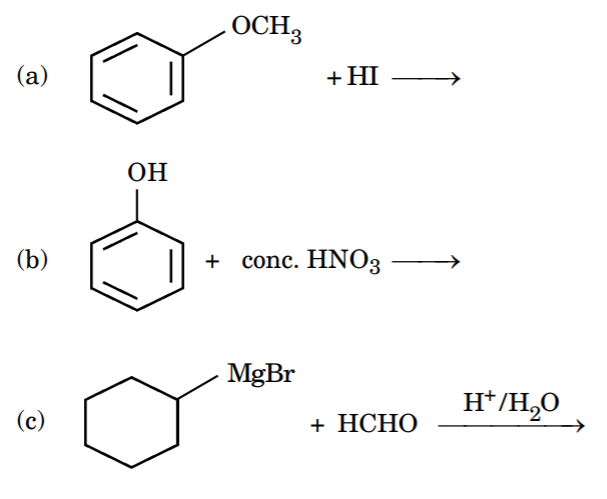
(ii) Mononitration of 3-methylphenol gives mainly 2-nitro-3-methylphenol as the OH group activates ortho and para positions. The product has a nitro group at ortho position relative to OH group.
(iii) Dinitration of 3-methylphenol introduces two nitro groups, mainly at the 2 and 4 positions relative to the OH group, due to strong activating effect.
(iv) Catalytic reduction of a compound generally involves addition of hydrogen (H2) over a catalyst, reducing double bonds or nitro groups to corresponding amines or alcohols, depending on starting material. The exact product depends on the reactant given.
Give reasons for the following :
(a) Benzoic acid does not undergo Friedel-Crafts reaction.
(b) HCHO is more reactive than CH₃CHO towards addition of HCN.
(c) Vinyl group directly attached with carboxylic acid should decrease the acidity of corresponding carboxylic acid due to resonance, but on the contrary it increases the acidity.
(b) HCHO (formaldehyde) is more reactive than CH₃CHO (acetaldehyde) towards addition of HCN because it has no alkyl group that donates electrons. Thus, the carbonyl carbon in HCHO is more electrophilic and easily attacked by nucleophiles like CN-.
(c) Although a vinyl group is expected to decrease acidity due to resonance donation to the carboxyl group, it actually increases acidity because the vinyl group is sp2 hybridised and more electronegative. This causes an electron withdrawing inductive effect, stabilising the carboxylate ion and increasing acidity.
Write the reaction of D-Glucose with the following :
(a) HCN (b) Br₂ water (c) (CH₃CO)₂O
(b) When D-Glucose is treated with bromine water (Br2 water), it gets oxidised to gluconic acid by converting the aldehyde group to a carboxylic acid group. This reaction shows glucose behaves as an aldose sugar.
(c) On reaction with acetic anhydride ((CH3CO)2O), glucose forms glucose pentaacetate by acetylation of all its hydroxyl (-OH) groups. In this reaction, no free aldehyde group is available as it forms a cyclic structure in glucose.
Section E
Account for the following:
(I) The E° Mn²⁺/Mn value for manganese is highly negative, whereas E° Mn³⁺/Mn²⁺ is highly positive.
(II) Actinoids show wide range of oxidation states.
(III) Transition metals have high melting points
Complete the following ionic equations:
(I) 5SO₃²⁻ + 2MnO₄⁻ + 6H⁺ ⟶
(II) 2MnO₄⁻ + H₂O + I⁻ ⟶ .
(b) Actinoids show a wide range of oxidation states because the 5f, 6d and 7s orbitals are close in energy, allowing variable electrons to participate in bonding. This results in oxidation states from +3 to +6 or more, reflecting their complex electron configurations.
(c) Transition metals have high melting points due to the presence of strong metallic bonding. This bonding arises from the delocalization of d-electrons which are more numerous and can form stronger bonds, requiring more energy to break, thus leading to high melting points.
Completion of ionic equations:
(I) 5SO₃²⁺ + 2MnO₄⁺ + 6H⁺ ⟶ 5SO₄²⁺ + 2Mn²⁺ + 3H₂O
(II) 2MnO₄⁺ + H₂O + I⁺ ⟶ 2MnO₂ + 2OH⁺ + I₂
Explanation:
In (I) sulphite ions are oxidized to sulphate, and permanganate ions are reduced to Mn²⁺ in acidic medium.
In (II) permanganate ions are reduced to manganese dioxide (MnO₂) and iodide ions are oxidized to iodine (I₂) in alkaline medium.
Answer the following questions :
(i) Name two elements of 3d series for which the third ionisation enthalpies are quite high.
(ii) Out of KMnO₄ and K₂MnO₄, which one is paramagnetic and why ?
(iii) Write any one consequence of lanthanoid contraction.
(iv) How do you prepare potassium manganate from pyrolusite ore ?
(v) Why is the ability of oxygen more than fluorine to stabilise higher oxidation states of transition metals ?
(ii) KMnO4 is paramagnetic because it contains Mn in +7 oxidation state with one unpaired electron, whereas K2MnO4 contains Mn in +6 oxidation state and is diamagnetic as all electrons are paired.
(iii) One consequence of lanthanoid contraction is that the atomic and ionic sizes of elements following lanthanoids decrease unexpectedly, which affects their chemical properties such as similar sizes of 4d and 5d transition elements.
(iv) Potassium manganate is prepared from pyrolusite ore (MnO2) by fusion with potassium hydroxide (KOH) in the presence of an oxidising agent like potassium nitrate (KNO3) or air. The reaction produces K2MnO4 as shown: MnO2 + 2KOH + 0.5O2 → K2MnO4 + H2O.
(v) Oxygen has a greater ability than fluorine to stabilise higher oxidation states of transition metals because oxygen can form pi bonds through its 2p orbitals which overlap with metal d orbitals, providing extra stability; fluorine lacks this ability due to its high electronegativity and inability to form pi bonds effectively.
(i) An organic compound (X) having molecular formula C5H10O can show various properties depending on its structures. Draw each of the structures if it :
(I) shows Cannizzaro reaction.
(II) reduces Tollens’ reagent and has a chiral carbon.
(III) gives positive iodoform test.
(ii) Write the reaction involved in the following :
(I) Clemmensen reduction
(II) Etard reaction
(I) Shows Cannizzaro reaction: Compound must be an aldehyde without alpha hydrogen. Example: Pentanal (CH3-CH2-CH2-CH2-CHO).
Structure: CH3-CH2-CH2-CH2-CHO
Cannizzaro reaction occurs as pentanal has no alpha hydrogen.
(II) Reduces Tollens’ reagent and has a chiral carbon: This implies it is an aldohexose with chiral center. Example: 2-Methylbutanal (CH3-CH(CH3)-CH2-CHO). The chiral carbon is the second carbon.
Structure: CH3-CH(CH3)-CH2-CHO
Tollens’ test positive because it is an aldehyde.
(III) Gives positive iodoform test: Compound has CH3-CO- group. Example: Methyl ethyl ketone (CH3-CO-CH2-CH3).
Structure: CH3-CO-CH2-CH3
Positive iodoform test due to methyl ketone group.
(ii) Reactions:
(I) Clemmensen reduction: Reduces aldehydes and ketones to alkanes using Zn(Hg) and HCl.
General reaction: R-CO-R/CHO + Zn(Hg)/HCl --> R-CH2-R/CH3
(II) Etard reaction: Oxidation of methyl group attached to aromatic ring to aldehyde using CrO3 in HCl.
General reaction: Toluene + Etard reagent (CrO3/HCl) --> Benzaldehyde
Answer the following questions :
(i) Draw structure of the methyl hemiacetal of methanal.
(ii) There are two – NH2 groups in semicarbazide. However only one is involved in the formation of semicarbazones. Give reason.
(iii) How will you convert ethanol to 3-hydroxybutanal ?
(iv) Complete the following equation :
(v) Write the final product formed when phthalic acid is treated with NH3 followed by strong heating.
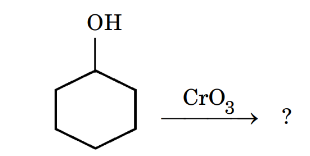
Methanal (HCHO) reacts with methanol (CH3OH) to form methyl hemiacetal as follows:
H-CH=O + CH3OH → H-CH(OH)-OCH3
Structure: H attached to C, C attached to OH and OCH3 groups.
(ii) Reason why only one – NH2 group in semicarbazide forms semicarbazones:
Semicarbazide has two – NH2 groups; one is attached to the carbonyl carbon (part of the urea group) and is less reactive, while the other free amine group (terminal – NH2) is more nucleophilic and involved in the formation of semicarbazones with aldehydes or ketones by condensation reaction.
(iii) Conversion of ethanol to 3-hydroxybutanal:
Step 1: Oxidize ethanol (CH3CH2OH) to ethanal (CH3CHO) using PCC or any mild oxidizing agent.
Step 2: Perform aldol condensation of ethanal under base (NaOH) and water to produce 3-hydroxybutanal (CH3CH(OH)CH2CHO).
(iv) Complete the following equation:
As the equation is not provided in the question text, no answer can be given.
(v) Final product when phthalic acid is treated with NH3 followed by strong heating:
Phthalic acid reacts with ammonia (NH3) to form phthalamic acid, which upon strong heating undergoes cyclization to give phthalimide.
C6H4(CO2H)2 + NH3 → C6H4(CO)CONH2 (phthalamic acid) → strong heat → C6H4(CO)2NH (phthalimide).
Calculate the emf of the following cell at 25°C:
(I)Zn(s)|Zn²⁺ (0.1 M) || H⁺ (0.01 M)|H₂(g) (1 bar),Pt(s).
[Given : E°zn²⁺/zn=-0.76v v, E°2H⁺/H₂=0.00V , log 10 =1]
(II)State Faraday’s second law of electrolysis. How much electricity is required in terms of Faraday for the reduction of 1 mol of Cr₂O₇²⁻ to Cr³⁺?
Given cell: Zn(s) | Zn²⁺ (0.1 M) || H⁺ (0.01 M) | H₂(g, 1 bar) | Pt(s)
Standard electrode potentials:
E°Zn²⁺/Zn = -0.76 V
E°2H⁺/H₂ = 0.00 V
Using Nernst equation: E = E° - (0.059/number of electrons) * log Q
For Zn/Zn²⁺ half cell, n = 2
Reaction at anode: Zn(s) → Zn²⁺ + 2e⁻
Reaction at cathode: 2H⁺ + 2e⁻ → H₂ (g)
Overall cell reaction: Zn(s) + 2H⁺ → Zn²⁺ + H₂ (g)
Reaction quotient Q = [Zn²⁺]/[H⁺]2 = 0.1/(0.01)2 = 0.1/0.0001 = 1000
Cell emf, E = E°cell - (0.059/2) * log Q
E°cell = E°cathode - E°anode = 0.00 - (-0.76) = +0.76 V
log 1000 = 3
E = 0.76 - (0.059/2)*3 = 0.76 - 0.0885 = 0.6715 V
Therefore, emf of the cell = 0.67 V (approx.)
(II) Faraday’s Second Law of Electrolysis:
The mass of an element liberated or deposited during electrolysis is directly proportional to the chemical equivalent weight of the element, which means different substances liberated by the same quantity of electricity are proportional to their equivalent weights.
Reduction of 1 mol of Cr₂O⁴²⁺ to Cr⁺ involves the reaction:
Cr₂O⁴²⁺ + 14H⁺ + 6e⁻ → 2Cr⁺ + 7H₂O
Number of electrons required per mole of Cr₂O⁴²⁺ = 6 mol of e⁻
Since 1 Faraday = charge of 1 mol of electrons,
Electricity required = 6 Faraday
Summary:
(I) emf = 0.67 V
(II) Faraday’s second law relates mass deposited to equivalent weight.
Electricity required for reducing 1 mol Cr₂O⁴²⁺ to Cr⁺ = 6 Faraday.
Answer the following questions :
(i) The conductivity of 0.20 M solution of KCl is 2.48 × 10⁻² S cm⁻¹. Calculate its molar conductivity and degree of dissociation (α).
[Given: λ⁰(K⁺) = 73.5 S cm² mol⁻¹, λ⁰(Cl⁻) = 76.5 S cm² mol⁻¹]
(ii) Calculate ΔrG⁰ of the following cell: Mg(s) + Cu²⁺(aq) ⟶ Mg²⁺(aq) + Cu(s)
[Given: E⁰(Mg²⁺/Mg) = –2.37 V, E⁰(Cu²⁺/Cu) = +0.34 V 1 F = 96500 C mol⁻¹]
(iii) What type of cell is mercury cell? Why is it more advantageous than dry cell?
Given concentration, c = 0.20 mol L⁻¹
Conductivity, κ = 2.48 × 10⁻² S cm⁻¹
Molar conductivity, Λ = κ / c = (2.48 × 10⁻²) / 0.20 = 0.124 S cm² mol⁻¹ × 1000 = 124 S cm² mol⁻¹
Limiting molar conductivity, Λ⁰ = λ⁰(K⁺) + λ⁰(Cl⁻) = 73.5 + 76.5 = 150 S cm² mol⁻¹
Degree of dissociation, α = Λ / Λ⁰ = 124 / 150 = 0.826 or 82.6%
(b) Calculation of standard Gibbs free energy change (ΔrG⁰):
Reaction: Mg(s) + Cu²⁺(aq) ⟶ Mg²⁺(aq) + Cu(s)
Calculate standard cell potential:
E⁰cell = E⁰cathode - E⁰anode = 0.34 - (–2.37) = 2.71 V
Use relation ΔrG⁰ = - n F E⁰cell, where n = 2 (number of electrons transferred)
ΔrG⁰ = - 2 × 96500 × 2.71 = -523730 J mol⁻¹ = -523.73 kJ mol⁻¹
(c) Mercury cell is a type of primary cell in which mercury oxide acts as the cathode and zinc acts as the anode.
It is more advantageous than dry cell because:
- It gives a steady voltage output during discharge
- It has a longer shelf life and better storage capacity
- It does not dry out easily
- It produces less pollution compared to dry cells
Paper Details
CBSE Board Exam 2025
Class
Class 12 PCM
Subject
Chemistry
Year
2025
Set
Set 6
Other Years — Chemistry