SOLUTIONS
2024 BOARD EXAM
CBSE Class 12 PCM Chemistry Board Paper 2024 — Set 3 Solutions
2024
Chemistry
Class 12 PCM
CBSE EXAMINATION PAPER-2024
CHEMISTRY
(Solved)
General Instructions :
Read the following instructions carefully and follow them :
- This question paper contains 40 questions. All questions are compulsory.
- This question paper is divided into 5 sections.
- Section A – questions number 1 to 6 are case based questions
- Section B – questions number 7 to 22 are multiple choice questions
- Section C – questions number 23 to 28 are very short answer
- Section D – questions number 29 to 35 are short answer
- Section E – questions number 36 to 40 are long answer
- There is no overall choice given in the question paper. However, an internal choice has been provided in few questions.
- Use of calculator is NOT allowed.
Section A
The involvement of (n 1)d electrons in the behaviour of transition elements impart certain distinct characteristics to these elements. Thus, in addition to variable oxidation states, they exhibit paramagnetic behaviour, catalytic properties and tendency for the formation of coloured ions. The transition metals react with a number of non-metals like oxygen, nitrogen and halogens. KMnO 4 examples. and K 2 Cr 2 O 7 are common The two series of inner transition elements, lanthanoids and actinoids, constitute the f-block of the periodic table. In the lanthanoids, there is regular decrease in atomic size with increase in atomic number due to the imperfect shielding effect of 4f-orbital electrons which causes contraction. Answer the following questions :
The involvement of (n 1)d electrons in the behaviour of transition elements impart certain distinct characteristics to these elements. Thus, in addition to variable oxidation states, they exhibit paramagnetic behaviour, catalytic properties and tendency for the formation of coloured ions. The transition metals react with a number of non-metals like oxygen, nitrogen and halogens. KMnO 4 examples. and K 2 Cr 2 O 7 are common The two series of inner transition elements, lanthanoids and actinoids, constitute the f-block of the periodic table. In the lanthanoids, there is regular decrease in atomic size with increase in atomic number due to the imperfect shielding effect of 4f-orbital electrons which causes contraction. Answer the following questions :
The involvement of (n 1)d electrons in the behaviour of transition elements impart certain distinct characteristics to these elements. Thus, in addition to variable oxidation states, they exhibit paramagnetic behaviour, catalytic properties and tendency for the formation of coloured ions. The transition metals react with a number of non-metals like oxygen, nitrogen and halogens. KMnO 4 examples. and K 2 Cr 2 O 7 are common The two series of inner transition elements, lanthanoids and actinoids, constitute the f-block of the periodic table. In the lanthanoids, there is regular decrease in atomic size with increase in atomic number due to the imperfect shielding effect of 4f-orbital electrons which causes contraction. Answer the following questions :
The following questions are case-based questions. Read the case carefully and answer the questions that follow
The involvement of (n-1)d electrons in the behaviour of transition elements impart certain distinct characteristics to these elements. Thus, in addition to variable oxidation states, they exhibit paramagnetic behaviour, catalytic properties and tendency for the formation of coloured ions. The transition metals react with a number of non-metals like oxygen, nitrogen and halogens. KMnO₄ examples. and K₂Cr₂O₇ are common
The two series of inner transition elements, lanthanoids and actinoids, constitute the f-block of the periodic table. In the lanthanoids, there is regular decrease in atomic size with increase in atomic number due to the imperfect shielding effect of 4f-orbital electrons which causes contraction.
(1) Why do transition metals and their compounds act as good catalysts ?
(2) What is the cause of contraction in the atomic size of lanthanoids ?
(3) In aqueous media, which is a stronger reducing agent Cr²⁺ or Fe²⁺ and why ?
(4) Define lanthanoid contraction. How does it affect the atomic radii of the third transition series and the second transition series ?
This contraction leads to slight decrease in atomic radii of third transition series elements compared to the second series, affecting their chemical properties as mentioned in the case passage.
(1) What are essential amino acids ?
[1 Mark](2) What is meant by zwitter ionic form of amino acids ?
[1 Mark](3) (i) Give one example each for Fibrous protein and Globular protein. (ii) What type of linkages hold monomers of proteins together?
(ii) The monomers of proteins, which are amino acids, are held together by peptide bonds. These peptide bonds link amino acids to form polypeptides, which make up proteins.
(4) (i) What is the structural feature which characterises a reducing sugar ? (ii) What is the structural difference between nucleoside and nucleotide?
(ii) A nucleoside consists of a nitrogenous base linked to a sugar (ribose or deoxyribose), but a nucleotide has an additional phosphate group attached to the sugar along with the nitrogenous base. Thus, nucleotide = nucleoside + phosphate group.
Section B
Which of the following does not show variable oxidation states?
Scandium (Sc) does not show variable oxidation states. It primarily exhibits a +3 oxidation state, while manganese (Mn), copper (Cu), and iron (Fe) can exhibit multiple oxidation states due to their ability to lose different numbers of electrons. This is typical in transition metals, whereas Sc is a d-block element that generally shows a fixed oxidation state.
The type of isomerism shown by the complex [CoCl₂(en)₂]⁺ is:
Which of the following is diamagnetic in nature?
[ Atomic number : Co = 27 ]
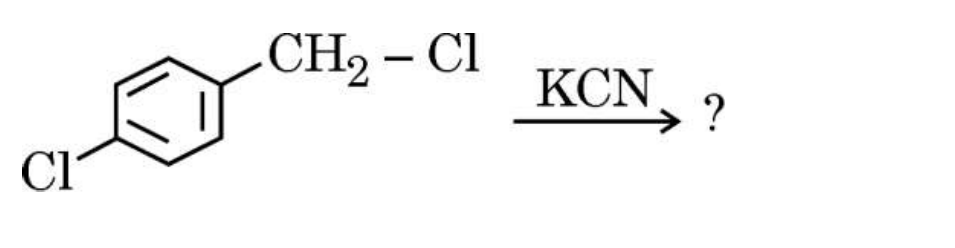
Consider the following reaction:
The major product of the reaction is:
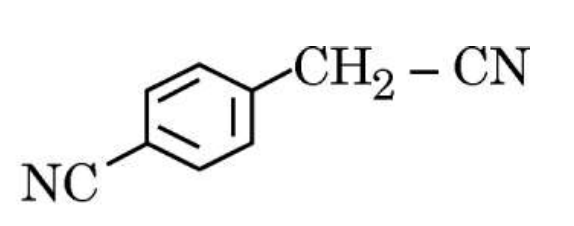
-
(A)
-
(B)
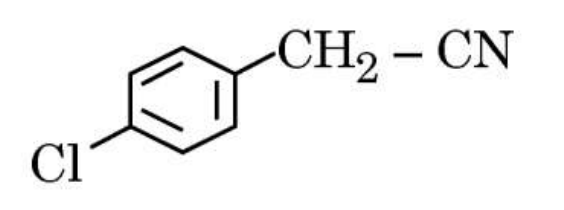
-
(C)
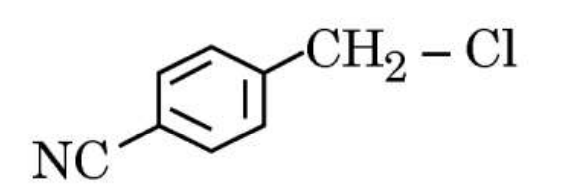
-
(D)
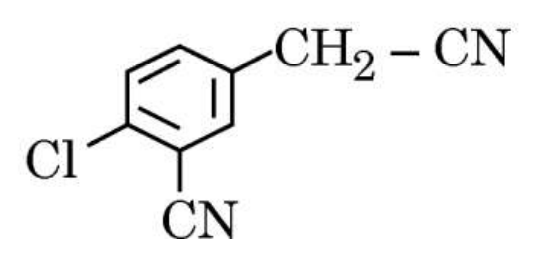
The starting compound is p-chlorobenzyl chloride (a benzene ring with one Cl on the ring and a –CH₂Cl side chain).
With KCN, the reaction proceeds by SN2 at the benzylic –CH₂Cl position (benzyl halides are very reactive in SN2).
The aryl Cl on the ring does not get substituted under these conditions.
So only this change happens:
–CH₂Cl → –CH₂CN
The ring chlorine remains unchanged.
Therefore, the major product is p-chlorobenzyl cyanide.
Which one of the following compounds has the lowest pKₐ value?
The compound with the lowest pKa value is 2,4,6-Trinitrophenol. This is because it has three nitro groups that strongly enhance its acidity by stabilizing the negative charge of the conjugate base through resonance. In comparison, the other compounds have fewer electron-withdrawing groups, leading to higher pKa values.
(CH₃)₂CH-O-CH₃ when treated with HI gives:
The correct answer is (CH₃)₂CH - OH + CH₃ - I. When (CH₃)₂CH-O-CH₃ (an ether) reacts with HI, it acts as an acid and generates an oxonium ion. The iodide ion then acts as a nucleophile, attacking the less hindered carbon (the carbon connected to the -O- group), resulting in the formation of isopropyl alcohol ((CH₃)₂CH - OH) and methyl iodide (CH₃ - I).
Which of the following compounds on treatment with benzene sulphonyl chloride forms an alkali-soluble precipitate?
The correct option is CH₃CONH₂ (acetanilide). Upon treatment with benzene sulphonyl chloride, acetanilide forms a sulphonamide which is soluble in alkali. The other compounds do not form precipitates that are alkali-soluble.
The order of increasing basicities of CH₃NH₂ (I), (CH₃)₂NH (II), (CH₃)₃N (III) and C₆H₅NH₂ (IV) in aqueous media is:
The correct order of increasing basicities is IV < III < I < II. Aniline (IV) has a phenyl group that decreases its basicity due to resonance. Dimethylamine (II) is more basic than methylamine (I) because the two methyl groups provide stronger +I effect than one methyl group. Trimethylamine (III) is the most basic due to the +I effect from the three methyl groups, which greatly enhance its ability to accept protons.
The vitamin which plays an important role in coagulating blood is:
Vitamin K is essential for the blood coagulation process, as it is required for the synthesis of certain proteins that are necessary for blood clotting. Without adequate vitamin K, the body cannot produce these proteins effectively, leading to increased bleeding and difficulty in clotting.
When a catalyst increases the rate of a chemical reaction, then the rate constant (k):
The correct answer is 'remains constant.' A catalyst speeds up a reaction by providing an alternative pathway with a lower activation energy, but it does not change the intrinsic rate constant (k) of the reaction, which is determined by the nature of the reactants and the temperature.
A 1% solution of solute 'X' is isotonic with 6% solution of sucrose (molar mass = 342 g mol⁻¹). The molar mass of solute 'X' is
The correct answer is 3.42 g mol⁻¹ because 1% mass means 1 gram in 100 grams of solution. Therefore, to find the mass for 1% of a substance with a molar mass of 342 g mol⁻¹, the calculation is (1/100) * 342 = 3.42 g mol⁻¹.
During the electrolysis of aqueous NaCl, the cathodic reaction is:
The correct answer is the 'Reduction of H₂O'. During the electrolysis of aqueous sodium chloride, at the cathode (negative electrode), water is reduced to form hydrogen gas and hydroxide ions. The reduction of Na⁺ ions is not favored since the reduction potential for water is lower than that for Na⁺. Therefore, the primary cathodic reaction is the reduction of water.
Assertion (A): Addition of ethylene glycol to water lowers its freezing point.
Reason (R): Ethylene glycol is insoluble in water due to lack of its ability to form hydrogen bonds with water molecules.
Assertion (A) is true because the addition of ethylene glycol to water indeed lowers its freezing point, a phenomenon known as freezing point depression. However, Reason (R) is false. Ethylene glycol is actually soluble in water and can form hydrogen bonds with water molecules, which contributes to its ability to lower the freezing point of the mixture.
Assertion (A): Order of reaction and molecularity are always same for complex reactions.
Reason(R): Order is determined experimentally and molecularity is applicable only for elementary reactions.
Both Assertion (A) and Reason (R) are true, but Reason (R) is not the correct explanation of the Assertion (A). The assertion is false because the order of a reaction can differ from its molecularity for complex reactions. The reason is true as order is indeed determined experimentally, while molecularity is applicable only to elementary reactions.
Assertion (A): The boiling point of ethanol is higher than that of dimethyl ether.
Reason (R): Ethanol molecules are associated through hydrogen bonding whereas in dimethyl ether, it is not possible.
Both Assertion (A) and Reason (R) are true and Reason (R) is the correct explanation of the Assertion (A). Ethanol has a higher boiling point compared to dimethyl ether due to the presence of hydrogen bonding in ethanol, which requires more energy to break compared to the weaker van der Waals forces in dimethyl ether.
Assertion (A): Aniline does not undergo Friedel-Crafts reaction.
Reason (R): Friedel-Crafts reaction is an electrophilic substitution reaction.
Assertion (A) is true because aniline, which contains a strong electron-donating amino group, deactivates the aromatic ring toward electrophilic substitution, preventing the Friedel-Crafts reaction from occurring. Reason (R) is also true as Friedel-Crafts reaction is indeed an electrophilic substitution reaction. However, Reason (R) does not explain why aniline does not undergo this reaction, so the correct answer is: Both Assertion (A) and Reason (R) are true, but Reason (R) is not the correct explanation of the Assertion (A).
Section C
It is related to the enthalpy of fusion because Kf is proportional to the ratio of the gas constant (R) times the square of the freezing point of the pure solvent (Tf2) to the enthalpy of fusion (\u0394Hfusion) of the solvent. Mathematically, Kf = (R * Tf2) / \u0394Hfusion. Thus, a solvent with a higher enthalpy of fusion will have a lower molal depression constant and vice versa.
What type of deviation is shown by ethanol and acetone mixture? Give reason.What type of azeotropic mixture is formed by that deviation ?
(a) In a reaction, if the concentration of reaction 'X' is tripled rate of reaction becomes twenty-seven times? What is the order of the reaction .
(b) State a condition under which a bimolecular reaction is kinetically a first-order reaction. Give an example of such a reaction.
So, (3)n = 27 = 33. Therefore, n = 3.
Hence, the order of the reaction is 3 (third order).
(b) A bimolecular reaction is kinetically first-order when one reactant's concentration is in large excess and remains nearly constant.
In such case, rate depends effectively on the concentration of the other reactant only.
Example: The hydrolysis of an ester in acid is bimolecular but appears as first-order because acid concentration is constant.
Rate = k [ester][H3O+], if [H3O+] is constant, rate = k' [ester], which is first-order.
Complete the following ionic equations:
(a) 2Mno⁻₄ +5SO₃²⁻ +6H⁺ →
(b) Cr₂O₇²⁻ + 14H⁺ + 6Fe²⁺
(b) Cr2O72- + 14H+ + 6Fe2+ → 2Cr3+ + 6Fe3+ + 7H2O
Explanation:
In (a), permanganate ion (MnO4-) is reduced to manganese dioxide (MnO2) and sulfite ion (SO32-) is oxidized to sulfate ion (SO42-). Acidic medium is represented by H+. The equation is balanced for atoms and charges.
In (b), dichromate ion (Cr2O72-) is reduced to chromium ion (Cr3+) and ferrous ion (Fe2+) is oxidized to ferric ion (Fe3+) in acidic medium. The atoms and charges are balanced properly.
(a) Which halogen compound will react faster in Sₙ2 reactions, and why?
CH₃- CH₂ -I or CH₃ - CH₂ - Br
(b) Why is chloroform stored in closed dark coloured bottles?
(b) Chloroform is stored in closed dark coloured bottles to prevent its decomposition by light and air. Light can cause chloroform to react and form toxic substances like phosgene. The dark bottle blocks light, and the closed container limits air exposure, thus increasing its stability.
Give the reaction of glucose with the following :
(a) HCN
(b) Conc. HNO₃
(b) Glucose reacts with concentrated nitric acid (Conc. HNO₃) and gets oxidised to produce glucaric acid (saccharic acid). Both the aldehyde group and the primary alcohol group at the end are oxidised to carboxylic acid groups.
Section D
A solution is prepared by dissolving 5 g of a non-volatile solute in 200 g of water. It has a vapour pressure of 31·84 mm Hg at 300 K. Calculate the molar mass of the solute.
(Vapour pressure of pure water at 300 K = 32 mm Hg)
Mass of solvent (water), m_solvent = 200 g = 0.2 kg
Vapour pressure of solution, P_solution = 31.84 mm Hg
Vapour pressure of pure solvent, P_solvent = 32 mm Hg
Step 1: Calculate the lowering of vapour pressure, ΔP = P_solvent - P_solution = 32 - 31.84 = 0.16 mm Hg
Step 2: Use Raoult's law relation for vapour pressure lowering:
ΔP / P_solvent = mole fraction of solute, x_solute
So, x_solute = 0.16 / 32 = 0.005
Step 3: Let the molar mass of the solute be M (g/mol). Number of moles of solute = n_solute = 5 / M
Number of moles of solvent (water), n_solvent = mass / molar mass = 200 / 18 = 11.11 mol
Step 4: Mole fraction of solute, x_solute = n_solute / (n_solute + n_solvent) ≈ n_solute / n_solvent (since n_solute is very small)
So, 0.005 = (5 / M) / 11.11
Step 5: Solve for M:
5 / M = 0.005 * 11.11 = 0.05555
M = 5 / 0.05555 ≈ 90 g/mol
Answer: The molar mass of the solute is approximately 90 g/mol.
A first-order reaction is 25 complete in 40 minutes. Calculate the value of rate constant. In what time will the reaction be 80 % complete ?
Given : log 2 = 0·30, log 3 = 0·48, log 4 = 0·60, log 5 = 0·69
For a first order reaction, the formula is ln(C) = ln(C_0) - k t or log C = log C_0 - (k t / 2.303).
Using concentrations: log (C_0 / C) = (k t) / 2.303.
Here, log (C_0 / C) = log (1 / 0.75) = log (4/3) = log 4 - log 3 = 0.60 - 0.48 = 0.12.
So, (k * 40) / 2.303 = 0.12 => k = (2.303 * 0.12) / 40 = 0.006909 min-1.
(b) To find time for 80 % completion, 20 % reactant remains, so C = 0.20 C_0.
log (C_0 / C) = log (1 / 0.20) = log 5 = 0.69.
Using same equation: (k * t) / 2.303 = 0.69 => t = (2.303 * 0.69) / k = (2.303 * 0.69) / 0.006909 = 230 minutes approx.
Hence, the rate constant k = 0.006909 min-1 and the time for 80 % completion is approximately 230 minutes.
(a) What type of nucleophilic substitution (SN1 or SN2) occurs in the hydrolysis of 2-Bromo butane to form (±)-Butan-2-ol ? Give reason.
(b) What happens when chlorobenzene and methyl chloride are treated with sodium metal in dry ether ?
(b) When chlorobenzene and methyl chloride are treated with sodium metal in dry ether, the sodium metal acts as a reducing agent leading to a Wurtz type coupling reaction. Methyl chloride undergoes coupling to form ethane (C2H6). However, chlorobenzene does not easily participate in Wurtz reaction due to the strong C-Cl bond in the aromatic ring; hence it remains mostly unreacted. Thus, the reaction mainly produces ethane and sodium chloride as byproduct with unreacted chlorobenzene.
Give the structures of A, B and C in the following reactions :
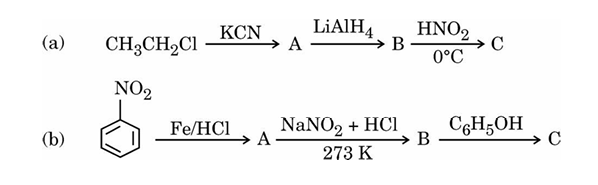
(a)
CH₃CH₂Cl —KCN→ A —LiAlH₄→ B —HNO₂ (0°C)→ C
CH₃CH₂Cl + KCN → A
KCN does SN2 substitution → Cl is replaced by CN.
A = CH₃CH₂CN (propionitrile / ethyl cyanide)A —LiAlH₄→ B
LiAlH₄ reduces nitrile –CN → –CH₂NH₂ (primary amine).
B = CH₃CH₂CH₂NH₂ (n-propylamine)B —HNO₂ (0°C)→ C
Primary aliphatic amine + nitrous acid → alcohol (via diazonium, which is unstable).
C = CH₃CH₂CH₂OH (1-propanol)
✅ Answers (a):
A = CH₃CH₂CN
B = CH₃CH₂CH₂NH₂
C = CH₃CH₂CH₂OH
(b)
Starting compound: Nitrobenzene (C₆H₅–NO₂)
C₆H₅–NO₂ —Fe/HCl→ A
Fe/HCl reduces –NO₂ to –NH₂
A = Aniline (C₆H₅–NH₂)A —NaNO₂ + HCl, 273 K→ B
Aniline undergoes diazotization → forms benzene diazonium chloride.
B = C₆H₅–N₂⁺Cl⁻ (benzene diazonium chloride)B —C₆H₅OH→ C
Diazonium salt couples with phenol → azo coupling (para position major).
C = p-hydroxyazobenzene
Structure: HO–C₆H₄–N=N–C₆H₅ (para)✅ Answers (b):
A = Aniline (C₆H₅NH₂)
B = Benzene diazonium chloride (C₆H₅N₂⁺Cl⁻)
C = p-Hydroxyazobenzene (azo dye)
(a) Ethyl chloride reacts with KCN to form propionitrile (A), which on reduction with LiAlH₄ gives propylamine (B), and with nitrous acid at 0°C gives propanol (C).
(b) Nitrobenzene is reduced by Fe/HCl to aniline (A), which on diazotization forms benzene diazonium chloride (B).
This diazonium salt couples with phenol to give p-hydroxyazobenzene (C
(a) Write the equations of the reactions involved in the following :
(i) Reimer-Tiemann reaction
(ii) Kolbe's reaction
(b) Name the reagent used in the bromination of phenol to form 2,4,6-Tribromophenol.
C6H5OH + CHCl3 + 3NaOH → C6H4(OH)CHO + 3NaCl + 2H2O
(a) (ii) Kolbe's reaction: Phenol when heated with sodium hydroxide and carbon dioxide under pressure forms salicylate salt, which upon acidification gives salicylic acid.
C6H5ONa + CO2 → C6H4(OH)COONa
C6H4(OH)COONa + HCl → C6H4(OH)COOH + NaCl
(b) The reagent used for bromination of phenol to form 2,4,6-Tribromophenol is bromine water (Br2 in H2O). When phenol is treated with bromine water at room temperature, 2,4,6-Tribromophenol is formed as a white precipitate.
How will you bring about the following conversions ?
(a) Benzoic acid to Benzaldehyde
(b) Ethanal to Propanone
(c) Acetophenone to Benzoic acid
(d) Bromobenzene to 1-Phenylethanol
(b) Ethanal to Propanone: Perform an aldol condensation by treating ethanal with dilute NaOH, then carry out oxidation with dilute acid to get propanone.
(c) Acetophenone to Benzoic acid: Oxidise acetophenone using alkaline KMnO4 and heat. The methyl side chain is cleaved, yielding benzoic acid.
(d) Bromobenzene to 1-Phenylethanol: React bromobenzene with magnesium in dry ether to form phenylmagnesium bromide (Grignard reagent), then treat with acetaldehyde followed by acidified workup to form 1-phenylethanol.
The conductivity of 0·2 M solution of KCl is 2·48 10⁻² S cm⁻¹. Calculate its molar conductivity and degree of dissociation ( α).
Given :
λ°ₖ⁺ = 73.5 S cm² mol⁻¹
λ°cl⁻ = 76.5 S cm² mol⁻¹
Concentration, c = 0.2 mol L-1
Conductivity, κ = 2.48 * 10-2 S cm-1
λ°K+ = 73.5 S cm2 mol-1, λ°Cl- = 76.5 S cm2 mol-1
(a) Molar conductivity (Λm) = κ / c
= (2.48 * 10-2) / 0.2 = 0.124 S cm2 mol-1
(b) Molar conductivity at infinite dilution, Λ°m = λ°K+ + λ°Cl- = 73.5 + 76.5 = 150 S cm2 mol-1
(c) Degree of dissociation, α = Λm / Λ°m
= 0.124 / 150 = 0.000827 or approximately 0.083%
Conclusion: Molar conductivity of 0.2 M KCl solution is 0.124 S cm2 mol-1 and the degree of dissociation is approximately 0.083%. This shows that KCl is almost completely dissociated but the low molar conductivity is due to high concentration.
Section E
(i) Calculate emf of the following cell at 25ºC :
Zn (s) |Zn²⁺ (0·001M)| Cd²⁺ (0·1 M) Cd (s)
Given:E °zn²⁺/zn= -0·76 V, E°cd²⁺/Cd = - 0·40 V [log 10 = 1]
(ii) State faraday 's second law of electrolysis How will the ph of aqueous NaCl solution be affected when it is electrolyzed?
Standard electrode potentials are: E°(Zn2+/Zn) = -0.76 V, E°(Cd2+/Cd) = -0.40 V
The cell potential Ecell = Ecathode - Eanode
Cathode is Cd since it has less negative E°, anode is Zn
Standard emf, E°cell = (-0.40) - (-0.76) = 0.36 V
Using Nernst equation at 25 deg C:
E = E° - (0.0592/2) * log([Zn2+]/[Cd2+])
Substitute values:
E = 0.36 - (0.0592/2) * log(0.001/0.1) = 0.36 - 0.0296 * log(0.01)
Since log(0.01) = -2,
E = 0.36 - 0.0296 * (-2) = 0.36 + 0.0592 = 0.4192 V
Therefore, emf of the cell is approximately 0.42 V.
(ii) Faraday's Second Law of Electrolysis states that when the same quantity of electricity passes through different electrolytes, the masses of different substances deposited or liberated are proportional to their chemical equivalent weights.
When aqueous NaCl solution is electrolyzed, at cathode hydrogen gas is evolved and at anode chlorine gas is produced. Water can also decompose affecting pH.
The pH of the solution will become acidic due to the formation of HCl in the solution as chlorine dissolves and reacts with water producing HCl and HClO.
Hence, the pH of aqueous NaCl decreases and solution becomes acidic during electrolysis.
(i) Calculate the ∆ᵣG° and log Kc for the following cell reaction :
Fe (s) + Ag⁺ (aq) ⇌ Fe²⁺ (aq) + Ag (s)
Given: E° fe²⁺/fe = -0.44V, E°Ag⁺/Ag= +0.80V, 1F = 96500 C mol⁻¹
(ii) Write any two advantages of the fuel cells over primary and secondary batteries ?
(iii) How many Faradays are required for the oxidation of 1 mole of H₂O to O₂ ?
Given electrode potentials are: E° Fe²⁺/Fe = -0.44 V, E° Ag⁺/Ag = +0.80 V.
To find E° cell, use: E° cell = E° cathode - E° anode.
Here, Ag⁺/Ag is cathode (reduction), Fe/Fe²⁺ is anode (oxidation).
So, E° cell = 0.80 V - (-0.44 V) = 1.24 V.
Number of electrons transferred, n = 2 (Fe goes from 0 to +2 oxidation state).
Calculate ΔrG° using formula: ΔrG° = - nFE° cell = - 2 * 96500 * 1.24 = -239720 J/mol or -239.72 kJ/mol.
Calculate log Kc using: ΔrG° = - 2.303 RT log Kc.
At 298 K, R = 8.314 J/mol K,
So, log Kc = nFE° cell / (2.303 RT) = (2 * 96500 * 1.24) / (2.303 * 8.314 * 298) ≈ 20.8.
(ii) Advantages of fuel cells over primary and secondary batteries:
1. Fuel cells can continuously produce electricity as long as fuel and oxidant are supplied, unlike batteries which store limited energy.
2. Fuel cells have higher efficiency and produce less pollution compared to conventional batteries.
(iii) Oxidation of water: 2 H₂O → O₂ + 4 H⁺ + 4 e⁻.
Thus, 4 moles of electrons are involved per mole of O₂ formed.
Therefore, for oxidation of 1 mole of H₂O to O₂, 4 Faradays of electricity are required.
(i) Write the major product(s) in the following reactions :
(ii) Give simple chemical tests to distinguish between the following pairs of compounds :
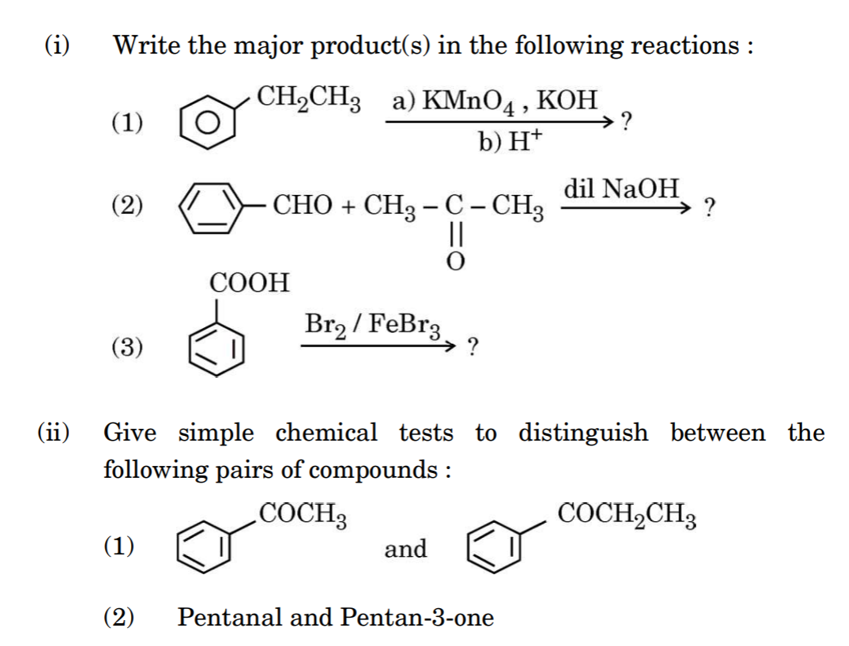
(i) Write the major product(s)
(1) Ethylbenzene + KMnO₄ / KOH, then H⁺
Strong oxidation of any alkyl side chain on benzene → benzoic acid.
Product: C₆H₅COOH (Benzoic acid)
(2) Benzaldehyde (C₆H₅CHO) + Acetone (CH₃COCH₃) with dil. NaOH
This is a Claisen–Schmidt (aldol) condensation.
Major product: Benzylidene acetone
Structure: C₆H₅–CH=CH–CO–CH₃ (α,β-unsaturated ketone)
(3) Benzoic acid + Br₂ / FeBr₃
–COOH is a meta-directing, deactivating group.
Product: m-Bromobenzoic acid (3-bromobenzoic acid)
(ii) Give simple chemical tests to distinguish
(1) C₆H₅COCH₃ (acetophenone) and C₆H₅COCH₂CH₃ (propiophenone)
Iodoform test (I₂/NaOH):
Acetophenone (C₆H₅COCH₃) → Positive (yellow CHI₃ precipitate)
Propiophenone (C₆H₅COCH₂CH₃) → Negative
(2) Pentanal and Pentan-3-one
Tollens’ test or Fehling’s test:
Pentanal (aldehyde) → Positive (silver mirror / red precipitate)
Pentan-3-one (ketone) → Negative
(i)
Benzoic acid
C₆H₅–CH=CH–CO–CH₃ (benzylidene acetone)
m-Bromobenzoic acid
(ii)
Iodoform test: acetophenone positive, propiophenone negative
Tollens’/Fehling’s test: pentanal positive, pentan-3-one negative
(i) Give reasons for the following :
(1) In semicarbazide, only one NH₂ group is involved in the formation of semicarbazone.
(2) Acetaldehyde is more reactive than acetone towards addition of HCN.
(ii) (1) Arrange the following in decreasing order of their acidic strength :
CH₃COOH, O₂N CH₂ COOH, HCOOH
(2) Name the reagent in the following reaction :
CH₃- CH = CH-CH₂-CN ⟶ CH₃- CH = CH- CH₂ CHO
(iii) Write the reaction involved in Hell-Volhard-Zelinsky reaction.
(2) Acetaldehyde is more reactive than acetone towards the addition of HCN because acetaldehyde has only one alkyl group which exerts less electron-donating effect, making its carbonyl carbon more electrophilic and thus more reactive. In contrast, acetone has two alkyl groups that donate electrons and decrease the carbonyl carbon's reactivity.
(ii)(1) The acidic strength in decreasing order is: O₂NCH₂COOH > HCOOH > CH₃COOH. This is because the nitro group (O₂N-) is strongly electron withdrawing and stabilizes the conjugate base of O₂NCH₂COOH the most, increasing its acidity. Formic acid (HCOOH) is more acidic than acetic acid (CH₃COOH) due to the absence of electron-donating alkyl groups.
(2) The reagent that converts CH₃- CH = CH-CH₂-CN to CH₃- CH = CH- CH₂ CHO is DIBAL-H (Diisobutylaluminium hydride). It selectively reduces nitriles to aldehydes.
(iii) Hell-Volhard-Zelinsky reaction involves the alpha-halogenation of carboxylic acids using phosphorus tribromide (PBr₃) and bromine (Br₂). For example: R-CH₂-COOH + Br₂ + PBr₃ → R-CHBr-COOH which upon hydrolysis forms alpha-bromo acid. This reaction helps in introducing a halogen atom at the alpha-position of carboxylic acids.
Attempt any five of the following:
(a) Write the IUPAC name of the complex : [Co(H₂O)(CN)(en)₂]²⁺
(b) Why is geometrical isomerism not possible in tetrahedral complexes having two different types of unidentate ligands coordinated with the central metal ion ?
(c) Arrange the following complex ions in increasing order of their crystal field splitting energy ( Δₒ) :
[Co(NH₃)₆]³⁺, [CoF₆]³⁻ , [Co(CN)₆]³⁻
(d) Write the hybridization and magnetic character of the complex [Ni(CO)₄] on the basis of valence bond theory. [Atomic No. : Ni = 28]
(e) Out of [CoF₆]³⁻ and [Co(C₂O₄)₃]³⁻ , which one complex is :
(i) more stable ?
(ii) the high spin complex ?
(f) What is the difference between an ambidentate ligand and bidentate ligand ?
(g) Write the electronic configuration of d⁵ in terms of t₂g and eg in an
octahedral field when :
(i) Δₒ > P, and (ii) Δₒ <P
(b) Geometrical isomerism is not possible in tetrahedral complexes with two different types of unidentate ligands because tetrahedral complexes have all ligands arranged symmetrically at the corners of a tetrahedron, resulting in no cis or trans arrangements. Due to rapid ligand interchange and high symmetry, distinct geometrical isomers do not exist.
(c) The crystal field splitting energy (Δo) depends on the nature of ligands according to the spectrochemical series. Among NH3, F-, and CN-, the order of increasing ligand field strength is F- < NH3 < CN-. Therefore, increasing order of Δo is [CoF6]3- < [Co(NH3)6]3+ < [Co(CN)6]3-.
(d) In [Ni(CO)4], Ni has atomic number 28 with electronic configuration [Ar] 3d84s2. CO is a strong field ligand and causes pairing of electrons in Ni. The hybridization is dsp2, forming four equivalent hybrid orbitals for bonding with four CO ligands. The complex is diamagnetic as all electrons are paired.
(e) (i) [Co(C2O4)3]3- is more stable because oxalate (C2O42-) is a bidentate ligand which forms stable chelate rings with Co, increasing stability.
(ii) [CoF6]3- is the high spin complex because F- is a weak field ligand causing less pairing and higher number of unpaired electrons.
(f) An ambidentate ligand can coordinate to the metal through two different atoms but only uses one atom at a time, for example SCN- (can bind through S or N). A bidentate ligand has two donor atoms that coordinate simultaneously to the metal forming a chelate, for example ethylenediamine (en).
(g) For d5 configuration in an octahedral field:
(i) When Δo > P (high crystal field splitting energy > pairing energy), electrons pair in lower t2g orbitals first: electronic configuration is t2g5 eg0 (low spin).
(ii) When Δo < P, electrons occupy t2g and eg orbitals singly to minimize pairing: configuration is t2g3 eg2 (high spin).
Paper Details
CBSE Board Exam 2024
Class
Class 12 PCM
Subject
Chemistry
Year
2024
Set
Set 3
Other Years — Chemistry