SOLUTIONS
2025 BOARD EXAM
CBSE Class 12 PCM Chemistry Board Paper 2025 — Set 3 Solutions
2025
Chemistry
Class 12 PCM
CBSE EXAMINATION PAPER-2025
CHEMISTRY
(Solved)
General Instructions :
Read the following instructions carefully and follow them :
- This question paper contains 39 questions. All questions are compulsory.
- This question paper is divided into 5 sections.
- Section A – questions number 1 to 3 are case based questions
- Section B – questions number 4 to 19 are multiple choice questions
- Section C – questions number 20 to 25 are very short answer
- Section D – questions number 26 to 33 are short answer
- Section E – questions number 34 to 39 are long answer
- There is no overall choice given in the question paper. However, an internal choice has been provided in few questions.
- Use of calculator is NOT allowed.
Section A
According to the generally accepted definition of the ideal solution there are equal interaction forces acting between molecules belonging to the same or different species. (This is equivalent to the statement that the activity of the components equals the concentration.) Strictly speaking, this condition is fulfilled only in exceptional cases for mixtures (optical isomers, isotopic mixtures of an element, hydrocarbon mixtures). It is still usual to talk about ideal solutions as limiting cases in reality since very dilute solutions behave ideally with respect to the solvent. This view is further supported by the fact that Raoult’s law empirically found for describing the behaviour of the solvent in dilute solutions can be deduced thermodynamically via the assumption of ideal behaviour of the solvent.
Answer the following questions :
(1) Give one example of miscible liquid pair which shows negative deviation from Raoult’s law. What is the reason for such deviation ?
(2) Raoult’s law is a special case of Henry’s law. Comment.
(3) State Raoult’s law for a solution containing volatile components.
(4) Write two characteristics of an ideal solution.
Ribose and 2-deoxyribose have an important role in biology. Among the most important derivatives are those with phosphate groups attached at the 5 position. Mono-, di- and tri-phosphate forms are important, as well as 3-5 cyclic monophosphates. Purines and pyrimidines form an important class of compounds with ribose and deoxyribose. When these purine and pyrimidine derivatives are coupled to a ribose sugar, they are called nucleosides.
Answer the following questions :
(1) Differentiate between nucleotide and nucleoside.
(2) Mention two important functions of nucleic acid.
(3) What products would be formed when DNA is hydrolysed ? How is DNA different from RNA with reference to a structure ?
(4) Name the linkage which joins two nucleotides. Name the base that is found in nucleotide of RNA but not in DNA.
Section B
In an electrochemical cell, the following reaction takes place :
2Cu⁺(aq) + Zn(s) → 2Cu(s) + Zn²⁺(aq)
E°cell = 1·28 V
As the reaction progresses, what will happen to the overall voltage of the cell?
Out of Fe³⁺, Sc³⁺, Cr³⁺ and Co³⁺ ions, the one which is colourless in aqueous solution is:
[Atomic number : Fe = 26, Sc = 21, Cr = 24, Co = 27]
Hoffmann Bromamide degradation reaction is given by:
In the Haworth structure of the following carbohydrate, various carbon atoms have been numbered. The anomeric carbon is numbered as:
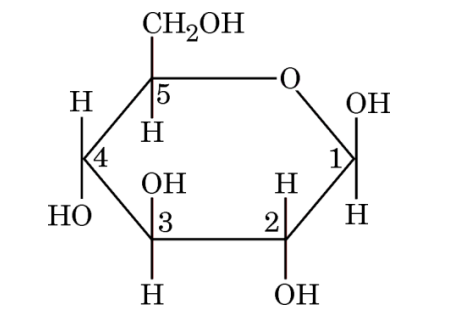
The anomeric carbon is typically the carbon atom that is part of the carbonyl group in the open-chain form of the sugar, which becomes a new chiral center upon cyclization. In glucose, this is carbon 1 when considering the Haworth structure. Thus, the correct option is 1.
The value of Henry’s constant Kₕ is:
Out of the following statements, the incorrect statement is:
he incorrect statement is 'Lanthanoids are radioactive in nature.'
This is incorrect because most lanthanoids are not radioactive. Only a few elements like Promethium (Pm) exhibit radioactivity. The majority of lanthanoids are stable and non-radioactive. The context emphasizes the chemical and physical properties of lanthanoids, such as the lanthanoid contraction, which affects atomic and ionic radii—not radioactivity, which is a key feature of actinoids, not lanthanoids.
Out of 2-Bromobutane, 1-Bromobutane, 2-Bromopropane and 1-Bromopropane, the molecule which is chiral in nature is:
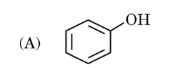
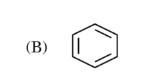
In the given reaction sequence, the structure of Y would be:
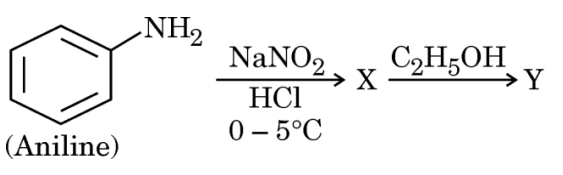
-
(A)
-
(B)
-
(C)
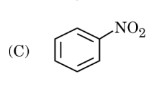
-
(D)
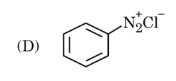
The correct structure of Y can be identified based on the provided electron pair shifting reactions, which indicate how Y interacts with adjacent bonds or atoms through π bonds. The text explains the geometrical isomerism of double bonds in alkenes, where Y's structure is influenced by the positioning of substituents (like X) relative to the double bond. Therefore, the appropriate representation of Y must consider its position as determined by these reactions. The options should reflect these geometric outcomes.
The product of the oxidation of I⁻ with MnO₄⁻ in alkaline medium is:
Polyhalogen compounds have wide application in industries and agriculture. DDT is also a very important polyhalogen compound. It is a:
What amount of electric charge is required for the reduction of 1 mole of MnO₄⁻ into Mn²⁺?
Alkenes are formed by heating alcohols with conc. H₂SO₄. The first step in the reaction is:
Assertion (A) : Cuprous salts are diamagnetic.
Reason (R) : Cuprous ion has completely filled 3d-orbitals.
Assertion (A) : n-Butyl chloride has higher boiling point than n-Butyl bromide.
Reason (R) : C – Cl bond is more polar than C – Br bond.
Assertion (A) : Acetanilide is less basic than aniline.
Reason (R) : Acetylation of aniline results in decrease of electron density on nitrogen.
Assertion (A) : Electrolysis of aqueous NaCl gives H₂ at cathode and Cl₂ at anode.
Reason (R) : Chlorine has higher oxidation potential than H₂O.
Section C
Reactant ‘A’ underwent a decomposition reaction. The concentration of ‘A’ was measured periodically and recorded in the table given below :
Based on the above data, predict the order of the reaction and write the expression for the rate law.
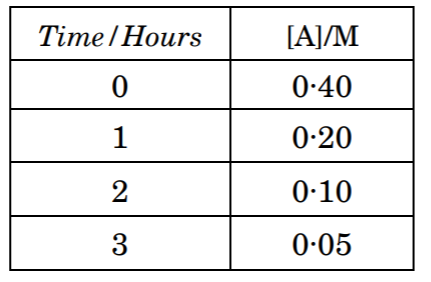
Here, since concentration of A decreases linearly with time, the reaction is zero order.
Rate law expression: Rate = k[A]0 = k. So the rate is independent of concentration of A.
The reaction between H₂ (g) and I₂ (g) was carried out in a sealed isothermal container. The rate law for the reaction was found to be :
Rate =Rate = k[H₂][I₂]
If 1 mole of H₂ (g) was added to the reaction chamber and the temperature was kept constant, then predict the change in rate of the reaction and the rate constant.
The rate law is Rate = k[H₂][I₂]. If 1 mole of H₂ is added, the concentration of H₂ increases, so the rate of reaction will increase proportionally because rate depends directly on [H₂].
Since the temperature is constant in the isothermal container, the rate constant k does not change.
Therefore,
- Rate of reaction increases
- Rate constant k remains unchanged.
PtCl₄ . 2KCl doesn’t give precipitate of AgCl with AgNO₃ solution. Write the structural formula and IUPAC name of the complex.
IUPAC name: Potassium hexachloroplatinate(IV)
Explanation: PtCl4 . 2KCl is actually potassium hexachloroplatinate(IV) containing the complex ion [PtCl6]2-. Here, all chloride ions are coordinated to Pt(IV) as ligands and no free chloride ions exist. Therefore, no AgCl precipitate forms with AgNO3.
Define fuel cell. Give two advantages of fuel cell over ordinary cell.
Advantages of Fuel Cell over Ordinary Cell:
(1) Fuel cells can produce electricity continuously as long as fuel is supplied, whereas ordinary cells have limited stored energy.
(2) Fuel cells are more efficient and pollution-free compared to ordinary cells which may involve harmful chemicals and produce waste.
Write the structures of the main products of the following reactions :
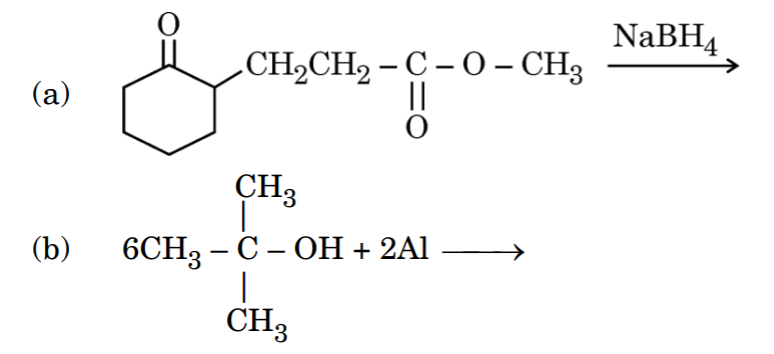
(b) Dinitration of 3-methylphenol results in 2,4-dinitro-3-methylphenol as the major product. Here, both ortho and para positions relative to the -OH group get nitrated. The final product has -OH at position 1, methyl at position 3, and nitro groups at positions 2 and 4.
The presence of activating -OH and methyl groups direct the electrophilic substitution to ortho and para positions relative to -OH. Thus, nitration occurs preferentially at these positions.
What is meant by essential amino acids ? Why are amino acid amphoteric in nature ?
(b) Amino acids are amphoteric in nature because they contain both acidic carboxyl group (-COOH) and basic amino group (-NH2) in the same molecule. Thus, they can react with both acids and bases, behaving as either acid or base.
Section D
Account for the following :
(i) Allyl chloride is hydrolysed more readily than n-propyl chloride.
(ii) Isocyanides are formed when alkyl halides are treated with silver cyanide.
(iii) Methyl chloride reacts faster with O̅H ion in Sₙ² reaction than t-butyl chloride.
(ii) Isocyanides are formed when alkyl halides are treated with silver cyanide because AgCN is ionic with silver cation Ag+ and cyanide anion CN-. The cyanide ion exists as CN- and NC- (isocyanide form). In this reaction, alkyl halides react with the isocyanide ion (NC-) leading to formation of isocyanides.
(iii) Methyl chloride reacts faster with OH- ion in SN2 reaction than t-butyl chloride because methyl chloride has less steric hindrance, so the nucleophile can attack the carbon directly and easily. In t-butyl chloride, bulky groups around the carbon prevent the nucleophile from attacking, thus slowing the reaction.
Complete the following reactions by writing the structural formulae of ‘A’ and ‘B’ :
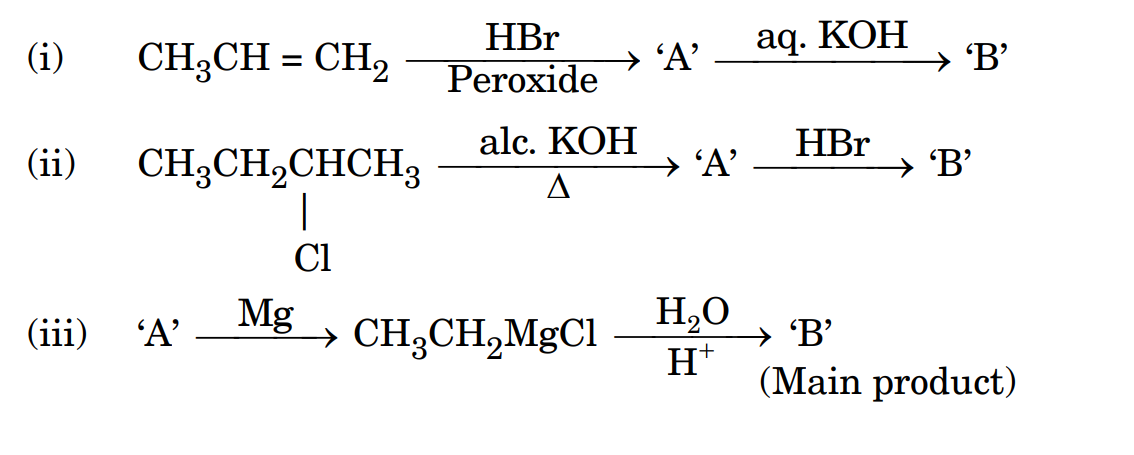
Compound (A) is acetophenone with molecular formula C8H8O. Its structural formula is a benzene ring attached to a carbonyl group (C=O) and a methyl group (CH3) - C6H5-CO-CH3.
Compound (B) is benzoic acid with molecular formula C7H6O2. Its structural formula is a benzene ring attached to a carboxyl group (COOH) - C6H5-COOH.
Explanation: Acetophenone (A) on oxidation with chromic acid converts the methyl ketone group into a carboxylic acid group forming benzoic acid (B). Thus, A is acetophenone and B is benzoic acid.
Calculate the cell voltage of the voltaic cell which is set up by joining following half-cells at 25⁰C: Al/Al³⁺ (0·001 M) and Ni/Ni²⁺ (0·1 M)
Given : EᵒNi²⁺/ Ni = – 0·25 V, EᵒAl³⁺/Al = – 1·66 V
Oxidation (Anode): Al → Al3+ + 3e-, Eᵒ = –1.66 V
Reduction (Cathode): Ni2+ + 2e- → Ni, Eᵒ = –0.25 V
Step 2: Identify the anode and cathode. Since Al has more negative Eᵒ, it will be oxidized and Ni will be reduced.
Step 3: Calculate the standard cell potential, Eᵒcell = Eᵒcathode – Eᵒanode = (–0.25) – (–1.66) = 1.41 V
Step 4: Use the Nernst equation to calculate the cell voltage at given concentrations:
Ecell = Eᵒcell – (0.0591 / n) * log(Q), where n = number of electrons transferred, Q = reaction quotient.
Balanced equation: 2Al + 3Ni2+ → 2Al3+ + 3Ni, n = 6 electrons.
Q = [Al3+]2 / [Ni2+]3 = (0.001)2 / (0.1)3 = 1e–6 / 1e–3 = 0.001
Step 5: Calculate Ecell:
Ecell = 1.41 – (0.0591 / 6) * log(0.001) = 1.41 – 0.00985 * (–3) = 1.41 + 0.02955 = 1.4395 V
Final Answer: The cell voltage of the voltaic cell is approximately 1.44 V at 25 deg C.
Give explanation for each of the following observations :
(a) With the same d-orbital configuration (d4), Mn3+ ion is an oxidising agent whereas Cr2+ ion is a reducing agent.
(b) Actinoid contraction is greater from element to element than that among lanthanoids.
(c) Transition metals form large number of interstitial compounds with H, B, C and N.
(b) Actinoid contraction is greater than lanthanoid contraction because actinoids have poor shielding effect due to the involvement of 5f orbitals which penetrate closer to the nucleus. This results in a greater decrease in atomic and ionic sizes across the series compared to lanthanoids where 4f orbitals shield electrons more effectively.
(c) Transition metals have small atomic sizes and large surface areas with vacant d-orbitals. They can accommodate smaller atoms like H, B, C, and N in their interstitial spaces forming interstitial compounds. These compounds exhibit high hardness and stability due to strong metal-nonmetal bonds.
An aqueous solution of NaOH was made and its molar mass from the measurement of osmotic pressure at 27⁰C was found to be 25 g mol⁻¹. Calculate the percentage dissociation of NaOH in this solution.
[Atomic mass : Na = 23 u, O = 16 u, H = 1 u]
Arrange the following compounds as asked : 3
(a) in decreasing order of pKb values C₂H₅NH₂, (C₂H₅)₂NH, C₆H₅NHCH₃, C₆H₅NH₂
(b) increasing order of boiling point C₂H₅OH, C₂H₅NH₂, (CH₃)₂NH
(c) increasing order of solubility in water C₆H₅NH₂, (C₂H₅)₂NH, C₂H₅NH₂
Decreasing order of pKb (increasing basic strength) is: C₆H₅NH₂ > C₆H₅NHCH₃ > C₂H₅NH₂ > (C₂H₅)₂NH
(b) Boiling point depends on intermolecular forces like hydrogen bonding and molecular weight.
C₂H₅OH has strongest hydrogen bonding due to O-H group, so highest boiling point.
C₂H₅NH₂ and (CH₃)₂NH have N-H bonds and can hydrogen bond, but C₂H₅NH₂ has stronger hydrogen bonding due to two N-H bonds compared to one in (CH₃)₂NH.
Increasing order of boiling point is: (CH₃)₂NH < C₂H₅NH₂ < C₂H₅OH
(c) Solubility in water depends on the ability to form hydrogen bonds and polarity.
C₂H₅NH₂ is most soluble due to strong hydrogen bonding and smaller size.
(C₂H₅)₂NH is less soluble due to bulkier alkyl groups reducing hydrogen bonding.
C₆H₅NH₂ is least soluble due to hydrophobic phenyl ring.
Increasing order of solubility is: C₆H₅NH₂ < (C₂H₅)₂NH < C₂H₅NH₂
An aromatic compound ‘A’ with molecular formula C₈H₈O gives positive 2,4-DNP test. It gives yellow precipitate. of compound ‘B’ on treatment with sodium hypoiodite. Compound ‘A’ does not react with Tollen’s or Fehling’s reagent; on drastic oxidation with KMnO₄ it forms a carboxylic acid ‘C’. Elucidate the structures of A, B and C. Also give their IUPAC names.
(a) Can sodium ethoxide and t-butyl chloride be used for the preparation of t-butyl ethyl ether ? Give suitable explanation. Justify your answer by suggesting the appropriate starting material required for preparation of t-butyl ethyl ether.
(b) Give the IUPAC name of above mentioned ether.
(b) The IUPAC name of t-butyl ethyl ether is ethoxy-2-methylpropane.
Section E
(i) Complete the following reactions by writing the structure of the main products:
(ii) Give simple chemical test to distinguish between the following pairs of compounds :
(I) Ethyl benzoate and benzoic acid
(II) Propanal and propanone
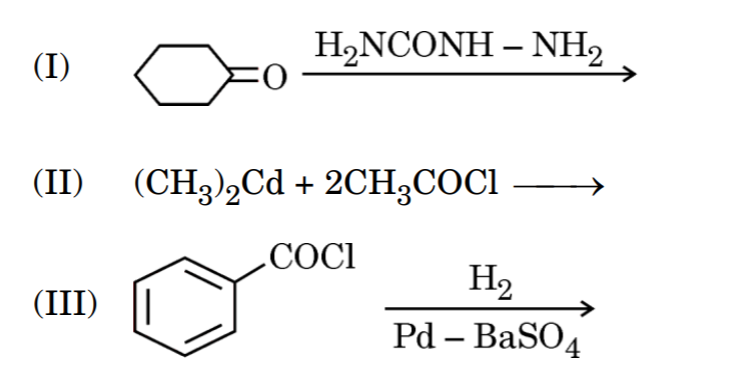
(a) Mononitration of 3-methylphenol gives mainly 2-nitro-3-methylphenol where a nitro group (-NO2) is introduced at the ortho position to the hydroxyl group (-OH).
Structure: 3-methyl-2-nitrophenol.
(b) Dinitration product of 3-methylphenol has two nitro groups substituted at ortho and para positions relative to the -OH group. The main product is 2,4-dinitro-3-methylphenol.
(ii) Chemical tests to distinguish:
(I) Ethyl benzoate and benzoic acid:
Test: Sodium bicarbonate test.
Observation: Benzoic acid reacts with sodium bicarbonate (NaHCO3) to give effervescence of CO2 due to formation of sodium benzoate, whereas ethyl benzoate does not react.
Explanation: Benzoic acid is acidic and reacts with NaHCO3, ester ethyl benzoate is not acidic and does not react.
(II) Propanal and propanone:
Test: 2,4-Dinitrophenylhydrazine (2,4-DNPH) test and Tollen's test.
Observation: Both give orange precipitate with 2,4-DNPH indicating presence of carbonyl group.
Tollen's test: Propanal (an aldehyde) gives silver mirror with Tollen's reagent, whereas propanone (a ketone) does not.
Thus, Tollen's test distinguishes propanal and propanone.
Summary:
1. Mononitration of 3-methylphenol gives 2-nitro-3-methylphenol.
2. Dinitration of 3-methylphenol gives 2,4-dinitro-3-methylphenol.
3. Benzoic acid reacts with NaHCO3 to evolve CO2, ethyl benzoate does not.
4. Propanal gives silver mirror with Tollen's reagent but propanone does not.
(i) Complete each synthesis by giving missing starting =material, reagent or products :
(ii) Carry out the following conversions :
(I) Benzaldehyde to Benzophenone
(II) Benzaldehyde to 3-phenyl propanol
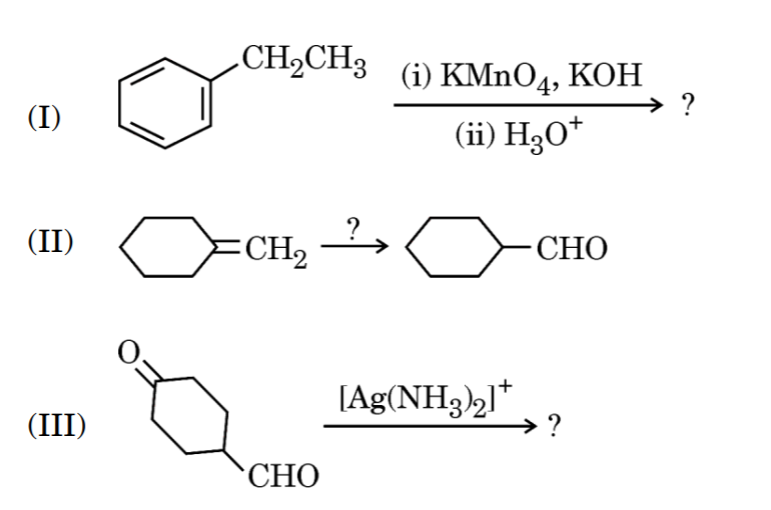
2. Cyclohexanol to Cyclohexanone : Starting material - Cyclohexanol; Reagent - PCC or CrO3/H2SO4; Product - Cyclohexanone.
3. p-Fluorotoluene to p-Fluorobenzaldehyde : Starting material - p-Fluorotoluene; Reagent - SeO2; Product - p-Fluorobenzaldehyde.
4. Ethanitrile to Ethanal : Starting material - Ethanitrile; Reagent - DIBAL-H at low temperature; Product - Ethanal.
5. Allyl alcohol to Propenal : Starting material - Allyl alcohol; Reagent - PCC or MnO2; Product - Propenal.
6. But-2-ene to Ethanal : Starting material - But-2-ene; Reagent - Ozonolysis (O3/Zn); Product - Ethanal.
(ii) Conversion of Benzaldehyde to Benzophenone :
- Step 1: Benzaldehyde undergoes nucleophilic addition with phenylmagnesium bromide (C6H5MgBr) (Grignard reagent) to form an intermediate alcohol.
- Step 2: The intermediate is oxidized to benzophenone using an appropriate oxidizing agent like PCC.
Conversion of Benzaldehyde to 3-Phenylpropanol :
- Step 1: Benzaldehyde is treated with acetaldehyde under aldol condensation conditions to give 3-phenyl-2-propenal.
- Step 2: This product is then hydrogenated using H2/Pd to give 3-phenylpropanol.
These reactions demonstrate use of oxidation, Grignard reagent addition, aldol condensation and reduction methods to achieve target transformations.
Give reasons :
(I) [Ni(CO)4] is diamagnetic whereas [NiCl4]²⁻ is paramagnetic. [Atomic number : Ni = 28]
(II) CO is a stronger complexing agent than NH₃.
(III) The trans isomer of complex [Co(en)₂Cl₂]+ is optically inactive.
(ii) Using Crystal Field theory, write the number of unpaired electrons in octahedral complexes of Fe3+ in the presence of :
(I) Strong field ligand
(II) Weak field ligand
[Atomic number : Fe = 26]
(b) CO is a stronger complexing agent than NH3 because CO has a vacant d orbital which allows back bonding from metal to ligand, making the metal-ligand bond stronger. NH3 lacks this property and is only a sigma donor.
(c) The trans isomer of [Co(en)2Cl2]+ is optically inactive because it has a plane of symmetry, making it superimposable on its mirror image, thus it does not show optical isomerism.
(d) Using Crystal Field Theory for Fe3+ (d5) in octahedral complexes:
(I) With strong field ligands (like CN-) electrons pair up resulting in 1 unpaired electron.
(II) With weak field ligands (like H2O) electrons remain unpaired leading to 5 unpaired electrons.
(i) Name the type of isomerism exhibited by the following compounds. Also draw their corresponding isomers.
(I) [Co(NH₃)₆] [Cr(CN)₆]
(II) [Co(en)₃]³⁺
(III) [Co(NH₃)₃(NO₂)₃]
(ii) Differentiate between weak field and strong field ligands. How does the strength of the ligand influence the spin of the complex ?
(I) [Co(NH3)6][Cr(CN)6] exhibits Coordination Isomerism. In this case, the NH3 ligands and CN- ligands can interchange between the two metal centers to give an isomer [Cr(NH3)6][Co(CN)6].
Isomers: [Co(NH3)6]3+ with [Cr(CN)6]3- and [Cr(NH3)6]3+ with [Co(CN)6]3-.
(II) [Co(en)3]3+ exhibits Optical Isomerism. The molecule has chiral forms which are non-superimposable mirror images known as Δ (delta) and Λ (lambda) isomers.
Isomers: Δ-[Co(en)3]3+ and Λ-[Co(en)3]3+ which are optical isomers.
(III) [Co(NH3)3(NO2)3] exhibits Geometrical Isomerism (fac and mer isomers). The three NO2- ligands can be arranged either all adjacent (fac) or in a plane (mer).
Isomers: fac-[Co(NH3)3(NO2)3] and mer-[Co(NH3)3(NO2)3].
(ii) Difference between weak field and strong field ligands and effect on spin:
Weak Field Ligands: These ligands produce a small crystal field splitting energy (Δo). Examples include H2O, F-, Cl-. Complexes with weak field ligands tend to have high spin configurations due to smaller splitting, so electrons occupy higher energy orbitals to minimize repulsion.
Strong Field Ligands: These ligands cause large crystal field splitting (Δo). Examples are CN-, NH3, en (ethylenediamine). Complexes formed with strong field ligands are usually low spin as electrons pair up in lower energy orbitals to avoid higher energy level occupation.
Effect on Spin: Strong field ligands increase crystal field splitting energy causing electron pairing in lower orbitals leading to low spin complexes. Weak field ligands have smaller splitting, so electrons remain unpaired in higher orbitals resulting in high spin complexes.
Thus, ligand strength controls the magnetic properties and spin state of coordination complexes.
(i) The initial concentration of N₂O₅ in the first order reaction :
N₂O₅(g)→2NO₂(g)+1/2O₂(g)
was 1·2 × 10⁻² mol L⁻¹. The concentration of N₂O₅ after 60 minutes was 0·2 × 10⁻² mol L⁻¹. Calculate the rate constant of the reaction at 318 K.
[log 6 = 0·778]
(ii) Account for the following :
(I) We cannot determine the order of a reaction by taking into consideration the balanced chemical equation.
(II) A bimolecular reaction may become kinetically of first order under a specified condition.
Given reaction is first order: N₂O₅(g)→2NO₂(g)+1/2O₂(g)
Initial concentration, [N₂O₅]0 = 1.2 × 10⁻² mol L-1
Concentration after time t = 60 minutes, [N₂O₅]t = 0.2 × 10⁻² mol L-1
Time, t = 60 min = 60 × 60 = 3600 s
For a first order reaction, the rate constant k is calculated using the formula:
k = (1 / t) * log([N₂O₅]0 / [N₂O₅]t)
The log is base 10 and the factor 2.303 is included as:
k = (2.303 / t) * log([N₂O₅]0 / [N₂O₅]t)
Substituting the values:
k = (2.303 / 3600) * log(1.2 × 10⁻² / 0.2 × 10⁻²) = (2.303 / 3600) * log(6)
Given log 6 = 0.778
So, k = (2.303 / 3600) * 0.778 = 0.000498 s-1
(ii) Explanation:
(I) We cannot determine the order of a reaction by considering only the balanced chemical equation because the reaction mechanism may involve steps that do not correspond to the stoichiometric coefficients. The order depends on the reaction mechanism and how the rate depends on concentration, which must be determined experimentally.
(II) A bimolecular reaction may appear kinetically first order under certain conditions such as when the concentration of one reactant is very large and remains effectively constant during the reaction. This makes the rate depend only on the concentration of the other reactant, making it appear as a first order reaction with respect to the limiting reactant.
(i) The rate of the chemical reaction doubles for an increase of 10 K in absolute temperature from 298 K. Calculate activation energy (Eₐ).
[2·303 R = 19·15 JK⁻¹ mol⁻¹, log 2 = 0·3]
(ii)
For a reaction :
2H₂O₂ (I⁻)⎯⎯⎯→ 2H₂O + O₂
the proposed mechanism is as given below :
(I) H₂O₂ + I⁻ ⎯⎯→ H₂O + IO⁻ (slow)
(II) H₂O₂+ IO⁻ ⎯⎯→ H₂O + I⁻ + O₂ (fast)
(1) Write rate law for the reaction.
(2) Write the overall order and molecularity of the reaction.
Using Arrhenius equation: k = A e^(-E_a/RT). When temperature increases, rate constant k changes.
Given, log(k_2/k_1) = (2.303 * R * E_a / R) * (1/T_1 - 1/T_2), where k_2/k_1 = 2, T_1 = 298 K, T_2 = 308 K
Given 2.303*R = 19.15 J mol⁻¹ K⁻¹ and log 2 = 0.3
So, 0.3 = (19.15 * E_a) * (1/298 - 1/308)
Calculate (1/298 - 1/308) = (308 - 298)/(298 * 308) = 10 / (91784) = 1.089 * 10^-4
So, 0.3 = 19.15 * E_a * 1.089 * 10^-4
Therefore, E_a = 0.3 / (19.15 * 1.089 * 10^-4) = 0.3 / 0.002085 = 143.8 kJ mol⁻¹ approx
(ii)(1) The slow step is the rate determining step: H₂O₂ + I⁻ → H₂O + IO⁻
Rate law = rate = k[H₂O₂][I⁻]
(2) Overall order of reaction = 1 (H₂O₂) + 1 (I⁻) = 2
Molecularity of the slow step = 2 (bimolecular reaction)
Final answers:
(i) Activation energy E_a = 143.8 kJ mol⁻¹
(ii)(1) Rate law: rate = k [H₂O₂][I⁻]
(ii)(2) Overall order = 2, Molecularity = 2 (bimolecular)
Paper Details
CBSE Board Exam 2025
Class
Class 12 PCM
Subject
Chemistry
Year
2025
Set
Set 3
Other Years — Chemistry