SOLUTIONS
2023 BOARD EXAM
CBSE Class 12 PCM Chemistry Board Paper 2023 — Set 5 Solutions
2023
Chemistry
Class 12 PCM
CBSE EXAMINATION PAPER-2023
CHEMISTRY
(Solved)
General Instructions :
Read the following instructions carefully and follow them :
- This question paper contains 41 questions. All questions are compulsory.
- This question paper is divided into 5 sections.
- Section A – questions number 1 to 3 are case based questions
- Section B – questions number 4 to 21 are multiple choice questions
- Section C – questions number 22 to 30 are very short answer
- Section D – questions number 31 to 36 are short answer
- Section E – questions number 37 to 41 are long answer
- There is no overall choice given in the question paper. However, an internal choice has been provided in few questions.
- Use of calculator is NOT allowed.
Section A
The following questions are case – based questions. Read the passage carefully and answer the questions that follow :
Nucleophilic Substitution
Nucleophilic Substitution reaction of haloalkane can be conducted according to both SN1 and SN2 mechanisms. SN1 is a two step reaction while SN2 is a single step reaction. For any haloalkane which mechanism is followed depends on factors such as structure of haloalkane, properties of leaving group, nucleophilic reagent and solvent. Influences of solvent polarity : In SN1 reaction, the polarity of the system increases from the reactant to the transition state, because a polar solvent has a greater effect on the transition state than the reactant, thereby reducing activation energy and accelerating the reaction. In SN2 reaction, the polarity of the system generally does not change from the reactant to the transition state and only charge dispersion occurs. At this time, polar solvent has a great stabilizing effect on Nu than the transition state, thereby increasing activation energy and slow down the reaction rate. For example, the decomposition rate (SN1) of tertiary chlorobutane at 25 °C in water (dielectric constant 79) is 300000 times faster than in ethanol (dielectric constant 24). The reaction rate (SN2) of 2-Bromopropane and NaOH in ethanol containing 40% water is twice slower than in absolute ethanol. Hence the level of solvent polarity has influence on both SN1 and SN2 reaction, but with different results. Generally speaking weak polar solvent is favourable for SN2 reaction, while strong polar solvent is favourable for SN1. Generally speaking the substitution reaction of tertiary haloalkane is based on SN1 mechanism in solvents with a strong polarity (for example ethanol containing water).
(1) Why racemisation occurs in SN1 ?
(2) Why is ethanol less polar than water ?
(3) Which one of the following in each pair is more reactive towards SN2 reaction ?
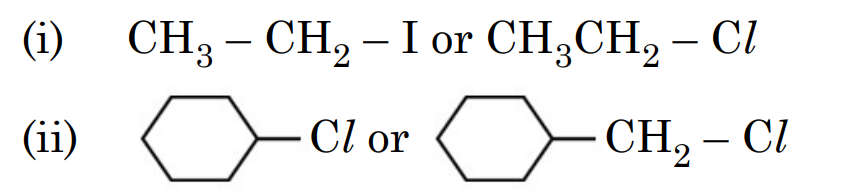 [2 Marks]
(i) CH₃–CH₂–I or CH₃–CH₂–Cl
Both are primary alkyl halides, so steric factor is same.
But I⁻ is a better leaving group than Cl⁻ (weaker C–I bond, larger size).
More reactive: CH₃–CH₂–I
(ii) Cyclohexyl–Cl or Cyclohexyl–CH₂–Cl
Cyclohexyl–Cl → secondary halide (Cl attached directly to ring carbon → more steric hindrance)
Cyclohexyl–CH₂–Cl → primary halide (less steric hindrance)
SN2 prefers less hindered (primary) substrates.
More reactive: Cyclohexyl–CH₂–Cl
(4) Arrange the following in the increasing order of their reactivity towards SN1 reactions : (i) 2-Bromo-2-methylbutane, 1-Bromopentane, 2-Bromopentane (ii) 1-Bromo-3-methylbutane, 2-Bromo-2-methylbutane, 2-Bromo-3 methylbutane
Rahul set-up an experiment to find resistance of aqueous KCl solution for different concentrations at 298 K using a conductivity cell connected to a Wheatstone bridge. He fed the Wheatstone bridge with a.c. power in the audio frequency range 550 to 5000 cycles per second. Once the resistance was calculated from null point he also calculated the conductivity K and molar conductivity ∧ₘ and recorded his readings in tabular form.
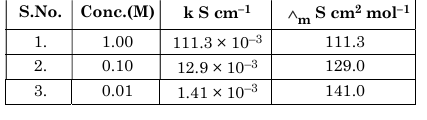
(1) Why does conductivity decrease with dilution ?
(2) If Λₘ° of KCl is 150.0 S cm² mol⁻¹, calculate the degree of dissociation of 0.01 M KCl.
(3) Amit, a classmate of Rahul repeated the same experiment with CH₃COOH solution instead of KCl solution. Give one point that would be similar and one that would be different in his observations as compared to Rahul.
Different point: Amit would find lower molar conductivity values for CH3COOH compared to KCl because CH3COOH is a weak electrolyte and partially ionizes, while KCl is a strong electrolyte that fully ionizes, leading to higher conductivity. This difference is due to the nature of the solute, as mentioned in Rahul's experiment with KCl solutions.
(4) If Rahul had used HCl instead to KCl then would you expect the ∧ₘ values to be more or less than those per KCl for a given concentration. Justify.
Section B
Which of the following molecules has a chiral centre correctly labelled with an asterisk (*)?
The correct answer is HOCH₂C*H(OH)CH₂OH. A chiral center is a carbon atom that is bonded to four different groups. In this molecule, the carbon atom marked with an asterisk is attached to four distinct substituents: a hydroxymethyl group (HOCH₂), a hydroxyl group (OH), a hydrogen (H), and a methylene group (CH₂OH), making it chiral. The other options do not present a carbon atom bonded to four different groups.
Which of the following alcohols will not undergo oxidation?
2-Methylbutan-2-ol is the correct answer because it is a tertiary alcohol. Tertiary alcohols are resistant to oxidation under normal conditions, unlike primary and secondary alcohols, which can be oxidized to aldehydes or ketones respectively. The context mentions that alkanes having tertiary hydrogen can be oxidized, but it must be noted that tertiary alcohols generally do not undergo oxidation readily.
A voltaic cell is made by connecting two half cells represented by half equations below: Sn²⁺(aq) + 2e⁻ → Sn(s) E° = – 0.14 V Fe³⁺(aq) + e⁻ → Fe²⁺(aq) E° = + 0.77 V Which statement is correct about this voltaic cell?
The correct answer is 'Sn is oxidised and the voltage of the cell is 0.91 V.' In the voltaic cell, Sn is oxidised from Sn(s) to Sn²⁺(aq), while Fe³⁺ is reduced to Fe²⁺. To find the cell voltage, we subtract the standard reduction potential of the oxidised species (Sn, -0.14 V) from that of the reduced species (Fe³⁺, +0.77 V): 0.77 V - (-0.14 V) = 0.91 V.
Four half reactions I to IV are shown below:
I. 2Cl⁻ → Cl₂ + 2e⁻
II. 4OH⁻ → O₂ + 2H₂O + 2e⁻
III. Na⁺ + e⁻ → Na
IV. 2H⁺ + 2e⁻ → H₂ Which two of these reactions are most likely to occur when concentrated brine is electrolysed?
The correct answer is I and IV. During the electrolysis of concentrated brine, chlorine is generated at the anode (I: 2Cl⁻ → Cl₂ + 2e⁻) and hydrogen is produced at the cathode (IV: 2H⁺ + 2e⁻ → H₂). Reaction II (4OH⁻ → O₂ + 2H₂O + 2e⁻) is not preferred due to higher overpotential for oxygen generation compared to chlorine, and reaction III is not relevant in this context since sodium does not get reduced in the electrolysis of brine.
Which property of transition metals enables them to behave as catalysts?
The correct option is 'Variable oxidation states'. Transition metals are known for their ability to adopt multiple oxidation states, which allows them to participate in various chemical reactions and form intermediate complexes, making them effective catalysts.
In the two tetrahedral structures of dichromate ion,
All Cr – O bonds are non-equivalent. In the dichromate ion (Cr2O7^2-), the two tetrahedral structures result in Cr–O bonds that are not all the same in length due to the shared oxygen and the differing angles that arise from its structure, specifically the Cr–O–Cr bond angle of 126°. This creates a situation where some of the bonds behave differently due to the geometry and resonance in the molecule.
1 mole of liquid A and 2 moles of liquid B make a solution having a total vapour pressure 40 torr. The vapour pressure of pure A and pure B are 45 torr and 30 torr respectively. The above solution
The correct option is 'shows positive deviation.' The total vapour pressure (40 torr) is lower than what would be expected based on Raoult’s law for an ideal solution, which indicates that the interactions between the molecules of A and B are weaker than those in the pure components. Thus, the solution exhibits positive deviation from Raoult’s law.
Which of the following would not be a good choice for reducing nitrobenzene to aniline?
The correct option is LiAlH₄. While H₂/Ni, Sn and HCl, and Fe and HCl are effective methods for reducing nitrobenzene to aniline, LiAlH₄ is a strong reducing agent that would more likely reduce nitro compounds to amines but is generally not preferred for this specific reduction, as it can lead to over-reduction or undesired side reactions.
If molality of a dilute solution is doubled, the value of the molal elevation constant (Kb) will be
Hydrolysis of sucrose is called
The correct answer is 'inversion' because hydrolysis of sucrose involves the breakdown of sucrose into its component monosaccharides, glucose and fructose, resulting in a mixture that is sweeter and has different optical rotation compared to the original disaccharide. This process is specifically referred to as 'inversion'.
Which one of the following has lowest pKₐ value?
The compound with the lowest pKₐ value is O₂N–CH₂–COOH (Nitroacetic acid). The presence of the electron-withdrawing nitro group (-NO₂) increases the acidity of the carboxylic acid, resulting in a lower pKₐ compared to the other options which have less electron-withdrawing substituents.
Which of the following cell was used in Apollo space programme?
The correct answer is H₂–O₂ Fuel cell, as it directly produces electricity from the reaction of hydrogen and oxygen, which was a key technology utilized during the Apollo space program for powering spacecraft.
The following experimental rate data were obtained for a reaction carried out at 25 °C:
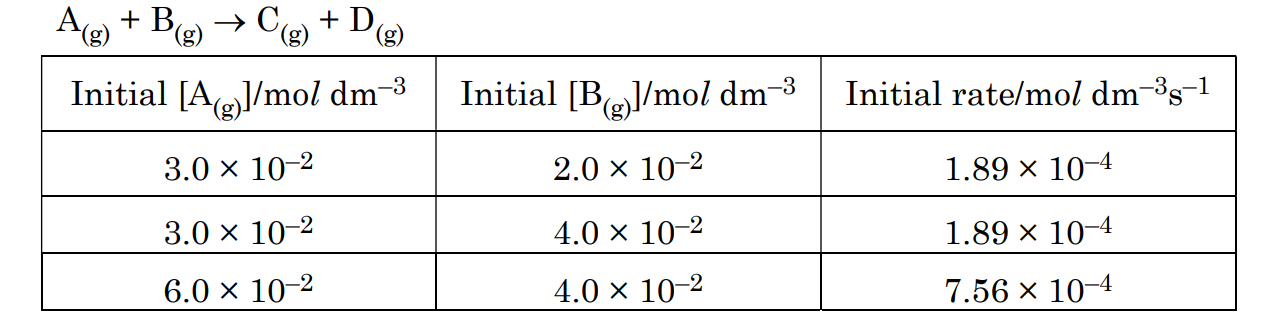
Let the rate law be:
Rate = k [A]ᵐ [B]ⁿ
Compare experiments 1 and 2:
[A] is same (3.0 × 10⁻²), [B] doubles (2.0 × 10⁻² → 4.0 × 10⁻²), but rate remains the same (1.89 × 10⁻⁴).
So, order with respect to B = 0.
Compare experiments 2 and 3:
[B] is same (4.0 × 10⁻²), [A] doubles (3.0 × 10⁻² → 6.0 × 10⁻²), and rate increases 4 times (1.89 × 10⁻⁴ → 7.56 × 10⁻⁴).
So, order with respect to A = 2.
Answer:
Order w.r.t. A = Second
Order w.r.t. B = Zero
The magnetic moment of [NiCl₄]²⁻ is [Atomic number : Ni = 28]
Assertion (A) : Proteins are polymers of α-amino acids connected by a peptide bond.
Reason (R) : A tetrapeptide contains 4 amino acids linked by 4 peptide bonds
Both Assertion (A) and Reason (R) are true and Reason (R) is the correct explanation of the Assertion (A). Proteins are indeed polymers of amino acids linked by peptide bonds, and in a tetrapeptide, which consists of 4 amino acids, there are 3 peptide bonds connecting them, which confirms the relationship stated in Reason (R).
Assertion (A) : For a zero order reaction the unit of rate constant and rate of reaction are same.
Reason (R) : Rate of reaction for zero order reaction is independent of concentration of reactant.
Assertion (A) : Acetic acid but not formic acid can be halogenated in presence of red P and Cl₂.
Reason (R) : Acetic acid is a weaker acid than formic acid.
Assertion (A) is true, but Reason (R) is false. Acetic acid can be halogenated due to its structure and the presence of the methyl group which facilitates the free radical halogenation process. However, formic acid is actually a stronger acid than acetic acid, which contradicts Reason (R). Therefore, while the assertion is correct, the reason provided does not support it.
Assertion (A) : Trans [Cr Cl2(ox)₂]³⁻ shows optical isomerism.
Reason (R) : Optical isomerism is common in octahedral complexes involving didentate ligands.
Section C
(i) What should be the signs (positive/negative) for E°Cell and ΔG° for a spontaneous redox reaction occurring under standard conditions?
(ii) State Faraday’s first law of electrolysis.
(ii) Faraday’s first law of electrolysis states that the mass of a substance deposited or liberated at an electrode during electrolysis is directly proportional to the quantity of electricity passed through the electrolyte.
What happens to the rate constant k and activation energy Eₐ as the temperature of a chemical reaction is increased? Justify.
a) Which of the following species cannot act as a ligand? Give reason.
OH⁻, NH₄⁺, CH₃NH₂, H₂O
(b) The complex [Co(NH₃)₅(NO₂)]Cl₂ is red in colour. Give IUPAC name of its linkage isomer.
(b) The linkage isomer of [Co(NH3)5(NO2)]Cl2 has the nitrite ligand bonded through oxygen as -ONO. Its IUPAC name is pentaammine nitrito-O-cobalt(III) chloride.
However, the melting point of the para isomer is higher because p-dichlorobenzene molecules are more symmetrical and pack more efficiently in the solid state, resulting in a more stable crystalline structure and higher melting point.
For the pair phenol and cyclohexanol, answer the following:
(a) Why is phenol more acidic than cyclohexanol?
(b) Give one chemical test to distinguish between the two.
(b) To distinguish, perform the neutral FeCl3 test. Phenol gives a violet colour with FeCl3 indicating the presence of phenol, while cyclohexanol shows no colour change.
(i) Draw the zwitter ion structure for sulphanilic acid.
(ii) How can the activating effect of –NH₂ group in aniline be controlled?
(ii) The activating effect of the –NH2 group in aniline can be controlled by protecting it through acetylation using acetic anhydride to form an acetanilide. This reduces the electron donating effect of –NH2 making substitution reactions more selective. After the substitution, hydrolysis of the amide group regenerates the free –NH2 group.
(i) Complete the reaction with the main product formed :
(ii) Convert Bromoethane to Propanamine.
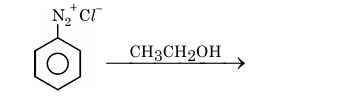
(i) The given compound is benzenediazonium chloride reacting with ethanol (CH₃CH₂OH).
In alcoholic medium, diazonium salts are reduced and the –N₂⁺ group is replaced by H.
So, the main product is benzene.
Reaction:
C₆H₅–N₂⁺Cl⁻ + CH₃CH₂OH → C₆H₆ + N₂ + CH₃CHO + HCl
Main product: Benzene (C₆H₆)
Reason (straight): Ethanol acts as a reducing agent, replacing the diazonium group by hydrogen.
(ii) To convert bromoethane (CH3-CH2-Br) to propanamine, first react bromoethane with excess ammonia (NH3) in ethanolic solution. This causes nucleophilic substitution replacing bromine with amine group forming ethylamine (CH3-CH2-NH2). For propanamine, extend the carbon chain by first converting bromoethane to propyl bromide and then reacting with ammonia to get propanamine (CH3-CH2-CH2-NH2).
Give the reaction of glucose with hydrogen cyanide. Presence of which group is confirmed by this reaction ?
Calculate the emf of the following cell at 298 K:
Fe(s) | Fe²⁺ (0.01 M) || H⁺ (1 M) | H₂(g) (1 bar), Pt(s)
Given: E°cell = 0.44 V
Step 1: Write the cell reaction: Fe(s) → Fe²⁺ + 2e⁻ and 2H⁺ + 2e⁻ → H₂(g)
Step 2: Number of electrons, n = 2
Step 3: Use Nernst equation to calculate emf:
E = E° - (RT/nF) * lnQ, where
R = 8.314 J/mol K, T = 298 K, F = 96485 C/mol, Q = [Fe²⁺]/[H⁺]^2 = 0.01/1 = 0.01
Step 4: Calculate (RT/nF) = (8.314*298)/(2*96485) ≈ 0.0128 V
Step 5: Calculate lnQ = ln(0.01) = -4.605
Step 6: Calculate E = 0.44 - 0.0128 * (-4.605) = 0.44 + 0.059 = 0.499 V
Answer: The emf of the cell at 298 K is approximately 0.50 V.
Section D
(a) For the reaction
2N₂O₅(g) → 4NO₂(g) + O₂(g) at 318 K,
calculate the rate of reaction if rate of disappearance of N₂O₅(g) is 1.4 × 10⁻³ mol m⁻³ s⁻¹.
(b) For a first order reaction, derive the relationship
t₉₉% = 2t₉₀%
Rate of reaction = (1/2) * rate of disappearance of N2O5 because 2 moles of N2O5 react.
= (1/2) * 1.4 * 10-3 = 0.7 * 10-3 mol m-3 s-1.
(b) For first order reaction, rate = k[A]. The integrated rate law is ln([A]0/[A]) = kt.
For t90%, 90% react means 10% left: [A] = 0.1 [A]0.
So, ln(1/0.1) = k t90% => ln10 = k t90%.
For t99%, 99% react means 1% left: [A] = 0.01 [A]0.
ln(1/0.01) = k t99% => ln100 = k t99%.
Divide both: t99%/t90% = ln100/ln10 = 2, hence t99% = 2 t90%.
(a) On the basis of crystal field theory, write the electronic configuration for d⁵ ion with a strong field ligand for which Δ₀ > P.
(b) [Ni(CO)₄] has tetrahedral geometry while [Ni(CN)₄]²⁻ has square planar, yet both exhibit diamagnetism. Explain.
[Atomic number: Ni = 28]
(b) [Ni(CO)4] has tetrahedral geometry and is diamagnetic because Ni is in oxidation state zero with electronic configuration 3d8 4s2. CO is a strong field ligand causing pairing of electrons, leading to no unpaired electrons.
[Ni(CN)4]2- has a square planar geometry due to strong field ligand CN- which causes pairing of d electrons and dsp2 hybridization. Ni is in +2 oxidation state (d8). The electrons pair up, making the complex low spin and diamagnetic. Tetrahedral complexes are usually high spin, but strong ligand CO can cause pairing even in tetrahedral geometry.
Thus, both complexes are diamagnetic due to electron pairing induced by strong field ligands, despite having different geometries.
(a) Illustrate Sandmeyer’s reaction with an equation.
(b) Explain why (CH₃)₂NH is more basic than (CH₃)₃N in aqueous solution.
C6H5N2+Cl- + CuCl → C6H5Cl + N2 + Cu+
Here, benzenediazonium chloride reacts with cuprous chloride to give chlorobenzene.
(b) Basicity of (CH3)2NH vs (CH3)3N:
(CH3)2NH (dimethylamine) is more basic than (CH3)3N (trimethylamine) in aqueous solution because in (CH3)3N the lone pair on nitrogen is more sterically hindered and less available for protonation. Also, in aqueous medium, the bulky methyl groups repel water molecules, reducing solvation of the protonated species. In contrast, dimethylamine has less steric hindrance and better solvation of its conjugate acid, making it more basic.
Give reasons for any three of the following observations:
(a) Penta-acetate of glucose does not react with hydroxylamine.
(b) Amino acids behave like salts.
(c) Water-soluble vitamins must be taken regularly in diet.
(d) The two strands in DNA are complementary to each other.
(b) Amino acids behave like salts because they contain both acidic (—COOH) and basic (—NH2) functional groups. In aqueous solution, they exist as zwitterions having both positive and negative charges, which is characteristic of salts.
(c) Water-soluble vitamins must be taken regularly in the diet because they are not stored in the body and are easily excreted through urine, so a regular supply is necessary.
(d) The two strands in DNA are complementary because the nitrogenous bases on one strand form specific hydrogen bonds with bases on the opposite strand; adenine pairs with thymine and guanine pairs with cytosine. This complementarity helps in accurate replication and maintaining the DNA structure.
(i) Why is the C–O bond length in phenols less than that in methanol?
(ii) Arrange the following in order of increasing boiling point:
Ethoxyethane, Butanal, Butanol, n-butane
(iii) How can phenol be prepared from anisole? Give reaction.
(ii) Order of increasing boiling point based on intermolecular forces and molecular structure is: n-butane < ethoxyethane < butanal < butanol.
- n-butane is non-polar with weak van der Waals forces.
- Ethoxyethane is an ether with dipole-dipole interactions but no hydrogen bonding.
- Butanal is an aldehyde with dipole interactions and slightly higher boiling than ethoxyethane.
- Butanol is an alcohol with hydrogen bonding which gives it the highest boiling point.
(iii) Phenol can be prepared from anisole by acidic hydrolysis. Under acidic conditions, anisole undergoes cleavage of the methoxy group to produce phenol.
C6H5OCH3 + HBr (acidic hydrolysis) → C6H5OH + CH3Br
(i) Give mechanism of the following reaction :
(ii) Illustrate hydroboration – oxidation reaction with an example.

(i) This is the acid-catalysed dehydration of ethanol to form diethyl ether at 413 K. The mechanism is as follows:
Step 1: Protonation of ethanol
CH3CH2OH+H+ ⟶ CH3CH2OH2+
Ethanol gets protonated, making water a good leaving group.
Step 2: Nucleophilic attack by another ethanol molecule (SN2)
CH3CH2OH+CH3CH2OH2+ ⟶ CH3CH2OCH2CH3++H2O
Another ethanol molecule attacks the ethyl group, forming a protonated ether.
Step 3: Deprotonation
CH3CH2OCH2CH3+ ⟶ CH3CH2OCH2CH3+H+
Loss of a proton gives diethyl ether and regenerates the acid catalyst.
Overall reaction:
2 CH3CH2OH (413 K , conc. H2SO4) → CH3CH2OCH2CH3+H2O2
This is the intermolecular dehydration of ethanol to form an ether.
(ii) Hydroboration-oxidation reaction: This reaction converts an alkene into an alcohol by adding water across the double bond without rearrangement.
Step 1 (Hydroboration): The alkene reacts with diborane (B2H6) to form trialkylborane; boron adds to the less substituted carbon and hydrogen to the more substituted carbon.
Step 2 (Oxidation): The trialkylborane is treated with hydrogen peroxide (H2O2) in basic medium (NaOH), converting it into corresponding alcohol.
Example: CH2=CH2 + B2H6 → CH3CH2-B
Then, CH3CH2-B + H2O2/NaOH → CH3CH2OH + B(OH)3
This reaction provides anti-Markovnikov addition of water to the alkene.
Section E
(i) Why is boiling point of 1 M NaCl solution more than that of 1 M glucose solution?
(ii) A non-volatile solute ‘X’ (molar mass = 50 g mol⁻¹) when dissolved in 78 g of benzene reduced its vapour pressure to 90%. Calculate the mass of X dissolved in the solution.
(iii) Calculate the boiling point elevation for a solution prepared by adding 10 g of MgCl₂ to 200 g of water assuming MgCl₂ is completely dissociated.
(Kᵦ for water = 0.512 K kg mol⁻¹, Molar mass of MgCl₂ = 95 g mol⁻¹)
(ii) Given:
Vapour pressure of pure benzene, P0; vapour pressure of solution, P = 0.90 P0
Mass of solvent (benzene), msolvent = 78 g = 0.078 kg
Molar mass of solute X = 50 g mol-1
Using Raoult’s law:
P = Xsolvent * P0 => Xsolvent = P / P0 = 0.90
Mole fraction of solvent, Xsolvent = moles of solvent / (moles of solvent + moles of solute) = 0.90
Let mass of X = m g, moles of X = m / 50
Moles of benzene = 78 / 78 = 1 mol
So, 0.90 = 1 / (1 + m / 50) => 1 + m / 50 = 1 / 0.90 = 1.111
m / 50 = 0.111
m = 0.111 * 50 = 5.55 g
Therefore, mass of X dissolved is 5.55 g.
(iii) Given:
Mass of MgCl2 = 10 g
Mass of water = 200 g = 0.2 kg
Molar mass of MgCl2 = 95 g mol-1
Kb for water = 0.512 K kg mol-1
Moles of MgCl2 = 10 / 95 = 0.105 mol
MgCl2 dissociates into Mg2+ and 2Cl- ions; number of particles = 3
Van't Hoff factor, i = 3
Molality, m = moles of solute / mass of solvent in kg = 0.105 / 0.2 = 0.525 mol/kg
Boiling point elevation, ΔTb = i * Kb * m = 3 * 0.512 * 0.525 = 0.806 K
Thus, the boiling point elevation is approximately 0.81 K.
(i) Why is the value of Van’t Hoff factor for ethanoic acid in benzene close to 0.5?
(ii) Determine the osmotic pressure of a solution prepared by dissolving 2.32 × 10⁻² g of K₂SO₄ in 2 L of solution at 25 °C, assuming that K₂SO₄ is completely dissociated.
(R = 0.082 L atm K⁻¹ mol⁻¹, Molar mass of K₂SO₄ = 174 g mol⁻¹)
(iii) When 25.6 g of sulphur was dissolved in 1000 g of benzene, the freezing point lowered by 0.512 K. Calculate the formula of sulphur (Sₓ).
(Kf for benzene = 5.12 K kg mol⁻¹, Atomic mass of sulphur = 32 g mol⁻¹)
(ii) Given data:
Mass of K₂SO₄ = 2.32 × 10⁻² g = 0.0232 g, Volume of solution = 2 L, Temperature (T) = 25 °C = 298 K, R = 0.082 L atm K⁻¹ mol⁻ⁱ, Molar mass of K₂SO₄ = 174 g mol⁻¹.
Calculate moles of K₂SO₄ = mass / molar mass = 0.0232 / 174 = 1.33 × 10⁻ӑ mol.
K₂SO₄ dissociates into 2K+ and SO42−, total 3 ions, so i = 3.
Osmotic pressure π = i * (n / V) * R * T = 3 * (1.33 × 10⁻ӑ / 2) * 0.082 * 298 = 3 * 6.65 × 10⁻ˆ * 0.082 * 298 = 3 * 0.162 = 0.486 atm.
(iii) Given:
Mass of sulphur (solute), m = 25.6 g; Mass of benzene (solvent), w = 1000 g = 1 kg; Freezing point depression, ΔT = 0.512 K; Kf for benzene = 5.12 K kg mol⁻ⁱ; Atomic mass of sulphur = 32 g mol⁻¹.
Using freezing point depression formula: ΔT = Kf * molality => molality = ΔT / Kf = 0.512 / 5.12 = 0.1 mol kg⁻¹.
Molality = moles of solute / kg of solvent => moles = molality * kg solvent = 0.1 * 1 = 0.1 mol.
Molar mass of sulphur molecule = mass / moles = 25.6 / 0.1 = 256 g mol⁻¹.
Number of sulphur atoms in molecule x = molar mass / atomic mass = 256 / 32 = 8.
Therefore, the formula of sulphur is S8.
(i) Write the reaction involved in Cannizzaro’s reaction.
(ii) Why are the boiling points of aldehydes and ketones lower than that of the corresponding carboxylic acids?
(iii) An organic compound ‘A’ with molecular formula C₅H₈O₂ is reduced to n-pentane with hydrazine followed by heating with NaOH and glycol. ‘A’ forms a dioxime with hydroxylamine and gives a positive Iodoform and Tollen’s test. Identify ‘A’ and give its reactions for Iodoform and Tollen’s test.
(i) Cannizzaro’s reaction: Aldehydes without an alpha-hydrogen atom undergo Cannizzaro reaction on heating with concentrated alkali. In this reaction, one molecule of aldehyde is oxidized to carboxylic acid ion and another molecule is reduced to alcohol.
Example: 2 C6H5CHO + NaOH \u2192 C6H5CH2OH + C6H5COONa
(ii) Reason for lower boiling points of aldehydes and ketones than carboxylic acids: Aldehydes and ketones have polar carbonyl groups (C=O) which exhibit dipole-dipole interactions. However, carboxylic acids have both carbonyl and hydroxyl groups that form hydrogen bonds between molecules. Hydrogen bonding is stronger than dipole-dipole interaction, so carboxylic acids have higher boiling points than corresponding aldehydes and ketones.
(iii) Identification of compound A (C5H8O2): Compound A gives positive iodoform and Tollen’s test and forms dioxime with hydroxylamine.
This indicates that A is methyl ketone with two carbonyl groups making it a diketone. Since it reduces to n-pentane with hydrazine followed by heating with NaOH and glycol (Wolff-Kishner reduction), the compound is pentane-2,4-dione (CH3COCH2COCH3).
Reactions:
Iodoform test: Pentane-2,4-dione reacts with I2 and NaOH to give yellow precipitate of iodoform (CHI3), confirming the presence of methyl ketone.
CH3COCH2COCH3 + 3I2 + 4NaOH \u2192 CHI3 (yellow ppt) + other products
Tollen’s test: Pentane-2,4-dione contains a keto group that can show positive Tollen’s test due to enolisation.
R-CO-CH3 + 2[Ag(NH3)2]+ + 3OH- \u2192 R-COO- + 2Ag (silver mirror) + 2NH3 + 2H2O
Thus, compound A is pentane-2,4-dione which shows positive iodoform and Tollen’s tests and forms dioxime with hydroxylamine.
(i) Give a chemical test to distinguish between ethanal and ethanoic acid.
(ii) Why are the α-hydrogens of aldehydes and ketones acidic in nature?
(iii) An organic compound ‘A’ with molecular formula C₄H₈O₂ undergoes acid hydrolysis to form two compounds ‘B’ and ‘C’. Oxidation of ‘C’ with acidified potassium permanganate also produces ‘B’. Sodium salt of ‘B’ on heating with soda lime gives methane.
(1) Identify ‘A’, ‘B’, and ‘C’.
(2) Out of ‘B’ and ‘C’, which will have higher boiling point? Give reason.
(ii) Acidity of α-hydrogens in aldehydes and ketones: α-hydrogens are acidic because the adjacent carbonyl group (C=O) stabilizes the carbanion formed after deprotonation through resonance. This resonance delocalizes the negative charge onto oxygen, increasing acidity.
(iii) (1) Identification of compounds: Given molecular formula C4H8O2, compound ‘A’ is an ester which on acid hydrolysis gives an acid ‘B’ and an alcohol ‘C’.
- Since oxidation of ‘C’ with acidified KMnO4 forms ‘B’, ‘C’ is a primary alcohol and ‘B’ is a carboxylic acid.
- Sodium salt of ‘B’ on heating with soda lime gives methane, indicating ‘B’ is ethanoic acid (CH3COOH).
- Therefore, ‘B’ is ethanoic acid, ‘C’ is ethanol (CH3CH2OH) and ‘A’ is ethyl ethanoate (CH3COOCH2CH3).
(2) Boiling point comparison: Ethanoic acid (‘B’) has higher boiling point than ethanol (‘C’) because ethanoic acid molecules form strong hydrogen-bonded dimers due to their carboxyl groups, leading to higher intermolecular forces and boiling point compared to ethanol which forms hydrogen bonds but not dimers as strong as acids.
(i) Why is chemistry of actinoids complicated as compared to lanthanoids ?
(ii) Complete the following reaction and justify that it is a disproportionation reaction :
3MAnO4²⁻₄– + 4H⁺ →_____ + _____ + 2 H2O.
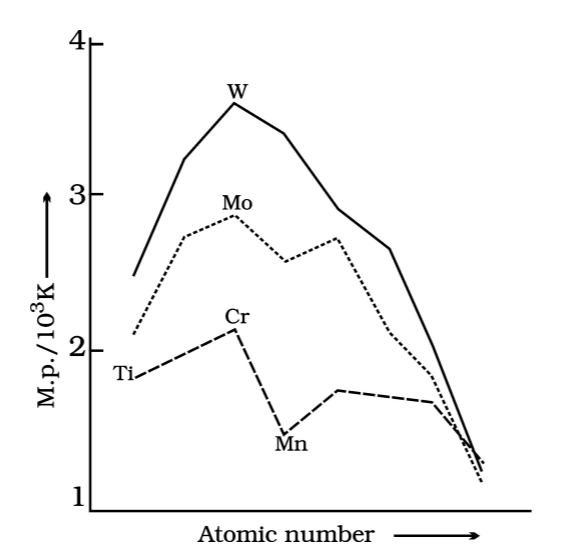
(iii) The given graph shows the trends in melting points of transition metals :Explain the reason why Cr has highest melting point and manganese (Mn) a lower melting point.
Explain the reason why Cr has highest melting point and manganese
(Mn) a lower melting point.
(a) The chemistry of actinoids is more complicated than that of lanthanoids because actinoids show a wide range of oxidation states from +3 to +6, whereas lanthanoids mainly exhibit +3 oxidation state. This variety in oxidation states leads to complex chemistry. Also, actinoids have 5f orbitals which are more extended and can participate in bonding, whereas lanthanoids have more buried 4f orbitals that do not participate much in bonding. Moreover, actinoids are radioactive, which presents additional experimental challenges.
(b) The reaction is: 3MnO42- + 4H+ → 2MnO4- + MnO2 + 2H2O.
This is a disproportionation reaction because the manganese in MnO42- is in +6 oxidation state and it undergoes simultaneous oxidation to MnO4- (+7 oxidation state) and reduction to MnO2 (+4 oxidation state). Thus the same species is both oxidized and reduced.
(c) Chromium (Cr) has a high melting point because:
Cr has electronic configuration [Ar] 3d⁵ 4s¹.
It has a large number of unpaired d-electrons (6).
More unpaired electrons → stronger metal–metal bonding (strong metallic bonding).
Strong metallic bonding requires more energy to break → high melting point.
Manganese (Mn) has a lower melting point because:
Mn has configuration [Ar] 3d⁵ 4s².
Though it has half-filled d-orbitals, its metallic bonding is comparatively weaker due to:
Stable half-filled 3d⁵ configuration
Less effective overlap between orbitals
Therefore, metallic bonds are weaker → lower melting point.
Paper Details
CBSE Board Exam 2023
Class
Class 12 PCM
Subject
Chemistry
Year
2023
Set
Set 5
Other Years — Chemistry