SOLUTIONS
2022 BOARD EXAM
CBSE Class 12 PCM Chemistry Board Paper 2022 — Set 4 Solutions
2022
Chemistry
Class 12 PCM
CBSE EXAMINATION PAPER-2022
CHEMISTRY
(Solved)
General Instructions :
Read the following instructions carefully and follow them :
- This question paper contains 17 questions. All questions are compulsory.
- This question paper is divided into 3 sections.
- Section A – questions number 1 to 2 are case based questions
- Section B – questions number 3 to 4 are short answer
- Section C – questions number 5 to 17 are long answer
- There is no overall choice given in the question paper. However, an internal choice has been provided in few questions.
- Use of calculator is NOT allowed.
Section A
Read the passage given below and answer the questions that follow :
The rate law for a chemical reaction relates the reaction rate with the concentrations or partial pressures of the reactants. For a general reaction aA + bB→ C with no intermediate steps in its reaction mechanism, meaning that it is an elementary reaction, the rate law is given by r = k[A]X [B] y , where [A] and [B] express the concentrations of A and B in moles per litre. Exponents x and y vary for each reaction and are determined experimentally. The value of k varies with conditions that affect reaction rate, such as temperature, pressure, surface area, etc. The sum of these exponents is known as overall reaction order. A zero order reaction has a constant rate that is independent of the concentration of the reactants. A first order reaction depends on the concentration of only one reactant. A reaction is said to be second order when the overall order is two. Once we have determined the order of the reaction, we can go back and plug in one set of our initial values and solve for k.
(1) Calculate the overall order of a reaction which has the following rate expression : Rate = k[A] ¹ᐟ² [B] ³ᐟ²
Step 2: Find the order with respect to B which is 3/2.
Step 3: Add both exponents to find overall order = 1/2 + 3/2 = 2.
Therefore, the overall order of the reaction is 2, which means it is a second order reaction as explained in the passage.
(2) What is the effect of temperature on rate of reaction ?
The rate constant k varies with temperature according to the passage. As temperature increases, the rate constant k increases, which makes the reaction rate faster. Therefore, higher temperature increases the rate of reaction by increasing k, as stated in the passage.
(3) A first order reaction has a rate constant 1x 10 ⁻³ per sec. How long will 5 g of this reactant take to reduce to 3 g ? (log 3 = 0·4771; log 5 = 0·6990)
(4) A first order reaction takes 77·78 minutes for 50% completion. Calculate the time required for 30% completion of this reaction. (log 10 = 1, log 7 = 0·8450)
We use the first order kinetics formula: log (100/(100 - x)) = kt/2.303, where x is percentage completion.
For 30% completion, log (100/70) = k*t/2.303.
Log (100/70) = log 10 - log 7 = 1 - 0.8450 = 0.155.
Since k = 0.693 / 77.78, solving gives t = (2.303 * 0.155) / k = 47.6 minutes approximately.
So, time required for 30% reaction completion is about 47.6 minutes as per the rate law given in the passage.
(5) What is meant by rate of a reaction ?
Section B
In a plot of ∧m against the square root of concentration (C1/2) for strong and weak electrolyte, the value of limiting molar conductivity of a weak electrolyte cannot be obtained graphically. Suggest a way to obtain this value. Also state the related law, if any.
Write reasons for the following statements :
(i) Benzoic acid does not undergo Friedel-Crafts reaction.(1)
(ii)Oxidation of aldehydes is easier than that of ketones. (1)
(ii) Oxidation of aldehydes is easier than ketones because aldehydes have a hydrogen atom attached to the carbonyl carbon, which can be easily removed in oxidation. Ketones have alkyl groups on both sides of the carbonyl group, making them more stable and resistant to oxidation. Hence, aldehydes are easily oxidised to carboxylic acids, while ketones are not easily oxidised under normal conditions.
Section C
Write reasons for the following :
(i) Ethylamine is soluble in water whereas aniline is insoluble.(1)
(ii) Amino group is o- and p-directing in aromatic electrophilic substitution reactions, but aniline on nitration gives a substantial amount of m-nitroaniline. (1)
(iii) Amines behave as nucleophiles.(1)
(ii) The amino group (-NH2) is an o- and p-directing activating group because it donates electron density into the benzene ring, favoring substitution at ortho and para positions. However, during nitration, the reaction conditions are strongly acidic, which protonates the amino group to form anilinium ion (-NH3+). This protonated group is a meta-directing deactivating group, causing the formation of substantial m-nitroaniline.
(iii) Amines behave as nucleophiles because the nitrogen atom has a lone pair of electrons that can be donated to electron-deficient species (electrophiles) to form a new bond. This lone pair makes amines reactive in nucleophilic substitution and addition reactions.
How will you carry out the following conversions :
(i) Ethanenitrile to Ethanamine. (1)
(ii) Ethanamide to Methanamine. (1)
(iii) Nitrobenzene to Aniline. (1)
(ii) Ethanamide to Methanamine: First convert ethanamide (CH3CONH2) into an intermediate by Hofmann bromamide reaction, using bromine (Br2) and sodium hydroxide (NaOH) which removes one carbon atom to form methanamine (CH3NH2).
(iii) Nitrobenzene to Aniline: Reduce nitrobenzene (C6H5NO2) using tin (Sn) and concentrated hydrochloric acid (HCl), or catalytic hydrogenation using H2 and a metal catalyst to get aniline (C6H5NH2).
(i) Write the electronic configuration of d5 on the basis of crystal field splitting theory if Δo < P.(1)
(ii) [Fe(CN)₆] ³⁻ is weakly paramagnetic whereas [Fe(CN)₆] ⁴⁻ is diamagnetic. Give reason to support this statement. [Atomic no. : Fe = 26].(1)
(iii) Write the number of ions produced from the complex [Co(NH₃)₆]Cl₂ in solution.(1)
(b) In [Fe(CN)6]3-, Fe is in +3 oxidation state (d5). CN- is a strong field ligand causing pairing, but here pairing is only partial resulting in one unpaired electron hence it is weakly paramagnetic. In [Fe(CN)6]4-, Fe is +2 (d6) and all electrons pair up in the lower energy t2g orbitals with no unpaired electrons. Therefore it is diamagnetic.
(c) [Co(NH3)6]Cl2 dissociates in solution into one complex cation [Co(NH3)6]2+ and two Cl- ions. Total ions produced = 3.
(b) (i) Calculate the spin only magnetic moment of the complex [CoF₆] ³⁻ (Atomic no. of Co = 27).(1)
(ii) Write the IUPAC name of the given complex : [CrCl₂(H₂O)₄]Cl. (1)
(iii) Which out of the two complexes is more stable and why ? [Fe(H₂O)₆]3+, [Fe(C₂O₄)₃]³⁻. (1)
Spin only magnetic moment, μ = sqrt(n(n+2)) Bohr magneton = sqrt(4(4+2)) = sqrt(24) = 4.9 BM.
(ii) The IUPAC name of [CrCl₂(H₂O)₄]Cl is Tetraaquadichloridochromium(III) chloride.
(iii) [Fe(C₂O₄)₃]3- is more stable than [Fe(H₂O)₆]3+, because oxalate ion C₂O₄2- is a bidentate ligand that forms chelate rings with Fe3+. Chelate complexes are more stable due to chelate effect compared to complexes with monodentate ligands like H₂O. Therefore, [Fe(C₂O₄)₃]3- is more stable.
(i) Which ion amongst the following is colourless and why ? Ti⁴⁺, Cr³⁺, V³⁺ (Atomic number of Ti = 22, Cr = 24, V = 23). (1)
(ii) Why is Mn²⁺ much more resistant than Fe²⁺ towards oxidation ?(1)
(iii) Highest oxidation state of a metal is shown in its oxide or fluoride only. Justify the statement. (1)
(b) Mn⁺ is more resistant to oxidation than Fe⁺ because Mn⁺ has a half-filled d⁵ configuration (3d⁵), which is more stable due to exchange energy and symmetry. Therefore, it is less easily oxidized compared to Fe⁺ which has a 3d⁶ configuration and is less stable.
(c) The highest oxidation states of metals are usually observed in their oxides or fluorides because oxygen and fluorine are highly electronegative elements and can stabilize high positive charges on the metal atoms. These compounds have strong covalent character that helps stabilize high oxidation states which are often not possible in other types of compounds due to instability and lack of suitable electronegative ligands.
A compound 'A' (C2H4O) on oxidation gives 'B' (C2H4O2). 'A' undergoes Iodoform reaction to give yellow precipitate and reacts with HCN to form the compound 'C'. 'C' on hydrolysis gives 2-hydroxypropanoic acid. Identify the compounds 'A', 'B' and 'C'. Write down equations for the reactions involved.
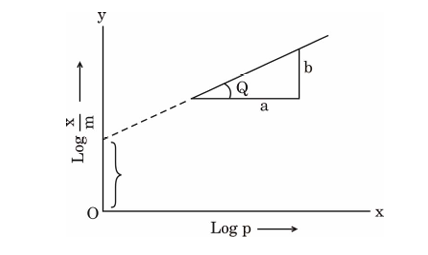
Observe the given figure and answer the following questions :(i) (a) Write the expression for adsorption of gases on solids in the form of an equation. (ii)What is the slope of the graph ? (iii)What does the intercept of the line represent ?
Write equations involved in the following reactions :
(i) Ethanamine reacts with acetyl chloride.(1)
(ii) Aniline reacts with bromine water at room temperature.(1)
(iii) Aniline reacts with chloroform and ethanolic potassium hydroxide.(1)
C2H5NH2 + CH3COCl → CH3CONHCH2C2H5 + HCl
Explanation: Ethanamine reacts with acetyl chloride to form N-ethylacetamide and hydrogen chloride.
(ii) Reaction of Aniline with Bromine Water at Room Temperature:
C6H5NH2 + 3Br2 → C6H2Br3NH2 + 3HBr
Explanation: Aniline reacts with bromine water to give 2,4,6-tribromoaniline as a white precipitate and hydrobromic acid.
(iii) Reaction of Aniline with Chloroform and Ethanolic Potassium Hydroxide (Reimer-Tiemann Reaction):
C6H5NH2 + CHCl3 + 4KOH → C6H4NH2CHO + 3KCl + 3H2O
Explanation: Aniline reacts with chloroform and ethanolic KOH to form salicylaldehyde (an aldehyde derivative) via Reimer-Tiemann reaction along with potassium chloride and water.
(i)Write the IUPAC name for the following organic compound :
(CH₃CH₂)₂NCH₃ (1)
(ii) Write the equations for the following : (1)
(I) Gabriel phthalimide synthesis (II) Hoffmann bromamide degradation. (1)
(ii) (I) Gabriel phthalimide synthesis: This reaction is used to prepare primary amines. It involves the reaction of potassium phthalimide with an alkyl halide followed by hydrolysis.
C6H4COCONH + KOH + R–X → C6H4COCONHR (alkyl phthalimide)
C6H4COCONHR + 2H2O + KOH → R–NH2 + phthalic acid salt
(II) Hoffmann bromamide degradation: This reaction converts an amide to a primary amine with one less carbon atom using bromine and alkali.
RCONH2 + Br2 + 4KOH → R–NH2 + K2CO3 + 2KBr + 2H2O
Thus, (i) the IUPAC name is N-methyldiethylamine, (ii) the two reaction equations are as given above.
Write the Nernst equation and calculate emf of the following cell at 298 K :
Cr|Cr³⁺ (0·1 M)||Fe²⁺ (0·01 M)|Fe
Given : EΘ Cr³⁺ /Cr =- 0·75 V EΘ Fe²⁺ / Fe =- 0·45 V (log 10 = 1)
The Nernst equation for a cell is given by:
E = E∇ - (RT / nF) * ln Q
Where, E is the emf of the cell at non-standard conditions,
E∇ is the standard emf of the cell,
R is the gas constant = 8.314 J/mol K,
T is the temperature in Kelvin = 298 K,
n is the number of moles of electrons transferred,
F is Faraday constant = 96485 C/mol,
Q is the reaction quotient.
Step 2: Determine the cell reaction and E∇ cell.
Given half reactions:
Cr³· + 3e− → Cr, E∇ = -0.75 V
Fe²· + 2e− → Fe, E∇ = -0.45 V
The anode (oxidation) will be Cr → Cr³· + 3e− (oxidation potential = +0.75 V)
The cathode (reduction) will be Fe²· + 2e− → Fe (reduction potential = -0.45 V)
Since electrons must balance, multiply Fe reaction by 3 and Cr reaction by 2:
Anode: 2 Cr → 2 Cr³· + 6e−
Cathode: 3 Fe²· + 6e− → 3 Fe
Overall reaction: 2 Cr + 3 Fe²· → 2 Cr³· + 3 Fe
Calculate standard emf:
E∇ cell = E∇ cathode - E∇ anode = (-0.45 V) - (-0.75 V) = +0.30 V
Step 3: Calculate reaction quotient Q.
Q = [Cr³·]2 / [Fe²·]3 = (0.1)2 / (0.01)3 = 0.01 / 0.000001 = 10000
Step 4: Calculate emf using Nernst equation.
Use the simplified Nernst equation at 298 K:
E = E∇ - (0.0592 / n) * log Q
Number of electrons transferred n = 6
E = 0.30 V - (0.0592 / 6) * log (10000)
log 10000 = 4
E = 0.30 V - (0.00987) * 4 = 0.30 V - 0.0395 V = 0.2605 V
Answer: The emf of the cell at 298 K is approximately 0.261 V.
(a) (i) Silver atom has completely filled d-orbitals in its ground state, it is still considered to be a transition element. Justify the statement. (1)
(ii) Why areEΘ M ²⁺/ M values of Mn and Zn more negative than expected ? (1)
(iii) Why do transition metals form alloys ?
(ii) The standard electrode potentials (EΘ) of Mn2+/Mn and Zn2+/Zn are more negative than expected because of their stable half-filled (Mn: 3d5) and completely filled (Zn: 3d10) d-subshells which make these elements more stable in the metallic state. Thus, more energy is required to remove electrons and form ions, resulting in more negative EΘ values.
(iii) Transition metals form alloys easily because they have similar atomic sizes and their atoms can replace each other in the crystal lattice. Their incomplete d orbitals and metallic bonding allow for the formation of solid solutions with varied properties, enhancing hardness, strength and resistance to corrosion.
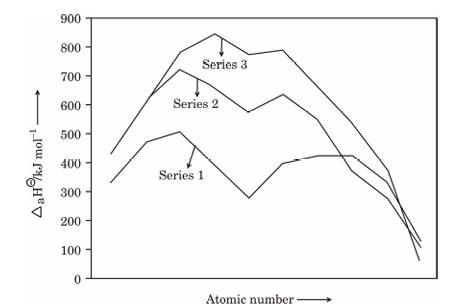
Answer the following questions on the basis of the figure given below :(i) Which element in 3d series has lowest enthalpy of atomisation ?(ii) Why do metals of the second and third series have greater enthalpies of atomisation ? (iii) Why are enthalpies of atomisation of transition metals quite high ?
Arrange the following compounds in the increasing order of their property indicated :
(i) Acetaldehyde, Benzaldehyde, Acetophenone, Acetone (Reactivity towards HCN).(1)
(ii) (CH₃)₂CHCOOH, CH₃CH₂CH(Br)COOH, CH₃CH(Br)CH₂COOH (Acidic strength)
(iii) CH₃CH₂OH, CH₃CHO, CH₃COOH (Boiling point)
Reactivity towards HCN depends on the electrophilicity of the carbonyl carbon. Aldehydes are more reactive than ketones due to less steric hindrance and less electron donating alkyl groups.
- Acetaldehyde (an aldehyde) is more reactive than acetone (a ketone).
- Benzaldehyde is less reactive than acetaldehyde because the phenyl group withdraws electron density by resonance, reducing electrophilicity.
- Acetophenone has a phenyl group attached to the carbonyl carbon and is less reactive than acetone due to resonance stabilization.
Increasing order of reactivity: Acetophenone < Benzaldehyde < Acetone < Acetaldehyde.
(ii) Acidic strength of carboxylic acids with halogen substituents:
Acid strength increases with electronegative groups that stabilize the carboxylate ion by withdrawing electron density.
- (CH₃)₂CHCOOH (Isobutyric acid) has no halogen and thus lowest acidity.
- CH₃CH₂CH(Br)COOH has Br on the third carbon from COOH, showing weaker inductive effect.
- CH₃CH(Br)CH₂COOH has Br closer on the second carbon, stronger inductive effect, thus more acidic.
Increasing order of acidic strength: (CH₃)₂CHCOOH < CH₃CH₂CH(Br)COOH < CH₃CH(Br)CH₂COOH.
(iii) Boiling point order of CH₃CH₂OH (ethanol), CH₃CHO (acetaldehyde), CH₃COOH (acetic acid):
Boiling points depend on inter molecular forces.
- Alcohols and acids have hydrogen bonding, higher boiling points.
- Acetic acid has stronger hydrogen bonding (dimer formation), highest boiling point.
- Ethanol also hydrogen bonds but less strongly than acetic acid.
- Acetaldehyde has only dipole-dipole interactions, lowest boiling point.
Increasing boiling point: CH₃CHO < CH₃CH₂OH < CH₃COOH.
Paper Details
CBSE Board Exam 2022
Class
Class 12 PCM
Subject
Chemistry
Year
2022
Set
Set 4
Other Years — Chemistry