QUESTION PAPER
2024 BOARD EXAM
CBSE Class 12 PCM Chemistry Board Paper 2024 — Set 1
2024
Chemistry
Class 12 PCM
CBSE EXAMINATION PAPER-2024
CHEMISTRY
(Solved)
General Instructions :
Read the following instructions carefully and follow them :
- This question paper contains 49 questions. All questions are compulsory.
- This question paper is divided into 5 sections.
- Section A – questions number 1 to 15 are case based questions
- Section B – questions number 16 to 31 are multiple choice questions
- Section C – questions number 32 to 37 are very short answer
- Section D – questions number 38 to 44 are short answer
- Section E – questions number 45 to 49 are long answer
- There is no overall choice given in the question paper. However, an internal choice has been provided in few questions.
- Use of calculator is NOT allowed.
Section A
Batteries and fuel cells are very useful forms of galvanic cell. Any battery or cell that we use as a source of electrical energy is basically a galvanic cell. However, for a battery to be of practical use it should be reasonably light, compact and its voltage should not vary appreciably during its use. There are mainly two types of batteries secondary batteries. primary batteries and In the primary batteries, the reaction occurs only once and after use over a period of time the battery becomes dead and cannot be reused again, whereas the secondary batteries are rechargeable. Production of electricity by thermal plants is not a very efficient method and is a major source of pollution. To solve this problem, galvanic cells are designed in such a way that energy of combustion of fuels is directly converted into electrical energy, and these are known as fuel cells. One such fuel cell was used in the Apollo space programme.
Answer the following questions :
Batteries and fuel cells are very useful forms of galvanic cell. Any battery or cell that we use as a source of electrical energy is basically a galvanic cell. However, for a battery to be of practical use it should be reasonably light, compact and its voltage should not vary appreciably during its use. There are mainly two types of batteries secondary batteries. primary batteries and In the primary batteries, the reaction occurs only once and after use over a period of time the battery becomes dead and cannot be reused again, whereas the secondary batteries are rechargeable. Production of electricity by thermal plants is not a very efficient method and is a major source of pollution. To solve this problem, galvanic cells are designed in such a way that energy of combustion of fuels is directly converted into electrical energy, and these are known as fuel cells. One such fuel cell was used in the Apollo space programme. Answer the following questions :
Batteries and fuel cells are very useful forms of galvanic cell. Any battery or cell that we use as a source of electrical energy is basically a galvanic cell. However, for a battery to be of practical use it should be reasonably light, compact and its voltage should not vary appreciably during its use. There are mainly two types of batteries secondary batteries. primary batteries and In the primary batteries, the reaction occurs only once and after use over a period of time the battery becomes dead and cannot be reused again, whereas the secondary batteries are rechargeable. Production of electricity by thermal plants is not a very efficient method and is a major source of pollution. To solve this problem, galvanic cells are designed in such a way that energy of combustion of fuels is directly converted into electrical energy, and these are known as fuel cells. One such fuel cell was used in the Apollo space programme. Answer the following questions :
Batteries and fuel cells are very useful forms of galvanic cell. Any battery or cell that we use as a source of electrical energy is basically a galvanic cell. However, for a battery to be of practical use it should be reasonably light, compact and its voltage should not vary appreciably during its use. There are mainly two types of batteries secondary batteries. primary batteries and In the primary batteries, the reaction occurs only once and after use over a period of time the battery becomes dead and cannot be reused again, whereas the secondary batteries are rechargeable. Production of electricity by thermal plants is not a very efficient method and is a major source of pollution. To solve this problem, galvanic cells are designed in such a way that energy of combustion of fuels is directly converted into electrical energy, and these are known as fuel cells. One such fuel cell was used in the Apollo space programme. Answer the following questions :
Batteries and fuel cells are very useful forms of galvanic cell. Any battery or cell that we use as a source of electrical energy is basically a galvanic cell. However, for a battery to be of practical use it should be reasonably light, compact and its voltage should not vary appreciably during its use. There are mainly two types of batteries secondary batteries. primary batteries and In the primary batteries, the reaction occurs only once and after use over a period of time the battery becomes dead and cannot be reused again, whereas the secondary batteries are rechargeable. Production of electricity by thermal plants is not a very efficient method and is a major source of pollution. To solve this problem, galvanic cells are designed in such a way that energy of combustion of fuels is directly converted into electrical energy, and these are known as fuel cells. One such fuel cell was used in the Apollo space programme. Answer the following questions :
The following questions are case-based questions. Read the case carefully and answer the questions that follow.
Batteries and fuel cells are very useful forms of galvanic cell. Any battery or cell that we use as a source of electrical energy is basically a galvanic cell. However, for a battery to be of practical use it should be reasonably light, compact and its voltage should not vary appreciably during its use. There are mainly two types of batteries primary batteries and secondary batteries.
In the primary batteries, the reaction occurs only once and after use over a period of time the battery becomes dead and cannot be reused again, whereas the secondary batteries are rechargeable.
Production of electricity by thermal plants is not a very efficient method and is a major source of pollution. To solve this problem, galvanic cells are designed in such a way that energy of combustion of fuels is directly converted into electrical energy, and these are known as fuel cells. One such fuel cell was used in the Apollo space programme.
(1) How do primary batteries differ from secondary batteries ?
(2) The cell potential of Mercury cell is 1·35 V, and remains constant during its life. Give reason.
(3) Write the reactions involved in the recharging of the lead storage battery.
(4) Write two advantages of fuel cells over other galvanic cells.
The Valence Bond Theory (VBT) explains the formation, magnetic behaviour and geometrical shapes of coordination compounds whereas" The Crystal Field Theory" for coordination compounds is based on the effect of different crystal fields (provided by ligands taken as point charges), on the degeneracy of d-orbital energies of the central metal atom/ion. The splitting of the d-orbitals provides different electronic arrangements in strong and weak crystal fields. The crystal field theory attributes the colour of the coordination compounds to d-d transition of the electron. Coordination compounds find extensive applications in metallurgical processes, analytical and medicinal chemistry
(1) What is crystal field splitting energy ?
(2) Give reason for the violet colour of the complex [Ti(H₂O)₆]³⁺ on the basis of crystal field theory.
(3) Explain why [Fe(CN)₆]³⁻ is an inner orbital complex, whereas [Fe(H₂O)₆]³⁺ is an outer orbital complex. [Atomic No. : Fe = 26]
(4) [Cr(NH₃)₆]³⁺ is paramagnetic while [Ni(CN)₄]²⁻ is diamagnetic. Explain why. [Atomic No. : Cr = 24, Ni = 28]
Section B
Which one of the following first row transition elements is expected to have the highest third ionization enthalpy ?
Two among the three components of DNA are β-D-2-deoxyribose and a heterocyclic base. The third component is :
For an electrolyte undergoing association in a solvent, the vant factor :
For the reaction X + 2Y → P, the differential form equation of the rate law is :
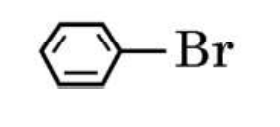
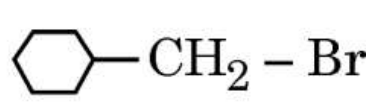
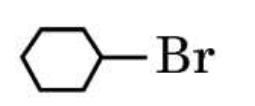
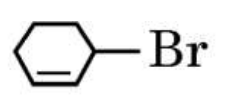
The compound which undergoes SN_1 reaction most rapidly is
;
-
(A)
-
(B)
-
(C)
-
(D)
Acetic acid reacts with PCl₅ to give :
The formation of cyanohydrin from an aldehyde is an example of :
In the Arrhenius equation, when log k is plotted against 1/T, a straight line is obtained whose :
The reaction of an alkyl halide with sodium alkoxide forming ether is known as :
The correct order of the ease of dehydration of the following alcohols by the action of conc. H₂SO₄ is :
Which functional groups of glucose interact to form cyclic hemiacetal leading to pyranose structure ?
Assertion (A) : When NaCl is added to water a depression in freezing point is observed.
Reason (R) : NaCl undergoes dissociation in water.
Assertion (A) : Separation of Zr and Hf is difficult.
Reason (R) : Zr and Hf have similar radii due to lanthanoid contraction.
Assertion (A) : The pKₐ of ethanoic acid is lower than that of Cl -CH₂- COOH.
Reason (R) : Chlorine shows electron withdrawing ( I) effect which increases the acidic character of Cl -CH 2- COOH.
Assertion (A) : Aniline is a stronger base than ammonia.
Reason (R) : The unshared electron pair on nitrogen atom in aniline becomes less available for protonation due to resonance.
Which of the following compounds will give a ketone on oxidation with chromic anhydride (CrO₃) ?
Section C
Calculate the potential of Iron electrode in which the concentration of
Fe2+ ion is 0·01 M.
(E°Fe2+/Fe = 0·45 V at 298 K)
[Given : log 10 = 1]
Define molecularity of the reaction. State any one condition in which a bimolecular reaction may be kinetically of first order
What happens when D-glucose is treated with the following reagents?
(a) HI (b) Conc. HNO₃
Draw the structures of major monohalo products in each of the following reactions:
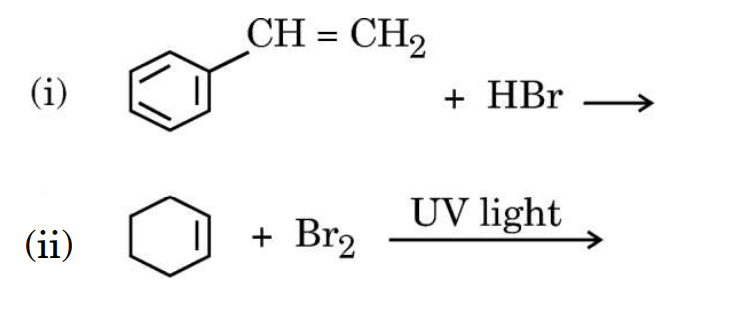
Give reasons for the following:
(i) Grignard reagent should be prepared under anhydrous conditions.
(ii) Alkyl halides give alcohol with aqueous KOH whereas in the presence of alcoholic KOH, alkenes are formed.
Write the chemical equation when :
(i) Butan-2-one is treated with Zn(Hg) and conc. HCl.
(ii) Two molecules of benzaldehyde are treated with conc. NaOH.
Section D
When a certain conductivity cell was filled with 0·05 M KCl solution, it has a resistance of 100 ohm at 25ºC. When the same cell was filled with 0·02 M AgNO₃ solution, the resistance was 90 ohm. Calculate the conductivity and molar conductivity of AgNO3 solution.
(Given : Conductivity of 0·05 M KCl solution = 1·35 * 10 ⁻² ohm-1cm⁻¹)
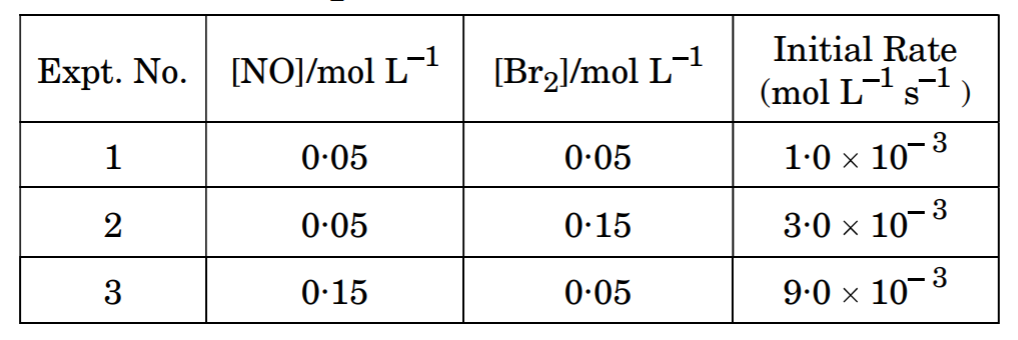
The following initial rate data were obtained for the reaction : 2NO (g) + Br₂ (g) → 2NOBr (g)
(a) What is the order with respect to NO and Br₂ in the reaction ?
(b) Calculate the rate constant (k).
(iii) Determine the rate of reaction when concentration of NO and Br₂ are 0·4 M and 0·2 M, respectively.
(a) Write the formula for the following coordination compound : Potassium tetrahydroxidozincate (II)
(b) Arrange the following complexes in the increasing order of conductivity of their solution : [Cr(NH₃)₅Cl]Cl₂, [Cr(NH₃)₃Cl₃], [Cr(NH₃)₆]C₃
(c) Identify the type of isomerism exhibited by the following complexes :
(i) [Co(NH₃)₅NO₂]²⁺
(ii) [Co(en)₃]Cl₃
(a) Which of the following is an allylic halide ?
(i) CH₃ -CH=CH-Br
(ii) CH₂=CH-CH (Br)-CH₃
(b) Out of chlorobenzene and 2,4,6-trinitrochlorobenzene, which is more reactive towards nucleophilic substitution and why ?
(c) Which isomer of C₄H₉Cl has the lowest boiling point ?
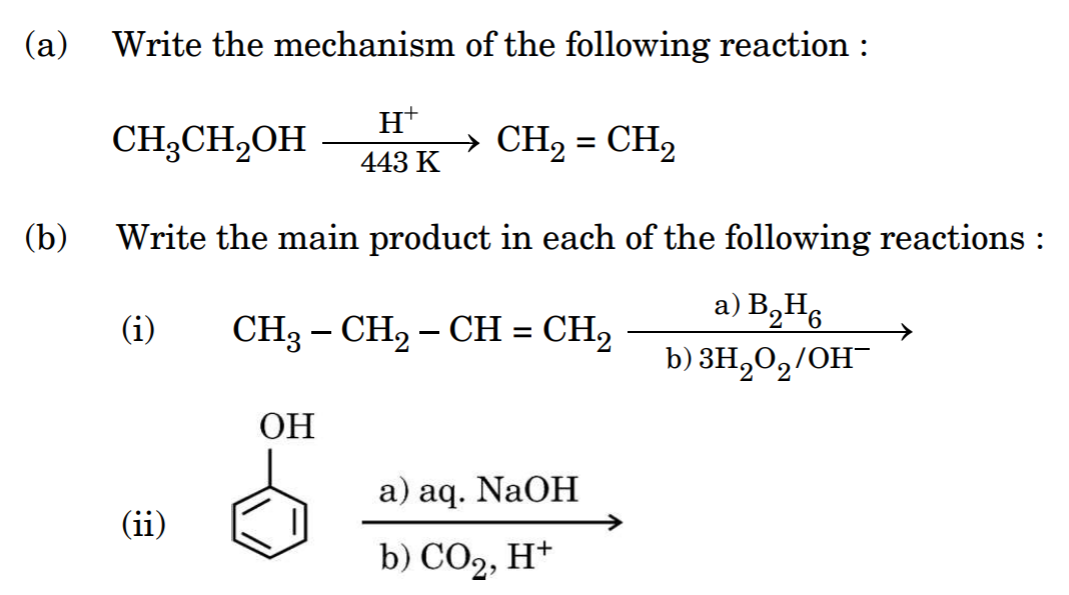
(a) Write the mechanism of the following reaction
(b) Write the main product in each of the following reactions :
Answer the following: (any three)
(a) What is peptide linkage ?
(b) What type of bonds hold a DNA double helix together ?
(c) Which one of the following is a polysaccharide ? Sucrose, Glucose, Starch, Fructose
(d) Give one example each for water-soluble vitamins and fat-soluble vitamins.
Compound (A) (C₆H₁₂O₂) on reduction with LiAlH₄ gives two compounds (B) and (C). The compound (B) on oxidation with PCC gives compound (D) which upon treatment with dilute NaOH and subsequent heating gives compound (E). Compound (E) on catalytic hydrogenation gives compound (C). The compound (D) is oxidized further to give compound (F) which is found to be a monobasic acid (Molecular weight = 60). Identify the compounds (A), (B), (C), (D), (E) and (F).
Section E
(i) At the same temperature, CO₂ gas is more soluble in water than O₂ gas. Which one of them will have higher value of Kₕ and why?
(ii) How does the size of blood cells change when placed in an aqueous solution containing more than 0.9% (mass/volume) sodium chloride?
(iii) 1 molal aqueous solution of an electrolyte A₂B₃ is 60% ionized. Calculate the boiling point of the solution.
(Given : Kb for H₂O = 0·52 K kg mol ⁻¹)
(i) The vapour pressures of A and B at 25ºC are 75 mm Hg and 25 mm Hg, respectively. If A and B are mixed such that the mole fraction of A in the mixture is 0.4, then calculate the mole fraction of B in vapour phase.
(ii) Define colligative property. Which colligative property is preferred for the molar mass determination of macromolecules?
(iii) Why are equimolar solutions of sodium chloride and glucose not isotonic?
(i) Account for the following:
(1) The melting and boiling points of Zn, Cd and Hg are low.
(2) Of the d⁴ species, Cr²⁺ is strongly reducing while Mn³⁺ is strongly oxidizing.
(3) Eº value of Cu²⁺/Cu is +0.34 V.
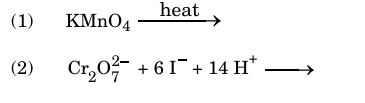
(ii) Complete and balance the following chemical equations:
(i) Out of Cu₂Cl₂ and CuCl₂, which is more stable in aqueous solution and why?
(ii) Write the general electronic configuration of f-block elements.
(iii) Predict which of the following will be coloured in aqueous solution and why ? Sc³⁺ , Fe³⁺ , Zn²⁺
[Atomic number : Sc = 21, Fe = 26, Zn = 30]
(iv) How can you obtain potassium dichromate from sodium chromate ?
(v) Why do transition metals and their compounds show catalytic activities ?
Answer any five questions of the following:
(a) N,N-diethyl-benzenesulphonamide is insoluble in alkali. Give reason.
(b) Aniline does not undergo Friedel-Crafts reaction. Why ?
(c) Write a simple chemical test to distinguish between methylamine and aniline.
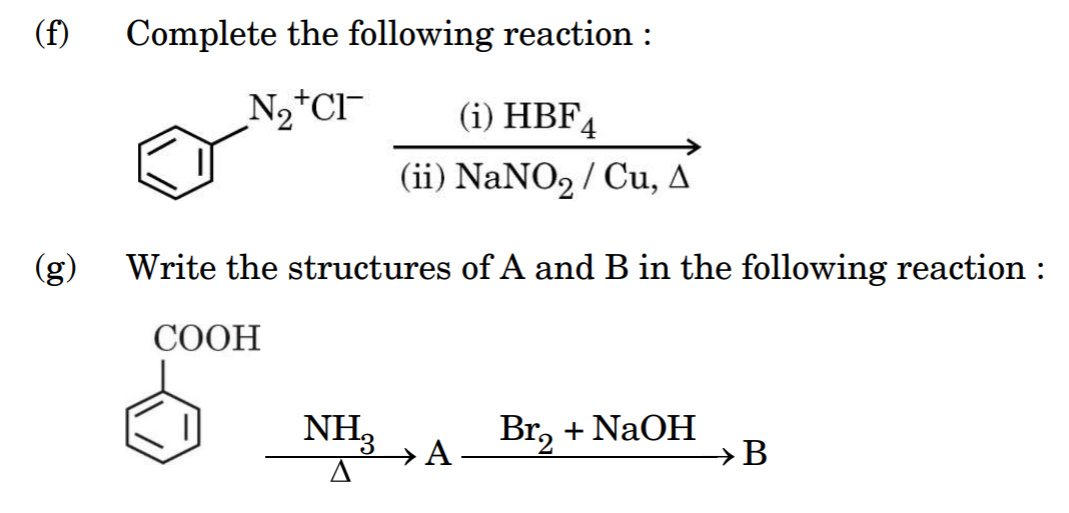
(d) Write the chemical reaction involved in Gabriel phthalimide synthesis.
(e) How will you convert aniline to p-bromoaniline ?
Paper Details
CBSE Board Exam 2024
Class
Class 12 PCM
Subject
Chemistry
Year
2024
Set
Set 1
Other Years — Chemistry